


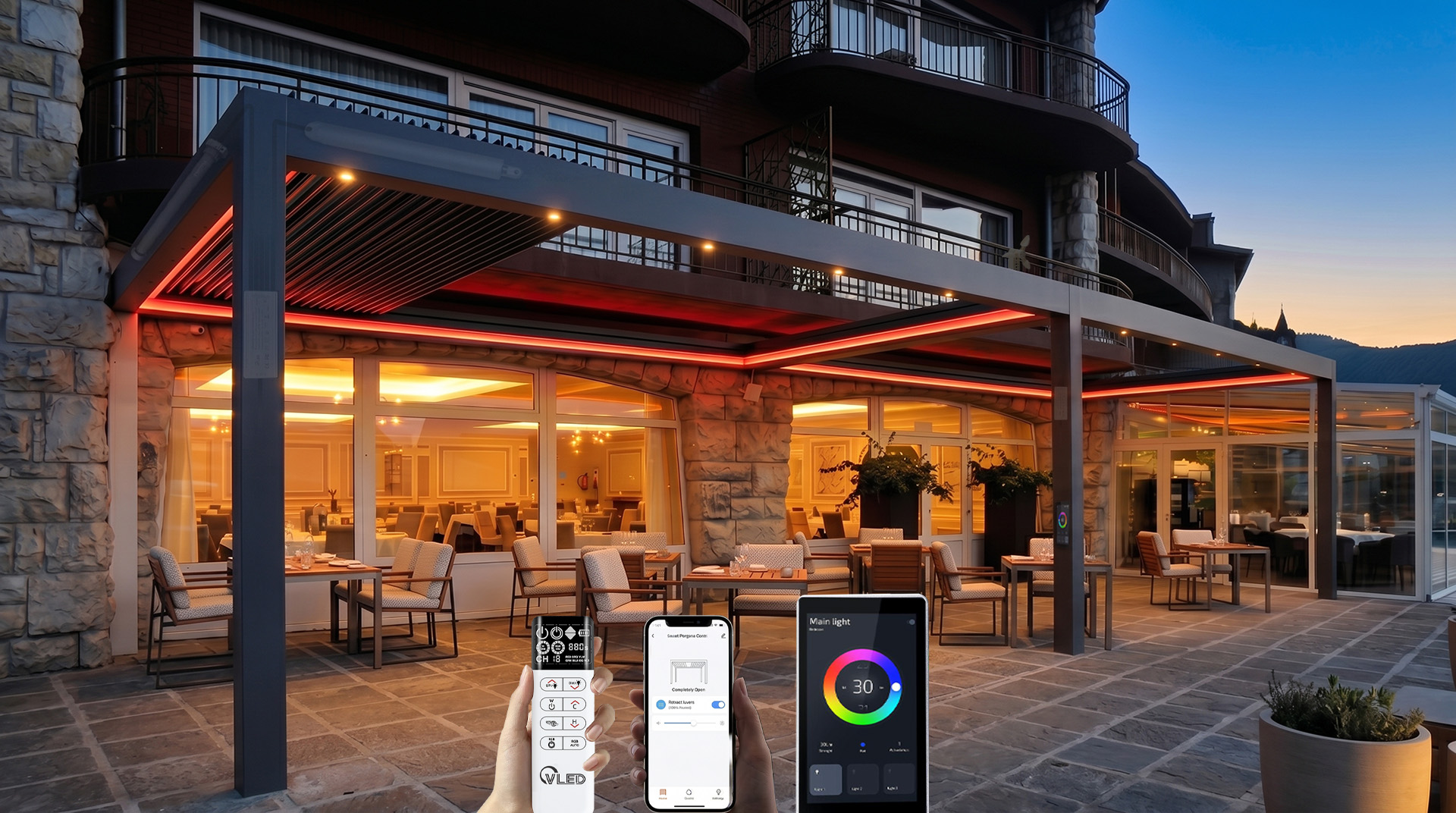
A pergola buyer should not need one remote for warm white lighting, another remote for RGB lighting, another switch for louver rotation, and a separate controller for a retractable roof. For manufacturers, that is more than a user-experience problem. It is a product architecture problem.
Separate remotes usually appear harmless at the prototype stage. The lighting supplier ships a receiver. The motor supplier ships a handset. The app gateway comes from another ecosystem. A wall switch is added later because dealers ask for it. Each part works by itself, so the system looks complete.
Then the pergola reaches real customers. The homeowner asks which remote closes the roof. The restaurant manager cannot remember which channel controls the RGB strip over bay two. The installer labels cables by hand. The dealer calls the factory because the lighting scene works but the louver actuator does not respond. The product still looks premium, but the control experience feels assembled instead of engineered.
Our view is simple: pergola manufacturers should treat lighting and louver control as one product platform, not as a collection of accessories. A modern نظام التحكم في البرجولا should control single-color lighting, RGB or RGBW lighting, linear actuators for louver rotation, tubular motors for louver retraction, and weather sensors through one coordinated interface. The user can operate it by RF remote, Tuya app, or wall panel, while the manufacturer gains a cleaner system to build, sell, install, and support.
What the Current Search Results Reveal About Buyer Intent
Before choosing the angle for this article, we reviewed current search results around pergola control systems, louvered pergola lighting, remote and app control, and motorized aluminum pergola controls. The top-ranking content generally follows three patterns.
First, consumer-facing pergola brands such as StruXure and Hanso Home present smart control as part of a finished lifestyle product: open the louvers, adjust shade, turn on lighting, and use app or remote control from one premium pergola package. The message is easy for homeowners to understand, but it rarely explains the control architecture behind the experience.
Second, buyer guides such as Pergola Cave’s louvered pergola guide explain that basic systems start with a wall switch or handheld remote, while higher-end systems add app control, programmable scenes, multi-zone operation, and weather sensors. This confirms that users already expect control to move beyond a single motor switch.
Third, manufacturer-side articles, including technical control-system guides from aluminum pergola suppliers, discuss motor matching, sensor inputs, wiring constraints, environmental exposure, commissioning, and maintenance. These pages are closer to the real problem manufacturers face, but many still separate lighting control from louver control.
The innovation space is not “another smart remote.” The opportunity is to help pergola manufacturers standardize one integrated control architecture that reduces accessory fragmentation while improving the buyer experience.
That is the writing angle of this article: replacing separate remotes is not mainly a convenience upgrade. It is a manufacturing, installation, service, and brand-positioning upgrade for pergola OEM and ODM product lines.
The Separate-Remote Model Creates Hidden Cost
For a pergola manufacturer, every additional controller adds cost in more places than the bill of materials. It adds an extra receiver, extra pairing logic, extra packaging, extra manual pages, extra warranty questions, and extra training for dealers.
The effect becomes more visible when the pergola includes both lighting and motion. A simple fixed pergola may only need one lighting circuit. A premium louvered pergola may need warm white perimeter lighting, RGB accent lighting, linear actuators for 0-90 degree louver rotation, tubular motors for retractable louvers, rain response, wind response, sun sensing, snow protection, and multi-zone grouping. If each function comes with its own control habit, the pergola becomes harder to explain and harder to troubleshoot.
Manufacturers often measure control cost by component price. That is too narrow. The better question is: how much does the control system cost after purchasing, wiring, inventory, installation, customer training, and after-sales support are included?
| Separate control model | Integrated control model | Manufacturer impact |
|---|---|---|
| Lighting remote, motor remote, app gateway, and wall switch are handled separately. | One control unit manages lighting, louver rotation, louver retraction, sensors, remote, app, and wall panel. | Fewer SKUs, simpler manuals, easier dealer training, and cleaner product positioning. |
| Pairing steps differ by supplier. | Channels and scenes are configured inside one control logic. | Commissioning becomes easier to repeat across projects. |
| Failure diagnosis starts with “which device is the problem?” | Inputs and outputs are mapped in one system architecture. | Support teams can troubleshoot by zone, channel, and function. |
| The user sees a group of accessories. | The user sees one pergola operating system. | The finished pergola feels more premium and more intentional. |
This is why control integration should be decided early in product development, not after the frame, louvers, motor brackets, and lighting profiles are already finalized.
What an Integrated Pergola Control System Should Actually Control
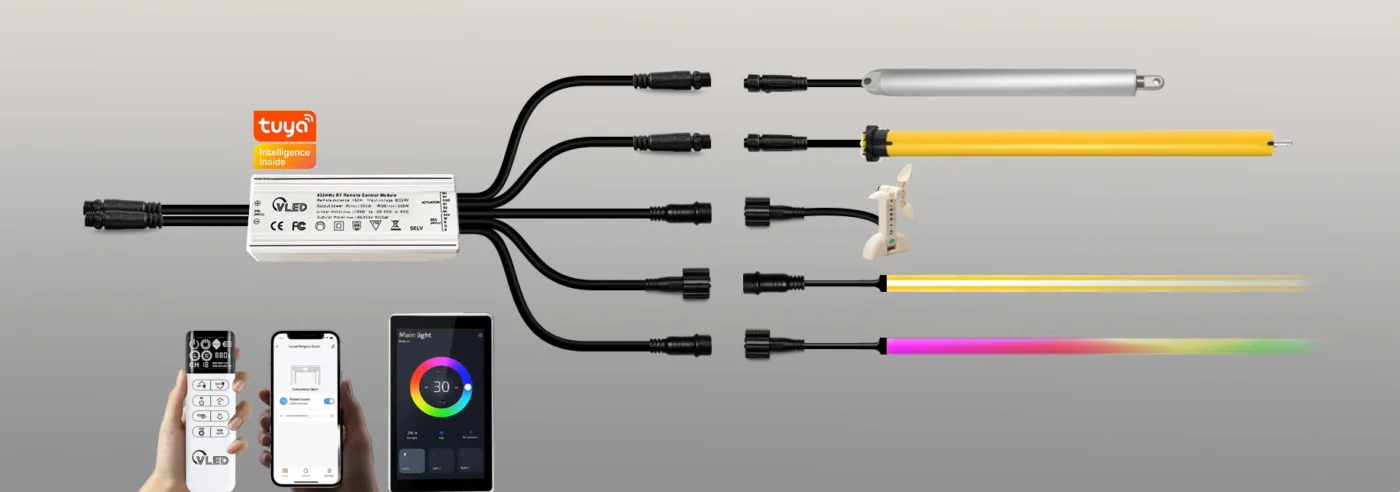
An integrated control system should not simply put several relays into one box. It should understand the real functions of a modern pergola and make those functions work together.
Single-Color Lighting
Single-color LED lighting remains the practical foundation for many pergola projects. Warm white or neutral white perimeter lighting gives homeowners, restaurants, and hotels reliable evening visibility without turning every scene into decoration. For manufacturers, the key is stable dimming, correct driver sizing, waterproof connection planning, and predictable output. A system that supports DC24V single-color lighting with smooth dimming is easier to standardize across product sizes.
If your pergola line already uses structural aluminum profiles for recessed strip lighting, the lighting plan should be developed together with the control plan. Our pergola lighting solutions page shows how strip lights, downlights, spotlights, wall lights, kits, drivers, controls, and accessories can be treated as one integrated supply package rather than separate decorative parts.
RGB and RGBW Lighting
RGB lighting gives dealers a stronger showroom story and gives end users more atmosphere for dining, hospitality, entertainment, and seasonal use. But RGB control can also become messy if it is isolated from the rest of the pergola. If the RGB strip uses one remote and the louver roof uses another, the premium effect is weakened.
The best approach is to make RGB or RGBW lighting part of the same command structure as the rest of the pergola. A user should be able to set a scene from the app, adjust brightness by RF remote, or use a wall panel for a simple evening mode. For manufacturers, this avoids forcing dealers to explain three unrelated control behaviors on one premium product.
Linear Actuators for Louver Rotation
Linear actuators are often used to rotate louver blades between open, partial shade, ventilation, and closed positions. Here, control quality affects both user comfort and mechanical life. The system should support smooth movement, reliable stop behavior, correct limit logic, and sensible response to obstruction or overload where the hardware allows it.
It is not enough to ask whether an actuator moves. Manufacturers should ask whether the control system can support the louver positions that dealers actually sell: fully open, rain-close, sunshade angle, ventilation angle, and intermediate positions for comfort. That is where control logic becomes part of product design.
Tubular Motors for Louver Retraction
Retractable louver systems add another layer. Tubular motors may be used to slide, retract, or stack roof sections depending on the pergola architecture. These motors often come from established motor ecosystems, and compatibility matters. A practical integrated controller should be designed around the motors the manufacturer already uses or plans to offer, including common brands such as Somfy, AOK, Dooya, or equivalent project-specified motor platforms.
For manufacturers that build both rotating and retractable pergola models, one control platform can reduce product-line complexity. The same family of controllers, remotes, panels, and app logic can support different pergola mechanisms, which makes dealer training and spare-part management easier.
The Control Interface Should Match Real Use, Not Just the Specification Sheet
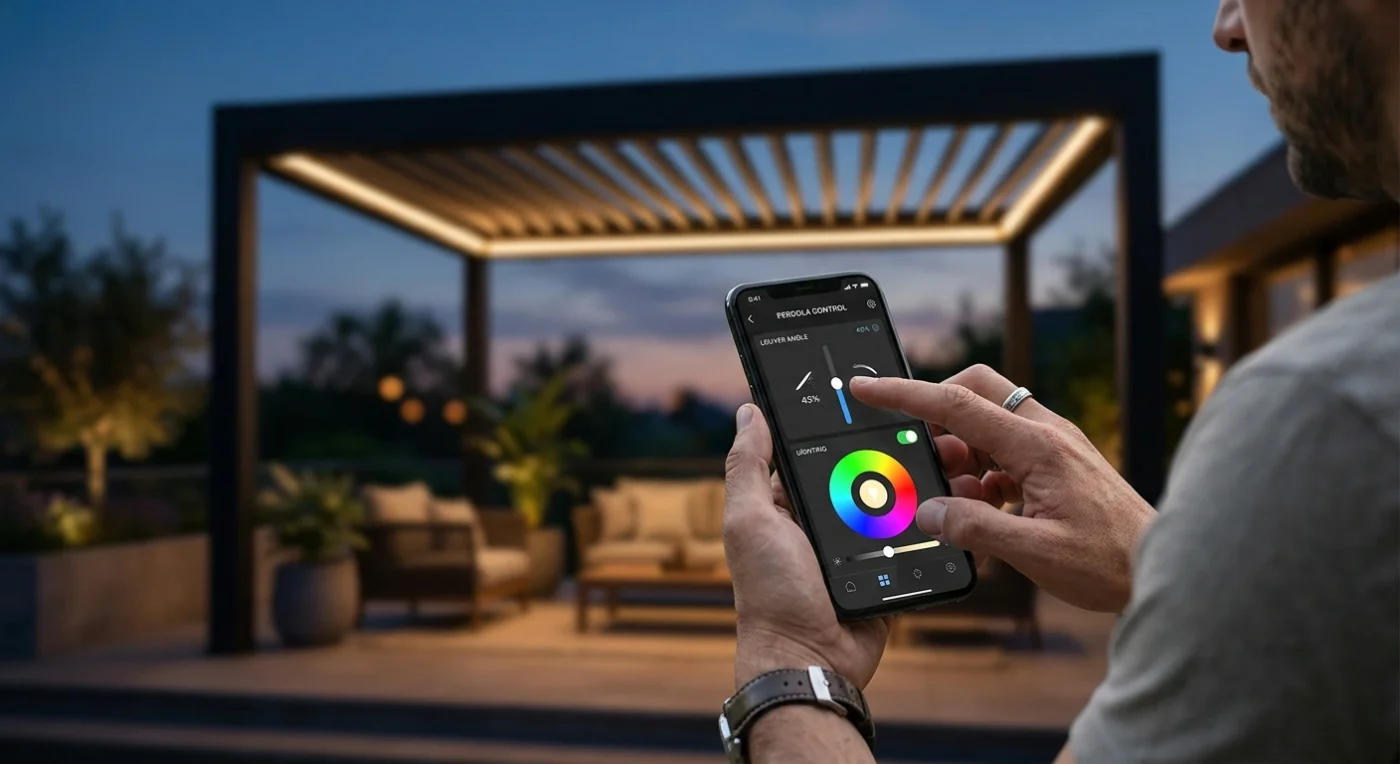
Many spec sheets list “remote control” and “app control” as if these are interchangeable features. They are not. Each control method has a different job.
RF remote control is still the fastest daily interface. It works without opening an app, it is easy to hand to a homeowner or restaurant manager, and it can be designed with dedicated buttons for lighting, louvers, groups, and scenes. For pergola structures made from aluminum, RF design also needs careful antenna placement and anti-interference testing. Your control system page highlights a 100m+ open-area RF range and signal performance through 3mm aluminum structures, which is exactly the kind of practical detail manufacturers should validate before mass production.
Tuya app control is valuable for users who expect smart home habits, remote access, scheduling, room or zone naming, and scene control. Tuya presents itself as a global AIoT platform for smart device development, with app, cloud, commercial lighting, hospitality, and smart residential solutions. For pergola brands, the important point is not simply saying “we have an app.” It is making the app a useful part of the pergola package rather than a disconnected add-on.
Wall panel control is important because fixed controls reduce confusion. A wall panel gives installers, hotel staff, restaurant operators, and homeowners a predictable place to operate the pergola. In commercial projects, this can matter more than a beautiful app. Staff need fast operation during service hours, not a search for a missing handheld remote.
The strongest control architecture gives each interface a clear role: RF remote for daily direct operation, Tuya app for smart control and scenes, and wall panel for fixed-location control. Your RF remote vs app vs voice vs wall switch guide is a useful internal link for readers who want to compare those interface options in more detail.
Weather Sensors Should Be Part of the Same Control Logic
Rain, wind, sun, and snow sensors should not be treated as small optional gadgets added at the end of a project. They change how the pergola behaves when the user is not actively holding the remote.
A rain sensor may command the louvers to move to the correct closed position. A wind sensor may trigger a protective response based on the engineering limits of the pergola. A sun sensor may support comfort or shade automation. A snow sensor may help protect the roof strategy in cold-weather markets, depending on the structural design and control logic.
The important phrase is “control logic.” Sensor input has to be translated into an action sequence. Should the louvers close immediately? Should the system wait through a delay to prevent false triggers? Should lighting stay on or change scene? Should user override be allowed? Should wind protection take priority over rain comfort?
For manufacturers selling into Europe and North America, sensor behavior should be documented clearly for dealers and installers. Outdoor environments differ by region, and safety requirements must follow the final pergola structure, electrical design, and local installation rules. Standards and references such as NEMA enclosure type guidance, Matter from the Connectivity Standards Alliance, and applicable radio rules for short-range devices are useful reminders that controls live inside a broader compliance environment.
Our pergola sensor integration guide goes deeper into rain, wind, and sun logic. In this article, the key point is narrower: sensor decisions should be built into the integrated control platform, not left to isolated accessories.
Why Manufacturers Gain More Than End-User Convenience
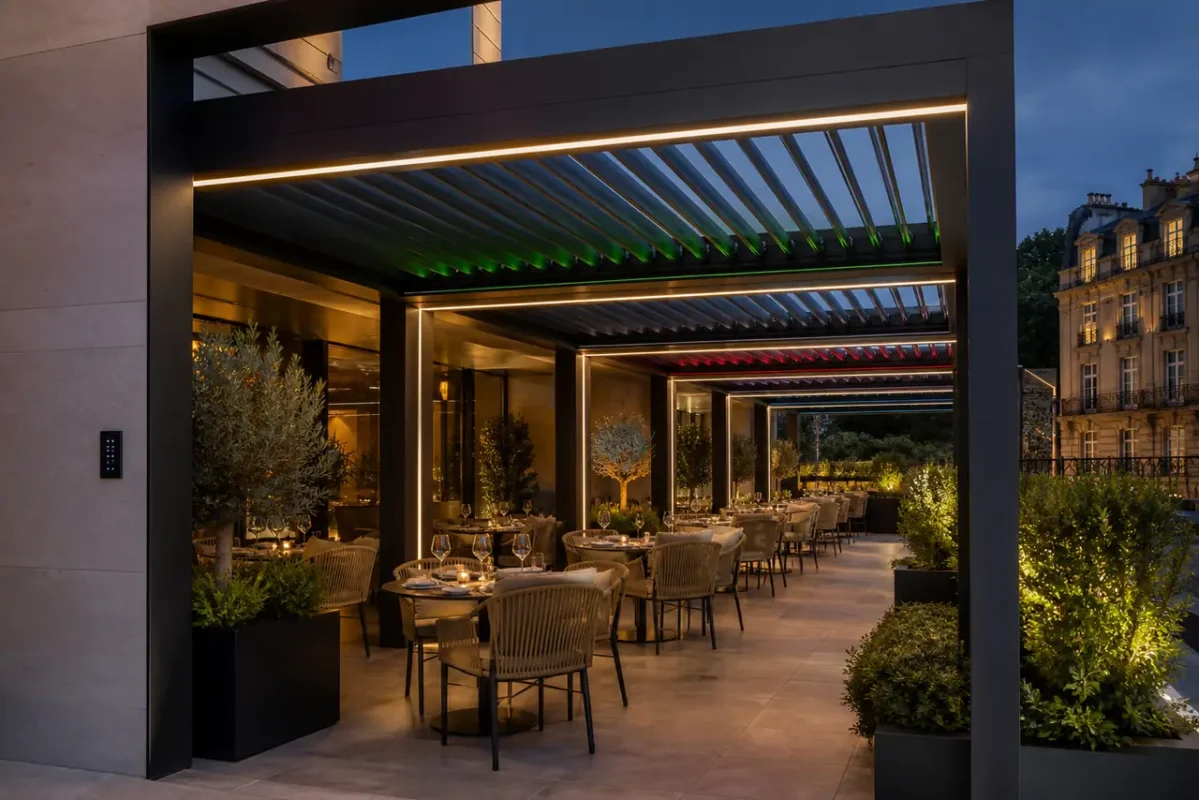
The visible benefit of one integrated remote is simple: the customer has fewer controls to manage. The deeper benefit is that the manufacturer gains a more repeatable product.
Repeatability matters because pergola manufacturers scale through dealers, installers, project partners, and distributors. Every person in that chain needs to understand how the system is specified, wired, packaged, paired, operated, serviced, and replaced.
An integrated lighting and louver controller can improve the manufacturer side in several ways:
- Product managers can define standard control packages instead of rebuilding each project from mixed components.
- Purchasing teams can reduce supplier fragmentation for remotes, receivers, lighting controllers, and control panels.
- Engineers can match channels, loads, waterproof connectors, antenna placement, and enclosure dimensions before launch.
- Production teams can pre-wire and test a kit before it reaches the installer.
- Dealers can sell a clearer upgrade path from basic louver control to lighting scenes, app control, sensors, and multi-zone packages.
- After-sales teams can diagnose problems from a known architecture instead of reverse-engineering every project.
This is why an integrated controller often supports margin better than an isolated accessory bundle. It helps the pergola feel like a finished premium product. Our article on raising pergola ASP and margin with smart lighting explains the commercial side of that idea in more detail.
The Right System Architecture for OEM and ODM Pergola Brands
A practical integrated pergola control system for manufacturers should start with a clear architecture. In our experience, the best structure includes four layers.
1. Output Layer
This is where lighting and motion are controlled. A strong system should support single-color LED lighting, RGB or RGBW lighting, linear actuators for louver rotation, and tubular motors for retraction. The output capacity, voltage, load, channel grouping, and dimming behavior should be documented before the system is approved for production.
2. Input Layer
This includes RF remote commands, wall panel commands, Tuya app commands, and sensor input. It should be clear which inputs can override which actions. For example, a wind-protection command should not be treated the same way as a decorative lighting scene.
3. Logic Layer
This layer decides what the pergola does when a command or sensor signal is received. It includes scene memory, group control, automatic closing logic, delay timers, limit behavior, pairing, and fault response. This is where the system becomes more than a box of outputs.
4. Integration Layer
This includes connectors, cable harnesses, enclosure shape, installation position, labels, remote layout, private-label firmware, app naming, manuals, packaging, and service documentation. For OEM and ODM brands, this layer is often the difference between a product that can be sold once and a product that can be scaled across a full pergola range.
إن وحدة التحكم في البرجولا page is relevant here because it frames the controller as a complete ready-to-integrate kit, including the control unit, RF remote, wall-mounted panel, sensors, wiring and connector solution, and OEM customization options.
How to Replace Separate Remotes Without Disrupting Your Product Line
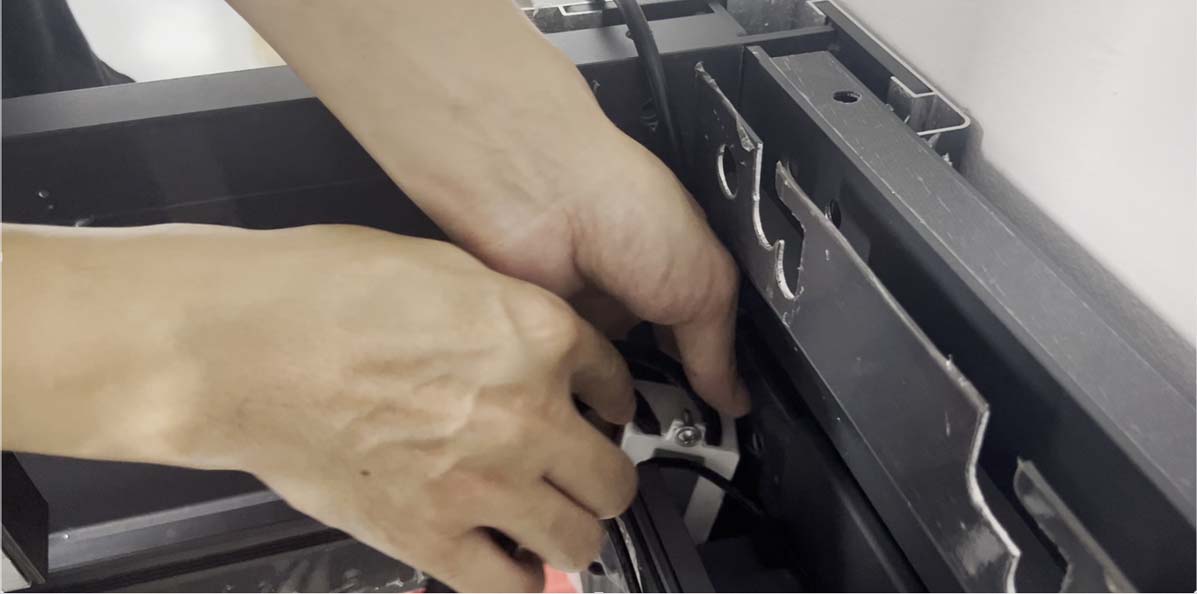
Manufacturers do not need to redesign every pergola model at once. The transition can be handled in a controlled way.
Start with the pergola model where the control problem is most visible. This is usually a premium louvered or retractable model that already includes lighting, motorization, and dealer-installed options. Map every function the user currently controls: white light on and off, dimming, RGB color, louver open and close, tilt positions, retract and extend, rain close, wind response, group control, and wall operation.
Next, decide which functions should be standard and which should be optional. Some manufacturers may standardize RF remote control and white lighting while offering Tuya app, RGB lighting, and sensors as higher packages. Others may make app control and RGB lighting standard for premium European or North American lines. The right answer depends on channel strategy, dealer capability, and target price.
Then build a test kit that reflects the real pergola, not a loose bench demo. Include the control box, RF remote, wall panel, single-color light, RGB light, linear actuator, tubular motor, sensors, connectors, cable lengths, and installation position. Test the system inside or near the aluminum structure, because signal performance and cable routing behave differently in the real frame than on a table.
Finally, update the sales and service documentation. A one-remote system only creates value if the dealer can explain it and the installer can commission it. Use channel maps, pairing instructions, wiring diagrams, load limits, app setup steps, sensor placement notes, and troubleshooting flowcharts. Our دليل استكشاف الأعطال وإصلاحها الخاص بجهاز التحكم في البرجولا RF can support this service-oriented approach.
What to Specify Before Choosing a Supplier
Before selecting an integrated control supplier, pergola manufacturers should define the system in manufacturing language. The following checklist is a practical starting point.
- Which pergola models require louver rotation, louver retraction, or both?
- How many linear actuators must be controlled per pergola or per zone?
- How many tubular motors must be controlled, and which motor brands or protocols must be supported?
- Which lighting types are standard: single-color, CCT, RGB, RGBW, downlights, strip lights, or post lights?
- What output voltage and power should the lighting channels support?
- How many independent zones or groups should the RF remote and app support?
- Should the system include RF remote, Tuya app, wall panel, or all three?
- Which sensors are required for each market: rain, wind, sun, snow, or a combined weather package?
- Where will the control box be installed inside the frame, post, beam, or service cavity?
- What waterproof rating is required for the control box, connectors, cable exits, and installed assembly?
- What private-label elements are needed: remote logo, app naming, enclosure color, packaging, manuals, firmware, or channel configuration?
- How will dealers test, pair, reset, replace, and troubleshoot the system after installation?
This checklist prevents the most common mistake: choosing a controller first and discovering the real system requirements later. For a broader procurement framework, see our buyer checklist for sourcing a pergola lighting and control system و... دليل «البناء مقابل الشراء» لأنظمة التحكم في البرجولات.
Our Position: One Control System Becomes Part of the Pergola Brand
In premium outdoor living, the control experience shapes how the product is remembered. A pergola may have strong aluminum profiles, good drainage, durable powder coating, and attractive lighting. But if the user has to manage several remotes and unclear app behavior, the product feels unfinished.
Manufacturers in Europe and North America are already selling a more complete idea of outdoor living: shade, airflow, rain protection, lighting atmosphere, automation, and easy operation. The control system is the part that makes those promises happen at the user’s hand.
That is why we believe integrated lighting and louver control should become a standard design direction for modern pergola manufacturers. The strongest brands will not present controls as accessories. They will present a coordinated operating system for the pergola.
For some brands, the first step is replacing two lighting remotes with one RF and app lighting controller. For others, it is integrating linear actuators, tubular motors, lighting, and sensors into one OEM control kit. The exact path can differ. The direction should not.
Conclusion: Replace Control Clutter with a System Your Dealers Can Sell
Separate remotes make a pergola harder to use, harder to explain, and harder to support. One integrated lighting and louver control system gives manufacturers a cleaner way to package premium outdoor living: single-color lighting, RGB lighting, louver rotation, louver retraction, weather response, RF remote control, Tuya app control, and wall panel operation working from one coordinated platform.
As a professional pergola lighting and control system manufacturer, VLEDSTAR builds integrated solutions for OEM and ODM pergola brands that need more than a generic controller. We help manufacturers combine lighting, motors, sensors, wiring, RF remote, app control, and panel control into product-ready kits that can be tested, branded, installed, and supported at scale.
If your pergola product line still depends on separate remotes for lighting and louvers, now is the right time to redesign the control experience. Review our نظام التحكم المتكامل في البرجولا, compare your current control architecture, and talk with our team about a sample configuration for your next louvered or retractable pergola series.

التنبيه: التحكم في مصابيح LED من أنواع RGB وRGBW وMono للبرجولات ذات الشرفات ذات الفتحات: دليل المواصفات
التنبيه: دليل الشركات المصنعة للمعدات الأصلية (OEM) للتحكم في فتحات التهوية ومصابيح LED والشاشات وأجهزة التدفئة وأجهزة الاستشعار ضمن منصة واحدة للبرجولات
التنبيه: الحدود القصوى لمستويات استشعار الرياح في البرجولات: كيفية تحقيق التوازن بين السلامة والضوضاء وراحة المستخدم