


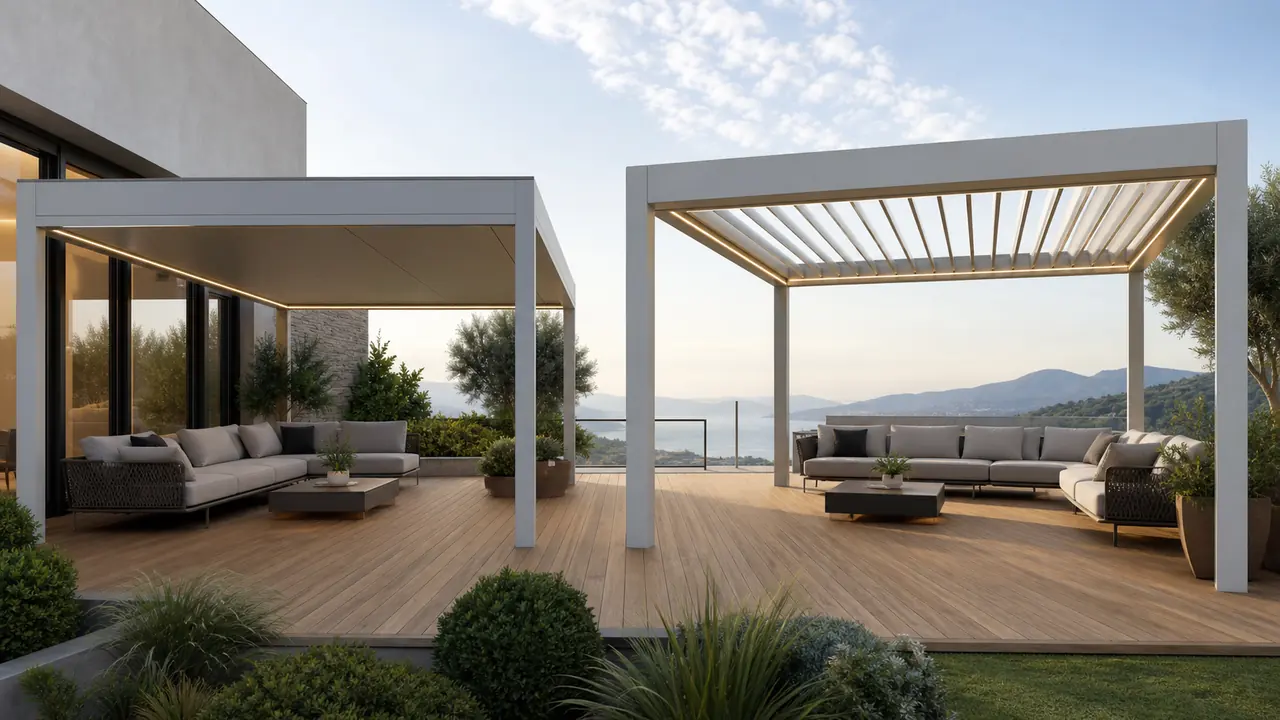
A homeowner can compare a fixed pergola roof and a motorized louvered roof by asking one simple question: do I want permanent cover or adjustable shade? A pergola manufacturer has to ask a harder question: what kind of product platform am I prepared to own after the sale?
That distinction matters. A fixed panel roof is mostly a structural and water-management decision. A motorized louvered roof is a structural, electrical, firmware, weather-sensing, commissioning, and service decision. The second option can raise average selling price, strengthen differentiation, and open the door to lighting, screens, heaters, app control, and smart-home integration. It can also create avoidable warranty noise if the control package is treated as an accessory instead of a core system.
Most search results on this topic are written for end users. They usually compare fixed panels, retractable covers, fixed louvers, and motorized louvers by comfort, rainfall protection, sun exposure, maintenance, aesthetics, and cost. That structure is useful, but it stops at the patio. OEMs in Europe and North America need a more commercial lens: which roof format reduces SKU complexity, which one gives dealers a cleaner installation story, which one supports sensor automation, and which one gives the brand a defensible premium position?
Our view is direct: fixed panels should remain the dependable baseline, but motorized louvers should become the premium OEM platform when the control architecture is engineered from the beginning.
What Fixed Panels Actually Control
A fixed roof panel does not control the weather. It controls uncertainty. Once installed, the roof angle, shade pattern, drainage path, and customer experience are largely fixed. That simplicity is the reason fixed panels still deserve a place in an OEM catalog.
For manufacturers selling through dealers, builders, or retail channels, fixed panels can reduce technical exposure. There is no motor pairing, no louver travel calibration, no wind or rain sensor logic, no app onboarding, and fewer electrical interfaces to troubleshoot. Installation teams focus on frame squareness, panel alignment, sealing, gutter slope, and anchoring. Those are familiar construction disciplines.
That does not make fixed panels low value. In many regions, especially where customers prioritize rain shelter over variable sunlight, a well-designed fixed roof can be the most honest solution. Polycarbonate panels, insulated sandwich panels, aluminum panels, and glass each produce a different balance of daylight, heat, noise, load, and perceived quality. The OEM still needs to control drainage, condensation behavior, panel expansion, fastening methods, and replacement access.
The limitation is equally clear. A fixed panel roof cannot modulate sunlight hour by hour. It cannot open to release trapped heat. It cannot respond to changing wind and rain patterns except through passive geometry. It also gives the manufacturer fewer opportunities to extend the system with branded electronics, remotes, sensors, or connected accessories.
What Motorized Louvers Actually Control
A motorized louvered roof controls microclimate. It can open for light and ventilation, partially close for shade, and close fully for rain protection when the roof design includes proper blade overlap and drainage. The perceived value is not just movement. It is the ability to change the outdoor room without changing the structure.
From a control-system manufacturer perspective, motorized louvers are best understood as a motion platform. The roof has actuators or motors, limit positions, synchronized channels, obstruction risks, weather inputs, user interfaces, and possible integration with lighting or screens. The louver blade is only one visible part of a larger control chain.
That chain includes the power supply, control box, remote receiver, wall switch, sensor inputs, motor outputs, connector system, cable routing, grounding or bonding strategy where applicable, app gateway, and service documentation. If the OEM sells the louvered roof as a premium product but sources these parts separately, the customer may experience one product while the factory is supporting five unrelated subsystems.
This is where OEMs either create a platform or create a problem. A louvered roof with a unified control architecture can support lighting scenes, wind response, rain closing, grouped zones, installer diagnostics, and future accessories. A louvered roof assembled from disconnected components can still move, but it becomes hard to train, hard to support, and hard to scale.
Consumer Comparison Is Not Enough for OEM Decisions
The strongest ranking pages around pergola roof options tend to follow a familiar pattern. They define each roof type, compare shade and weather protection, discuss materials, mention maintenance, then close with a “which one is right for you” recommendation. Some articles also include cost, style, climate suitability, and installation notes.
That answers the homeowner’s question. It does not answer the manufacturer’s question. An OEM needs to know what happens after the option is added to a catalog. Will it require a separate installer training path? Can the same control box work across multiple frame sizes? Are rain and wind sensors optional accessories or part of the standard safety story? Can dealers replace a controller without rewiring the entire roof? Does the documentation support CE, UKCA, UL, or local electrical expectations in the markets where the product is sold?
This article takes the missing angle: fixed panels versus motorized louvers is not only a roof-cover choice. It is a decision about control responsibility. The OEM that understands this can build a cleaner product ladder: fixed panels for dependable shelter, motorized louvers for premium adaptive comfort, and a unified control ecosystem to protect margins after installation.
Fixed Panels vs Motorized Louvers: OEM Comparison Table
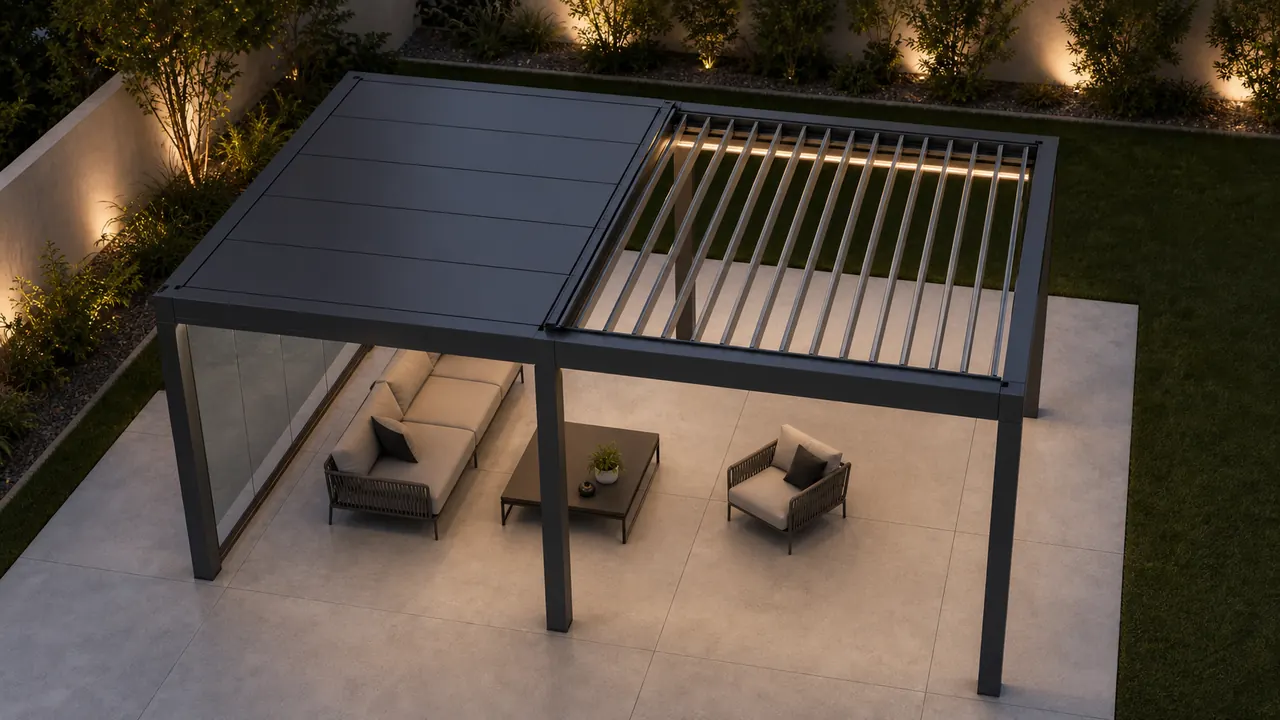
| Decision factor | Fixed roof panels | Motorized louvers | OEM implication |
|---|---|---|---|
| Product promise | Permanent shelter, predictable shade, simple operation. | Adjustable shade, ventilation, rain closing, premium user control. | Fixed panels sell certainty. Louvers sell adaptability and experience. |
| Control complexity | Low. Lighting and accessories can remain separate. | High. Motors, sensors, remotes, app gateways, and safety logic should be unified. | Louvers need a control specification, not just a motor selection. |
| Installation skill | Frame alignment, panel fixing, sealing, drainage. | All fixed-roof skills plus wiring, pairing, calibration, limit testing, sensor checks. | Dealer training must become part of the product launch plan. |
| After-sales risk | Usually concentrated in leaks, noise, thermal expansion, or damaged panels. | Can include leaks, motor faults, sensor behavior, connectivity issues, and user confusion. | A premium louver program needs diagnostic tools and modular replacement parts. |
| Accessory revenue | Moderate. Lighting and screens may be sold separately. | High. Lighting, screens, heaters, weather sensors, remotes, and apps can share one control story. | Louvers can support a higher lifetime value when the electronics are planned as a system. |
| Brand positioning | Reliable, practical, cost-controlled. | Premium, responsive, architectural, smart-home ready. | Use fixed panels as the base offer and louvers as the flagship experience. |
When Fixed Panels Are the Better OEM Choice
Fixed panels are the better choice when the customer promise is shelter first. If the pergola is sold for restaurants that need reliable rain cover, rental properties that need low-maintenance operation, or budget-conscious residential lines where the dealer must install quickly, fixed roof panels can be the cleaner business decision.
They also make sense when the OEM is building a product for channels with uneven installer skill. A simple roof package reduces the number of things a dealer can misconfigure. There is still engineering work to do, but the risk profile is easier to contain. The manufacturer can focus on structural testing, drainage validation, finish quality, packing protection, spare-panel availability, and clear installation instructions.
Fixed panels are especially useful for a tiered catalog. They allow a brand to offer an accessible permanent-cover model without pushing every buyer into automation. That can reduce price resistance and protect the premium value of motorized louvers. If every roof is positioned as smart and motorized, the brand may win attention but lose buyers who only need dependable cover.
The mistake is to make fixed panels look like an afterthought. They need their own product logic. OEMs should define panel material, drainage capacity, acoustic behavior during rain, heat buildup expectations, snow-load assumptions where relevant, and replacement process. A fixed roof that performs quietly and predictably can protect the brand as much as a premium louver system.
When Motorized Louvers Are the Better OEM Choice
Motorized louvers are the better choice when the OEM wants to compete in premium outdoor living rather than basic shelter. In high-end residential, hospitality, and commercial terrace projects, the buyer is not only purchasing cover. They are purchasing control over daylight, airflow, mood, privacy, and seasonal use.
The strongest louvered pergola programs are not sold as “a roof that opens.” They are sold as adaptive outdoor rooms. The roof connects with dimmable LED lighting, ZIP screens, ceiling fans, heaters, rain sensors, wind sensors, wall keypads, remotes, and app control. This is why control-system integration becomes a margin issue, not a convenience feature.
For OEMs, motorized louvers can create a more defensible product line because competitors cannot copy the experience by matching the frame extrusion alone. A similar aluminum profile may be easy to source. A reliable control ecosystem, clean installer workflow, stable RF range, weather-priority logic, serviceable wiring, and accessory roadmap are harder to replicate.
The commercial upside is real, but it depends on discipline. Louvers should not be launched with vague phrases such as “smart control available” or “sensor optional” without a documented control architecture. The motor type, control box capacity, channel count, power limits, connector rating, sensor behavior, pairing process, manual override, and replacement method should be defined before the first dealer sample leaves the factory.
The Control Architecture Should Decide the Premium Line
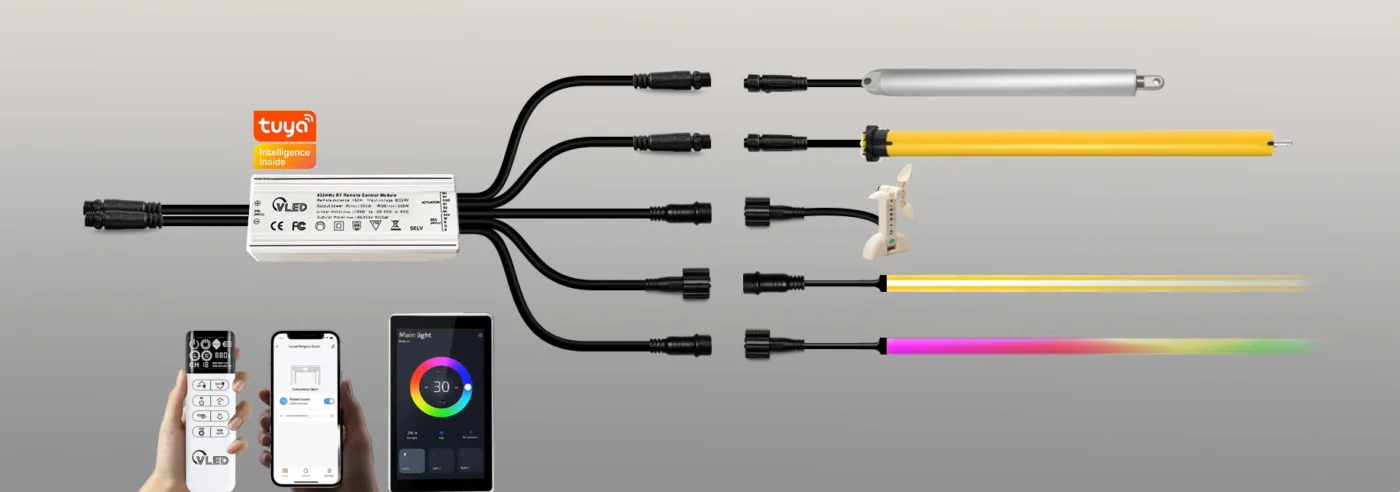
In our work with pergola lighting and control systems, the most expensive failures rarely come from a single component. They come from unclear responsibility between components. The motor supplier says the controller is wrong. The controller supplier says the wiring is wrong. The installer says the instructions were unclear. The homeowner only knows that the roof did not behave as promised.
A professional louvered pergola control package should define the system as one operating chain. At minimum, OEMs should specify:
- Motor or actuator voltage, current draw, duty cycle, travel time, and limit-setting method.
- Control box input and output capacity, including spare capacity for product variants.
- Remote control channel structure for single-zone and multi-zone pergolas.
- Weather sensor hierarchy, including what happens when wind and rain signals conflict.
- Manual override behavior and installer reset process.
- Connector type, cable length, strain relief, waterproofing, and labeling.
- Lighting and accessory integration, including dimming method and channel grouping.
- Service replacement logic, so a dealer can replace one failed module without rebuilding the roof.
For a deeper look at integrated accessory control, see the related guide How to Control Pergola Lights and Fans from One Remote or App. For broader system design, the article Motorized Pergola Control Systems: Kit, Replacement, Installation, and OEM Design Guide covers kit architecture, replacement, installation, and OEM customization.
Weather Automation Is Where Many Louver Programs Win or Lose
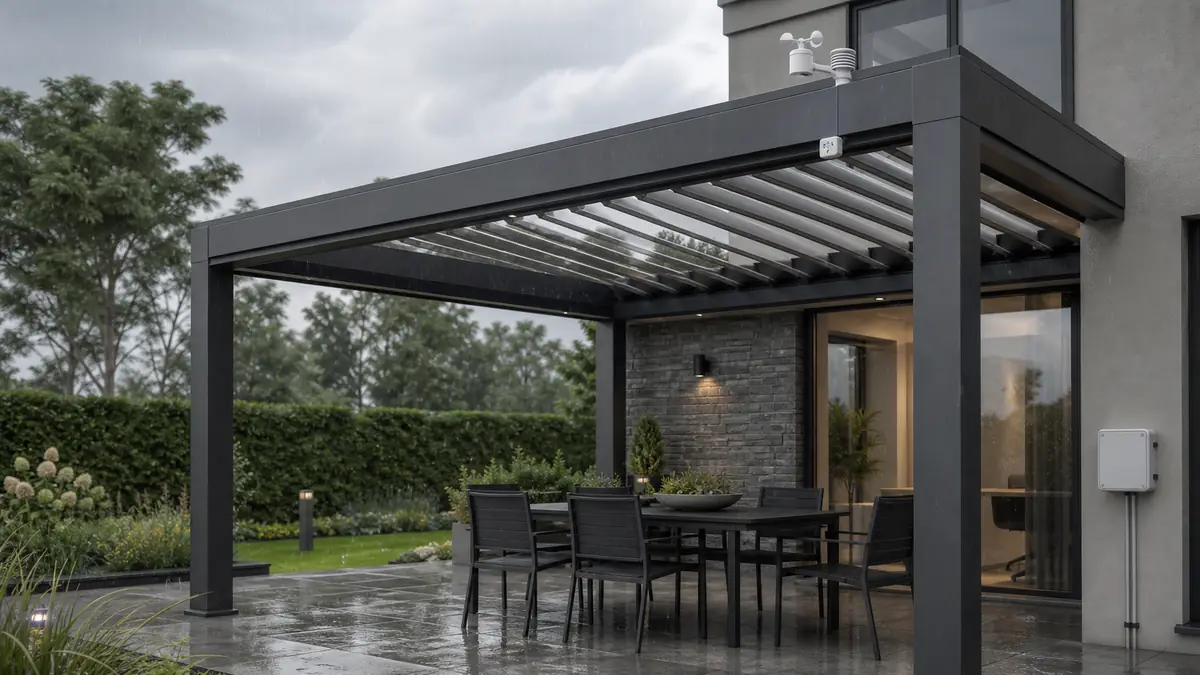
Weather automation is often marketed as a simple benefit: the roof closes when it rains and reacts when wind rises. For an OEM, that sentence hides the hardest part of the system.
Rain sensors, wind sensors, snow or temperature inputs, and sun sensors do not have equal priority. A sun command may open louvers for daylight. A rain command may close them to protect furniture. A high-wind command may need a different safe position depending on the roof design and manufacturer’s engineering assessment. A freeze condition may require motion to be disabled until the system is safe to operate.
The OEM must decide these behaviors before they reach the customer. Leaving the logic to an installer or a generic controller creates inconsistent field performance. The stronger approach is to define a control hierarchy and test it as part of product validation. The goal is not to promise that automation can handle every weather event. The goal is to make the system’s decisions predictable, explainable, and aligned with the roof’s mechanical limits.
Manufacturers should also avoid treating sensors as decorative premium accessories. If the product is sold in areas with fast weather changes, wind exposure, or unattended commercial use, sensors may be part of responsible system design. The final specification should reflect local codes, project requirements, and the manufacturer’s own structural limits.
Compliance Starts Before the Control Box Is Chosen
Motorized louvers move. That means the OEM must think beyond comfort and convenience. Depending on market, application, voltage, and integration method, a pergola control system may intersect with electrical safety, radio equipment, machinery, enclosure protection, and installation-code expectations.
For the United States and Canada, manufacturers and integrators often need to pay attention to product safety standards for motor-operated systems, relevant electrical installation requirements, and listed components where required by the project. The UL 325 standard for door, drapery, gate, louver, and window operators and systems is an important reference point when discussing powered louver-type operators in North American contexts.
For the European market, CE-related work may involve multiple directives or regulations depending on the final product configuration. The European Commission machinery guidance is a useful starting point for understanding machinery obligations. Radio controls, power supplies, and electrical assemblies may introduce additional requirements. OEMs should confirm the applicable route with qualified compliance partners before launch.
Ingress protection also deserves sober attention. An outdoor control system faces rain, condensation, dust, insects, cleaning practices, and temperature cycling. The ANSI/NEMA 250 enclosure standard overview is one useful reference for enclosure thinking in North America, while IP ratings are commonly used internationally. The important OEM habit is not to chase the highest number in a brochure. It is to specify protection levels based on real mounting position, cable entry, drainage, maintenance access, and service replacement needs.
Cost Should Be Compared Across the Whole Product Life
Fixed panels usually have a lower initial system cost. The bill of materials is easier to forecast, and the installation path is shorter. If the manufacturer only compares frame, panels, and basic hardware against a louver roof with motors and controls, fixed panels will almost always look more economical.
That comparison is incomplete. OEMs should compare total product economics:
- Factory assembly time and wiring labor.
- Dealer training and installation support.
- Packaging and damage risk for panels, louvers, motors, and controllers.
- Warranty call frequency and average troubleshooting time.
- Spare-part inventory and replacement complexity.
- Accessory attach rate for lighting, screens, heaters, sensors, remotes, and gateways.
- Premium pricing power in retail, dealer, and project channels.
A louvered roof may cost more to engineer and support, but it can also carry a stronger upgrade story. The OEM can sell a base remote version, then add weather sensors, app gateway, lighting scenes, multi-zone control, and commercial project configurations. That only works when the control backbone is consistent. If every upgrade requires a different controller, a different wiring diagram, or a different installer process, the margin disappears into complexity.
A Practical Product-Line Strategy for OEMs
The best answer is rarely to choose fixed panels or motorized louvers for every customer. A stronger OEM strategy is to use both, with clear boundaries.
Use fixed panels as the reliable shelter line
This line should be easy to quote, easy to install, and easy to service. Make the promise specific: permanent cover, defined material choices, clear drainage design, and optional lighting or screen compatibility. Do not overload the fixed panel line with too many roof materials unless the channel can explain them well.
Use motorized louvers as the adaptive comfort line
This line should justify its premium through control. Standardize the motor interface, controller, remotes, sensors, and wiring as much as possible across sizes. Give dealers a repeatable commissioning checklist. Offer app control and accessory integration as part of a logical upgrade path, not as scattered add-ons.
Keep the customer language simple
End users do not need to hear about channel loads or sensor priority tables. They need to understand what the roof will do. The OEM, however, must write the technical story behind that simple promise. Sales copy can say “adjust shade, airflow, and rain protection from one remote.” Engineering documents must define how that promise is achieved.
Specification Checklist Before Launching a Motorized Louver Model
Before adding a motorized louver option to a catalog, OEM teams should align product management, engineering, purchasing, quality, and after-sales around one shared control specification.
| Specification area | Questions to answer before production | Why it matters |
|---|---|---|
| Motor and motion | What voltage, force or torque, travel range, speed, duty cycle, and limit method will be standard? | Prevents undersized drive selection and inconsistent louver movement. |
| Control box | How many motor channels, lighting channels, sensor inputs, and accessory outputs are required? | Allows one controller family to support multiple pergola sizes and options. |
| User interfaces | Will the product use handheld remotes, wall switches, app control, voice integration, or all of them? | Keeps the sales promise aligned with what installers can configure reliably. |
| منطق الطقس | Which commands override others, and what safe position should the roof use during wind, rain, or freeze events? | Reduces field confusion and supports clearer warranty decisions. |
| Waterproofing | Where will controllers, connectors, power supplies, and cable exits be mounted? | Protects electronics based on real exposure, not only brochure ratings. |
| الخدمة | Can a dealer replace a motor, controller, sensor, or remote without removing major roof sections? | Turns after-sales service into a planned process instead of an emergency repair. |
| Documentation | Are wiring diagrams, pairing steps, reset steps, fault symptoms, and spare-part codes ready? | Protects the product launch after the first installation wave. |
How to Talk About the Choice in Sales Material
OEMs should avoid making fixed panels sound outdated. That can weaken a profitable entry-level or mid-range product. The better message is that each roof type serves a different use case.
For fixed panels, speak in terms of permanent protection, simple ownership, stable coverage, and material choice. For motorized louvers, speak in terms of adaptive comfort, daylight control, ventilation, integrated lighting, and weather-responsive automation. The customer should feel that both options are intentional, not that one is merely the cheaper version of the other.
The premium louver message becomes stronger when it is tied to a unified control experience. One remote or app for roof movement, lighting, screens, and sensors is easier to understand than a list of electronic parts. When the controls feel coherent, the pergola feels like a designed product. When controls are fragmented, even expensive hardware can feel unfinished.
Common OEM Mistakes to Avoid
The first mistake is sourcing the roof and electronics separately without assigning system ownership. If the roof frame, motor, controller, sensor, and lighting all come from different suppliers, someone inside the OEM must still define how they work together. Otherwise, the customer becomes the test site.
The second mistake is treating app control as the center of the experience. App control is valuable, but outdoor products still need reliable local control. Remotes and wall switches remain important because phones are not always available, charged, connected, or convenient. A strong system gives the user more than one dependable control path.
The third mistake is overselling weather automation. Sensors improve protection and convenience, but they do not remove the need for structural design, responsible use, and clear installation rules. Claims should match the tested behavior of the roof system.
The fourth mistake is ignoring service access. If a motorized louver roof requires major disassembly to replace a controller, connector, or actuator, the OEM has created a future cost center. Serviceability should be designed before the product is released, not after the warranty calls begin.
Our Recommendation
For European and North American pergola manufacturers, fixed panels and motorized louvers should not fight for the same position. Fixed panels are the dependable roof-cover option for customers who value permanent shelter, cost control, and simple ownership. Motorized louvers are the premium control option for customers who want the outdoor space to adapt throughout the day and across seasons.
The deciding factor is not only demand. It is OEM readiness. If your team has not defined the motor, controller, sensor, wiring, compliance, documentation, and service package, start with a fixed panel line or a limited louver pilot. If your team can engineer the control system as part of the pergola from day one, motorized louvers can become the strongest product in the catalog.
That is the position we recommend as a control-system manufacturer: keep fixed panels for reliable shelter, but build your premium growth around motorized louvers with an integrated control backbone. The aluminum roof creates the structure. The control system creates the product experience customers remember.
Build the Roof Around the Control Experience
If you are developing a new fixed-roof or motorized louvered pergola line for Europe or North America, involve the control-system supplier before the frame design is frozen. Motor selection, wiring paths, lighting channels, sensor behavior, remotes, app gateways, and service access should be reviewed together. That early coordination is what turns a pergola roof option into a scalable OEM product.
For OEM projects, our team can support control-box planning, RF remote architecture, lighting and fan integration, weather-sensor logic, and custom control kits for pergola manufacturers who need a reliable electronics platform behind their roof system.

أرسل لنا طلبك