


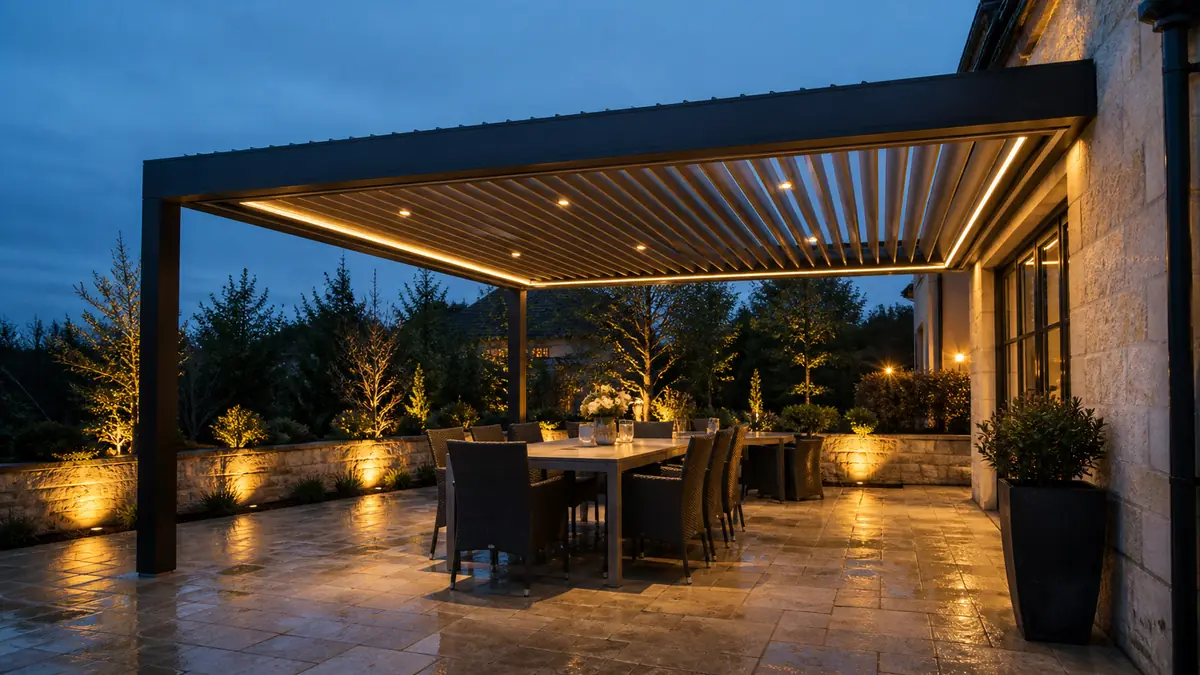
A pergola buyer usually notices the failure at the worst possible moment. The RGB strips stop responding during a dinner service. A louver remote works from one side of the terrace but not the other. The lights flicker after the first winter. A dealer opens the control box and finds corrosion around terminals that were supposed to be protected.
At that point, the conversation becomes emotional. The end user sees a premium outdoor structure. The dealer sees a warranty claim. The manufacturer sees a margin leak and a reputation problem. But the root cause often sits further upstream: the lighting control system was treated as an accessory, not as part of the pergola’s operating architecture.
That is the central argument of this article. For pergola manufacturers, outdoor control reliability is not achieved by asking for “waterproof parts” at the end of sourcing. It is achieved by designing the lighting, driver, receiver, enclosure, cable, connector, RF interface, sensor logic, and service process as one outdoor system from the beginning.
The Search Results Miss the Manufacturer’s Real Problem
Search results around outdoor lighting failures mostly answer consumer troubleshooting questions. They cover dead batteries, loose wires, tripped breakers, wet transformers, faulty timers, blown fuses, damaged fixtures, and remote pairing resets. That content is useful for a homeowner or installer standing next to a failed system. It is less useful for a pergola OEM deciding what to put into hundreds or thousands of units.
The top-ranking content tends to follow the same structure: identify symptoms, check power, inspect wiring, reset the controller, replace damaged components, and call an electrician if the problem continues. Again, there is nothing wrong with that. The problem is that a manufacturer cannot build a product strategy around after-sales troubleshooting.
The innovation gap is clear. Pergola manufacturers need content that answers a different question: why do these failures keep appearing across product lines, climates, dealers, and installation teams, even when each individual component looks acceptable on a datasheet?
Our position is that most failures come from mismatched assumptions. A supplier assumes the box will be mounted vertically under cover. The installer places it near a drainage path. The LED driver is sized for nominal wattage, not long continuous evening operation. The RF receiver is tested on a bench, not inside an aluminum beam. The enclosure has an IP claim, but the cable entry, gasket compression, connector orientation, and service opening procedure are not tested as a complete assembly.
The manufacturer-level question is not “Why did this one controller fail?” The better question is “Which assumptions allowed this failure mode into the product architecture?”
Failure Starts When Control Is Treated as an Add-On
The most expensive outdoor control failures begin with a harmless sourcing habit: lighting, motors, sensors, remotes, app gateways, and power supplies are selected as separate packages. Each supplier proves its own part. No one proves the whole pergola.
This is why a control system can look complete in a showroom and still become fragile outdoors. One RF receiver controls mono white lighting. Another receiver handles RGB. A third control board manages louver movement. A rain sensor talks to a motor controller but not to the lighting logic. The app depends on a gateway that was added after the mechanical design was frozen. Every piece works alone; the combined system creates hidden failure points.
For a louvered pergola manufacturer, the better approach is integrated control architecture. A single platform should define the relationship between lighting loads, louver actuators, tubular motors, weather sensors, remote channels, app logic, and service diagnostics. That is why we build our Steuerungssystem für Pergolen around the idea of one coordinated controller rather than a stack of unrelated transmitters and receivers.
Integration is not only about user convenience. It reduces wiring ambiguity, simplifies dealer training, makes channel logic easier to document, and gives the manufacturer a clearer BOM. It also prevents an underrated reliability problem: when several control ecosystems compete inside one metal structure, after-sales teams struggle to isolate which device failed and why.
Waterproof Ratings Are Necessary, but They Are Not a Design Strategy
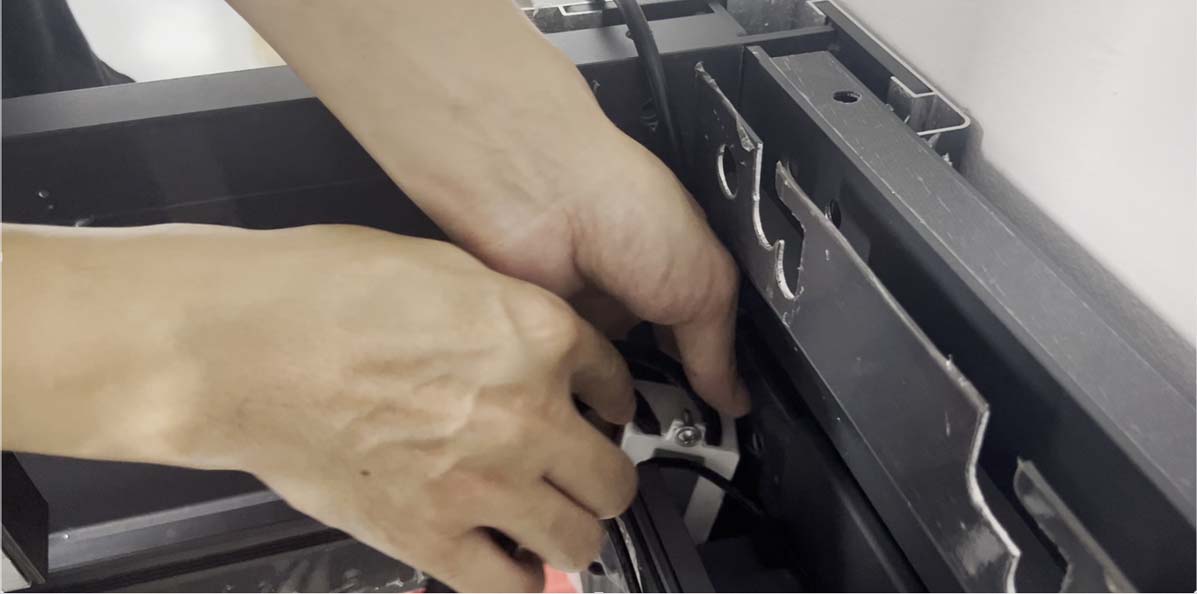
IP ratings matter, but they are often misunderstood. The IEC IP rating system defines degrees of protection against solids and water. North American projects may also reference NEMA enclosure types, which consider conditions such as rain, sleet, hose-directed water, corrosion, and indoor or outdoor use depending on the type.
Those standards give manufacturers a language for protection. They do not remove the need for application engineering. A controller can be labeled IP65 and still fail if the cable gland is over-tightened, if a non-rated connector is added later, if the enclosure is opened repeatedly without gasket inspection, or if condensation forms because the box cycles between hot daytime air and cold night temperatures.
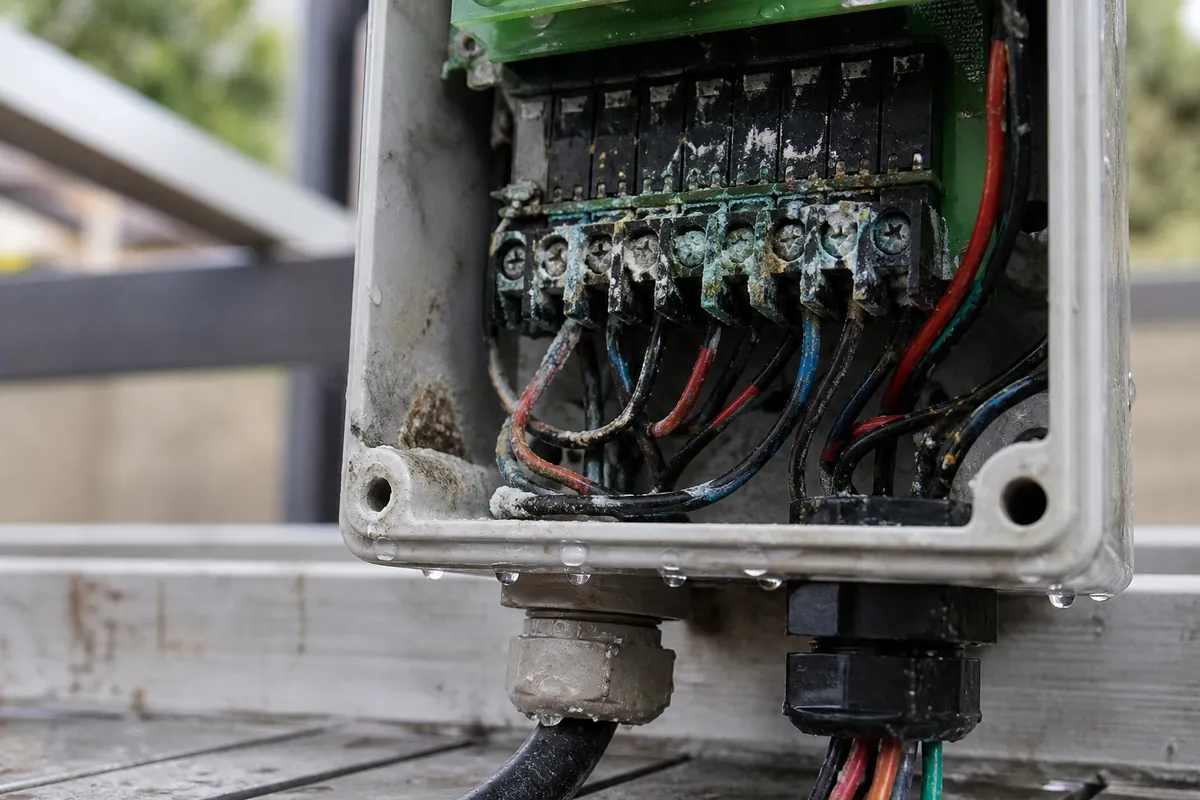
In pergola systems, water usually enters through the boring parts: the underside cable route, the terminal cover, the drain path near a beam, the forgotten service loop, or the installer-made hole that was never part of the original test. Once moisture enters, corrosion and leakage current can create symptoms that look unrelated: dimming errors, RF range loss, random resets, or channel failure.
This is why a serious OEM specification should not stop at “IP65 controller.” It should define the enclosure, gasket, cable entry, connector family, mounting orientation, drainage clearance, installation procedure, and post-service inspection. Our own IP rating guide for outdoor pergola lighting goes deeper into IP44, IP65, and IP67 selection because the right rating depends on exposure, not marketing language.
The Five Outdoor Failure Modes Manufacturers Should Design Around
Reliable control systems are not created by hoping every installation is gentle. They are created by assuming the outdoor environment will find weak points. The following five failure modes appear repeatedly in pergola lighting and control projects.
1. Moisture ingress and condensation
Direct rain is only one part of the problem. Condensation can form inside enclosures when temperature changes pull humid air through tiny gaps or pressure-equalization paths. In coastal markets, moisture also carries salt that accelerates corrosion. Salt spray and cyclic corrosion tests such as ASTM B117 und IEC 60068-2-52 are useful references when manufacturers want a more disciplined corrosion validation plan.
2. Driver stress and voltage drop
A 24V LED lighting package is not stable just because the strip lights turn on. Long beam runs, multi-zone RGBW loads, shared wiring routes, and warm enclosure temperatures can expose weak driver sizing. When drivers are selected too close to the nominal load, the system may pass a short test and still flicker, dim unevenly, or shut down during real evening use. Our 24V LED driver sizing guide explains why OEMs should group loads by circuit behavior, not only by total wattage.
3. RF signal loss inside aluminum structures
Bioclimatic pergolas use a lot of aluminum. That is good for structure and weather resistance, but it can be difficult for wireless control. Metal beams, louver geometry, controller placement, and receiver antenna orientation can reduce range or create direction-sensitive operation. A remote that works in an open test room may feel unreliable once the controller is installed inside a pergola cavity. For deeper RF details, see our article on Störungen durch Metall bei der Steuerung der Pergola-Beleuchtung und unser Anleitung zur Fehlerbehebung beim RF-Pergola-Controller.
4. Fragmented sensor logic
Rain, wind, sun, and snow sensors are supposed to protect the structure. They can also create support problems if their priorities are not clearly defined. What happens if rain is detected while the user has the lights in a custom scene? Should the louvers close but lighting stay on? Should a high wind condition override a scheduled command? These are not small software details. They determine whether the pergola feels intelligent or unpredictable. Our sensor integration guide covers how manufacturers can define these relationships before production.
5. Poor service access
A controller that can only be inspected by dismantling half the pergola is not an outdoor-ready controller. Serviceability affects reliability because every difficult service action creates new risk: damaged gaskets, reversed connectors, missing strain relief, or undocumented pairing changes. Manufacturers should design access, labeling, channel mapping, and replacement procedures into the product, not leave them to dealer improvisation.
The Better Standard: Environment-First Control Architecture
Manufacturers should stop evaluating pergola lighting controls as component purchases and start evaluating them as outdoor operating systems. The standard should be environment-first control architecture: define the real exposure, electrical load, wireless condition, installation method, user interface, and service process before finalizing the controller.
This approach changes the supplier conversation. Instead of asking only for a waterproof controller, the manufacturer asks:
- Where will the controller be mounted in each pergola model?
- Which cable entries, connectors, and glands are part of the tested assembly?
- What happens when RGB lighting, mono lighting, louvers, tubular motors, and sensors operate together?
- How much load headroom does the LED driver have during continuous evening operation?
- What RF range is realistic inside aluminum beams, not just in open air?
- How will a dealer identify, replace, re-pair, and document the controller in the field?
At VLEDSTAR, this is the reason our pergola control work focuses on integrated systems rather than isolated accessories. Our Pergola-Steuergerät is positioned for OEMs that need one control box to manage LED lighting, linear actuators, tubular motors, weather sensors, RF remote control, Tuya app control, and touchscreen panel operation. The value is not simply that the controller has many outputs. The value is that those outputs can be configured as a product line, with firmware, enclosure, logo, channel layout, and dealer workflow considered together.
For manufacturers comparing build, buy, white-label, and custom development paths, our sourcing checklist for pergola lighting and control systems gives a practical framework for supplier evaluation.
A Manufacturer’s Prevention Checklist
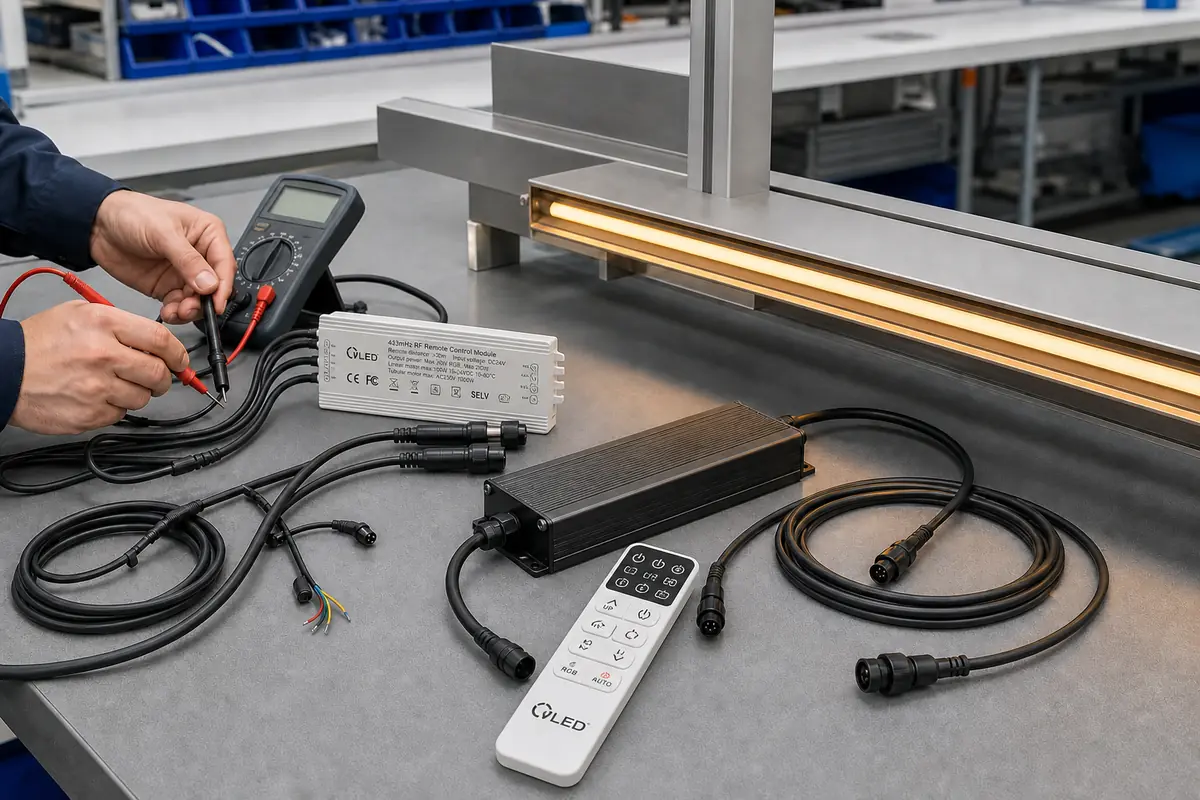
The following checklist is more useful than a generic troubleshooting guide because it moves the work before the warranty claim. Manufacturers can use it during product development, supplier qualification, and pre-production validation.
| Risk Area | What Usually Goes Wrong | Prevention Requirement |
|---|---|---|
| Enclosure protection | The controller rating is considered alone, while glands, terminals, service openings, and mounting orientation are ignored. | Validate the complete assembly with the planned cable entries, connectors, gasket, mounting direction, and service procedure. |
| LED power design | Drivers are sized from nominal wattage without enough headroom for heat, long runs, and combined zone operation. | Calculate full-load behavior, voltage drop, channel grouping, thermal conditions, and future option expansion before BOM lock. |
| Wireless control | RF performance is tested on the bench, then weakened by aluminum beams, receiver placement, and hidden antenna orientation. | Test remote range in the real pergola frame, with the controller mounted where production units will place it. |
| System logic | Lighting, motors, sensors, app gateways, and remotes follow separate rules, creating inconsistent user behavior. | Define one control logic for manual commands, automation, safety overrides, scenes, and service reset behavior. |
| Dealer installation | Installers improvise wiring routes, cable lengths, connector protection, and pairing steps because the kit is not self-explanatory. | Provide labeled harnesses, channel maps, mounting instructions, QR-based documents, and pre-configured control modes where possible. |
| After-sales service | Faults are hard to isolate, so dealers replace multiple parts or escalate every case to the manufacturer. | Design service access, spare-part strategy, controller replacement steps, and diagnostic documentation before launch. |
If your team is building a new control BOM, use our Checkliste für die Stückliste des Pergola-Steuerungssystems as a companion resource. It helps separate necessary control architecture from optional accessories.
Outdoor Reliability Is Also a Brand Experience
Lighting failures rarely stay technical in the customer’s mind. A flickering LED strip is read as poor quality. A remote with weak range is read as cheap engineering. A controller that fails after rain is read as a broken promise, even if the mechanical pergola frame is excellent.
This matters for European and North American pergola brands because the market has moved beyond passive shade. Buyers now expect controlled light, automated louvers, weather response, app integration, voice compatibility, and smooth dealer support. The control system is becoming part of the brand experience, not a hidden accessory.
That shift is why manufacturers should be cautious with overly generic outdoor lighting advice. For example, DarkSky International’s outdoor lighting principles correctly emphasize useful, targeted, controlled, warm, and properly shielded light. Those principles help manufacturers avoid glare and light pollution. But the pergola OEM still has to translate good lighting practice into a controllable, durable, serviceable kit that dealers can install consistently across different structures.
The same is true for safety and electrical standards. Standards and certifications provide boundaries, but they do not automatically produce a coherent customer experience. Manufacturers still need to decide how lighting scenes interact with louver movement, how the controller responds during rain, how circuits are isolated, and how the system behaves after power loss.
What We Would Change Before the Next Product Launch
If a pergola manufacturer asked us to reduce outdoor lighting control failures before a new product launch, we would start with four changes.
- Freeze the control architecture before freezing the aluminum extrusion. Controller placement, antenna routing, drainage, and service access are easier to solve before the frame design is locked.
- Test the complete assembly, not isolated samples. Put the controller, driver, wiring, connectors, lights, motors, and sensors into the real pergola layout and test them together.
- Reduce ecosystem fragmentation. Separate remotes and receivers may feel flexible during sourcing, but they create long-term support complexity. Our guide to integrated lighting and louver control explains why one user logic is usually stronger for OEM product lines.
- Design the dealer workflow as part of the product. A reliable system includes clear labeling, documented channel pairing, predictable replacement steps, and training materials that match the actual kit.
These changes are not glamorous. They are exactly the kind of engineering discipline that keeps a premium outdoor product from becoming a support burden. They also give manufacturers more control over margin, option packages, and brand differentiation.
Frequently Asked Questions
Is IP65 enough for pergola lighting controls?
IP65 can be enough for many protected outdoor pergola control locations, but only when the complete assembly is designed around that rating. The enclosure, cable glands, connectors, gasket compression, mounting direction, and service procedure all matter. If the controller faces standing water, pressure washing, or repeated service openings, the specification may need to be stronger.
Why do RF pergola remotes work during testing but fail after installation?
Bench testing does not represent an aluminum pergola. Metal beams, controller cavities, antenna position, nearby motors, and installation height can reduce RF performance. Manufacturers should test the remote inside the real frame and document receiver placement instead of relying only on open-air range claims.
Should manufacturers use one integrated controller or separate controllers?
Separate controllers can work for simple products, but integrated control is usually better for OEM lines with lighting, louvers, motors, sensors, and app control. One platform reduces wiring ambiguity, creates consistent user behavior, and makes after-sales support easier. The stronger question is not “How many controllers are cheaper?” but “Which architecture is easier to install, diagnose, and scale?”
What is the first step to reducing outdoor control warranty claims?
Start by mapping every failure mode before choosing components. List moisture paths, LED load cases, RF barriers, sensor overrides, wiring routes, and service steps. Then ask suppliers to validate the full system against that map. This moves reliability from reactive troubleshooting into product development.
Conclusion: The Control System Is the Product Promise
Pergola lighting controls fail outdoors when manufacturers treat them as accessories instead of engineered outdoor systems. Waterproof ratings, RF remotes, app modules, drivers, sensors, and connectors all matter, but none of them can carry the product alone.
The manufacturers that will win in premium outdoor living are the ones that make control reliability part of the product definition. They will test earlier, integrate more intelligently, document dealer workflows, and choose suppliers who understand pergola structures rather than only electronics catalogs.
Build a More Reliable Pergola Lighting and Control Platform
VLEDSTAR develops and manufactures integrated pergola lighting and control systems for OEMs, including lighting control, motor control, weather sensor integration, RF remote control, app control, touchscreen panels, and customized product-line configurations.
If your next pergola line needs fewer support calls, cleaner installation, and a control system designed for outdoor manufacturing realities, start with our pergola lighting and smart control solutions or review our smart pergola controller platform.

Pingback: Rain Sensor Placement for Motorized Louvered Roofs: Factory and Installer Guidelines
Pingback: How Integrated Controls Reduce Pergola Installation Labor for Dealers
Pingback: Designing a Dealer-Friendly Control Kit for Motorized Pergolas
Pingback: What Is a Smart Pergola Control System? A Manufacturer’s Explanation
Pingback: Scene Control for Pergolas: Dinner Mode, Storm Mode, Sunset Mode, and Dealer Presets
Pingback: IP65 vs IP66 vs IP67 for Pergola Controllers
Pingback: Manual Override and Fail-Safe Design for Motorized Pergola Controls