


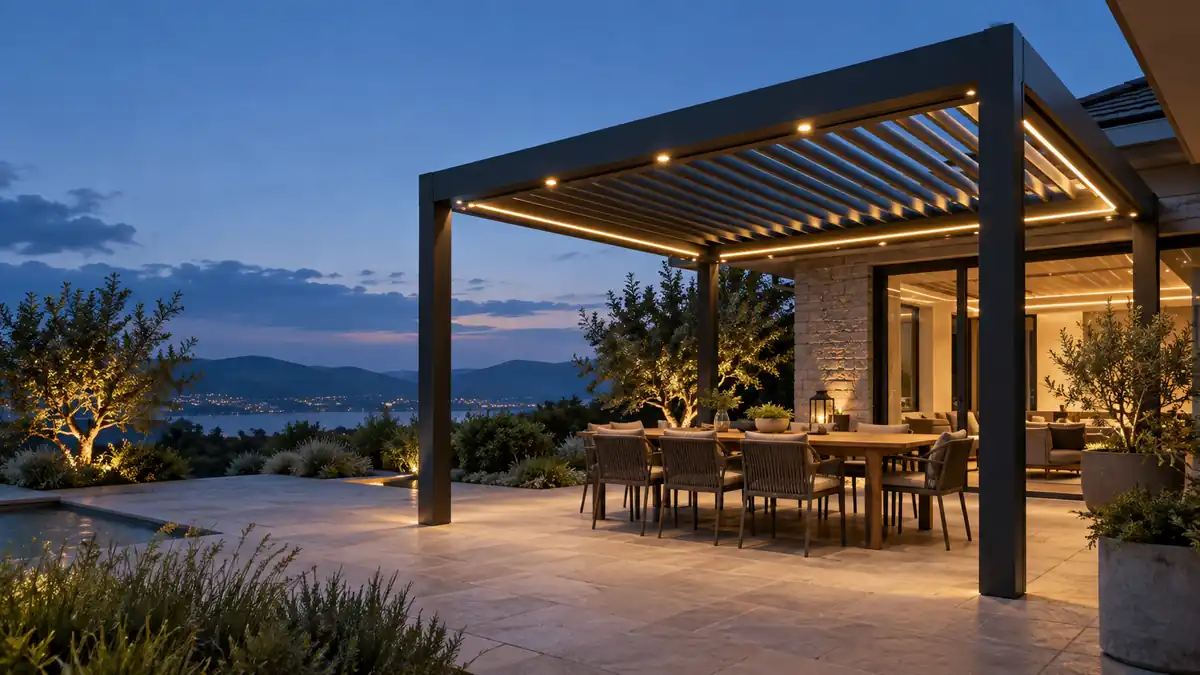
A pergola lighting control supplier can look attractive during a sample demonstration and still create problems once the product enters production. A remote may dim the LEDs correctly, yet the controller may not fit the beam cavity. A control box may operate one motor, but fail to coordinate two actuators, weather sensors, and multiple lighting zones. A kit may work in a showroom, then generate difficult service calls after exposure to moisture, temperature changes, vibration, and installer error.
For OEMs, supplier comparison should therefore begin with system responsibility rather than product price. The essential question is not “Which controller has more functions?” It is “Which supplier can help us deliver a repeatable pergola platform that is easy to build, install, commission, and support?”
This guide sets out the comparison criteria we use as a pergola lighting and control-system manufacturer. It covers the features that affect your product architecture, your installation process, and your brand reputation after the sale.
Notre position : approve a supplier only when its control platform, lighting package, manufacturing process, documentation, and technical support have been reviewed as one connected system.
Start with a system-level comparison, not a remote-control comparison
Many supplier evaluations begin with a catalogue: RF range, app support, RGBW scenes, number of channels, and maximum wattage. Those details matter, but they do not tell you whether the complete solution is suitable for your pergola range.
A proper comparison should map the full operating chain:
- Input power, voltage, drivers, fuses, and load limits
- Lighting types, zones, dimming behavior, and color control
- Linear actuators, tubular motors, screens, heaters, fans, and sensors
- Wireless and wired communication, signal behavior, and commissioning
- Connectors, cable lengths, enclosure dimensions, and service access
- Firmware ownership, configuration control, replacement parts, and warranty support
This is why an integrated architecture is valuable for OEMs. VLEDSTAR’s système de contrôle de pergola is designed to bring lighting, actuators, tubular motors, weather sensors, and multiple control modes into one platform. The purpose is not to add functions for marketing. It is to reduce the number of interfaces your engineering and service teams must manage.
Quick comparison: the features that deserve technical review
| Comparison area | Minimum question for the supplier | Why it matters to an OEM |
|---|---|---|
| System scope | Which devices are designed, tested, and supported as one system? | Prevents interface disputes between lighting, motor, and sensor suppliers. |
| Lighting control | Does it support the required white, CCT, RGB, or RGBW loads with predictable dimming? | Protects the lighting experience and simplifies product configuration. |
| Motor integration | Which exact actuators and tubular motors have been tested? | Reduces synchronization, startup-current, and compatibility risks. |
| Outdoor protection | What is the rating of the complete installed assembly, not only one enclosure? | Moisture protection depends on connectors, cable entries, installation, and housing design. |
| Installation | Can installers identify, connect, and replace parts without opening finished structures? | Shortens installation time and lowers field-service cost. |
| OEM support | Can the supplier freeze the BOM, customize interfaces, and document revisions? | Creates a stable platform for your own product line. |
| Lifecycle support | How are firmware, replacement units, and technical faults handled over time? | Protects your brand after the original installation. |
1. Control architecture and channel capacity
The controller should match the way your pergola is built and sold. A single-bay residential pergola has different requirements from a multi-bay commercial system with separate roof sections, screens, heaters, and lighting scenes.
Ask the supplier to show the channel structure in a wiring diagram. Confirm whether users can operate zones independently, group them, or run a whole-pergola scene. Check whether the architecture supports the number of actuators and lighting circuits required by your product family, rather than only by the sample unit.
VLEDSTAR’s published platform specifies up to four linear actuators, up to two tubular motors, 15 RF channels, and RF remote, app, and touchscreen control modes. It also describes obstacle response and weather-sensor logic. These are useful starting points for an OEM review, but each manufacturer should still validate the exact motor, load, and configuration required for its own structure.
Do not accept “multi-channel” as a complete answer. Ask what each channel can control, whether channels can be reassigned, what happens after a power interruption, and how the system behaves when one motor or sensor becomes unavailable.
2. Lighting performance: dimming, color, and load management
Lighting control quality is visible to the end customer every evening. Flicker, uneven color transitions, poor low-level dimming, or a controller that resets under load can make a premium pergola feel unfinished.
Compare suppliers against the lighting specification your brand actually needs:
- Monochrome dimming for functional and ambient white light
- CCT adjustment when users need to move between warm and cool white
- RGB or RGBW mixing for entertainment and scene-based products
- Low-level dimming behavior without visible stepping or abrupt cut-off
- Separate zones for downlights, strips, post lights, and perimeter lighting
- Driver compatibility, maximum load, inrush behavior, and thermal margin
VLEDSTAR’s pergola lighting range includes recessed downlights, spotlights, LED strips, wall and post lights, and accessories. The practical advantage of reviewing these products with the controller is that the electrical and mechanical interfaces can be considered together. A lighting supplier should be able to explain not only the LED specification, but also how the selected lights behave with the proposed control hardware, cable lengths, and power supply.
For an approval sample, test every lighting mode at minimum and maximum load. Test the transition from off to low brightness, a full-white RGBW scene, a long cable run, and simultaneous motor movement. Record the result in the product approval file.
3. Motor and sensor integration
Lighting control becomes a pergola control problem as soon as the system must coordinate with moving hardware. The supplier should be able to discuss the exact motor interface, voltage, current, limit arrangement, feedback method, and failure behavior.
Ask for compatibility evidence for each motor family you intend to use. “Compatible with tubular motors” is not enough. The tested model, wiring method, operating current, direction logic, and limit-setting procedure should be documented. The same applies to linear actuators: confirm how the controller handles synchronized movement, limit switches, Hall feedback, obstruction, and a stalled motor.
Sensors deserve equal attention. Wind, rain, sun, and snow inputs can trigger protective actions, but a supplier must explain the priority logic. What happens if a user sends a manual lighting command while a weather protection event is active? Does a sensor close only the roof, or does it also change lighting and other outputs? How is the system reset after the weather condition ends?
These details determine whether your dealer can commission the product confidently. They also determine who gets the service call when the roof, lights, and sensor have been sourced from different companies.
4. Outdoor reliability: evaluate the complete installation
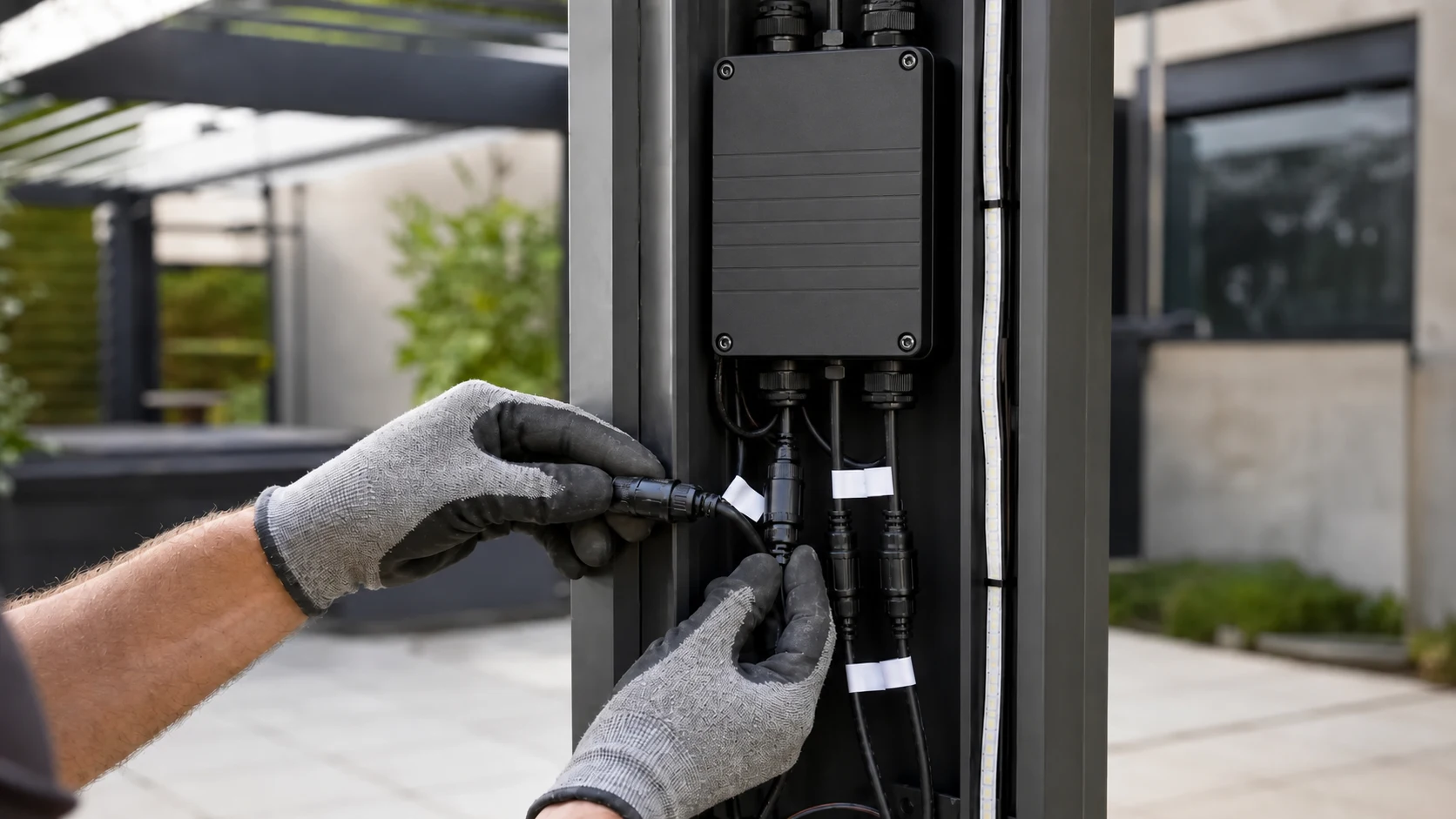
Outdoor protection is more than printing an IP code on a control-box label. IEC 60529 defines the IP Code classification for protection provided by enclosures, but the performance of a pergola installation also depends on connectors, cable glands, seals, drainage, mounting position, and assembly practice.
Compare the supplier’s evidence in four layers:
- Enclosure: material, sealing method, mounting orientation, and access to terminals
- Connections: connector design, locking method, cable strain relief, and replacement procedure
- Electrical behavior: overload protection, thermal management, EMC behavior, and restart after power loss
- Environmental validation: water exposure, dust, temperature, vibration, and signal interference relevant to the installation
VLEDSTAR’s control-system page specifies IP65 protection for the control unit, a compact enclosure intended for pergola cavities, and waterproof connectors. For OEM approval, those published features should be matched to your own installation drawing. Confirm where the box will be mounted, how water is prevented from tracking along cables, and whether an installer can reach the unit without dismantling the pergola.
A supplier that talks clearly about installation conditions is more valuable than one that uses outdoor-rated language without showing the boundary of its claim.
5. Installation and serviceability are commercial features
Every connection hidden inside a finished beam becomes a future service decision. When suppliers are compared only on component price, OEMs often overlook the labor cost created by difficult installation and inaccessible replacement parts.
Review the physical package as carefully as the electronics:
- Does the control box fit the smallest beam and post cavity in the range?
- Are connectors keyed and clearly labeled?
- Can the wiring harness be installed before final assembly?
- Can a dealer isolate a failed light, driver, sensor, or controller?
- Are cable lengths and extension options documented for each model?
- Does the supplier provide a wiring diagram and commissioning sequence written for installers?
VLEDSTAR’s platform includes compact control-box design and fast waterproof connectors, while its lighting offering includes connection accessories and plug-and-play kit options. For a serious comparison, ask for the complete installation pack: bill of materials, wiring diagram, connector map, controller settings, fault checks, and replacement instructions.
Serviceability is not an after-sales detail. It is part of the product architecture you are selling to dealers and homeowners.
6. OEM and private-label capability
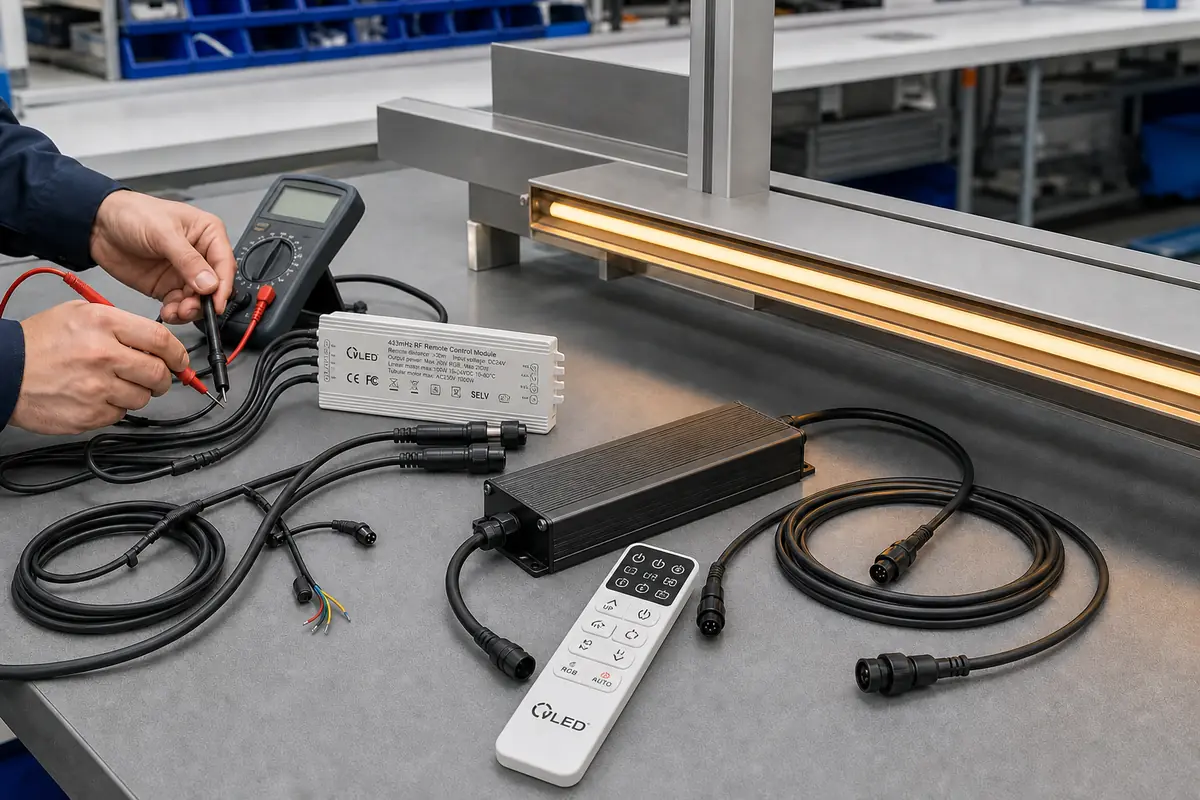
There is a major difference between buying a standard controller and building a controlled product platform with a manufacturing partner. OEM buyers should examine how much of the system the supplier can adapt and how changes are governed.
Important questions include:
- Can the supplier customize the housing, labels, connectors, harness, remote, or user documentation?
- Can the lighting and control BOM be frozen for a defined production period?
- How are component substitutions approved and recorded?
- Can the supplier support pilot samples, engineering validation, and production ramp-up?
- Who owns the firmware configuration, test fixtures, tooling, and technical drawings?
- What is the process for engineering changes after launch?
Our view is that OEM value comes from controlled repeatability. VLEDSTAR describes itself as a manufacturer with roots in LED lighting since 2010 and offers integrated lighting and control solutions for pergola brands. That combination gives OEM teams one technical conversation covering luminaires, power, control logic, connectors, and production requirements. It does not remove the need for validation; it makes validation more coherent.
For a broader sourcing decision, compare the trade-offs between OEM, ODM, white-label, and off-the-shelf pergola lighting before approving a supply model.
7. Protocol and ecosystem compatibility
European and North American pergola manufacturers often need a control path that fits an existing motor or smart-home ecosystem. The important question is not whether a supplier can mention a protocol. It is whether the integration is documented at the electrical, radio, app, and commissioning levels.
When evaluating Somfy, Teleco, Tuya, custom RF, or another control route, ask:
- Which functions are controlled directly, and which require a gateway?
- Is lighting controlled by the same user interface as the roof and screens?
- What happens if the internet or app is unavailable?
- Can the installer commission a complete system without relying on undocumented settings?
- Will the selected protocol remain suitable for your product roadmap and target markets?
Official ecosystem documentation should be part of the review. For example, Somfy’s product material describes pergola lighting and motor-control accessories within its RTS ecosystem. Use such references to confirm the boundaries of an integration claim, then test the exact combination of controller, motor, lighting load, and gateway that you plan to sell.
VLEDSTAR also publishes a practical comparison of Somfy, Tuya, Teleco, Bond, and custom RF pergola controls. The right choice depends on your product range, dealer network, target market, and desired ownership of the user experience.
8. Documentation, testing, and technical support
A supplier’s engineering maturity is visible in its documents. Before approval, request a controlled document set rather than a collection of marketing PDFs.
The set should include:
- Electrical specifications and load tables
- Connection and wiring diagrams
- Mechanical dimensions and mounting constraints
- Configuration and commissioning instructions
- Compatibility list for motors, drivers, sensors, and gateways
- Environmental and protection information
- Inspection and end-of-line test procedure
- Fault isolation, spare-part, and warranty process
Ask how the supplier tests each production unit. A useful answer explains what is checked at incoming inspection, assembly, firmware loading, functional testing, and final packing. It should also explain how traceability is maintained when a component or firmware revision changes.
For new product programs, define acceptance criteria before samples are built. Include lighting performance, motor response, sensor priority, wireless communication, water-management installation, fit inside the structure, and service access. This turns a demonstration into an engineering decision.
How OEMs should score suppliers
Use a weighted scorecard that reflects the risk of your product, not a generic procurement template. A practical model is:
| Catégorie | Suggested priority | Evidence to request |
|---|---|---|
| System integration | Very high | Architecture drawing, compatibility tests, failure logic |
| Lighting performance | Haut | Load tests, dimming test, RGB/RGBW behavior, driver data |
| Outdoor reliability | Haut | Enclosure details, connector data, installation conditions, test records |
| Manufacturing control | Very high | BOM control, end-of-line test, traceability, change-control process |
| Installation and service | Haut | Harness, connector map, replacement procedure, installer guide |
| Commercial fit | Medium | MOQ, lead time, sampling plan, support model, warranty terms |
Do not let a low unit price compensate for missing technical evidence. A controller that costs less but requires additional adapters, longer installation, more service visits, or a second company to diagnose faults may be the more expensive option over the product lifecycle.
Our recommendation for pergola manufacturers
Choose the supplier that can participate in your product engineering, not only your purchasing process. The best partner will ask about your roof mechanism, beam dimensions, lighting layout, target markets, dealer installation method, expected volumes, and after-sales workflow before proposing a final configuration.
For a first technical review, prepare your motor datasheets, lighting loads, cable lengths, cavity dimensions, sensor requirements, preferred control ecosystem, target certifications, and expected order volumes. Then ask the supplier to return a system proposal with a bill of materials, wiring architecture, sample plan, and acceptance criteria.
VLEDSTAR supports this type of discussion through its integrated pergola control solutions, pergola lighting products, and OEM-oriented manufacturing approach. The goal is a stable, own-brand platform that your engineering team can approve and your dealers can install with confidence.
Foire aux questions
What is the most important feature to compare between pergola lighting control suppliers?
Compare system responsibility first. The supplier should be able to explain how lighting, motors, sensors, power supplies, connectors, firmware, and service parts work together. A long feature list is less valuable than documented compatibility and a clear process for diagnosing faults across the complete pergola.
Should pergola OEMs choose a separate lighting controller and motor controller?
Separate controllers can work when the interfaces and service responsibilities are clearly defined. An integrated controller can reduce wiring, user-interface complexity, and compatibility risk. The best choice depends on the pergola architecture, target ecosystem, product range, and the level of control your team wants over the complete user experience.
Is IP65 enough for a pergola control system?
IP65 can be a useful enclosure specification, but it does not describe every condition in a finished pergola. OEMs should also review connector sealing, cable routing, mounting orientation, drainage, installation quality, temperature, and service access. Validate the complete installed arrangement against the intended environment.
What should an OEM request before approving a sample?
Request an architecture diagram, complete BOM, wiring diagram, motor and lighting compatibility data, enclosure dimensions, configuration instructions, test criteria, and replacement procedure. Then test the exact loads and motors planned for production, including simultaneous operation, power recovery, sensor events, and low-level dimming.
Build your supplier shortlist around the pergola you actually sell
Send your lighting layout, motor specification, control preferences, beam dimensions, and target market requirements to VLEDSTAR. We can help you define a practical lighting and control configuration for sample evaluation and OEM production planning.
Contact VLEDSTAR about your pergola lighting and control project.

Envoyez-nous votre demande