


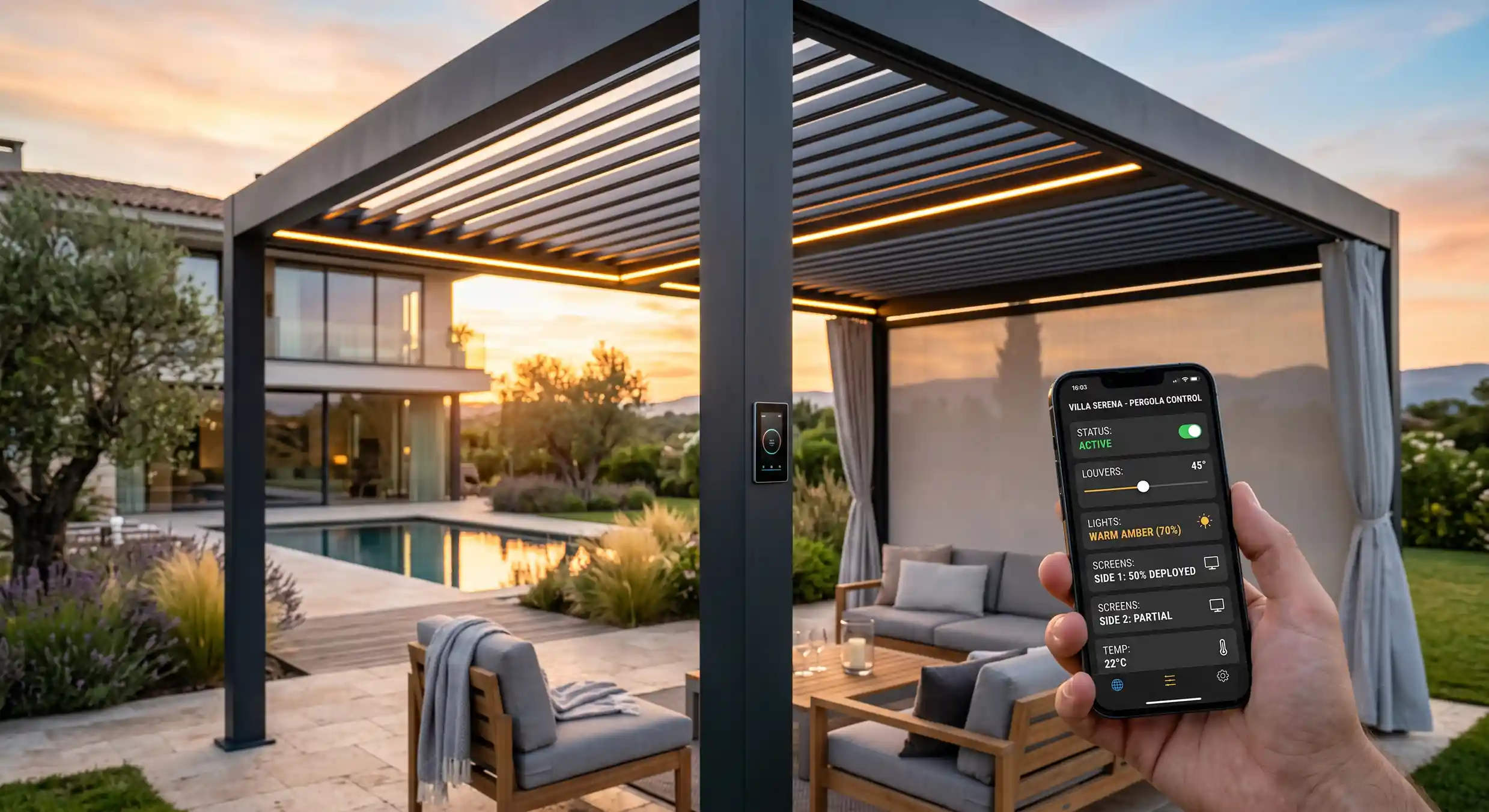
Picture this scenario: your sales team has just finished presenting your latest Bioclimatic Pergola to a high-end villa owner. The system features premium 6063-T5 aluminum extrusions, whisper-quiet tubular motors, seamlessly integrated RGBW ambient lighting, and wind- and rain-resistant roller blinds. Then, at the very moment of closing, the client asks a question that sounds simple but carries lethal consequences: “Can this pergola connect directly into my existing Apple Home ecosystem and work seamlessly with my security system?”
If your answer is “you will need to download our proprietary app” or “you will need to purchase an additional gateway hub for a few hundred dollars,” a deal potentially worth tens of thousands of dollars has very likely just walked out the door.
The European and North American outdoor living market is undergoing an irreversible structural transformation. Pergolas have evolved from simple shade structures into sophisticated electromechanical systems and extended nodes of the smart home. In this transition, what determines a product’s market positioning, user experience, and after-sales maintenance cost is no longer simply the thickness of the aluminum or the quality of the powder coating — it is the underlying communication protocol buried deep inside the motor and control box.
As a manufacturer specializing in outdoor lighting and foundational control system R&D, we work daily with complex hardware and software systems across every category. Across a large volume of OEM and ODM projects, we have observed that European and North American pergola manufacturers planning the electrical architecture of their next-generation products consistently find themselves adrift among three fundamentally different technical paths: the proprietary radio frequency (Proprietary RF) protocols exemplified by Somfy, the rapid-deployment platform ecosystem represented by Tuya, and the open standard Matter over Thread promoted by the Aliança para as Normas de Conectividade (CSA).
This article sets aside opaque marketing language. Drawing on physical environment constraints, the underlying logic of safety, system architecture evolution, and supply chain commercialization, it offers a rigorous control system selection and integration guide for manufacturers planning their next intelligent pergola generation.
The Unforgiving Physical Constraint: Full-Aluminum Structures and the Electromagnetic Shielding Trap
Before discussing any software protocol stack, we must first confront the extreme physical environment that intelligent pergolas inhabit. High-end modern pergolas universally use high-strength architectural-grade aluminum alloy for primary load-bearing beams and louver blades, providing resistance to snow loads and hurricane-force winds. From an electromagnetic engineering perspective, however, this fully enclosed metal structure forms a near-perfect Faraday cage.
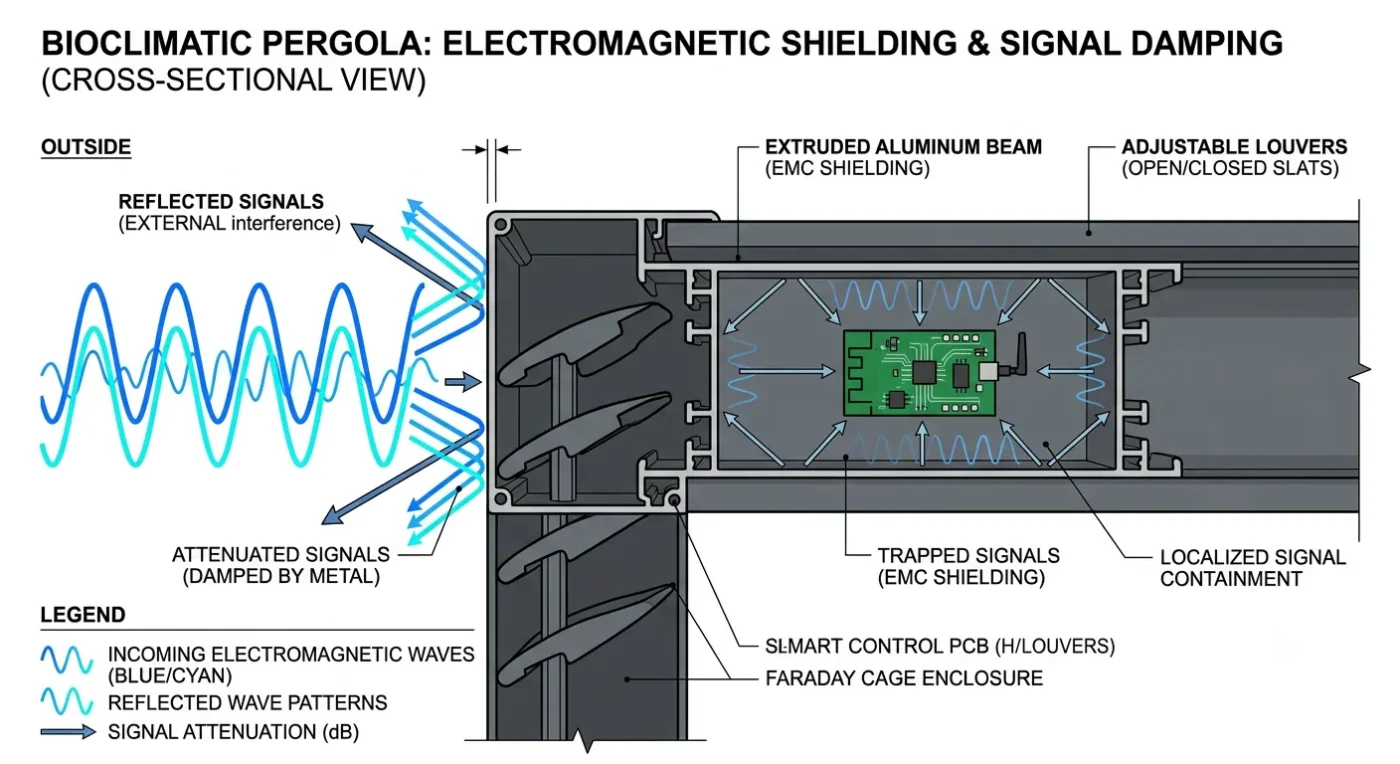
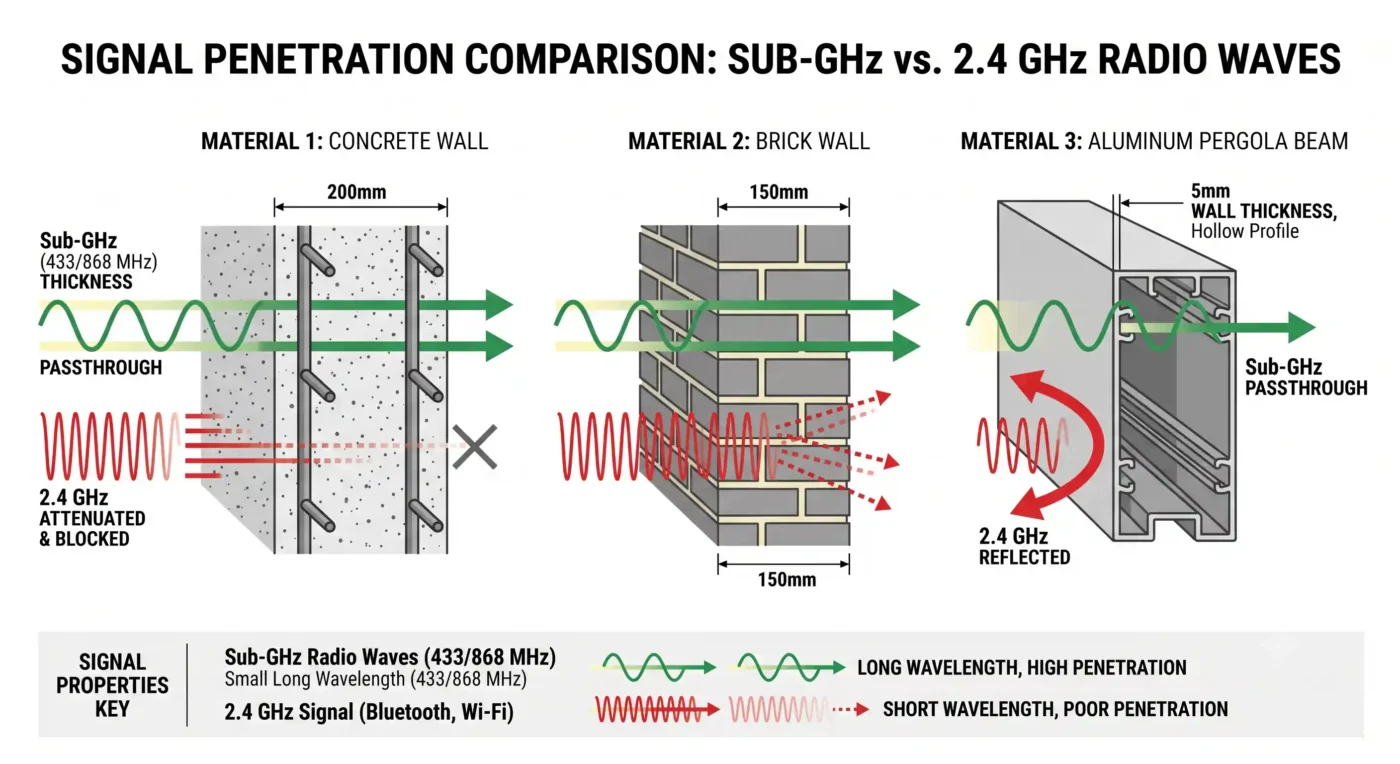
When a communication protocol relies on radio waves for data transmission, metal shielding becomes the greatest technical nightmare. Wi-Fi, Zigbee, and Thread protocols all operate primarily on the 2.4 GHz Industrial, Scientific, and Medical (ISM) band, with a physical wavelength of approximately 12.5 centimeters. When 2.4 GHz electromagnetic waves encounter a continuous aluminum surface, they are readily reflected or absorbed. The physical principle of skin depth governs electromagnetic penetration through conductors; for aluminum, the penetrating power of a 2.4 GHz signal is effectively zero. Even millimeter-scale metallic gaps — far smaller than the signal wavelength — cannot effectively leak the signal. Instead, they cause severe impedance mismatch, radically reducing RF radiation efficiency. Signal attenuation commonly reaches 10 dB or higher.
This means that if the smart control board and PCB patch antenna are fully enclosed inside aluminum main beams or columns, the signal will be completely locked in. Outdoor environments add further challenges. Exterior walls of European and North American homes typically use concrete, masonry, or energy-efficient glass with metallic low-e coatings — all of which are equally devastating to the 2.4 GHz and 5 GHz Wi-Fi signals from indoor routers. Research on building materials shows that a 203 mm concrete wall produces extremely high decibel attenuation, leaving outdoor Wi-Fi signal vanishingly weak.
Any manufacturer seeking to apply 2.4 GHz high-frequency protocols within fully metallic outdoor structures must therefore make deliberate engineering compromises in both hardware structure and antenna design. In practice, we commonly employ two solutions: an externally mounted IP67-rated weatherproof dome antenna installed atop the aluminum profile for omnidirectional radiation, or an engineering-plastic RF signal transparency window (RF Window) designed into the control box endcap to create a controlled RF escape path. By contrast, traditional proprietary RF signals operating in Sub-GHz bands — 433 MHz or 868 MHz — benefit from longer wavelengths and superior diffraction capability, enabling them to pass through brick walls and aluminum profile gaps with relative ease. This fundamental physical difference is the core reason these protocols have historically dominated the professional shading industry.
The Non-Negotiable Baseline: Safety Takes Absolute Precedence Over Smart Features
Before comparing smart protocols in depth, we must establish an absolute product design principle: the safety of outdoor shading equipment must take precedence over every aspect of the smart experience.
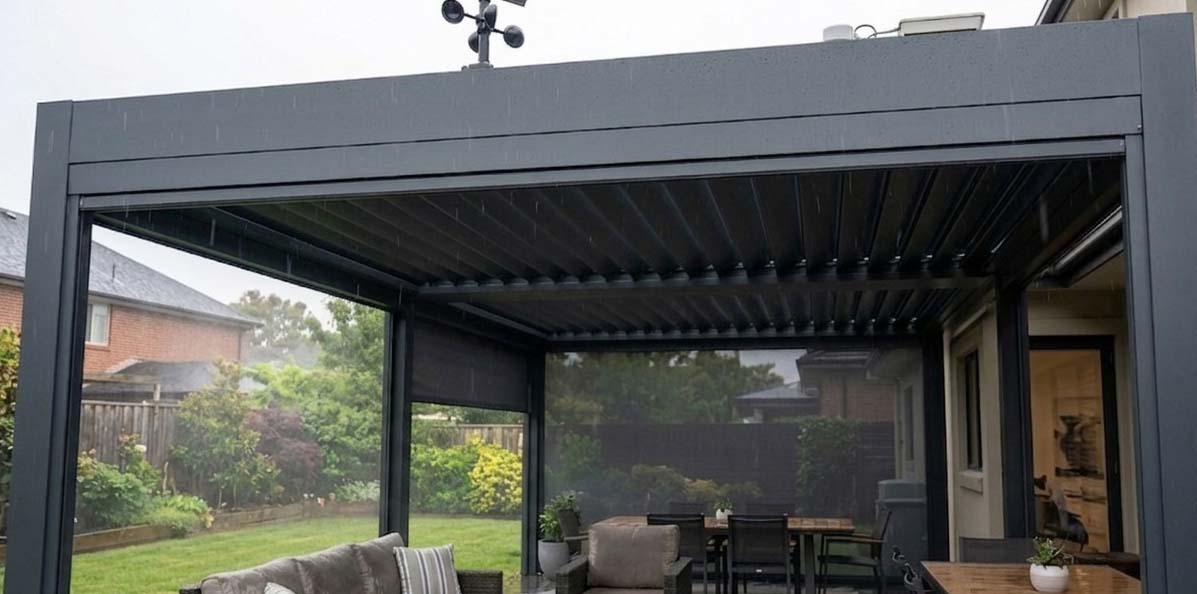
Unlike indoor smart curtains or lighting, outdoor pergolas face unpredictable natural weather. A pergola covering 150 square feet, with dozens of solid aluminum louver blades overhead and deployed windbreak blinds on all sides, is essentially a giant sail when winds exceed 25 mph. If the system cannot respond in time, enormous wind pressure can deform main beams, tear rail tracks, or rip the entire structure — together with its wall anchors — clean out of the building, causing catastrophic property damage. For this reason, whether using 24V DC low-voltage motors or 120V AC motors, the base hardware must directly connect to anemometers and rain sensors.
Safety Architecture Principle
Physical safety sensor dry-contact signals and local-area low-level RF signals must hold unconditional interrupt priority over any smart protocol command — without exception. When an anemometer detects high wind, the motor control board must immediately block all commands from mobile apps or voice assistants at the local hardware level, and force-execute the protective action: opening louvers for pressure relief or retracting windbreak blinds.
A smart system that relies entirely on a cloud server for logic decisions is therefore extremely dangerous. If sensor data must first travel to the cloud, which then issues a protection command, a delay of just a few seconds — or a momentary home Wi-Fi outage — is enough to destroy an expensive piece of equipment. A core evaluation criterion for any control protocol is consequently the robustness of its local device-to-device communication.
Protocol Deep-Dive 1: The Walls and the Legacy of Proprietary RF
Proprietary RF protocols are the traditional dominant force in the global professional shading and fenestration automation industry. This camp is typified by Somfy’s RTS (Radio Technology Somfy, 433 MHz) and io-homecontrol (868 MHz), alongside the closed-band RF systems independently developed by brands such as Dooya and Rollease Acmeda. These protocols do not depend on standard Internet Protocol (IP) communications; they use point-to-point or star network topologies for local-area communication.
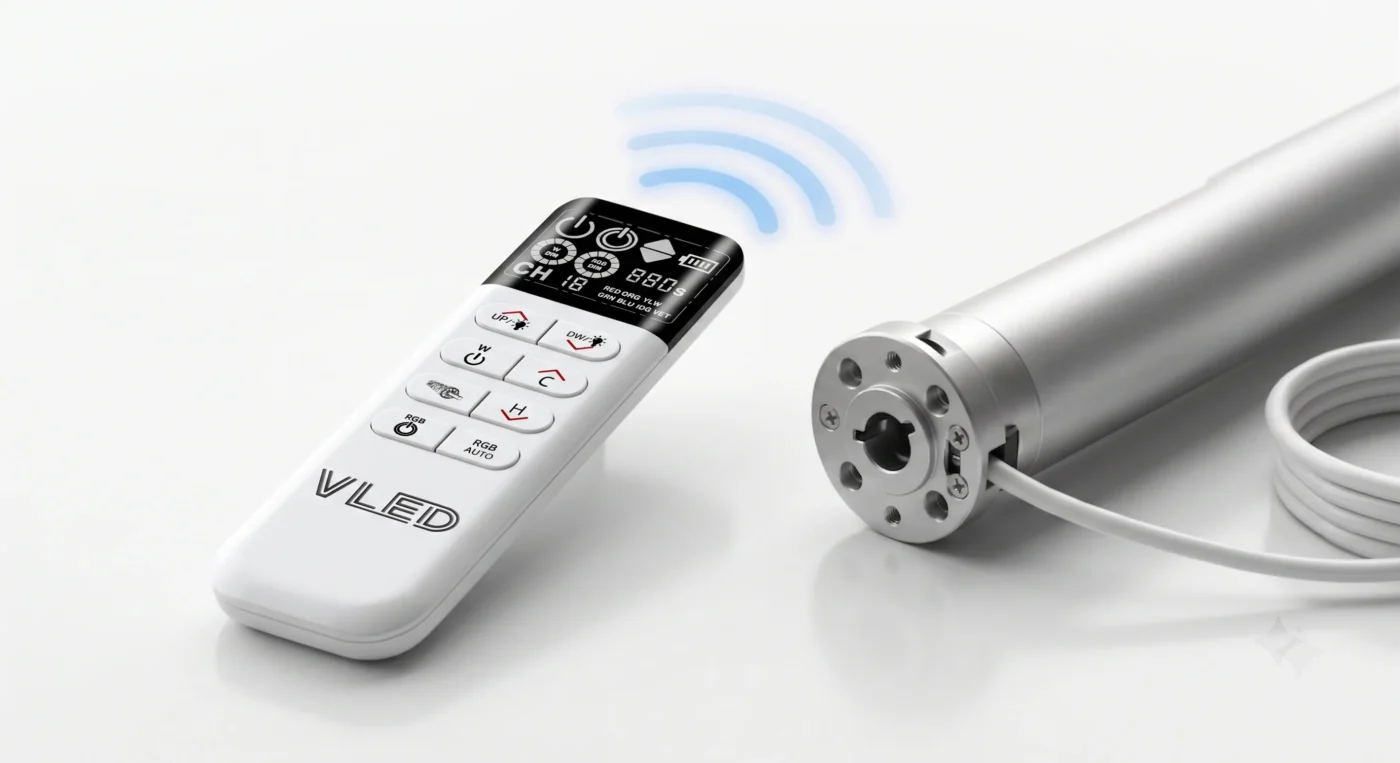
The greatest strength of this family is its battle-tested physical stability and enormous base of professional installer dealers. Thanks to the excellent penetrating power of Sub-GHz frequencies, a user holding a remote can reliably control louver tilt at distances of 20 meters or more — even when motors are embedded deep inside metal tubing — completely unaffected by router upgrades or broadband outages. More importantly, tens of thousands of professional shading installation contractors across Europe and North America know these motors inside out: mechanical limit settings, electronic travel adjustment, and remote pairing procedures. This path dependency, built over several decades, gives proprietary RF systems an unshakeable position in professional engineering and dealer channels.
The technology itself continues to evolve. Traditional RTS is unidirectional: after the remote sends a command, there is no way to confirm whether the motor executed it, and the system cannot report the current louver angle back to the user. To address this, the multi-brand collaborative io-homecontrol protocol introduced bidirectional communication and 128-bit encryption, enabling transmitters and receivers to mutually verify messages. Users can now see the device’s current state with precision on-screen.
The fundamental limitation of proprietary RF, however, is its severe disconnect from modern IoT ecosystems. These devices are essentially “offline” — unable to connect directly to a home Wi-Fi network. If end users want the convenience of modern smart home features — voice control through Apple HomeKit, Amazon Alexa, or Google Assistant, or time-based sunrise/sunset automation logic — they must purchase and configure an expensive proprietary protocol gateway such as the Somfy TaHoma Switch or Bond Bridge. This additional cost and cumbersome configuration step — known in the industry as the “bridge tax” — significantly undermines the out-of-the-box consumer experience. Furthermore, the closed ecosystem means RF devices from different brands are mutually incompatible, leaving pergola controls, outdoor lighting, and garden security fragmented across several disconnected proprietary apps, completely defeating the purpose of whole-home smart integration.
Protocol Deep-Dive 2: Tuya and the Double-Edged Sword of Cloud Agility
For pergola manufacturers eager to quickly deliver smart functionality, establish a proprietary branded app, and avoid the enormous cost of building software infrastructure from scratch, Tuya offers what appears to be a near-perfect full-stack PaaS (Platform as a Service) and SaaS solution. Tuya’s ecosystem is not limited to any single wireless standard; it broadly spans Wi-Fi, Zigbee, Bluetooth Low Energy (BLE), and even certain wired protocols, allowing manufacturers to adapt quickly to different market requirements by swapping standardized communication modules.
The greatest strategic advantage of the Tuya route is extreme time-to-market speed and cost efficiency. Manufacturers do not need to build teams of embedded developers and cloud infrastructure engineers. By leveraging Tuya’s white-label app templates, ready-made IoT cloud platform, and standardized API interfaces, a traditional metal fabrication factory can bring a smart-control pergola to market within weeks. Additionally, Tuya’s ecosystem houses tens of thousands of hardware sensors globally. Pergola manufacturers can effortlessly integrate wind and rain sensors, temperature and humidity sensors, and even security cameras to build highly complex automation logic. This mature supply chain makes Tuya-based smart controllers extremely cost-competitive — well suited for price-sensitive direct-to-consumer (DTC) e-commerce channels or the mid-market commercial sector.
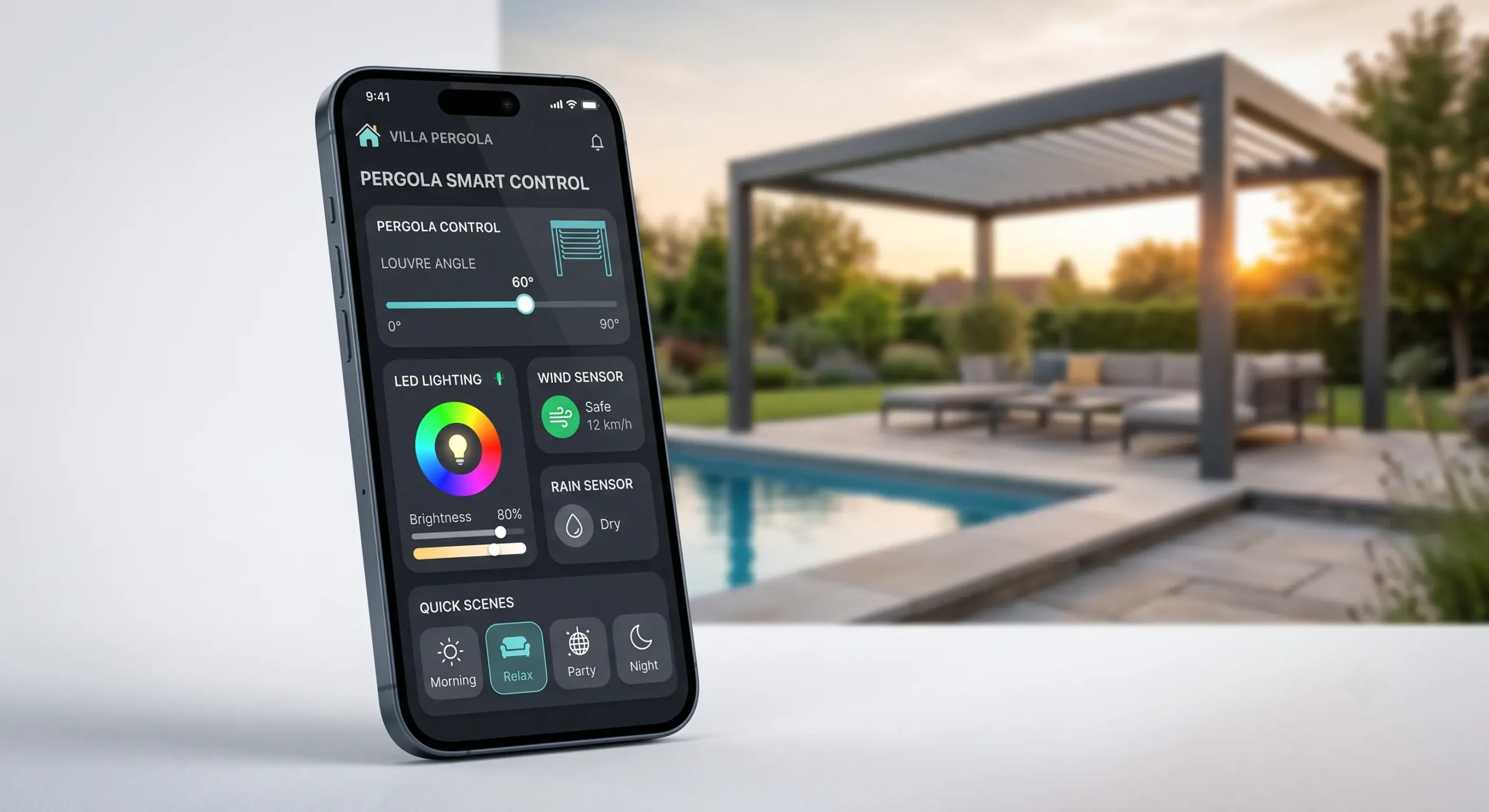
The other side of the coin is that Tuya’s core architecture is cloud-first. Although parts of its ecosystem — such as the Zigbee subsystem — support some degree of local network control, the vast majority of complex scene automation and third-party voice assistant integration depends heavily on a continuously stable internet connection and responsive Tuya cloud servers. If the user’s home network is interrupted, or cloud servers experience disruption in a given region, cloud-dependent automation rules can fail instantly. Beyond this, in the European market under GDPR and in increasingly scrutinized North American markets, some high-end consumers carry inherent privacy concerns about platforms that rely heavily on cloud collection of device usage data.
In terms of specific RF selection: deploying a Tuya Wi-Fi direct connection module on a pergola is problematic — the already-weak outdoor Wi-Fi signal, compounded by aluminum shielding, very easily causes frequent device disconnection. For moderately complex large outdoor projects, we strongly recommend a Tuya Zigbee-based control solution instead. Zigbee’s excellent mesh network characteristics mean that placing an inexpensive Zigbee gateway indoors near the garden is sufficient for outdoor devices to maintain stable connectivity through mesh routing — and to reduce dependence on real-time internet connectivity to a meaningful degree.
Protocol Deep-Dive 3: Matter over Thread and the Vision of Universal Interconnection
The creation of the Matter protocol marks a watershed moment in smart home history. Defined and actively promoted under the framework of the Connectivity Standards Alliance (CSA) by virtually every major technology ecosystem player — Apple, Google, Amazon, Samsung, and others — Matter, and particularly its underlying Thread network transport layer (Matter over Thread), represents the clear direction of travel for the next five to ten years. Cutting-edge products such as the Pergolux S3 series and SmartWings Flexar Q3 have already adopted this standard as a core differentiating feature.
The revolution of Matter over Thread lies in the fact that it fundamentally reconstructs the logic of device connectivity. First, it definitively ends the era of fragmented gateway monopolies. Through Matter’s Multi-Admin mechanism, a single smart pergola control box can connect directly and simultaneously to multiple Matter-compatible ecosystems — Apple Home, Google Home, SmartThings — without downloading any third-party proprietary app and without purchasing any brand-specific hub. A user simply scans the Matter QR code on the device with a smartphone, and the device is discovered and enrolled. As long as any Thread Border Router is present in the home — the ubiquitous Apple HomePod mini, a Google Nest Hub, or certain high-end Wi-Fi routers — the pergola connects seamlessly.
Second, the Matter standard mandates Local Control priority. Unlike cloud-dominant architectures, Matter device communication within a local area network is conducted entirely over IPv6, minimizing dependence on cloud servers. Even if the external broadband connection physically disconnects, as long as the local network is running, users can still precisely control the pergola’s louver tilt angle and adjust LED strip color temperature and brightness through their phone or a wall switch. This local-first design not only eliminates operational latency and dramatically raises privacy protection, but is a perfect match for the high reliability demands of outdoor hardware.
Finally, the physical advantages of Thread network architecture are impossible to ignore. Thread is a low-power, self-healing mesh network technology built on IPv6. When a pergola is equipped with a Matter over Thread controller continuously powered by mains AC or 24V DC, that controller does not merely function as a receiving endpoint — it automatically becomes a Router Node in the home’s Thread network. This means the pergola itself acts as a mesh repeater, continuously extending wireless signal coverage deeper into the backyard, dramatically improving connection stability for outdoor sensors such as pool temperature controllers and soil moisture detectors, while providing network self-healing capability.
However, the road to universal connectivity is not without obstacles. Applying Matter over Thread to metal pergolas faces stringent engineering and compliance challenges. From a hardware development perspective, Thread — operating on the same 2.4 GHz band — demands rigorous antenna engineering. Engineers must precisely plan RF transparency windows in the control box’s structural design, tune impedance matching, and carefully evaluate multipath effects to ensure antenna gain can break through the physical barrier of the aluminum beams. From a commercial compliance perspective, launching a legal Matter product requires significant upfront sunk costs. Manufacturers must join the CSA alliance as formal members, obtain unique Vendor IDs and Product IDs (VID/PID), engage an Authorized Test Lab (ATL) to complete exhaustive hardware and software conformance testing, and ultimately record the product on the Distributed Compliance Ledger (DCL). For traditional mechanical manufacturers lacking embedded software development capabilities and sufficient R&D budget, this represents a formidable barrier to entry.
Multi-Dimensional Analysis: The Commercial Impact Matrix of Protocol Technology
To evaluate the real-world impact of these technical paths more clearly, the following three tables compare each protocol across foundational technical specifications, supply chain and commercialization considerations, and ecosystem user experience.
Table 1 — Foundational Technical Architecture and Physical Constraints
| Technical Criterion | Proprietary RF (e.g. Somfy RTS / io) | Tuya Platform (Wi-Fi / Zigbee) | Matter over Thread (CSA Open Standard) |
|---|---|---|---|
| Operating Frequency | Sub-GHz (433 MHz / 868 MHz) | 2.4 GHz (Wi-Fi) or 2.4 GHz (Zigbee) | 2.4 GHz (IEEE 802.15.4 MAC/PHY) |
| Metal Structure Penetration | Excellent — long wavelength suffers minimal attenuation through aluminum profiles | Poor — heavily dependent on external antennas, RF window design, or mesh routing | Poor — demands precise antenna engineering and carefully considered internal PCB layout |
| Core Control Architecture | Local RF closed-loop communication; logic centralized in single control unit | Cloud-first computation with partial local network support | Local network priority (Local Control); decentralized edge computing |
| Communication Feedback | Legacy protocols: unidirectional, no feedback. New protocols: bidirectional encrypted feedback | Bidirectional real-time data sync and state feedback | Native bidirectional feedback; strongly typed data model; high-security encryption |
| Offline Resilience | Excellent — remote and sensors operate via local RF, always available | Poor — complex automation and third-party voice fully dependent on cloud connectivity | Excellent — IPv6 LAN communication ensures seamless local control fallback |
Table 2 — Supply Chain, Integration Complexity, and Market Entry Strategy
| Commercial Criterion | Proprietary RF (e.g. Somfy RTS / io) | Tuya Platform (Wi-Fi / Zigbee) | Matter over Thread (CSA Open Standard) |
|---|---|---|---|
| OEM Development Timeline | Very short — procure proven, market-validated motor and remote control kits directly | Short — white-label apps and ready-made generic modules enable rapid packaging | Long — requires deep firmware development and lengthy CSA certification process |
| Initial System Cost | High — premium brand pricing and closed-system marginal costs | Low — mature Asia-Pacific supply chain and cloud platform economies of scale | High — significant alliance membership fees, ATL testing costs, and high-performance chipsets |
| Professional Installer Dependency | Very high — trained technicians required for physical limit calibration and multi-device pairing | Low — end users can complete network setup and parameter configuration via app guidance | Low — smartphone QR code scan; relies on OS-level guided onboarding |
| After-Sales Maintenance | Heavily reliant on offline dealer on-site diagnosis; negligible remote monitoring capability | Powerful cloud platform remote device monitoring and over-the-air (OTA) firmware updates | Standardized local diagnostic logs; cross-platform ecosystem failover and unified maintenance |
| Optimal Market Entry | Large professional engineering contracts, legacy system upgrades, standalone control solutions | Price-sensitive DTC e-commerce channels; whole-home customization rapid deployment | High-end luxury outdoor living market demanding deep smart technology and seamless ecosystem integration |
Table 3 — Ecosystem Interconnectivity and End-User Experience
| User Experience Criterion | Proprietary RF (e.g. Somfy RTS / io) | Tuya Platform (Wi-Fi / Zigbee) | Matter over Thread (CSA Open Standard) |
|---|---|---|---|
| Dedicated Gateway Required | Mandatory — brand-specific protocol gateway purchase required for any form of smart connectivity | Wi-Fi devices connect directly to router; Zigbee devices require Tuya-ecosystem gateway | None required — reuses existing consumer Thread Border Routers already in the home |
| Cross-Ecosystem Compatibility | Weak — cloud-to-cloud API integration introduces noticeable latency and synchronization errors | Strong — broad support for major voice assistants, though requiring cumbersome account re-authorization | Excellent — native cross-platform direct connection; true Multi-Admin multi-ecosystem sharing |
| UI / UX Interaction | Primarily minimalist physical remote; proprietary apps tend to be conservative in design and limited in function | Feature-rich interface but fragmented brand experience; frequent switching between different brand apps | Natively integrated into OS-level control centers such as Apple Home or Google Home; exceptionally fluid interaction |
The Strategic Selection Path: Recommendations for Control System Architecture Evolution
Faced with increasingly complex communication protocols and a rapidly evolving market, there is no single perfect protocol that works universally for all pergola manufacturers. The essence of the selection process is a deep alignment between brand DNA, supply chain management capability, and the value priorities of the target customer segment.
As a professional control system R&D manufacturer, we offer the following strategic evolution recommendations for different types of pergola brands:
Recommendation 1
High-End Luxury Custom Brands: Embrace Matter over Thread Without Reservation
If your pergola products are priced above $20,000 and position themselves around luxury lifestyles and exceptional design, your high-end clientele have an intense aversion to the fragmented experience of juggling multiple disconnected apps. What they expect is an entire residential system operating in concert like a symphony orchestra. Making Matter over Thread a standard feature enables a large, complex pergola system to integrate into the consumer’s Apple, Google, or Savant ecosystem in the most elegant and invisible way — completely eliminating the visual and configuration burden of extra hubs, and expressing an irreplaceable sense of technological luxury.
Recommendation 2
High-Volume DTC Brands Prioritizing Scale: Deepen Your Tuya Zigbee Architecture
For brands relying on e-commerce channels and emphasizing value and fast order velocity, time and cost control are everything. Adopting a Tuya Zigbee-based solution not only provides the most efficient Asia-Pacific supply chain coordination, but also enables rapid derivation of countless differentiated SKUs through its modular technical architecture — for example, a base model supporting only louver tilt, a premium version with RGBW LED strips, or a flagship model with full perimeter roller blinds. This achieves the best commercial balance between manufacturing cost, smart functionality, and development timeline.
Recommendation 3
Engineering-Oriented Enterprises with Large Installer Networks: Build a Dual-Mode Hybrid Architecture
If you have a nationwide dealer and installer network, do not underestimate the learning curve and habitual resistance of your installation crews. Traditional proprietary RF protocols like RTS and io carry absolute stability — power on and use, network independent — which is the guarantee that field delivery will not be buried under customer complaints. To bridge the traditional and the future, the wisest strategy is a physically isolated modular control design: decouple the powerful base motor drive module from the communication logic board. Retain a high-bandwidth proprietary RF receiver in the control box’s base layer to accommodate installers’ remote calibration workflows, while attaching a higher-level smart logic board supporting Matter or TCP/IP via a digital interface. This hybrid dual-mode architecture honors the vast installed-base habits of your traditional workforce while physically reserving a port for smooth migration toward the premium smart market.
Conclusion: Beyond Hardware, Defining the Future of Intelligent Outdoor Living
The accelerating evolution of smart control protocols is quietly reshaping the competitive moats of the outdoor architectural hardware industry. The choice of smart protocol determines not only whether a louver’s tilt angle can be precisely synchronized or whether an LED ambient light can smoothly transition — it defines the core influence a pergola brand will command in the whole-home smart ecosystem competition of the next decade.
From electromagnetic shielding analysis in aluminum structures to high-frequency antenna layout design, from the complex and demanding CSA Matter certification process to the development of high-reliability wind and rain safety logic — the depth of R&D required in foundational smart control hardware and software algorithms has clearly far exceeded the core competency of most traditional metal fabrication and profile extrusion enterprises.
As your most trusted technical partner, we bring deep expertise accumulated over years of specialized pergola lighting and control system manufacturing, staying at the forefront of industry innovation. If you are planning the next generation of market-competitive intelligent bioclimatic pergola product lines, we sincerely invite your product engineering team to connect with us. Let us work together to explore deep OEM/ODM customization solutions — fusing the most cutting-edge IoT protocols with impeccable hardware craftsmanship — and help you firmly secure the technical and market high ground in the fierce competition defining the next era of intelligent outdoor living spaces.

Pingback: Pacotes de controlo para pérgulas de cozinhas exteriores: iluminação, persianas, ventiladores e sensores
Pingback: Somfy, Bond, Tuya, Teleco ou RF personalizado: qual é o ecossistema de controlo mais adequado para uma linha de produtos de pérgulas?