


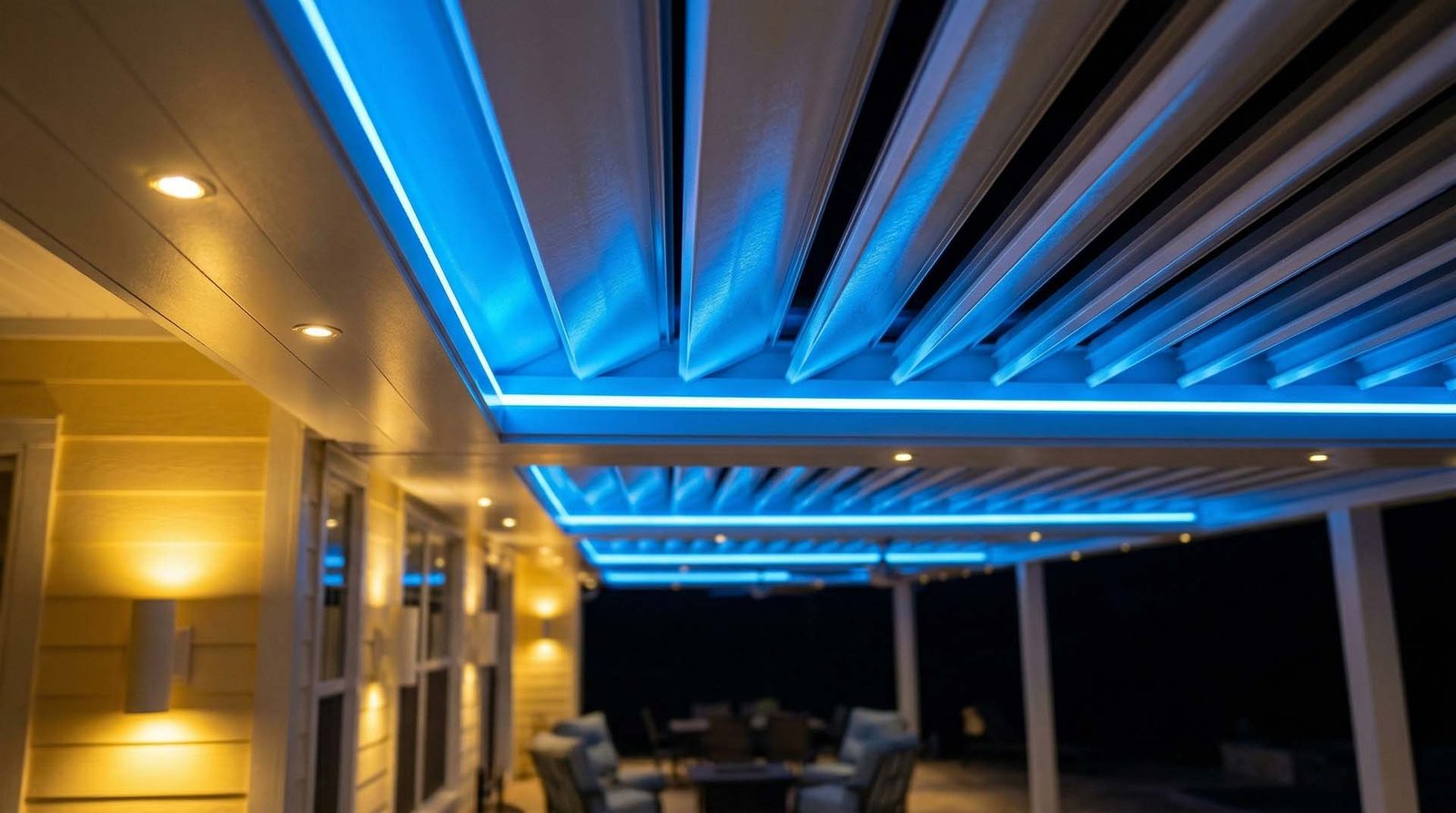
For pergola manufacturers, lighting control is no longer a decorative accessory decision. It is a product architecture decision that affects wiring, installation speed, perceived value, after-sales support, and how confidently dealers can sell a premium outdoor living system.
A louvered pergola can look beautifully engineered in daylight and still feel unfinished at night if the lighting control is treated as an add-on. The risk is not only poor color performance. The larger risk is a system that is difficult to wire, hard to explain to dealers, inconsistent across project sizes, or too limited for the product tier the manufacturer wants to sell.
The practical question is not whether mono, RGB, or RGBW is best in isolation. The better question is which lighting control structure should become the standard for each pergola line, and which options should remain upgrades. A residential entry model, a premium villa pergola, and a hotel terrace structure should not share the same lighting specification simply because the LED strip happens to fit the aluminum profile.
Our position: mono LED control should remain the reliable baseline for functional white lighting, RGB should be used selectively for decorative color scenes, and RGBW should be the preferred premium specification when a louvered pergola must deliver both true usable white light and controlled color ambience from the same integrated system.
This guide is written for European and North American pergola manufacturers who need to specify lighting and control as part of a repeatable product platform. It focuses on control channels, wiring, power planning, weather protection, remote and app behavior, and the real trade-offs between RGB, RGBW, and mono LED systems.
Why Lighting Specs Are Often Underdefined
Most pergola lighting discussions stay close to visible outcomes: recessed spotlights, LED strips, perimeter glow, color scenes, and night-time ambience. Those points matter, but they do not answer the questions that decide whether a lighting package can become a repeatable OEM product.
Manufacturers need to know what can be produced consistently, packed clearly, wired quickly by installers, supported across markets, and integrated with louver motors, wind sensors, rain sensors, and remote controls. The gap between a beautiful lighting idea and a stable product specification is usually found in the control system.
That is why this topic should not be reduced to “RGB vs RGBW vs white light” as a simple feature comparison. The lighting mode should be selected according to the pergola’s product tier, control topology, installation workflow, and expected after-sales burden.
Mono, RGB, and RGBW Are Different Control Products
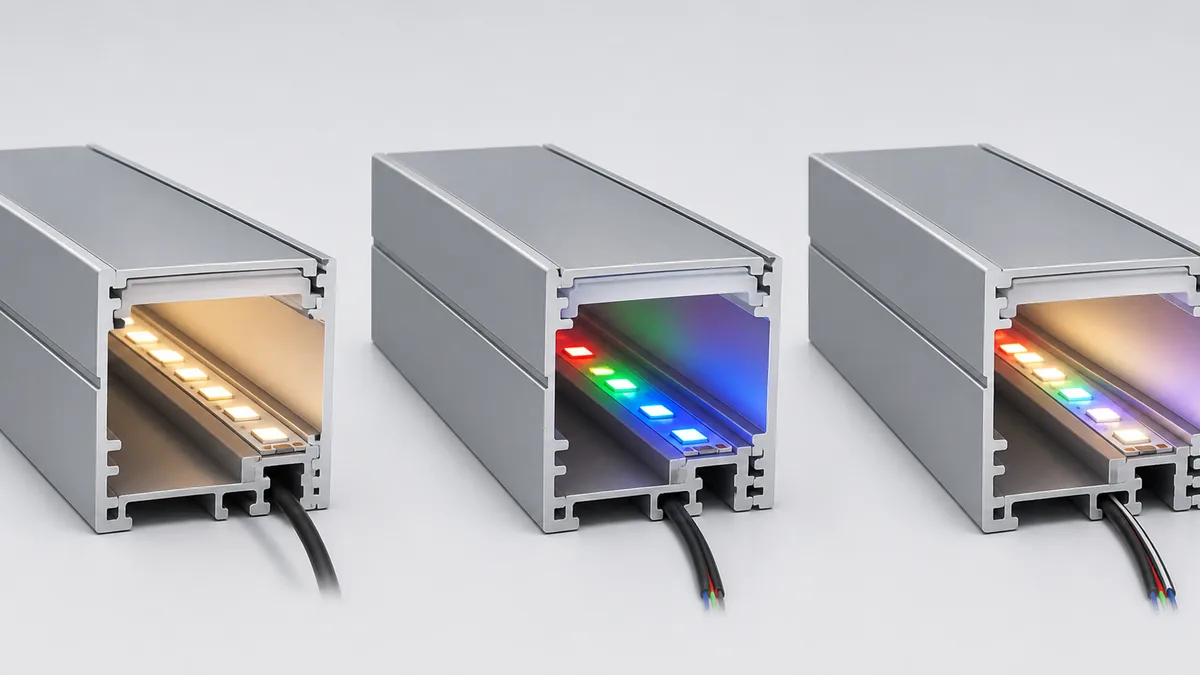
Many specifications describe LED lighting by color output only. That is too shallow for pergola manufacturing. Mono, RGB, and RGBW require different channel counts, connector choices, driver capacity, user interface logic, spare-part policies, and quality-control routines.
| LED type | Control channels | Best use in louvered pergolas | Main specification risk |
|---|---|---|---|
| Mono white | One dimming channel | Functional perimeter lighting, downlights, basic residential kits, clean architectural illumination | Too basic for premium projects if no color or scene upgrade is available |
| RGB | Three channels: red, green, blue | Decorative color scenes, entertainment terraces, visual differentiation at a controlled cost | Mixed white is usually not a satisfying task light or warm architectural white |
| RGBW | Four channels: red, green, blue, white | Premium pergolas that need both usable white light and color ambience from one lighting circuit | Requires tighter power, wiring, controller, and connector discipline |
Mono LED control: the baseline that still matters
Mono LED lighting is not outdated. For many louvered pergola lines, it is still the most dependable core specification. A single-color white LED strip or spotlight circuit is easy to dim, easy to test, and easy for installers to understand. It also keeps the remote interface simple, which matters when the same handheld control must also operate louvers, screens, sensors, or fans.
Mono control is strongest when the pergola needs calm, functional illumination rather than visual effects. It suits dining areas, residential patios, garden walkways, and entry-level pergola packages where the buyer expects reliability more than scene complexity. It also works well for spotlights because the beam is often task-oriented: table lighting, seating zones, countertop lighting, or column accents.
For manufacturers building a structured product range, mono white lighting can be the standard package. It pairs naturally with single-color pergola LED strip sets, recessed downlights, and compact power distribution. The commercial advantage is clear: fewer wires, fewer channels, simpler training, lower troubleshooting time.
The limitation is positioning. If a premium louvered pergola sells against brands offering color scenes and app control, a mono-only lighting package can make the whole system feel basic, even when the aluminum structure is excellent. That does not mean every model needs RGBW. It means the product line needs a clear upgrade path.
RGB LED control: strong for color, weak for true white
RGB lighting is popular because it gives an immediate visual effect. Dealers can show red, blue, green, fade, jump, and party scenes in a showroom. For pergolas used around pools, outdoor bars, or entertainment decks, that color capability can help close a sale.
However, RGB should not be specified as if it were a white-light system. White created by mixing red, green, and blue channels rarely behaves like a dedicated white LED. It can look cold, tinted, uneven, or uncomfortable when used as everyday illumination. Under a louvered roof, where the light often grazes aluminum beams, gutters, wall surfaces, or tabletops, weak white quality becomes visible fast.
RGB makes sense when color is the main purpose. It is less convincing when the customer expects one lighting circuit to serve both family dinner and late-night ambience. For a manufacturer, that distinction should be made before the bill of materials is frozen.
RGBW LED control: the premium default for mixed-use pergolas
RGBW adds a dedicated white channel to the RGB color channels. That one extra channel changes the product logic. Instead of forcing the controller to simulate white from color channels, the system can use the white channel for functional lighting and the RGB channels for ambience.
This is why RGBW is usually the better specification for premium louvered pergolas. A villa terrace may need warm white for dinner, soft low-level light for conversation, colored scenes for a gathering, and one-button return to a comfortable default. RGBW supports that range without asking the customer to accept poor white light as the price of color.
The trade-off is system discipline. RGBW needs four controlled outputs, compatible cable cores, correct connector pinout, enough driver capacity, proper PWM design, and a user interface that does not confuse installers or homeowners. A weak RGBW implementation can create more problems than a strong mono system. A strong RGBW implementation can lift the perceived value of the entire pergola package.
For integrated kits, see how an RGBW lighting package can be positioned around a complete outdoor structure in the pergola RGBW strip lights kit.
Start With Control Architecture, Not LED Strip Type
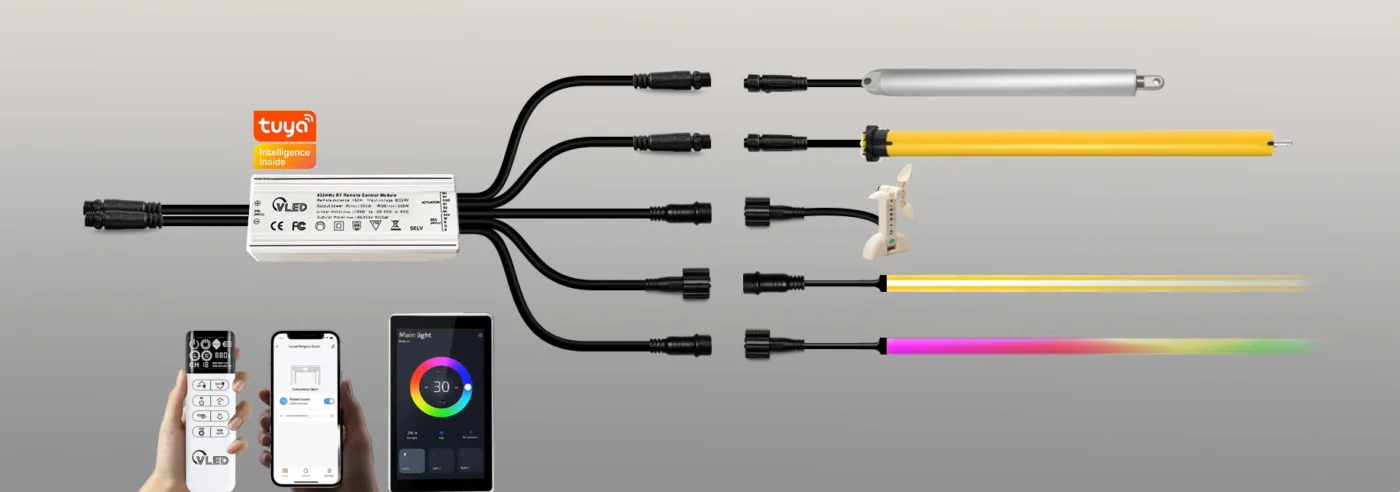
The common mistake is selecting the LED strip first and solving control later. For a manufacturer, the order should be reversed. Define the control architecture, then choose the strip, spotlight, connector, cable, driver, and remote interface that fit that architecture.
Channel planning
Every lighting type consumes control channels. Mono uses one. RGB uses three. RGBW uses four. If the same control unit also operates louver motors, tubular motors for screens, weather sensors, fans, or multiple lighting zones, channel planning becomes a product-management issue rather than a small electrical detail.
A small residential pergola may need only one white perimeter light circuit and one louver motor output. A larger patio model may need separate beam lights, spotlights, post lights, and louvers. A hospitality project may need multiple pergola bays grouped by terrace zone. Before specifying RGBW everywhere, the manufacturer should decide how many independent zones are truly needed and which zones should be synchronized.
A useful platform approach is to define three control levels:
- Base: one mono dimming zone for white lighting and one louver control group.
- Premium residential: one RGBW zone for perimeter lighting, optional mono spotlights, and louver control.
- Commercial or multi-bay: grouped lighting zones, synchronized scene control, louver groups, sensors, and installer-programmable channel assignment.
This structure keeps the product range understandable. It also helps sales teams explain why an upgrade costs more: the customer is not just buying color. They are buying a more capable control architecture.
Remote and app behavior
Control behavior should be written into the specification. It is not enough to say “remote control included” or “app control supported.” The important questions are more specific:
- Can the user dim white light without entering color mode?
- Can the system return to the previous white level after a color scene?
- Are RGB effects disabled or limited in hospitality areas where staff need predictable operation?
- Can installers pair multiple pergolas without cross-control between nearby units?
- Does the remote clearly separate louvers, lighting, and accessories?
These details shape customer satisfaction. A premium pergola should not require a homeowner to scroll through party modes just to set a warm white dinner scene. For manufacturers seeking one interface across louvers and lighting, a unified control approach such as one pergola remote for lighting and louvers can reduce friction for both installers and end users.
Protocol choice: proprietary RF, app ecosystem, DMX, DALI, or hybrid
Most pergola manufacturers do not need stage-lighting complexity. Many need robust RF remote control, optional app integration, and reliable grouping. Still, protocol decisions should be deliberate.
Proprietary RF is often practical for pergolas because it is simple, fast to install, and does not depend on the homeowner’s network. App-based control is valuable for premium buyers and multi-function systems. DMX can be useful where pergolas are part of a hospitality or architectural lighting environment, because the current ANSI E1.11 DMX512-A standard listed by ESTA is built around digital transmission for lighting equipment and accessories. DALI can be relevant in building-centric projects, although it is less common for compact pergola kits than RF or app-based systems.
The manufacturer should avoid protocol decisions that sound impressive but complicate installation without a real customer benefit. A villa pergola does not automatically need DMX. A hotel terrace with dozens of synchronized zones may benefit from a more structured control layer. The right answer depends on scale, installer skill, and the sales channel.
Power Planning: Where Many RGBW Specifications Fail
RGBW systems often fail in the details. The product brochure says color plus white. The installation site reveals voltage drop, overheated drivers, overloaded connectors, inconsistent brightness, or sections of strip that do not match. These problems are preventable if power planning is treated as part of the product design.
Specify voltage around run length and profile layout
For pergola LED strips, 24 V systems are often preferred over 12 V for longer runs because they can reduce current for the same power level. Lower current helps with voltage drop and cable sizing. That does not remove the need for calculation, especially in large louvered roofs with long perimeter channels.
Manufacturers should define maximum strip length per feed, recommended injection points, permitted cable lengths, and approved splitter layouts. If installers must improvise these decisions on site, quality will vary from project to project.
Use realistic load assumptions
RGBW load planning should not assume that every channel will run at maximum output all night, but it also should not depend on unrealistic best-case behavior. Drivers, controllers, connectors, and cables should be sized with margin according to the expected maximum operating scenes and local safety requirements.
The white channel may be used often because it is the everyday functional light. RGB channels may be used for scenes or accents. The control system should manage transitions smoothly and avoid visible flicker, harsh jumps, or color shifts at low dimming levels.
Keep spare parts and replacement logic simple
An OEM lighting system is not finished when the first installation works. It must remain supportable years later. For mono systems, spare-part logic is simple: replace one dimming controller, one driver, one strip segment, or one spotlight type. RGBW adds pinout, channel order, cable cores, and controller compatibility to the service equation.
That is why connector standardization matters. Waterproof connectors should be keyed, clearly assigned, and difficult to miswire. Installers should not be able to reverse RGBW channel order accidentally. If a replacement strip is shipped to a dealer, it should match the same voltage, channel type, connector, profile, and CCT specification as the original.
Outdoor Reliability Is a Control-System Requirement
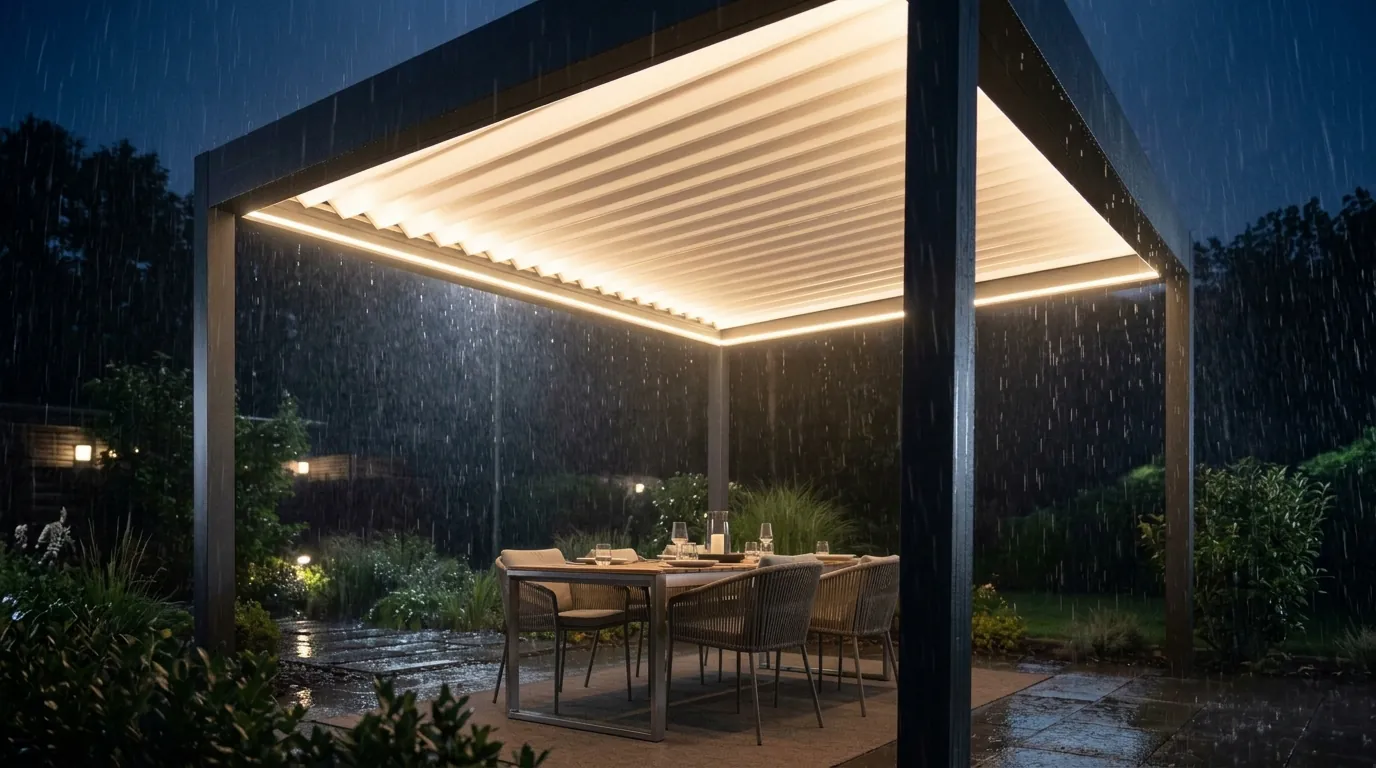
Louvered pergolas are outdoor products. The lighting control system must survive the same business reality as the aluminum frame: rain, condensation, heat, cold, UV exposure, wind-driven moisture, installation variation, and repeated seasonal use.
Ingress protection should be specified with care. The IEC explains IP ratings as a way to grade resistance of electrical and electronic enclosures against dust and liquid intrusion under IEC 60529. For pergola manufacturers, that means IP ratings should be applied to the actual risk points: power supplies, control boxes, connectors, sensors, cable entries, and exposed fixture housings.
Do not treat an IP rating on one component as proof that the complete pergola lighting system is protected. A waterproof strip connected to a weak junction point is still a weak system. A sealed control box with poor cable strain relief can still fail after thermal movement or repeated service access.
Relevant compliance references
Market requirements vary, and final certification decisions should be reviewed by qualified compliance professionals. Still, several references should shape the design conversation. UL Solutions notes that low-voltage outdoor luminaires may be used as systems or as separate luminaires with compatible power units, and that National Electrical Code Article 411 limits power units to no more than 25 A per circuit in that context. UL also identifies UL 8750 for LED equipment used in lighting products. These references do not replace project-specific evaluation, but they show why lighting, power units, and controls cannot be specified as isolated parts.
For European and North American OEM programs, a good supplier discussion should cover low-voltage architecture, component conformity, enclosure protection, cable routing, thermal behavior, and documentation. The goal is not to overload the brochure with standards. The goal is to prevent a beautiful pergola from depending on an under-specified electrical package.
Thermal and optical consistency
LED control is not only electrical. It is also optical. Under aluminum louvers, small differences in color temperature, brightness, or dimming curve can become visible along long profiles. RGBW makes this more important because the system may move between functional white and color ambience.
Manufacturers should define acceptable binning, CCT targets for the white channel, dimming behavior, and test scenes for outgoing inspection. A factory test should not only confirm that the strip turns on. It should check that mono, RGB, and RGBW channels respond correctly, dim smoothly, and match the intended remote or app commands.
For deeper lighting-quality decisions such as life, lumen maintenance, and fixture standards, the guide on LED fixture lifespan standards is a useful supporting reference.
How to Choose the Right Specification by Pergola Type
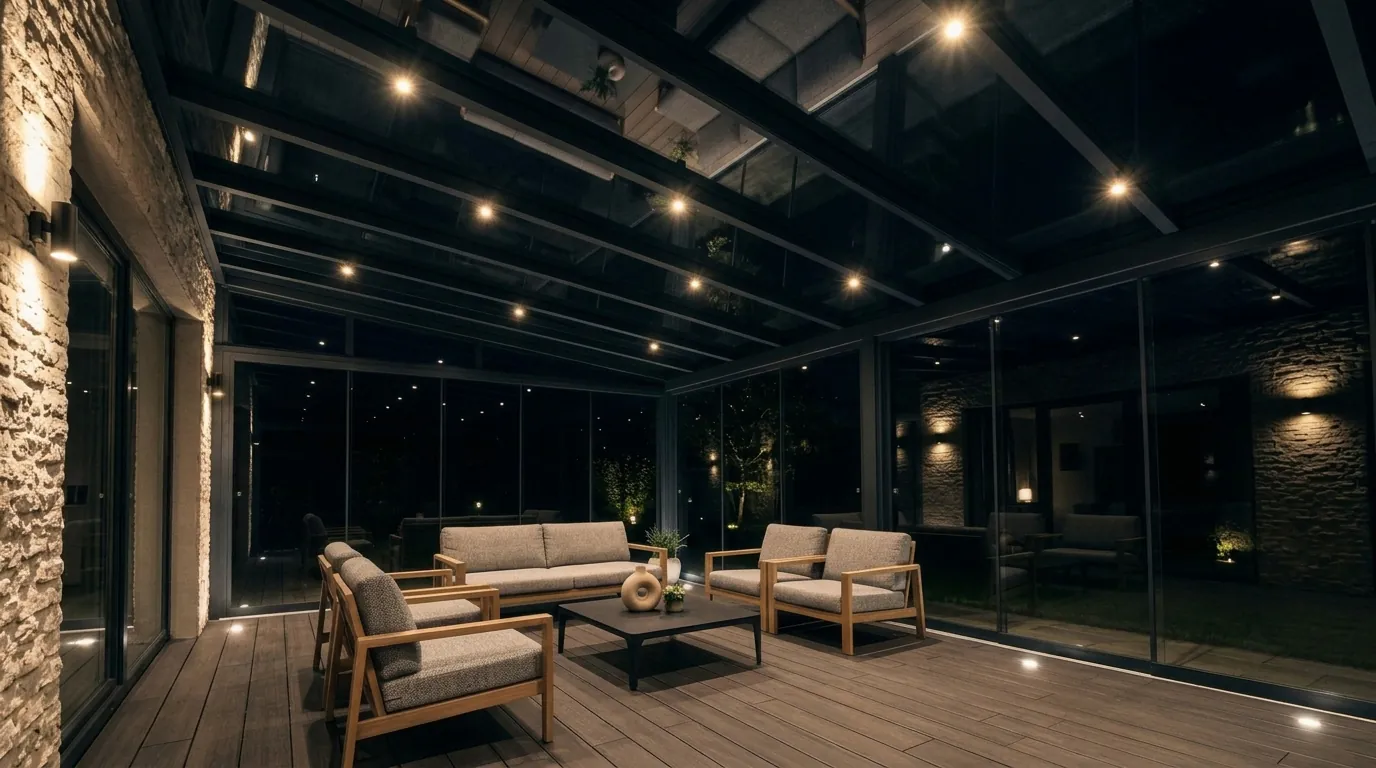
The best LED control specification depends on the product line. A single rule for all pergolas usually creates either unnecessary cost or disappointing performance. Use the following framework when building or revising a louvered pergola lighting program.
Entry residential pergola
For an entry residential louvered pergola, mono white lighting is often the best standard. Keep it dimmable, low-glare, and easy to install. The sales promise should be simple: clean evening usability with a reliable remote or wall-control option.
Recommended specification:
- Mono warm white or neutral white LED strip, selected for the target market’s preferred outdoor ambience.
- One dimming zone for perimeter or beam lighting.
- Optional spotlight kit for dining or seating areas.
- Waterproof connectors and pre-defined cable lengths.
- Simple remote control with brightness memory.
This package should be easy for dealers to quote and easy for installers to repeat. It becomes the dependable base for the product range.
Premium residential pergola
For premium villas, high-end patios, and outdoor kitchens, RGBW should be considered the preferred upgrade. The buyer expects mood, convenience, and polish. RGB alone may impress for five minutes in a showroom, but RGBW is more likely to satisfy daily use because it keeps real white light available.
Recommended specification:
- RGBW perimeter strip or RGBW downlight option, depending on the structure.
- Dedicated white mode with smooth dimming.
- Preset scenes for dinner, relax, color ambience, and full-off.
- Unified control with louvers where possible.
- Optional app control for homeowners who expect smart-home behavior.
Manufacturers can connect this tier to broader pergola lighting kits and smart controls instead of treating each fixture as a separate accessory.
Hospitality and commercial pergola projects
Commercial pergolas need consistency, serviceability, and staff-friendly control. A restaurant terrace may need warm white light most of the time, with color scenes for events. A hotel pool area may require multiple zones, synchronized ambience, and restrictions that prevent guests or staff from creating chaotic effects.
Recommended specification:
- Mono or RGBW depending on the venue concept, not RGB by default.
- Multiple grouped zones with installer-defined pairing.
- Scene presets that staff can operate without technical training.
- Documented spare parts and replaceable control modules.
- Clear separation between guest-facing controls and service settings.
For larger OEM and venue projects, the lighting decision should be coordinated with sensor logic and motorized control. The guide to motorized louvered pergola controls, sensors, and lighting shows how these systems interact in the complete pergola platform.
Details That Separate a Product Platform From an Accessory Kit
A manufacturer-grade lighting system is repeatable. That repeatability comes from small specification decisions that are easy to overlook when the focus is only on color modes.
Define the default white
For mono and RGBW systems, define the white channel carefully. Warm white may suit hospitality, dining, and residential patios. Neutral white may suit modern architectural projects or task-oriented outdoor kitchens. If the system uses RGBW, the white channel should be treated as the primary everyday light, not a minor add-on.
If your range includes dim-to-warm or tunable white options, separate those products clearly from RGBW. They solve different problems. Dim-to-warm and tunable white focus on white-light comfort and color temperature control, while RGBW adds decorative color. The comparison in dim-to-warm vs tunable white lighting controls can help product teams avoid mixing those concepts in dealer training.
Control glare before adding color
Color effects cannot rescue an uncomfortable lighting layout. Louvered pergolas often place light close to the user’s line of sight: inside beams, along gutters, near posts, or under movable blades. The specification should address diffuser type, profile angle, spotlight beam angle, mounting depth, and surface reflection before color scenes are promoted.
This is especially important for RGBW strip lighting because bright saturated colors can feel harsh when the diffuser, profile, or viewing angle is wrong. The better design route is controlled brightness, soft diffusion, and usable white first. Color should add value, not hide poor optical design.
Use plug-and-play only when the plug is truly controlled
Plug-and-play installation is a strong selling point for pergola OEMs, but it must be engineered. The cable harness, splitter, controller, driver, and connectors should be designed as one package. If installers must cut, splice, label, or guess channel order, the system is no longer a true plug-and-play product.
For product teams building a complete bill of materials, the pergola control system BOM checklist for OEMs is a useful companion because it connects lighting, controls, sensors, power, and accessories into one procurement structure.
Plan for factory testing
Every control mode should be testable before the kit leaves the factory. For mono, test on, off, dimming range, memory, and remote pairing. For RGB, test each channel separately and then color scenes. For RGBW, test red, green, blue, white, mixed colors, white-only mode, dimming behavior, and scene recall.
This matters because many field failures are not component failures. They are channel mapping errors, wiring mistakes, pairing confusion, or inconsistent setup. A clear test routine reduces dealer frustration and protects the pergola brand.
Integrating Lighting With Louvers, Sensors, and Accessories
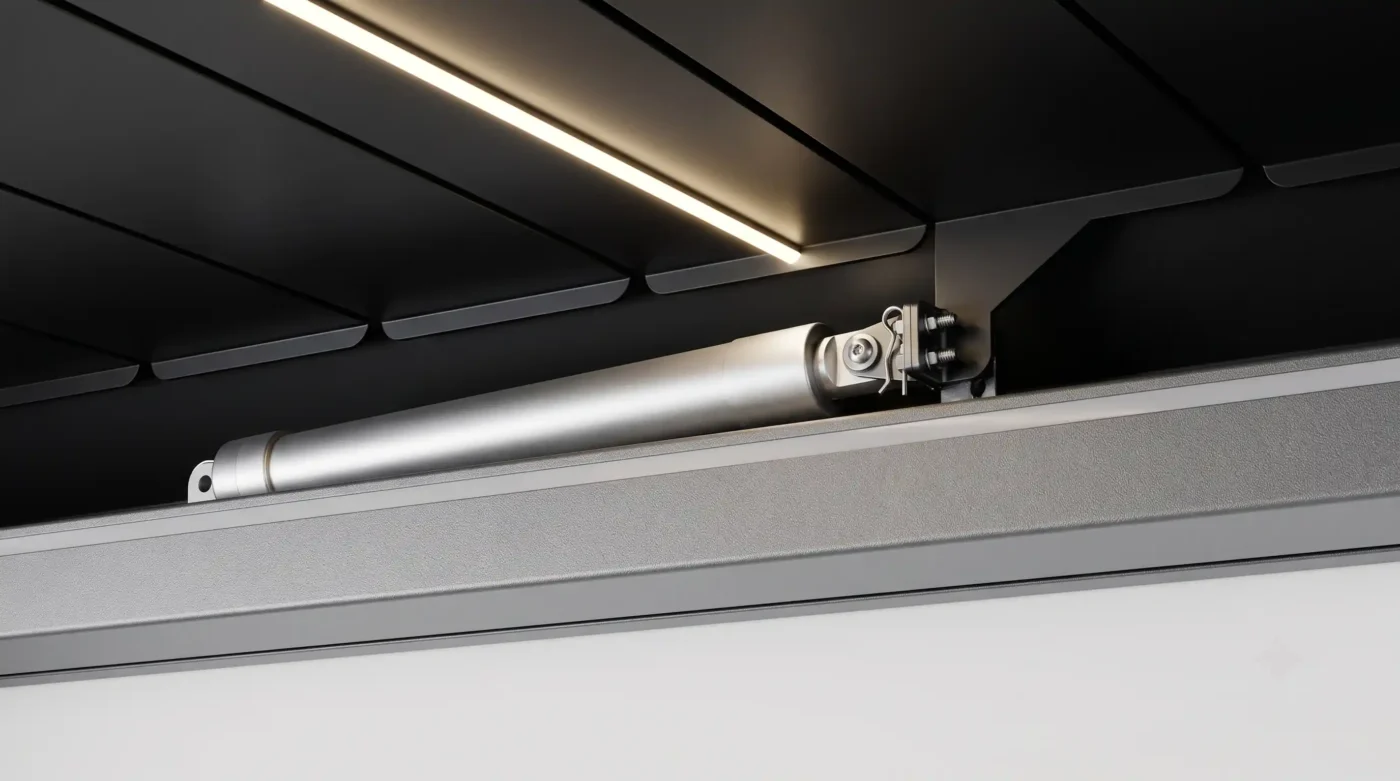
The most valuable pergola control systems do not isolate lighting from the rest of the structure. They treat louvers, lighting, screens, fans, and sensors as one outdoor living platform.
This is where manufacturers can create real differentiation. A customer may not understand the difference between a three-channel and four-channel LED output. They will understand one remote that opens the roof, dims the warm white lights, sets an evening scene, and responds to weather sensors without turning the product into a complicated control cabinet.
O pergola light control kit and outdoor LED system page shows this integrated direction: lighting control, mono and RGB modes, motor control, sensor integration, long-distance remote capability, multi-channel grouping, waterproof protection, and compact control hardware.
For verandas and adjacent outdoor structures, a similar logic applies. The outdoor lighting control system for pergolas and verandas gives product teams a route to standardize power supplies, splitters, cable cores, RGB control, RGBW control, and mono dimming across related product lines.
When the control unit becomes part of the pergola platform, RGBW can be sold as more than color. It becomes one element in a coordinated premium experience: white light for function, color for ambience, louver motion for climate comfort, and sensor logic for protection.
OEM Specification Checklist
Before approving a mono, RGB, or RGBW LED control system for a louvered pergola, use this checklist with engineering, purchasing, sales, and service teams.
Lighting output
- Is the lighting type mono, RGB, or RGBW clearly defined for each product tier?
- Is the white CCT specified for mono and RGBW systems?
- Are brightness, diffuser, glare, and beam-angle requirements documented?
- Are default scenes defined in plain language for dealers and end users?
Control and channels
- How many control channels are required per pergola size?
- Are lighting zones separated from louver, screen, fan, and sensor channels?
- Can multiple pergolas be grouped without accidental cross-control?
- Does the remote or app make white light easy to access?
Power and wiring
- Is the system voltage selected according to run length and load?
- Are maximum strip lengths and feed points documented?
- Are driver, controller, cable, and connector ratings aligned?
- Are waterproof connectors keyed or labeled to prevent channel mistakes?
Outdoor protection
- Are IP ratings applied to the real risk points, not only the LED strip?
- Are cable entries, strain relief, and junction points protected?
- Is the control box location suitable for heat, moisture, and service access?
- Are market-specific compliance requirements reviewed before launch?
Manufacturing and service
- Can the system be tested fully at the factory?
- Are spare parts defined by voltage, channel type, connector, and CCT?
- Can dealers install the system without custom wiring decisions?
- Does the lighting upgrade increase product value without increasing support complexity too much?
The Practical Specification Position
If a manufacturer wants a clean, dependable base model, specify mono white LED control and make it excellent. Do not make it look cheap. Use a good diffuser, a comfortable CCT, smooth dimming, and simple control.
If the product needs color mainly for visual excitement, RGB can still have a place. Use it honestly. Position it as decorative color, not as the best white-light solution.
If the pergola line is premium, mixed-use, or dealer-led, RGBW is usually the stronger choice. It supports everyday white light and color scenes in one package, which matches how outdoor living spaces are actually used. The key is to specify it as a complete control system, not only as a four-channel LED strip.
This is the core point: lighting control should support the pergola manufacturer’s product strategy. Mono, RGB, and RGBW are not just lighting options. They are signals of product tier, installation maturity, service readiness, and brand positioning.
FAQ
Is RGBW always better than RGB for louvered pergolas?
RGBW is usually better when the pergola needs both usable white light and color ambience. RGB is suitable when decorative color is the main purpose, but its mixed white is often less comfortable than a dedicated white channel.
Should an entry-level pergola use RGB lighting?
Not always. A well-designed mono white lighting system can be more reliable, easier to install, and easier to support. RGB should be added when the target buyer values color scenes enough to justify the extra control complexity.
What is the biggest mistake in RGBW pergola lighting specifications?
The biggest mistake is specifying RGBW as a strip choice without planning power, channels, connectors, cable cores, control behavior, and factory testing. RGBW performs well only when the full system is engineered around four-channel control.
Can pergola lighting and louver motors use one control system?
Yes, and this is often the better OEM direction. A unified system can simplify the user experience, reduce remote-control clutter, and make the pergola feel like a complete smart outdoor product rather than a frame with separate accessories.
Build the Lighting Control Into the Pergola Platform
If your next louvered pergola line needs mono, RGB, or RGBW lighting control, start with the control architecture before approving the LED strip. VLEDSTAR can support pergola manufacturers with integrated lighting kits, RGBW strip solutions, spotlight kits, control units, waterproof connectors, power distribution, and OEM-ready control logic.
Review the full soluções de iluminação para pérgulas range or explore the unidade de controlo da pérgula to plan a repeatable lighting and louver control package for your market.

Pingback: Como dimensionar controladores LED de 24 V para conjuntos de iluminação de vigas de pérgula, persianas e fitas luminosas
Pingback: Como controlar dois atuadores, duas zonas de LED mono e uma zona RGB a partir de um único comando à distância Pergola