


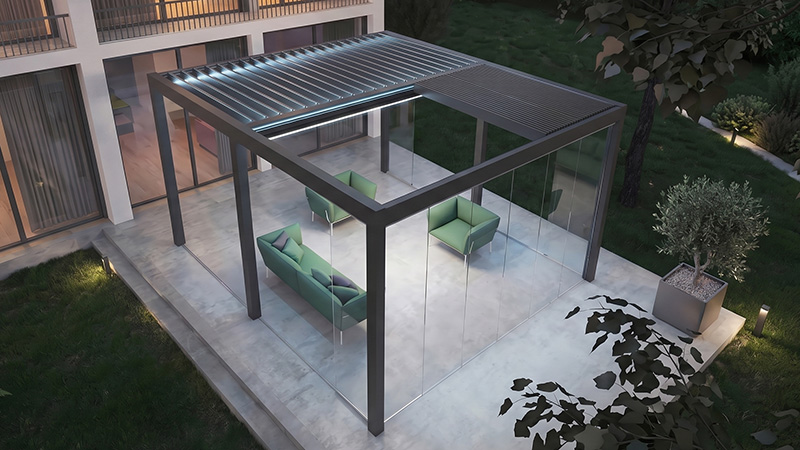
A premium louvered pergola does not fail because the brochure lacks features. It fails when the control architecture treats motion, lighting, sensors, and user interfaces as separate accessories. The frame may be strong, the louvers may look precise, and the motor may pass a bench test. Yet the final product can still feel unfinished if the actuator, tubular motor, rain sensor, RF remote, app, and service process do not behave as one system.
For pergola manufacturers in Europe and North America, the real integration question is no longer, “Can the roof move?” It is, “Can the same product platform control louver rotation, louver retraction, lighting, and weather response with repeatable wiring, predictable commissioning, and fewer support calls?” That is where actuator and tubular motor control becomes an OEM-level decision.
Pontos-chave
- Linear actuators are best used for louver rotation, usually controlling blade tilt from closed to open positions.
- Tubular motors are best used for retractable motion, including louver deployment, roof retraction, screens, and related rolling mechanisms.
- The stronger OEM approach is one control platform with clear channel mapping, weather priority logic, and serviceable wiring.
- A pergola controller should be specified like a product operating system, not purchased as the last electrical accessory.
Why Should OEMs Separate Louver Rotation from Louver Retraction?
OEMs should separate louver rotation from louver retraction because the two motions place different demands on the controller, the motor, and the installer. A linear actuator is usually selected to push or pull a linkage so louver blades rotate between closed and open angles. A tubular motor is usually selected to roll, pull, or retract a roof section, screen, or louver assembly.
This distinction sounds basic, but it is often where electrical architecture becomes messy. A rotating louver roof may need accurate stops, synchronized actuator movement, rain-close logic, and manual override behavior. A retractable roof or screen needs travel-limit control, direction safety, load handling, and clear feedback to the user.
When both motion types exist in the same pergola range, the controller should not blur them into a generic “motor” category. The user interface may show simple open, close, stop, and scene commands, but the internal logic should know which channel rotates blades and which channel retracts the structure. That separation makes factory testing, installation, and dealer support much easier.
This is the same reason VLEDSTAR positions its sistema de controlo da pérgula as an integrated platform for linear actuators, tubular motors, LED lighting, and weather sensors. The goal is not to add more electronics. The goal is to give the pergola one coordinated decision layer.
What Role Should a Linear Actuator Play in a Louvered Pergola?
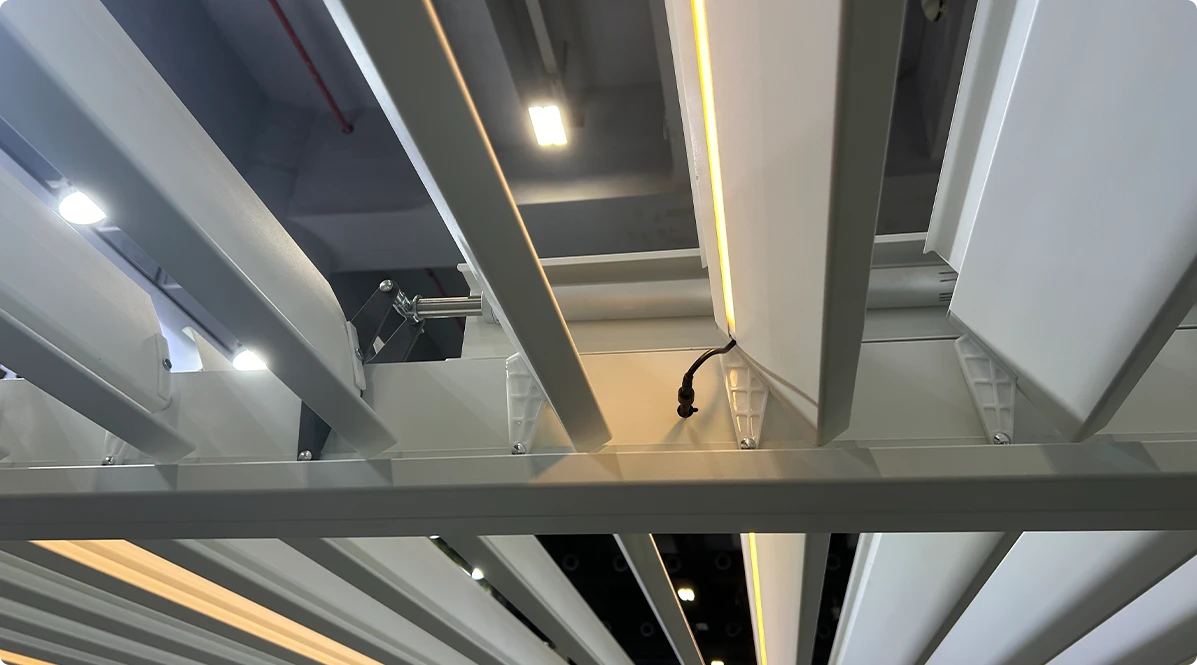
A linear actuator should control blade rotation where the pergola needs stable, repeatable angular movement. In most louvered pergolas, the actuator converts linear stroke into louver tilt through a linkage bar. That makes it suitable for opening louvers for ventilation, closing them against rain, or positioning them for shade.
For OEM design, the actuator is not only a mechanical part. It is also a control signal problem. The controller must know which direction opens the blade, which direction closes it, how long movement should run, and what happens if current rises because the mechanism is blocked.
Many manufacturers start with a simple forward and reverse relay. That can work for a basic prototype. However, production products need more discipline: defined stroke length, protected wiring, overload response, channel labels, and pairing rules that installers can repeat in the field.
Actuator control decisions that affect the product experience
The first decision is whether the system needs only timed movement or position-aware control. Timed movement can be simpler, but it depends heavily on consistent load, voltage, and mechanical friction. Position feedback can improve repeatability, especially when the product promises intermediate blade angles.
The second decision is whether multiple actuators must move together. Larger roofs may use more than one actuator, and uneven movement can create stress on the linkage. A controller that supports up to four actuator channels, as used in VLEDSTAR’s unidade de controlo da pérgula, gives OEMs more flexibility for different roof sizes.
The third decision is weather priority. If the rain sensor requests closure, should the actuator close immediately? What if a wind sensor asks the roof to open or retract? What if the user presses the remote during a protective movement? These are not app features. They are product safety and warranty questions.
What Role Should a Tubular Motor Play in a Retractable Pergola?
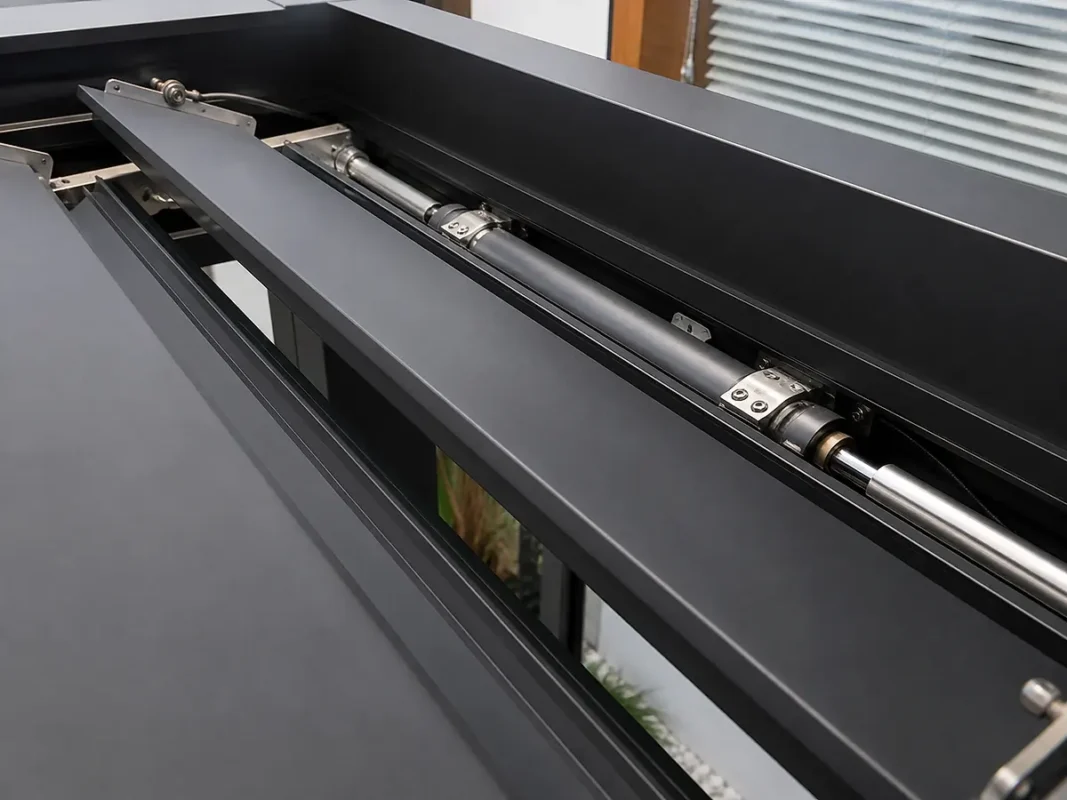
A tubular motor should control rolling or retractable movement where torque, compact packaging, and travel-limit behavior matter more than linear stroke. In pergola systems, tubular motors are commonly used for retractable roof sections, rolling screens, shade fabrics, and louver deployment or retraction mechanisms.
That makes tubular motor control different from actuator control. The controller must manage direction, stop, travel limits, and compatibility with the motor brand or receiver logic. In many projects, it must also coexist with lighting and louver rotation commands on the same remote or app.
Global motor brands such as Somfy helped shape expectations for tubular motor reliability in outdoor shading. Pergola OEMs can learn from that category, but a pergola is not just a blind or awning. It often combines moving aluminum, weather sensors, LED lighting, and multiple user interfaces in one outdoor structure.
Why tubular motor compatibility matters
Compatibility is not only electrical voltage. It includes direction logic, limit setting, control pulse behavior, RF ecosystem, user pairing, and service replacement. A motor that works alone can still create problems if it cannot fit the wider pergola control strategy.
For that reason, many OEM teams evaluate tubular motors together with the control box and not after the roof design is already frozen. VLEDSTAR’s control platform is designed to support up to two tubular motors and is positioned for compatibility with brands such as Somfy, AOK, and Dooya. This gives manufacturers a cleaner path when the same pergola family includes retractable louvers, screens, or roof sections.
The article on retractable louvered pergola control systems expands this point from a broader motor, remote, and sensor perspective. The short version is simple: retractable motion deserves its own channel logic, not a borrowed lighting receiver or a vague auxiliary output.
What Do Existing Motor Guides Miss?
Most public motor guides split the topic into separate lanes: actuator suppliers explain louver movement, shading brands explain tubular motors, and pergola brands describe finished comfort features. That helps homeowners, but it leaves a gap for OEM teams that must design a repeatable control architecture across models.
Pages from actuator specialists such as LINAK’s pergola actuator material focus on motion quality, outdoor resistance, and actuator selection. Tubular motor ecosystems focus on shade automation and established motor control. Finished pergola brands often lead with app control, rain sensors, screens, lighting, and lifestyle scenes.
Those are useful viewpoints, but they rarely answer the manufacturer-level question: how should a pergola OEM combine actuator channels, tubular motor channels, RGB lighting, mono lighting, weather sensors, RF remote, app control, and wall or touchscreen control into one product that can be built at scale?
The strongest position is not “actuator versus tubular motor.” It is “actuator plus tubular motor under one control architecture.” That view matches the real sourcing problem for manufacturers that sell multiple pergola formats, from fixed louver roofs to retractable louvered systems.
How Should One Controller Manage Both Motor Types?
One controller should manage both motor types by assigning each movement to a defined channel family: actuator channels for louver rotation, tubular motor channels for retraction, and separate LED channels for lighting. This avoids the common OEM problem where every accessory arrives with its own receiver, remote, and support logic.
A professional pergola control system should make the user experience simple while keeping the engineering structure clear. On the outside, the user may see one remote, one app, and one touchscreen panel. Inside the controller, each output still needs a specific role, protection model, and commissioning process.
| Control Function | Best-Fit Hardware | OEM Integration Priority |
|---|---|---|
| Louver blade rotation | Linear actuator | Stroke length, direction, stop logic, overload response, synchronized movement |
| Louver or roof retraction | Tubular motor | Travel limits, direction control, brand compatibility, service replacement |
| RGB or RGBW lighting | Low-voltage LED driver channels | Scene control, dimming smoothness, RF/app mapping, waterproof connectors |
| Mono white lighting | DC 24 V lighting output | Load capacity, voltage drop, profile compatibility, dimming behavior |
| Weather response | Rain, wind, sun, snow sensors | Priority rules, false trigger handling, protective movement, manual override policy |
VLEDSTAR’s smart pergola controller follows this integrated logic: RGB lighting, mono lighting, actuator-driven louver tilt, tubular motor movement, and weather sensors are handled in one compact outdoor control box. That structure reduces the number of separate transmitters and helps OEMs standardize installation across product lines.
Why Weather Logic Should Sit Above Manual Commands
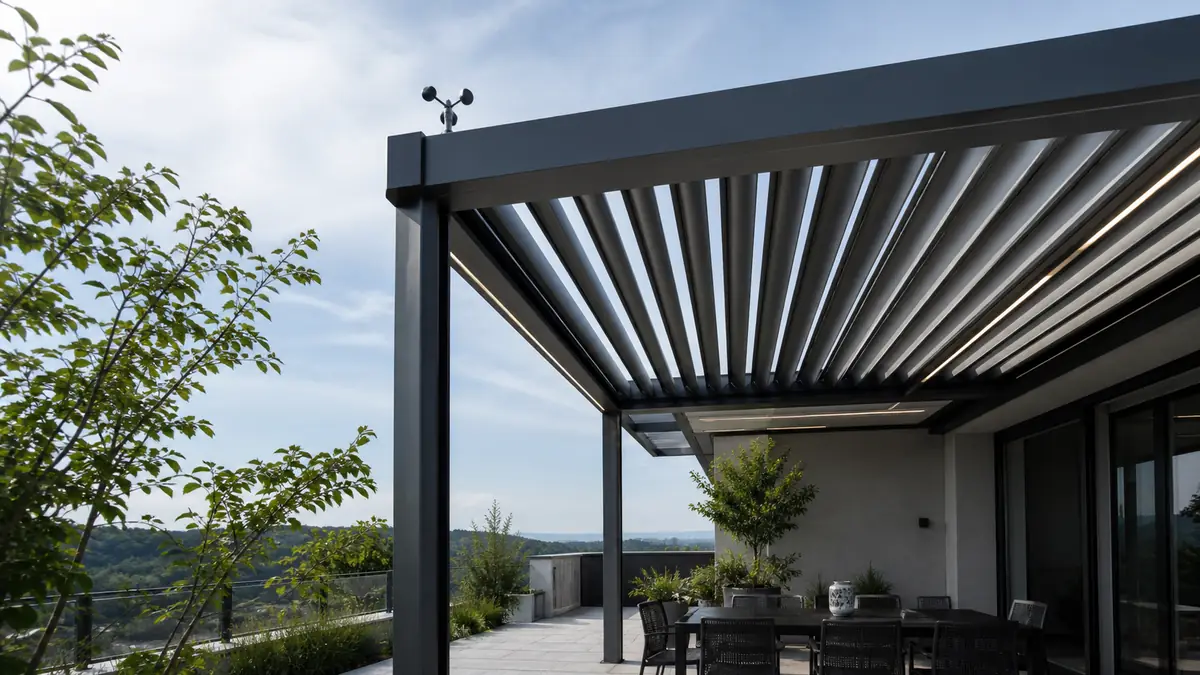
Weather logic should sit above manual commands because rain, wind, sun, and snow are not comfort inputs. They are protection inputs. When a sensor condition is active, the controller needs a defined priority order so the roof does not receive conflicting movement requests from the remote, app, touchscreen, or automation scene.
This is where many pergola systems become fragile. A homeowner may press open because the app looks idle. A restaurant manager may trigger a lighting scene during wind. A dealer may test a remote channel while the rain sensor is wet. If the controller lacks a hierarchy, the motor can move at the wrong time or fail to move when protection matters.
For louver rotation, rain logic usually closes the blades. For high wind, the correct behavior depends on the mechanical design and local engineering assumptions. Some systems may open louvers to reduce uplift, while retractable systems may need a defined safe position. Snow logic may require a different decision again, because closing a roof under heavy load can be more dangerous than leaving it open.
This is why sensor behavior should be specified early. The Guia de integração do sensor da pérgula and the dedicated rain sensor automation guide are useful companion references for teams defining these rules. Motor control is only as reliable as the logic that decides when the motor is allowed to move.
What Should OEMs Specify Before Choosing Motors?
OEMs should specify the control behavior before choosing motors because the motor is only one part of the finished pergola experience. The critical inputs are roof type, motion sequence, channel count, power architecture, weather policy, market regulations, and the level of dealer support the brand is willing to carry.
If the specification starts with “find a motor,” the team may end up solving the same problem several times. The louver supplier chooses an actuator. The screen supplier chooses a tubular motor. The lighting team chooses an LED receiver. The app gateway arrives later. Each decision seems reasonable, yet the product becomes harder to install and harder to support.
A practical OEM specification sequence
- Define the motion types: rotation only, retraction only, or both.
- Map every output channel: actuator, tubular motor, RGB lighting, mono lighting, and sensor input.
- Define safe states for rain, wind, sun, snow, power loss, and communication loss.
- Choose the user interfaces: RF remote, app, wall switch, touchscreen panel, or a combination.
- Confirm wiring routes, connector ratings, service access, and factory test points.
- Validate market needs for North America, the European Union, the United Kingdom, and other target regions.
At this stage, the controller becomes a product platform. It can support multiple pergola models without forcing the OEM to redesign the entire electrical system for every size or accessory package. VLEDSTAR’s Plataforma de controlo de pérgulas OEM is built around that idea: louvers, LEDs, screens, heaters, and sensors should be planned as a connected system.
How Do RF, App, and Touchscreen Interfaces Affect Motor Control?
RF, app, and touchscreen interfaces affect motor control because they define how users send commands and how installers diagnose problems. A strong OEM system should not make the homeowner remember which remote controls which motor. It should present a clear interface while preserving the technical channel map underneath.
RF remotes remain important for pergolas because they are fast, familiar, and independent of Wi-Fi. Apps add scene control, remote access, and smart-home expectations. Touchscreen or wall panels give hospitality and commercial projects a fixed control point that staff can use without searching for a handset.
The risk is interface stacking. If an OEM adds RF first, then app control, then a touchscreen panel, each layer may create its own pairing rules. A better approach is to define one channel map and let each interface call the same underlying commands.
For teams planning this layer, the remote louver channel pairing guide explains how channel layout and pairing affect support. The broader comparison of RF remote, app, voice, and wall switch control is also useful when deciding how much control to expose to dealers and end users.
What Wiring and Enclosure Details Matter Outdoors?
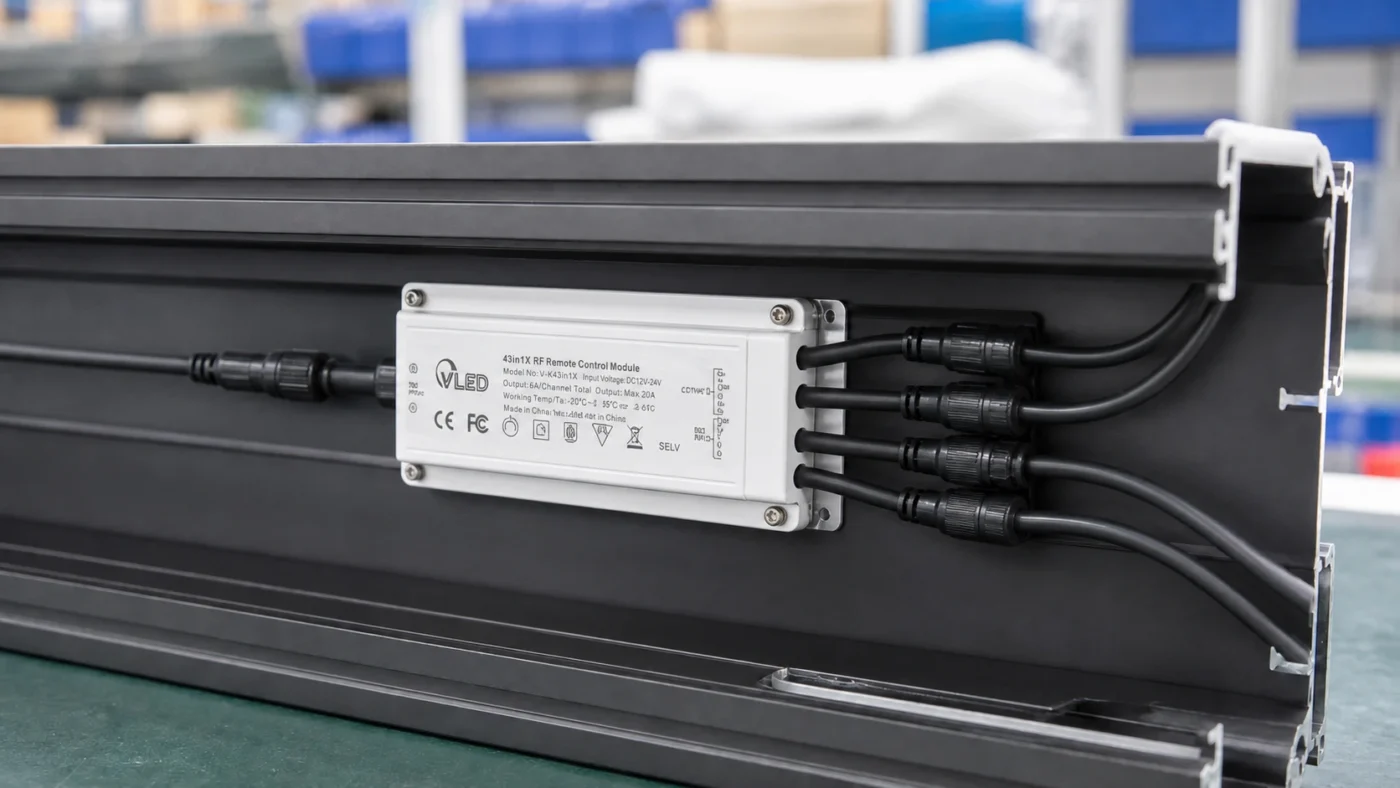
Outdoor wiring and enclosure details matter because pergola control failures are often blamed on electronics when the root cause is water ingress, cable strain, unclear labeling, or poor service access. The controller should be designed for the pergola cavity, the installer workflow, and the climate where the structure will be sold.
Ingress protection should be treated as a system property. A control box may carry an IP rating, but the final installation also depends on cable glands, connector orientation, drain paths, harness routing, and how the enclosure is opened for service. The IEC overview of IP ratings is a useful external reference when teams compare enclosure and connector claims.
OEMs should also keep low-voltage lighting, motor current, sensor inputs, and communication paths organized. Poor cable discipline can create voltage drop, RF interference, service confusion, and inconsistent behavior between factory test and field installation. A clean harness strategy is rarely visible in marketing photos, but it shows up quickly in dealer satisfaction.
Manufacturer viewpoint: A controller that looks more expensive on the BOM can reduce total product cost if it removes extra receivers, cuts pairing mistakes, shortens installation, and lowers after-sales calls. For OEMs, the cheapest control layout is not always the lowest-priced part list.
Which Compliance Questions Should OEMs Ask Early?
OEMs should ask compliance questions early because motor control, RF communication, outdoor wiring, and smart connectivity may fall under different rules in different markets. A controller intended for North America and Europe should be reviewed as a product system, not as a loose collection of modules.
For RF devices in the United States, teams should understand the scope of FCC Parte 15. For the European Union, connected radio equipment should be reviewed against the Radio Equipment Directive. These links are not substitutes for certification work, but they point OEM teams toward the right conversation.
Electrical compliance also depends on the power supply, installation method, end market, and whether the controller is supplied as part of a listed finished product. The safest path is to involve compliance partners before freezing the enclosure, antenna placement, cable glands, labels, and power architecture.
For a pergola manufacturer, the business risk is not only test failure. Late compliance changes can force tooling revisions, new harness lengths, new manuals, or a different RF configuration. Early review costs less than redesign after dealer samples have already shipped.
How Should OEMs Commission and Test the Complete System?
OEMs should commission and test the complete system with a repeatable checklist that covers every motor, sensor, light channel, remote channel, app command, and protective state. A pergola that passes a single open-close test is not ready for scalable production.
Factory testing should verify actuator direction, louver close position, tubular motor direction, travel limits, stop command behavior, sensor triggers, lighting dimming, RGB scenes, remote pairing, app response, and touchscreen control. It should also include misoperation tests, such as pressing manual commands during rain or wind priority.
Dealer commissioning should be shorter but still structured. Installers need channel labels, a pairing record, sensor placement guidance, reset steps, and a way to prove that each output belongs to the correct pergola zone. If a two-bay system has four actuators and two tubular motors, channel confusion can become an after-sales problem before the homeowner ever uses the pergola.
Suggested acceptance checklist
- Each actuator moves in the expected direction and stops cleanly.
- Each tubular motor reaches its intended travel limits without drift.
- Rain, wind, sun, and snow inputs trigger the specified safe response.
- RF remote, app, and touchscreen commands call the same channel map.
- Lighting channels dim smoothly and do not interfere with motor movement.
- Manual override behavior is documented for installers and dealers.
- Replacement pairing can be completed without opening unrelated assemblies.
VLEDSTAR’s control system pages also discuss integrated lighting and motor control in more detail, including how one remote can replace separate lighting and louver handsets. The guide on integrated lighting and louver control is especially relevant for OEMs that want the finished product to feel engineered rather than assembled from unrelated accessories.
Where Does VLEDSTAR Fit in the OEM Control Architecture?
VLEDSTAR fits as a pergola lighting and control system manufacturing partner for OEMs that want one source-factory platform for motion, lighting, sensors, and user interfaces. The company’s site presents RF outdoor lighting control systems, LED kits, pergola control boxes, and OEM or ODM configuration for motorized pergola manufacturers.
The current VLEDSTAR control platform is designed for RGB lighting, mono DC 24 V lighting, up to four linear actuators for louver tilt, up to two tubular motors for retraction, and weather sensors for wind, rain, sun, and snow. Control options include RF remote, Tuya app, and touchscreen panel, which helps manufacturers align residential, dealer, and hospitality use cases around one command structure.
This does not mean every pergola needs every function. A cost-sensitive product may only need mono lighting and actuator control. A premium model may need RGB lighting, retractable louver motion, rain-close automation, wind logic, and app scenes. The platform approach lets an OEM keep the electrical language consistent while changing the feature package by model.
For more context on the lighting side of the system, the pergola lighting page and the Somfy, Nice, and Teleco compatibility guide show why motor control and lighting control should be planned together. When these pieces are sourced separately, the customer sees the gap every time they pick up the remote.
Final View: Specify the Control System Before the Motor List
The best OEM pergola products start with a control architecture, then choose the motors that fit it. Linear actuators and tubular motors are not competing answers. They solve different movement problems, and both can belong in the same louvered pergola platform when their roles are defined clearly.
A linear actuator is the right tool for controlled louver rotation. A tubular motor is the right tool for retractable movement. The controller is the layer that makes both feel like one premium product to the end user and one repeatable assembly to the manufacturer.
For European and North American pergola manufacturers, this is where product differentiation is moving. Aluminum quality still matters. Motor quality still matters. But the brand experience is increasingly shaped by how cleanly the pergola responds to a remote command, a rain event, an app scene, a service replacement, or a dealer support call.
Plan Your OEM Pergola Control Platform
If your next pergola line needs actuator-driven louver rotation, tubular motor retraction, LED lighting, weather sensors, and one coordinated control interface, start with the control architecture before the BOM is locked.
Review VLEDSTAR’s sistema integrado de controlo de pérgulas or contact the factory team through VLEDSTAR’s company page to discuss OEM channel configuration, enclosure requirements, firmware behavior, and lighting integration for your product line.

Pingback: O que é um sistema de controlo inteligente para pérgulas? A explicação de um fabricante
Pingback: What Is a Smart Pergola Control System? OEM Guide
Pingback: IP65, IP66 ou IP67 para controladores e sensores de pérgulas: o que realmente importa
Pingback: Manual Override and Fail-Safe Design for Motorized Pergola Controls
Pingback: How to Evaluate Pergola Control System Suppliers 15 Questions for OEM Buyers
Pingback: Separate Modules vs Integrated Pergola Controller: Cost, Wiring, and Support Comparison