


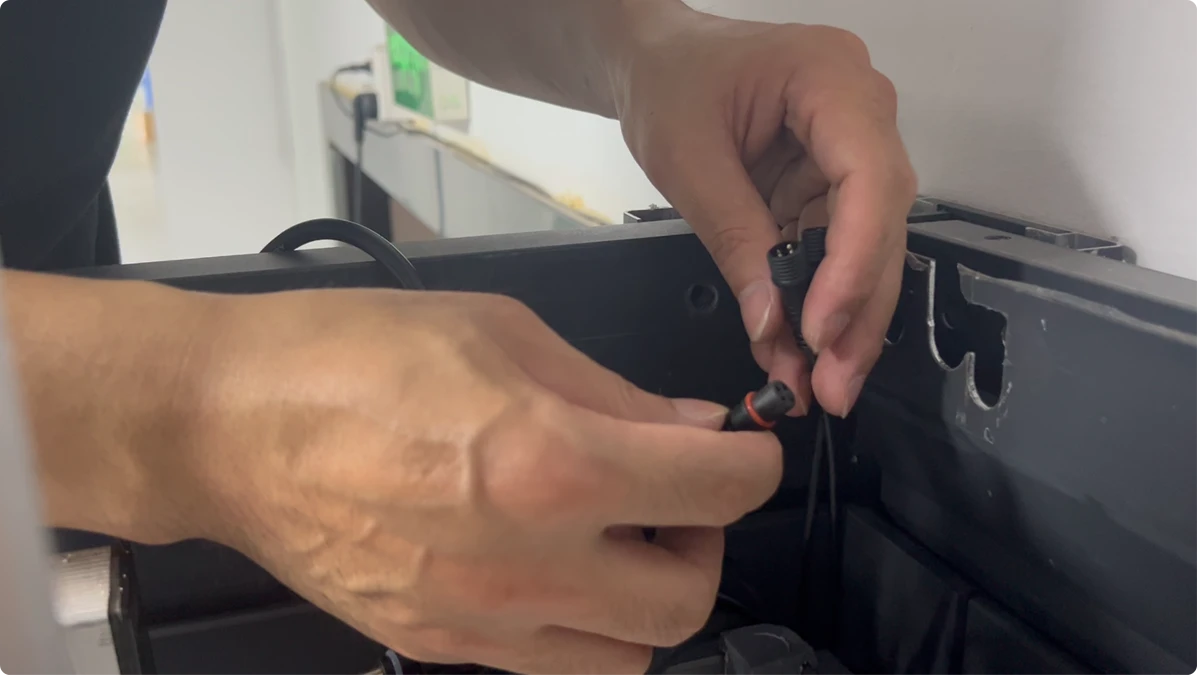
Dealer installation time is not lost only in the big construction steps. It is often lost in the small electrical decisions: which driver goes where, which receiver talks to which remote, which connector belongs to which LED zone, and which outdoor joint will still be dry after the first storm. Integrated pergola controls remove many of those decisions before the product reaches the jobsite.
Our view is simple: for pergola manufacturers selling through dealer networks, the control system should be treated as part of the installation architecture, not as an accessory package added at the end. When louvers, lighting, sensors, remotes, and wiring are designed as one coordinated system, dealers spend less time interpreting the product and more time completing the installation correctly.
Why the Motor Choice Alone Does Not Answer the OEM Question
A modern pergola is no longer just an aluminum frame with a roof. It may include linear actuators or tubular motors, dimmable LED strips, spotlights, RGBW ambience lighting, rain and wind sensors, wall switches, handheld remotes, app control, heaters, and side screens. Every extra function adds commercial value, but it also adds installation exposure.
If those functions arrive as separate electrical subsystems, the dealer becomes the integrator on site. That means the installer may need to match drivers, wire receivers, pair remotes, identify polarity, protect connections, label zones, test every circuit, and explain the control logic to the homeowner. Even experienced crews lose time when the system is not obvious.
For OEM manufacturers, this matters because dealer labor does not stay with the dealer. Slow installs reduce dealer confidence, complicate training, increase technical support calls, and make the product harder to scale across markets. A pergola that is mechanically strong but electrically confusing is still difficult to sell through a dealer channel.
Why Smart Pergola Features Alone Do Not Reduce Dealer Labor
Many high-ranking pages around smart pergolas, motorized pergolas, and outdoor automation focus on the end user’s convenience: app control, voice control, weather sensors, and luxury outdoor living. That content is useful, but it usually speaks to homeowners. The installer is almost invisible.
Other pages from automation brands focus on broad motor control. They explain how remotes, receivers, sensors, and smart-home hubs can operate awnings, shades, shutters, and pergolas. That tells manufacturers what the electronics can do, but it does not always answer a more practical OEM question: how much field labor does the control architecture create for the dealer?
This is the content gap. Dealers do not only need a pergola to be smart. They need it to be installable, repeatable, serviceable, and easy to teach to new technicians. The strongest control system is not the one with the longest feature list; it is the one that reduces decision-making at the jobsite.
Integrated Controls Turn Site Wiring Into Product Assembly
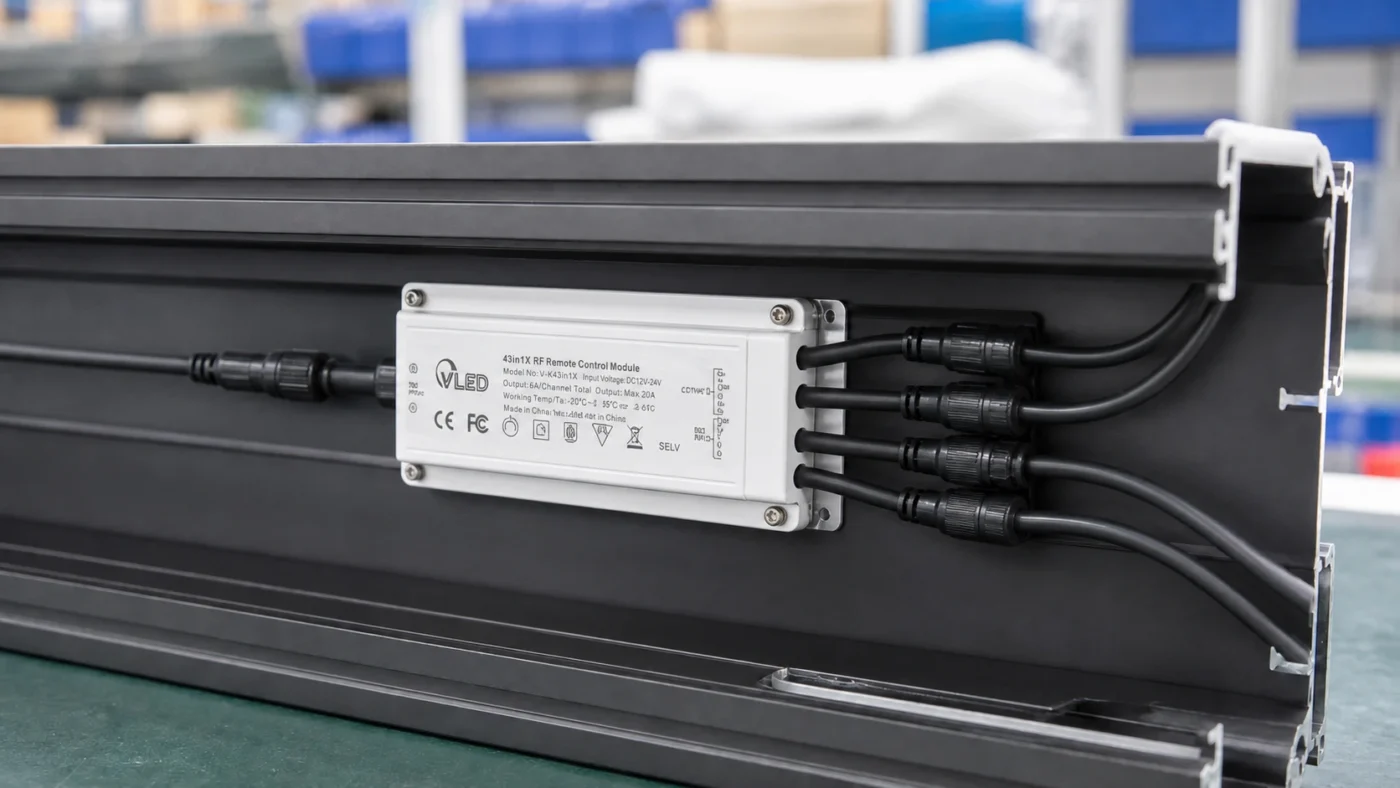
The most direct way integrated controls reduce labor is by turning electrical work into controlled assembly. Instead of asking a dealer to combine multiple control products in the field, the manufacturer supplies a pre-engineered control package with defined ports, connectors, power logic, channel mapping, and test procedures.
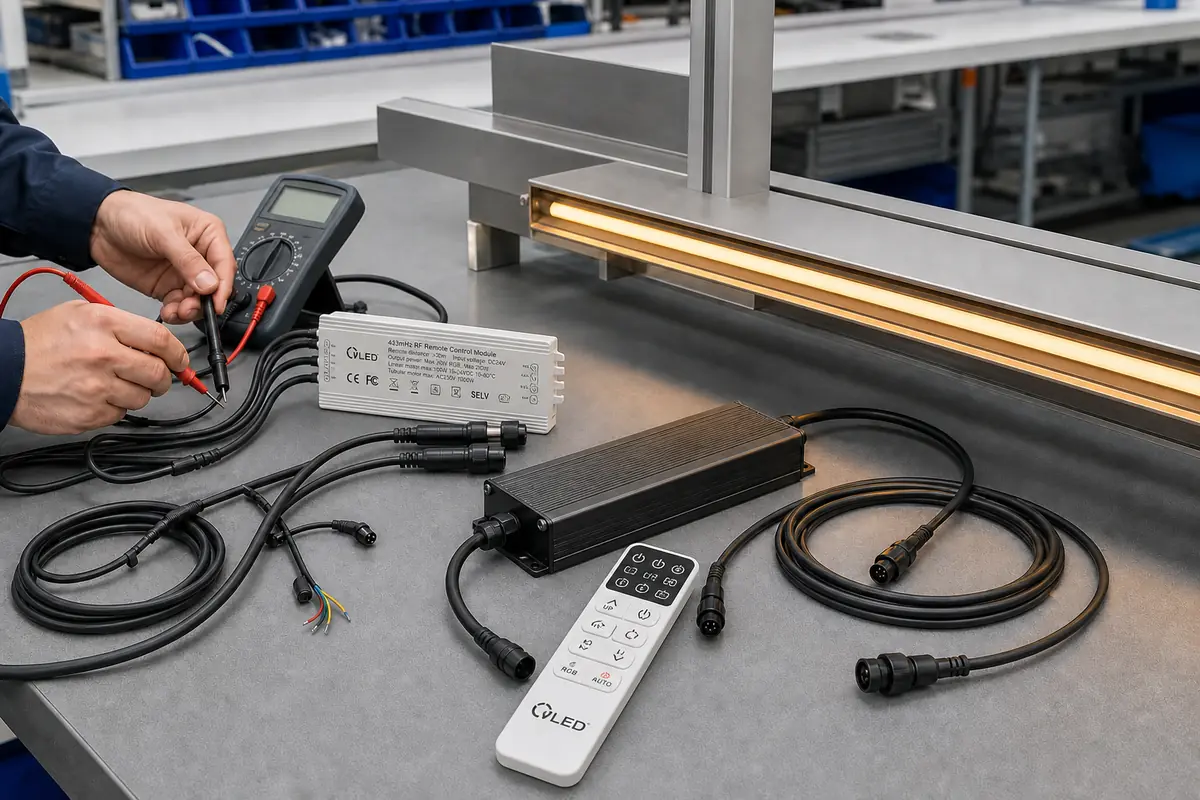
For example, a complete pergola control package can define where the louver motor connects, where the mono or RGBW LED output connects, where sensors enter the system, and how a remote or app interface controls each function. The dealer still installs the product, but the number of open-ended choices drops sharply.
VLEDSTAR’s sistema de controlo da pérgula is built around this principle: one system can coordinate lighting, long-range RF remote control, waterproof junctions, and outdoor pergola use cases. For manufacturers, that means the electrical design can be documented, packaged, and repeated across projects instead of improvised on every installation.
Plug-and-Play Connectors Reduce More Than Connection Time
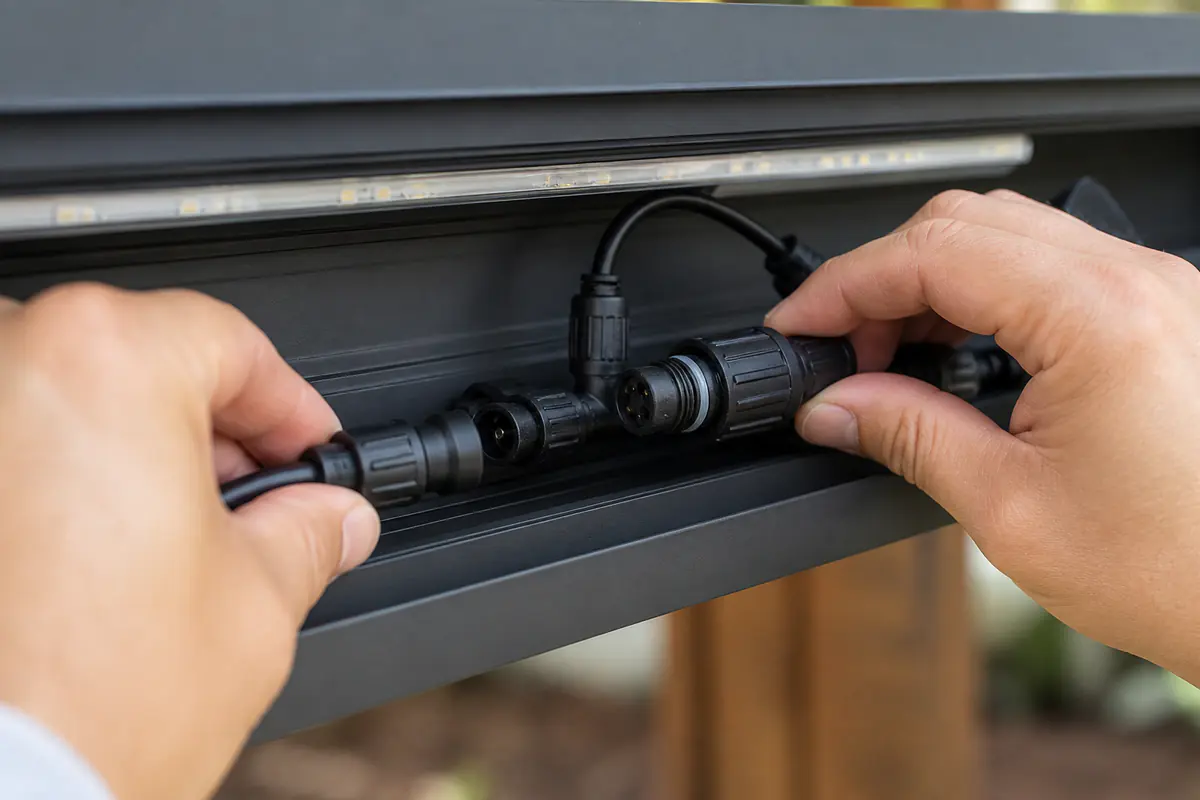
A plug-and-play connector saves seconds at the point of connection. The larger saving comes from everything it prevents: stripped wires, wrong polarity, loose terminals, mislabeled circuits, exposed copper, missing waterproofing steps, and repeated testing after a fault appears.
In pergola installations, this matters because most electrical work happens inside beams, posts, roof channels, or tight service spaces. A small wiring error can force the installer to reopen a profile, remove a cover, lift a panel, or trace a cable through the frame. That rework is where labor cost grows.
When the control system and lighting system use keyed plug-and-play waterproof connectors, the installer can follow a physical logic. The connector shape, pin layout, cable length, and labeling guide the installation. A good connector strategy makes the correct connection feel obvious and the wrong connection difficult.
VLEDSTAR applies this approach across pergola lighting and control packages. Our soluções de iluminação para pérgulas are designed around plug-and-play LED kits, outdoor control compatibility, and manufacturer-level customization. That is important for OEMs because labor reduction begins at the design table, not at the jobsite.
Waterproof Connections Protect the Install Schedule
Outdoor control failures are often blamed on electronics, but the root cause is frequently the connection point. Water does not need a dramatic leak to create trouble. Condensation, capillary movement, incorrectly seated caps, cable strain, and poorly protected junctions can all create intermittent faults that are painful for dealers to diagnose.
Using waterproof connectors does not remove the need for proper installation practice, but it gives the dealer a better starting point. The connection is engineered for outdoor exposure, the sealing method is consistent, and the installer is not forced to create a weatherproof joint from generic parts.
For international projects, manufacturers should also be precise when discussing ingress protection. The IEC 60529 IP Code describes degrees of protection provided by enclosures against solids and water. It is useful language for product specification, but it should be matched to the actual connector, enclosure, and installation environment rather than used as decoration in marketing copy.
VLEDSTAR has written separately about the outdoor failure modes that affect pergola lighting controls, including water ingress, RF interference, driver stress, and poor integration. That deeper technical discussion is available in Why Pergola Lighting Controls Fail Outdoors.
One Control Platform Lowers Training Burden
Dealer networks grow when installation knowledge can be transferred quickly. If every product line uses different remotes, different pairing steps, different LED controllers, and different sensor logic, the manufacturer is effectively asking dealers to maintain several mini-systems in memory.
An integrated control platform creates a common language. A technician learns the power layout once, understands how channels are assigned, repeats the same pairing process, and knows where to look when a function does not respond. That consistency makes onboarding easier for new installers and reduces dependence on one highly experienced technician.
This is especially valuable for manufacturers selling in Europe and North America, where dealer teams may vary in electrical experience and local installation practices. The more consistent the control package is, the easier it is to support a wide dealer network without turning every project into a custom technical consultation.
For OEMs that need louvers, LEDs, screens, heaters, and sensors in one logic, VLEDSTAR’s Plataforma de controlo de pérgulas OEM outlines how multiple pergola functions can be coordinated through a single architecture.
Integrated Controls Reduce Commissioning Time
Installation labor does not end when the last cable is connected. Dealers still need to commission the system: test motors, check LED zones, pair remotes, verify sensor response, confirm app control if included, and show the customer how to operate the pergola.
A fragmented control package stretches commissioning because each device has its own logic. The installer may need to pair one receiver for louvers, another for lighting, another for RGBW control, and a separate bridge for app operation. If something fails, the technician must decide whether the issue is power, wiring, RF range, controller configuration, sensor input, or user operation.
Integrated controls shorten this process because the system can be commissioned as a whole. The dealer follows a defined order: power check, motor movement, lighting output, sensor input, remote channels, app or wall control, final customer handover. The process becomes teachable and repeatable.
VLEDSTAR’s smart pergola controller page reflects this direction by combining lighting, motors, and sensors in one control concept for OEM manufacturers.
Fewer Boxes Mean Fewer Support Questions
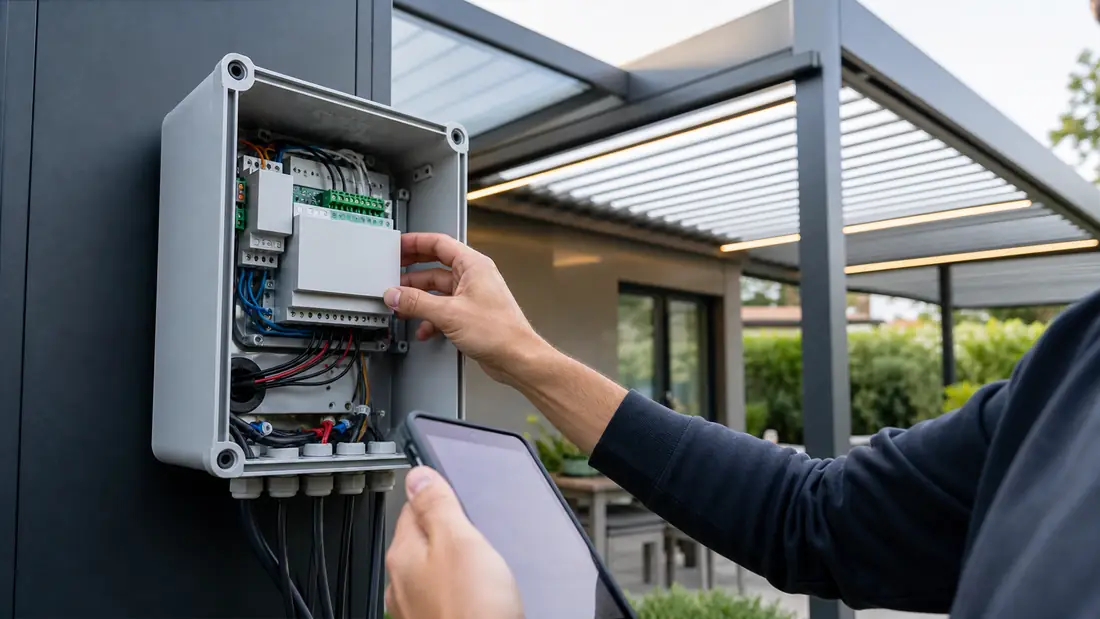
A dealer support call often begins with a simple question: “Which box controls this function?” If the answer requires three receivers, two power supplies, a separate LED controller, and a smart bridge, troubleshooting becomes slower before the real problem is even found.
Integrated control packages reduce the number of possible failure points. They also make documentation clearer. Instead of producing separate manuals for unrelated devices, the manufacturer can provide a project wiring diagram, channel map, pairing guide, and fault checklist around one control architecture.
This is not only a technical advantage. It is a commercial advantage. Dealers prefer products that let them quote confidently, install predictably, and finish without a long support chain. A control system that reduces after-sales friction makes the manufacturer’s pergola line easier to recommend.
Lighting Integration Is Where Many Pergola Projects Get Messy
Lighting looks simple to the customer, but it can be one of the most labor-sensitive parts of the installation. LED strips need correct voltage, driver sizing, dimming compatibility, cable routing, zone control, waterproof connections, and clean integration inside aluminum profiles. Spotlights add another layer because multiple fixtures often need distribution inside limited space.
If lighting is treated as a separate add-on, dealers may need to adapt components in the field. They may choose a driver, route separate cables, find a place for a controller, protect joints, and pair another remote. That can work for one project, but it becomes inefficient across a dealer network.
A better model is to design lighting as part of the pergola control system. The output channels, dimming method, connector type, splitter layout, and control interface should be planned together. VLEDSTAR’s iluminação da pérgula range includes LED strips, downlights, spotlights, wall lights, and smart controls built for outdoor pergola use rather than generic indoor lighting retrofits.
For spotlight-heavy projects, distribution hardware can make a real difference. VLEDSTAR’s 12-way IP65 splitter shows how a compact waterproof distribution component can simplify multiple LED spotlight connections in tight outdoor spaces.
The Best Labor Saving Is Designed Before the Dealer Arrives
Manufacturers sometimes try to solve installation labor with better instructions alone. Clear documentation helps, but instructions cannot fully compensate for a control system that has too many open choices. The better approach is design for installation.
That means choosing the control architecture while the pergola structure, lighting channels, motor positions, cable paths, and service access are still being defined. If the control supplier is involved early, the manufacturer can avoid conflicts such as insufficient space for connectors, hard-to-reach receivers, unnecessary cable length, or a sensor input that is not practical for the frame design.
As a manufacturer of pergola lighting and control systems, VLEDSTAR supports this early-stage OEM work. Our role is not only to supply LED kits or controllers. We help pergola brands think through control layout, connector strategy, waterproofing, RF use, lighting zones, and production repeatability so dealers receive a system that is easier to install in the real world.
What Manufacturers Should Specify in an Integrated Control Package
A strong integrated package should be evaluated by how well it reduces site decisions. The following specification points are more useful than a broad claim that the pergola is “smart.”
- Defined control scope: Identify whether the platform controls louvers, LED strips, spotlights, screens, heaters, sensors, wall panels, remotes, app control, or a combination of these functions.
- Pre-mapped channels: Make it clear which button, app control, or remote channel operates each pergola function.
- Plug-and-play wiring: Use keyed connectors, consistent cable labeling, and practical cable lengths to reduce wiring interpretation.
- Outdoor connector protection: Match waterproof connector and enclosure ratings to the expected installation environment.
- Service access: Place control units, drivers, and junction points where a dealer can inspect them without dismantling major structural parts.
- Commissioning checklist: Provide a simple order for testing power, motors, lighting, sensors, remotes, and app functions.
- Regional compliance path: Consider radio, electrical, and low-voltage requirements for the target market before launch.
For radio-based products, the compliance path matters. Manufacturers selling in the United States should understand the relevance of FCC Parte 15 for radio frequency devices. Brands selling into the European Union should review the Radio Equipment Directive framework for wireless equipment. These links do not replace testing advice, but they help OEM teams ask better questions before choosing a control platform.
Why Integrated Controls Help Dealer Margins
Dealer margin is not only the difference between product cost and selling price. It is also affected by crew time, return visits, warranty calls, training burden, and how confidently the sales team can quote an installation.
When control and lighting systems are fragmented, the dealer may need to add hidden labor buffers because the installation is uncertain. A predictable control package can reduce that uncertainty. The dealer knows what is included, how it connects, how long commissioning usually takes, and what support documentation is available.
This helps manufacturers in a second way: a dealer who can install the system efficiently is more willing to sell advanced options. Integrated lighting, RGBW ambience, weather sensors, app control, and multi-zone operation become easier to position when the dealer does not fear a difficult installation.
Where Integration Should Stop
Integrated does not mean locked, complicated, or impossible to service. A control package should reduce installation complexity without trapping the manufacturer in a rigid design. Dealers still need clear access to service parts, and OEMs still need options for different pergola sizes, motor types, lighting layouts, and market requirements.
The right balance is modular integration. The system should feel unified to the installer, but flexible to the manufacturer. A control unit may support different lighting outputs. A connector system may work across several frame sizes. A remote or app logic may be consistent even when the pergola specification changes.
That is why VLEDSTAR focuses on OEM customization as well as finished control kits. The goal is not to force every pergola brand into the same package. The goal is to give each brand a repeatable control architecture that fits its structure, market, and dealer network.
A Practical Example: From Separate Parts to a Dealer-Ready Kit
Consider a pergola manufacturer that wants to offer motorized louvers, dimmable warm-white LED strips, optional RGBW perimeter lighting, and a rain sensor. In a fragmented setup, the dealer may receive a motor controller, LED driver, RGBW controller, sensor module, multiple remotes, connectors from different suppliers, and separate manuals.
That installation can succeed, but it depends heavily on the installer. The dealer must understand every subsystem and make them work together inside one structure.
In an integrated setup, the manufacturer can supply a pre-defined package: one control unit or coordinated control platform, labeled plug-and-play motor and lighting ports, waterproof connector harnesses, a defined sensor input, one remote logic, and one commissioning checklist. The dealer is not building the control system. The dealer is installing it.
That distinction is the heart of labor reduction.
How VLEDSTAR Supports Pergola Manufacturers
VLEDSTAR is a pergola lighting and control system manufacturer with more than ten years of R&D and production experience in outdoor LED lighting and control solutions. Our work is focused on helping pergola brands turn lighting and controls into a reliable OEM package rather than a loose set of parts.
Our capabilities include integrated pergola lighting kits, RF control systems, smart control options, waterproof connector solutions, LED strip and spotlight packages, control units for motorized pergolas, and manufacturer-oriented customization. The VLEDSTAR factory profile explains our focus on pergola lighting, smart controls, OEM service, and product development for outdoor structures.
For manufacturers developing a new pergola line, the most valuable question is not “Which controller can we buy?” A better question is “Which control architecture will make our dealers faster, more confident, and easier to support?”
Final Takeaway
Integrated controls reduce pergola installation labor because they remove uncertainty. Plug-and-play waterproof connectors reduce wiring interpretation. Coordinated lighting and motor control reduce commissioning steps. A single control logic reduces training. Better outdoor connection design reduces troubleshooting. Clear OEM architecture reduces the support load that follows every installation.
For pergola manufacturers in Europe and North America, this is not a small accessory decision. It is a dealer-channel decision. The control system affects how easily the product can be installed, taught, serviced, and scaled.
Build a Dealer-Ready Pergola Control Package
If your pergola line needs integrated lighting, motor control, waterproof connectors, RF remote control, app-ready control logic, or OEM customization, VLEDSTAR can help you design a control package that is easier for dealers to install and easier for your team to support.
Explore our sistema de controlo da pérgula, review our soluções de iluminação para pérgulas, or contact VLEDSTAR through PergolaLights.net to discuss a custom OEM control architecture for your next pergola project.

Pingback: How to Differentiate a Pergola Product Line with Custom Control Features
Pingback: Controlo de cenários para pérgulas: Modo Jantar, Modo Tempestade, Modo Pôr-do-sol e predefinições do revendedor
Pingback: Separate Modules vs Integrated Pergola Controller: Cost, Wiring, and Support Comparison
Pingback: Why Pergola Manufacturers Should Treat Controls as a Core Product Feature
Pingback: Pergola Controls: A Core Product Feature for Manufacturers