


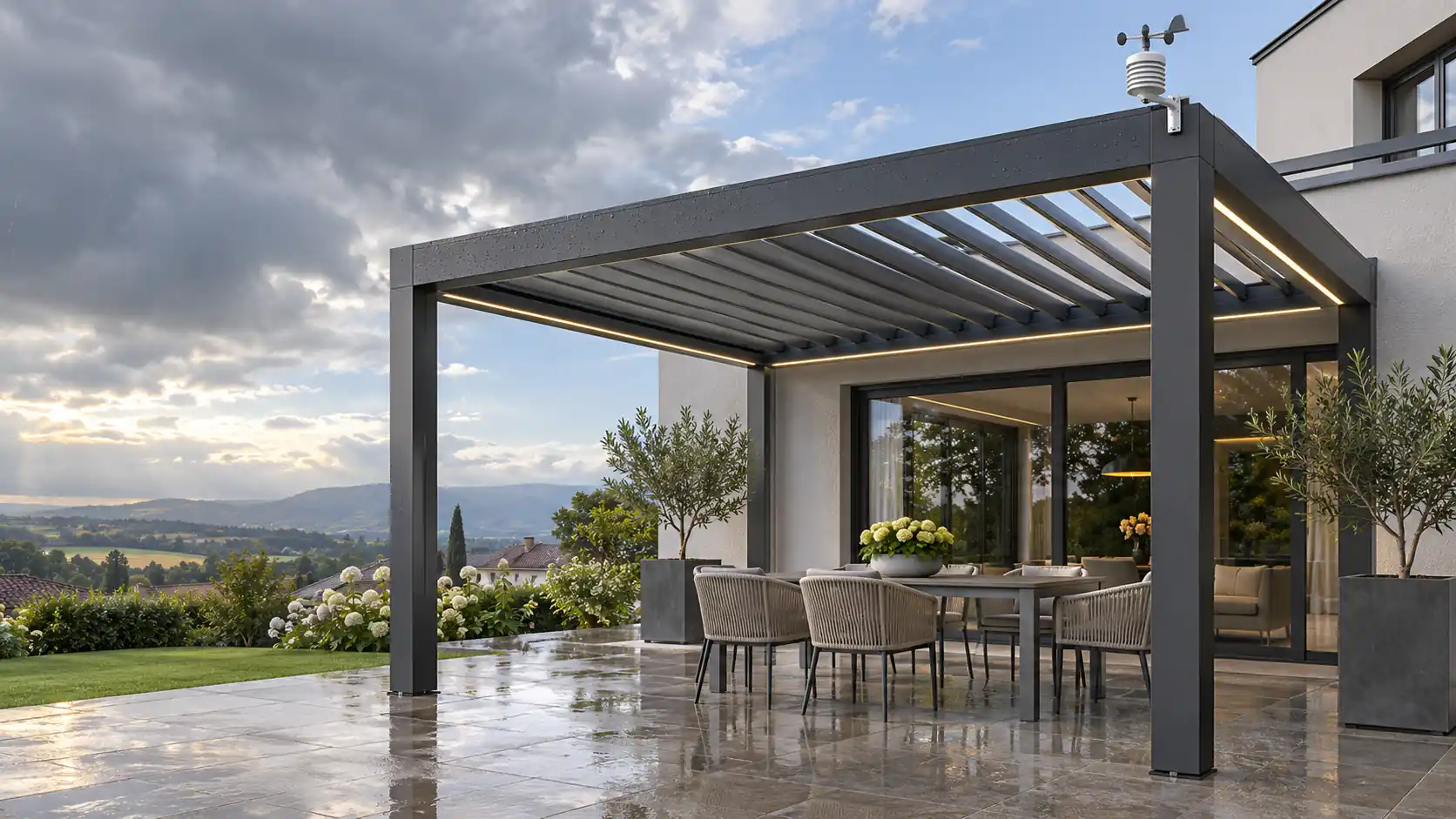
A louvered pergola can look mechanically complete and still be control-incomplete. Add a rain sensor, a wind sensor, and an app to a roof without defining what happens when their signals overlap, and the installer is left to resolve safety decisions in the field. That is not automation. It is a warranty risk with a remote control attached.
For OEMs, weather response belongs in the product specification alongside load limits, actuator travel, drainage geometry, and enclosure design. Rain may call for a watertight close. Wind may require a low-drag open or park position. Snow may require a completely different response from rain. Sun is normally a comfort function, but it can still create a movement request at exactly the wrong time. The controller must know which condition wins, how long that decision remains in force, and what proof is needed before it releases the roof.
Our position: do not market four weather sensors as four independent features. Develop one weather-safety policy, implement it as a priority-based state machine, and validate it with the actual louver geometry, motor system, wiring, sensor location, and local climate strategy.
This is the direction we take at VLEDSTAR when co-developing lighting and control systems for motorized outdoor structures. A customer may see one remote, one wall panel, or one app. Behind that experience, the roof, lighting, sensor inputs, and manual commands need a clear authority model.
A weather sensor package needs a state machine, not a list of triggers
Most market pages describe a simple chain: rain is detected, so louvers close; wind rises, so the roof moves; sunlight increases, so shade is created. Those statements are useful to homeowners, but they do not answer the questions an OEM must settle before production: What if rain arrives while the roof is moving toward its wind position? What if a user presses Open during a snow lockout? What if RS485 data disappears halfway through a snow confirmation timer?
A state machine makes those cases testable. Instead of issuing disconnected commands, the controller enters named states with entry conditions, permitted actions, exit conditions, and a known safe position. Typical states might include Normal Operation, Rain Protection, Wind Protection, Solar Shading, Snow Protection, Recovery Lockout, Sensor Fault, and Service Mode.
That distinction matters in a retractable louver roof. A full-close sequence may first extend the tubular motor to distribute louvers across the roof, then bring the linear actuator to the closed angle. A full-open sequence may first open the louvers to approximately 90 degrees, then stack them to one side. The safe movement is a sequence, not merely an output relay changing state. For the wider motor-and-lighting architecture, see our louvered pergola wiring concepts.
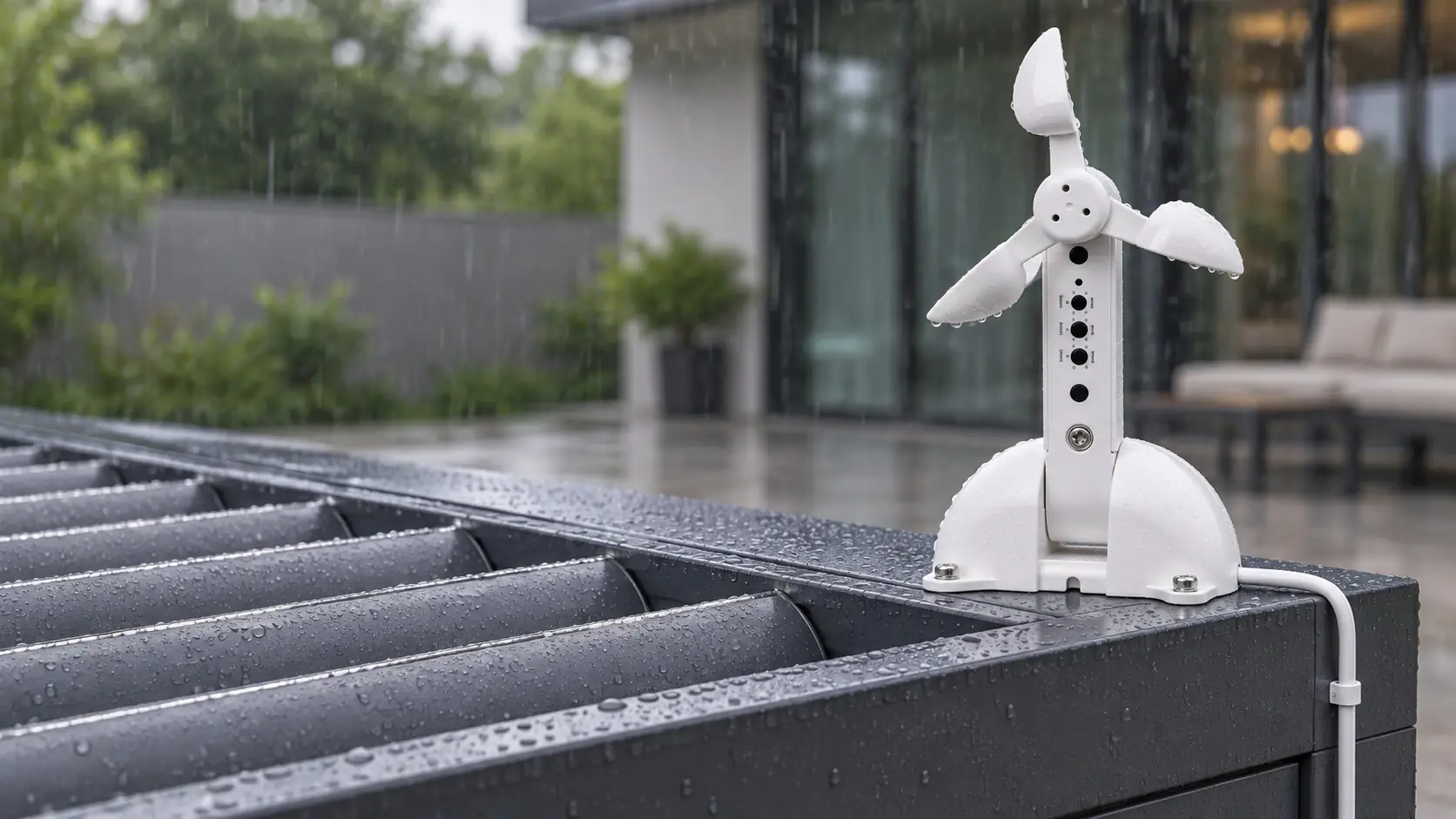
Competitor material correctly emphasizes automatic protection and configurable sensors. The opportunity for an OEM is to go further: publish a behavior policy that your engineering team, dealer network, service staff, and software team can all read the same way. A system that cannot explain why it moved will eventually be called unreliable, even when the sensor itself is accurate.
Define the safe position per hazard before you choose a threshold
The first design question is not “what sensor should we buy?” It is “what roof position is safe for this model under this hazard?” There is no universal answer. A fully closed roof may be appropriate for rain because it supports drainage and protects the occupied space. Under high wind, the lowest structural load may instead occur with louvers opened or stacked so air can pass through. Snow behavior depends on the roof’s verified winter strategy, not on a generic precipitation rule.
| Состояние | Controller objective | Example OEM decision to validate | What must not be assumed |
|---|---|---|---|
| Rain | Keep water out and preserve the tested drainage path. | Full close, including the required motor sequence; retain the position after rain stops. | That every rain sensor location sees first rainfall rather than splash, runoff, or a sheltered dry zone. |
| Сильный ветер | Reduce aerodynamic load on the complete installed assembly. | Full open, a defined louver angle, screen retraction, or another model-specific wind position. | That “closed” is inherently safer than “open,” or that an awning threshold can be copied to a louver roof. |
| Strong sun | Improve shade and thermal comfort without defeating safety. | Move to a tested shading position after a sustained light condition. | That comfort automation deserves the same authority as structural protection. |
| Snow or freeze risk | Support the roof’s defined winter load and anti-binding strategy. | Move to a verified winter position only after combined precipitation and temperature confirmation. | That a sensor makes a pergola snow-rated, or that every snow event should close the roof. |
That last point deserves plain language in every dealer manual. A controller can help a roof reach its intended winter position; it cannot replace structural engineering. In the U.S., roof and structure load design is commonly addressed through standards such as ASCE 7. The controller should never be used to imply a snow-load rating that the structure, anchors, and installation have not earned.
For a deeper treatment of this distinction, our snow and frost protection logic guide separates weather automation from structural capacity. This is especially important for OEMs selling one platform across coastal Europe, Alpine regions, Canada, and U.S. mountain markets.
Safety priorities must be written into the controller, not left to user expectation
When conditions overlap, the system needs one authoritative answer. Our recommended rule is simple: mechanical protection and verified faults outrank all weather logic; weather safety outranks remote, app, and lighting-scene convenience; sun remains lowest because it is a comfort request.
A practical priority model: mechanical safety protection > approved service/recovery authority > snow protection > rain protection > wind protection > sunlight protection. The exact placement of rain and wind must match the roof’s tested safe positions. A different sequence is acceptable only when the manufacturer can explain and verify it.
In the PERGO Pro Retract controller logic, mechanical safety protection has the highest authority, followed by RF or app manual motor control, then snow, rain, wind, and light protection. That model is useful because it explicitly states that one active protection mode overrides a lower one. For a product line destined for more exposed sites, however, do not copy any priority table blindly. Decide whether a manual command should ever outrank an active weather state. In many applications, a normal user command should be able to stop movement but not force a roof through an active safety interlock.
That is the difference between manual control and safety bypass. Our manual override and fail-safe design guide explains how to separate those permissions. The user should understand whether a command was accepted, queued, rejected, or limited by a safety state; an unexplained non-response produces service calls, while an unrestricted override can produce damage.
Use confirmation windows, lockouts, and recovery rules to make automation calm
Weather is noisy. A rain plate can see a brief splash. An anemometer can register a short gust. A sun sensor can change sharply as a cloud edge passes. The right response is not to ignore the sensor; it is to specify what counts as a credible condition and what should happen after it clears.
Confirmation filters prevent nuisance movement
Use a continuous-validity period before entering a protective state when the application allows it. In the supplied PERGO Pro Retract logic, rain and high-wind alarms require a stable signal for 3–5 seconds, strong sunlight requires two minutes, and snow needs 15 seconds of valid precipitation-plus-temperature confirmation. These are not universal settings. They are examples of a key principle: a threshold alone is not a control policy. Duration, hysteresis, and the sensor’s physical exposure determine whether the roof behaves decisively or nervously.
Lockouts stop the system from oscillating
After the rain signal clears, the PERGO Pro Retract keeps the roof fully closed for 15 minutes and ignores lower-priority wind and light actions during that period. After high wind clears, it retains the full-open position for 15 minutes and ignores light actions. After snow clears, its five-minute snow lockout ignores rain, wind, and light actions. This is sensible state-machine behavior: the controller gives the roof time to settle before it responds to a less important request.
The duration must be validated at system level. Consider actuator travel time, drainage behavior, gust recurrence, the potential for a wet sensor to dry slowly, and the owner’s reasonable expectation of how the product should behave. For a rain state, a post-rain drainage routine may also matter. Somfy’s published louver-control guidance, for example, describes a configurable water-evacuation sequence after rain; it is a useful reminder that “rain has stopped” does not always mean “move immediately.”
Recovery must require evidence, not wishful thinking
A strong design defines both how a state begins and how it ends. For snow, do not release protection simply because communication was interrupted or a timer expired. The PERGO Pro Retract approach requires the rain/snow sensor to show no precipitation and the temperature to rise above the applicable threshold before clearing snow protection. If RS485 data becomes invalid during the 15-second confirmation period, the timer resets. Once snow protection is confirmed, disconnecting communications alone does not clear it.
This conservative approach is appropriate where the controller cannot prove that a movement is safe. It should be paired with a clear service process so technicians can diagnose a failed sensor, damaged cable, or communication fault without teaching end users to defeat the interlock. Sensor cabling, connectors, and ingress protection are part of that decision; see our practical comparison of IP ratings for pergola controllers and sensors.
Snow logic should be regional, humidity-aware, and tied to the roof mechanics
Snow is not rain at a lower temperature. Wet snow, dry snow, freezing rain, frost, and ice binding create different mechanical risks. The sensor package should therefore use at least a precipitation input and temperature logic, with a winter position that has been verified for the specific roof. The National Weather Service distinguishes freezing rain, sleet, and other winter hazards for good reason: they do not create the same field condition. A pergola controller should not pretend that they do.
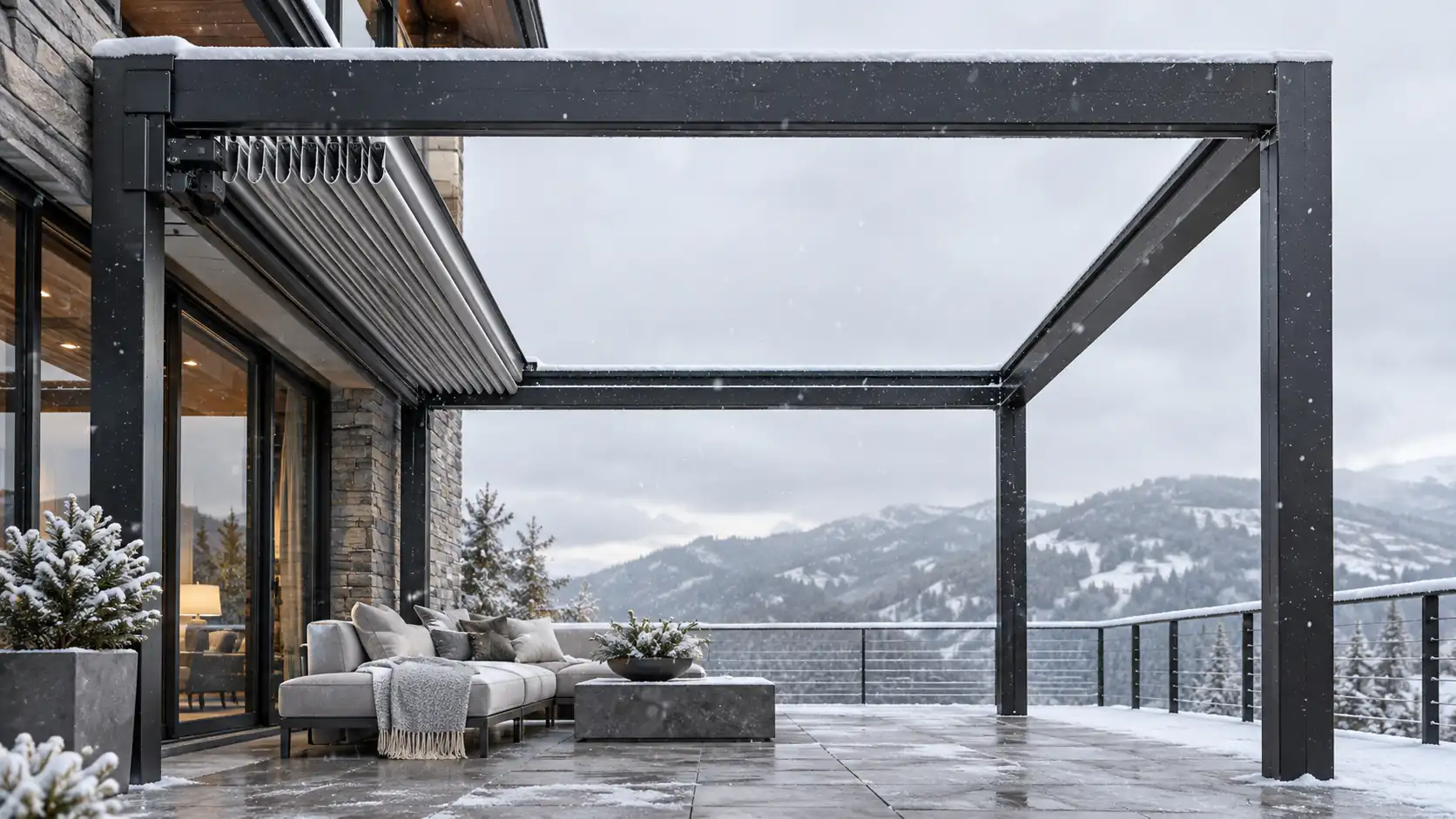
The PERGO Pro Retract instructions take a useful regional approach. The controller selects one climate region and adjusts the snow-detection temperature threshold by relative humidity:
| Configured region | Relative humidity condition | Snow detection threshold |
|---|---|---|
| North America | RH at or above 70% | Temperature at or below 0.0°C |
| North America | RH below 70% | Temperature at or below -0.5°C |
| Western or Northern European coastal areas | RH at or below 85% | Temperature at or below +0.5°C |
| Western or Northern European coastal areas | RH above 85% | Temperature at or below +1.0°C |
| Central Europe, Alpine regions, or eastern U.S. mountainous areas | RH at or below 85% | Temperature at or below -0.5°C |
| Central Europe, Alpine regions, or eastern U.S. mountainous areas | RH above 85% | Temperature at or below 0.0°C |
This table is a controller-specific example, not a universal climate map. Its value is the method: make the choice explicit, select only one region, state the default if no valid selection is made, and record that parameter during commissioning. If one controller is sold into multiple climates, regionalization is safer than hiding a one-size-fits-all temperature threshold in firmware.
Sensor placement still decides whether the logic has useful inputs. Mount a precipitation sensor where it receives representative weather, not gutter splash or a protected shadow zone; keep it serviceable; and protect the cable path from water ingress. Our rain sensor placement guidance details those factory and installer decisions. For wind, use the roof’s actual geometry, nearby buildings, turbulence, gust profile, and certified operating limits rather than regional weather-station data alone. The right decision framework is covered in our wind sensor thresholds guide.
Commissioning is where the OEM policy becomes repeatable field behavior
An OEM should not ask an installer to invent the final control policy from a menu of unnamed parameters. Factory defaults, DIP switches, region selection, commissioning records, and test procedures should all point to the same documented behavior.
For the PERGO Pro Retract platform, rain, wind, and light functions can be individually enabled or disabled using dedicated DIP switches. Turning a switch off disables its automatic function and cancels the related delayed lockout. That is practical for service and product configuration, but it makes labeling and commissioning discipline essential. A light-related instruction should never be printed under a rain switch label; ambiguous documentation becomes a field fault even when the electronics are correct.
Use a commissioning sheet that records the following for every project:
- Roof model, size, motor and actuator type, firmware version, and verified end positions.
- Configured rain, wind, sun, snow, frost, and fault responses, including each safe roof position.
- Wind threshold, confirmation period, hysteresis or reset rule, and sensor mounting location.
- Selected snow region, humidity assumption, temperature threshold, and tested winter strategy.
- Rain sensor exposure, cable route, drip loop, connector protection, and service access.
- Who may use service mode, what manual commands remain available during a lockout, and how the interface reports the active state.
- Power-loss behavior. In the PERGO Pro Retract design, rain, wind, and snow lockouts are not retained after power loss; on restart, the controller reads current sensor conditions and re-establishes protection. Snow still requires valid RS485 data and a new 15-second confirmation period.
Finally, test combinations, not just individual inputs: rain during a sun close, wind during rain recovery, snow with an interrupted communication line, a manual command during every active state, and power restoration under an active sensor condition. This is where a compact интегрированная система управления перголой earns its value: not because it has more channels, but because the electrical architecture and behavior policy have been developed together.
What OEMs should take from this
Weather-aware control can make a louvered pergola feel effortless. But the premium experience does not come from adding sensors to a brochure. It comes from a controller that resolves conflicting conditions predictably, moves the roof through a validated sequence, retains protection long enough to avoid oscillation, and explains when user control is limited.
Build the product around a declared safety philosophy: define the safe position for each hazard, rank every command source, require credible sensor confirmation, specify recovery rules, adapt snow logic to climate and mechanics, and make every setting commissioning-visible. That turns weather automation from an accessory into a durable part of your product platform.
Develop the control policy with the hardware
VLEDSTAR works with pergola manufacturers on integrated lighting, motor, remote, app, and weather-sensor control systems. Share your roof mechanism, target markets, and required functions, and we can help frame a control architecture that is manufacturable, serviceable, and aligned with your product strategy.

Отправьте нам запрос