


Основные выводы
- IEC 60529 defines the IP code with 2 digits: solids first, water second.
- IP65 is often enough for sheltered pergola control boxes, but only when cable entries and connectors are also controlled.
- IP66 is stronger against powerful water jets, while IP67 addresses temporary immersion.
- The best specification separates controllers, sensors, power supplies, remotes, and cable accessories instead of using one blanket rating.
A pergola manufacturer rarely loses money because a datasheet says IP65 instead of IP67. The expensive failures happen when the datasheet answer and the field condition are talking about different things.
A control box sits inside an aluminum beam, but the installer routes the cable upward. A rain sensor passes a bench test, but it is mounted where splash and condensation collect around the connector. A remote control is called waterproof, then left on a wet table through a winter freeze. None of these problems are solved by repeating “higher IP is better.”
This is where pergola OEMs need a more practical standard. The controller, weather sensors, wiring harness, splitter, driver, mounting cavity, and after-sales opening procedure must be designed as one outdoor control system. VLEDSTAR’s pergola control system already treats lighting, motors, sensors, RF remote, app control, and waterproof connectors as one architecture. That is the lens manufacturers should use when choosing between IP65, IP66, and IP67.
Why Does the IP Rating Debate Mislead Pergola Manufacturers?
The IEC IP code uses 2 characteristic numerals: the first for protection against solid foreign objects, the second for water ingress protection, according to IEC guidance on IP ratings. That makes IP65, IP66, and IP67 useful, but it does not make them complete product reliability specifications.
Most IP rating guides answer a narrow question: what does each IP number mean? They usually provide a definition, a comparison chart, a few application examples, and a short reminder that IP67 can survive temporary immersion. That helps buyers decode labels, but pergola manufacturers face a harder decision.
They need to know which rating reduces warranty risk without making the product larger, harder to assemble, harder to service, or unnecessarily expensive. A control box hidden inside a louvered roof frame does not see the same water as a roof-mounted wind and rain sensor. A power supply under a gutter does not see the same exposure as a low-mounted cable splitter near paving stones.
So the better question is not “Which rating is best?” The better question is “Where can water realistically reach this component, and what happens after assembly, installation, service, and several seasons outdoors?”
What Do IP65, IP66, and IP67 Actually Mean?
IP65, IP66, and IP67 all share the same first digit, 6, which means dust-tight protection under the IP code. The difference is the second digit: 5 covers water jets, 6 covers powerful water jets, and 7 covers temporary immersion under specified test conditions.
| Rating | Plain meaning | Relevant pergola use | Common mistake |
|---|---|---|---|
| IP65 | Dust-tight and protected against water jets. | Control boxes mounted inside profiles, under covers, or in protected service cavities. | Assuming the enclosure rating still applies after poor cable entry or repeated service opening. |
| IP66 | Dust-tight and protected against powerful water jets. | Components exposed to heavy rain, washdown, side splash, or more aggressive cleaning. | Assuming IP66 also means immersion protection. |
| IP67 | Dust-tight and protected against temporary immersion. | Low-mounted sensors, cable accessories, or components with possible standing water risk. | Assuming IP67 is automatically better than IP66 for water jets. |
One detail matters: the IP code is test-condition specific. IP67 is about temporary immersion, not necessarily stronger jet resistance than IP66. If a component needs both jet and immersion protection, the specification should say so clearly, such as IP66/IP67, and the supplier should confirm test coverage rather than rely on a sales label.
North American customers may also ask about NEMA enclosure types. NEMA’s enclosure type guidance includes environmental conditions such as rain, sleet, hose-directed water, corrosion, and temporary submersion depending on type. NEMA and IP ratings are not identical systems, so manufacturers should avoid treating them as simple one-to-one substitutes.
Where Does IP65 Make Sense in a Pergola Control System?
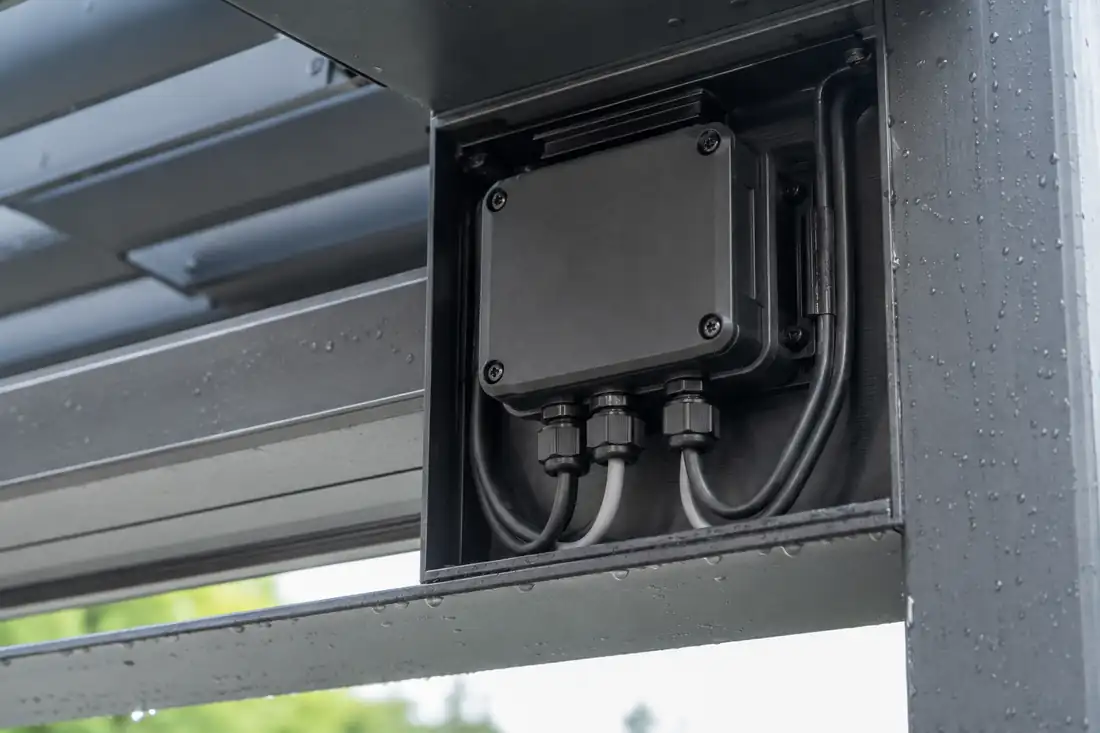
IP65 makes sense when the control box is protected from direct standing water and the full assembly controls cable entry, gasket compression, connector quality, and mounting direction. For many pergola controllers, that is a realistic and efficient target because the box usually sits inside or beneath the structure.
This is why many integrated pergola controller platforms use IP65 as the baseline. The goal is not to put the controller underwater. The goal is to protect electronics from dust, rain splash, incidental jets, and moisture exposure that can happen during outdoor use.
For example, a блок управления перголой installed in an aluminum profile cavity may need to manage DC24V mono lighting, RGB lighting, linear actuators, tubular motors, and weather sensor inputs. It must fit the mechanical cavity, remain serviceable, and maintain reliable signal performance inside metal structures. A thicker immersion-rated enclosure may not solve those problems. It may create new ones.
The IP65 decision should include the harness
A controller housing can pass IP65, then fail in the field because the cable system was treated as separate. The gland, fast connector, splitter, strain relief, cable jacket, and installer routing all decide whether water reaches the PCB.
Manufacturers should specify the complete wiring route. Cable entries should face down or sideways where possible. Drip loops should be part of the installation manual. Connectors should not sit in the lowest water-collecting point of the frame. If the box must be opened during service, the gasket and screw pattern must survive that workflow.
This is also where integrated kits help dealers. A dealer-friendly wiring package, like the architecture described in VLEDSTAR’s motorized pergola control kit guide, reduces improvisation on site. Less improvisation usually means fewer moisture paths.
When Should You Specify IP66 Instead?

IP66 is the better choice when the component faces stronger water jets, exposed side spray, pressure cleaning, or a location where heavy wind-driven rain can hit the enclosure directly. It is especially relevant when a component cannot be protected by the pergola frame itself.
For pergola projects, IP66 is most useful for exposed accessories, external junction points, wall-mounted boxes near open weather, or components used in commercial spaces where staff may wash nearby surfaces. Restaurants, hotels, and coastal terraces can be tougher on accessories than residential patios.
The practical question is not whether IP66 sounds more premium. It is whether the component will see jet-like water pressure. If the answer is yes, IP66 belongs in the specification. If the answer is no, the extra rating may add cost and volume without improving the failure mode that matters most.
IP66 still needs corrosion planning
Water ingress is only one enemy. Coastal air, pool chemicals, fertilizers, and cleaning agents can attack screws, springs, connectors, and exposed terminals. An IP66 box with poor metal selection can still become an after-sales problem.
For coastal pergola lines, manufacturers should ask about housing material, screw material, PCB coating strategy, connector plating, and salt spray validation. A separate article on salt spray testing limits explains why corrosion testing should not be reduced to a simple year-conversion claim.
When Is IP67 the Right Answer?
IP67 is the right answer when temporary immersion is a credible risk, such as low-mounted cable accessories, sensor modules near drainage paths, or control accessories installed where water can pool. It is not a universal upgrade for every pergola electronics component.
This distinction matters because pergola roofs move water. Gutters, posts, louver channels, and drainage outlets create very specific wet zones. A component mounted above the drainage path may only see splash. A connector at the bottom of a post may sit near temporary water accumulation after heavy rain.
Sensors deserve special attention. A rain sensor, wind sensor, sun sensor, or snow sensor usually performs its job by being exposed to weather. If the sensing surface is protected too much, the logic becomes slow or inaccurate. If the electronics and connector are underprotected, the sensor can fail before it protects the structure.
That balance is why sensor integration should be specified as a system. The pergola sensor integration guide gives a wider view of how rain, wind, sun, and snow inputs fit into motorized roof logic.
Why Sensors Need a Different Rating Conversation Than Controllers
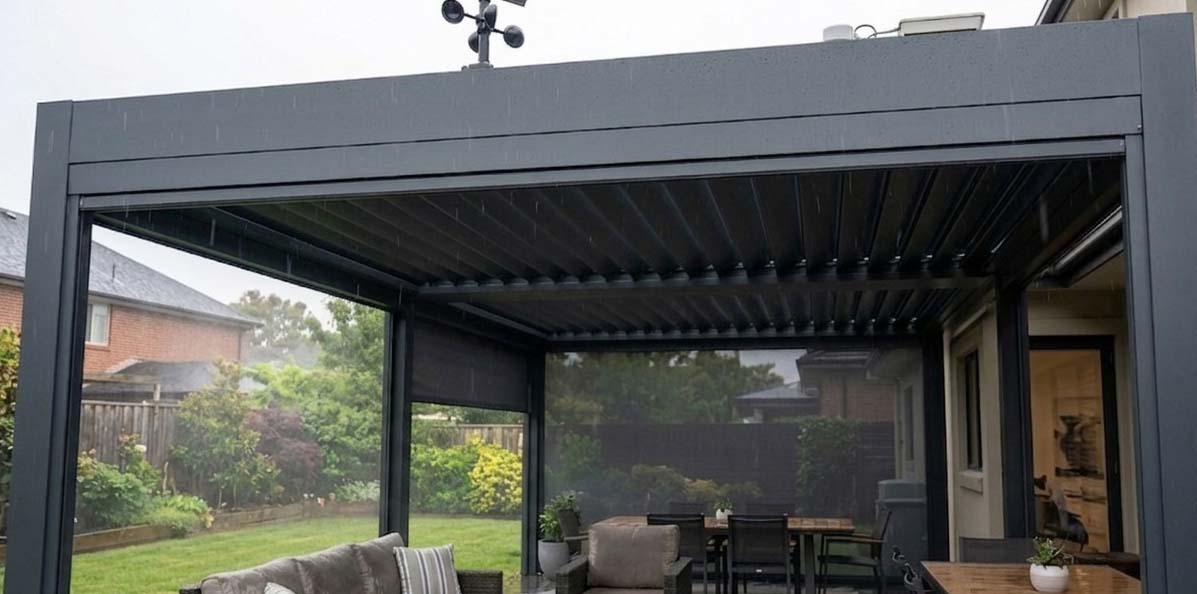
Controllers usually need protection from water. Sensors need controlled exposure to weather plus protection for their electronics. That is a different engineering problem, especially for rain detection, wind thresholds, frost logic, and automatic louver movement.
A rain sensor that is too sheltered may not close the louvers quickly enough. A sensor placed in the wrong roof shadow can read the weather late. A cable exit under the sensor body can invite water into the connector even when the top housing looks well sealed.
For rain detection, location often matters as much as the IP label. The sensor should be horizontal enough to detect drops, exposed enough to see real rainfall, and placed away from louver shadow zones that delay detection. The detailed placement logic is covered in VLEDSTAR’s rain sensor placement guide.
Wind sensors raise another issue. The enclosure must survive outdoor exposure, but the control logic must also avoid nuisance operation. Too low a threshold makes the roof move too often. Too high a threshold can delay protective action. For manufacturer-level settings, the wind sensor threshold guide is a useful internal link for engineering teams.
Manufacturer view: A sensor should not be judged only by its sealed housing. It should be judged by detection speed, false-trigger resistance, connector sealing, cable routing, firmware logic, and how easily installers can mount it correctly.
What Does IP Rating Not Tell You?
An IP rating does not tell you whether the product will survive UV exposure, condensation, corrosion, thermal cycling, wrong mounting, poor service reassembly, or RF signal loss inside aluminum profiles. Those are common outdoor pergola control failure causes.
This is the gap many generic IP guides miss. A test rating tells you how a housing performs under defined conditions. It does not prove that the complete installed pergola system will keep working after the dealer cuts a cable shorter, opens the control box twice, mounts a sensor under a louver edge, or pairs several remotes in a metal-framed structure.
For a control platform, the rating must sit beside other design checks:
- Condensation path inside the enclosure and around cable glands.
- Downward-facing connector orientation and strain relief.
- Thermal rise at full lighting load, especially for RGBW and long mono LED runs.
- RF range through aluminum beams and dense installation environments.
- Firmware behavior when rain, wind, snow, lighting, and manual commands conflict.
- Field service process after the enclosure has been opened.
VLEDSTAR’s article on why pergola lighting controls fail outdoors goes deeper into this full-system reliability problem. The short version is simple: IP is necessary, but the architecture decides whether the rating creates real value.
How Should OEMs Write the Specification?
OEMs should write IP requirements by component, not by slogan. A stronger specification separates controller, sensor, driver, connector, splitter, remote, wall panel, and installation zone, then asks the supplier to prove the complete assembly.
A practical specification can look like this:
| Component | Typical exposure | Reasonable target | Extra proof to request |
|---|---|---|---|
| Main control box | Inside profile, under roof, or protected cavity. | IP65, unless exposed to washdown or direct jet pressure. | Installed cable-entry test, gasket reassembly check, load temperature check. |
| Weather sensor | Exposed to rain, wind, sun, snow, and temperature cycling. | IP65 to IP67 depending on electronics location and mounting height. | Detection logic, bracket design, cable exit sealing, false-trigger testing. |
| Connector or splitter | Beam cavity, gutter zone, post base, or underside routing. | IP65 for protected routes, IP67 where temporary pooling is possible. | Mate-unmate cycle, pull relief, downward orientation, installer assembly method. |
| Power supply or driver | Protected enclosure, technical compartment, or external mounting. | Match the real mounting zone and ventilation need. | Load margin, heat dissipation, dimming compatibility, cable length planning. |
| Remote or wall panel | Handheld use, wall mounting, occasional splash, user handling. | Depends on placement and market expectation. | Button sealing, battery compartment sealing, drop and handling checks. |
For lighting-heavy pergolas, IP selection also intersects with driver sizing. An enclosure that is well sealed may trap heat. If the driver runs close to its limit, thermal stress can shorten life or cause unstable dimming. The 24V LED driver sizing guide is worth reading before finalizing the controller box layout.
What Should Procurement Ask a Supplier Before Approving Samples?
Procurement should ask how the IP rating was validated in the final assembly, not only whether a catalog enclosure has an IP label. The sample approval process should include mounting, cable, connector, firmware, and service checks before the product enters dealer trials.
Start with these questions:
- Was the IP test performed on the complete product with cable entries installed?
- Does the rating still apply after the box is opened and closed for service?
- Are connectors keyed, strain-relieved, and protected from upward water paths?
- Can the controller handle lighting load, motor load, and sensor logic in one platform?
- Has RF control been checked inside aluminum pergola structures?
- What happens when rain, wind, snow, app commands, and remote commands conflict?
- Are installation manuals written for real dealer behavior, not only laboratory mounting?
- Can firmware, enclosure, remote layout, logo, channel logic, and harness design be customized for the OEM line?
These questions shift the discussion away from label shopping. They make the supplier prove that the controller belongs inside a pergola product line, not just inside a waterproof-box catalog.
Our Position: Use IP Ratings as Design Boundaries, Not Marketing Badges
For pergola controllers and sensors, IP ratings should define the minimum exposure boundary for each installed component. IP65 can be right. IP66 can be right. IP67 can be right. The wrong answer is using one rating to avoid thinking about the system.
Our recommended approach is straightforward. Use IP65 for protected integrated control boxes when the cable system is designed with the enclosure. Use IP66 where strong jets, washdown, or direct side spray are realistic. Use IP67 where temporary immersion or pooling is possible. For sensors, make the decision around both exposure and detection performance.
Then verify the whole assembly. That means the control box, waterproof connectors, harness, sensors, power supply, mounting bracket, RF antenna position, and firmware logic should be reviewed together. A well-designed IP65 pergola controller can outperform a poorly integrated IP67 box because the field failure path is often the cable, service opening, heat, or installation method.
This is why an OEM pergola control platform is a stronger long-term choice than scattered components. It gives the manufacturer one place to align enclosure design, smart control, lighting output, motor movement, sensor response, and dealer installation.
Build the Rating Around the Pergola, Not the Other Way Around
If you are developing a new louvered or retractable pergola line, define the wet zones first. Then choose the controller, sensor, connector, and power architecture around those zones. VLEDSTAR can support OEM and ODM development for integrated pergola lighting and control systems, including firmware, enclosure, wiring, channel logic, weather sensors, RF remote, Tuya app, and touchscreen panel integration.

Пингбэк: Ручное управление и система защиты от сбоев в конструкции систем управления моторизированными перголами
Пингбэк: Pergola Controls: A Core Product Feature for Manufacturers