


A grill station needs useful light on the work surface. A dining table needs comfortable light on faces and food. The circulation path needs enough visibility to feel safe, while the structure itself should still look calm after dark. These requirements are related, but they are not the same lighting task and should not be forced onto one undifferentiated circuit.
For pergola manufacturers, the commercial opportunity is clear: a well-designed control architecture turns lighting from an accessory into a product feature that improves usability, perceived quality, installation consistency, and future upgrade potential. This guide explains how to specify that architecture for outdoor kitchens and dining areas, from the first electrical drawing through commissioning.
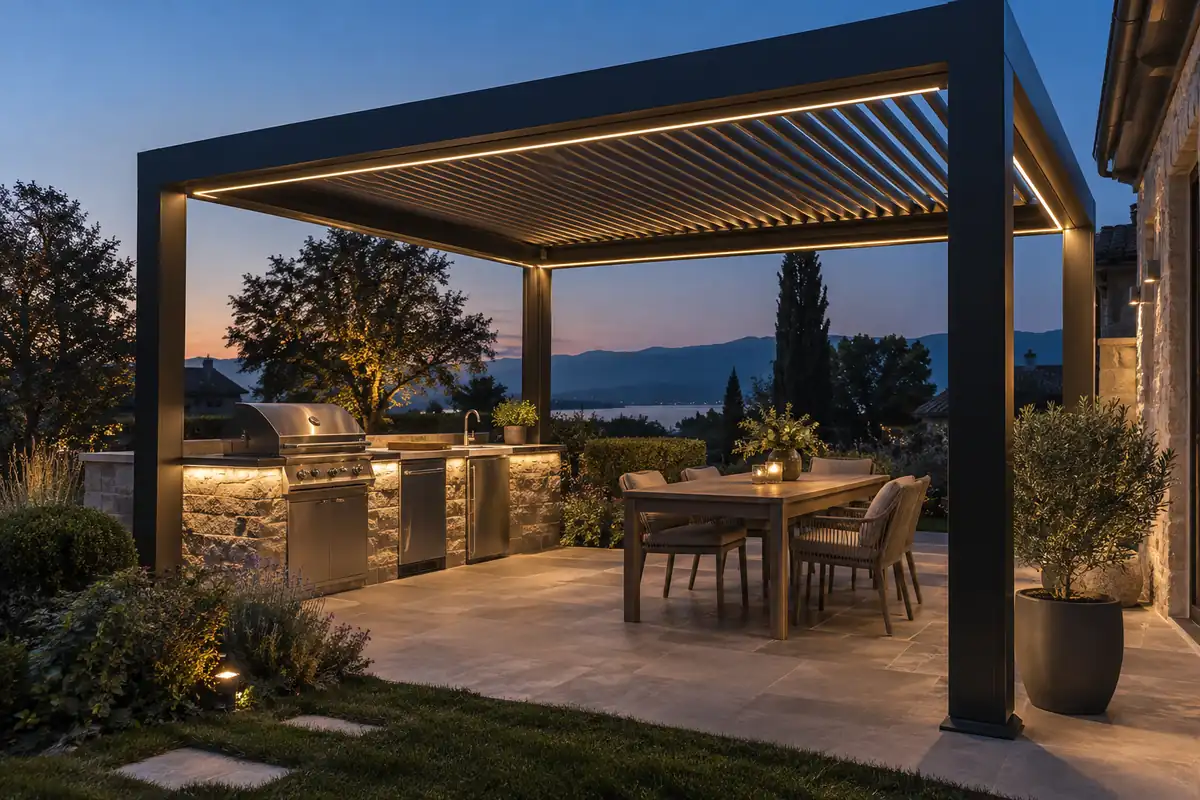
Görüşümüz: the best pergola lighting control system separates task, ambient, accent, and safety-related loads; gives each zone an appropriate dimming range; and lets the customer combine those zones into simple scenes. The controller should also be designed around the pergola’s motors, sensors, wiring routes, and service requirements from the beginning.
Why outdoor kitchens and dining areas need more than an on/off light circuit
An outdoor kitchen is a work environment. The user is handling knives, heat, food, and cookware. The dining area is a social environment. The user wants to see a meal and the people around the table without feeling as if they are sitting under a floodlight. Treating both areas as one lighting load creates a predictable compromise: the kitchen is underlit when the dining setting feels comfortable, or the dining area is overlit when the kitchen is made practical.
Outdoor lighting guidance commonly separates illumination into ambient, task, and accent layers. That principle is useful for pergola manufacturers because it maps directly to product architecture:
- Task lighting supports grilling, food preparation, plating, and cleaning.
- Ambient lighting creates an even, comfortable base level across the covered area.
- Accent lighting highlights beams, louvers, posts, walls, landscape, or architectural details.
- Safety and circulation lighting supports steps, edges, paths, and transitions between the pergola and the house.
The control system is what turns those layers into a usable experience. A customer should be able to select a cooking mode without manually balancing three dimmers. They should be able to move to dinner mode without switching off the light that makes the path visible. In premium projects, those actions can be combined with louver position, retractable screens, and weather responses.
For a broader component view, see VLEDSTAR’s pergola aydınlatma çözümleri, which cover downlights, LED strips, post and wall lights, accessories, and plug-and-play kits.
Start with functional zones, not fixture counts
A fixture list is not a lighting strategy. Begin by mapping how the outdoor room is used, then assign a control zone to each function that may need an independent light level.
| Zone | Primary job | Control requirement | Typical light approach |
|---|---|---|---|
| Cooking and grill line | Reveal food, tools, and work surfaces | Independent dimming; higher usable output; low glare | Focused downlights or carefully aimed task fixtures |
| Prep and serving counter | Support preparation and plating | Separate from the grill when the layout is long or L-shaped | Linear strip, downlight, or under-counter light |
| Dining table | Make food and faces comfortable to see | Fine dimming; warm and stable white light | Soft downlight, indirect strip, or controlled pendant |
| Perimeter and structure | Give the pergola a visual outline | Low-level independent ambient or accent control | Linear strips in beams, gutters, or profiles |
| Paths and steps | Support movement and orientation | Low, consistent output; optional timer or scene link | Post, wall, step, or landscape lights |
For a compact residential pergola, some zones may share a channel. For a larger outdoor kitchen, hospitality terrace, or multi-bay structure, combining them too early makes future service and customer handover harder. A manufacturer should document which loads can be grouped, which must remain independent, and how the zones are named in the remote, app, and installation guide.
Use the right lighting layer for each outdoor-kitchen task
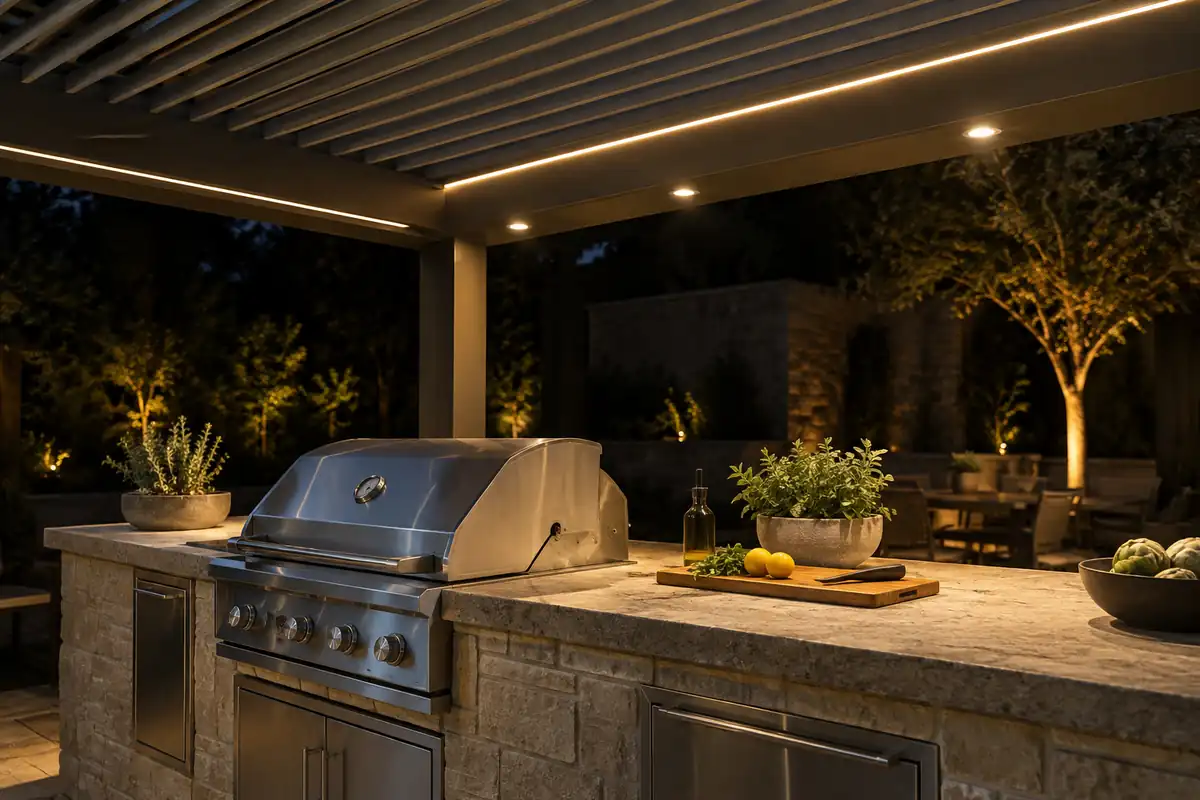
Task lighting over the cooking line
The cook needs light on the surface, not light directly in the eyes. Deeply recessed or shielded downlights can reduce glare when they are positioned above the work plane and aimed correctly. A linear source can work well when it is concealed in a beam or profile, but the diffuser and mounting position must prevent bright points from appearing in the user’s normal view.
Task lighting should have its own dimming channel. It may be used at a higher level while cooking, then reduced when the meal is served. A single “all lights on” command cannot provide that transition cleanly.
Ambient light across the room
Ambient light establishes the base level for conversation and movement. Integrated LED strips along beams, gutters, or roof profiles can create an even wash without making the ceiling visually busy. For premium aluminum pergolas, continuous COB strips can be useful where the design calls for a dot-free line of light; the choice still depends on the profile, diffuser, output, IP rating, and thermal design.
Ambient channels should dim smoothly through the range the customer actually uses. A system that jumps from bright to dark, flickers at low output, or shuts down before the room feels comfortable will be judged as a control failure even if the LED strip itself is sound.
Accent light for the structure and landscape
Accent light gives the pergola a finished appearance from inside and outside the structure. Post lights, wall washers, small spotlights, and carefully placed RGBW elements can define the frame or connect the pergola to the surrounding garden. Accent should be restrained. If every beam, post, and planting feature is at the same brightness, nothing reads as a focal point.
RGB and RGBW are most useful when they have a clear role. RGBW can deliver a true white setting for everyday use and color for entertainment scenes. Manufacturers should make the white mode easy to access and should not force customers to navigate a color wheel for basic dining light.
Why Do Motor Feedback and Fail-Safe Logic Matter?
Scenes are where a control system becomes understandable to the end user. They translate a technical architecture into a small number of decisions that match how people use the space.
| Scene | Lighting response | Optional pergola response |
|---|---|---|
| Cooking | Raise grill and prep zones; keep perimeter light moderate | Keep louvers in a comfortable working position |
| Dinner | Reduce task light; set dining and ambient zones to a softer level | Adjust louvers or screens for comfort if required |
| Entertaining | Add controlled accent or RGBW effects without overwhelming the table | Coordinate with audio, screens, or a wider open position |
| Cleaning | Raise functional zones for visibility and maintenance | Open or position the roof for inspection access |
| Night or away | Turn off decorative loads; retain only selected path or security lighting | Close or secure the structure according to the project logic |
VLEDSTAR’s integrated pergola control system is designed around this type of combined architecture, with lighting outputs, motor control, sensor inputs, and multiple control methods. The exact scene behavior should still be agreed with the manufacturer, installer, and project designer before production.
For a deeper treatment of scene logic, the pergola scene-control guide shows why dinner, sunset, and weather presets should be specified as operating behaviors rather than marketed as vague “smart” features.
Specify dimming, color, and control interfaces together
Lighting quality is not defined by the LED source alone. The driver, controller, wiring, load calculation, and user interface all influence the result. A manufacturer’s specification should therefore state the complete control path.
- Monochrome white: choose when the priority is consistent, practical illumination and straightforward operation.
- RGB: choose when saturated color effects are central to the product experience.
- RGBW: choose when the same system must provide useful white light plus entertainment color.
- Multi-CCT or tunable white: consider when the product line needs adjustable white appearance, but validate the user interface and color consistency before standardizing it.
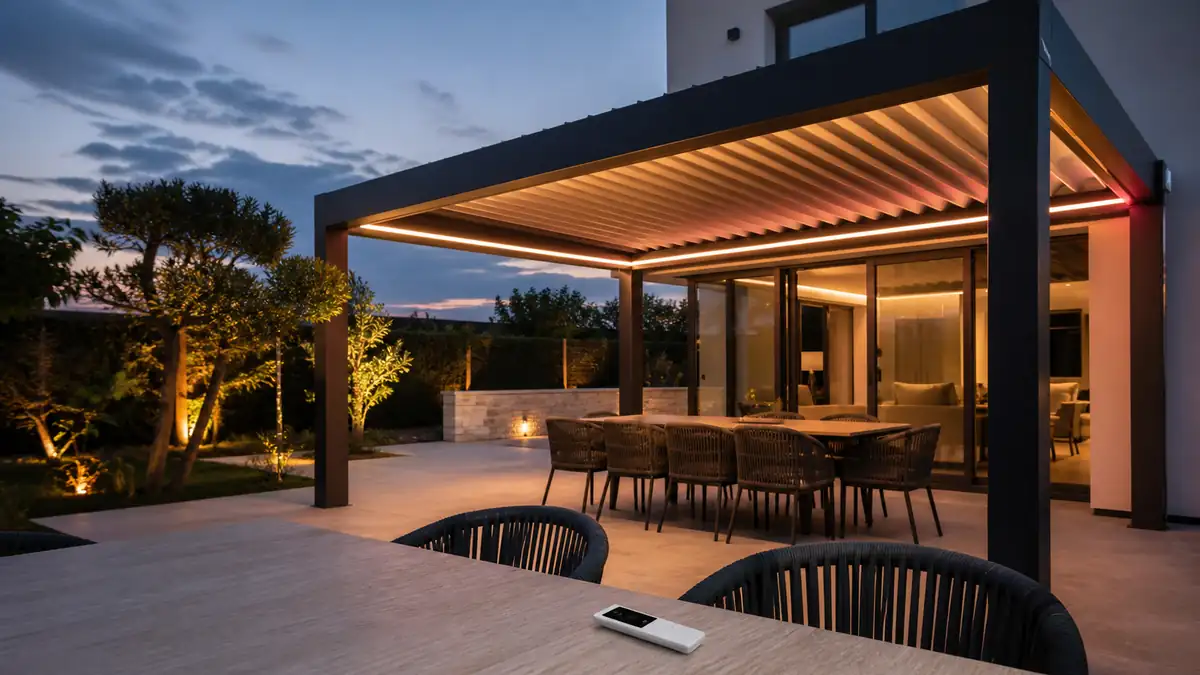
Remote control, mobile app, and wall-panel control serve different users. A remote is fast and resilient at the pergola. An app is convenient for scenes, scheduling, and status. A wall panel can be preferable for hospitality or projects where shared access matters. Providing more interfaces is not automatically better; each interface must expose the important functions without creating contradictory states.
Keep the basic actions obvious: on/off, dimming, scene selection, and motor operation. Advanced configuration can remain in the app or commissioning process. This division reduces support requests and makes the product easier for installers to explain during handover.
Build outdoor reliability into the control architecture
Outdoor kitchens combine water exposure, grease, heat, cleaning, condensation, and frequent human interaction. A controller that works in a dry showroom may still fail in the field if enclosure, connectors, cable routing, and load margins are treated as afterthoughts.
Enclosure and ingress protection
Choose the enclosure and installation location based on actual exposure, not only on a label. The IEC 60529 IP Code is the relevant international reference for classifying protection against solids and water. The controller, connector, power supply, and light fitting should be evaluated as a system, including cable entries and service access.
VLEDSTAR provides IP-rated pergola control and lighting components, including compact control boxes, waterproof connectors, splitters, and outdoor lighting products. Manufacturers should still define where each component may be installed and should not use an IP rating to justify placement in a location beyond the product’s tested conditions.
RF performance around aluminum structures
Aluminum frames can affect wireless performance through shielding, reflections, and signal shadowing. The control plan should identify where receivers are mounted, how far they are from the user interface, and how a service technician can access them. Do not leave RF performance to a showroom demonstration outside the finished frame.
For practical design checks, review VLEDSTAR’s guidance on preventing RF signal problems in aluminum pergolas. The important manufacturing lesson is to validate the complete structure, not just the transmitter and receiver on a bench.
Power, heat, and service margin
Calculate each channel from the actual strip length, wattage per meter, driver behavior, connector losses, and a sensible thermal margin. If a kitchen zone, dining zone, or perimeter run is close to the controller’s maximum capacity, split it into logical channels before production. A controller that is technically able to carry a load but has no practical margin is difficult to defend in a warranty conversation.
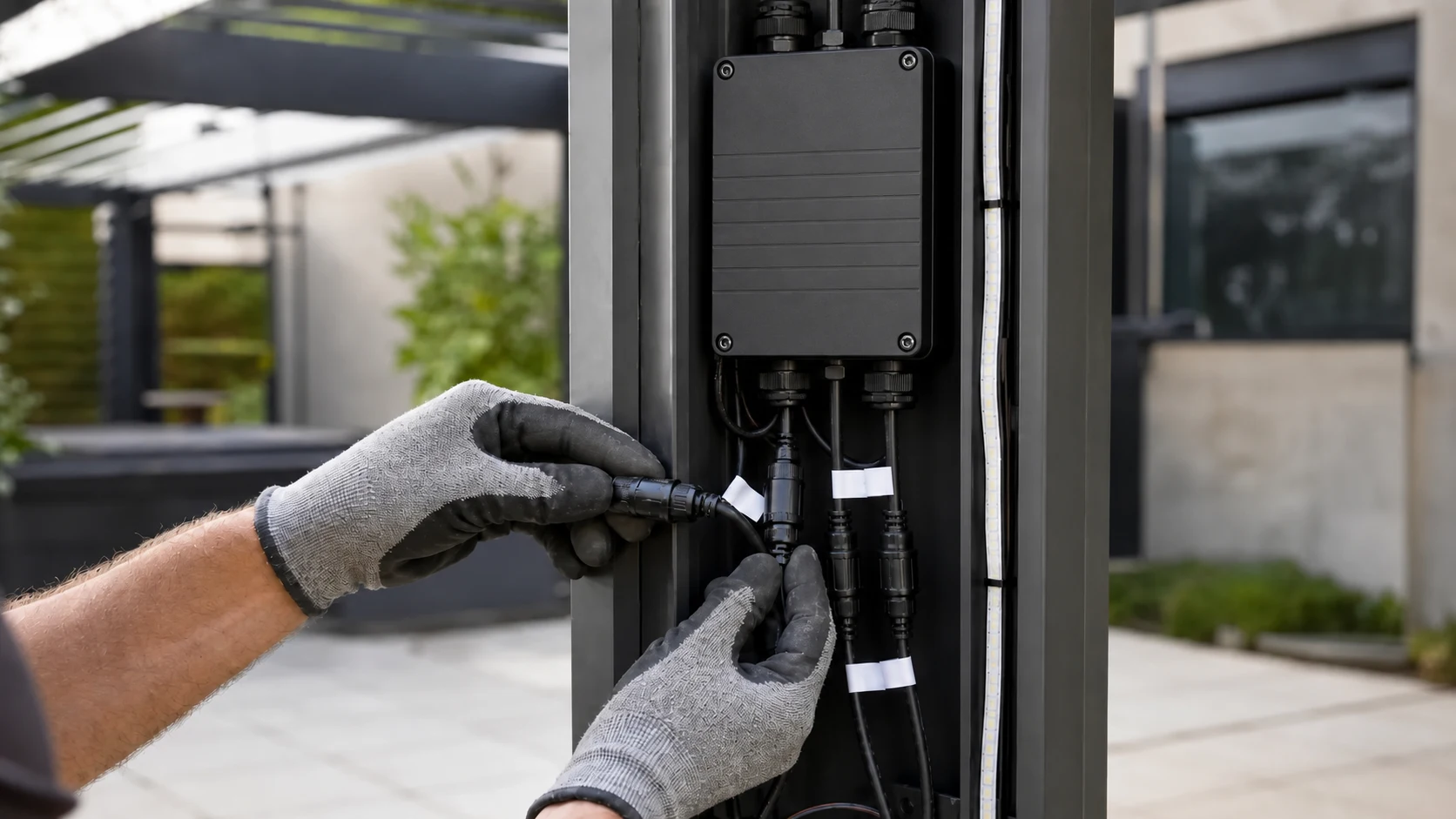
Use accessible mounting and labeled wiring. A future installer should be able to identify the cooking, dining, ambient, accent, and sensor circuits without reverse-engineering the pergola. This is a small design decision with a large effect on commissioning time and after-sales support.
Integrate lighting with louvers, screens, and weather sensors
The strongest product experience comes from coordination. Lighting should not fight the roof, screen, or weather logic. A rain event may close the louvers while the dining scene remains active. A wind event may override a user command. A sunset scene may lower ambient light while keeping the cooking zone available. These are control decisions that should be documented, tested, and communicated.
Safety behavior should have priority over decorative behavior. If the pergola enters a protective state, the controller should define which lighting outputs remain available, which motor commands are blocked, and how the system returns to normal operation. The customer needs a predictable result, not a collection of disconnected devices.
VLEDSTAR’s smart pergola control system guide covers the broader relationship between lighting, motors, sensors, and control interfaces. For manufacturers, the practical takeaway is to write the operating logic as part of the product specification rather than leaving it to each installer.
What pergola manufacturers should include in the product brief
A clear brief prevents the common failure mode in which lighting is chosen late, after the profile, roof, motor, and electrical layout have already been fixed. At minimum, document:
- Structure type, bay count, dimensions, and aluminum profile constraints.
- Lighting layers and the zones that must remain independent.
- LED type, voltage, color options, strip lengths, fixture cutouts, and target mounting positions.
- Maximum channel load, driver location, thermal conditions, and cable lengths.
- Required control interfaces: RF remote, app, wall panel, or an external automation gateway.
- Motor brands and protocols that must coexist with the lighting controller.
- Weather sensor inputs and the priority of protective actions.
- Commissioning steps, pairing method, zone naming, reset behavior, and service access.
- Market requirements, local electrical rules, and the responsibility of the licensed installer.
For OEMs evaluating suppliers, VLEDSTAR’s pergola control system supplier guide provides a useful question framework for compatibility, validation, customization, and production support. A good supplier should be able to discuss these topics before a purchase order, not only after a field issue.
Why an integrated system improves the manufacturer’s product
Separate lighting, motor, sensor, and remote suppliers may appear flexible at the start of a project. In practice, each additional control layer adds another pairing process, power requirement, failure point, and support boundary. The customer experiences the result as one pergola, so the product team eventually inherits the integration problem.
An integrated platform can reduce that fragmentation when it is engineered properly. It allows the manufacturer to standardize zone naming, preconfigure scenes, design repeatable cable routes, and offer a consistent handover experience. It can also support a clearer product ladder: a basic white-light package, a premium RGBW package, and a larger multi-zone package can share a control philosophy instead of becoming unrelated accessory bundles.
VLEDSTAR positions itself as an R&D and manufacturing partner for this type of product development. The company states that it has worked in LED lighting since 2010 and provides lighting, control, accessory, and kit solutions for pergolas and related outdoor structures. Explore the VLEDSTAR company profile and the custom pergola controls product-line service when your requirement goes beyond a standard catalog configuration.
Commission every kitchen and dining scene before handover
Commissioning is not complete when every lamp turns on. Test the experience the customer will actually use:
- Run the cooking scene with the grill, prep surface, and serving counter occupied.
- Check that the dining scene reduces glare and leaves faces and food readable.
- Confirm low-level dimming is stable and does not produce visible flicker or abrupt cutout.
- Test every zone independently, then test group commands and scenes.
- Operate the controller with the pergola closed, open, and in the expected weather states.
- Verify RF range and pairing from the locations where the owner will actually use the controls.
- Record zone names, receiver locations, driver ratings, and final scene settings for service.
Where electrical work, mains power, or local compliance is involved, the project should be completed and verified by qualified professionals under the applicable local requirements. In the United States, consult the NFPA National Electrical Code resources; in other markets, use the applicable national and regional standards.
Sık Sorulan Sorular
How many lighting zones does an outdoor kitchen pergola need?
There is no universal number. Start with the functions that must be controlled independently: cooking, prep and serving, dining, ambient structure lighting, accent lighting, and paths or steps. Small pergolas may combine compatible loads, while larger or hospitality projects benefit from more independent zones and a documented expansion plan.
Should outdoor kitchen and dining lights use the same color temperature?
They can use the same general white family for visual consistency, but the cooking zone may need a different output level or color specification than the dining zone. The key is controlled, comfortable light without glare. Validate the actual food, countertop, and skin-tone appearance in the finished structure before standardizing the product.
Is RGBW better than single-color lighting for pergolas?
RGBW is more flexible because it combines usable white light with color effects, but flexibility adds specification and commissioning responsibility. Single-color systems are often the better choice for a clean, simple product. Choose RGBW when scenes and entertainment are part of the product promise, not merely because more colors are available.
Can pergola lighting share a controller with motors and weather sensors?
Yes, when the controller is designed for the required device types, loads, protocols, and protective logic. The integration must be validated as a complete system: lighting zones, motor behavior, sensor priority, RF performance, power supply, enclosure, and user interfaces all affect the result.
What should a manufacturer ask a pergola control supplier?
Ask about independent zones, channel load, dimming behavior, compatible motor types, sensor inputs, wireless performance inside aluminum structures, enclosure and connector ratings, firmware and pairing, customization, test procedures, documentation, and after-sales support. A supplier should answer with application details, not only a list of headline features.
Plan a pergola lighting control package for your next outdoor-kitchen project
Share your pergola dimensions, lighting zones, motor type, preferred control interface, and target market with VLEDSTAR. Our team can help map the lighting and control architecture into a manufacturable kit or customized product solution.
Talk with VLEDSTAR about your pergola lighting and control requirements.

Talebinizi Bize Gönderin