


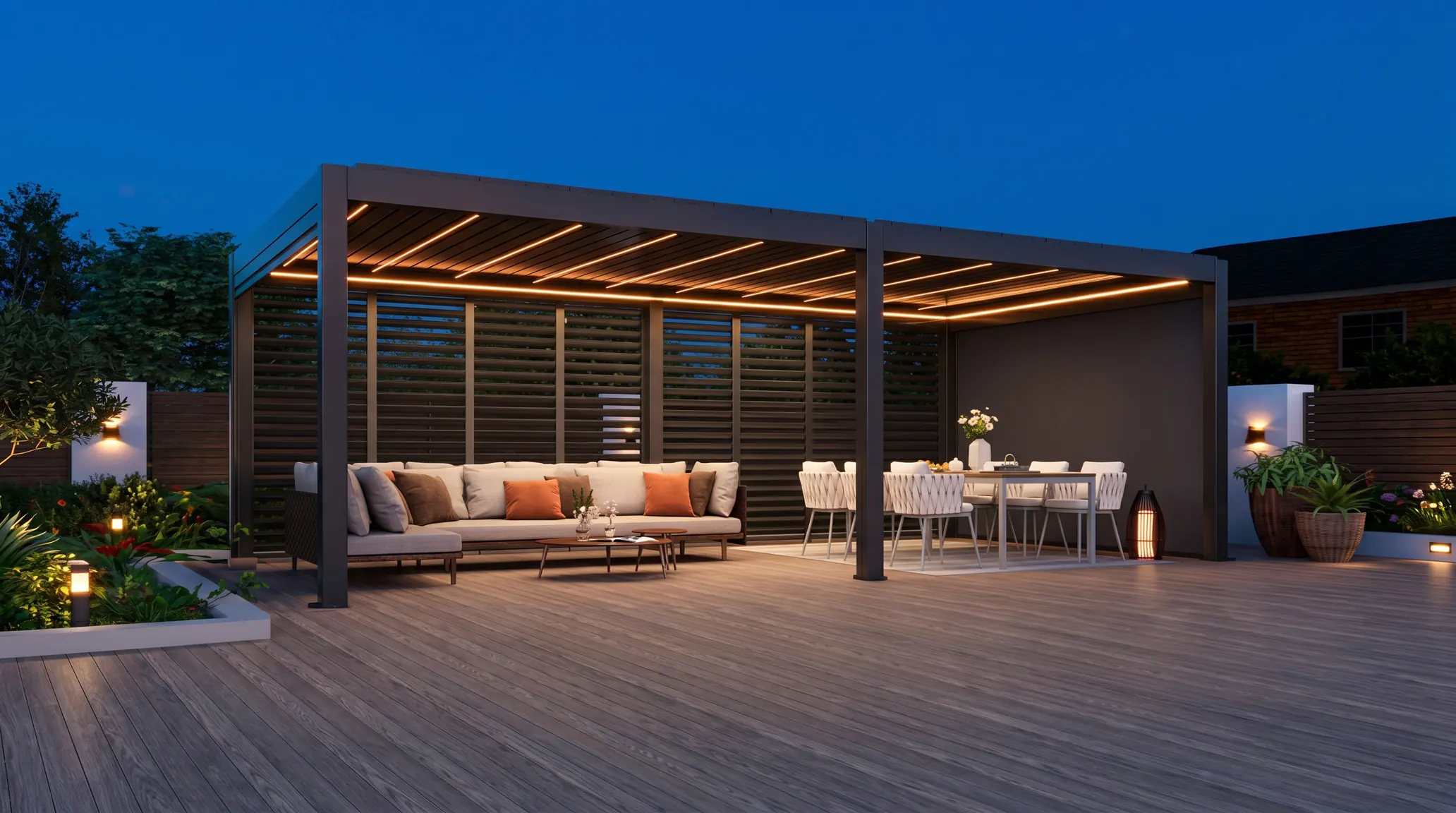
Traditional outdoor shading structures are undergoing a profound technological reconstruction. In the premium markets of Europe and North America, the definition of outdoor living space has evolved from a passive physical shelter into a bioclimatic architectural system that senses its environment, regulates itself adaptively, and is deeply interconnected. Through this evolution, aluminum extrusion profiles and mechanical drive assemblies have steadily become standardized commodities. The real product premium, the brand’s competitive moat, and the core profit pool are all migrating toward the underlying electrical architecture—the intelligent lighting and control system.
For pergola manufacturers across Europe and North America, sourcing, evaluating, and integrating an industrial-grade lighting and control ecosystem is no longer a peripheral accessory-purchasing decision. It is the strategic core that will determine a company’s market positioning for the next five years. If the control hub fails in extreme weather, or if the lighting system yellows and leaks within a few short months because of UV degradation, the entire architectural value of the pergola is wiped out. Written from the engineering perspective of professional lighting and control system R&D and manufacturing, this report gives pergola manufacturers a deep, hard-edged sourcing and integration checklist. It sets out to deconstruct market trends, the underlying technical architecture, safety-certification barriers, and the strategic give-and-take of the OEM/ODM supply chain.
Market Reconstruction and a Strategic Read on the Smart Profit Pool
Before drawing up a concrete sourcing list, manufacturers must accurately grasp the macroeconomic and technological variables driving growth in outdoor lighting and control systems. Understanding why consumers are willing to pay a steep premium for smart connectivity is the first step in deciding system specifications.
1.1 The Explosive Growth Trajectory of Smart Outdoor Lighting
The global lighting market is undergoing a paradigm shift from basic illumination toward smart micro-climate management. According to authoritative industry market research, the global smart lighting market was valued at USD 15.7 billion in 2024 and is projected to surge to USD 88.4 billion by 2034, sustaining a robust compound annual growth rate (CAGR) of 19.3% over the forecast period. More importantly for pergola manufacturers, the outdoor application segment is the fastest-growing of all, with a projected CAGR of as much as 20.6%.
| Market segment | 2024 valuation | 2030/2034 forecast | CAGR | Core growth drivers |
|---|---|---|---|---|
| Total global smart lighting | USD 15.7B | USD 88.4B (2034) | 19.3% | Deep IoT integration, long-term cost efficiency, rising safety standards |
| Hardware components | USD 12.5B | — | — | Miniaturization of sensors and controllers, greater durability in extreme conditions |
| Software & algorithm services | — | — | 17.4% | AI-driven adaptive lighting algorithms, real-time environmental data analysis |
| Wireless communication systems | USD 11.0B (wired) | — | 20.3% (wireless) | Lower installation cost, mobile remote control, seamless whole-home integration |
| Outdoor applications | — | — | 20.6% | Spread of bioclimatic architecture, landscape aesthetics, environment-aware automation |
This data reveals an underlying industry logic that cannot be ignored: growth in hardware systems is slowing, while software, algorithms, and wireless control protocols are becoming the core drivers. The implication is that a European or North American pergola manufacturer who merely sources cheap standalone switches and single-color LED strips will completely miss this 20.6% growth windfall. Today’s high-net-worth consumer is no longer buying “an aluminum frame for shade and rain”—they are buying “an outdoor living room whose ambiance can be set with a single tap on a smartphone.” A sourcing strategy must therefore elevate “openness of the software ecosystem” and “compatibility of wireless protocols” to the same strategic level as “physical corrosion resistance.”
1.2 The Engineering Shift from Static Components to Adaptive Systems
Industry trends make it clear that the outdoor living spaces of the future will rely heavily on advanced sensors, AI-driven lighting control, and real-time data analysis to enable adaptive regulation based on the natural environment and human activity. Leading brands such as StruXure, for example, offer not only superb mechanical engineering (like the Pergola X series capable of handling complex geometries) but also emphasize integrated automatic lighting, climate control, and smart sensor technology. Their Smart Pergola integrates “Weather Sense Technology,” which delivers an instant mechanical response to heavy rain or harsh sun, paired with an “Adaptive Lighting” system that automatically renders the right ambiance based on a timeline or weather conditions.
If a manufacturer’s control system cannot automatically cut the lighting and open the louvers to shed wind load when wind speed exceeds a threshold, or cannot be summoned within a whole-home smart system, its product will quickly be marginalized. The core focus of the sourcing checklist must therefore be a deep audit of the supplier’s underlying protocols and electrical architecture.
A Deep Look at Control Architecture: From Standalone RF to Whole-Home Connectivity
A pergola’s control system is the structure’s “central nervous system.” It governs not only the rotation angle of the louvers and the raising and lowering of wind-resistant screens, but also the voltage distribution and dimming smoothness across a multi-circuit lighting system. At the sourcing stage, procurement engineers must be clear about which tier of the smart-home ecosystem their product line will support.
2.1 The Four Tiers of Smart Integration
The electrical control architecture of any modern louvered pergola can be divided into four progressive tiers of integration. Each step up places exponentially greater demands on the receiver, gateway, and firmware algorithms.
- Tier One: Radio Frequency (RF) remote control. This is the baseline standard for every motorized pergola. The system relies on a specific radio frequency (such as 433.420 MHz) to establish point-to-point communication between the handheld remote and the motor receiver. RF control offers extremely fast response and stability that does not depend on the internet, but its fatal weakness is that it cannot operate without the physical remote and cannot achieve logic-based automation.
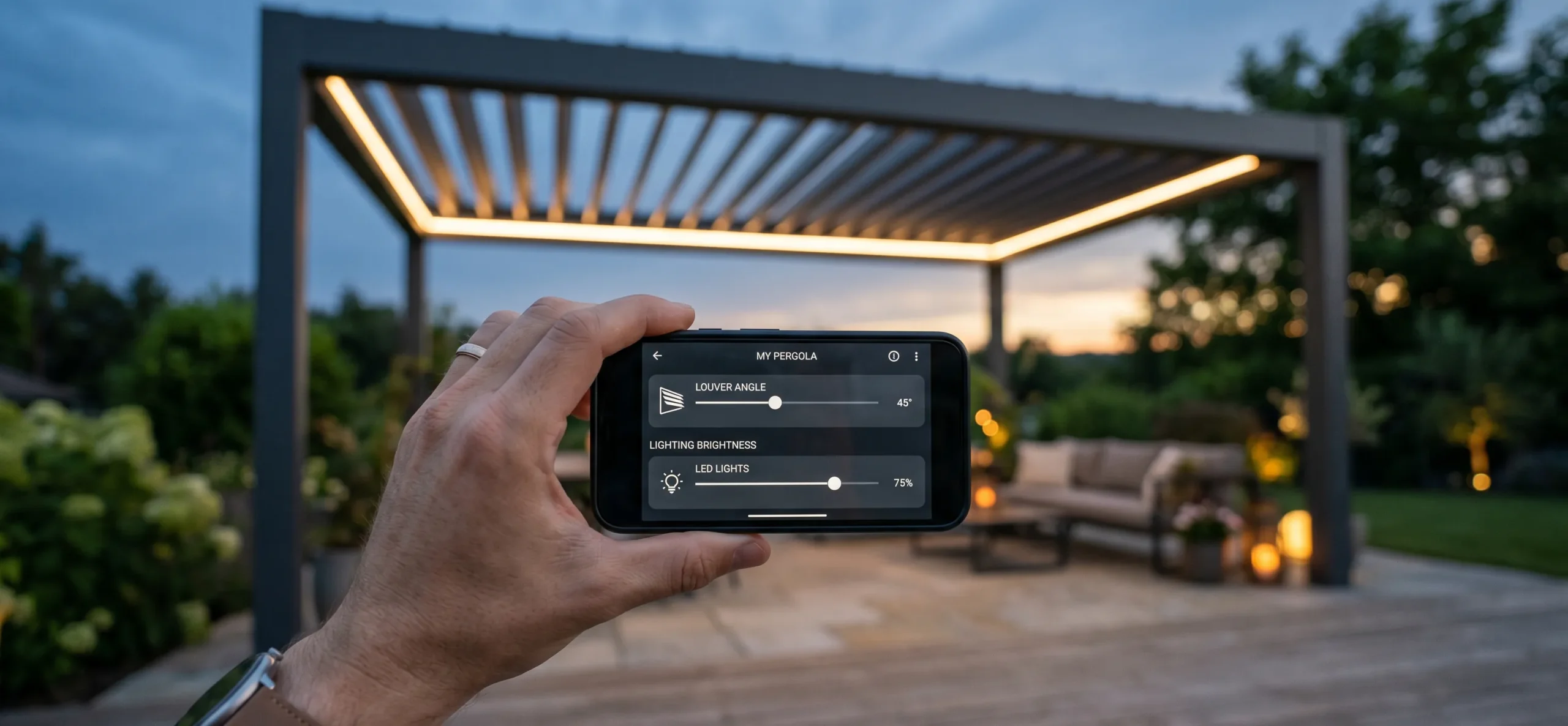
- Tier Two: Wi-Fi LAN and app control. To reach this tier, the manufacturer must source a system equipped with a Wi-Fi bridge or gateway. The gateway device (such as Somfy’s TaHoma Hub or Teleco’s Daisy interface) converts traditional RF signals into TCP/IP network protocols, letting the user precisely control the pergola’s opening angle and light brightness from anywhere in the world via a smartphone app. This tier unlocks “time scheduling” and “scene linkage.”
- Tier Three: Cloud voice-assistant integration. For consumers in Europe and North America, voice control is one of the most frequently cited smart requirements. When evaluating a control-system supplier, you must verify whether its API has earned official certification from Amazon Alexa, Google Assistant, and Apple Siri. Unverified third-party cloud interfaces are highly prone to dropouts, leading to serious customer-complaint disasters.
- Tier Four: Professional whole-home ecosystem integration. For high-end new-build mansions or commercial real estate projects, the pergola is only one node within a full building-automation system. At this tier, the control system must support seamless handshaking with professional automation platforms such as Savant, Control4, Crestron, and Lutron. This requires the supplier to provide a transceiver supporting the RS232 protocol, or a physical interface module with isolated dry contacts—such as Teleco’s TXL series interface module.
2.2 Benchmarking the Core Supplier Architectures: Somfy vs. Teleco Automation
Once product positioning is set, the procurement team typically has to choose between the world’s two major control-system schools of thought: the standard smart-home ecosystem represented by Somfy, and the outdoor-architecture-specific automation ecosystem represented by Teleco Automation. Deeply understanding the underlying logic of each is key to avoiding later system-rejection problems.
Somfy ecosystem: standardization and breadth of integration
Somfy offers a globally recognized communication protocol (RTS and IO-Homecontrol). Its core strengths are very high brand recognition and cross-category compatibility. Take its Pergola 12V/24V dual-motor RTS receiver, a device designed specifically for outdoor solutions.
- Electrical specs and protection: The receiver supports 12V or 24V DC and operates in the 433.420 MHz band. It supports motors both with and without encoders, and has built-in overload and overcurrent protection. If a louver is jammed by a branch or by ice and snow, the overcurrent protection instantly cuts power to prevent the motor from burning out or the mechanical linkage from snapping.
- Commissioning efficiency: Sourcing this system significantly lowers the installer’s labor cost. It offers fully automatic and semi-automatic travel-limit setting; the installer only needs to set one physical limit point, and the system automatically learns and controls the full stroke length. Users can also define a custom “my” (favorite) intermediate position for one-tap light-and-shadow adjustment.
- Strategic sourcing significance: Choosing the Somfy system means the pergola can link seamlessly with the consumer’s existing Somfy indoor shades and garage doors. For manufacturers targeting the mass premium market, this lowers the consumer’s learning curve.
Teleco Automation ecosystem: granularity and deep customization
Compared with Somfy’s breadth, Teleco Automation offers an engineering solution that is deeply customized for the bioclimatic pergola. Its control units are finely segmented according to the pergola’s mechanical motion type.
- Modular drive matrix: Teleco provides dedicated control boards for “adjustable-angle louvers” (PLA/PLD/PLS series), “retractable folding louvers” (PLP series), and “hybrid louvers” (PLR series). The PLR series, for example, can not only control two independent motors working in concert but also directly integrates a 24Vdc LED dimming controller, greatly shrinking the size of the electrical box so it can be perfectly hidden inside the pergola’s posts.
- High-power and complex load management: In cold-climate outdoor applications, pergolas often need to integrate infrared heaters. Teleco offers dimming receivers that can directly handle up to 6800W of purely resistive load over RF. At the same time, its Daisy Wi-Fi interface can synchronously orchestrate these high-voltage devices alongside low-voltage RGBW linear lighting.
- Advanced peripheral integration (audio and lighting): The innovative Melody audio system is a 12/24 Vdc Bluetooth control unit that can drive 4-ohm or 8-ohm embedded speakers, upgrading the pergola directly into an outdoor audio-visual room.
- Strategic sourcing significance: For manufacturers focused on extreme luxury who demand a high degree of customization and need to fuse audio, high-power heating, dynamic RGBW lighting, and complex mechanical motion into one whole, Teleco offers a more professional and deeper ODM foundation.
The Deep Fusion of Optical Engineering and Mechanical Structure
Having chosen the “brain” (the control system), you must then carefully select the “visual organs” (the lighting fixtures). Outdoor lighting is far more than slotting bulbs into aluminum tubes; it is a systemic challenge involving thermodynamics, optical distribution, DC voltage-drop calculation, and precision waterproofing engineering. Because of the structural characteristics of aluminum pergolas, the lighting system must be designed into the profile itself at the manufacturing stage.
3.1 The DC Architecture Debate: 12V or 24V?
When sourcing LED drivers and strips, settling the system’s reference voltage is the first technical watershed. While much entry-level landscape lighting still sits at 12V, in large bioclimatic pergolas a 24V system has become the absolute engineering consensus.
- Line loss and voltage-drop effects: When a pergola spans 4 or even 6 meters, long runs of strip wiring cause severe DC voltage drop. With a 12V system, the LED chips farthest from the power supply may receive a voltage that drops to 9V or even lower, producing a clearly visible “dark zone” or “color shift” (for example, white light turning pink) at the far end. The 24V architecture raises the initial voltage, dramatically easing voltage drop over long distances and ensuring perfectly uniform light output around the entire pergola.
- Current load and thermal management: By Ohm’s law, at the same power the current in a 24V system is only half that of a 12V system. Lower current means the wiring harness generates less heat during operation, which is critical for a pergola where cables are hidden inside sealed, unventilated aluminum posts. Reducing thermal stress not only extends the LED driver’s life but also eliminates a potential fire hazard.
3.1 The DC Architecture Debate: 12V or 24V?
When sourcing LED drivers and strips, settling the system’s reference voltage is the first technical watershed. While much entry-level landscape lighting still sits at 12V, in large bioclimatic pergolas a 24V system has become the absolute engineering consensus.
- Line loss and voltage-drop effects: When a pergola spans 4 or even 6 meters, long runs of strip wiring cause severe DC voltage drop. With a 12V system, the LED chips farthest from the power supply may receive a voltage that drops to 9V or even lower, producing a clearly visible “dark zone” or “color shift” (for example, white light turning pink) at the far end. The 24V architecture raises the initial voltage, dramatically easing voltage drop over long distances and ensuring perfectly uniform light output around the entire pergola.
- Current load and thermal management: By Ohm’s law, at the same power the current in a 24V system is only half that of a 12V system. Lower current means the wiring harness generates less heat during operation, which is critical for a pergola where cables are hidden inside sealed, unventilated aluminum posts. Reducing thermal stress not only extends the LED driver’s life but also eliminates a potential fire hazard.
3.2 Pergola Lighting Topology and Hardware Specifications
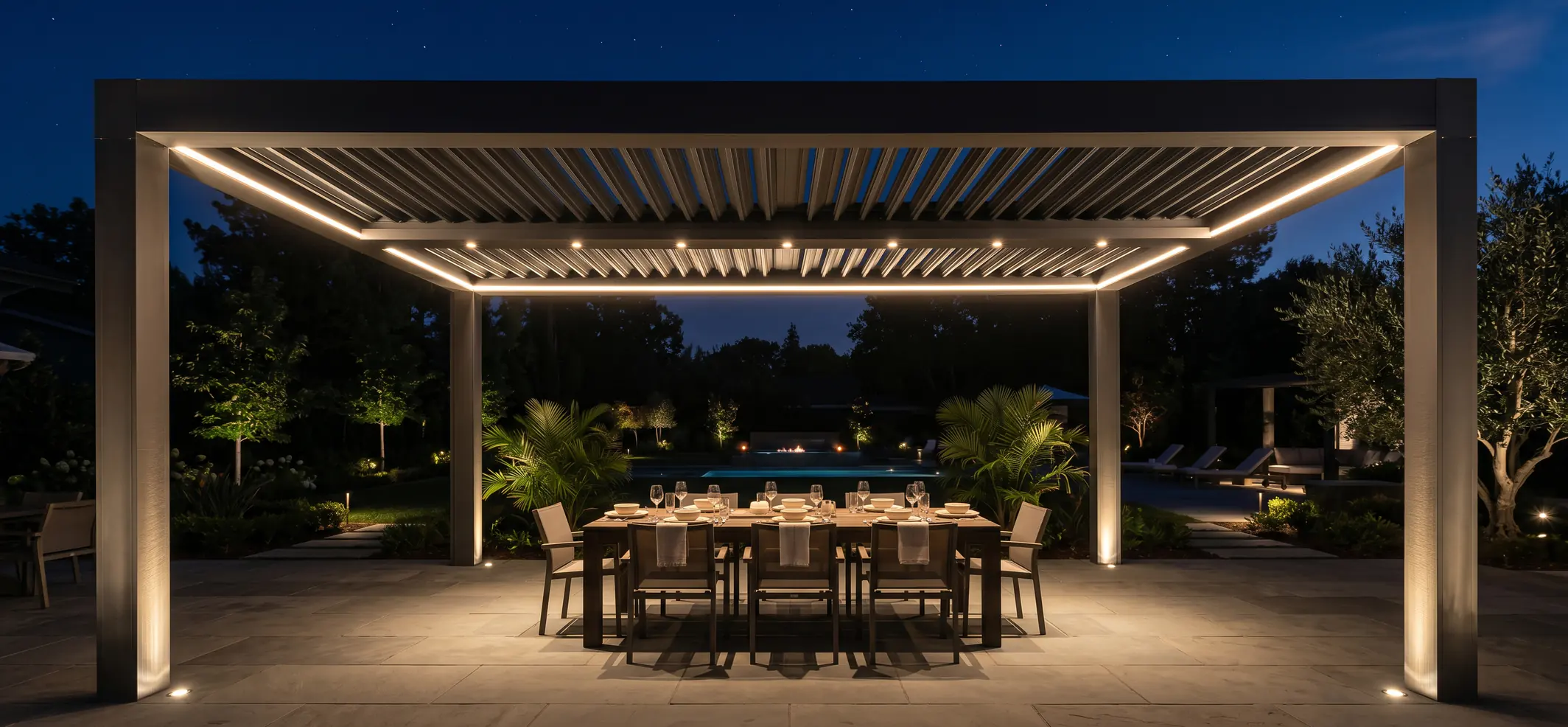
Outstanding pergola lighting requires combining ambient lighting, task lighting, and accent lighting to build a three-dimensional layering of light and shadow. Different lighting needs correspond to entirely different hardware specifications, which means the supply chain must offer a rich mix of product categories.
1. Linear LED strips — the cornerstone of ambient atmosphere
Linear lighting is the most central light source for a louvered pergola, usually hidden inside the perimeter awning drainage gutter or on the inner side of the louver blades.
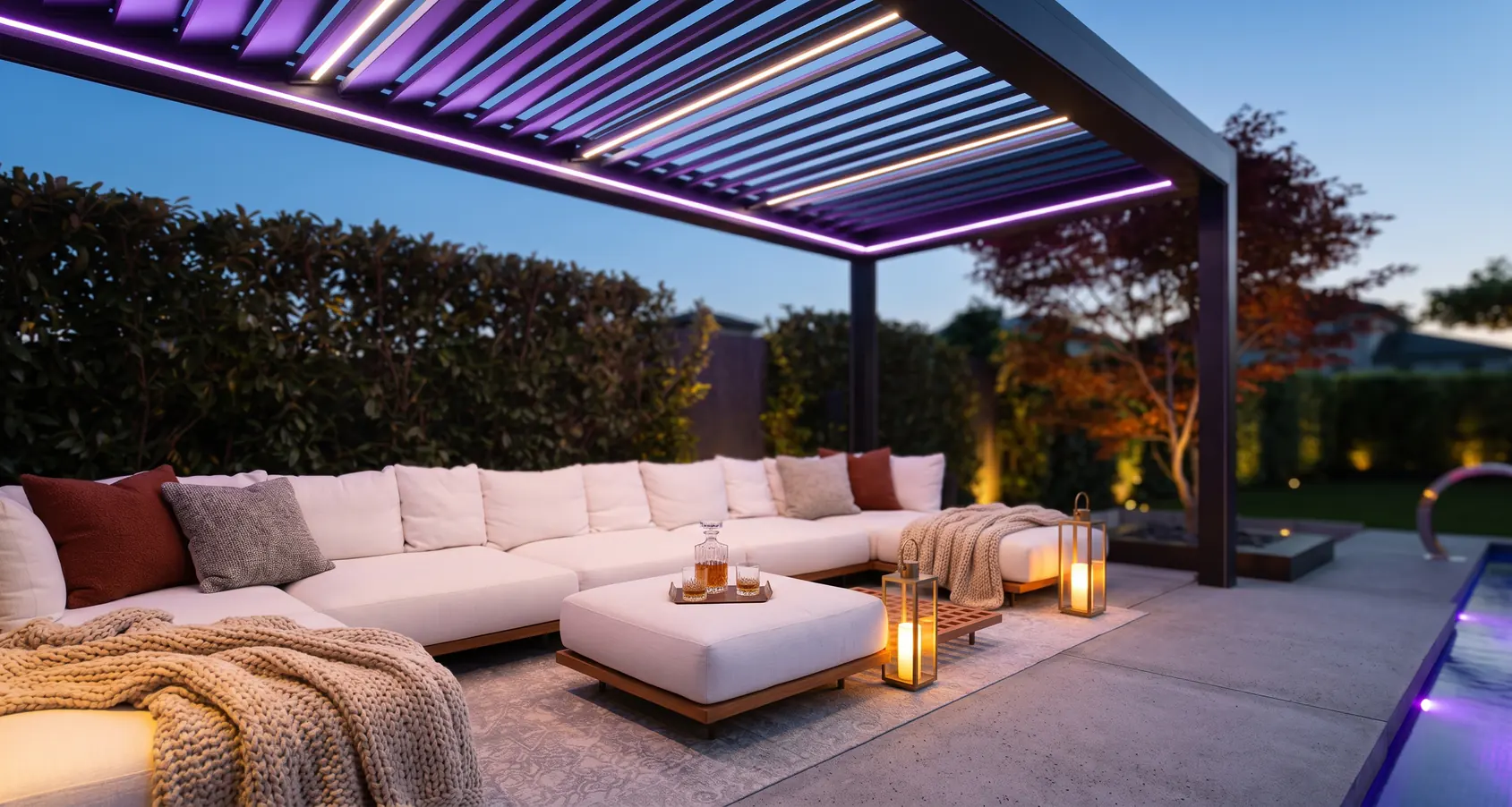
- Chip and color-temperature control: Top-tier manufacturers should source strips with RGBW (red, green, blue, plus a dedicated warm white) four-in-one chips. A true RGBW system can not only synthesize tens of millions of colors; its independent white channel (typically 2700K warm white or 3000K soft white) can deliver high-CRI (CRI > 90) illumination without skewing color—ideal for reading and dining.
- The fatal difference in encapsulation material (silicone vs. PVC): This is the easiest pitfall in the supply chain. Cheap OEM factories typically offer epoxy-dipped or sleeve-type PVC-encapsulated strips. Under intense outdoor UV exposure and sharp temperature swings, the plasticizers inside the PVC migrate out rapidly, causing the strip to yellow, become brittle, and even crack within half a year—followed by moisture ingress that causes short circuits and dead LEDs. A professional sourcing checklist must mandate UV-resistant, food-grade silicone extruded strips. Teleco’s NOS-101 and NOS-5 series, for example, fully encase the LED chips in inert silicone, making them completely immune to UV aging and chemical corrosion.
- Concealed structural design: Fixtures must achieve a geometric-level match with the pergola profile. Excellent systems (such as Paragon Outdoor’s integrated design) fully embed the strip via a custom aluminum light-diffusing channel, achieving “you see the light, not the fixture,” preserving a minimalist modern aesthetic with no exposed flying leads.
2. Recessed downlights and adjustable spotlights — precise optical strikes
To deliver sufficient illuminance without disrupting the pergola’s roofline, recessed downlights are the best choice.
- Ultra-thin physical constraints: Traditional “can lights” are far too bulky to fit inside a pergola’s limited beam frame. The procurement team needs to find spring-clip LED panel lights or downlights that are extremely thin (typically under one inch). For example, the Aura Downlights series integrated into Trex Pergolas is very low-profile, with precise CNC punching and pre-installation completed before the aluminum ships from the factory.
- Heat-sink design for external spotlights: If you choose externally mounted, adjustable aluminum spotlights (such as Teleco’s Regulus or Beta series), you must evaluate the heat-dissipating fin design of the aluminum housing. Under direct summer sun, an outdoor pergola’s surface temperature can exceed 60°C; if the spotlight dissipates heat poorly, the LED chip will suffer severe lumen depreciation.
3. Accent and vertical lighting
Using up/down wall lights mounted on the posts, or in-ground lights illuminating the pergola’s architectural outline from below, can dramatically elevate the nighttime sense of luxury. When sourcing in-ground lights, because they are in direct contact with soil or concrete, you must require IP67 or even IP68 waterproof ratings and very high crush strength (drive-over rated).
3.3 Dimming Smoothness: The Trade-off Between PWM and Higher-Order Control Protocols
If the brightness gradient is not smooth, it directly undermines the luxury experience. Basic LED controllers use low-frequency pulse-width modulation (PWM), which produces visible flicker at low brightness and can only dim down to 10%. A high-quality lighting system should use high-frequency PWM drive, or dimmers that support commercial-grade protocols such as 0-10V and DALI (Digital Addressable Lighting Interface). These higher-order drivers achieve stepless, smooth dimming with “one-thousandth (0.1%)” deep-dimming capability, so the light can be as soft and flicker-free as a candle late at night.
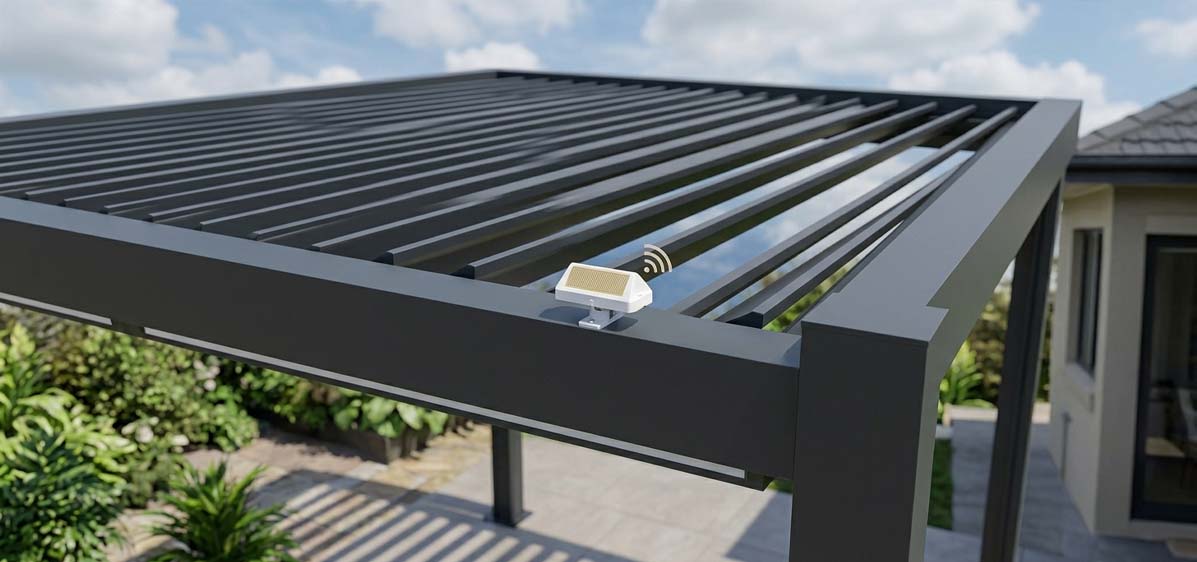
The Bioclimatic Sensing Network: Sensor Matrix and Liability Protection
A pergola with adjustable louvers earns the name “bioclimatic architecture” because it can respond reflexively to surrounding weather changes, like a living organism, without active human intervention. This capability depends entirely on a high-precision sensor matrix. Sourcing high-quality sensors is not only about adding selling points—it is about avoiding catastrophic legal liability. If the structure fails to respond in time during a storm and collapses, the manufacturer will face enormous claims.
4.1 The Fail-Safe Logic of Anemometers (Wind-Speed Telemetry)
When the louvers are fully closed into a flat plane, the entire pergola roof becomes a giant airplane wing. In strong convective weather, high-speed airflow generates extremely powerful aerodynamic uplift force at the top—enough to tear posts anchored into concrete with expansion bolts right out by the roots.
- Dynamic wind-load shedding: The control system must be equipped with an industrial-grade anemometer (such as the Somfy Eolis 24V or Teleco ANEM4). The control logic must include a top-priority underlying forced interrupt: once wind speed reaches the danger threshold set by the installer (for example, an adjustable range of 12 to 60 mph), the system must instantly block any close command from the user and automatically force all louvers to flip to a fully open 90-degree position, letting the wind pass straight through the structure and completely shedding the uplift.
- Wired vs. wireless: While wireless anemometers are easy to install, in commercial areas with severe electromagnetic interference the procurement team should prioritize wired anemometers to ensure that the signal of this last safety line is never lost.
4.2 The Fatal Flaw in Precipitation Detection: Why You Must Source Heated Sensors
A rain sensor’s job is to close the louvers the instant precipitation is detected, protecting the furniture and people beneath the pergola. However, in regions of Europe and North America with significant four-season temperature swings, an ordinary conductive rain sensor has a fatal engineering flaw: freeze-thaw failure.
- The ice-and-snow trap: An ordinary rain sensor relies on water droplets bridging a circuit to trigger a signal. When the temperature drops below freezing, snow or ice covers the sensor surface. At this point the solidified water no longer conducts, and the sensor may fail to respond during a blizzard. Conversely, when the ice and snow begin to melt, the residual slush keeps the sensor in a false-positive “it’s raining” state for a long time, locking up the entire pergola system so the user cannot open the louvers.
- The mandatory heating standard: To solve this pain point, the sourcing checklist must set a hard requirement: only source rain/snow sensors with a built-in self-heating array (PTC heating element). For example, the RAIN105H (a wired rain-temperature combination sensor) and RAIN106WTS (a five-in-one wind, light, rain, snow, and temperature sensor) offered by Teleco. When these sensors detect that ambient temperature is approaching freezing, they automatically activate a heating panel to melt surface ice and snow, ensuring accurate, real-time precipitation telemetry in any extreme-cold climate.
4.3 Light Thresholds and Passive Thermodynamic Management
To achieve true energy savings and comfort, the system needs to perform thermodynamic regulation based on the sun’s radiation intensity (lux).
- Solar tracking and ventilation: A sunlight sensor (such as the Somfy Sunis or Teleco’s Green Mouse) continuously monitors light intensity in kilolux (Klux). When the summer sun is high and intensity breaks the set threshold, the system should automatically adjust the louvers to a slightly open 45-to-60-degree state. This specific angle fully blocks direct sunlight while exploiting the stack effect, letting the hot air gathered below escape rapidly through the louver gaps to form a natural breeze convection.
- Astronomical clock and ambient-light linkage: Illuminance sensors such as the Teleco EOS control not only the louvers but are also deeply bound to the lighting system. As dusk falls and natural light decays to a specific value, the ambient sensor sends a signal to the control hub to automatically illuminate the pergola’s hidden ambient lighting, achieving a seamless day-to-night transition.
Clearing the Compliance Moat: An Engineering Analysis of UL 8750 and IEC 60529
The most easily overlooked yet most devastating link in the sourcing process is the safety compliance of electrical components. Integrating an uncertified, cheap power supply or controller into a high-end aluminum pergola and selling it is equivalent to burying a time bomb in the consumer’s backyard. The markets of Europe and North America have the world’s most stringent safety-review mechanisms, especially for outdoor electrical products.
5.1 UL 8750: The Lifeline for LED Equipment in North America
To enter the North American market, the Underwriters Laboratories (UL) mark is an iron gate you cannot get around. Many manufacturers wrongly believe that a UL-certified power supply is enough, but in reality, for LED equipment integrated inside fixtures and the building structure, you must meet the UL 8750 standard.
- Guarding against thermal runaway and fire: The official UL 8750 guidelines clearly define the safe-operation requirements for LED modules, arrays, drivers, and controllers, focusing on evaluating electrical insulation, grounding, overcurrent protection, and thermal stability. In pergola applications, the LED driver (transformer) is often forced to be installed inside sealed aluminum posts or main beams. In a Texas or Florida midsummer, the baking temperature inside a post can exceed 70°C. If you source a cheap driver that has not undergone UL 8750 thermal testing, the potting compound or electrolytic capacitors inside it can easily swell and rupture at high temperature, triggering an electrical fire.
- The Class 2 circuit exemption: The latest revised UL 8750 exemption clauses strongly emphasize the importance of “Class 2” output-power circuits. If the sourced driver’s output is certified as Class 2 (voltage below 60Vdc, power strictly limited to within 100W), then its downstream wiring and strips will not produce fire-starting sparks or fatal shocks even under a short circuit. Using a Class 2 system lets manufacturers legally adopt lighter wiring harnesses and, in many regions, waive the regulatory requirement for hardwiring by a licensed electrician, dramatically lowering the end customer’s installation cost.
5.2 IEC 60529: Decoding the Watertight Secrets of IP Ratings
In Europe and global markets, the 60529 standard set by the International Electrotechnical Commission (IEC)—the IP rating—is the sole yardstick for measuring an electrical enclosure’s ability to resist the ingress of solids and liquids. The IP code consists of two digits: the first represents protection against solids (0-6), and the second against water (0-9). Many suppliers abuse the word “waterproof” in their sales pitch, and the procurement team must use IP data to cut through that rhetoric.

| IP code | First digit: solid-particle protection | Second digit: liquid-ingress protection | Engineering specification for pergola manufacturing |
|---|---|---|---|
| IP20 | Prevents ingress of solids > 12.5mm (finger-proof). | No water protection at all. | Outdoor use strictly prohibited. Suitable only for main control boards or gateway modules installed in a dry indoor enclosure. |
| IP54 | Dust-protected (limited non-harmful dust may enter). | Protection against splashing water from all directions. | On the edge of danger. Many low-end sensors are rated IP54, but in a strong convective storm, rain can still be forced through the seams by wind pressure, causing a short circuit. |
| IP65 | Fully dust-tight (no dust contact whatsoever). | Protection against low-pressure water jets from all directions. | The pass line for outdoor systems. This is the minimum mandatory standard for all motor housings, downlights, and ambient sensors installed on top of the pergola. |
| IP67 / IP68 | Fully dust-tight. | Protection against temporary immersion (1m deep, 30 min) / continuous immersion. | The ultimate defense for wet, standing-water zones. Any linear strip inside a drainage gutter, or in-ground light in direct contact with soil, must be mandated to IP67 or even IP68. |
The weak point of a waterproof system: connector engineering. Even if you source IP67-rated strips and control boxes, if the connectors between harnesses are only IP44, the whole system still collapses. Rain will travel by capillary action along the gaps of poor-quality connectors, climbing up through the voids inside the copper wires until it finally burns out the controller mounted above the post. The sourcing checklist must therefore explicitly require that all outdoor extension harnesses use IP67-rated waterproof connectors with aviation-thread locking mechanisms; for strips that must be cut and joined on-site, you must require matching waterproof end caps, heat-shrink tubing, and a thorough secondary seal with RTV silicone.
The OEM/ODM Sourcing Deep-Dive Checklist for Manufacturers
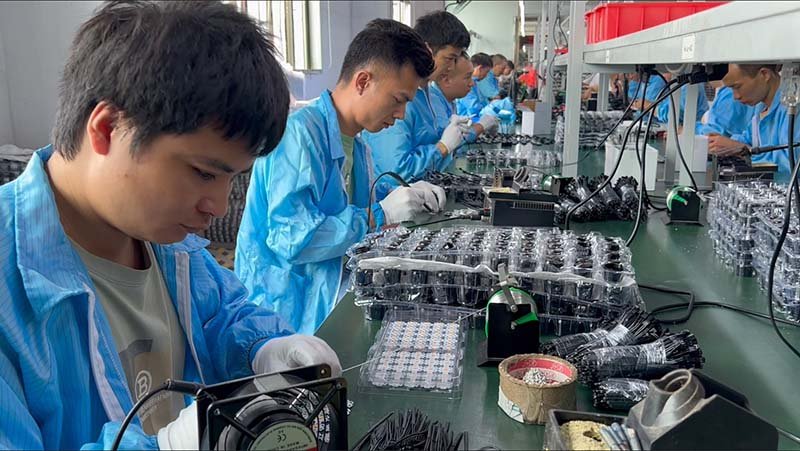
Having mastered market trends, the underlying architecture, optical characteristics, and safety barriers, all of this theory must ultimately land in supply-chain management. In B2B sourcing logic, shifting from traditional “take it off the shelf” thinking toward deep OEM (contract manufacturing) and ODM (original design manufacturing) partnerships is the only path for a pergola manufacturer to build a moat. Below is a comprehensive evaluation checklist a procurement director can use directly.
6.1 Stripping Out the Hidden Total Cost of Ownership (TCO)
When negotiating with lighting suppliers in China, Taiwan, or Eastern Europe, procurement teams often fall into the “BOM unit price” trap. If a low unit price brings high assembly time and terrifying after-sales costs, the total cost of ownership (TCO) will completely drag down the company’s cash flow.
- Production-line assembly efficiency (plug & play): Does the supplier’s system require line workers to perform complex wire-stripping, terminal crimping, and soldering, or does it offer error-proof “plug-and-play” harness assemblies? A system with built-in error-proof connectors can save up to 2 hours of assembly time per pergola and completely eliminate the human error of reversing polarity.
- RMA (return authorization) and trans-ocean logistics loss: Assessing the supplier’s quality-control system is critical. If a cheap strip embedded inside an aluminum tube fails at the customer’s site, the manufacturer must pay for an electrician’s on-site diagnostic labor, the destructive cost of removing the aluminum panel, and the high international air-freight cost of shipping replacement parts. These hidden costs are often hundreds of times the value of the strip itself. You must therefore find suppliers willing to offer a 2-to-5-year commercial limited warranty (such as Somfy’s 5-year warranty and Structureworks’ 2-year warranty), and require 100% full-load burn-in testing before shipment.
- Currency hedging and inventory buffers: International buyers must recognize how exchange-rate fluctuations, tariff barriers (such as anti-dumping duties), and shipping freight affect final pricing. An excellent ODM partner should have localized service capability—for example, setting up overseas warehouses in Europe and North America for vendor-managed inventory (VMI) to resist macro supply-chain shocks.
6.2 White-Labeling and System Symbiosis
If the control app your pergola uses opens to show the logo of some obscure electronics factory, your brand premium instantly drops to zero.
- Private deployment of UI/UX: A quality ODM supplier provides not only hardware but also software-level white-label service. They allow the pergola manufacturer to redesign the app’s user interface (UI) in colors that match its own brand identity and to imprint its own corporate logo. In the eyes of the end user, this complex smart system is core technology developed in-house by the pergola brand.
- Profile-structure fusion design: Standard strip aluminum channels often cannot perfectly fit each brand’s unique extruded profile. Top OEM manufacturers (such as Se.Lighting and other factories with rich customization experience) can open molds for special silicone sleeves or aluminum positioning clips based on the manufacturer’s CAD drawings, achieving a seamless friction-fit between fixture and beam.
- Firmware-level modification rights: Is the supplier willing to open the underlying control-logic permissions to you? For example, a certain pergola may need its louvers to open precisely to 33 degrees in snow mode for the best snow-shedding effect. A supplier with strong R&D capability can write this specific angle into the underlying chip by modifying the firmware, forming an exclusive competitive advantage.
6.3 Extreme Corrosion-Resistance Material Review
Outdoor structures face not only wind and rain but also high concentrations of salt spray (salinity) in coastal regions and acid rain in industrial cities.
- Marine-grade heavy corrosion protection: The checklist must mandate that all clips, hinges, and exposed screws used to fix strips be made of 316L marine-grade stainless steel. Any compromise toward galvanized carbon steel will leave ugly rust streaks after the first storm, completely ruining the pristine aluminum.
- Architectural-grade certification for surface coatings: All external aluminum electrical boxes and spotlight housings must be anodized, or use an outdoor architectural-grade UV-resistant powder coating compliant with AAMA 2604 / AAMA 2605. This guarantees that the product will not chalk, peel, or fade even after ten years of intense UV exposure.
6.4 Verifying Supply-Chain Resilience and R&D Depth
The final step is to perform due diligence on the supplier’s enterprise-level vitality.
- Manufacturing capacity and automation rate: Audit whether the contract factory has a cleanroom of sufficient scale and fully automated SMT (surface-mount technology) lines. Workshop-style manual production absolutely cannot guarantee color-temperature consistency across millions of LED chips.
- Optical-consistency management: The core metric—does the supplier have an integrating-sphere laboratory? Does it enforce a strict MacAdam ellipse binning standard? Only then can you guarantee that the color temperature of the pergola lighting you ship this year will exactly match the color temperature of a replacement strip a customer requests three years later after accidental damage, avoiding the awkward situation of one strip skewing yellow and another skewing blue.
Conclusion: Reject Patchwork, Embrace a Full-Domain Ecosystem
In the increasingly brutal blue-ocean race of the smart pergola, the era of assembling products from cobbled-together components is firmly over. A sourcing checklist that can withstand harsh environmental testing is, in essence, a refusal letter against engineering compromise.
From grasping the voltage-drop laws of the 24V architecture to insisting on UV-resistant silicone encapsulation; from avoiding the freeze-thaw trap of rain sensors to holding the UL 8750 and IP65/67 safety red lines; and on to white-label customization down to the app source-code level—every small engineering decision will ultimately be magnified across macro market share and brand reputation.
To colleagues across the pergola manufacturing industry: now is the best moment to re-examine your own electrical supply chain. Don’t let outdated standalone RF remotes and inferior PVC strips become the Achilles’ heel that drags down your superb aluminum structural design. Use this checklist now to conduct a deep technical-penetration audit of your existing control-system supplier; at the same time, open the door to professional ODM partners with true underlying R&D capability, an integrating-sphere laboratory, and a software-customization team. Together, let us use light, shadow, and intelligent code to redefine the boundaries of outdoor luxury architecture.

Pingback: How Pergola Manufacturers Can Replace Separate Remotes with One Integrated Lighting and Louver Control System
Pingback: One Pergola Remote for Lighting & Louvers | OEM Guide
Pingback: RGB, RGBW, and Mono LED Control for Louvered Pergolas: Specification Guide
Pingback: Why Pergola Lighting Controls Fail Outdoors
Pingback: Rain Sensor Placement for Motorized Louvered Roofs: Factory and Installer Guidelines
Pingback: Designing a Dealer-Friendly Control Kit for Motorized Pergolas