


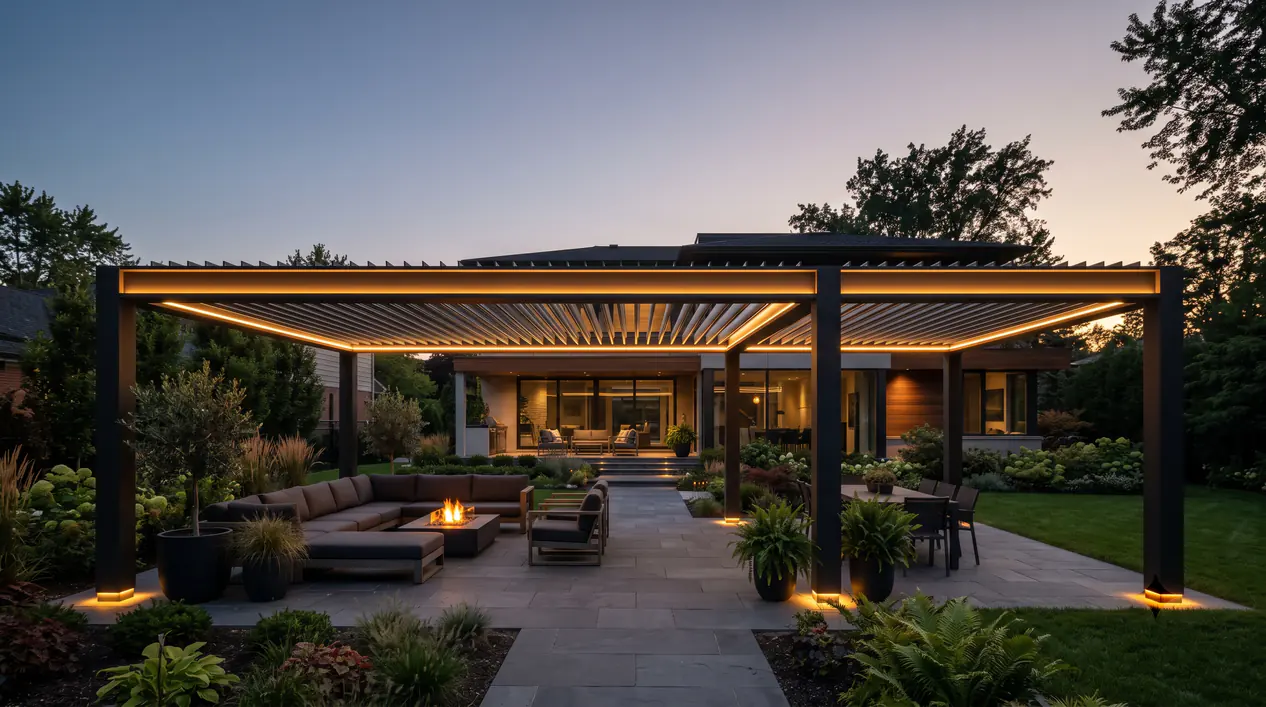
When consumers in Europe and North America search for “motorized louvered pergola,” they are no longer looking for a simple rain cover. They expect an intelligent outdoor climate space that integrates seamlessly with the smart home ecosystem, senses environmental changes, and delivers commercial-grade ambience lighting at night.
As a specialist manufacturer deeply focused on pergola lighting and control systems, we have found a decisive rule through joint development projects with leading European and North American brands: the final retail premium and brand moat of a pergola are defined by four electronic systems inside it — motors, controls, lighting, and sensors. In the current market, a basic imported manual kit may sell for only USD 2,000, while a commercial-grade or dealer-customized pergola with top-tier electronics can easily exceed USD 55,000. This price gap of tens of thousands of dollars is essentially a revaluation of automation, climate awareness, and light-based experience.
This report analyzes how these four core electronic components directly reshape the BOM cost of a louvered pergola from the professional perspective of B2B manufacturing, supply chain cost breakdown, and smart system architecture. It also explains how pergola manufacturers can move beyond low-end price wars and achieve a step-change in per-unit margin through advanced OEM and ODM electronic supply chain strategies.
Market Segmentation: How Electronic System Configuration Defines Pricing Power
Before discussing the technical details, we must first break down the pricing pyramid in today’s European and North American markets. The large differences in consumer-end pricing accurately reflect the level of electronic integration in the B2B supply chain. The pergola market is no longer a single-category competition. It has evolved into four clearly differentiated value tiers.
Four Value Tiers in the Louvered Pergola Market
By aggregating the pricing models of mainstream brands such as StruXure, Azenco, and The Luxury Pergola, we can clearly see the decisive role played by electronic systems:
| Market Tier | Retail Price (10×13 ft) | Cost per sq ft | Core Electronic Configuration | Target Customers |
|---|---|---|---|---|
| Basic imported kit | USD 2,000–5,000 | USD 19–38 | Thin-wall aluminum, ~250–450 lb; basic unnamed DC motor, 3–5 yr warranty; single RF remote only; no sensors. | Price-sensitive DIY consumers via big-box retailers or low-end ecommerce. |
| Mid-range DTC brand | USD 6,000–12,000 | USD 46–92 | Moderate structure, ~500–900 lb; mid-grade tubular motor; basic mobile app; optional single-color LED strip and simple rain sensor. | Middle-class consumers seeking value, served mainly by direct-to-consumer online brands. |
| High-end commercial-grade DTC | USD 15,000–25,000 | USD 115–195 | Aerospace-grade 6061-T6 aluminum, up to 1,500–1,800 lb; premium quiet 24V DC motor; multi-channel RS485/Zigbee; full wind, rain, snow sensors; RGBW dotless lighting; smart-home compatible. | High-end residences, premium restaurants, and hotels valuing all-weather usability and lifetime warranty. |
| Local dealer customization | USD 35,000–60,000+ | USD 230–420 | Electronics similar to high-end commercial, plus 30–50% dealer markup, local site survey, custom drawings, municipal permits, and white-glove installation. | Ultra-high-net-worth homeowners and large commercial complexes via premium contractor networks. |
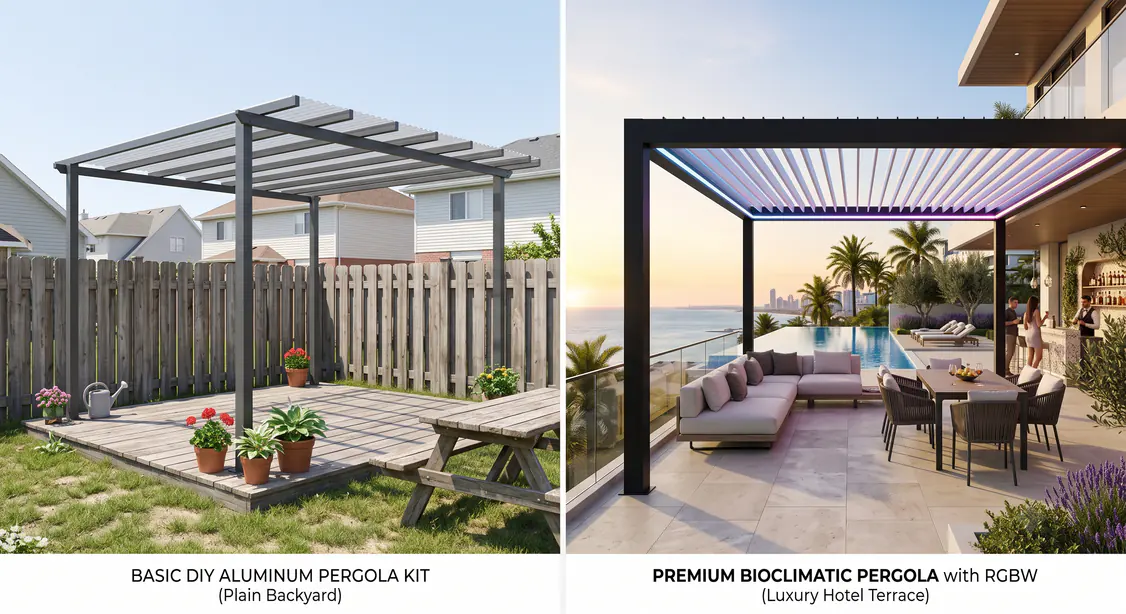
One key conclusion can be drawn from this matrix: the BOM cost increase from a basic kit to a high-end commercial product is not linear, but the retail premium can grow exponentially. In mature markets such as Los Angeles, a luxury automated pergola with AI-optimized control, hidden ZIP screens, and RGBW lighting can reach USD 325–375 or more per square foot, with total project prices easily exceeding USD 62,000. Within this total cost, the difference in structural aluminum cost may only be a few thousand dollars. The real differentiator that absorbs the premium is the intelligent nervous system, which may account for roughly 20–25% of the total cost and allows the pergola to protect itself even under hurricane-force wind conditions.
The Power Core: Physical Limits and Cost Logic of Tubular Motors
Every dynamic experience of a louvered pergola — from the quiet rotation of the louvers to their tight closure — depends on the actuator hidden inside the aluminum beam. Because of its compact cylindrical design, the tubular motor can be perfectly concealed inside the profile cavity and has become the natural choice for modern motorized pergolas. However, in B2B procurement, short-sighted motor selection is often the root cause of severe after-sales claims, including leaking louvers and burned motors.
Strategic Voltage Platform Choice: 24V DC vs. 110V/230V AC
The first technical dividing line for manufacturers is the voltage platform. This decision affects not only procurement cost, but also the end user’s installation cost and acoustic experience.
24V low-voltage DC motors currently dominate the high-end residential pergola market. Their most important commercial value lies in excellent NVH performance: noise, vibration, and harshness. First-tier 24V DC tubular motors, built with precision planetary gearboxes and electronic soft braking, can keep operating noise around 40–60 dB, similar to a quiet conversation and low enough to preserve the tranquility of an outdoor space. More importantly, low-voltage systems significantly reduce electric shock risk. In North America and Europe, this allows many consumers to complete DIY installation without hiring a licensed electrician at USD 150 per hour for hardwiring approval, directly lowering total installation cost. In addition, the 24V platform is highly compatible with solar-powered off-grid systems, aligning with the energy independence and carbon-neutral trend currently favored in the European market.
110V/230V AC motors remain irreplaceable in oversized commercial pergolas and heavy rolling shutter applications. AC voltage can easily deliver higher rated torque, typically from 15 Nm to more than 50 Nm, making it suitable for heavy, wide metal louver structures weighing more than 30 kg. It also helps avoid serious voltage drop over long cable runs. The tradeoff is higher electrician installation cost, more complex municipal electrical permits, and more noticeable operating noise.
Engineering Logic and Safety Margin in Torque Calculation
Trying to reduce cost by purchasing cheap, low-torque generic motors is one of the most dangerous gambles in pergola manufacturing. Insufficient torque not only prevents louvers from sealing tightly — which can cause leakage in heavy rain — but also keeps the motor close to overload for long periods and accelerates physical wear of the electromagnetic brake.
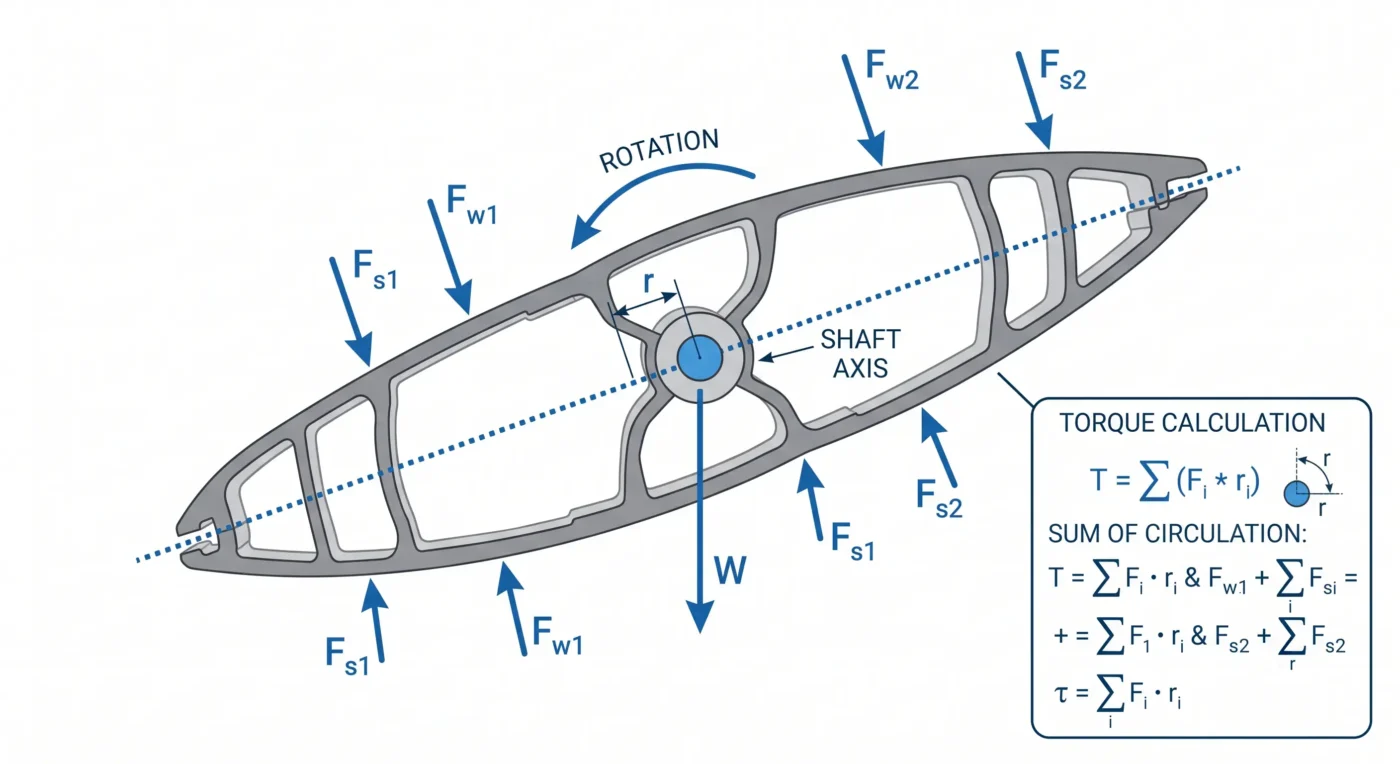
The theoretical physical torque formula for a tubular motor is:
In real pergola engineering, however, a strict safety margin must be added. Consider three practical engineering scenarios:
- Standard residential application. Assume a medium-size louver set weighs 15 kg and the drive shaft diameter is 50 mm, giving a radius of 0.025 m. The basic torque requirement is 0.375 Nm. For daily residential use (typically 2–4 opening and closing cycles per day), manufacturers usually need a 20% safety margin. The actual motor selection should therefore be no lower than 0.45 Nm.
- High-frequency commercial office application. If the same pergola is installed on an office terrace and paired with frequent micro-adjustments from a daylight-tracking system, the safety margin should increase to 30%, raising the motor requirement to 0.49 Nm.
- Heavy luxury hotel structure. For large commercial louvers weighing 25 kg with a 60 mm drive shaft, the basic torque is 0.75 Nm. Considering high-frequency, unattended automated operation in hotel environments, the safety factor should be raised to 35–40%, meaning final motor output torque should not be lower than 1.05 Nm.
Ignoring safety margin directly leads to serious coil heating, thermal protection triggering, and even motor burnout. On the B2B procurement side, smart motors from premium brands such as Somfy or Nice may cost USD 800–1,500, while motors from unknown contract factories may cost only USD 300–600. But the few hundred dollars of difference buys torque-sensing intelligent limit technology. It can detect the physical resistance of the louvers and automatically fine-tune closing force, ensuring 10,000–50,000 fault-free cycles, equivalent to roughly 13–68 years of service life. For high-end brands, premium motors are the only physical foundation that can support a lifetime warranty promise to consumers.
Visual Experience and Ambience: OEM Strategy and Margin Reshaping for High-End LED Lighting
If the motor determines the physiological lifespan of a pergola, the lighting system determines its emotional premium. In the European and North American markets, a well-designed integrated LED lighting system — including canopy ambience lighting and column wall-washing lights — can easily add USD 500–3,000 in retail value. However, many pergola manufacturers that are strong in metal fabrication lack electronic component expertise. They often adopt a rough “market purchase plus on-site assembly” model, which wastes significant margin and creates serious safety risks.
Why IP67 24V COB Dotless Technology Becomes the Natural Standard
Outdoor pergolas are exposed year-round to strong UV radiation, heavy rain, and sharp day-night temperature changes. In this harsh environment, any compromise that uses indoor-grade light strips — such as IP20 or IP44 products — can turn within months into yellowed silicone, light decay, water ingress, and short-circuit after-sales failures.
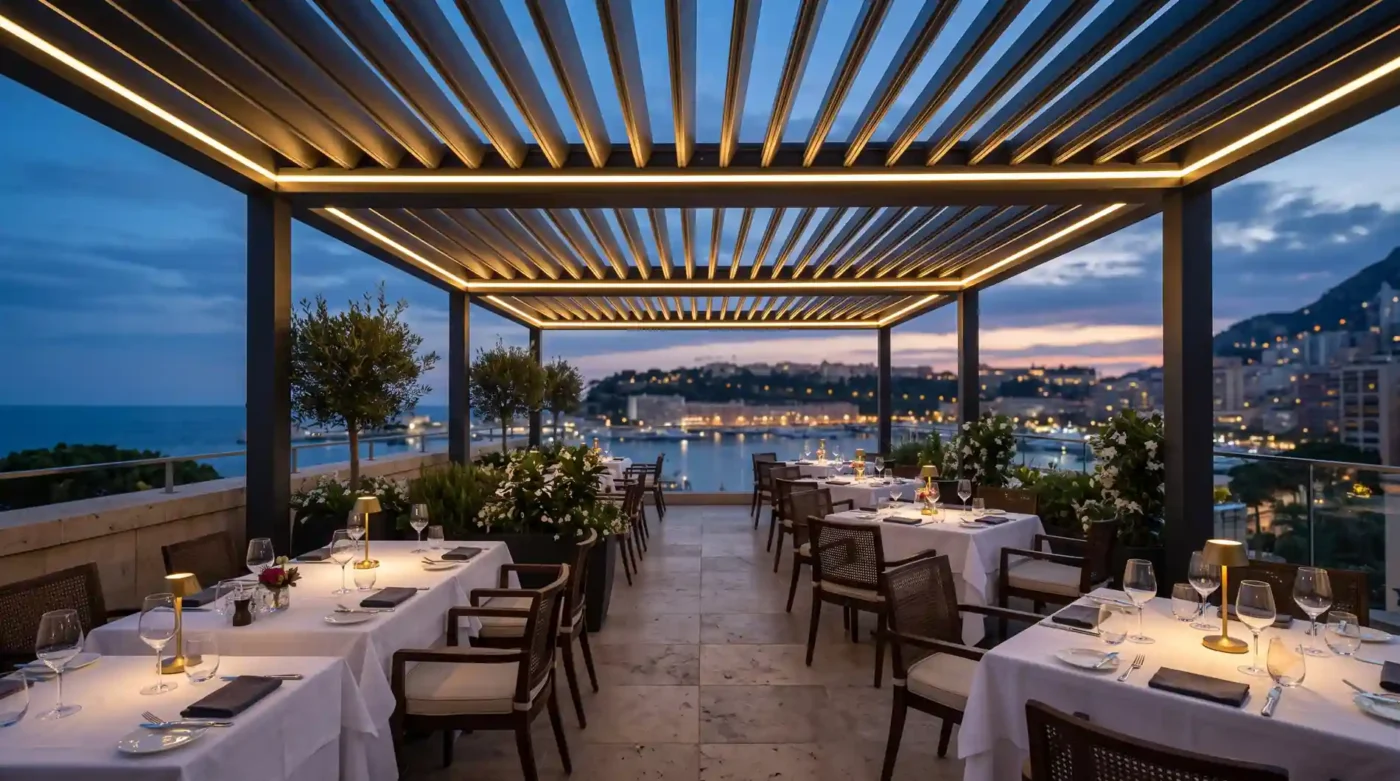
The industry standard for premium pergola lighting in 2026 is IP67-rated 24V COB flexible strip lighting. COB (chip-on-board) technology packages more than 320 LED microchips per meter directly onto a flexible substrate and covers them with a continuous special phosphor layer. This completely eliminates the dotted appearance of traditional SMD strips and creates seamless, neon-like, dotless linear illumination. Since the strip is usually embedded into a narrow groove below the beam, any visible glare or light spots can instantly damage the minimalist architectural look of the pergola.
In addition, a 24V constant-voltage drive system has decisive electrical advantages over a 12V system. Large commercial pergolas — such as 16×20 ft systems — require very long perimeter strip runs. A 24V system effectively suppresses voltage drop over long series wiring and keeps brightness and color temperature consistent from beginning to end, whether the lighting is 3000K warm white or 5500K cool white. A high color rendering index (CRI greater than 90) is also essential for premium restaurant terraces because it accurately restores the gloss of food and the natural tone of guests’ skin, directly improving the commercial value of the space.
Electronic Supply Chain Choice: White-Label vs. ODM vs. Full OEM
For pergola brands that want to maximize profit, planning the supply chain for lighting and control systems is a strategic decision that can determine the future of the business. For brands still deciding between a ready-made lighting product, a white-label system, an ODM program, or a fully customized OEM architecture, a useful companion framework is OEM vs. White-Label vs. Off-the-Shelf Pergola Lighting: Which Sourcing Model Fits Your Brand?, which compares the practical tradeoffs between speed, differentiation, ownership, and long-term profitability.
To show the strategic differences clearly, we use a mid-sized manufacturer with an annual target of 5,000 pergola lighting component sets as an example and analyze the three-year direct cost and revenue impact based on real B2B price assessments in the European market:
| Business Metric | White-Label Purchasing | ODM Customization | Full OEM Joint Development |
|---|---|---|---|
| Unit purchase price | EUR 87 | EUR 105 | EUR 132 |
| MOQ | None or very low (50–100 sets) | Medium (500–1,000 sets) | High (2,000–3,000 sets) |
| Upfront development cost (NRE) | EUR 0 | EUR 15,800 | EUR 68,000 |
| Development and delivery cycle | Stock item, direct shipment | 8 weeks | 16–20 weeks |
| Design ownership | Supplier-owned, no differentiation | Manufacturer-exclusive appearance and logo | 100% independent IP with custom tooling |
| Estimated retail price | EUR 150 | EUR 165 | EUR 190 |
| Three-year total failure rate | 6.0% | 2.5% | 0.75% |
| Final three-year net margin | −10% (heavy after-sales cost consumes profit) | 12% | 11%, rising to 37% in year three |
Many startups are tempted by the EUR 87 white-label price, but the fatal weakness of this model is that the brand is actually paying for the contract factory’s inventory risk premium while using the most generic components. In the end market, the product is easily dragged into a price war against cheap imports. A 6% failure rate means that for every 1,000 systems sold, the hidden costs of returns, labor diagnosis, and customer appeasement alone can reach EUR 18,600.
By contrast, as a professional control system manufacturer, we strongly recommend that ambitious pergola brands move toward ODM or full OEM. Through deep customization, we can develop exclusive light-emitting tracks that fit perfectly with your aluminum extrusions, design aviation-grade waterproof connectors with foolproof plug-in architecture, and integrate them with the central control box at the underlying protocol level. This factory-ready plug-and-play integration can reduce on-site electrician labor time by 70% and push system failure rates below 0.75%. Data shows that brands committed to a full OEM strategy can secure favorable 60-day payment terms and use their exclusive look and feel to win municipal and commercial projects. By the third year, overall profit margin can rise sharply to 37%.
The Brain and Nerves: How Bioclimatic Sensors and the Matter Smart Ecosystem Change the Game
In the context of 2026, the modern louvered pergola has gained a more scientific name: the bioclimatic pergola. Its core philosophy is that the system is no longer a static object. It is a responsive outdoor structure that breathes and self-adjusts according to external climate conditions. This depends entirely on the coordination of highly sensitive environmental sensors and an intelligent central controller.
Defensive Logic and Cost of Environmental Sensors
In coastal regions of Europe and North America with rapidly changing weather, or in high-latitude snow zones, sensors are not eye-catching gimmicks. They are the last line of defense protecting expensive assets from catastrophic damage.
Rain sensors cost roughly USD 300–600 to add. When a precise optical or conductive probe detects the first drop of rain, the system bypasses user operation and forces the motor to close the louvers within seconds, protecting expensive outdoor sofas, televisions, and audio equipment below the pergola.
Wind or anemometer sensors cost roughly USD 200–600. For wide-span louvers or systems equipped with side motorized ZIP screens, these are life-saving devices for the structure. When sudden gusts exceed a dangerous threshold — such as 60 mph — the system automatically adjusts the louvers to a specific aerodynamic pressure-relief angle or forces the ZIP screens to retract, preventing the aluminum structure from being torn by wind or the motor from burning out due to excessive resistance.
Temperature and frost sensors are critical in northern cold regions. When the temperature drops below freezing, the sensor instructs the louvers to remain slightly open (for example at a 15-degree angle). This prevents the waterproof rubber seals at the louver edges from freezing shut. Without this protection, a user who starts the motor with a remote control in the morning may instantly damage the mechanical linkage system because of the huge resistance created by ice.
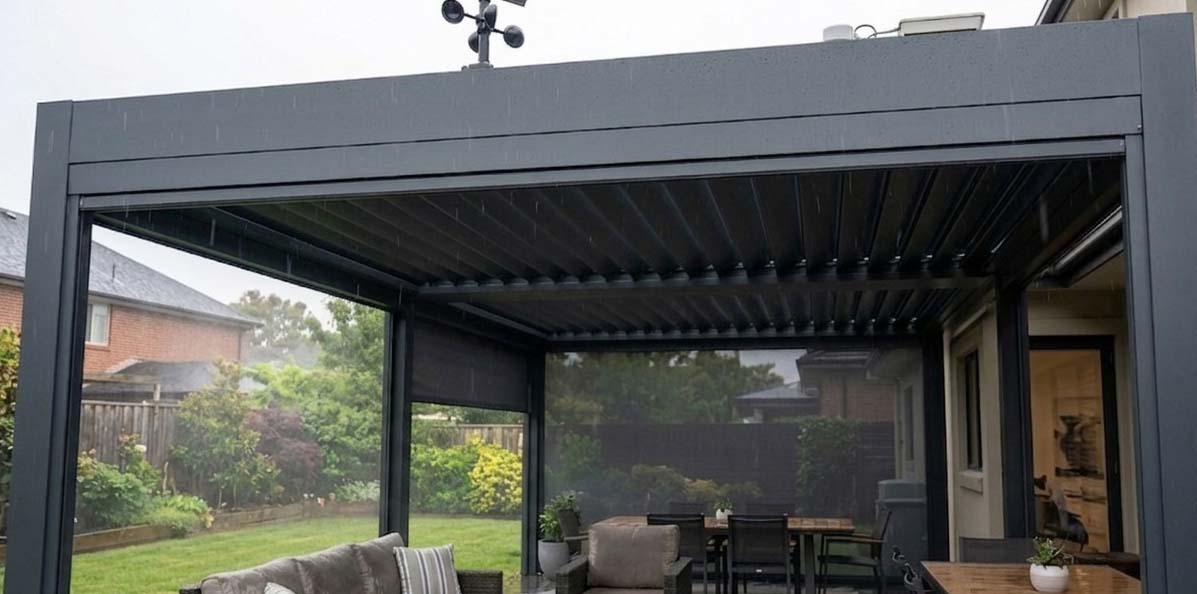
These sensors elevate the system from passive response to active defense. They are the reason top-tier pergola brands can confidently promise structural lifespans of up to 25 years.
The Endgame of Smart Homes: Embracing the Matter Standard
Early pergola controls relied mainly on closed RF remotes or hardwired wall switches. Later, Wi-Fi and Bluetooth modules were introduced, but they created serious app fatigue. Consumers ended up with a phone full of incompatible apps just to control devices around one home.
Today, the full implementation of the Matter standard is reshaping the underlying architecture of pergola control. Matter is an IP-based open smart-home standard jointly initiated by Apple, Google, Amazon, and the Connectivity Standards Alliance. For B2B pergola manufacturers, native Matter integration in the control box through Thread, Wi-Fi, or Ethernet creates major strategic advantages:
Break device silos and remove app dependency. A pergola controller with Matter certification does not require the manufacturer to spend heavily on maintaining a proprietary app. Consumers can simply use an existing Apple Home or Google Home platform, scan the device QR code, and complete seamless cross-ecosystem setup.
Local fulfillment over the LAN. This is a crucial experience upgrade. Traditional Wi-Fi pergolas often rely on third-party cloud servers, creating annoying 1–3 second delays and sometimes turning the system into a useless device during broadband outages. Matter requires local network communication. As long as the home router is powered, users can control pergola louvers and lighting with millisecond-level response, whether or not the external internet is connected.
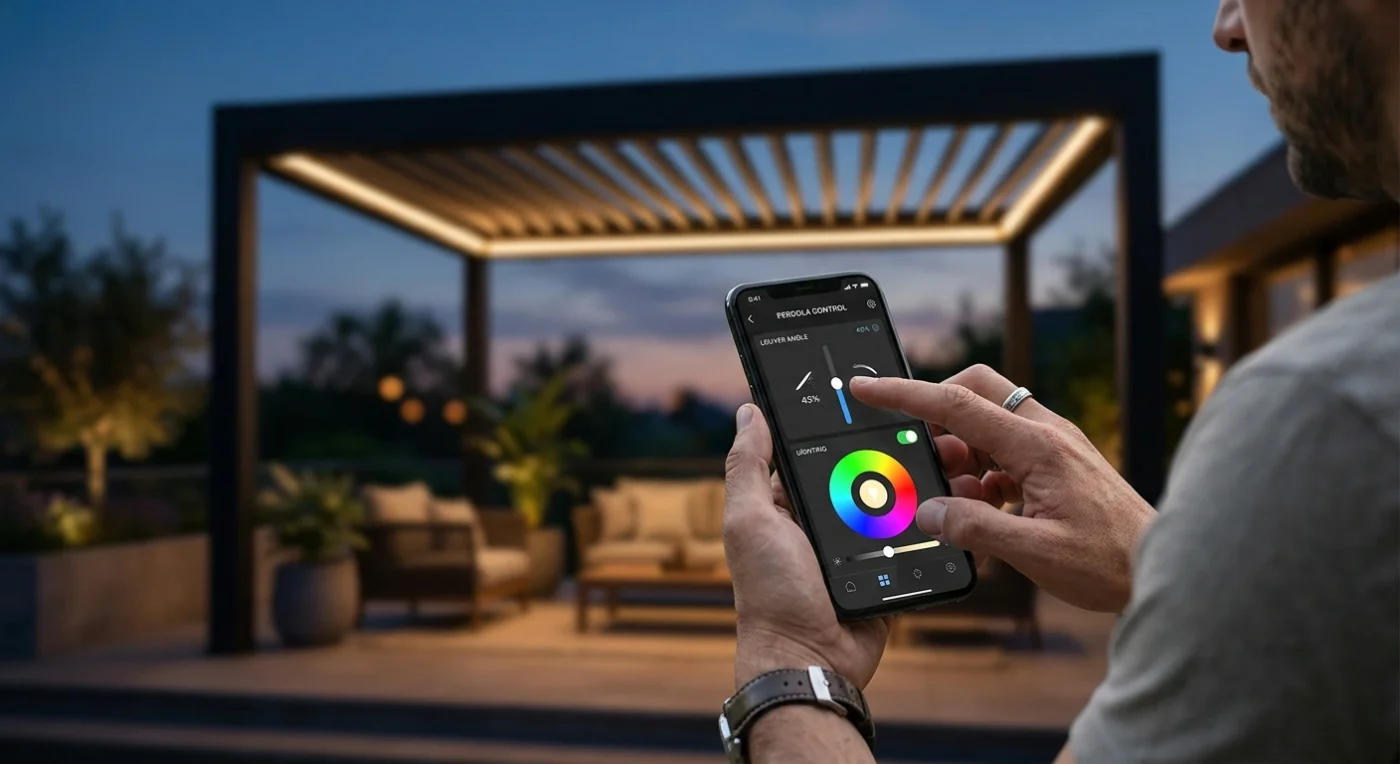
Scenario-based automation. Through the Matter ecosystem, the pergola is no longer an isolated structure. It becomes an extension of the whole-home smart system. A user can easily create a “summer dinner” scene: when triggered, the louvers automatically open to 45 degrees to bring in the evening breeze, the IP67 COB ambience lights gradually brighten to a warm 3000K tone, the surrounding ZIP screens lower to block insects, and the outdoor speakers begin playing background music. This tangible lifestyle experience is one of the strongest sales tools for persuading customers to pay a premium of tens of thousands of dollars.
The Invisible Shield: Understanding IEC 60529 IP Protection Ratings
When purchasing control boxes, motors, and LED strips, B2B buyers often see IP65 or IP67 on supplier datasheets. However, many pergola procurement managers do not fully understand the IEC 60529 standard behind these ratings and can easily fall into the waterproofing trap created by suppliers.
The IP (ingress protection) code consists of two key digits. The first digit (0–6) defines dust protection, with 6 meaning dust-tight. The second digit (0–9) defines water ingress protection. In complex outdoor pergola applications, a difference of one digit can be the difference between survival and failure:
| IP Rating | Water Ingress Test Standard (IEC 60529) | Practical Application and Recommendation |
|---|---|---|
| IP54 | Protection against splashing water. Limited volume, no pressure requirement. | Should never be used in fully exposed outdoor environments. Only suitable for auxiliary switches on indoor walls completely protected from rain. |
| IP65 | Protection against low-pressure water jets from any direction using a 6.3 mm nozzle. | Suitable for side motor housings or control boxes installed high above the ground where water accumulation is unlikely. Minimum acceptable line for outdoor use. |
| IP66 | Protection against powerful high-pressure water jets using a 12.5 mm nozzle. | Suitable for main pergola controllers in coastal areas with typhoons and heavy rain, capable of withstanding horizontal rain impact driven by strong wind. |
| IP67 | Temporary immersion. Protection against water ingress after immersion at 1 m depth for up to 30 minutes. | A hard requirement for bottom lighting and gutter light strips. Strips inside drainage channels are highly likely to encounter backflow and standing water — IP65 will fail. |
| IP69K | Protection against very close-range, high-pressure (80–100 bar), high-temperature (80°C) steam jet cleaning. | The ultimate selling point for top commercial or medical-grade terraces. Restaurant staff often use high-pressure washers directly on pergolas. |
As rigorous manufacturers, we should never rely on a supplier’s verbal claim of “waterproof” during global B2B procurement. Procurement contracts must require official test reports from third-party international certification bodies such as Intertek or TÜV, strictly following IEC 60529 test procedures. This is the key defense against future brand-level failure caused by large-scale water ingress in electronic components.
Global View: Regional Differences and Strategic Deployment in Europe and North America
Although both North America and Europe are major markets for motorized pergolas, their underlying business logic and functional preferences have already diverged significantly. B2B manufacturers must build differentiated electronic system configuration strategies for each market.
Europe: bioclimatic design, strict environmental requirements, and commercial expansion. Europe is deeply influenced by the bioclimatic concept and has strict requirements for building energy efficiency, including various EU energy efficiency directives. Pergola products exported to Europe must therefore strengthen sensor-based automated climate management — such as using precise daylight tracking to adjust louvers and reduce indoor air-conditioning load. In addition, Europe has a deep culture of street cafés and hotel outdoor dining, and HoReCa businesses have strong demand for expanding outdoor seating areas. For this segment, highly customizable RGBW matrix lighting, robust wind-resistant ZIP screen control logic, and compatibility with solar off-grid power — aligned with Europe’s energy independence policy — are key tools for winning large B2B procurement orders.
North America: DTC growth, extreme-weather resistance, and whole-home intelligence. The U.S. market is currently experiencing rapid growth in outdoor living space upgrades, driven especially by post-pandemic DIY culture and the rise of DTC brands. For North America, the first priority is physical strength against extreme weather — such as Cat 5 165 mph+ hurricane certification required in Florida. This requires AC motors or specialized DC motors with very high braking torque. Second, American consumers have strong enthusiasm for whole-home smart systems, especially Alexa and Google Assistant ecosystems. Therefore, providing a pre-wired plug-and-play control box that significantly lowers the electrician installation threshold, while ensuring Matter-based zero-setup smart integration, will be a decisive advantage in the North American market.
Conclusion: Rebuilding the Brand Moat Through the Electronic Supply Chain
When consumers willingly pay USD 25,000 for a smart louvered pergola, they are not paying only for hundreds of kilograms of industrial aluminum profiles. What truly gives the pergola life — allowing it to sense wind and rain, regulate light and shade, and create a compelling commercial ambience at night — is the tightly integrated and reliable electronic nervous system inside it.
From premium tubular motors with precise torque and quiet operation to IP67 COB dotless linear lighting that can survive temporary immersion; from precision weather sensor arrays that prevent failure before it happens to Matter-based smart control hubs that cross ecosystem barriers — every careful investment in electronic components protects long-term brand reputation and directly monetizes premium product value.
In today’s highly competitive structural hardware industry, only companies that master advanced electronic system integration can remove the low-end label of traditional metal fabrication and move up to become high-premium intelligent outdoor space solution providers. As a specialist system manufacturer deeply focused on outdoor shading control and lighting, we have built full-chain technical capabilities covering underlying communication protocols, motor drive algorithms, and top-tier optoelectronic packaging. Whether you want to create a unique dotless smart lighting series through a full OEM model or completely upgrade your central control architecture for the next generation of Matter smart ecosystems, we are ready to provide military-grade custom solutions. Work with us, and let world-class electronics become the engine that drives your brand to the top of the global high-end pergola market.

Pingback: Retractable Louvered Pergola Control Systems: Motor, Remote, and Sensor Requirements