


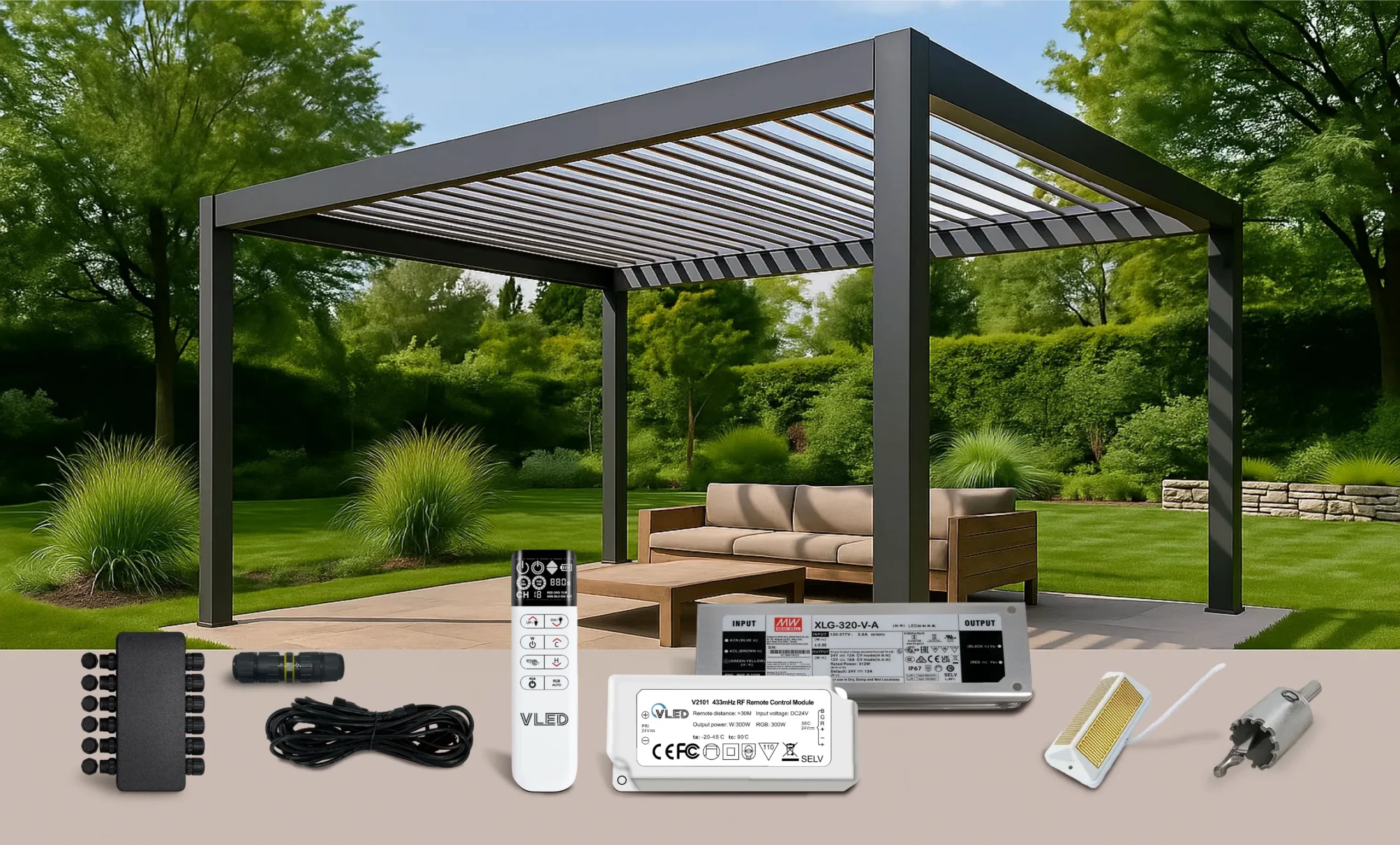
A louvered pergola kit can look complete on the packing list and still be incomplete in the field. The beams arrive. The louvers align. The fasteners are counted. Then the installer opens the control box and discovers that the rain sensor is optional, the receiver cannot handle lighting expansion, the connectors are not keyed, the wall switch needs extra sourcing, or the wireless module has no clear path to local approval.
That is where a kit stops being a kit. It becomes a project that asks the dealer, electrician, or end user to finish the manufacturer’s engineering.
For pergola brands selling into the United States, Canada, the United Kingdom, and the European Union, control hardware should no longer be treated as a loose accessory category. It should be specified as a core kit system: motor control, power distribution, user interface, environmental sensing, wiring, documentation, and service access designed to work together before the structure leaves the factory.
Our position is simple: manufacturers should include every control component that affects safety, water protection, installation repeatability, warranty exposure, and future accessory compatibility. Premium lifestyle options can remain modular, but the electrical foundation should be complete by default.
Manufacturer’s Real Question
Current search results around louvered pergola kits mostly answer homeowner questions. They compare manual and motorized roofs, explain how louvers rotate, list app control and LED lighting as benefits, and discuss price tiers. Some pages mention that motorized systems may include app control, rain or wind sensors, lighting, and professional installation. Others describe a minimum package of handheld remote or wall switch control, then place smartphone control and home automation in the premium tier.
That structure is useful for buyers, but it leaves manufacturers with a harder question: what should be included so that dealers can install the kit consistently, local partners can approve it confidently, and end users can add lighting, screens, and smart controls without rewiring the structure two years later?
The innovation space is not another consumer checklist. It is an OEM checklist. The best kit is not the one with the longest feature list. It is the one that ships with a clear control architecture and leaves fewer decisions to the jobsite.
The Control Package Should Start With a Defined Boundary
Before choosing a motor, remote, or app module, manufacturers should define where the kit’s control responsibility begins and ends. A vague phrase such as “motorized control included” is not enough for B2B procurement. It can mean a simple receiver and handheld remote, or it can mean a coordinated hardware package with low-voltage power, weather input, lighting outputs, limit control, service diagnostics, and compliance documentation.
A professional control hardware package should include three layers.
The first layer is required for movement: motor drive, controller, power supply, limit setting, overload protection, and at least one physical user interface. Without this layer, the pergola is not a motorized kit.
The second layer is required for outdoor protection: rain input, wind input where the structure requires it, properly rated enclosures, weather-resistant connectors, strain relief, drainage-aware cable routing, and clear lockout logic. Without this layer, automation is only convenience, not protection.
The third layer is required for product growth: lighting outputs, accessory ports, dry contacts, smart-home gateway compatibility, firmware identification, and field-replaceable modules. Without this layer, the manufacturer can sell the first kit but struggles to build a durable platform.
Manufacturer’s rule of thumb: if a missing control component can cause water damage, wind damage, electrical rework, failed commissioning, or a warranty claim, it should not be treated as a casual upsell.
1. Motor Drive Hardware: Include the Parts That Protect the Mechanism
The motor is not just a convenience device. It is the load endpoint of the entire pergola roof. Every louver, linkage arm, gasket, and bearing eventually reports its resistance back through the motor current. If the motor drive hardware is weak, the structure may still look premium, but the user experience will feel fragile.
Manufacturers should include a matched motor and control driver rather than leaving dealers to combine generic motors with separate receiver boxes. The drive package should support smooth start and stop behavior, electronic limit setting, overload cut-off, and a clear recovery procedure after obstruction or freeze events.
For most modern louvered pergola kits, a low-voltage DC architecture is the practical baseline. It simplifies integration with LED lighting, sensors, battery backup, and solar options. It also reduces exposure in wet outdoor areas when compared with mains-voltage devices mounted near aluminum frames, furniture, pools, kitchens, and wet flooring.
The kit should include the motor mounting interface, pre-terminated motor cable, connector protection, manual limit-setting method, and a commissioning guide that explains how installers confirm open, closed, and intermediate louver positions. If the mechanism needs a service hand crank, hex access, or emergency release, that hardware should be included and physically reachable after installation.
2. A Central Controller Built for Outdoor Service, Not Indoor Convenience
The controller is where many kits reveal whether they were designed as outdoor architectural products or adapted from indoor shade hardware. A pergola controller must survive heat, condensation, dust, vibration, insects, hose-down cleaning, and occasional installation mistakes. It also has to be understandable to a technician who arrives years later without meeting the original installer.
At minimum, the kit should include a central controller with labeled terminals or keyed connectors for motor output, sensor input, lighting output, power input, wall control, and optional gateway connection. Each channel should have documented electrical limits. If the controller supports multiple pergola modules, addressing must be visible and repeatable.
The enclosure matters as much as the circuit board. Outdoor control boxes should be selected with recognized enclosure standards in mind. The NEMA enclosure type guide is a useful reference for North American projects because it distinguishes protection against rain, sleet, snow, dust, hose-directed water, corrosion, and external icing. For international product language, the IEC 60529 ingress protection framework helps specify how well electrical enclosures resist dust and liquids.
Manufacturers should avoid using the word waterproof without a testable rating. IP65, IP66, IP67, NEMA 3R, NEMA 4, and NEMA 4X do not mean the same thing. The correct enclosure depends on mounting location, exposure, cleaning method, cable entry, and the service environment. A wall-mounted covered patio controller has a different risk profile from a post-hidden controller near a pool or coastal restaurant.
3. Physical Controls: Remote and Wall Switch Should Both Be Planned
Smartphone control is attractive in marketing, but physical control still belongs in the kit. Installers need it for commissioning. Owners need it when phones are unavailable. Facility managers need it when restaurants, hotels, and multifamily projects cannot rely on one user’s app account.
A professional kit should include a handheld remote for immediate use and reserve a hardwired or low-voltage wall control path. Whether the wall switch itself is included in every SKU depends on channel strategy, but the controller should be ready for it. The wiring diagram should show open, close, stop, and preset behavior clearly.
For multi-module pergolas, a single-channel remote is rarely enough. The control package should support individual module control, grouped control, and a way to label or pair channels without guesswork. If the kit will be sold through dealers, pairing should be easy to repeat after a replacement remote is issued.
Manufacturers should also define the hierarchy between physical controls and weather protection. A user pressing “open” during a wind alarm should not override the protection logic unless the system requires a documented service mode. This priority structure should be engineered into the controller, not explained vaguely in a manual after the fact.
4. Weather Sensors: Include the Inputs That Prevent the Expensive Claims
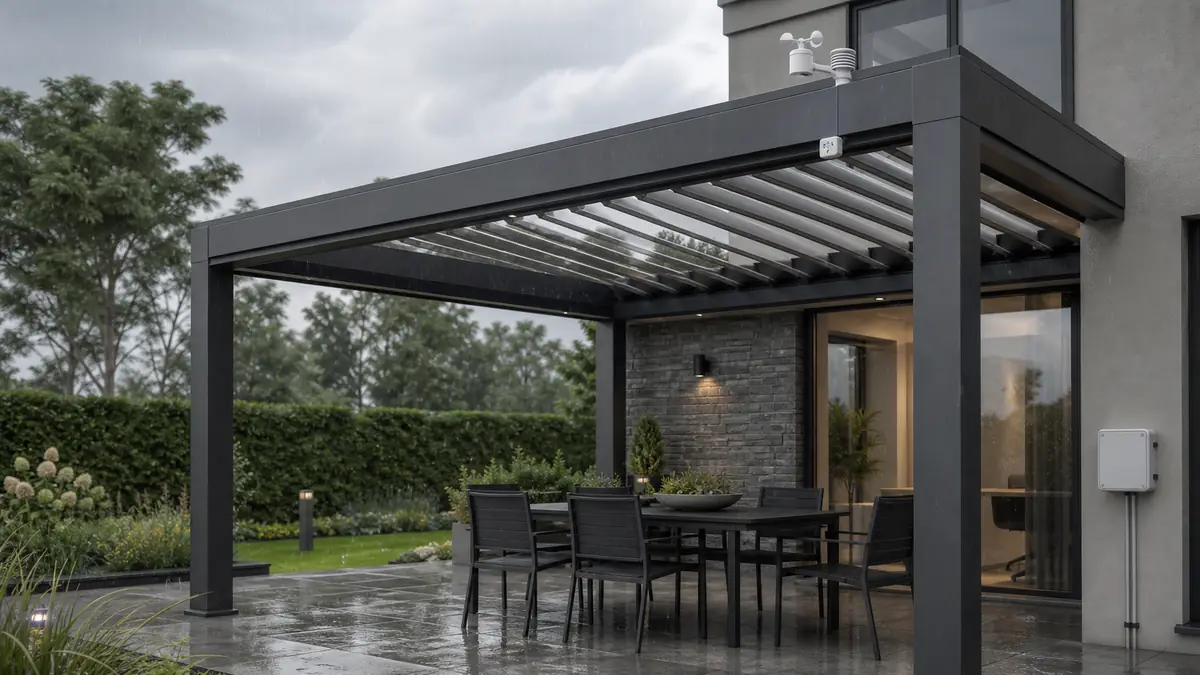
Rain and wind sensors are often sold as premium accessories because they are easy to describe as convenience features. For manufacturers, that framing is too narrow. Weather sensors protect the structure, outdoor furniture, electrical accessories, and brand reputation.
At the basic level, a rain sensor allows the louvers to close when the owner is away. At a higher level, wind sensing can move louvers or screens into a safer position before loads become dangerous. Sun sensors can improve comfort and reduce user friction. Somfy’s own pergola category, for example, presents rain and sun sensors for motorized pergolas as part of automating slat movement and protection.
The hardware question is not whether every kit should include every possible sensor. The question is which sensor inputs must be native. We recommend that the controller include rain input as standard, wind input as standard on motorized kits, and an expansion path for sun, temperature, and snow or freeze logic where the market requires it.
For Europe and North America, manufacturers should be especially careful with cold-weather logic. A basic rain sensor may close the louvers when precipitation begins. In freezing conditions, however, a flat closed roof can create snow accumulation or ice bonding risks if the structure and local instructions are not designed for that scenario. The controller should support different weather behaviors for rain, wind, low temperature, and service lockout instead of treating all moisture as the same event.
5. Lighting-Ready Power and Dimming Should Be Standard Infrastructure
Integrated lighting is no longer a decorative afterthought for premium pergolas. It is part of the reason homeowners, restaurants, resorts, and outdoor living contractors justify a higher product tier. But lighting becomes expensive when the structure is not prepared for it at the kit level.
Manufacturers should include lighting-ready control infrastructure even when the visible LED fixtures are optional. That means a power supply strategy, protected outputs, dimming control, cable routes, connector locations, and channel capacity defined before the beams are fabricated.
A kit aimed at professional channels should support at least one warm-white lighting zone and reserve capacity for RGBW ambient lighting where the brand sells premium packages. The controller should manage motor startup without visible LED flicker. It should also keep lighting loads electrically separated from motor loads so a fault in one channel does not disable the entire pergola.
For North American low-voltage lighting systems, manufacturers should review relevant requirements early. The UL 2108 scope for low voltage lighting systems connects low-voltage lighting components with NEC installation requirements. If wet contact is likely, voltage limits and power-unit selection cannot be treated as informal engineering preferences.
6. Accessory Interfaces: Screens, Fans, Heaters, and Third-Party Systems
A pergola kit should not pretend that the roof is the final product. In developed outdoor living markets, the roof is usually the platform. Screens, LED strips, heaters, fans, speakers, privacy walls, and building automation systems are what turn it into a usable outdoor room.
That does not mean every kit should include every accessory. It means the control hardware should include the right interfaces. Motorized side screens need output channels and limit logic. Fans may need relay control or protected low-voltage signal switching. Infrared heaters usually require separate high-voltage power and proper licensed installation, but the pergola controller can still provide isolated dry-contact control or compatible low-voltage command interfaces.
Dry contacts remain important because commercial projects often involve building management systems, fire alarm interfaces, restaurant controls, or third-party automation platforms. RS485, CAN, or other wired communication options may be justified for larger multi-bay projects where wireless control is not stable enough or where integrators require addressable devices.
The strongest manufacturers do not force customers into one accessory bundle. They create a control platform that lets dealers add accessories cleanly without opening beams, drilling improvised cable holes, or mounting extra boxes around a newly finished structure.
7. Wireless Connectivity: Make It Ready, But Do Not Make It Fragile
App and voice control matter, but they should not be the only way the pergola works. Outdoor structures must keep core protection functions local. Rain, wind, obstruction, limit, and emergency behavior should not depend on a cloud server, a router, or a subscription.
For connected product lines, manufacturers should decide whether the kit will ship with a gateway, include a gateway-ready port, or offer region-specific wireless modules. The decision affects certification, stocking, and support. A Wi-Fi module may be easy for consumers to understand, but it can be unreliable at the far edge of a backyard. RF can be robust and simple, but one-way RF may not provide status feedback. Zigbee, Thread, and Matter-ready architectures can improve ecosystem compatibility, but they require more careful product planning.
The Connectivity Standards Alliance describes Matter as an IP-based connectivity standard for reliable, secure IoT ecosystems. For pergola manufacturers, the strategic lesson is broader than a logo. If future product lines need to work with Apple, Google, Amazon, and professional integrators, the control hardware should not be trapped in a closed protocol with no upgrade path.
Wireless approvals also belong in the kit strategy. In the United States, the FCC states that radio frequency devices must be properly authorized before being marketed or imported, as explained in its equipment authorization guidance. In Europe, CE marking is tied to product responsibility across safety, health, and environmental protection requirements, as summarized by the European Commission CE marking guidance. A manufacturer that changes wireless modules late in production may also change the compliance work behind the product.
8. Wiring Harnesses and Connectors: The Most Underrated Kit Hardware
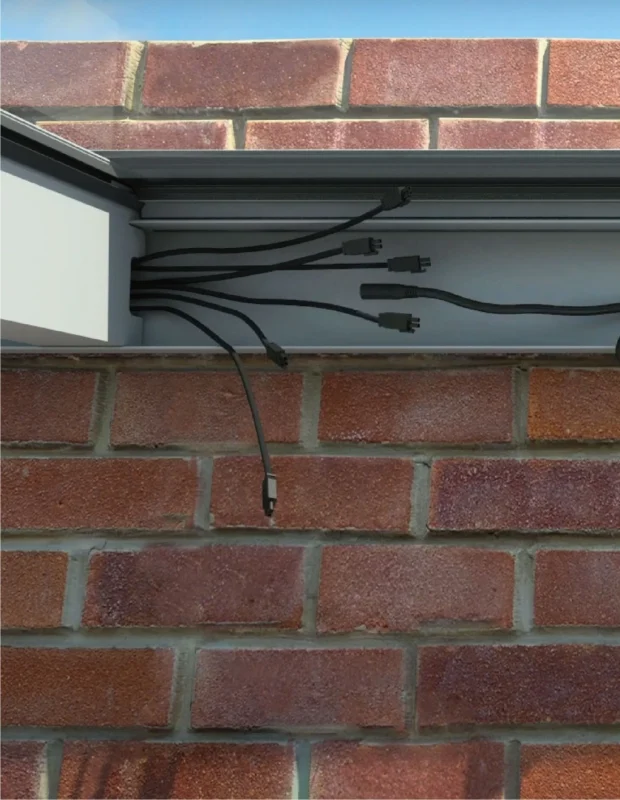
If a manufacturer wants fewer service calls, it should care deeply about wiring harnesses. The connector system is where engineering meets the person standing outside with limited time, changing weather, and a structure that may already be partially assembled.
A professional kit should include pre-measured, pre-terminated wiring harnesses for motors, sensors, lighting, and control interfaces. Connectors should be keyed so they cannot be reversed. Cable labels should survive handling. Strain relief should prevent water from tracking along the cable into the enclosure. Spare connector caps should be included for unused ports.
The kit should also define cable routing. A cable path that looks acceptable in a factory render may become impossible when the installer adds a corner post, gutter insert, side screen track, or wall connection. Good control hardware packaging includes cable length logic, post entry positions, bend radius guidance, and service loops where maintenance access is expected.
From a manufacturer’s point of view, plug-and-play wiring is not just installer convenience. It is quality control. Every field crimp, field splice, and improvised waterproof wrap is a variable that the brand may later have to warranty.
9. Documentation: Ship the Paperwork That Protects the Dealer
Control hardware is only as good as the documentation that travels with it. A dealer cannot confidently sell a motorized louvered pergola into a demanding market if the electrical package arrives with unclear ratings, missing wiring diagrams, or translated instructions that do not match the actual terminals.
The kit should include a clear electrical diagram, controller rating label, motor data, power supply information, sensor wiring, commissioning steps, troubleshooting flow, maintenance schedule, and region-specific compliance references. If the same kit is sold in both North America and Europe, the documentation should not blur UL, cUL, CE, UKCA, FCC, and IP language into one generic statement.
Manufacturers should also provide a spare-parts map. Five years after installation, the dealer should be able to identify the controller model, motor type, remote version, sensor type, and compatible replacement parts without dismantling the entire roof. Good documentation reduces support time and makes a brand easier to specify repeatedly.
A Practical Inclusion Matrix for Louvered Pergola Kits
Not every product tier needs the same hardware bundle. A manufacturer selling DIY patio kits has different cost targets from a brand supplying hotels, restaurants, and luxury villas. Still, the platform logic should be consistent.
| Hardware Area | Essential Kit | Premium Kit | Commercial or OEM Project Kit |
|---|---|---|---|
| Motor and drive | Matched motor, controller, limit setting, overload protection | Quieter motor, position feedback, smoother speed control | Addressable multi-module control, service diagnostics, replaceable drive modules |
| User interface | Handheld remote and wall-control-ready input | Multi-channel remote, wall switch, preset scenes | Group control, zone naming, third-party control interface |
| Weather sensing | Rain input and wind-input-ready controller | Rain sensor, wind sensor, sun or temperature expansion | Wind, rain, temperature, lockout logic, project-specific safety behavior |
| Lighting | Lighting-ready power and protected output | Dimmable white lighting and RGBW-ready channel capacity | Multi-zone dimming, external driver support, serviceable power distribution |
| Connectivity | Local control without cloud dependency | Gateway-ready or included app module | Integrator interface, documented protocol, region-specific wireless approvals |
| Wiring | Pre-terminated harnesses and labeled connectors | Keyed waterproof connectors and accessory-ready spare ports | Factory-routed harness options, service loops, module addressing labels |
| Documentation | Wiring diagram, commissioning guide, rating labels | Dealer troubleshooting guide and accessory wiring guide | Compliance pack, spare-parts map, project handover documents |
What Should Stay Optional
Including more hardware is not always better. A kit can become too expensive, too complex, or too region-specific if every advanced accessory is forced into the base package. Manufacturers should separate warranty-critical hardware from lifestyle hardware.
RGBW lighting fixtures, decorative beam lights, app gateways, solar batteries, heaters, ceiling fans, audio, and motorized screens can remain optional. But the controller, wiring paths, power capacity, and accessory interfaces that make those upgrades possible should be designed into the base platform.
This approach protects both price competitiveness and long-term product value. Entry models remain accessible. Premium dealers can upsell without re-engineering. Commercial partners can specify project options without doubting whether the kit can support them.
The Manufacturer’s Real Competitive Advantage
In the louvered pergola category, aluminum quality is visible. Control quality is remembered. The customer notices the frame on day one, but they judge the control system during rain, wind, dinner service, power interruptions, and the first service visit.
A manufacturer that includes the right control hardware can reduce installation variation, shorten dealer training, avoid improvised electrical work, and make future accessories easier to sell. More importantly, it can speak to Western buyers in the language they already care about: reliable operation, documented compliance, serviceability, and a product that feels engineered rather than assembled.
The opposite path is expensive. A low-cost receiver, generic remote, missing sensor input, weak enclosure, or undocumented wireless module may save money at the bill-of-material level. But it can create costs later through field support, product returns, poor reviews, dealer hesitation, and delayed approvals.
Final Recommendation: Ship a Control System, Not Control Parts
For pergola manufacturers targeting Europe and North America, a louvered pergola kit should include more than louvers, posts, beams, and a motor. It should include a complete control hardware foundation: matched motor drive, outdoor-rated controller, physical controls, weather sensor inputs, lighting-ready power, accessory interfaces, pre-terminated wiring, and documentation that dealers can trust.
That does not mean every kit must become a luxury smart-home package. It means the base kit should be engineered so the pergola can be installed correctly, protected automatically, serviced cleanly, and upgraded without structural rework.
The manufacturers that win the next stage of the louvered pergola market will not simply sell stronger aluminum. They will sell a better-controlled outdoor structure. The hardware included in the kit is where that promise begins.
Work With a Control Hardware Partner Early
If your next louvered pergola line needs integrated motor control, weather sensing, LED lighting control, accessory interfaces, or an OEM-ready control box for European and North American markets, involve the control hardware supplier before the aluminum profile is finalized.
Early electrical planning makes the kit easier to install, easier to certify, easier to support, and easier for dealers to sell. Build the control platform first, and the rest of the pergola becomes a more dependable product.

Pingback: Integrated Pergola Control Systems: A Manufacturer’s Guide to Louvers, Lighting, and Sensors
Pingback: Integrated Pergola Controls: Louvers, Lights & Sensors