


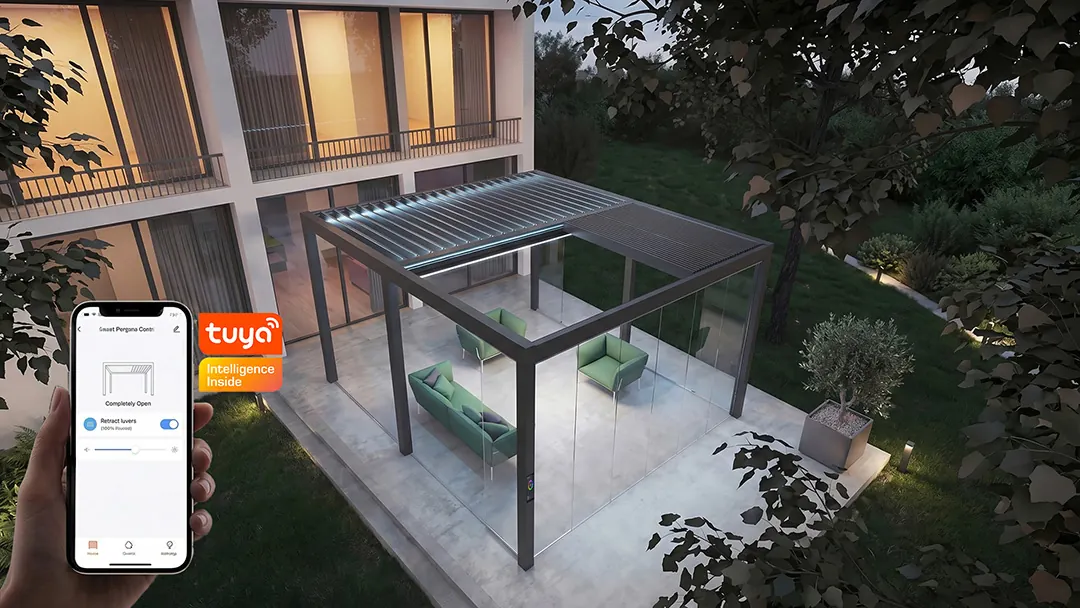
The short answer
- Keep motor protection, limits, weather priority, lighting loads, and local fallback inside the pergola control layer.
- Use Tuya when you want a practical branded app, schedules, scenes, remote access, and a connected-product foundation.
- Add Alexa and Google Home as consumer voice and routine interfaces, not as substitutes for the controller.
- Add Control4 and Crestron when your dealer network serves premium residential, hospitality, or commercial automation projects.
- Test every integration on the assembled aluminum pergola, including motors, lights, sensors, wiring, enclosure placement, and commissioning.
A pergola owner does not experience a motor, receiver, sensor, LED driver, and cloud account as separate products. They experience one roof that should move smoothly, stop accurately, protect itself during bad weather, and create useful light at night. If the louver uses one remote, the lights use another, and the weather sensor follows different rules in the app, the structure feels unfinished even when every component works on its own.
For OEMs, that makes the platform decision a product-engineering decision. The best integration is not the one with the most compatible brands. It is the one that gives the manufacturer a stable control core and gives each market the interface it expects.
What should a pergola OEM integrate first?
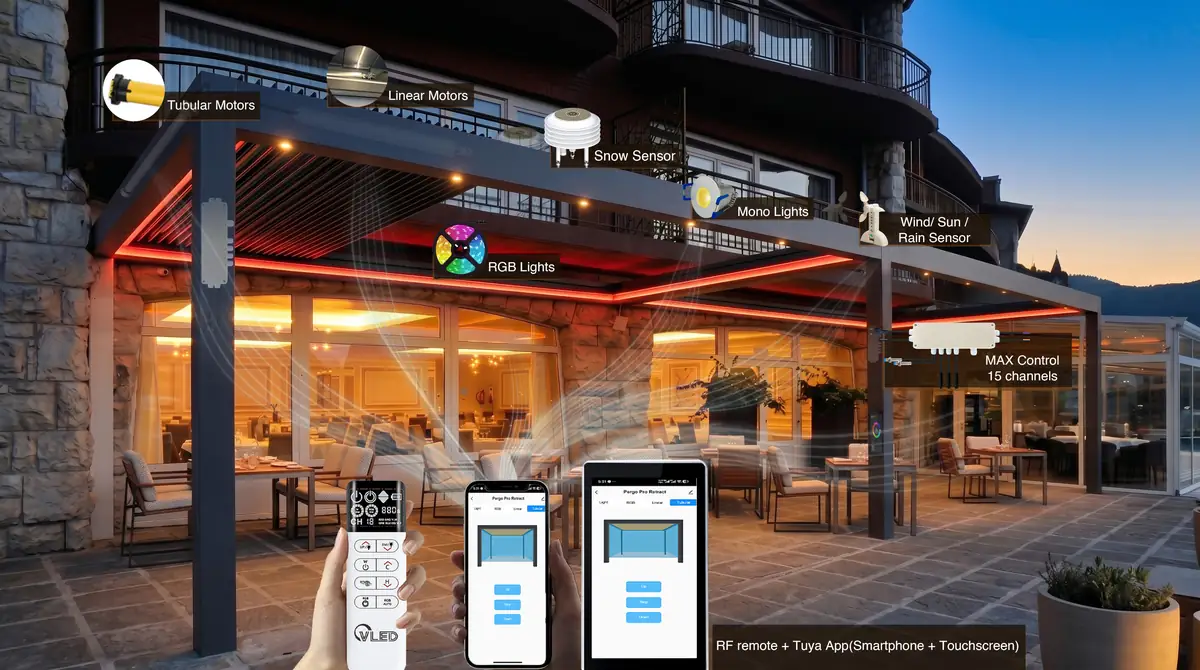
Start with a clear device model for the pergola itself: louver or roof position, open and close commands, stop behavior, lighting zones, screen position, sensor status, and fault state. Once these functions are reliable locally, they can be exposed through a mobile app, voice assistant, professional automation processor, or a branded touchscreen.
Smart-home platforms are designed for discovery, commands, routines, and status. They are not a complete safety controller for a moving outdoor structure. A rain signal may need to close the roof even if a user has just requested “open.” A high-wind event may require a different position from rain. A stalled actuator should not keep retrying because a cloud command remains active. These rules belong in the OEM control layer.
Define the following before selecting a platform or gateway:
- Motor family, voltage, current, travel limits, synchronization, overload protection, and obstruction behavior.
- Mono, RGB, or RGBW lighting zones, driver capacity, dimming method, cable length, and replacement access.
- Rain, wind, sun, snow, or temperature inputs, including trigger, reset, priority, and manual override rules.
- Local operation during internet, Wi-Fi, gateway, app, or cloud outages.
- Pairing, commissioning, channel naming, reset, replacement, diagnostics, and firmware-update procedures.
VLEDSTAR’s نظام التحكم المتكامل في البرجولا reflects this manufacturer-first approach by combining lighting, linear actuators, tubular motors, weather sensors, RF control, app control, and touchscreen operation in one control architecture.
How do Alexa, Google Home, Control4, Crestron, and Tuya compare?
These options are not equivalent. Tuya is an IoT platform and app ecosystem. Alexa and Google Home are consumer smart-home interfaces. Control4 and Crestron are professional automation environments normally configured by dealers and integrators. An OEM can support multiple options, but they should connect to the same defined product functions rather than create five unrelated control paths.
| Option | Best fit | OEM value | What must be controlled |
|---|---|---|---|
| Tuya | Branded residential app and connected product range | Scenes, schedules, remote access, device management, and a route to voice ecosystems | Cloud ownership, data policy, firmware, account support, and offline behavior |
| Alexa | Homes using Echo devices and voice routines | Pre-built voice interaction, app control, discovery, and device status | Capability mapping, account linking, certification, state reporting, and fallback |
| Google Home | Homes using Google Assistant, Nest, and Google Home routines | Cloud-to-cloud control, remote access, device traits, and optional local paths | OAuth, intent fulfillment, request sync, report state, traits, and certification |
| Control4 | Premium homes and dealer-led multi-room projects | Scenes that combine pergola, lighting, audio, security, and indoor systems | Driver or gateway availability, two-way feedback, naming, and dealer support |
| Crestron | High-end residential, hospitality, and commercial automation | Professional programming, touchscreens, scenes, and building-system integration | Supported driver, gateway, IP, serial, relay, or documented protocol and service ownership |
Platform capabilities and certification requirements change. Confirm the current requirements with the relevant provider before making a compatibility claim.
Where does Tuya fit in a pergola product line?
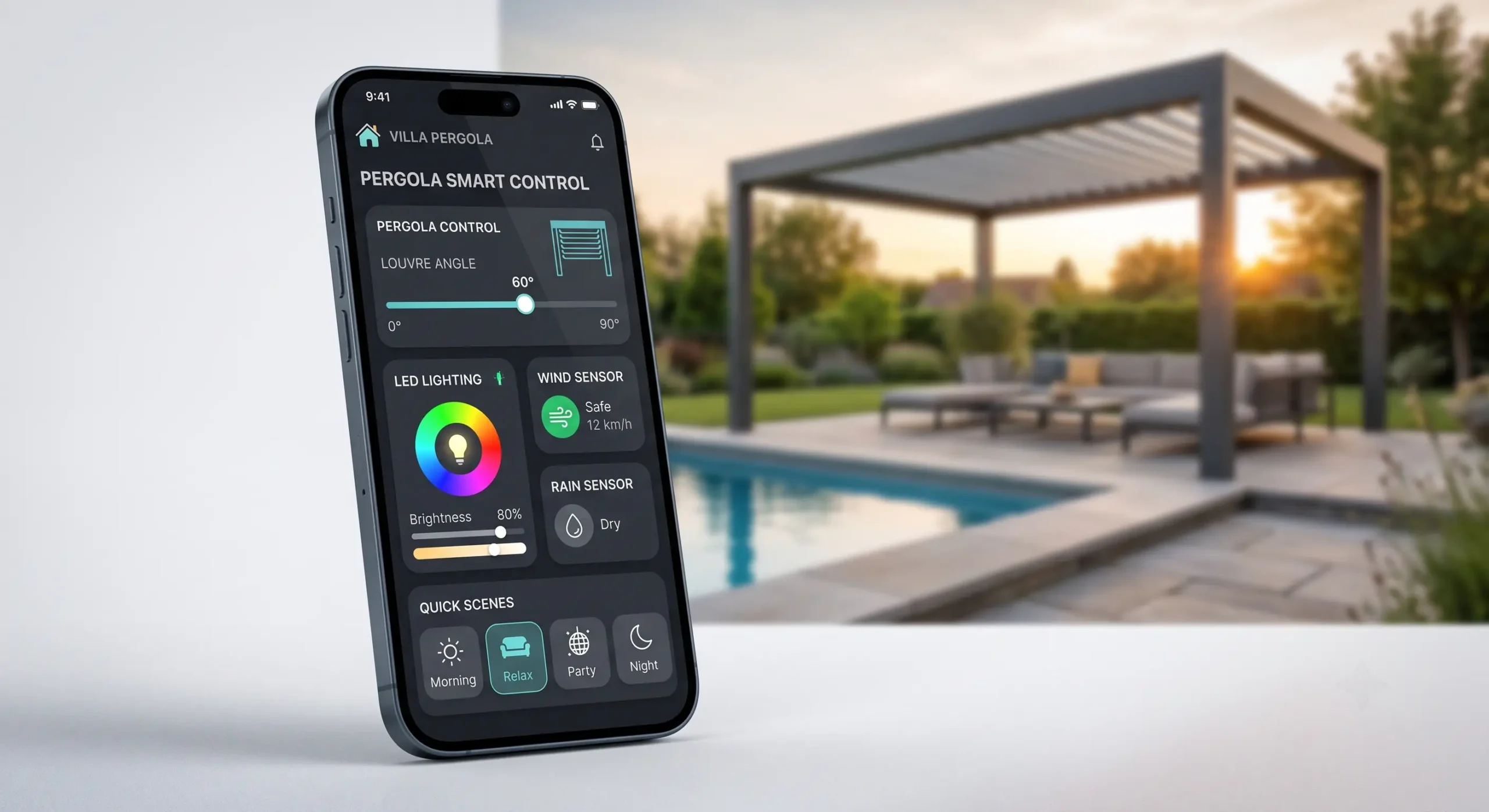
Tuya is often the fastest practical route when an OEM wants a branded app, cloud access, scenes, schedules, remote control, and a connected-product foundation without building every software layer from the ground up. Tuya’s official smart-home documentation describes an ecosystem built around device control, user and home management, OEM apps, and open APIs.
For a pergola, the value is not simply remote open and close. A useful product definition can expose separate louver groups, LED brightness, color mode, screen channels, timers, scenes, and sensor states. That gives the homeowner meaningful control and gives the OEM a common software layer across multiple frame sizes or accessory packages.
Tuya is a strong fit when you want:
- A private-label or branded mobile-app experience.
- Residential scenes such as dinner, sunset, away, and night lighting.
- Scheduling and remote access for homeowners, installers, or property managers.
- A common connected platform across pergola models and lighting accessories.
- A practical route to Alexa and Google Home without implementing each consumer ecosystem first.
The trade-off is ownership and dependency. Define who owns the app account, device data, cloud subscription, firmware process, customer support, and replacement workflow. Also define what remains available when the cloud is unreachable. The VLEDSTAR smart pergola controller keeps RF control and touchscreen control alongside the Tuya app path, which is the right direction for an outdoor product that must remain serviceable.
What do Alexa and Google Home add?
Alexa and Google Home add familiar voice commands, routines, and ecosystem-level control. They are useful when a homeowner wants to say “close the pergola,” include the roof in an evening routine, or combine outdoor lighting with indoor lighting and music.
Amazon’s official smart-home documentation lists cloud, local, managed-connectivity, and Alexa Built-in options for device makers. It also describes capability interfaces, account linking, and certification. An OEM should map only the functions that behave reliably. A louver position, a dimmable light zone, and a scene may be useful capabilities; an undocumented “smart” mode that cannot report state will create support calls.
Google’s Cloud-to-cloud documentation covers account linking, intent fulfillment, request sync, report state, testing, and certification. Google supports a broad range of device types and traits, including open/close, rotation, light, and scene-related behavior. The pergola still needs a disciplined mapping between physical functions and those abstract device capabilities.
The OEM position should be clear: Alexa and Google Home are presentation and automation layers. They should send commands to a tested pergola controller, not directly decide how a motor reacts to a sensor, how a limit fault is handled, or what happens after a power interruption.
When are Control4 and Crestron worth supporting?
Control4 and Crestron become valuable when the pergola is specified as part of a dealer-designed property rather than sold as a standalone connected product. In those projects, one scene may adjust louvers, dim RGBW lights, lower privacy screens, start audio, and change indoor lighting at the same time.
Professional integration also raises the buyer’s expectations. The dealer may need two-way feedback, named zones, reliable status, supported drivers, IP or wired control, commissioning tools, and a defined recovery path. “It works from the phone” is not enough for a luxury automation project.
Control4 commonly uses device drivers and dealer configuration. Its dealer documentation for voice and smart-home integration shows why names, scenes, subscriptions, and driver behavior matter to the finished installation. Before claiming Control4 compatibility, confirm the exact driver, gateway, feedback functions, supported motor commands, and who maintains the driver over time.
Crestron Home documents third-party drivers and supported shading paths. Its third-party device documentation explains that drivers are used to add other manufacturers’ equipment, while its shading documentation shows the importance of supported motors and control interfaces. An OEM should provide a real protocol or gateway specification instead of using “Crestron compatible” as an undefined marketing label.
Support these systems when your sales channel includes luxury residential, hospitality, architects, system integrators, or commercial terraces. If your route to market is direct-to-consumer and installation is intentionally simple, the cost of professional driver development and long-term integrator support may be better treated as a second-stage product option.
Why local-first architecture matters outdoors
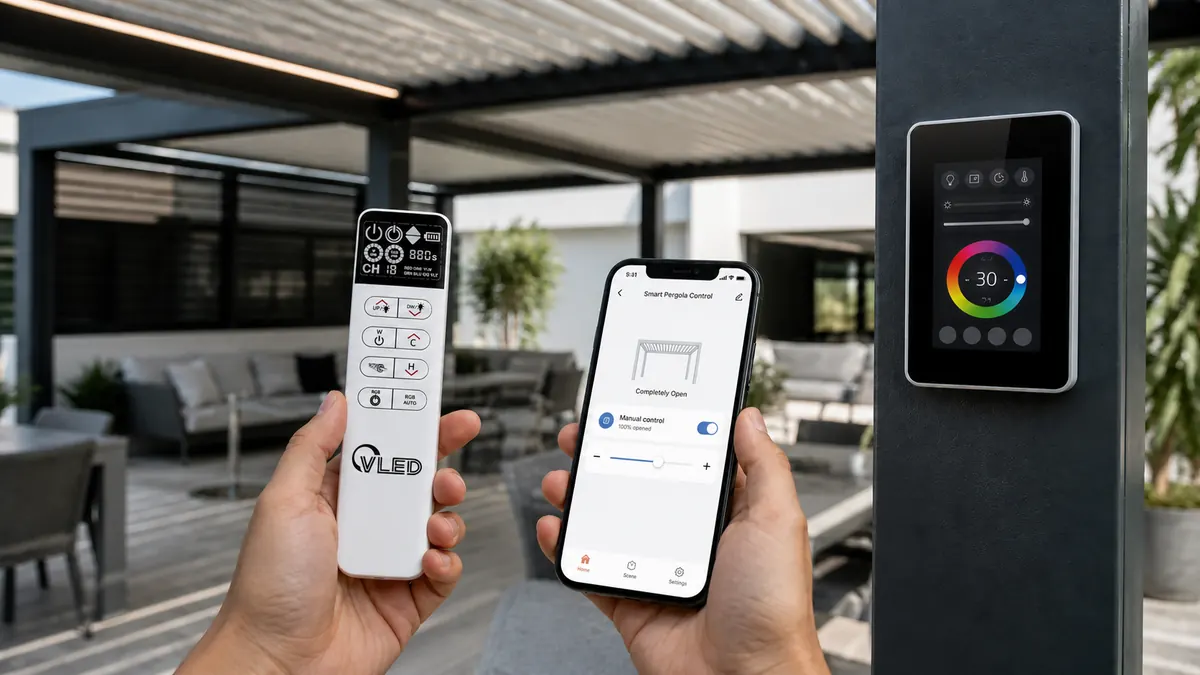
A pergola operates outside, where weather, radio interference, moisture, aluminum structures, and inconsistent network conditions are part of the installation environment. Its essential functions should remain available through a local control path even if Wi-Fi, a cloud account, or a third-party gateway is temporarily unavailable.
Local-first does not mean every feature must be local. Local control should cover safe movement, stop, manual override, core lighting, service commissioning, and the minimum weather response defined by the product specification. The app can add schedules, remote access, and scenes. Alexa and Google can add voice. Control4 and Crestron can add whole-property coordination.
- Protection logic: motor limits, current protection, obstruction response, sensor priority, and fault behavior inside the pergola controller.
- Local control: RF remote, wall switch, touchscreen, or wired service interface.
- Connected app: device setup, schedules, scenes, remote access, and status.
- Smart-home integration: Alexa, Google Home, Control4, Crestron, or another project platform.
This separation gives an OEM commercial flexibility. The same control core can support an entry package with RF, a residential package with Tuya, and a premium project package with a documented professional automation interface. It also limits the damage when an external platform changes its API, certification rules, subscription model, or device taxonomy.
Radio planning deserves particular attention in aluminum pergolas. Antenna position, enclosure location, cable routing, and the finished roof can affect reliability. VLEDSTAR’s control specifications address long-range RF, anti-interference behavior, compact enclosure design, and local control, but the correct validation remains a test of the complete assembled structure.
What should OEMs test before approving an integration?
Do not approve a platform from a cloud demo or a bare controller on a workbench. Build a representative pergola mock-up and test the final wiring, enclosure, motor, lighting, sensor, and aluminum profile arrangement. The test should represent the product that a dealer will actually install.
At minimum, validate:
- Pairing and commissioning time for a first-time installer.
- Open, close, stop, position, synchronization, and obstruction behavior across every approved motor type.
- Mono, RGB, and RGBW dimming, color changes, driver temperature, cable length, and zone naming.
- Rain, wind, sun, snow, and temperature response, including conflicts with manual commands.
- Operation after power loss, Wi-Fi loss, cloud loss, gateway restart, firmware update, and remote replacement.
- Feedback accuracy in the app and in the professional automation system.
- Fault isolation: whether a dealer can identify the failed part without replacing the whole kit.
- Service access: whether the control box, connectors, antenna, and fuses can be reached without dismantling finished roof sections.
For the hardware layer, review the VLEDSTAR pergola control unit and its documented outputs, sensor inputs, RF, enclosure, and OEM customization options. For the lighting layer, pair the control decision with a suitable مجموعة إضاءة البرجولات, including recessed lights, downlights, LED strips, wall lights, and accessories that can be standardized across the product family.
How should an OEM choose a platform roadmap?
Choose according to product strategy, sales channel, and service capability. Listing every ecosystem may look impressive, but it creates little value if the controller cannot deliver predictable local behavior or the dealer cannot commission the system confidently.
Choose Tuya first when the priority is connected product scale
Tuya is usually the practical first layer for branded app control, scheduling, scenes, remote access, and a product family that may later connect to voice ecosystems. It is especially useful when the OEM wants to launch a smart feature without building a complete cloud and mobile stack internally.
Add Alexa and Google Home for mainstream residential demand
These platforms make the pergola easier to include in familiar home routines. Add them after the device model, naming, state reporting, and local fallback are stable. Voice should simplify the experience, not hide unreliable behavior.
Add Control4 and Crestron for dealer-led premium projects
These platforms can unlock high-value specifications, but they require more than a cloud account. Plan for drivers, feedback, commissioning documents, integrator relationships, version control, and long-term service ownership.
Keep the local layer mandatory for every product tier
The local layer is what protects the OEM’s product reputation. It provides a known way to operate, test, and recover the pergola when an external service is unavailable.
What is the right integration position for VLEDSTAR?
VLEDSTAR’s position is that an OEM should own the behavior model of the pergola even when a third-party platform provides the customer interface. That means designing motor control, lighting, sensors, RF, app access, wiring, enclosure, and service documents as one product system.
VLEDSTAR began in LED lighting in 2010 and now develops and manufactures pergola lighting and integrated control solutions for OEM and private-label programs. The product range includes recessed spotlights, downlights, LED strips, wall and post lights, power supplies, connectors, weather sensors, and control systems for louvered and retractable structures. The VLEDSTAR factory and engineering overview explains the company’s manufacturing, R&D, quality-system, and customization capabilities.
For an OEM, the benefit of this approach is not simply sourcing several components from one supplier. It is the opportunity to standardize connector choices, channel mapping, lighting behavior, motor compatibility, enclosure fit, assembly instructions, and commissioning across a product family. That makes future integration work more repeatable and gives dealers a clearer system to install and service.
Final recommendation for pergola manufacturers
The strongest OEM architecture is rarely “one platform for everything.” It is one dependable pergola control core with documented interfaces above it. The core manages motors, lights, sensors, local inputs, and fault behavior. Tuya, Alexa, Google Home, Control4, and Crestron then become different routes to the same defined product functions.
For most manufacturers, a sensible sequence is:
- Define the motor, lighting, weather, fault, and local-control behavior.
- Build and test the controller inside the finished pergola structure.
- Add a branded app layer, often Tuya or a proprietary alternative, with clear ownership and offline rules.
- Add Alexa and Google Home where voice demand justifies certification and support.
- Add Control4 or Crestron when the dealer channel and premium project pipeline support the investment.
That sequence protects product reliability while allowing the commercial package to evolve. The OEM can sell a simple remote-controlled model, a connected residential model, and a premium automation-ready model without redesigning the entire control system each time.
الأسئلة الشائعة
Should a pergola OEM choose Tuya or build a proprietary app?
Tuya is often the faster route to branded app control, scheduling, scenes, and connected-home integrations. A proprietary app may offer greater control over the account, data, and user experience, but it also requires more software, cloud, security, and maintenance work. The right choice depends on the OEM’s roadmap and service capability.
Can Alexa or Google Home control pergola louvers directly?
They can expose open, close, position, lighting, and scene commands when the device is mapped to supported capabilities. The safety logic should remain in the pergola controller, however. Motor limits, obstruction behavior, weather priority, and local fallback should not depend on a voice assistant or cloud connection.
When should a pergola manufacturer support Control4 or Crestron?
Support Control4 or Crestron when the sales channel includes luxury residential, hospitality, architects, system integrators, or commercial terraces. These projects commonly require two-way status, scenes, professional commissioning, supported drivers or protocols, and a defined service process.
What is the most important test before launching a smart pergola?
Test the complete assembled pergola rather than a controller on a bench. Validate motors, limits, lighting loads, aluminum radio conditions, weather priority, power recovery, app behavior, local fallback, pairing, replacement, and installer commissioning on the exact product configuration.
Build the integration around your pergola range
VLEDSTAR helps pergola manufacturers develop OEM and private-label lighting and control packages around their roof mechanics, motor family, lighting plan, sensor requirements, and target market.
Share your pergola drawings, motor model, lighting zones, preferred control platforms, and certification targets through the VLEDSTAR website. The engineering team can help evaluate the control architecture, prepare a sample configuration, and define the path from prototype to repeatable production.

أرسل لنا طلبك