


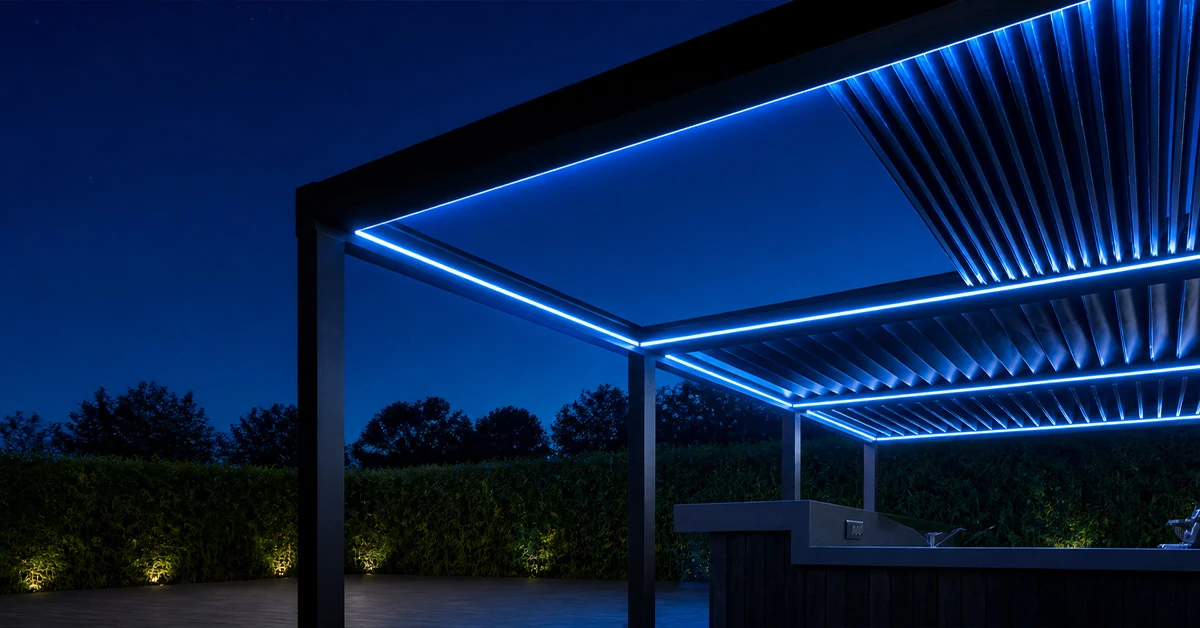
A customer does not experience a pergola as a motor, a control box, or a lighting channel. They experience one roof that should open smoothly, stop accurately, respond sensibly to weather, and create useful light after sunset. If the roof requires one remote, the lights another, and the rain sensor behaves differently from the app, the product feels fragmented even when the frame is well made.
That is why retractable louvered pergola control deserves attention early in product development. The actuator determines the mechanical behavior. The limits determine where movement ends. The sensor logic determines which command has priority. The lighting architecture determines whether the system feels integrated or merely accessorized.
This guide explains how manufacturers can evaluate those four layers together, using the system relationships shown in the supplied Pergo Pro Retract connection and application diagrams as a practical reference. The goal is not to prescribe one universal wiring layout. It is to help OEM teams ask better questions before a controller reaches production.
The central engineering decision: integrate the control architecture
The strongest control architecture gives the pergola one defined logic layer for actuators, tubular motors, lighting, sensors, and user interfaces. Separate modules can still exist inside that architecture, but they should share a documented channel map, power strategy, connector standard, and fault response.
شركتنا نظام التحكم المتكامل في البرجولا follows this manufacturer-first direction: one outdoor control unit can coordinate lighting, linear actuators, tubular motors, weather inputs, and multiple user interfaces. The exact channel count and motor compatibility should always be matched to the roof design, but the principle is broadly useful: define the system around the product line rather than around whichever component happens to be cheapest.
An integrated architecture can reduce duplicated receivers and simplify dealer training. More importantly, it makes behavior testable. A manufacturer can document what happens when a rain input arrives while the roof is retracting, when an actuator reaches a limit, or when the app loses connection during a local RF command. Those are product behaviors, not marketing details.
1. Choose the motor from the roof mechanics, not the remote
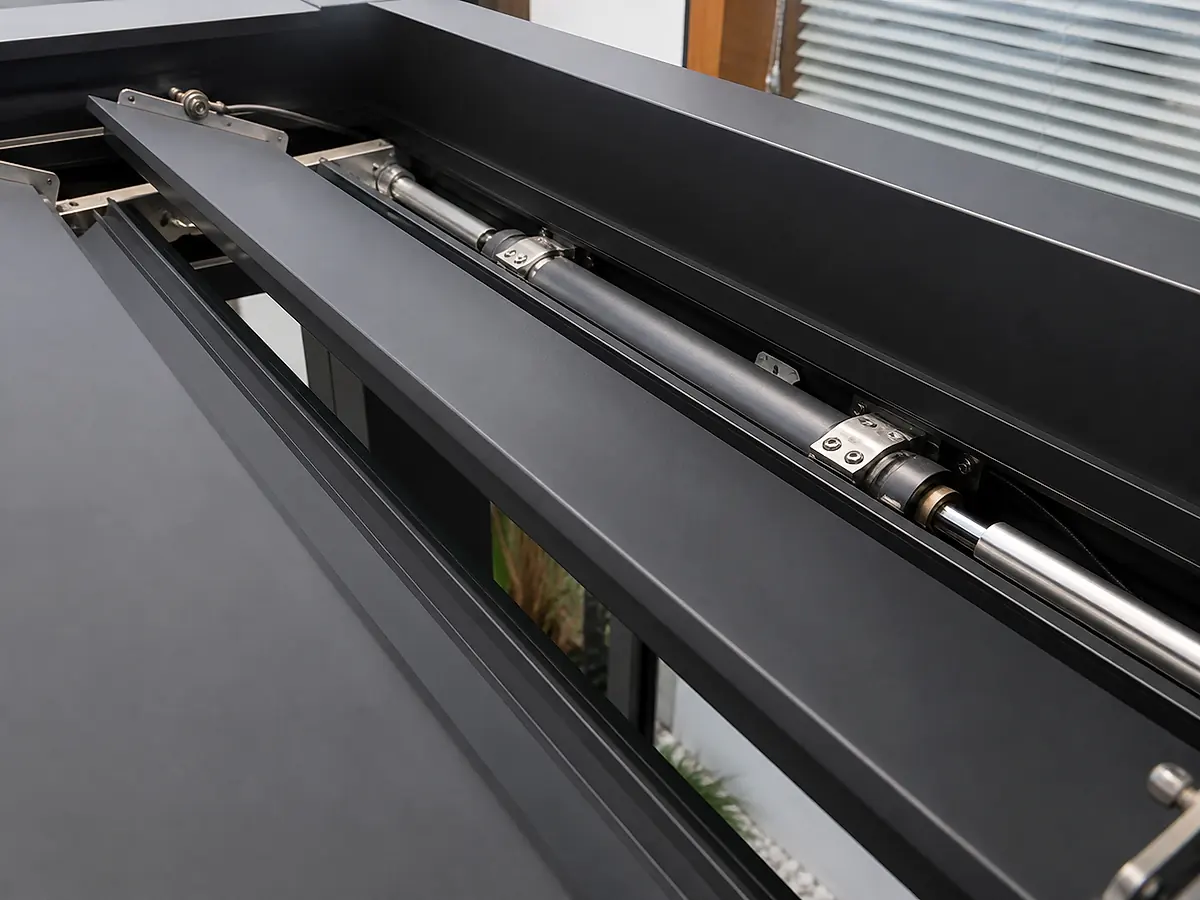
Motor selection begins with the roof mechanism. A motor that moves a sample roof in a clean workshop may not have enough margin after powder coating, seal compression, linkage friction, temperature changes, debris, or long-term wear. The motor and controller must be specified as a pair against the real mechanical load.
Retractable and louvered pergola designs commonly use two broad actuator families. Linear actuators create push-pull movement and are often suited to louver tilt or linkage-driven mechanisms. Tubular motors rotate a shaft and are often used for retractable roof sections, screens, blinds, or other roll-based elements. Neither is automatically better; the right choice depends on the transmission path, available installation space, service access, and required feedback.
| Specification question | Why it matters to the OEM |
|---|---|
| What load must the motor move after installation? | Torque or thrust margin must account for friction, seals, alignment, weather exposure, and aging rather than only the unloaded roof. |
| How will the motor report position? | Limit switches, Hall feedback, or another repeatable method determines whether the controller can stop accurately and detect abnormal movement. |
| What happens during a stall? | Current limiting, overload protection, thermal protection, and a defined retry or lockout behavior protect the motor and the roof linkage. |
| How is the roof recovered after a power failure? | A documented manual override or service procedure prevents an installer from improvising at height. |
| Can the motor cable and connector be replaced? | Serviceability matters because a sealed roof should not need to be dismantled to replace a low-voltage harness. |
For a deeper comparison, see our guide to linear actuators versus tubular motors in louvered pergolas. Manufacturers should also document the permitted motor family, voltage, direction convention, connector pinout, and maximum connected load in the product specification.
2. Limits are the system’s reference point
Limit control is what turns motor movement into a repeatable roof position. A control system may offer an attractive remote and app, but it cannot deliver dependable open, close, or intermediate positioning if the controller does not know where the mechanism starts and stops.
Limits may be mechanical, electronic, or built into the actuator. The engineering choice should be made together with the linkage and service process. A limit that is difficult to verify during installation becomes a warranty risk. A limit that drifts or is set against a misaligned roof can produce incomplete closure, unnecessary noise, or excessive force at the end of travel.
Every OEM control specification should answer five practical questions:
- How does the installer set or confirm the open and closed positions?
- Can the controller distinguish a normal stop from a stalled or obstructed movement?
- Does the system retain calibration after power is removed?
- Can the service team identify a limit fault without replacing unrelated components?
- What is the safe state if position feedback is missing or contradictory?
The supplied connection diagram illustrates an important product-development idea: the motor, linear actuator, sensors, power supply, control box, remote, and app are parts of one signal and power map. That map should be converted into an installer-facing harness diagram with labels, connector orientation, cable lengths, and access points. A marketing image is useful for explaining the concept; a production drawing is required for repeatable assembly and service.
3. Build sensor priority logic before adding sensor hardware
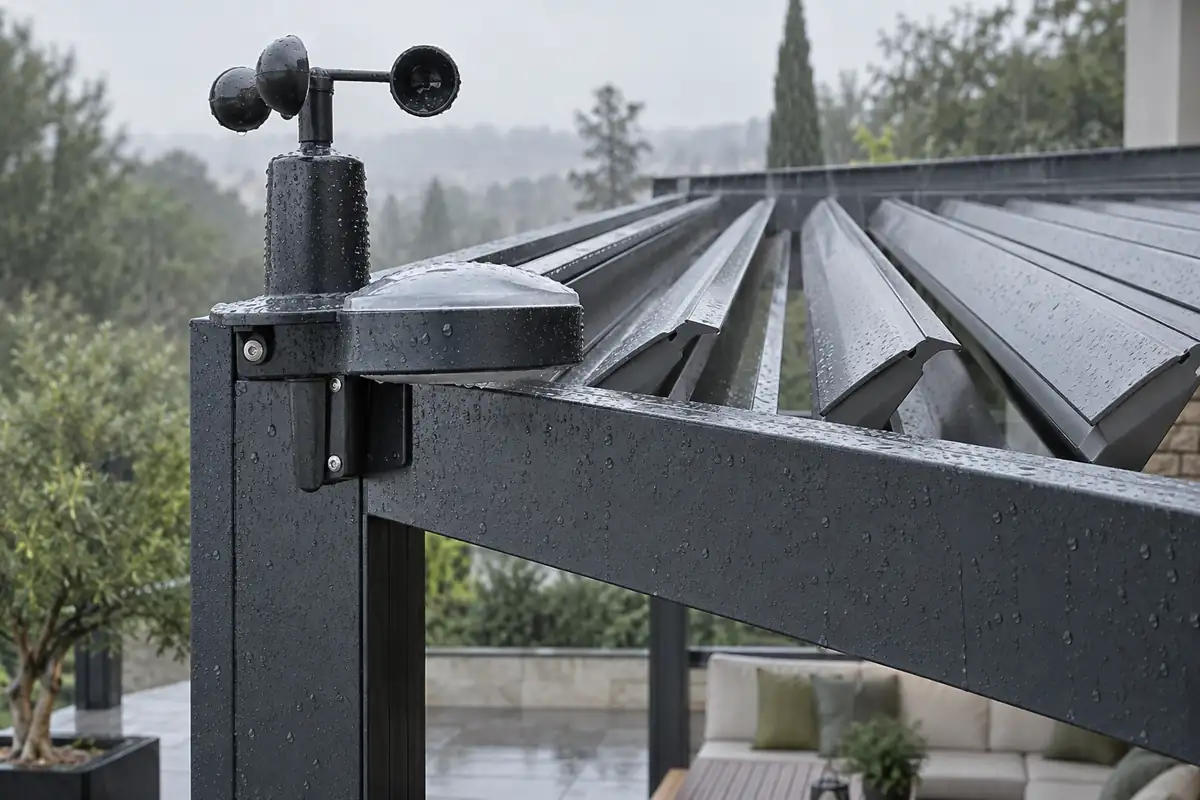
A weather sensor is useful only when the controller knows what its signal means, how long it must persist, and which commands it can override. Rain, wind, sun, and snow do not necessarily require the same response. A rain event may close the roof. A high-wind event may move the roof to a defined pressure-relief position or place screens in a protective state. Snow may require a separate response based on the structure and local engineering requirements.
Sensor logic should be written as a state model rather than a list of features. At minimum, define the normal state, the triggered state, the reset condition, the hold time, the manual override behavior, and the behavior when the sensor or communication path is unavailable.
| Input | Questions the manufacturer should define |
|---|---|
| Rain | Does the roof close immediately, after confirmation, or after a configurable delay? When may a user reopen it? |
| Wind | Which product is protected: louvers, retractable screens, or both? Does the controller latch the safety state until conditions remain below the reset threshold? |
| Sun or light level | Does the sensor change louver position, lighting scenes, or only an automatic schedule? |
| Snow or frost | What prevents movement when the mechanism may be iced or carrying a heavy snow load? Who defines the safe operating envelope? |
شركتنا دليل دمج مستشعرات البرجولا explains why sensor inputs should be connected to conditional scene logic rather than treated as simple on/off switches. The key lesson for OEMs is straightforward: hardware availability is not the same as a tested safety behavior.
Important: Weather automation is not a substitute for structural engineering, local code compliance, or a clear operating limit. Thresholds should be validated for the specific pergola, actuator, louver geometry, and installation environment.
4. Treat lighting as a controlled load, not an accessory
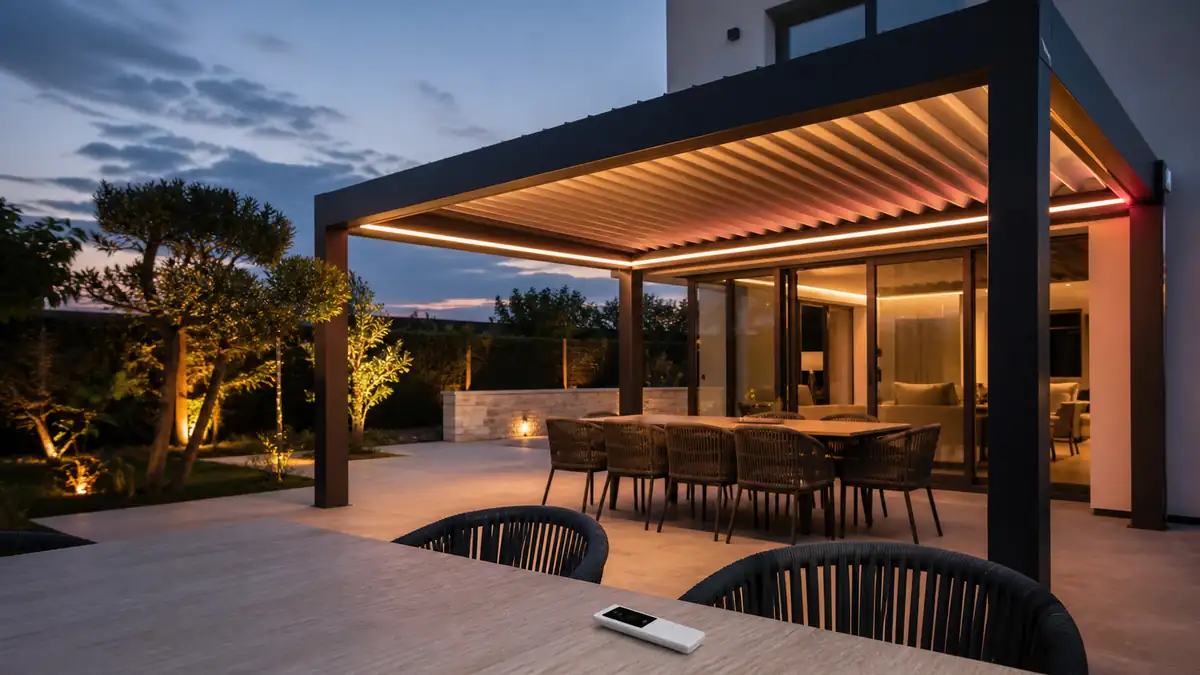
Integrated lighting changes the electrical design of the pergola. Mono white strips, spotlights, RGB or RGBW products, and task lighting may have different current requirements and control methods. The controller, driver, connectors, cable routing, dimming method, and heat path must be planned together.
DC24V lighting is often a practical architecture for integrated outdoor systems because it can share a low-voltage design language with accessories and simplify installation. That does not remove the need for voltage-drop calculations, driver headroom, thermal management, and connector protection. A waterproof lamp connected through an unsuitable junction or an overloaded driver is still a system failure.
Use separate, documented channels when the use case requires different behavior. Functional white light may need smooth dimming for dining or cooking. RGB or RGBW light may need independent scene control. A controller that merely switches every LED output together limits the product’s ability to create meaningful scenes and makes future product variants harder to support.
VLEDSTAR’s pergola lighting product range includes recessed spotlights, downlights, LED strips, wall lights, and accessories intended for outdoor structures. For OEM teams, the value of sourcing these elements with the control platform is not only convenience; it is the opportunity to standardize connectors, mounting details, color options, and test procedures across a product family.
Before approving a lighting channel, verify:
- nominal voltage and maximum current;
- driver rating and installation position;
- dimming range and visible flicker behavior;
- connector and cable ingress protection after assembly;
- maximum cable length and allowable voltage drop;
- replacement access without removing finished roof sections.
5. Choose the user interface after the control logic is stable
RF remote, mobile app, touchscreen panel, wall switch, and home-automation integration are interface options. They should expose the same underlying states instead of creating separate, conflicting systems.
RF remains valuable for local operation because it does not depend on a customer’s Wi-Fi connection. An app can add remote access, schedules, scenes, and status visibility. A touchscreen can make a commercial or hospitality installation easier to understand. The best combination depends on the product tier and market, but the controller should preserve local operation when cloud access is unavailable.
Aluminum structures also make radio planning part of the mechanical design. Antenna placement, enclosure position, cable routing, and the selected RF protocol can affect reliability. Our research on RF signal problems in aluminum pergolas addresses this issue in more detail. Test the complete roof assembly, not only the receiver on a workbench.
A multi-channel interface is especially useful when a product includes separate roof bays, screens, mono lighting, RGB lighting, fans, or auxiliary relays. The channel map should be understandable to the dealer and consistent across product variants. If the same button changes meaning from one model to another, training and support become unnecessarily expensive.
6. Make the connection diagram a manufacturing document
The supplied connection diagram shows the system at a glance: motor and actuator outputs, sensor inputs, control enclosure, power supply, lighting outputs, remote control, and app-based operation. For production, expand this concept into three documents.
Electrical architecture
Show the mains input, low-voltage supply, fusing or protection, controller outputs, sensor inputs, grounding approach, and separation between line-voltage and low-voltage wiring. The responsible electrical engineer must adapt this to the target market and applicable requirements.
Harness and connector schedule
Assign a part number, pinout, length, connector, sealing method, and label to every harness. Include which connections are factory-installed and which are made by the dealer. This is where plug-and-play installation becomes a real process rather than a slogan.
Behavior and commissioning checklist
Test motor direction, open and closed limits, obstacle response, each lighting channel, sensor trigger and reset, local RF operation, app pairing, power recovery, and manual service procedure. Record the expected result and the acceptable tolerance for each test.
Our article on wiring diagram concepts for louvered pergola lighting and motor control takes the same view: a wiring diagram is a product-development document, not just an installer’s sketch.
7. Specify the control box for the installed environment
Outdoor protection is a system property. The enclosure, cable glands, connectors, antenna, mounting orientation, drainage, and service access all influence reliability. An IP rating should be treated as one part of the design rather than a guarantee that every installed connection will perform the same way.
Place the controller where the wiring remains short, the antenna can communicate, condensation can be managed, and a technician can reach the unit without dismantling the finished pergola. Check clearance inside the frame and allow for connector bend radius. A compact controller is valuable only if it can be installed without sharply bending cables or trapping a connector against the aluminum profile.
إن IP65, IP66, and IP67 guide for pergola controllers and sensors is a useful companion when comparing enclosure claims. The correct question is not “Which number is highest?” but “Does the complete installed assembly match the exposure, service, and drainage conditions of the pergola?”
What manufacturers should put into the product specification
A control system specification should be detailed enough that engineering, purchasing, assembly, installation, and after-sales teams all describe the same product. Include:
- approved actuator and tubular-motor families;
- voltage, current, torque or thrust, travel, and duty assumptions;
- limit and feedback method;
- obstacle, stall, thermal, and overload behavior;
- sensor type, placement, trigger, reset, and priority logic;
- lighting channel type, driver requirements, dimming behavior, and maximum load;
- RF, app, touchscreen, and local-control behavior;
- connector, harness, enclosure, and service requirements;
- commissioning tests and fault codes;
- approved regional variants and documentation.
This level of definition also makes supplier comparison more useful. A lower component price may not be lower once separate receivers, custom harnesses, extra installation hours, dealer training, and warranty diagnosis are included.
In our view, the next step in retractable louvered pergola development is not adding more icons to an app. It is creating a clear behavior model that connects mechanical movement, weather protection, lighting, and service decisions.
That model should be simple enough for a homeowner to use and precise enough for an OEM to test. It should keep local control available, prioritize safety-related conditions, preserve repeatable limits, and give dealers a wiring and commissioning process they can follow. The physical products may vary by market, roof size, and accessory package, but the logic should remain coherent.
VLEDSTAR develops and manufactures integrated pergola control systems و حلول إضاءة البرجولات for OEM and private-label programs. Our role is to help manufacturers connect the control box, motors, sensors, lighting, harnesses, and user interfaces into a repeatable product rather than a one-off installation.
Conclusion: specify the system before you specify the parts
A retractable louvered pergola control system should be judged by what happens in real conditions: whether the roof reaches the intended position, whether limits remain reliable, whether weather inputs have clear priority, whether lighting operates without electrical compromises, and whether a dealer can install and service the product without guesswork.
Start with the roof mechanics. Define motor feedback and limits. Write sensor behavior before selecting sensor accessories. Separate and size lighting channels correctly. Test RF performance inside the finished aluminum structure. Then turn the architecture into a documented harness, commissioning process, and support package.
Planning a new pergola control platform?
Share your roof mechanism, actuator or tubular-motor requirements, lighting channels, target market, and sensor functions with the VLEDSTAR engineering team. We can help you evaluate a control architecture, prepare a sample configuration, and develop an OEM-ready lighting and control package.
Explore the integrated pergola control system أو learn about VLEDSTAR as a source factory.

التنبيه: Control Systems for Restaurant and Hotel Pergolas: Multi-Zone Lighting and Weather Automation
التنبيه: Mono White vs RGB Pergola Lighting Packages: Which Should OEMs Offer?