


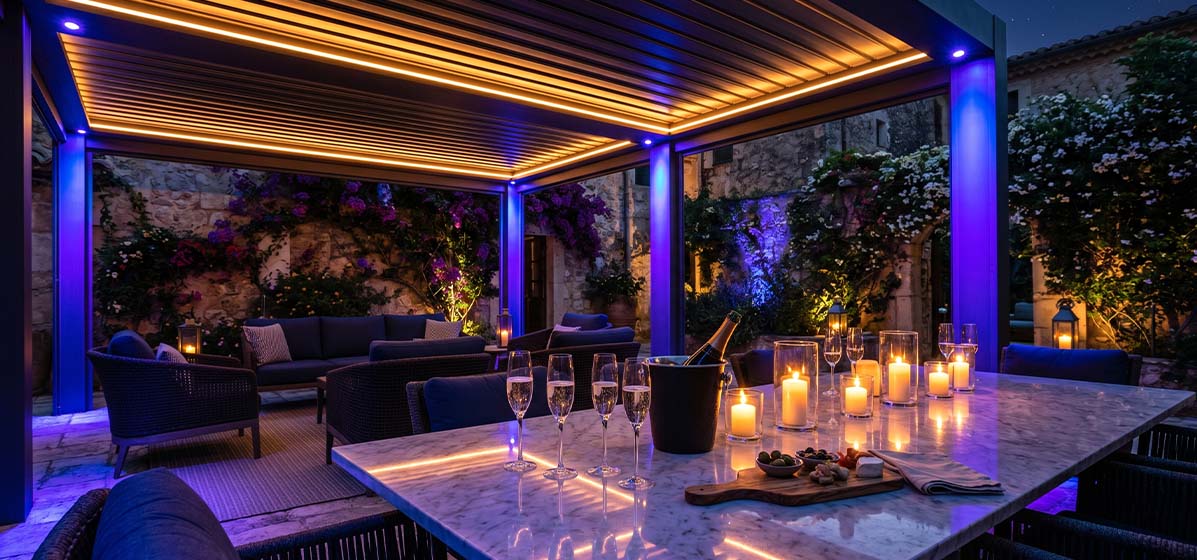
The high-end European and American outdoor living market is undergoing a profound shift — from static shading toward dynamic, electrified outdoor living spaces. Bioclimatic pergolas are at the center of this transformation, with the number and complexity of their integrated electrical devices growing exponentially. But when manufacturers attempt to build premium products with immersive lighting experiences, they consistently hit an invisible wall: the closed ecosystems built by industry-dominant motor brands like Somfy, Nice, and Teleco.
Motors govern the physical movement of structures; lighting gives the space its soul. In actual engineering and manufacturing, achieving seamless, stable, and cost-efficient compatibility between third-party advanced LED lighting kits and these proprietary motor protocols has become the defining technical challenge facing every pergola manufacturer. The industry reality is that “pseudo-compatibility” achieved through software gateways or dry-contact modules inflates BOM costs and plants serious failure risks in complex outdoor RF environments. The real breakthrough lies not in patching the edges of existing systems, but in going deep into the underlying architecture and adopting a native, all-in-one hardware control platform.
The Fragmented Outdoor Automation Ecosystem and the Hardware Island Problem
Before discussing integration solutions, it is essential to understand the communication barriers that define today’s pergola control landscape. The European motor supply market is highly concentrated. A few major brands have established proprietary RF communication standards based on their first-mover advantages in tubular motors and linear actuators. This moat strategy protects their market share — but it has pushed lighting, temperature control, and other peripheral devices to the margins of the system.
Somfy’s Closed-Loop Logic and Expansion Predicament
Somfy is the benchmark in global automated shading. Its control ecosystem is built on the one-way RTS protocol (Radio Technology Somfy, operating at 433.42 MHz) and the two-way io-homecontrol protocol (868–870 MHz). For pergola manufacturers, Somfy offers extremely reliable motor drive solutions — including the Ondeis rain sensor and the Eolis wind speed sensor network with weather-sensing linkage.
However, when manufacturers need to integrate customized RGB/RGBW dynamic lighting with Somfy remotes such as the Situo 5 RTS or Telis 16, the technical path becomes extremely narrow. The native lighting receivers Somfy provides — such as the 12V/24V 2-Motor RTS Receiver or the Dimmable LED RTS Light Kit — are designed primarily for basic warm-white/cool-white dimming. These modules fall far short when faced with modern full-color ambient lights, chasing light effects, or long-run LED strips.
To work around this limitation, many engineers turn to Dry Contact Interfaces. Through the Somfy RTS Dry Contact module, third-party systems can receive basic on/off pulse signals. But the cost is severe: a dry contact is a physical relay simulation. It cannot transmit smooth PWM (Pulse Width Modulation) dimming data, and it has no bidirectional status feedback. Users cannot precisely adjust brightness to 35% or 72% via the remote. Lighting control degrades to the most primitive “fully on” or “fully off.”
Teleco Automation and Nice’s Proprietary Territories
As representatives of Italian automation excellence, Teleco and Nice hold important positions in the overall control units for bioclimatic pergolas. Teleco provides dedicated controllers for adjustable slats and retractable slats — such as the PLR and PLP series — and deploys STICK series dimmers to handle 24Vdc single-color or RGB light strips.
Although Teleco provides a relatively complete internal ecosystem, and has recently achieved top-level interoperability with Somfy through the TaHoma program, for OEM pergola assemblers this still means cramming the motor’s control black box, an independent LED dimming driver, and possibly a signal amplifier into the narrow aluminum alloy beams of a pergola. The aluminum material creates a natural Faraday cage effect that severely attenuates high-frequency radio signals. The independent existence of multiple modules makes wire harness management a nightmare and exposes the entire system to extremely high electrical failure risk in humid, extreme-temperature outdoor environments.
The McKinsey Pricing Paradigm in Manufacturing
Faced with underlying hardware incompatibility, the market has spawned numerous software-bridging compromise solutions. Integrators typically introduce third-party Smart Hubs, attempting to forcibly connect devices from different brands via a local area network or the cloud.
The Application Limits of TaHoma and Bond Bridge
Somfy’s TaHoma switch is a powerful hub supporting Zigbee 3.0 and RTS, allowing users to control shading devices via smartphone or voice assistants such as Alexa and Google Assistant, and to link with smart lighting systems like Philips Hue. On the other end sits the Bond Bridge Pro — a Wi-Fi/Ethernet gateway designed for professional integrators that can clone and transmit signals from Somfy, Teleco, and even ordinary infrared devices, unifying all devices on platforms such as Control4, Savant, or SmartThings.
Reviewing actual user feedback and engineering deployment cases reveals that this cloud- or LAN-level patchwork is far from ideal for finished pergolas delivered directly to end consumers. On technical forums such as Reddit, complaints about multi-device integration are common. In one documented case, a user integrating the lighting of an Azenco pergola — with built-in Teleco RF hardware and Somfy motors — into a Lutron Caseta whole-home smart system was forced to build an extremely convoluted chain: a dedicated Teleco bridge communicating with Bond Bridge Pro, Bond connecting to Apple Home via Apple TV 4K, and finally a Lutron Pico remote triggering the lighting scene.
| Gateway Solution | Communication Chain | Latency | Dependencies | Fault Diagnosis Difficulty |
|---|---|---|---|---|
| TaHoma + Third-Party Lighting | Remote → RTS → Receiver (motor); App → Wi-Fi → Cloud → Zigbee → Fixture | Medium (1–3 sec) | Stable internet access and home router | Extremely high — difficult to isolate whether failure is RF, Wi-Fi, or cloud |
| Bond Bridge + Native RF | Remote → Bond Hub → RF translation → Individual actuators | High (commands sent serially) | Unobstructed 433 MHz RF penetration | High — gateway placement directly determines signal blind zones |
This chain brings high additional costs — a single advanced gateway can exceed $379 — and introduces uncontrollable latency. In an outdoor scenario, when a sudden storm hits, users expect to instantly close the louvers and activate warm lighting with a single button press. Any network fluctuation in a gateway-dependent setup could allow water to enter the pergola. Furthermore, this complexity shifts the entire commissioning responsibility onto on-site installers, violating the modern manufacturing standard of genuine plug-and-play.
Moving Toward Native Low-Level Integration: The 4-in-1 Control Architecture
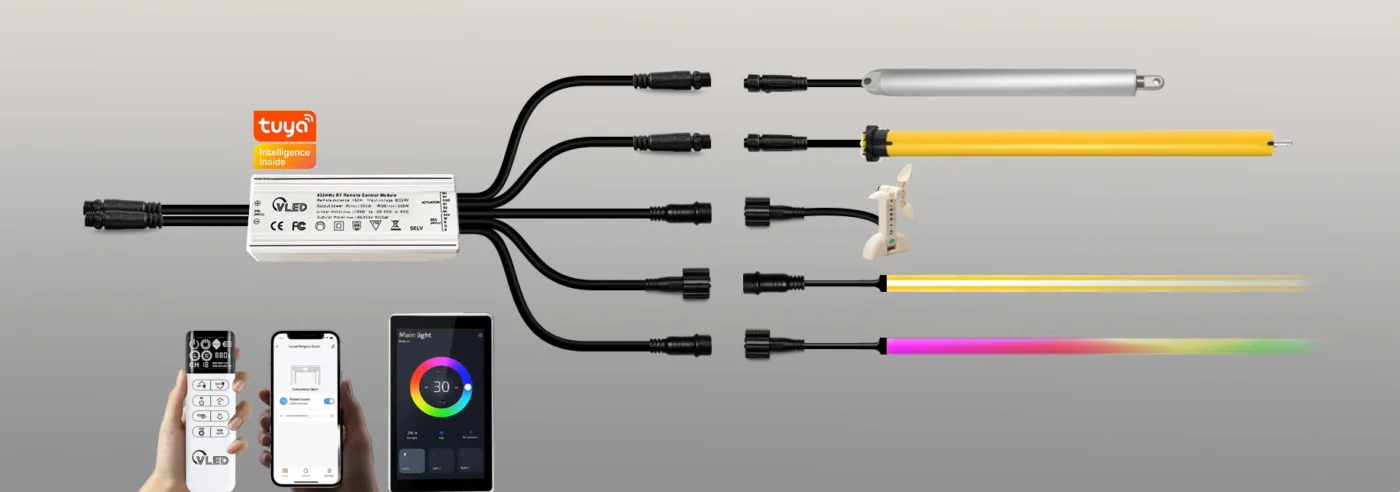
To fundamentally break the patchwork compatibility impasse, system design must shift from backend protocol conversion to frontend hardware board integration. True compatibility does not mean endlessly adapting to each proprietary protocol — it means providing a universal central processor that can seamlessly replace all the original discrete control boxes.
After evaluating the current innovation landscape, professional-grade integrated systems exemplified by the VLEDSTAR PERGO Pro demonstrate disruptive engineering potential. Rather than acting as an intermediary gateway, this system functions directly as the brain of the pergola — completing the unified management of motors, monochromatic lighting, full-color RGB lighting, and weather sensors within a single high-protection-grade (IP67) enclosure.
Completely Rebuilt Actuator Management Logic
The PERGO Pro system abandons the traditional redundant model of “one motor, one receiver; one LED strip, one driver” and establishes a centralized power supply and command distribution mechanism. This demonstrates overwhelming advantages when handling the most critical component of bioclimatic pergolas: linear actuators.
High-end bioclimatic pergolas — designed to handle snow loads and wind resistance — typically abandon tubular motors in favor of heavy-duty DC linear actuators. Taking the commonly used ANT-38P as an example, its maximum load capacity reaches 2500N, specifically designed for outdoor shading structures such as pergolas. Larger spans may require the ANT-52, which provides up to 6000N of thrust. When two actuators drive a large louvered array in parallel, even a few millimeters of travel deviation on either side can cause severe twisting and deformation of the aluminum alloy connecting rods.
Traditional RF controllers can only send simple start/stop pulses and cannot sense the real-time position of the motor. The 4-in-1 integrated system achieves precise motor travel limit programming through low-level hardware circuits. System engineers can directly calibrate each motor’s absolute extension point (Fully Extended) and absolute retraction point (Fully Retracted). In multi-channel group mode, the system uses high-frequency current detection and Hall sensor feedback to force multiple linear actuators to maintain microsecond-level synchronized operation. This level of low-level actuator control is a technical blind spot that no externally mounted smart gateway can reach.
Lossless Lighting Quality Under High-Frequency PWM Drive
After solving the rigid control of motors, the system demonstrates extreme flexibility in lighting compatibility. Pergola lighting is the core element shaping the outdoor environment’s atmosphere. An excellent lighting system not only needs to visually integrate with the aluminum frame but also demands absolute electrical stability.
Many pergola manufacturers purchase expensive waterproof RGBW flexible neon strips — such as Q-Tran or Element Neon products — only to end up with severe light flickering or color banding at low brightness, caused by inferior dimming controllers using extremely low-frequency PWM output to cut costs. The all-in-one pergola control system solves this compatibility issue at the source. The system features professional-grade constant voltage drive and high-frequency PWM dimming arrays, outputting clean 24V DC directly to the light strips.
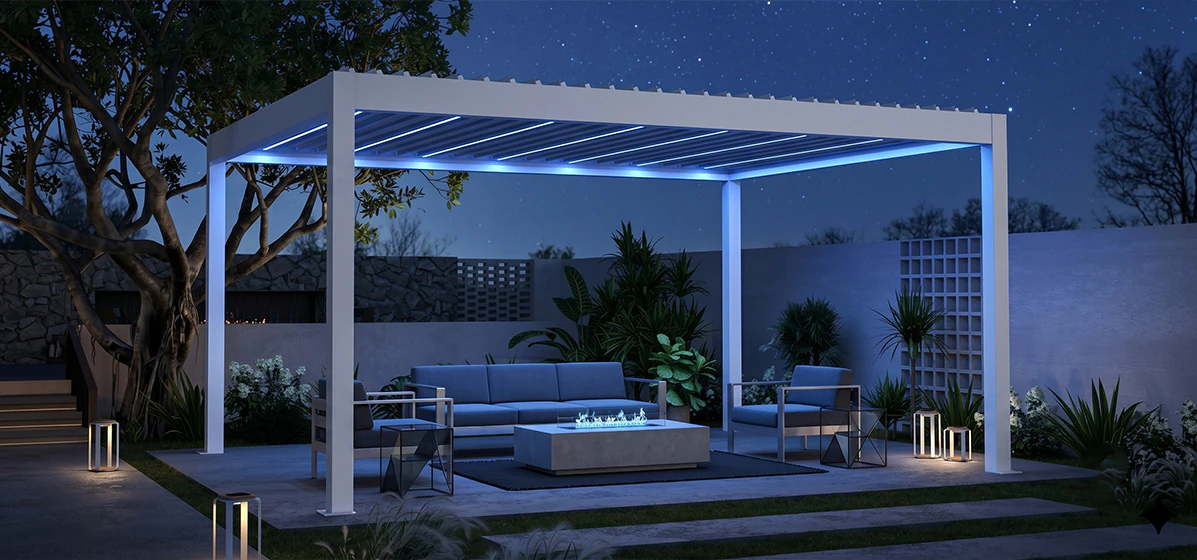
Smooth 0–100% stepless dimming curve, eliminating the flickering effect captured by camera lenses and ensuring absolute visual comfort across the full brightness range.
Built-in color mapping algorithms allow users to precisely select tens of millions of colors via a dedicated remote, and to activate preset dynamic effects such as adjustable rainbow gradient speed with a single click — instantly switching scene atmospheres for private gatherings or commercial events.
Since the lighting driver and motor controller are sealed within the same PCBA (Printed Circuit Board Assembly), the command interaction between them is completed entirely within the microsecond-level bus — completely eliminating the delays and packet loss caused by radio signals being reflected and absorbed by the metal frame.
Climate Response and Multi-Space Cascading: Redefining Commercial Deployment Standards
For pergola manufacturers primarily targeting hotels, restaurant terraces, and high-end custom residences, automating a single pergola unit is only the first step. The real challenge lies in handling complex large-area, multi-module commercial deployments and ensuring high system autonomy under extreme weather conditions.
Local Closed-Loop Weather Sensor Linkage
The highest standard for an automation system is to be imperceptible. When strong winds suddenly rise or heavy rain suddenly falls, the system must take protective action before humans can react. Somfy’s Eolis wind sensors and Ondeis rain sensors send wireless alerts that depend on receiver response speed. In sensor solutions relying on gateway relay — such as the Breeze Pro Gen 2 — climate data including wind speed, rainfall, and solar intensity must first be sent to Bond Bridge Pro, processed through internal logic, and then converted into motor control signals. While this cloud or LAN processing provides rich interface displays, it also increases the risk of single-point failures.
Native integrated controllers adopt a far more reliable local closed-loop logic. Rain and snow sensors establish direct hardware-level pairing and communication with the control system. Once a sensor detects a critical threshold, the signal enters the controller’s low-level interrupt directly — the system instantly takes over all actuators. Motors drive the louvers to a fully closed position, forming a waterproof barrier. The controller can even simultaneously activate warm-toned lighting inside the pergola according to preset logic, providing comfort to users sheltering from wind and rain. This instantaneous cross-subsystem linkage proves that native hardware integration has irreplaceable advantages in reliability.
The Commercial Value of 16-Channel Architecture and Channel 0 Master Control
When deploying more than three pergola units — such as across a large restaurant outdoor dining area — RF channel interference and operational complexity increase exponentially. If staff at closing time need to separately operate multiple independent Somfy remotes to close dozens of louvers and turn off lights, the process is not only time-consuming but almost guarantees missed units.
To address this commercial pain point, the VLEDSTAR system introduces a 16-channel control architecture with two key capabilities:
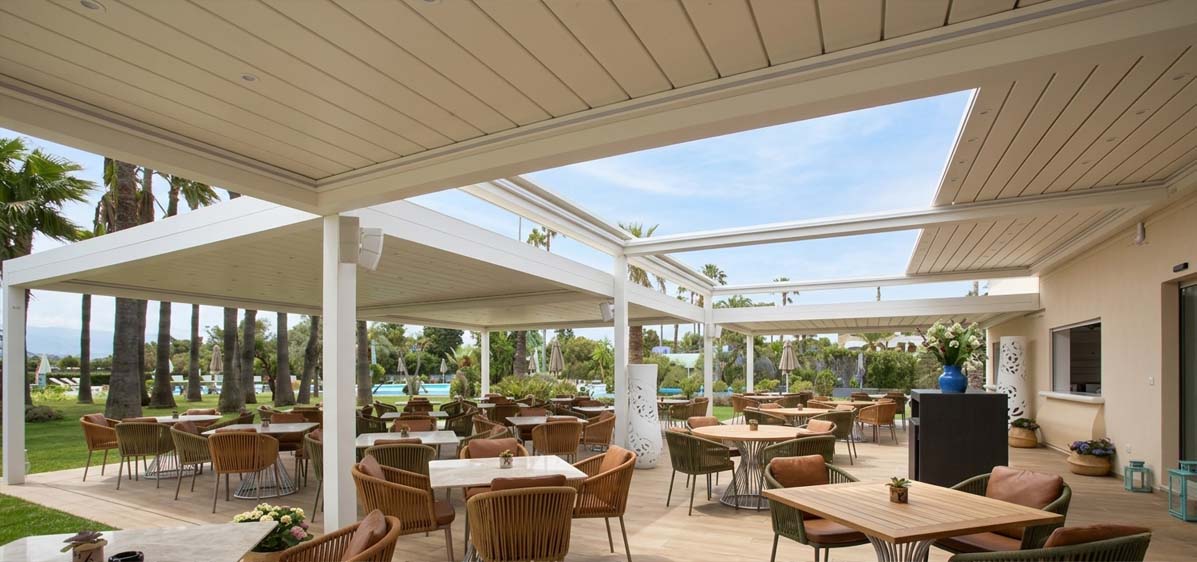
Each pergola unit can be assigned to an independent channel. Building on this, the system supports advanced Group Lock and Unlock functionality. Installation engineers can bind units in specific zones and lock control permissions, preventing ordinary users from accidentally pressing buttons and causing array misalignment.
Channel 0 carries super-master-control authority. When the remote switches to Channel 0, the system simultaneously takes over all functions of up to 15 paired channels in the local area. This is not limited to uniformly opening or closing louvers — it also includes synchronously dimming the entire outdoor area’s lighting to a 20% ambient mode. This one-click large-scale operational capability greatly enhances the system’s premium value in large commercial engineering projects.
Supply Chain Optimization: From BOM Reduction to Assembly Efficiency
For management teams at European and American pergola manufacturers, compatibility issues reach far beyond the R&D department’s blueprints. They directly affect capital turnover rates, supply chain management complexity, and after-sales repair costs. Transitioning the control system from fragmented assembly to highly integrated architecture delivers immediate financial and operational returns.
Eliminating Redundant Materials and Restructuring the Wiring Network
On a traditional distributed assembly line, workers must install a Somfy RTS receiver for the linear actuator, connect a Teleco dimmer in parallel for the LED strip, mount a large AC-to-24V DC switching power supply, and use numerous waterproof junction boxes to connect all these modules in series. This complex cable network consumes substantial copper wiring costs and extends wiring man-hours on the production line by more than 40%.
Introducing an integrated controller delivers a surgical simplification. The 4-in-1 architecture means the entire pergola has just one brain. The plug-and-play design using aviation-grade waterproof connectors makes cable connection as simple and error-proof as assembling building blocks. This directly reduces BOM procurement costs for control modules and wiring materials, significantly cuts assembly man-hours in the workshop, and — thanks to the greatly reduced module footprint — allows designers to conceal the controller entirely within more compact aluminum pillars, enhancing the minimalist aesthetics of the industrial design.
Reducing Overseas Maintenance Costs and After-Sales Disputes
In an export-oriented business model, after-sales costs are often the largest black hole consuming profits. When an end user reports that “the lights cannot be linked with the louvers,” manufacturers using fragmented solutions get caught in disputes with component suppliers: Somfy claims its motor receiver is working normally; the gateway vendor says the Wi-Fi connection is fine; the lighting supplier blames a PWM signal mismatch in the dimmer. Overseas distributors, lacking professional troubleshooting capability, often have no choice but to process full returns or exchanges.
An all-in-one control system fundamentally severs this chain of blame-shifting. System status is highly centralized, and with a clear LCD status display, fault diagnosis becomes linear and transparent. If there is a drive anomaly, the mainboard fault code directly pinpoints which linear actuator has triggered overcurrent protection. If lights are not working, the short circuit is quickly located on either the power supply side or the light-emitting side. This level of control not only protects the manufacturer’s brand reputation but also greatly reduces the labor costs of cross-national maintenance.
Beyond Compatibility: Defining the Next Generation of Outdoor Living Terminals
A clear conclusion emerges from this analysis of the automated shading market: attempting to achieve lighting system compatibility on top of the existing closed protocols of Somfy, Nice, or Teleco — by cobbling together third-party RF adapter modules or relying on consumer-grade smart gateways — is a high-risk, low-return engineering detour.
True system compatibility is not a compromise with outdated architectures. It is bottom-level integration implemented at the source of hardware manufacturing.
The future bioclimatic pergola should not be viewed as an aluminum frame with a movable roof. It should be defined as a highly intelligent outdoor super-terminal. Beyond precise motor travel synchronization and flicker-free RGBW dynamic lighting, advanced integrated control systems are already reserving underlying architectural capacity for higher-power infrared heaters, outdoor ceiling fans, and even immersive Bluetooth audio matrix systems.
For major European and American pergola manufacturers, mastering this unified hardware control logic means gaining the power to define products in intense market competition. Do not let complex protocol conversions and poor gateway experiences become the weak link dragging down your premium hardware craftsmanship. Abandon patchwork. Embrace native integration. This is the only path to reducing supply chain costs, improving commercial project win rates, and delivering the ultimate lighting experience to users.
To learn how a 4-in-1 integrated control architecture solves multi-motor synchronization, full-color lighting mapping, and large-scale array management in a single platform, and to obtain detailed engineering documentation and supply chain integration solutions, visit pergolalights.net/pergola-control-system/ now. It is time to cross the compatibility threshold and jointly set the industry standard for intelligent pergola control for the next decade.

Great content! Keep up the good work!
التنبيه: Retractable Louvered Pergola Control Systems: Motor, Remote, and Sensor Requirements
التنبيه: Integrated Pergola Control Systems: A Manufacturer’s Guide to Louvers, Lighting, and Sensors
التنبيه: قائمة مراجعة قائمة المواد (BOM) لنظام التحكم في البرجولة المخصصة لمصنعي الأسقف المزودة بفتحات تهوية
التنبيه: Somfy أم Bond أم Tuya أم Teleco أم نظام لاسلكي مخصص: أي نظام تحكم يناسب خط إنتاج البرجولات؟
التنبيه: كيفية تحديد سعة محركات LED ذات الجهد 24 فولت لمجموعات إضاءة عوارض البرجولة والفتحات والشرائط
التنبيه: موضع مستشعر المطر في الأسقف ذات الشرفات القابلة للتحريك آليًّا: إرشادات المصنع والمُركِّب
التنبيه: التحكم في المشغلات والمحركات الأنبوبية لفتحات التهوية في البرجولات: دليل التكامل مع مصنعي المعدات الأصلية (OEM)
التنبيه: Linear Actuator vs Tubular Motor for Louvered Pergolas: Control Implications