


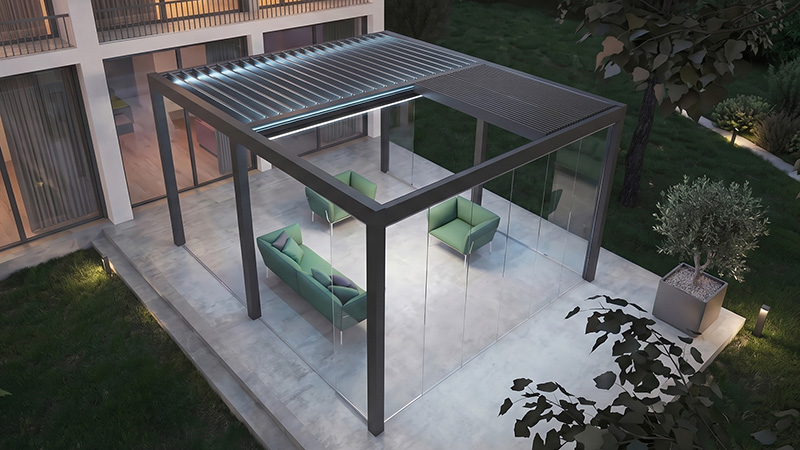
The practical answer: use one control architecture with separate motor channels, defined movement states, weather priorities, limit feedback, and lighting scenes that respond to the roof position. Rotation should manage shade, airflow, and rain direction. Retract/extend should create or remove the open-sky condition. Both functions should remain independently addressable while sharing the same safety and user interface.
That distinction matters to pergola manufacturers selling to dealers, installers, architects, and outdoor-living brands in Europe and North America. A buyer does not experience a linear actuator, a tubular motor, and a lighting receiver as separate components. They experience one roof: open, shaded, closed, retracted, extended, lit, or protected from weather. If those actions require different remotes, unclear button combinations, or manual intervention, the system feels unfinished even when the frame and motors are mechanically sound.
This article presents a manufacturer’s position on the problem: integrated control should be specified as part of the pergola system, not added after the roof design is complete. The goal is not to make every pergola identical. The goal is to give each model a predictable control language that can scale from a single residential module to a multi-zone commercial installation.
Why two roof movements need one control strategy
Rotating louvers and retracting louvers solve different environmental problems. Rotation changes the angle of the roof blades while the roof remains over the occupied area. It can reduce direct sun, maintain airflow, guide rain toward the drainage path, and create a more comfortable intermediate position. Retraction moves the roof assembly away from the opening, producing a fundamentally different relationship with the sky.
Those movements should not be treated as interchangeable “open” and “close” commands. A system must understand which action is available, which action has priority, and which positions are safe. For example, a retract sequence may require the louvers to reach a defined orientation before the roof can travel. A weather-protection sequence may close the blades without retracting them. A service mode may isolate one motor group while the remaining zones stay operational.
One control strategy does not mean one undifferentiated output. It means one user and installer experience built on correctly separated channels. The controller should be able to identify:
- which motors operate louver tilt or rotation;
- which motors operate retract and extend travel;
- which lighting zones belong to the roof, frame, posts, or adjacent space;
- which sensor conditions trigger protection, warning, or scene changes;
- which commands are allowed simultaneously and which must be interlocked.
Our view: a pergola control system should be evaluated by its state management and commissioning workflow, not by the number of buttons on the remote. More buttons can hide poor architecture. Clear states make a complex system understandable.
Define the roof states before choosing the remote
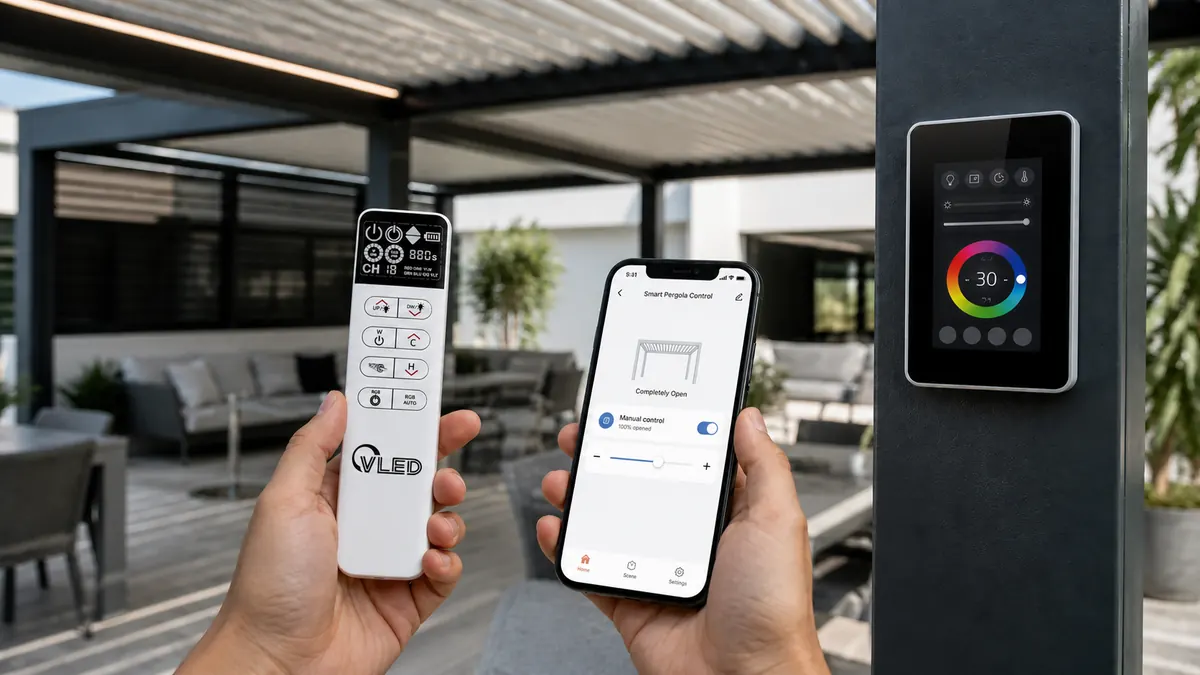
The remote is the visible part of the control system, but it should be the last part specified. Start with the roof states that the product must deliver. A manufacturer can then map those states to RF control, app control, a touchscreen panel, a building automation gateway, or a combination of interfaces.
| Roof state | Primary purpose | Control requirement |
|---|---|---|
| Rotated open | Increase daylight and ventilation | Position control with repeatable limits |
| Rotated shade | Reduce glare and direct solar exposure | Intermediate angle or preset scene |
| Closed | Provide overhead rain protection | Reliable end position and weather priority |
| Retracted | Create an open-sky roof condition | Sequenced travel with obstacle response |
| Extended | Restore the roof over the occupied area | Travel feedback and final alignment |
| Protected | React to wind, rain, snow, or service conditions | Defined automatic action and manual override policy |
This state-first method also clarifies product communication. “Smart control” is too vague for a dealer catalogue. A better specification explains whether the product supports independent louver adjustment, full roof retraction, grouped zones, automatic weather response, lighting scenes, and recovery after a power interruption.
Separate louver rotation from retract/extend at the hardware level
For a combined system to be dependable, each mechanical function needs a clear electrical identity. Louver rotation commonly uses linear actuators or a dedicated drive mechanism. Retract/extend may use tubular motors or another travel motor suited to the roof design. The controller must distinguish these outputs instead of relying on improvised wiring or a universal switch that cannot report what the roof is doing.
VLEDSTAR’s نظام التحكم المتكامل في البرجولا is designed around this type of separation. The published configuration supports up to four linear actuator outputs for louver blade tilt from 0 to 90 degrees and up to two tubular motor outputs, with compatibility listed for Somfy, AOK, and Dooya motor families. That gives pergola manufacturers a practical starting point for assigning independent channels while keeping lighting, motors, and sensors inside one control ecosystem.
For an OEM or private-label program, the important question is not whether a controller can theoretically drive a motor. It is whether the complete package can be documented, tested, and reproduced across model sizes. Motor voltage, current, travel limits, connector pinout, emergency behavior, and replacement procedure should be captured in the same technical file as the pergola configuration.
Use feedback to prevent “blind” operation
Open-loop commands create service problems. The controller sends a signal, but the installer and end user do not know whether the roof reached its expected position. Limit switches, Hall sensing, actuator feedback, or other position methods allow the system to stop accurately and recognize abnormal travel. VLEDSTAR’s control-system information specifically references actuator-internal limit switches and Hall sensing for precise motor control, as well as obstacle retraction to reduce the risk of damage to the roof mechanism.
Feedback is also valuable when a system contains multiple modules. If one zone is extended and another is retracted, a group command should not create an ambiguous final state. The controller or commissioning process should make zone identity visible and allow the installer to test each movement independently.
Build interlocks around movement, weather, and lighting
The most important logic in a combined roof system is often the logic that prevents a command. Interlocks protect the mechanism and make the system easier to understand. A typical control sequence may include the following rules:
- Rotation before retraction: move the louvers to the manufacturer-defined travel orientation before retracting or extending the roof.
- Travel exclusivity: prevent a rotation command from running while the retract mechanism is travelling, unless the mechanical design explicitly allows it.
- Obstacle response: stop or reverse the relevant movement when abnormal resistance or an obstruction is detected.
- Weather priority: define whether wind, rain, or snow protection overrides a user command and how the system reports that condition.
- Power recovery: specify what happens after an interruption: remain stopped, return to a safe state, or require an installer reset.
- Maintenance mode: provide a controlled way to isolate motor groups during installation, inspection, and service.
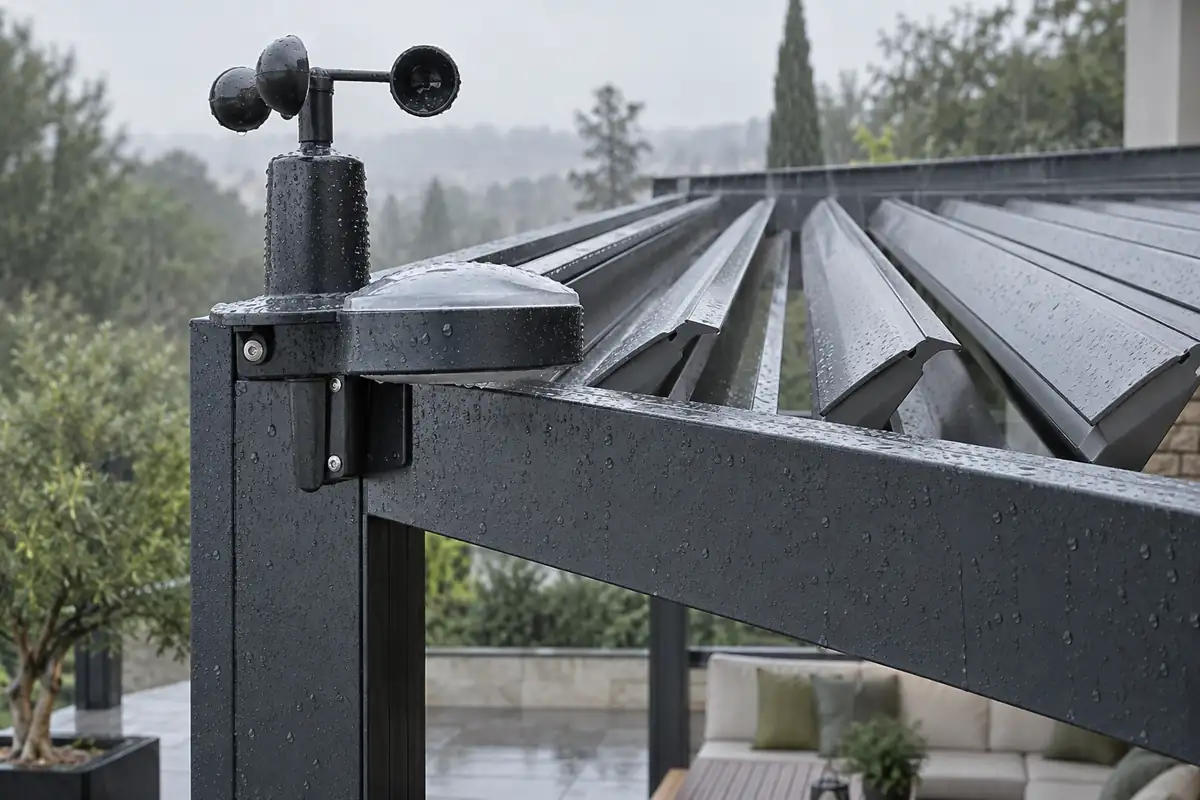
Weather sensors should be part of this logic, not an accessory described on a separate sales sheet. The VLEDSTAR system lists wind, rain, sun, and snow sensing with automatic protective logic. The correct response still depends on the pergola’s mechanical design, local engineering requirements, and the manufacturer’s risk assessment. A sensor does not make an unverified roof safe; it provides an input that the control system must interpret correctly.
External control ecosystems can be useful, but they should sit above a stable equipment-level architecture. For example, manufacturers evaluating motor interoperability can review Somfy’s control ecosystem و Tuya’s smart-home platform as reference points. The exact integration should be confirmed per motor, receiver, voltage, region, and project specification rather than promised as a generic “works with smart home” feature.
Make lighting part of the roof experience
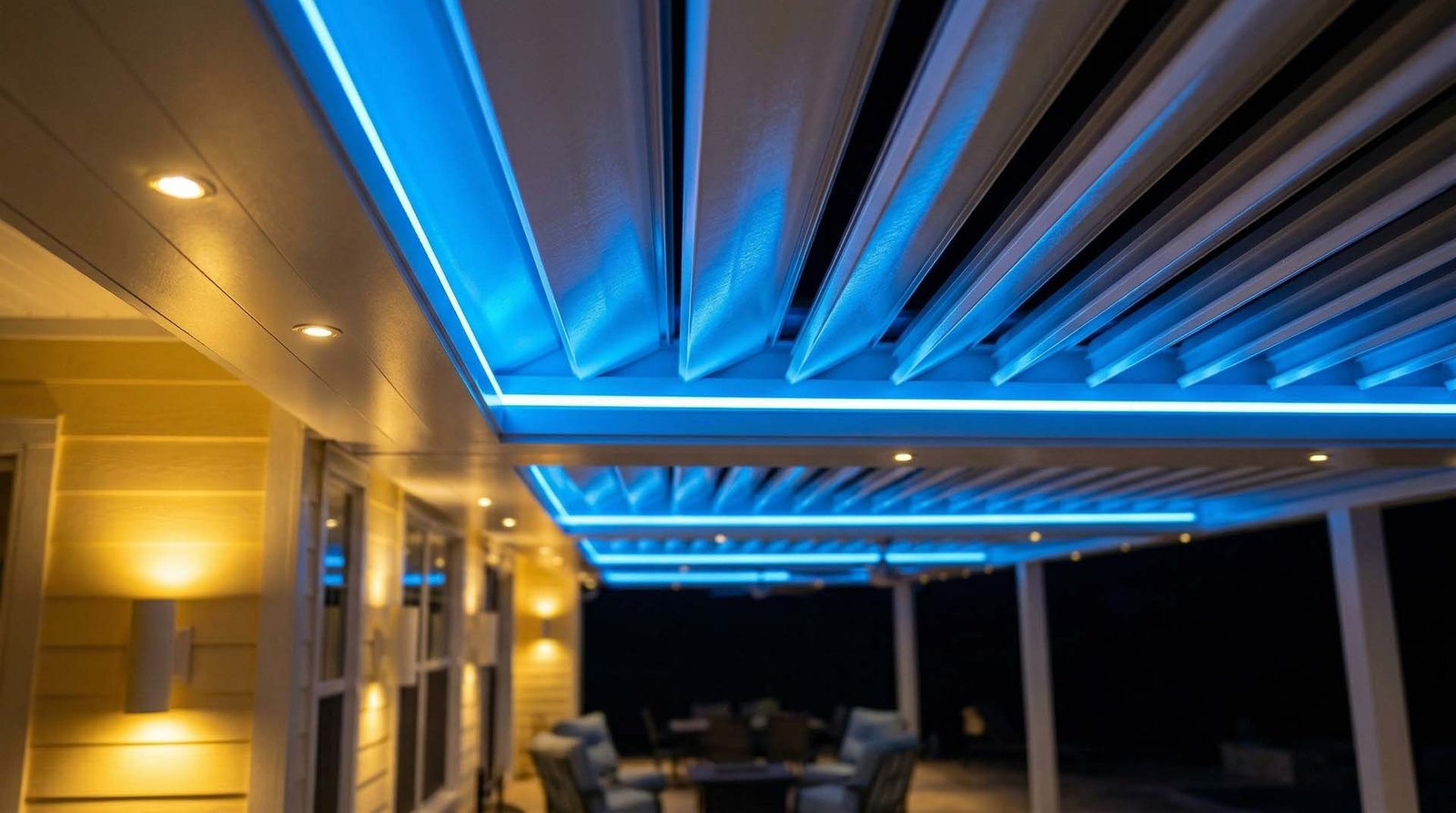
Lighting is where a combined roof system becomes a complete outdoor product rather than a motorized cover. The roof position changes the visual environment, so the lighting system should be planned around it. A closed roof may need low-glare ambient light. A retracted roof may call for perimeter or post lighting. A shaded daytime position may need less output than an evening dining scene.
VLEDSTAR’s مجموعة إضاءة البرجولات includes recessed spotlights and downlights, LED strip lights, wall and post lights, accessories, and lighting kits. The product information covers DC12V and DC24V options, IP-rated outdoor products, RGB and RGBW choices, and lights designed for beams, louvers, rafters, crossbars, and structural profiles. This breadth matters because a manufacturer can keep the lighting language consistent while selecting different fixtures for rotating blades, retractable roof sections, fixed beams, and posts.
The control design should answer three practical questions:
- Does roof movement change the lighting scene automatically, or does the user control lighting independently?
- Can the installer group lights by roof module, room zone, or function?
- Can lighting remain available when a motor is locked out for service?
Independent control is usually the safer default. A manufacturer can then offer optional scenes such as “open sky,” “shade,” “closed roof,” and “evening.” Scenes should be convenience layers, not the only way to access a function. If a user cannot turn off a light without moving the roof, the system is coupling unrelated actions too tightly.
For new builds, pre-integrated kits reduce compatibility risk. For installed pergolas, retrofit options can be equally important. VLEDSTAR describes pergola lighting kits that include spotlight kits, RGBW strip kits, single-colour strip sets, and a linear-actuator and LED strip kit. This is a useful product strategy for manufacturers with an installed base: offer a documented upgrade path instead of forcing a complete roof replacement for every lighting or control improvement.
Choose a control interface that matches the project
Different channels serve different users. RF remotes are practical for everyday operation and can work without a phone. Mobile apps support scenes, remote access, and multi-zone management. Touchscreen panels can make a showroom, hospitality space, or premium residential project easier to understand. The right approach is a layered interface, not a competition between interfaces.
VLEDSTAR publishes three control modes for its pergola system: RF remote, Tuya app, and touchscreen panel. The same page also describes 15-channel control, group and individual operation, a control range of more than 100 metres, signal performance through a 3 mm aluminium structure, and IP65 protection for the control unit. These details are useful to manufacturers because they translate directly into product decisions: number of zones, receiver placement, enclosure strategy, and commissioning documentation.
For commercial projects, the interface must also respect responsibility. A hotel operator may want a simple scene button, while a service technician needs individual motor access. A dealer may need to replace a remote without reprogramming the complete installation. A system that satisfies only the homeowner’s first-day experience can create unnecessary support work later.
Commission the complete system at the factory
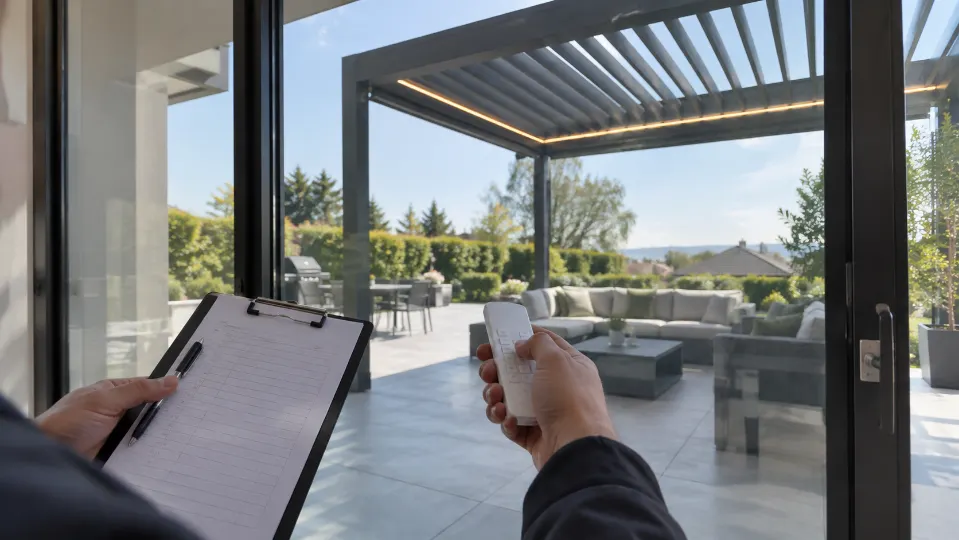
Factory testing should cover the roof and the control package together. Testing lights on a bench and motors on a separate jig does not prove that the final system will behave correctly after installation. The commissioning process should reproduce the actual wiring topology, channel assignment, sensor inputs, limit settings, and user commands as far as practical.
A manufacturer-level test record should include:
- motor direction and channel identification;
- louver open, shade, and closed positions;
- retract and extend end positions;
- transition rules between rotation and travel;
- obstacle or abnormal-load response where supported;
- weather sensor input and protective action;
- light output, dimming, colour, and group assignment;
- remote, app, and panel pairing;
- power interruption and restart behavior;
- installer reset, replacement, and service instructions.
Documentation is part of the product. A wiring diagram that shows only “motor” and “light” is not enough for an international dealer network. The file should identify connector types, cable roles, motor compatibility, sensor inputs, maximum supported outputs, and the conditions under which a manual override is permitted. When the same control architecture is reused across several pergola models, this documentation becomes a commercial advantage: training, installation, and after-sales support become more repeatable.
What pergola manufacturers should specify before requesting a quote
Manufacturers can avoid most integration problems by providing the control supplier with a short but complete project brief. The brief should describe the roof movement, not only the frame dimensions.
| Specification area | Questions to answer |
|---|---|
| Roof mechanism | Which sections rotate? Which sections retract or extend? Can both functions operate in one module? |
| Motor package | Motor family, voltage, current, travel, limit method, and required feedback. |
| المناطق | How many independent roof, lighting, and accessory zones are required? |
| منطق الطقس | Which sensors are required, and what should happen during wind, rain, sun, snow, or a sensor fault? |
| Lighting | White, CCT, RGB, RGBW, strip, spotlight, post, gutter, or mixed lighting; pre-installed or retrofit. |
| الواجهة | RF remote, app, touchscreen, building-control integration, or a layered combination. |
| Market requirements | Destination country, electrical expectations, installation method, documentation, private-label needs, and service model. |
This is also the point where a control manufacturer earns its place in the product-development process. VLEDSTAR began in the LED lighting industry in 2010 and now develops and manufactures lighting and integrated control solutions for pergola systems. The company’s published position is specific: it does not manufacture pergola frames, but focuses on the lighting, motor-control, sensor, connector, and kit layer that pergola brands need to integrate into their own structures. For an OEM customer, that separation can be valuable because the control supplier is focused on compatibility across pergola designs rather than trying to replace the frame manufacturer.
الأسئلة الشائعة
Can one controller manage both rotating louvers and a retractable roof?
Yes, if the controller has separate motor outputs, correct motor compatibility, position or limit feedback, and software logic that sequences the two movements safely. The system should support independent operation while preventing conflicting commands during travel. The final configuration must be validated against the exact motor and roof mechanism.
Should louver rotation and roof retraction use the same button?
They can share a scene or high-level command, but they should not lose their independent controls. A user may want shade without retraction, or an open sky without changing lighting. Use clear presets for convenience and separate controls for precise operation and service.
Can lighting be controlled through the same pergola system?
Yes. A suitable integrated system can manage lighting channels alongside motor and sensor channels. The lighting should remain independently addressable, with optional scenes linked to roof states. VLEDSTAR supports RGB, monochrome, motor, sensor, RF, app, and touchscreen functions within its published pergola control architecture.
What should happen when rain or wind is detected?
The response depends on the roof’s mechanical design and the manufacturer’s safety assessment. The control specification should define whether the roof closes, retracts, stops, or requires a warning. Sensor priority, manual override, fault handling, and restart behavior must be documented instead of left to installer interpretation.
Is a smart-home app enough for a professional pergola system?
No. An app is an interface, not the complete control architecture. A professional system also needs motor compatibility, local control, channel mapping, limit management, weather logic, service access, and clear commissioning records. App control can add value when it sits above a reliable equipment-level control layer.
Conclusion: sell one experience, engineer every movement
Rotating louvers and retractable roofs give pergola manufacturers a stronger product story, but only when the control system makes the difference between those movements invisible to the customer. The user should see one responsive outdoor room. The manufacturer should see clearly separated channels, defined states, safe interlocks, feedback, sensor priorities, and documented testing.
That is the position we take at VLEDSTAR: lighting and motor control should be designed together early enough to influence the product, not added after the roof is finished. With the right architecture, manufacturers can build differentiated pergola models, offer consistent dealer training, and create upgrade paths for lighting and automation without fragmenting the system.
Planning a pergola with both louver rotation and roof retract/extend?
Send the roof movement, motor details, number of zones, lighting plan, target market, and preferred control interfaces to VLEDSTAR. Our team can review the control architecture and help define a practical integrated lighting and motor-control package for your next model or OEM program.
Review the integrated pergola control system أو contact VLEDSTAR through the manufacturer website.

أرسل لنا طلبك