


Die wichtigsten Erkenntnisse
- Motorized pergolas have moved from single-function remote control to coordinated system control.
- Weather response becomes valuable only when sensor inputs, motor feedback, lighting, and safety priorities work together.
- Manufacturers should specify a control platform as part of the pergola product architecture, not as a late accessory.
- The strongest OEM systems are modular, serviceable, and ready for different control interfaces and regional requirements.
The first motorized pergolas solved a clear problem: replace the hand crank with a button. That was a meaningful improvement, but it did not change the product category. The roof still waited for a person to operate it.
Today, buyers expect more. A modern louvered pergola may include roof actuators, retractable screens, LED lighting, rain detection, wind protection, app control, and integration with a wider smart-home system. The commercial challenge for manufacturers is no longer adding one more feature. It is making these functions behave like one dependable product.
Our view is direct: the control architecture is becoming the product differentiator. Frame strength and finish still matter, but the system behind the frame increasingly determines installation effort, perceived quality, after-sales risk, and the manufacturer’s ability to develop a premium product line.
How Did Motorized Pergola Control Begin?
A basic remote control created the first step in pergola automation: a wireless command sent to a motor or actuator. That model remains useful for simple installations because it is familiar, fast to commission, and independent of a homeowner’s Wi-Fi network.
Early systems were usually divided by function. One transmitter operated the louvers. Another controlled a shade or screen. Lighting often had a separate switch, and sensor functions were added through an independent receiver. Each component could work correctly on its own, yet the complete installation felt fragmented.
| Generation | Primary control model | Manufacturer concern |
|---|---|---|
| Manual or assisted | Hand crank or local switch | Low electronics complexity, limited user comfort |
| Remote motorization | RF remote for open, close, or stop | Reliable command delivery and motor limits |
| Multi-device control | Several channels for louvers, screens, and lights | Channel mapping, wiring, and user confusion |
| Connected control | Remote, app, wall panel, and platform integration | Interoperability, commissioning, and support |
| Weather-responsive control | Sensor-driven scenes with safety priorities | Correct logic, feedback, fail-safe behavior, and testing |
That progression explains why the best modern systems are not simply “smart remotes.” They are control platforms. The remote is only one interface into a larger chain of inputs, decisions, outputs, and feedback.
Why Are Integrated Controls Replacing Multiple Remotes?
Integrated control reduces the number of independent decisions a user and an installer must manage. This matters because a pergola is a coordinated assembly: the roof, screen, lights, and sensors share the same frame, power strategy, and service environment.
For manufacturers, the benefit starts before the product reaches the customer. A unified controller can standardize channel assignments, connector choices, commissioning steps, and user instructions across a product range. It also gives the engineering team a clearer place to implement protection rules and future upgrades.
VLEDSTAR’s integriertes Pergola-Steuerungssystem is designed around this principle. The published platform combines RF remote, Tuya app, and touchscreen control with LED channels, linear actuators, tubular motors, and weather inputs. It supports up to four linear actuators for louver movement and up to two tubular motors for compatible retractable systems, subject to final project validation.
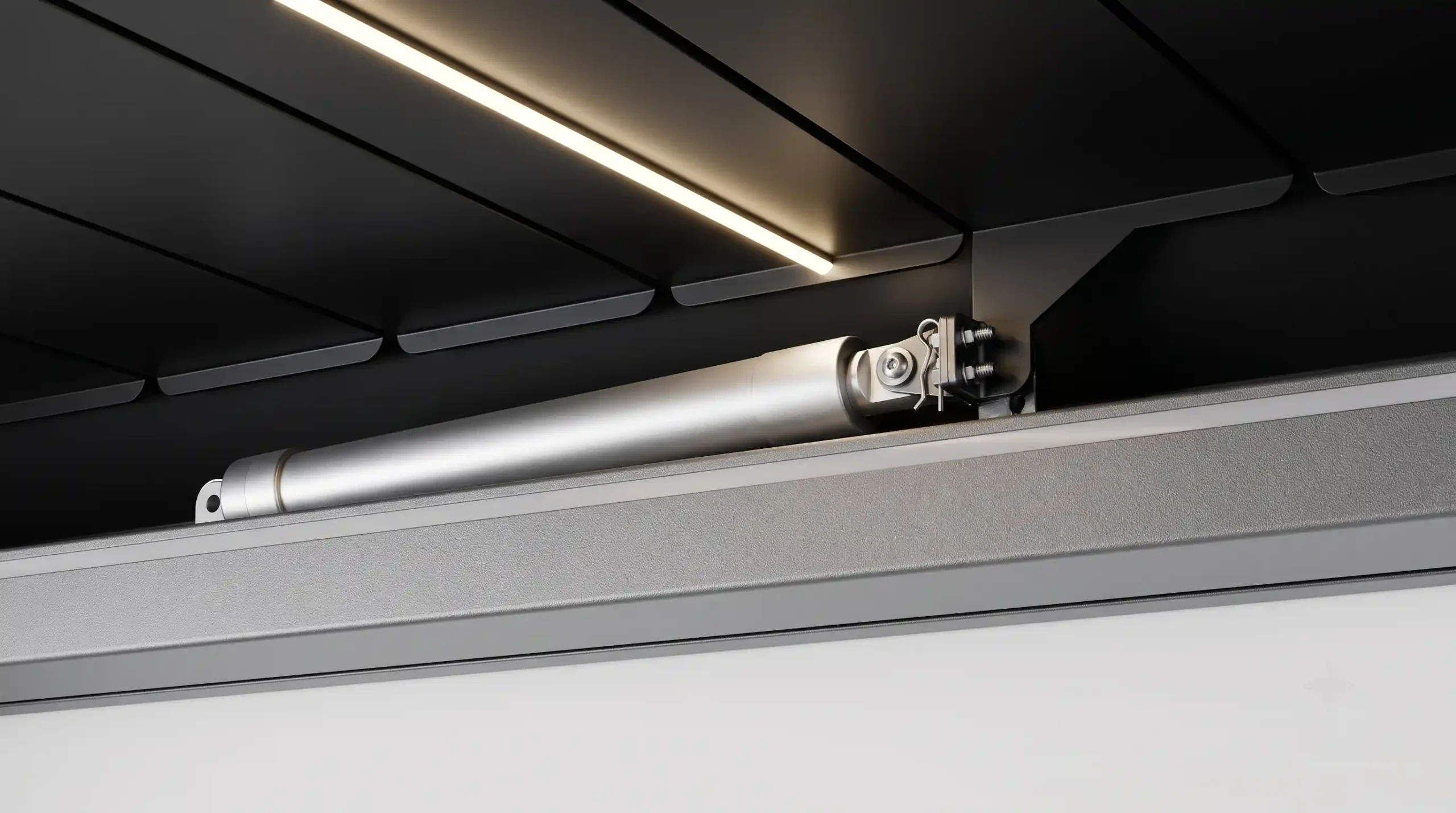
The point is not to force every project into one identical configuration. A good platform should let a manufacturer offer a simple remote-controlled model, a connected residential model, and a sensor-enabled premium model while keeping the underlying architecture recognizable.
What Changes When a Pergola Starts Responding to Weather?
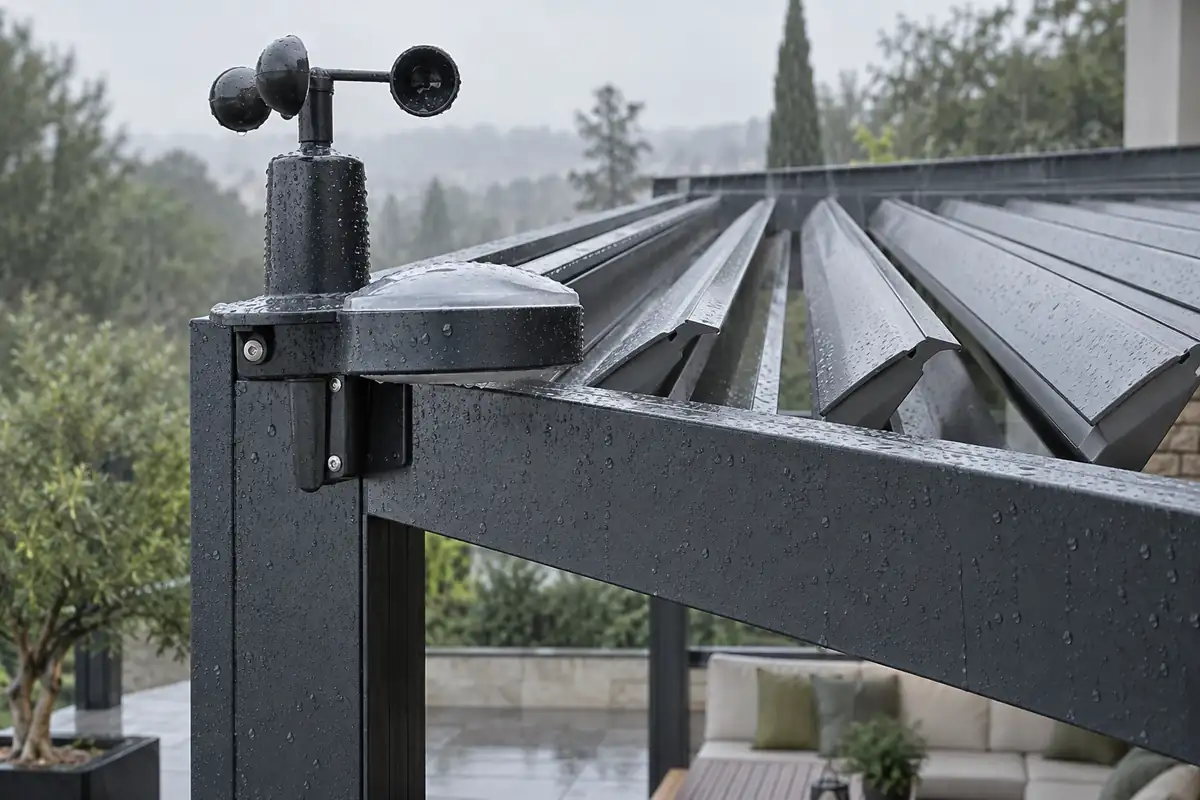
Weather responsiveness changes the control problem from command execution to decision-making. A rain sensor may request closure, a wind sensor may request a protective position, and a lighting scene may be active at the same time. The controller must decide which action has priority and how the system should report its state.
Rain, wind, sun, and snow are not interchangeable inputs. Rain detection is usually about comfort and water management. Wind response is about protecting the structure or its accessories. Sunlight can influence louver angle and lighting intensity. Snow introduces a different load condition and may require a separate protective strategy.
That is why a sensor should never be treated as a decorative add-on. The Anleitung zur Integration des Pergola-Sensors explains the need for conditional scene logic, where a sensor state can trigger a compound action such as a louver position plus a lighting response. Simple relay switching does not provide that level of coordination.
Design principle: define the system’s priority order before selecting the sensor hardware. A premium user experience begins with clear behavior under conflicting conditions, not with the longest feature list.
Weather automation also needs a manual path. Users need to understand when an automatic action has occurred, installers need a predictable commissioning process, and service teams need a way to isolate a sensor, motor, or lighting circuit without dismantling the whole pergola.
Why Do Motor Feedback and Fail-Safe Logic Matter?
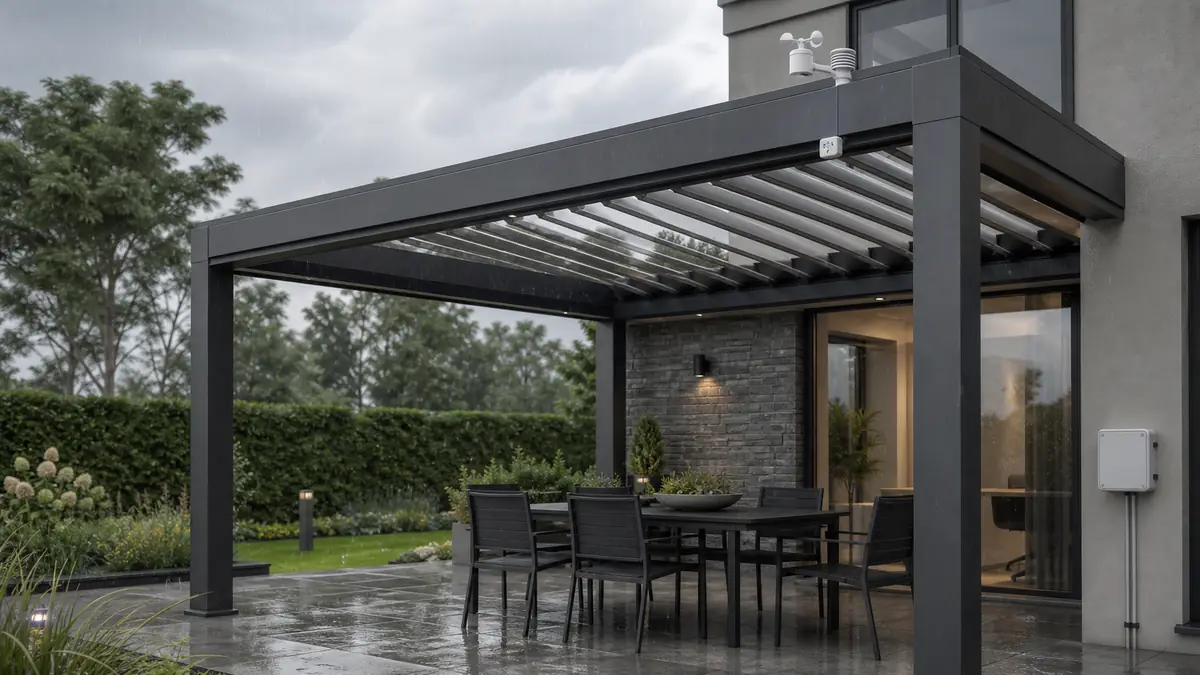
A command that says “close” is not the same as proof that the louvers have closed. Motor feedback, limit switches, obstruction handling, and power-loss behavior are what turn a moving assembly into a controlled product.
In our experience with outdoor control development, the most expensive failures often start at the boundary between mechanical design and electronics. A louver may reach an unexpected resistance. An actuator may stop before the roof seals. A frame cavity may leave little room for a service connection. If the controller cannot interpret the condition, the installer is left to diagnose a system with incomplete information.
Die manual override and fail-safe control guide sets out the OEM questions that should be answered before mass production: how channels are assigned, how service access is preserved, how the selected motors are validated, and how the system behaves when normal control is unavailable.
For louvered roofs, actuator-internal limit switches and Hall-sensor feedback can support more precise positioning. Obstacle retraction can help reduce mechanical stress, but it must be validated against the actual actuator, blade geometry, frame tolerances, and commissioning settings. These are engineering decisions, not software promises.
Where Does Lighting Fit in the Evolution?
Lighting has moved from a separate evening accessory to a core part of the pergola experience. Once roof movement, shade, and lighting share a control layer, the pergola can respond to use cases rather than isolated commands: dining, entertaining, sunset, cleaning, or storm protection.
That integration creates a design obligation. Light should support the roof and the space beneath it without producing glare, visible hotspots, or awkward wiring. The fixture type, profile, power supply, connector, dimming method, and control channel all need to be considered with the louver and frame geometry.
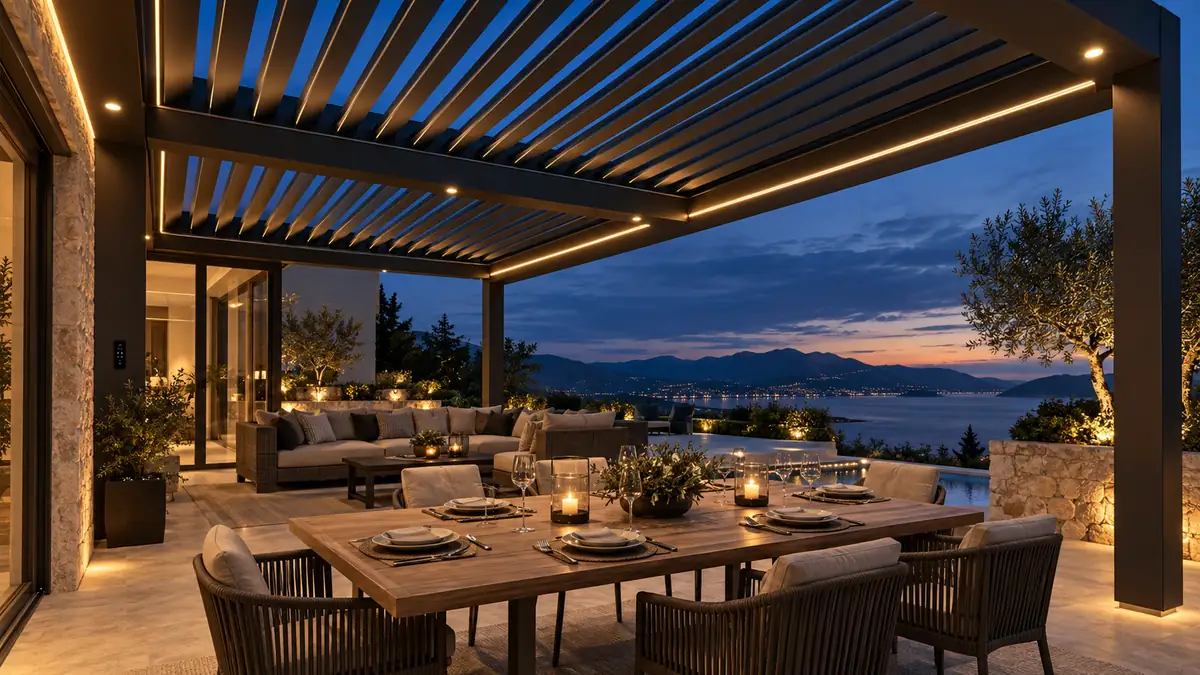
Manufacturers can use integrated pergola lighting to build layered packages around recessed downlights, spotlights, LED strips, wall lights, and post lights. The pergola lighting configuration guide also addresses project sizing, wiring, driver selection, and regional plug requirements, which are practical issues that directly affect installation quality.
The control evolution is therefore also a lighting evolution. A premium system should let the manufacturer define sensible scenes and zones, while still allowing the installer to configure brightness, color temperature, or RGB behavior for the project.
What Should Manufacturers Specify Before Choosing a Control Platform?
Manufacturers should begin with the product family and service model, then select the control hardware. Starting with a low-cost box and adding requirements later often creates incompatible motors, crowded cavities, inconsistent connectors, and difficult warranty conversations.
1. Define the device architecture
List every load and input: louver actuators, tubular motors, screens, mono-color LEDs, RGB or RGBW LEDs, rain, wind, sun, and snow sensors. Decide which functions require independent zones and which can share a scene.
2. Define the user interfaces
RF remains valuable for dependable local operation. App control adds remote access and scenes. A wall panel can be useful in hospitality or commercial projects. Voice and home-automation integration may matter in premium residential markets. These interfaces should expose the same core logic, not create competing versions of it.
3. Define the electrical and mechanical limits
Confirm voltage, output capacity, enclosure protection, connector type, motor compatibility, cable routes, service clearance, and regional compliance needs. VLEDSTAR’s platform documentation describes IP65 protection, multi-channel grouping, 24V lighting control, and compatibility options for Somfy, AOK, and Dooya motor families. Treat those as starting specifications and confirm the final configuration for each project.
4. Define the failure behavior
Document what happens during a power interruption, lost RF command, sensor fault, motor obstruction, communication failure, or unexpected weather event. This documentation is as important as the normal operating sequence.
Manufacturers that complete this specification work early gain a repeatable platform. They can launch variations without redesigning the control system for every new frame size or accessory package.
What Will the Next Generation of Motorized Pergolas Look Like?
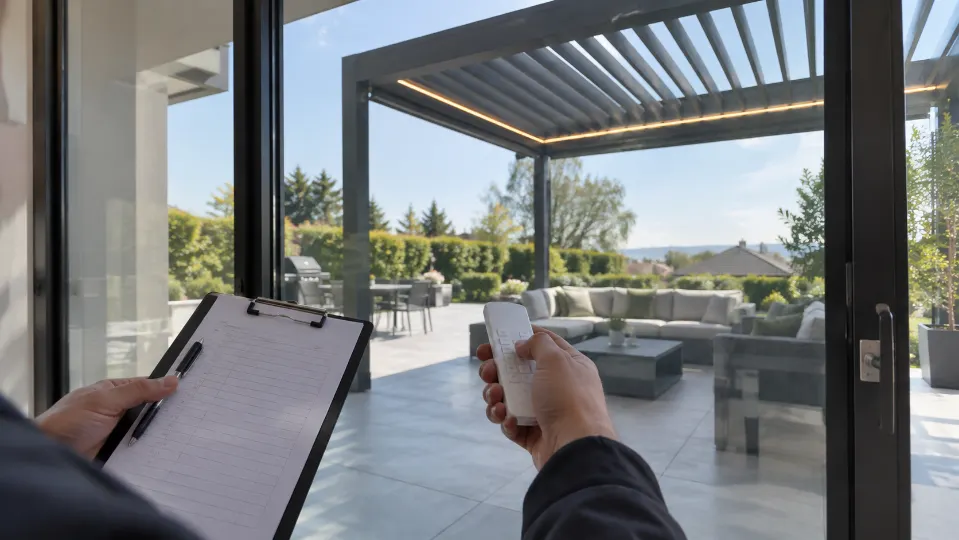
The next generation will not be defined by a single app or protocol. It will be defined by better coordination, clearer feedback, and more deliberate product ownership. Buyers will still want a physical remote, but they will also expect the pergola to behave correctly when nobody is standing beside it.
That creates room for manufacturers to differentiate through scenes, diagnostics, regional configurations, lighting quality, service tools, and enclosure design. A weather-responsive pergola should be able to communicate its state in a way that is understandable to the homeowner and useful to the installer.
Connectivity will continue to evolve. Somfy’s motorized pergola ecosystem demonstrates how remote control, connected control, lighting, heating, and weather sensors can be presented as one outdoor automation experience. In European commercial projects, the KNX standard is another reference point for structured building automation. The practical lesson is to design an integration path without making the base product dependent on one interface.
For OEMs, ownership of the platform matters. A generic controller may move a roof, but a well-specified platform can carry the manufacturer’s channel logic, installation method, support documentation, and future product roadmap.
How Can a Pergola Brand Turn Control Technology into Product Value?
Control technology becomes product value when it improves three measurable parts of the business: the customer’s daily experience, the installer’s work, and the manufacturer’s ability to support the product after delivery.
That means selling clear packages instead of disconnected components. A basic package might include local RF control and louver movement. A comfort package can add screens and dimmable lighting. A weather-responsive package can add sensor logic, protective behavior, and defined scenes. Each tier should have a clear use case and a documented bill of materials.
It also means choosing a partner that understands both electronics and outdoor structures. VLEDSTAR began in LED lighting in 2010 and has expanded into integrated pergola lighting and control development. Its company and engineering background describes work across lighting, motorized structures, sensors, and customized systems for international markets.
The strongest partnerships begin with the manufacturer’s actual frame, motor family, lighting layout, and target market. The final goal is not to add “smart” to a brochure. It is to create a system that can be built consistently, installed efficiently, operated intuitively, and serviced without guesswork.
Frequently Asked Questions
Are RF remotes still relevant for motorized pergolas?
Yes. RF control remains useful for local operation because it is familiar and does not depend on a homeowner’s Wi-Fi connection. The strongest systems treat RF as one interface alongside an app or wall panel, while keeping the underlying motor, lighting, sensor, and safety logic unified.
What sensors are most useful for a louvered pergola?
Rain and wind sensors are common starting points because they address comfort and protection. Sunlight sensing can support shading and lighting scenes. Snow sensing may be relevant in colder markets. The correct combination depends on the roof design, accessories, local climate, and the manufacturer’s defined response logic.
Should lighting and louver motors use separate controllers?
Separate controllers can work, but they create more wiring, more interfaces, and more opportunities for inconsistent behavior. An integrated platform is usually easier to standardize when lighting scenes, louver positions, screens, and weather events need to coordinate. Electrical isolation and output limits still need project-level validation.
What should an OEM test before launch?
Test normal movement, limit positions, obstruction response, sensor triggers, simultaneous loads, RF range, enclosure protection, connector reliability, power interruption, manual override, and service access. Test the complete frame and control package together. Component-level approval alone does not prove system-level performance.
Build the Control Layer into Your Next Pergola Platform
If your product line is moving from simple motorization toward integrated lighting and weather response, define the architecture before finalizing the frame and accessory package. Share your louver type, motor selection, lighting plan, target market, and desired control interfaces with the VLEDSTAR engineering team.
Review the integrated pergola control platform oder contact VLEDSTAR to discuss an OEM-ready configuration.

Senden Sie uns Ihre Anfrage