


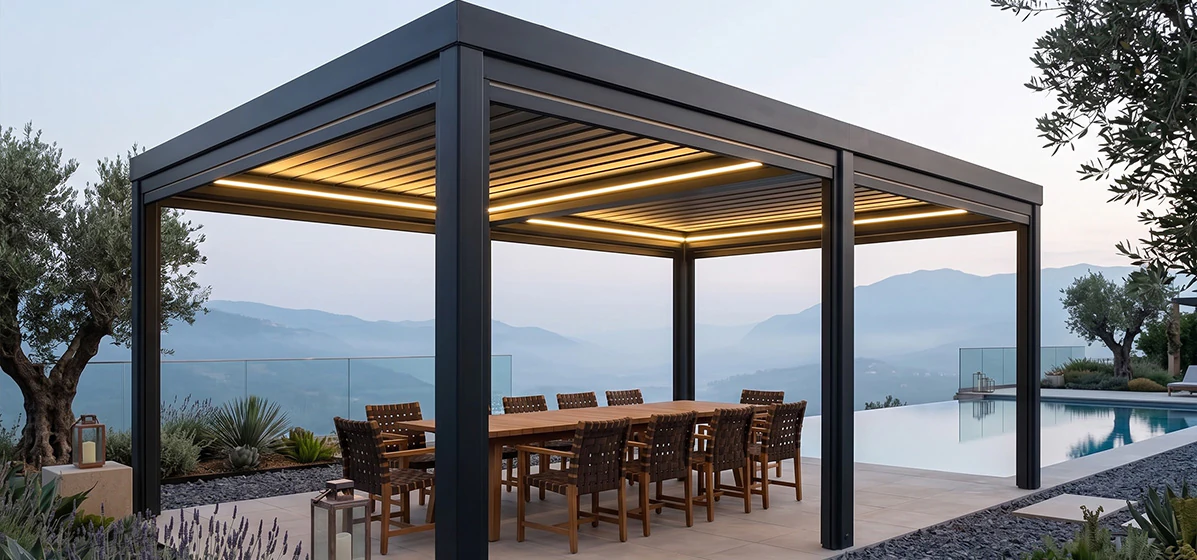
The era of the static, purely wooden pergola is firmly over. In today’s premium outdoor-living market across North America and Europe, buyers are no longer shopping for a simple shade structure — they want a bioclimatic, responsive microenvironment that actively adapts to its surroundings. When a gust hits 60 mph, the system has to retract the wind-rated zip screens and re-angle the louvers within milliseconds to shed the wind load. When the first raindrop falls, a rain sensor must fire the electric actuators within seconds, closing the aluminum louvers into a seamless, 100% waterproof canopy. This degree of absolute environmental control has completely rewritten the commercial value of outdoor space.
Yet the leap from pure structural fabrication to a high-tech IoT ecosystem drops European and American pergola makers at a hard strategic crossroads. When a company whose core competencies are aluminum extrusion, powder-coating, and wind-and-snow load engineering suddenly has to confront RF interference, multi-threaded firmware development, and cloud infrastructure, the question becomes unavoidable: should it build a proprietary control system from scratch, or source (buy) a mature solution from a specialist?
Both the data and the field evidence point to one clear answer. Apart from a tiny handful of tech giants with large in-house software organizations, pergola manufacturers who attempt to cross over and self-develop hardware control boards and an IoT cloud platform almost always sink into a swamp of runaway timelines, punishing hidden costs, and global-compliance setbacks. Deconstructing the underlying economics and technical barriers of “build vs. buy” is required homework for every pergola decision-maker before a project is ever greenlit.
Decoding the engineering inside a smart pergola control system
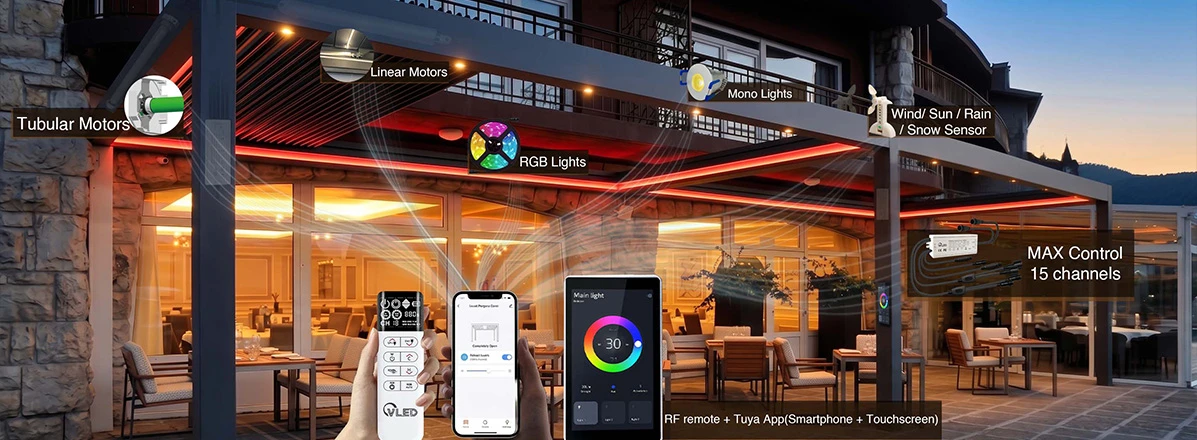
Before we get to the financial model, it is worth being clear about just how much engineering complexity sits inside a modern pergola control system. A high-end smart pergola is not “a motor” — it is a complete closed-loop system that fuses a sensor network, precision drives, and edge computing.
The unforgiving standards of the physical drive layer
The outdoor environment places extreme demands on the weatherability of electronic and electromechanical components. The electric linear actuator that tilts the louvers — the core moving part — has to run reliably for tens of thousands of cycles while withstanding high-salt-fog corrosion, extreme temperature swings, and the ingress stress of driving rain.
Motor Tier | Power Range | Design Cycle Life | Noise Level | Ingress Protection | Typical Unit Cost (USD) |
Premium / Top-tier (e.g., Somfy) | 200W–300W | 100,000+ cycles | 45–50 dB | IP65–IP67 | $1,200–$1,800 |
Mid-range standard (e.g., Nice) | 150W–250W | 50,000–75,000 cycles | 50–55 dB | IP54–IP65 | $800–$1,200 |
Basic / Generic | 100W–200W | 30,000–50,000 cycles | 55–65 dB | IP44–IP54 | $400–$700 |
Premium linear actuators such as TiMOTION’s TA16 or JP3 series can deliver up to 6,000 N of push or pull force with IP66M — even IP69K — class dust and water protection, smoothly driving the louvers through a 0-to-130-degree rotation in 10 to 15 seconds.
Beyond the basic drive, the control board itself has to handle highly parallel multi-channel inputs and outputs (I/O). In single-bay or multi-bay structures, the system must precisely synchronize several actuators to avoid racking the frame; at the same time, the board may need to distribute several kilowatts of current to drive infrared heaters and to provide flicker-free dimming for the RGB / warm-white LED strips integrated into the gutter. This mixed high- and low-voltage, strong-and-weak-current single-board design imposes very high requirements on electrical isolation and thermal management.
The expanding IoT and wireless dimension
Users are no longer satisfied with a wall switch or an infrared remote. Smartphone-app control, geofencing automation (closing the louvers automatically when the owner leaves home), predictive weather response (tapping radar data to brace for a storm in advance), and deep integration with Apple HomeKit, Amazon Alexa, and the Matter protocol have become standard expectations on pergolas priced above $20,000.
That means the control system has to provide stable RF communication over Wi-Fi, Bluetooth Low Energy (BLE), or Zigbee. For a traditional aluminum-fabrication business, mastering this full hardware-and-software stack is tantamount to spinning up the core R&D department of a mid-sized consumer-electronics company out of thin air.
The Hidden-Cost Black Hole of Building
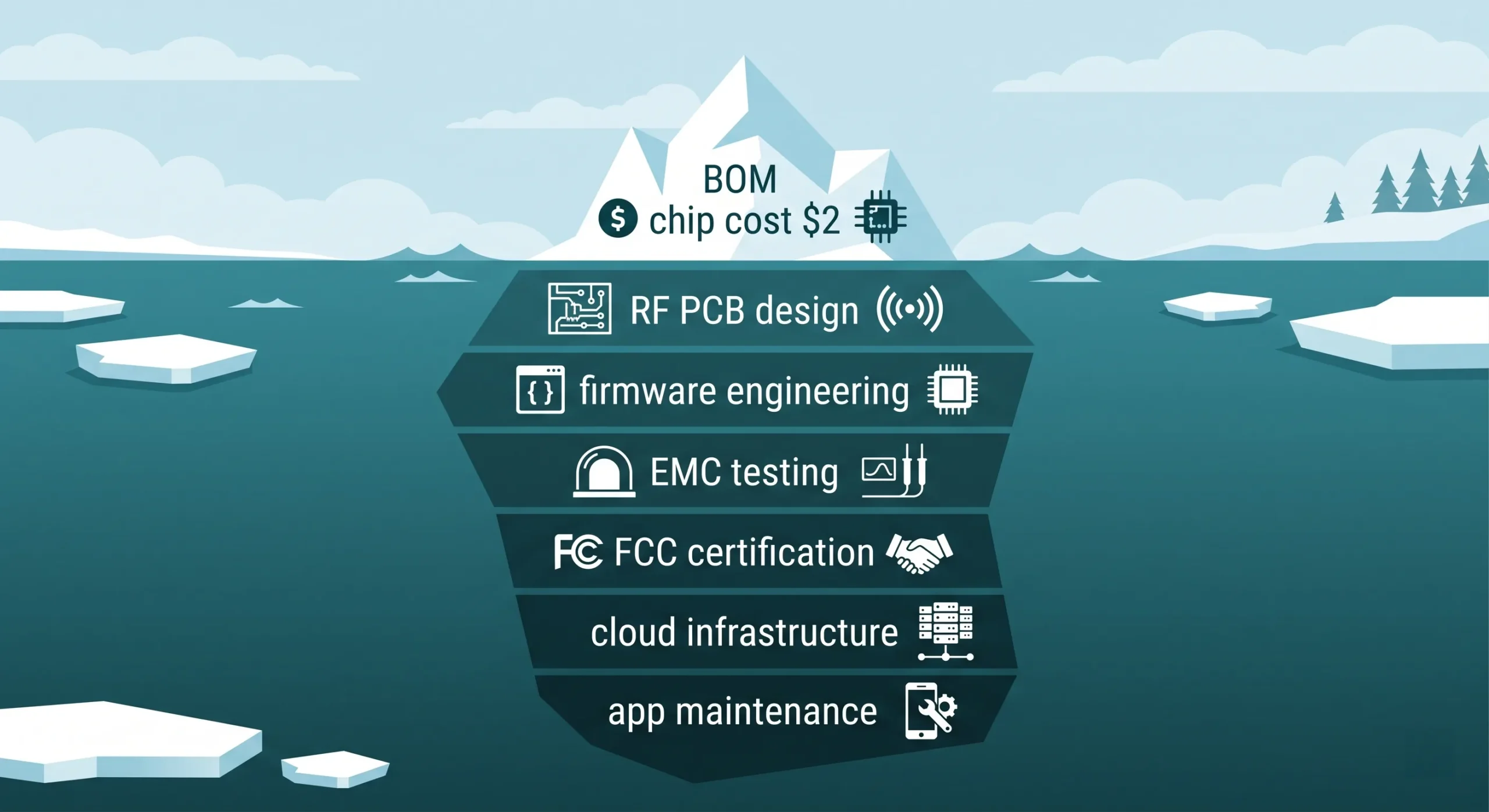
Many companies base their decision on a dangerous illusion: “A WiFi-and-Bluetooth ESP32 chip costs just $2 on the open market, so surely we can lay out our own PCB and write the firmware for next to nothing.” This bill-of-materials-only (BOM) tunnel vision hides the enormous, latent costs of carrying a product from prototype to commercial mass production.
According to field data from experienced RF and IoT engineering teams, the non-recurring engineering (NRE) spend on a self-developed smart control system follows an iceberg model — with a fatal drain on capital and time hidden beneath the waterline.
The Engineering Wall of RF Hardware Design
Designing an RF printed circuit board is far from simple point-to-point wiring. It is acutely vulnerable to signal-integrity problems and performance degradation caused by high-frequency operation. Engineers have to precisely control trace impedance and substrate dielectric constant (a substrate with Dk > 4 increases propagation delay), and tame the intense electromagnetic interference (EMI) thrown off by high-power motor drives and heater relays. To minimize parasitic inductance and optimize thermal performance, the board often needs thicker plated-through-hole (PTH) walls and a dedicated thermally conductive potting compound.
A detailed Texas Instruments white paper lays bare the real cost structure of building versus buying a wireless control module. Developing an industrial-grade RF module in-house carries an NRE spend of up to $146,750 — a startling figure built from the following core line items:
R&D Phase / Cost Item | Estimated Cost (USD) | Detail |
Initial engineering design | $39,000 | Hardware and firmware engineer hours (based on a fully loaded burn rate of ~$5k/week), covering protocol-stack management and antenna matching. |
Dev kits and prototype builds | $12,750 | Licensing fees plus initial PCB fabrication and assembly. |
Test, validation, and rework | $20,000 | Resolving prototype bugs and optimizing power draw and communication range. |
PCB respin | $2,500 | First-pass RF layouts are almost never perfect; a re-route and second spin are unavoidable. |
Manufacturing prep and environmental stress testing | $59,500 | Building production test fixtures and running high/low-temperature, humidity, and interference-aging tests. |
Compliance and certification (single region) | $13,000 | Assumes a clean first pass through FCC testing and the underlying wireless-protocol (e.g., Zigbee/BLE) certification. |
Total system development | $146,750 | If the team lacks RF experience, this cost balloons 1.5× to 2×, accompanied by serious launch delays. |
Designing from the chip down does not just mean a high upfront outlay — it also commits the R&D team to four to eight months of continuous debugging, time that could otherwise have gone into improving the pergola’s structural stability.
The “Life-or-Death Line” of Cross-Border Compliance
Any electronic control board with wireless functionality has to clear stringent legal-compliance gates — FCC, CE, ISED — before it can enter the U.S., European, or Canadian markets. The geometric escalation in certification cost is driven directly by the hardware-design path you choose.
If a pergola maker designs its RF circuitry from scratch purely to squeeze the BOM, that board will be classified by the FCC as an “intentional radiator”. That triggers a full suite of radiated-emissions, conducted-emissions, and spurious-emissions testing inside an expensive certification lab (a TCB).
Device Authorization Path / Type | Authorization Method | Total Cost Range (USD) | Expected Time |
Unintentional radiator (basic digital control board) | SDoC | $1,500 – $5,000 | 2 – 4 weeks |
IoT device using a pre-certified module | SDoC + module authorization | $3,000 – $10,000 | 3 – 6 weeks |
Custom single-band RF design (e.g., a self-built gateway) | Full Certification | $8,000 – $20,000 | 6 – 12 weeks |
Multi-radio combined device (WiFi+BLE+Zigbee) | Complex multi-module certification | $15,000 – $30,000 | 8 – 16 weeks |
The hidden killer in compliance is the “first-test failure rate.” Data shows that roughly 50% of consumer-grade electronics fail their first EMC (electromagnetic compatibility) test. Once that happens, the team has to hire pricey EMC consultants ($150–$250 per hour) to diagnose the fault, then modify the PCB layout (adding $1,000–$15,000 in cost) and re-queue for testing — a cycle that mercilessly pushes the launch back by months.
The Bottomless Pit of IoT Software and Cloud Architecture
Solving the hardware and compliance problems only buys you the entry ticket to the IoT era. What truly decides the user experience — and what most easily becomes a capital incinerator — is building out the entire software ecosystem.
A modern pergola buyer expects the same buttery-smooth phone control they get from Tesla or a top-tier smart-home brand such as Philips Hue or Nest. That demands an end-to-end cloud platform, a secure database, responsive mobile apps (iOS and Android), and stable APIs.
The capital required to build this software foundation is sobering:
IoT Software Development Stage | Estimated Cost Range (USD) | Core Resource Consumption |
Requirements discovery and architecture | $6,000 – $33,000 | Defining the communication protocol stack, edge-compute and cloud-gateway topology, and planning for high-concurrency data flows. |
UI/UX interaction design | $10,000 – $50,000 | A mobile interface designed for harsh outdoor glare, with multi-zone independent control-panel logic. |
Backend and API development | $20,000 – $150,000+ | Standing up cloud servers, building bidirectional low-latency channels, device-shadow sync, and third-party voice-assistant integration. |
Quality assurance and full-environment testing | $10,000 – $100,000+ | Large-scale concurrency stress testing, firmware OTA upgrade-and-rollback testing, and iOS/Android multi-device, multi-version compatibility testing. |
Total development (mid-to-advanced platform) | $100,000 – $500,000+ | The more customized the build — including complex logic like weather prediction — the closer the cost climbs to the ceiling. |
The harsher reality is that software development is never one-and-done. Annual app hosting, server operations, security patching against newly surfaced zero-day exploits, and iterating to keep pace with the yearly major releases of Apple’s and Google’s operating systems will consume an additional 15% to 30% of the initial development cost every year.
According to research from IoT-infrastructure specialist Blues, a company that tries to build its own in-house system ends up with a “new BOM” riddled with fatal hidden expenses. A device without a mature cloud platform, for example, has to be configured manually by a technician on site, at a deployment-and-travel cost of $1,000 to $3,750 per day. And asking your low-level hardware engineers to moonlight as telecom and cybersecurity experts means tens of thousands of hours of “innovation opportunity cost” are squandered every year chasing down network-connectivity faults.
The Economic Law of the Breakeven Point
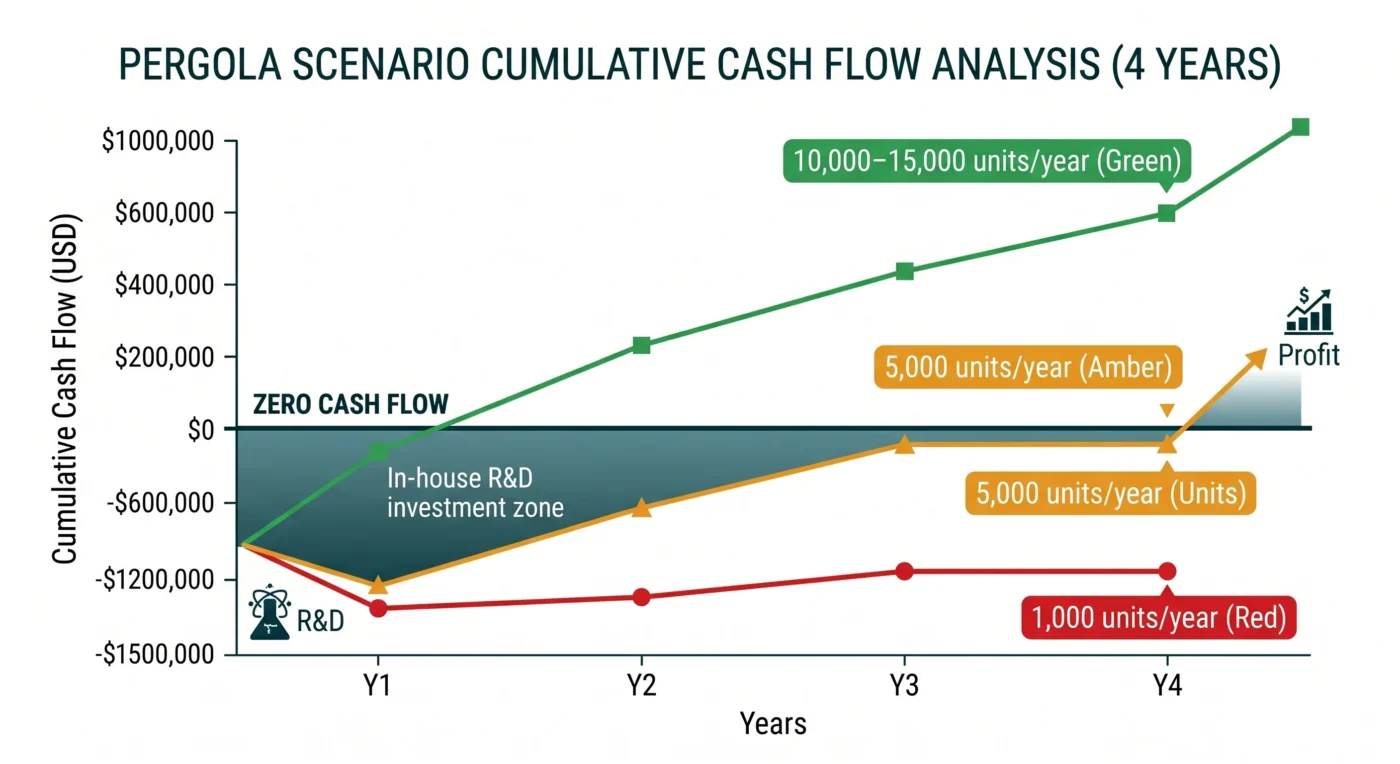
Set the technical detail aside, and we can examine this whole debate through a purely financial lens.
Suppose a pergola maker insists on building its own hardware control board and successfully holds the NRE cost to $145,000 (assuming everything goes to plan). By building in-house, the per-unit BOM cost of a control board drops to $6; by contrast, sourcing a high-reliability, pre-certified, off-the-shelf control system from a specialist supplier costs, say, $19 per unit. That implies a “saving” of $13 per unit by building.
But once you factor in a 12% cost of capital and the market-share erosion caused by a delayed time-to-market, the breakeven model turns out to be extraordinarily brutal:
- If a given pergola model sells only 1,000 units a year, the in-house project never recoups its cost — cumulative cash flow is still negative $187,000 by year four.
- Annual sales have to reach 5,000 unitsbefore the company barely scrapes to breakeven in year four.
- Only when single-model annual sales reliably break 10,000 to 15,000 units— and the team has deep RF development experience — can a build strategy generate positive cash-flow profit within the first or second year.
Look around today’s North American and European luxury pergola market — whether it is StruXure’s Pergola X or IntelliShade’s multi-bay commercial systems — and per-unit prices routinely run between $20,000 and $50,000. These are textbook high-value, low-frequency, made-to-order architectural structures. Apart from a tiny number of monopolistic industry giants, 99% of mid-to-high-end pergola makers simply cannot reach the volume needed to amortize hundreds of thousands of dollars of electronics R&D through sheer mass production.
Under this industry structure, adopting a “buy and build” strategy — sourcing an industrial-grade, fully validated, modular smart control system directly — is the only rational path to maximizing return on investment.
The Strategic Dividends of Sourcing — and Defending the Real Moat
Choosing a specialized pergola control-system manufacturer is not a technical compromise at all; it is a higher-order business strategy grounded in the optimal allocation of your resource endowment.
1. Lightning-Fast Time-to-Market and Agility
In a fast-moving market, the window of technological advantage is brutally short. A build approach means your product launch is held hostage to a 12-to-18-month electronics-and-software development cycle. Source a mature system instead, and the manufacturer only has to define its functional requirements; by leaning on the supplier’s ready-made control bus, wind-and-rain sensor modules, and complete APIs, it can push its next-generation flagship smart pergola to market in a matter of weeks. That agility lets a company respond to a competitor’s feature upgrades at any time — for instance, with our latest control system engineered for retractable and louvered pergolas, which lets you manage the LED lighting, actuators, motors, weather sensors, and every other device in the structure from a single remote or a mobile app.
2. Escaping the “Cobble-Together Trap” for System-Level Reliability
Many companies try to save money by separately sourcing motors, control boards, and weather sensors from different low-cost factories, then hiring a cheap outsourced team to cobble together an app. As ObjectSpectrum’s analysis points out, this approach typically leads to severe system-compatibility disasters. Frequent false alarms from uncalibrated sensors, and louvers that fail to close because the firmware has locked up, will directly destroy a brand’s premium image among affluent buyers.
A genuinely professional integrated control system delivers a plug-and-play whole-solution instead. Because the actuators, control hub, and sensors are designed and calibrated under one unified engineering logic, the system has unmatched cooperative reliability. The moment a rain sensor detects moisture, the command reaches the actuators within a few milliseconds over an encrypted protocol — keeping the owner’s outdoor leather sofa safe from any damage.
3. White-Label and Data Sovereignty: Goodbye to the Fear of Lock-In
The strongest resistance to adopting a third-party system usually stems from a fear of losing brand independence and of getting locked in to a vendor’s technology. A decade ago, in the era of closed systems, that worry was perfectly reasonable — but under modern IoT architecture, the pain point has all but disappeared.
Today’s leading IoT control platforms are built on deep white-label sourcing. What the end consumer downloads from the App Store is a control app carrying the pergola brand’s own logo, custom UI colors, and interaction logic; the powerful, complex server orchestration and secure-encryption layer underneath is hidden from view entirely.
More importantly, the manufacturer holds all of the core data the running system generates. By analyzing the telemetry devices upload, a company can know precisely how often the heater and louvers operate in tandem in cold northern Europe, or how many times a year the high-wind protection mechanism is triggered in Florida. These valuable data assets feed directly back into the stress analysis and engineering refinement of the next generation of pergola structures. On top of that, a quality supplier provides standardized API interfaces, so that even if the business pivots strategically down the road, the manufacturer can still migrate its data seamlessly to a new platform — keeping full command of the technology.
So What Is a Pergola Maker’s Ultimate Moat?
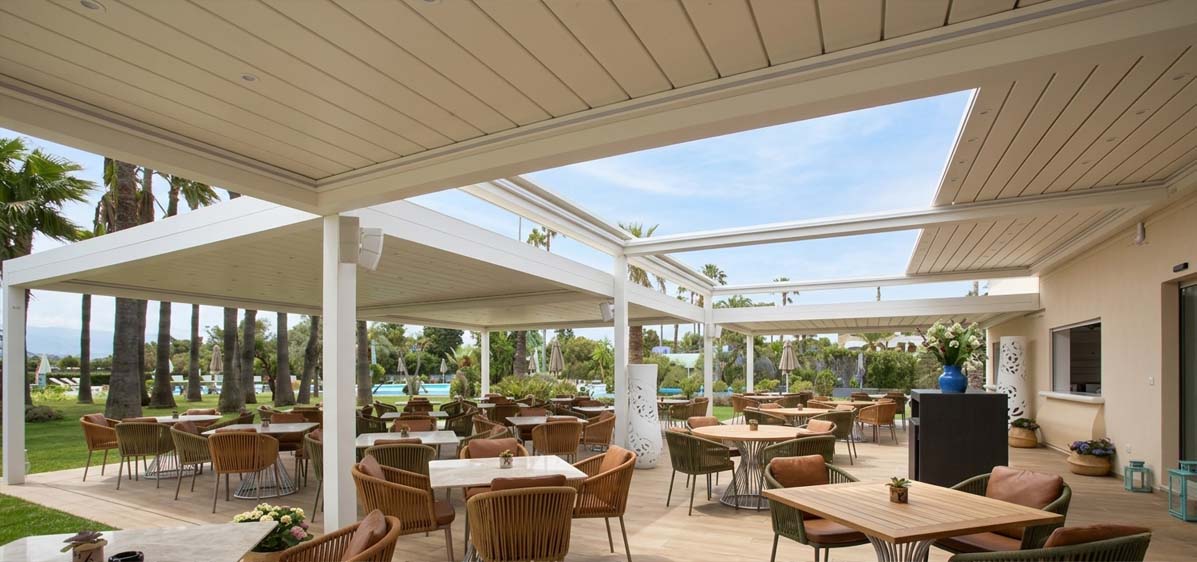
To settle the “build vs. buy” debate for good, a pergola company has to return to one core, soul-searching question: why exactly are customers willing to pay a premium of tens of thousands of dollars for your pergola?
The answer is absolutely not “because you wrote the low-level C code that handles the Bluetooth pairing,” nor “because you designed your own 2.4 GHz RF circuit board.”
The true competitive moat of the top North American and European pergola brands lies in macro-scale, architectural-grade structural engineering and uncompromising outdoor-living aesthetics:
- Mechanical resilience against extreme climate. For example, a system built from premium 6063-T6 extruded aluminum and finished with an AAMA 2604–grade powder coat can stand up to hurricanes of up to 155 mph (Miami-Dade County certification level) and extreme snow loads of 65 psf (roughly 180 kg/m²).
- Precision waterproof fluid dynamics. A gapless, double-wall louver system in the closed position, combined with concealed but highly efficient integrated gutters, achieves a genuinely watertight seal.
- Customization and architectural integration. The ability to support complex roof geometries, true gable configurations, and a seamless visual match with an existing residence’s architectural style.
On these dimensions, consumers can directly feel the extremity of the craftsmanship and the luxury. The electronic control system, by contrast, should be regarded as a high-spec component on par with high-strength stainless-steel fasteners or a top-tier powder coating — it is part of the foundation that gives a smart pergola its soul, but there is absolutely no need for a structural engineer to reinvent the wheel from scratch in an in-house lab.
As a seasoned IoT specialist puts it, pouring months of engineering time into building commoditized infrastructure is, in effect, a hidden tax on your product roadmap.
In an age when technical complexity is rising exponentially, the optimal answer for a modern pergola business is to concentrate its R&D capital and precious talent on structural innovation, manufacturing refinement, and channel service — while entrusting the complex work of RF connectivity, global compliance certification, and cloud-application maintenance to a specialized lighting-and-control-system manufacturer with deep electrical-engineering credentials. That is the route to exponential growth.
A smart control system should never become the technical black hole that trips up your structural team. Through deep strategic sourcing and OEM white-label customization, pergola makers can lead the next-generation revolution in premium bioclimatic outdoor-living spaces from a lighter, more reliable technical footing. Now is the time to take a hard look at your supply-chain strategy — and let a professional control system empower your brand.

Pingback: Integrated Pergola Controls: Louvers, Lights & Sensors
Pingback: Wie Pergola-Hersteller separate Fernbedienungen durch ein integriertes Steuerungssystem für Beleuchtung und Lamellen ersetzen können
Pingback: Stücklisten-Checkliste für Pergola-Steuerungssysteme für Hersteller von Lamellendächern
Pingback: Somfy, Bond, Tuya, Teleco, or Custom RF: Which Control Ecosystem Fits a Pergola Product Line?
Pingback: What Is a Smart Pergola Control System? A Manufacturer’s Explanation