


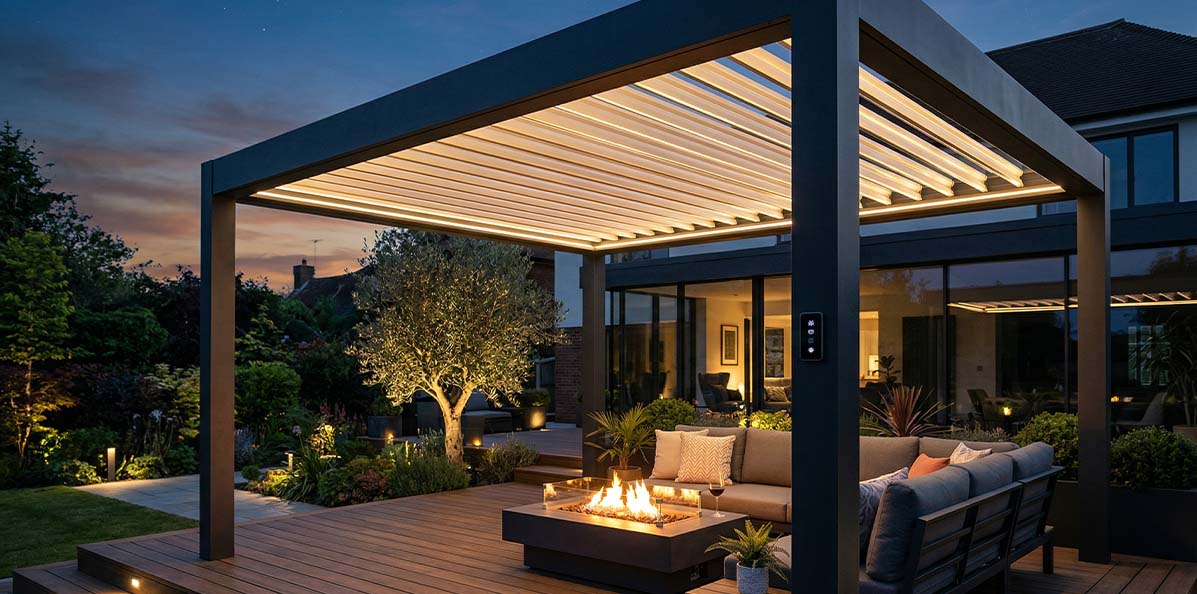
An outdoor-living revolution sweeping across Europe and North America is reshaping the commercial logic of patio architecture. The modern aluminum louvered pergola has evolved from a simple shading structure into a highly integrated, all-weather micro-building. Within this complex system of motorized louvers, climate sensors, concealed drainage, and a smart ecosystem, the lighting and control modules are no longer optional add-ons. They are core engineering components that determine the system’s overall pricing power, its usability after dark, and its win rate in commercial tenders.
Yet when confronting a complex global supply chain, many European and North American pergola manufacturers make a fatal strategic miscalculation in their sourcing approach. In 2023, a solar-lighting and outdoor-equipment distributor in Amsterdam, the Netherlands, paid a painful price of up to €340,000 over three years for adopting low-cost white-label lighting components. The case lays bare, without mercy, the high hidden costs and systemic failure risks concealed behind a low initial unit price. Procurement leaders must move beyond a single cost lens and examine the three mainstream sourcing models — white-label / off-the-shelf, original design manufacturing (ODM), and original equipment manufacturing (OEM) — through the deeper lenses of non-recurring engineering (NRE), bill-of-materials (BOM) control, thermal physics, and smart-home protocol integration.
This in-depth report takes the perspective of a professional pergola lighting and control-system manufacturer. Combining a financial-forensics model, engineering failure analysis, and best-in-class automation-protocol integration specifications, it offers premium pergola brands a detailed guide to supply-chain architecture.
The Underlying Logic of Sourcing Models and Systemic Restructuring
Evaluating the supply-chain logic of lighting and control components must rest on a foundation of long-term risk management and brand differentiation strategy. When sourcing decisions revolve solely around basic luminous flux and unit price, companies tend to sink into the quagmire of commoditized competition. Understanding the physical boundaries of each sourcing model in terms of engineering authority is the first step toward building a resilient supply chain.
White-Label and Off-the-Shelf: The Invisible, Dynamic BOM and Spec Dilution
The white-label or off-the-shelf model is one in which a supplier produces a standardized, generic product, and the buyer applies its own brand label and brings it to market. This model offers an unmatched speed advantage in the early stages of a commercial launch. It typically requires no tooling development costs, the minimum order quantity (MOQ) is sometimes as low as fifty to one hundred units, and a product can reach the market within a matter of weeks.
However, the fatal flaw of the white-label model is the buyer’s “zero visibility” into the underlying supply chain. The manufacturer of an off-the-shelf product holds absolute control over production, and the core of its business model is using economies of scale to drive costs down. To preserve margins in a volatile raw-materials market, the factory will frequently — and without notice — alter the underlying bill of materials (BOM). For example, an LED strip with an identical outward appearance may, by its second production batch, have had its heat-resistant imported Japanese capacitors swapped for cheaper substitutes, or had its once-precise LED chip binning standards loosened.
This behavior, known as “spec dilution,” may be imperceptible in a mild indoor environment, but under extreme outdoor thermal stress it leads directly to systemic field failures. Moreover, because the product is a generic design available to every buyer, the brand cannot build any technical moat. In a highly transparent e-commerce environment, consumers and contractors can easily discover twenty or more competing brands using the same tooling, dragging competition down to a pure price war.
Original Design Manufacturing (ODM): Differentiation Within a Shared Architecture
Original design manufacturing (ODM), also referred to as deeply customized private-label production, represents a middle path that balances speed with exclusivity. Under the ODM model, a specialist manufacturer provides a validated core engineering platform and base design architecture, while the brand customizes thirty to fifty percent of the specification parameters on top of it.
For pergola lighting, this means a brand can leverage the manufacturer’s existing waterproof aluminum extrusion profiles or smart-control receivers, while specifying a particular optical lens angle, color rendering index (CRI), color temperature (for example, the 2700K–3000K warm white commonly used in commercial settings), and a specific powder-coat color matched to its own pergola frame. This collaboration model typically requires the brand to invest €10,000–€20,000 in engineering validation and sample development, and to raise the order quantity to a level of five hundred to one thousand units. Through ODM, a pergola brand can obtain a lighting kit with clear parameter advantages within six to ten weeks, successfully sidestepping the low-end price war and gaining a competitive edge in regional B2B commercial projects.
Original Equipment Manufacturing (OEM): Forensic Control and Absolute Dimensional Stability
For top-tier pergola brands aiming to dominate the premium markets of North America and Europe, fully customized original equipment manufacturing (OEM) is the ultimate form of supply-chain evolution. The OEM model completely overturns the supply relationship: the buying brand (or its retained technical consultant) leads concept development, provides complete CAD drawings, and specifies precise material-science parameters and test protocols, while the manufacturer applies its superior process-conversion capability to dedicated contract production.
The core value of the OEM model lies in achieving “forensic BOM freezing.” After signing a detailed non-disclosure agreement (NDA) and an intellectual-property ownership agreement, the contract factory must strictly lock down the model of every resistor, the batch of every driver chip, and the thickness of every heat-dissipation substrate. This extreme degree of control gives the brand “dimensional stability.” Because the brand owns dedicated tooling, even a lighting module installed in 2026 will still match perfectly — in physical interface, electrical parameters, and optical performance — when an after-sales replacement part is needed in 2030.
Although the barrier to entry for the OEM model is very high — upfront tooling development, prototype iteration, and multi-country compliance testing typically cost between €48,000 and €94,000, with initial order volumes often running into the thousands of units — the long-term commercial dividends it delivers are remarkable. Large-scale consolidated production runs drive the marginal cost per unit down sharply, and combined with sixty-day credit terms, an OEM strategy can deliver even stronger medium- and long-term cash-flow performance than the constant restocking of the white-label model.
Table 1 — Pergola Lighting Supply-Chain Architecture & Core Decision Matrix
| Core Metric | White-Label / Off-the-Shelf | Deep Customization (ODM) | Original Equipment (OEM) |
|---|---|---|---|
| Product technology ownership | Entirely the manufacturer’s | Manufacturer base architecture + brand-customized parameters | 100% exclusive to the brand (dedicated tooling) |
| Capital development spend (CAPEX) | €0 | €10,200 – €21,500 | €48,500 – €94,000 |
| Time to market (TTM) | 1 – 3 weeks | 6 – 10 weeks | 12 – 20 weeks |
| Standard minimum order quantity (MOQ) | 50 – 100 units | 500 – 1,000 units | 2,000 – 3,000 units |
| BOM control | Zero visibility (manufacturer adjusts dynamically) | Core components visible and locked | Forensic freeze (any change requires brand authorization) |
| Average 3-year field failure rate | 5.0% – 8.0% | 2.0% – 3.0% | 0.5% – 1.0% |
| Win rate, municipal & large commercial projects | ~12% | ~34% | Up to 58% |
Figures synthesized from a three-year empirical study model covering 127 global solar and outdoor-lighting brands.
Financial Forensics: Uncovering the Hidden Black Hole of Total Cost of Ownership
In the premium outdoor-building-materials sector, the trap procurement teams fall into most easily is the “initial unit-price illusion.” A financial-forensics report based on a three-year lifecycle and covering sales data for ten thousand lighting products shows that cheap off-the-shelf products are often the very culprit destroying a company’s annual income statement.
Looking at a standard 40-watt solar outdoor lighting kit, the average purchase price of a white-label product is roughly €87, while a rigorously engineered OEM custom version runs as high as €132. Judged on the purchase order alone, the white-label option appears to save the company a great deal of cash. But once an after-sales failure-cost model is introduced, the financial truth surfaces.
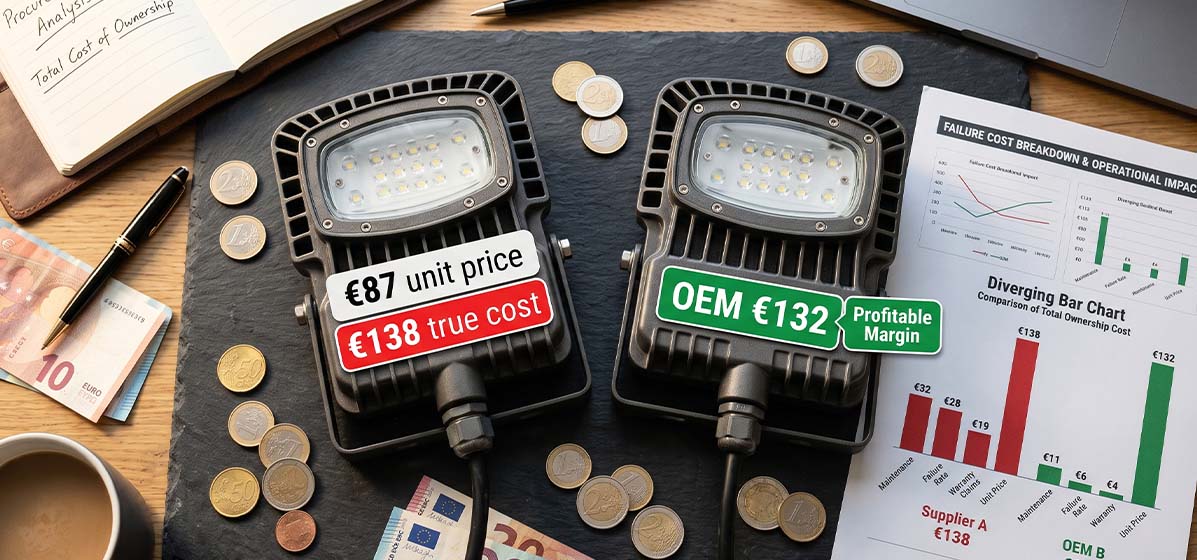
Because white-label products use cheap silicone seals, unoptimized heat-dissipation structures, and inconsistently controlled driver chips, their average failure rate within the first twenty-four months of service is as high as six percent. When sixty field failures occur for every thousand units sold, a hidden financial tsunami begins to devour profits. The distributor must bear direct replacement costs of more than €5,000 per fleet of units, accompanied by expensive on-site labor redeployment fees (around €1,800), cross-border logistics and tariff friction (close to €800), and goodwill compensation paid to placate angry customers. More damaging still, a high failure rate leads directly to contractor attrition, with the lost future potential sales estimated at more than €8,000.
Adding it all up, the true hidden failure cost of every thousand white-label units reaches as high as €18,600. When this steep maintenance expense is re-amortized into the cost of every product already sold, the originally listed €87 white-label product sees its true three-year total cost of ownership per unit soar past a staggering €138. Worse, because white-label products cannot support a premium at retail, the brand’s eventual net profit per unit turns negative (a loss of about €12), and the company falls into a death spiral where the more it sells, the more it loses.
Re-amortize the failures, and an €87 white-label unit carries a true three-year cost of ownership above €138 — and a net loss per unit.
By contrast, the OEM model, with its extremely low failure rate of 0.75 percent, holds after-sales costs per thousand units down to roughly €2,700. More crucial still, a 100% exclusive OEM design grants the brand powerful pricing power. OEM products can launch in the premium market at a premium of twenty-seven percent above generic off-the-shelf goods, allowing the company to still achieve a solid net profit of more than €21 per unit even after absorbing the high upfront tooling-development cost.
This financial chasm becomes even more pronounced when bidding on public procurement and large commercial tenders. Government and commercial tenders impose stringent requirements on luminous efficacy, material thickness, and smart-control interfaces. Because white-label specifications offer no differentiation in tender documents — and may not even meet the threshold — their average bid win rate is only twelve percent. OEM products purpose-built for a project, by virtue of extreme efficacy reaching 230 lm/W and exclusive environmental-adaptation certifications, can capture a 58 percent tender win rate. In a project pipeline worth an average of €180,000, choosing an OEM strategy means a company will capture more than €1.2 million in additional contract revenue compared with a competitor using white-label products.
The Engineering Fault Line: Why Indoor Lighting Logic Is Destined to Fail in a Pergola
Many companies that cross over into pergola manufacturing attempt to force finished LED strips originally designed for indoor or sheltered environments directly into aluminum louver profiles. At the level of mechanical engineering and thermodynamics, this is a disastrous decision. A pergola is not merely a frame that keeps off wind and rain; it is in essence a high-stress micro-building exposed long-term to intense ultraviolet radiation, extreme and rapid temperature swings, and marine salt-fog corrosion.
The Extreme Heat-Trap Effect and Re-engineering Thermal Conduction
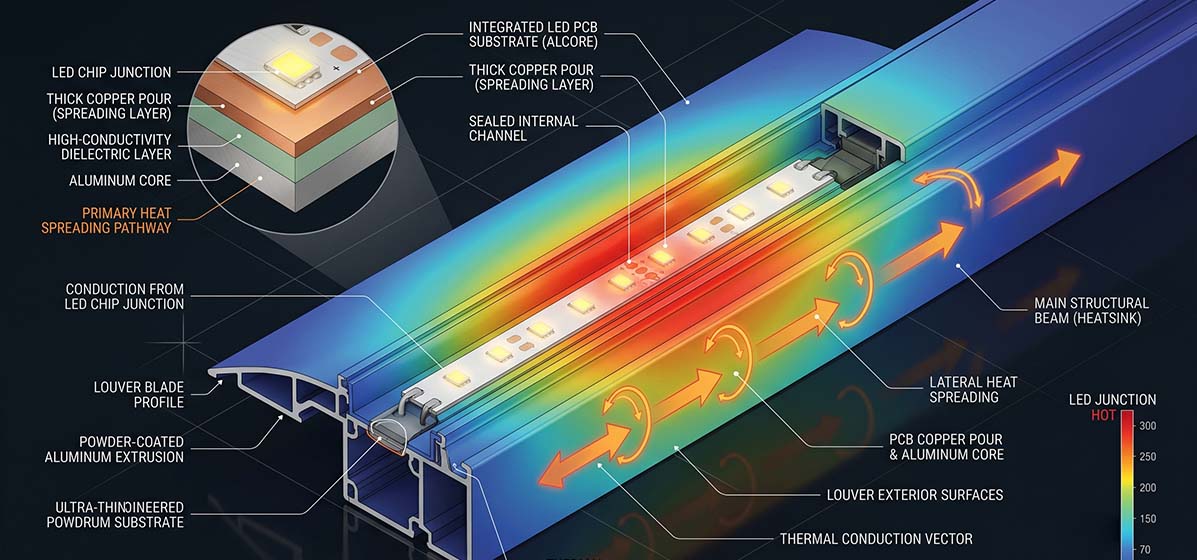
In the heat of summer, dark metal aluminum louvers rapidly absorb heat under direct sun, and the temperature inside their sealed internal channels can easily break seventy degrees Celsius. At this point, an airtight “heat trap” forms inside the louver. If off-the-shelf white-label LEDs are used in such an extreme environment, the LED chip’s junction temperature will rapidly exceed its critical value — because the printed circuit board (PCB) generally lacks sufficient copper-foil thickness and has no dedicated thermal-conduction path — triggering irreversible lumen depreciation and, in severe cases, even melting the internal insulation layer, short-circuiting, and catching fire.
Professional OEM/ODM lighting-system manufacturers perform deep thermal-physics intervention at the design stage. By redesigning the PCB layout, increasing the aluminum substrate to a specific thickness, enlarging the copper-pour area at key locations, and pairing it with custom industrial-grade thermal pads, a customized lighting system can ensure that internal heat is rapidly conducted to the pergola’s sturdy aluminum extrusion main beams. This allows the luminaire to maintain 100,000 hours of fault-free operation even under harsh conditions where the ambient temperature reaches fifty degrees Celsius. Premium systems such as the StruXure Pergola X and the Renson Camargue are defined precisely by this level of integrated engineering rather than by bolt-on hardware.
Physical Stress Resistance and Environmental Customization
Protection against environmental physical stress is likewise a key area where the value of an OEM supply chain shows itself. The floodlights supplied by standard distributors generally offer only basic splash resistance and an ordinary die-cast aluminum heat sink — and this “averaged” design fails quickly in high-humidity coastal environments.
Facing the contact oxidation and electrochemical corrosion brought on by high salt fog, a professional ODM expert can intervene at the material-science level. They can apply a corrosion-resistant marine-grade powder coating to the luminaire, mandate that exposed fasteners be upgraded to 316 stainless steel, and use a polycarbonate (PC) diffuser with outstanding UV-aging resistance, eliminating the hidden hazards of material degradation entirely. This defensive customization based on environmental stress is a depth of engineering that off-the-shelf distributors simply cannot provide.
Architectural Integration and Eliminating Installation Friction
Modern pergola designs — such as the industry-renowned StruXure Pergola X series or the Renson Camargue series — are famous for their minimalist architectural lines, free of any redundancy. In systems like these, exposed power cables or ugly transformer housings are absolutely forbidden; they rely on an internal concealed beam chase to keep the electrical system invisible.
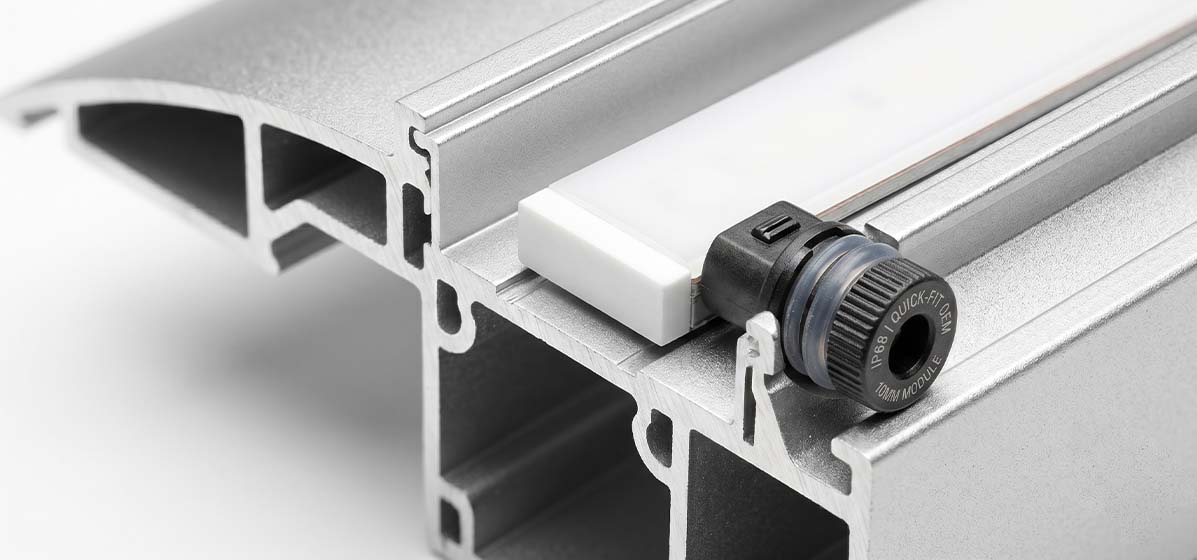
Trying to stuff an off-the-shelf LED fitted with a bulky standard connector into a narrow reserved track inevitably forces installers to drill into the structural beam, which not only undermines the profile’s load-bearing mechanics but also breaks the waterproof seal. A professional OEM contract factory can design precise dimensional tolerances based on the profile drawings the brand provides. They can produce ultra-thin linear light modules that fit perfectly into a 10mm or 12mm slot width, and achieve a high-density arrangement of up to one hundred eighty LED chips per meter within the louver blade, delivering a uniform wall-wash effect with no visible dots.
In addition, an excellent OEM manufacturer can deliver not only finished components but also semi-knocked-down (SKD) kits, fitted with miniature quick waterproof connectors rated to IP68. This plug-and-play prefabricated design cuts the contractor’s on-site installation and commissioning time to an absolute minimum. When a lighting system dramatically reduces friction on the job site, installation companies are more inclined to recommend that brand to the end client — and at that point a competitor’s low-price strategy looks utterly unappealing.
Decoding the Compliance Barrier: From IP Ratings to the Deep Waters of UL 1598 Testing
In the highly regulated markets of Europe and North America, compliance certification for outdoor electrical systems is not merely a permit to sell legally. It is the moat that protects a brand from enormous product-liability lawsuits, and a core, hard requirement for commercial clients applying for government energy-retrofit incentives (utility rebates). Relying on white-label products that lack rigorous certification means not only being disqualified outright in municipal tenders, but also facing the devastating risk of being refused coverage by commercial insurers.
The Physical Boundaries of IP Ratings, and Clearing Up Misconceptions
The Ingress Protection rating is defined rigorously and physically by the International Electrotechnical Commission (IEC) standard 60529. The standard is denoted by two digits: the first defines the level of protection against the intrusion of solid particles (from zero to six), and the second specifies the level of protection against liquids at various pressures and angles (from zero to nine).
In the practical procurement of outdoor building materials, many junior buyers seriously misunderstand the appropriate use cases for IP ratings, often believing an IP44-rated product is sufficient for outdoor needs.
Basic protection — IP44 / IP54
Luminaires at this level can only block solids larger than one millimeter (such as wire ends or screws) and, for liquids, withstand only pressureless splashing water. They must be strictly confined beneath deep eaves with a complete roof overhead or inside an enclosed balcony. The moment they meet driving rain on a strong wind, their cheap seals fail within minutes, allowing moisture to penetrate deep inside.
All-weather standard — IP65
For pergola-top lighting exposed to the natural environment, IP65 is the absolutely non-negotiable baseline. Its first digit, “6,” means the housing remains 100% dust-tight under up to eight hours of vacuum-suction testing. The second digit, “5,” proves the device can resist a sustained low-pressure water jet from any angle, delivered through a standard 6.3mm nozzle at a flow of 12.5 liters per minute. This margin of protection is enough to keep the device unharmed against storm wash-down and the accidental over-spray of a garden’s automatic irrigation system.
Heavy-exposure line — IP66 / IP67
Facing the intense storms of coastal regions or the routine high-pressure water-jet cleaning of commercial facilities, the IP66 level can withstand a powerful water jet at flows of up to one hundred liters per minute. And for in-ground landscape lights installed at the foot of a pergola’s load-bearing columns — right beside the pool deck, highly prone to flooding in heavy rain — IP67 provides core safety redundancy: it guarantees the device’s internal electronics remain entirely unharmed after thirty minutes of continuous immersion at a depth of up to one meter.
Table 2 — Core Outdoor-Lighting IP Ratings per IEC 60529
| IP-Schutzklasse | First digit — solids & dust | Second digit — liquids & moisture | Typical outdoor pergola use case |
|---|---|---|---|
| IP44 | Blocks objects larger than 1.0mm in diameter | Withstands very light splashing from any direction | Only the deepest pergola center, fully shielded from side wind |
| IP54 | Limited dust protection (minor ingress that does not affect operation) | Withstands light water spray from any direction | Accent lighting on the inner face of a semi-enclosed pergola column |
| IP65 | Fully dust-tight (zero dust ingress under vacuum-suction test) | Resists a low-pressure jet from a 6.3mm nozzle | Top louver linear lighting directly exposed to rain |
| IP66 | Fully dust-tight | Resists a high-pressure / high-flow jet from a 12.5mm nozzle | Building façades facing commercial pressure-washing or intense sea-wind spray |
| IP67 | Fully dust-tight | Withstands short-term (30-minute) immersion at 1m depth | Ground-level wall-wash lights at pool edges or in flood-prone areas |
Reference: IEC 60529 Ingress Protection and lighting-industry compliance parameters.

UL 1598: North America’s Supreme Law and Thermal-Shock Condensation Testing
In the North American market, holding an IP65 rating does not directly equate to a device being legally permitted to connect to the grid. Authorities Having Jurisdiction (AHJs) will only recognize the wet-location compliance mark issued by a Nationally Recognized Testing Laboratory (NRTL, such as UL or Intertek ETL) under the UL 1598 safety standard for luminaires.
IP testing and UL 1598 testing differ significantly in their core philosophy. IP testing focuses on whether a violent, short-duration water jet will immediately breach the seal; UL 1598’s wet-location testing probes more deeply into the long-term, chronic damage inflicted on electrical insulation by environmental condensation, material aging, and extreme thermal shock. In UL 1598’s stringent spray protocol for wet-location certification, a luminaire must endure a continuous four-hour thermal cycle of torture at a constant water pressure of 20 psi:
Hour 1 — heat-up & expansion
The luminaire runs powered on, with the spray off. This stage uses the fixture’s own heat to make the internal air expand and try to push outward.
Next 30 minutes — thermal shock & negative-pressure intake
The luminaire is abruptly cut from power while the cold-water spray switches on. This scenario, simulating a sudden plunge into freezing rain, makes the housing contract instantly, creating intense internal physical negative pressure that — like a vacuum cleaner — tries to draw surface moisture in through the tiniest gaps.
Following 2 hours — sustained energized spray
The luminaire is powered on again while the water spray continues, testing how the seals perform under electrical stress.
Final 30 minutes
The luminaire is switched off while the water continues to spray.
When this punishing sequence ends, not only must there be absolutely no accumulated water inside the housing sufficient to cause an electrical short or a fire hazard, but the device under test must also pass a stringent dielectric voltage-withstand test to prove its insulation remains entirely intact. White-label products’ polycarbonate lenses and cheap sealants tend to deform under this high-frequency thermal expansion and contraction, leading to catastrophic leaks. Professional OEM factories, by contrast, use medical-grade anti-aging silicone, precision injection-molded one-piece sealing processes, and full-coverage potting techniques to fundamentally ensure the device passes the test.
Finally, UL 1598 is about more than safety. If a contractor wants to apply on behalf of a commercial client for the highly attractive DesignLights Consortium (DLC) energy-efficiency cash rebates, submitting a UL 1598 wet-location certification report bearing an NRTL mark is a mandatory prerequisite. Top OEM/ODM specialists have deep experience working with compliance bodies; they can arrange “multiple listing” or “certificate transfer” directly for a brand’s exclusive design, allowing a new product to be placed legally and compliantly on North American shelves without months of retesting.
The Smart Control Matrix: Deep Integration of Somfy, Teleco, and the Full Ecosystem
Today’s premium consumers expect far more from an outdoor living space than basic illumination. They want to build a seamlessly connected smart ecosystem — one in which the opening angle of the top louvers, the raising and lowering of the surrounding wind-resistant screens, and the power output of the infrared heaters can coordinate with changes in the lighting module’s brightness and color in millisecond-level synchrony.
Low-end white-label lighting products often come bundled with closed-protocol, poorly made RF remotes that behave like isolated islands of information, utterly unable to connect to mainstream building-automation platforms. By choosing a high-grade ODM or full-turnkey OEM model, a pergola manufacturer can — at the very start of circuit-board design — physically bind the lighting driver’s underlying logic to the protocol layer of a globally recognized smart-control giant such as Somfy or Teleco.
Somfy Ecosystem Integration: From One-Way RF to Smart Gateway Architecture
As the undisputed leader in outdoor shading and automation control worldwide, Somfy‘s communication protocols are the default standard of the premium pergola market. To be perfectly compatible with Somfy at the hardware level, an OEM lighting system must achieve a very high degree of specification in its electrical driver design.
RTS (Radio Technology Somfy) one-way control layer. This is the most widely deployed, mature one-way wireless RF technology (the 433 MHz band). By integrating a dedicated Somfy 24V RTS dimming receiver module (for example, the Ref. 2320001) into the OEM circuit, a brand can let users control the entire pergola ecosystem with nothing more than a multi-channel Situo 5 Variation RTS remote (whose signature central physical scroll wheel enables extremely smooth 12-step precision dimming). More important still, a unified RTS receiver lets the lighting system respond directly to the low-level commands of weather sensors — for instance, when the Ondeis rain sensor or the Eolis wind gauge detects extreme weather, the system not only closes the roof louvers automatically to protect the furniture, but can simultaneously illuminate ambient safety-warning lighting, truly achieving automated coordination of the physical line of defense.
The io-homecontrol protocol and the bridge to whole-home automation. For more advanced power users, the communication network of the smart pergola is evolving toward a two-way encrypted protocol. The advanced io-homecontrol technology can not only send control commands but also report the device’s precise physical state back to the smartphone in real time (for example, “screen lowered to 60%” or “accent lighting currently in a warm color temperature”).
Tech enthusiasts and local server integration. For consumers determined to build the ultimate whole-home smart ecosystem, who often abandon closed systems in favor of high-flexibility platforms such as Home Assistant or Apple HomeKit, an OEM design with open hardware ports becomes especially important. By connecting through a TaHoma Switch smart gateway, for example, the lighting and louver-control system can be seamlessly converted into a usable HomeKit component over a Zigbee 3.0 network. Going further, a tech-savvy user can configure a Sonoff RF Bridge or a Raspberry Pi fitted with a CC1101 radio transceiver module, using GPIO pins to trigger a purpose-built dual-channel relay, bypassing the cloud server to achieve local LAN automation with millisecond-level latency. Supporting modifications this deep depends on an industrial-grade OEM driver with stable voltage output and interference resistance as its solid backbone.
Teleco Automation: Advanced Tuning for High-Power Outdoor Loads
If Somfy reigns supreme in the field of motor micro-control, then Teleco Automation, originating in Italy, demonstrates unique dominance in outdoor high-power electrical-load management and lighting-scene rendering.
High-voltage loads and a seamless control hub. Large commercial pergola projects typically need not only low-voltage top light strips, but also the integration of kilowatts of perimeter landscape wall-wash lights, underwater pool lighting, and even high-power heaters. Teleco’s GARDENPRO and OUTLUMINA kits are purpose-built for scenarios with such extreme demands. Their industrial-grade 230 Vac on/off receivers are fitted with high-current-rated 16A relays, capable of safely controlling a single channel of purely resistive load up to two thousand to four thousand watts.
Full quantified scene rendering with the Daisy App. With Teleco’s system architecture, the dedicated Daisy app brings every play of light and shadow in the pergola space to life. From the “neon martini bar” atmosphere created by hidden RGBW full-color strips inside the pergola, to a welcome mode triggered by a motion sensor at an outdoor carport, to a voice-interaction loop connected to Amazon Alexa, everything can be orchestrated through custom timers and scene scripts.
The great advantage of the OEM model is that a brand can, right at the assembly-line stage, design the integrated physical packaging of Teleco’s or Somfy’s smart gateways, transformers, and power-distribution modules — and even pre-flash proprietary communication firmware at the factory. This not only completely spares the on-site contractor the helplessness of facing a jumble of separate control boxes and wiring terminals, but also conveys a rock-solid premium brand image to the end user from the very first second of installation.
The Evolution of Commercial Strategy and a Decision Roadmap
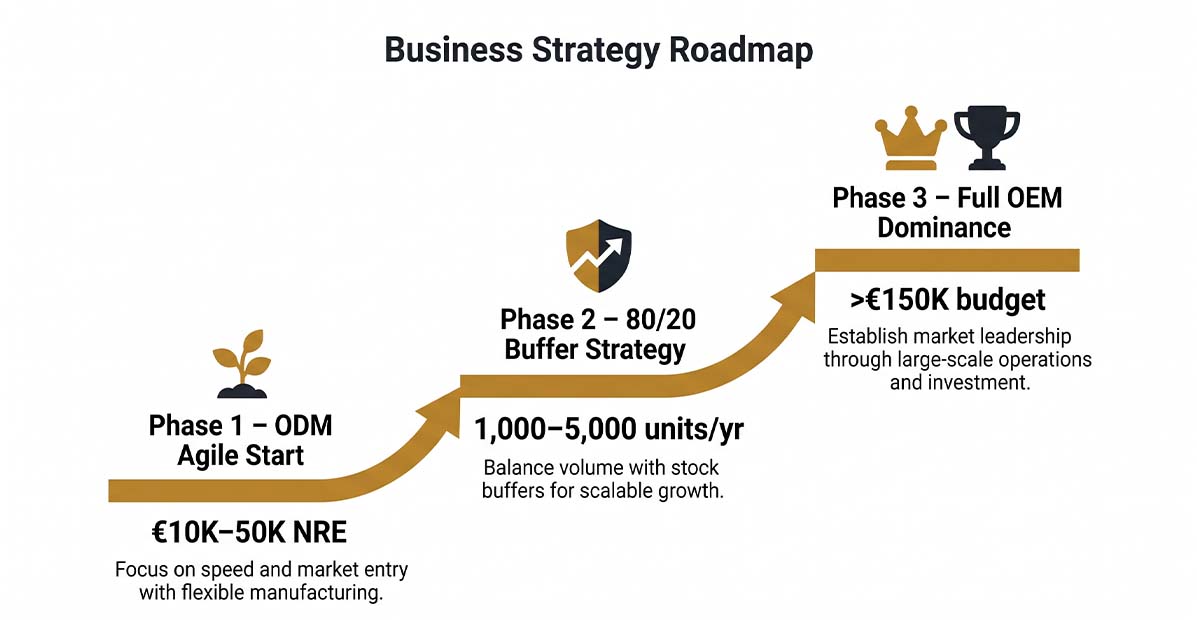
Having worked through the deeply technical principles of mechanical engineering, thermodynamics, compliance certification, and software control, we should recognize that for European and North American pergola manufacturers there is no single, perfect sourcing model. True strategic wisdom lies in precisely assessing a company’s current capital reserves, market positioning, and operational scale, and matching the supply-chain model best suited to its present stage of development.
Based on the evolutionary trajectories of hundreds of outdoor commercial brands, a forward-looking supply-chain advancement path should proceed steadily through the following three phases:
Phase 1 — Use ODM for Low-Risk, Agile Experimentation
For up-and-coming brands that have some sales channels and are eager to escape the low-grade price war but do not yet have large R&D budgets, ODM is the perfect springboard. At this stage, a company should leverage a top manufacturer’s already-mature aluminum extrusion platform and validated thermal foundation. By injecting a modest amount of non-recurring engineering (NRE) funding (in the range of roughly €10,000–€50,000), a brand can specify a particular surface finish, customize a matched color temperature, require ISTA 2A-grade drop-resistant retail packaging, and ensure the product carries a basic UL mark. This strategy can hold the development cycle to around eight weeks, delivering meaningfully differentiated products to regional dealers at the lowest possible cost of experimentation.
Phase 2 — Apply the 80/20 Rule to Build an Antifragile Profit Buffer
When a brand’s annual sales cross the threshold of one thousand to five thousand units, a strategic supply-chain line of defense must be introduced. As seasoned industry consultants advocate, a brand should adopt an 80/20 allocation strategy: allow eighty percent of the basic, high-traffic accessories to continue relying on the standard distribution network in exchange for extremely fast logistics; but on the core nodes that directly affect the user experience (such as integrated smart luminaires and core controllers), firmly retain control over the twenty percent that consists of privatized, high-margin, exclusive OEM products. When large generic brands in the market suffer sudden supply-chain breaks, malicious price hikes, or major changes to MAP (minimum advertised price) policy, that twenty percent of exclusive high-margin defense becomes the ultimate lifeboat keeping job-site work uninterrupted and the company’s cash flow intact.
Phase 3 — Move Fully to Full-Stack OEM and Forge an Insurmountable Industry Barrier
When a brand sets its ambitions on municipal projects, ultra-luxury hotel customization, and cross-border retail distribution networks of tens of thousands of units (a budget above €150,000), completely abandoning generic tooling and fully embracing the full-stack OEM model becomes the only strategic option. At this stage, a brand must establish an exclusive partnership with a top-tier engineering contract factory that possesses cutting-edge R&D laboratories (encompassing rigorous IQ, IPQC, and OQC processes, integrating-sphere efficacy analysis, and large constant-temperature, constant-humidity test chambers).
From ID concept design to the first machining drawing, from the precision development of injection-molding tooling to the iteration of 3D rapid prototypes, the brand will own 100% exclusive intellectual property (IP) for the product. The flagship-grade system it customizes will integrate an industry-leading salt-fog-resistant housing, a concealed integrated dot-free linear light guide, and an independent compute core capable of deep dialogue with the Matter protocol in the cloud. This not only completely cuts off any possibility of low-end imitators reverse-engineering the product, but — through the power of product definition — ascends the brand to become the absolute standard-setter of that market segment.
Far-sighted European and North American pergola manufacturers must clearly recognize that, in an era of systematic integration, outsourcing the core electrical and smart-control components to an uncontrollable white-label distribution market is tantamount to entrusting the brand’s reputational baseline to the most unstable gear of all. By deeply binding to an OEM/ODM engineering manufacturer that specializes in this field, freezing every critical material, and controlling the true physical specifications, a brand is not only defending itself against catastrophic failure — it is securing the core strategic fulcrum to keep winning high-premium orders and to sail far in the blue ocean of all-weather smart outdoor living.
This article is an educational analysis of sourcing strategy for outdoor lighting and is not legal, financial, or engineering advice. Compliance requirements, certifications, and rebate programs vary by jurisdiction; verify specifics with a licensed professional and your local authorities before procurement.
References & further reading: IEC 60529 · UL 1598 · DesignLights Consortium · Matter (CSA) · Somfy · Teleco Automation · Home Assistant

Pingback: Build vs. Buy: Should a Pergola Maker Develop Its Own Control System or Source One?
Pingback: Fernbedienung vs. App vs. Sprachsteuerung vs. Wandschalter: Die Wahl der Bedienoberfläche für Ihr Set
Pingback: Kosten einer Pergola mit Lamellen: Wie Motoren, Steuerungen, Beleuchtung und Sensoren den Preis beeinflussen
Pingback: Outdoor Pergola Lights: How to Build Reliable Lighting Packages for Dealers