


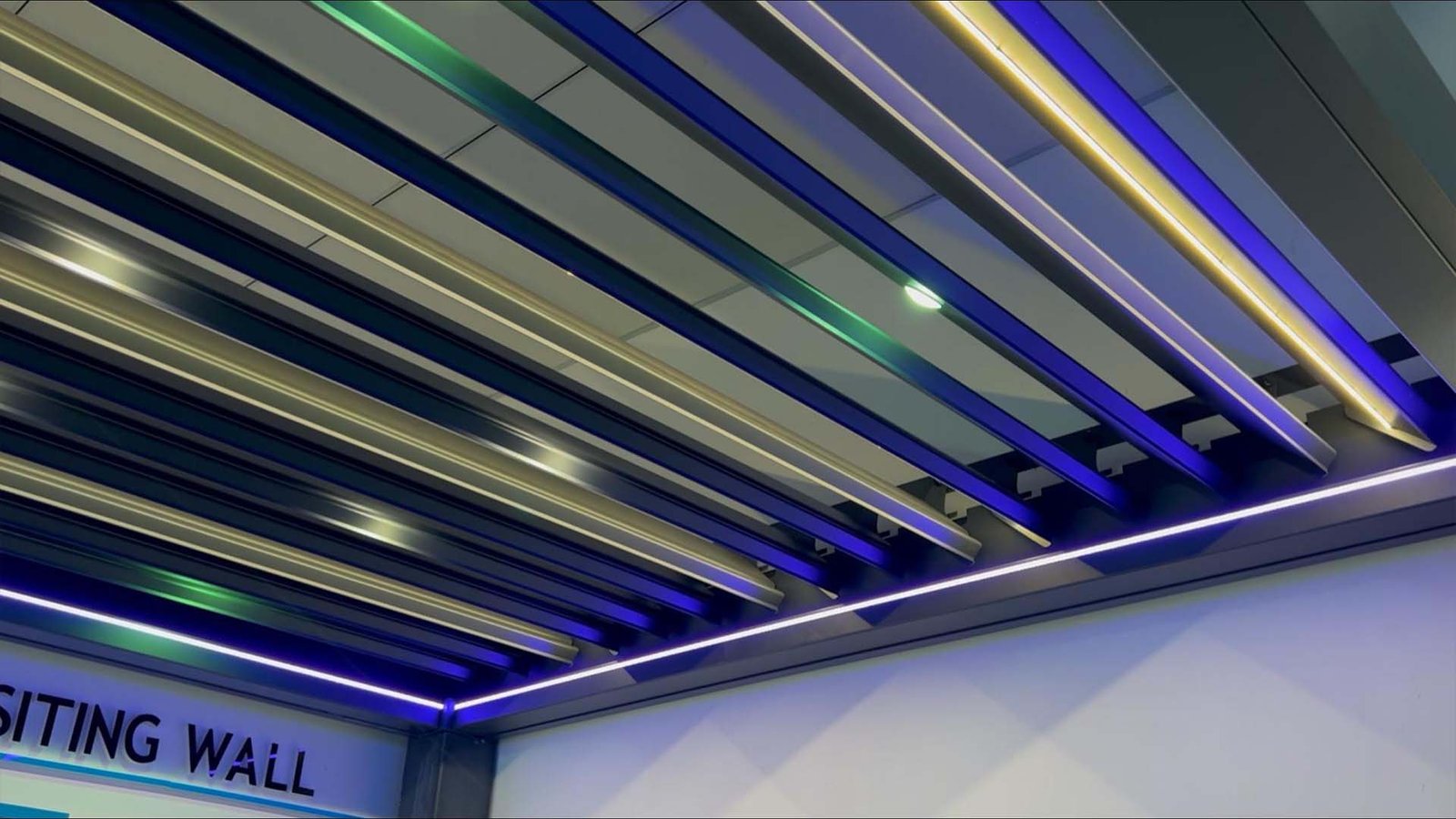
The motorized louvered pergola market in Europe and North America is undergoing a deep engineering transformation. It has moved beyond the category of traditional mechanical shading structures and evolved into a highly autonomous architectural IoT node.
As a professional supplier focused on the R&D and manufacturing of outdoor pergola lighting and control systems, we frequently observe a persistent industry pain point: many manufacturers invest heavily in aluminum extrusion and structural load capacity, yet compromise on motor drive, environmental sensor logic, and the electrical integration of low-voltage lighting systems. This article provides a detailed specification guide from the perspectives of electrical engineering, smart-control protocols, and optical thermal management.
Actuation Systems and Core Drive Architecture
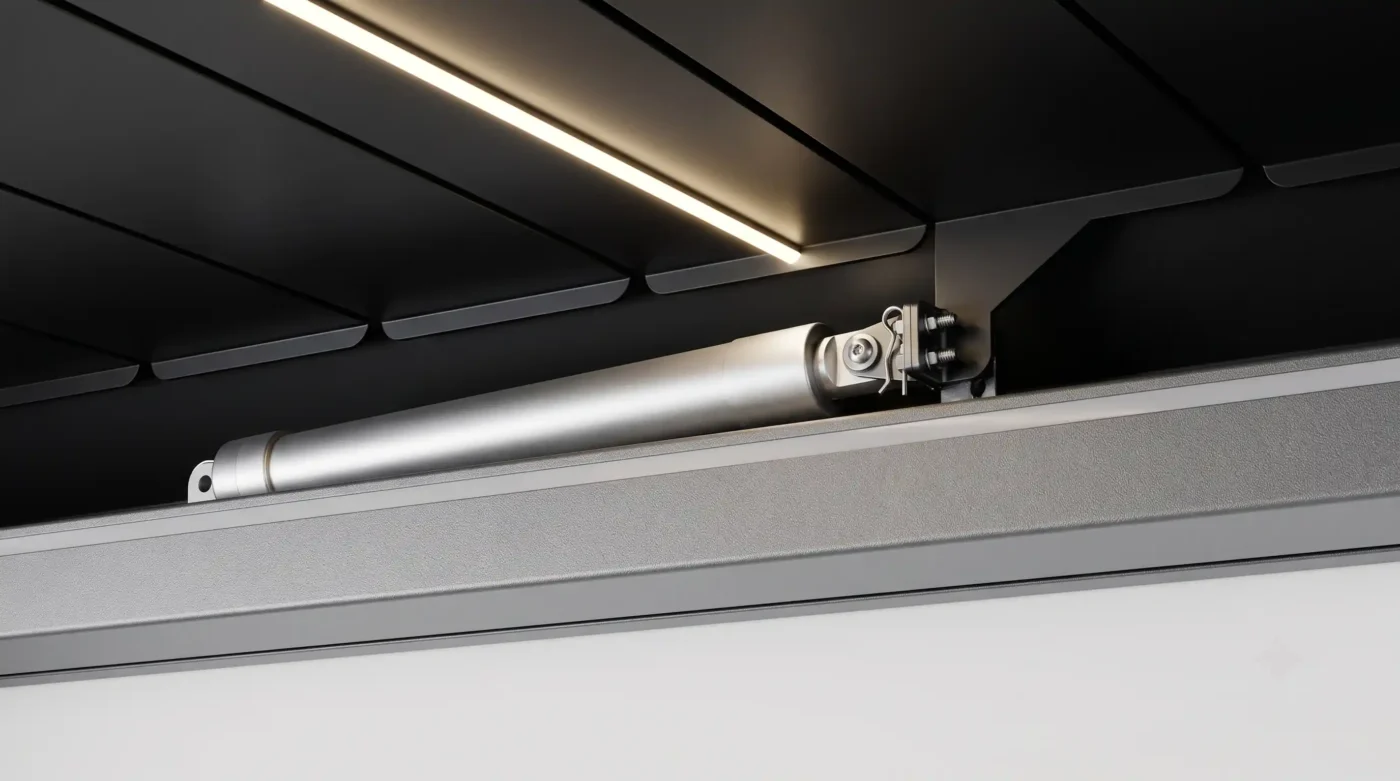
The final implementation of any intelligent control protocol depends on highly reliable physical actuators. Motor selection directly determines the response capability of the louvers under extreme conditions such as hydrostatic pressure, wind load, and ice or snow freezing.
Torque and Safety Advantages of 24 V DC Motors
Over the past decade, the industry standard has shifted from 120 V / 230 V AC tubular motors to 24 V DC linear actuators or tubular motors. The main drivers are electrical safety requirements in wet outdoor environments and the need for more precise torque control.
The 24 V DC system belongs to the safety extra-low voltage (SELV) category, meaning it will not pose a fatal electric-shock risk even if insulation is damaged. DC systems also integrate more smoothly with backup battery packs or off-grid solar systems, which is crucial for freestanding pergolas in remote areas or green-building projects.
High-quality motors include built-in overload protection. When louvers are blocked by foreign objects or when extreme freezing rain causes mechanical resistance to rise, the motor controller — such as a Teleco or Somfy 24 V DC control unit — detects the mechanical stop point through current absorption and cuts power immediately, preventing motor burnout or linkage breakage.
| Key Technical Indicator | Recommended Specification | Engineering Significance |
|---|---|---|
| Rated voltage | DC 24 V ±15% | Ensures electrical safety in wet environments and supports a unified low-voltage ecosystem |
| Rated thrust | ≥ 800 N | Ensures louvers can still be forced open or closed under snow coverage or strong wind resistance |
| No-load speed | 8 mm/s ±15% | Ensures full travel from 0° to 130°/140° within 10 to 15 seconds |
| Operating noise | ≤ 50 dB | Meets strict acoustic comfort requirements for high-end residences and commercial spas |
| Schutzart | IP67 or higher | Prevents water ingress during pressure washing or continuous heavy rain |
| Operating cycle life | ≥ 21,000 cycles | Equivalent to more than 15 years of mechanical life at two operations per day |
RS485, Dry Contacts, and Low-Level Communication Protocols
In high-end commercial projects — such as hotels, restaurants, clubs, or fully customized luxury villas — pergolas must be seamlessly integrated into central environmental control systems such as Lutron, Control4, or Crestron. In these scenarios, RS485 protocols and dry-contact interfaces remain irreplaceable backbone communication methods.
RS485 is a differential-signal serial physical-layer protocol with strong electromagnetic interference (EMI) resistance. The aluminum pergola structure itself behaves like a Faraday cage and can severely weaken high-frequency wireless signals. RS485 allows data transmission over twisted-pair cable up to 1,000 meters and supports multipoint topology, meaning one central controller can precisely address up to 100 independent motors or receivers through a single bus.
It is worth noting that high-end drivers with active power factor correction (active PFC) may see their PF value fall below 0.9 when the load is lower than 50 percent of the rated value, potentially causing harmonic violations. Therefore, excessive oversizing — such as configuring a 240 W driver for a 40 W load — is also a negative example in engineering design. The system should remain within the optimal 75 to 90 percent efficiency and PF operating range.Every factory-delivered motorized pergola controller must include isolated RS485 ports and dry-contact arrays as standard — this is a hard threshold for entering commercial engineering procurement lists.
Smart Mesh Networks and the Rise of Matter-over-Thread
In residential applications, wireless control has become the clear mainstream. However, traditional solutions rely on 433.92 MHz or 868 MHz radio frequency (RF) technology with dedicated one-way remote controls. While these perform reliably within line of sight, they lack two-way status feedback — users cannot know the exact current opening angle of louvers on a smartphone.
Proprietary Wi-Fi cloud systems followed, but these carry a fatal experience flaw: once the internet disconnects, or the manufacturer’s cloud server goes down, users completely lose smart control of the pergola. Outdoor courtyards are also often at the edge of home Wi-Fi router range, causing devices to go offline frequently.
Embracing the Matter Protocol and Thread Networks
Matter is an IPv6-based application-layer standard designed to break down ecosystem barriers between Apple Home, Google Home, Amazon Alexa, and SmartThings. The underlying network transport technology that allows Matter to shine in outdoor devices is Thread — a low-power IPv6 wireless mesh-network technology designed specifically for IoT.
Unlike Wi-Fi’s star topology, every mains-powered node in a Thread network can act as a routing node and relay signals to the next device. Multiple pergolas, smart lawn lights, and outdoor outlets in a yard connect to one another and form a robust signal network covering the entire backyard. Even if one node fails, the network automatically reroutes, greatly improving system reliability.
Strategic Benefits of Matter-over-Thread
Complete local control
Matter devices do not rely on external cloud servers. All control commands, automation scenes, and responses are completed locally, delivering sub-second response latency and eliminating delays caused by cloud handshakes.
Multi-admin architecture
End users are no longer forced to download a rough third-party app. With Matter’s multi-admin capability, one user can control the pergola through the Home app on an iPhone while another simultaneously uses the Google Home app on Android, with device status synchronized in real time.
Eliminating interoperability anxiety
Wind and rain sensors, temperature sensors, RGBW lighting dimmers, and motor controllers can all operate as standard Matter nodes. When a Matter-compliant water-leak sensor detects heavy rain, it can send a close command directly to the pergola motor over the local Thread network, without even passing through the home’s main router.
For pergola brands aiming to capture the premium European and North American markets, placing the “Matter over Thread” certification mark on the product specification sheet is one of the strongest technical endorsements available today.
Environmental Sensor Logic and Structural Safety Standards (EN 13659)
A high-grade motorized louvered pergola should not rely only on passive user control. It must have a self-protection instinct driven by precise sensors. Control logic affects not only user convenience but also the structural survival rate of the entire aluminum frame.
Rain Detection and Multidimensional Climate Response
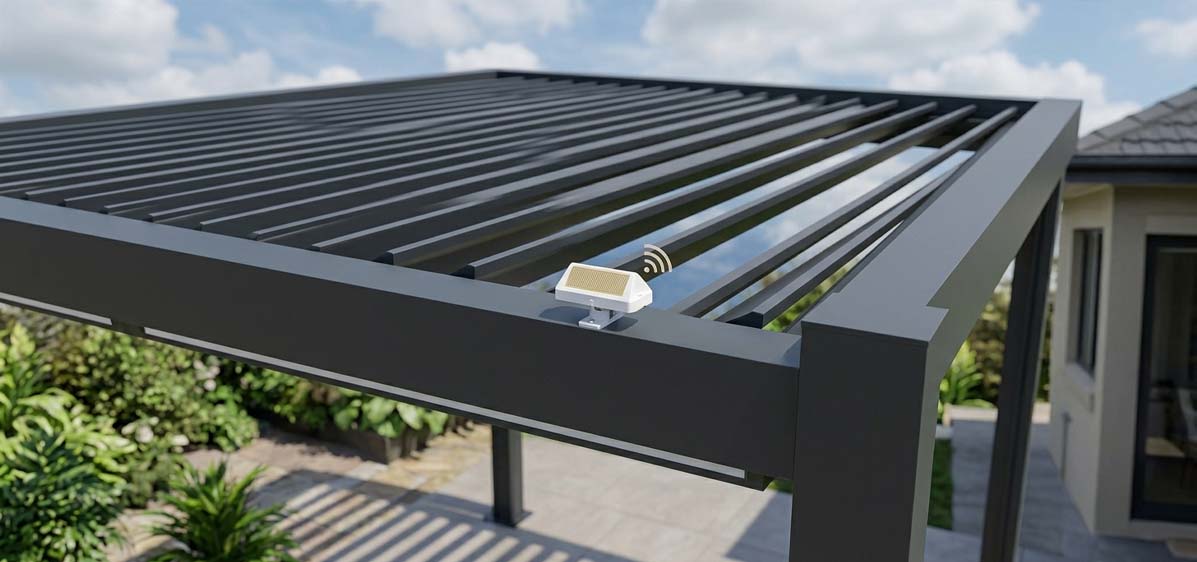
Modern automatic pergola systems widely use conductive rain sensors with interlaced gold or copper electrodes. In dry conditions the circuit is open; when rainwater lands on the surface, it bridges the electrodes and closes the circuit. Once rainfall is detected, the sensor informs the central controller within seconds, triggering the motor to rotate the louvers to the fully closed 0-degree position, compressing the built-in waterproof seals and guiding rainwater into the concealed gutter system.
In high-humidity coastal environments such as the United Kingdom or the Pacific Northwest of North America, heavy morning sea fog or condensation can cause false triggers. Professional-grade rain sensors must include built-in thermistor heating elements that rapidly evaporate standing water on the sensor surface, preventing false triggers caused by morning condensation and ensuring the roof closes only when it is truly raining.
Snow and Freeze Protection Logic in Severe Cold
In regions vulnerable to blizzards and freezing such as Canada or the U.S. Midwest, mechanical freeze protection is the key to system survival. The most dangerous issue is the melt-freeze cycle: moisture seeps into the louver joints, then freezes and locks all aluminum blades together. If the motor receives an open command and starts under force, high torque can directly twist off the transmission linkage or burn out the motor gearbox.
Anti-Freeze Control Strategies
Low-temperature dry mode — Freeze prevention
If the external thermistor detects that temperature has fallen to 37.4°F (3°C) with no moisture, the system proactively rotates all louvers open by about 10 degrees. This small tilt breaks the tight contact surface between blades, preventing condensation from freezing and locking the blades together.
Low-temperature precipitation mode — Active snow shedding
When temperature is below 37.4°F (3°C) and the rain sensor also detects moisture, the system determines that snow or freezing rain is occurring. The controller overrides all other commands and forces the motor to rotate the louvers to 90 degrees — fully vertical — letting snow pass directly through the louvers to the ground, reducing snow load to zero and protecting the entire frame from collapse.
Wind-Load Dynamics and EN 13659 Compliance
Wind load is the leading cause of catastrophic structural failure for aluminum shading structures. When wind blows over a fully closed flat pergola roof in high-frequency gusts, the Bernoulli effect creates a massive pressure difference, producing strong uplift force. In the European market, all exterior shutters and shading products must comply with DIN EN 13659, which strictly defines wind-resistance classes from Class 0 to Class 6.
| EN 13659 Wind Class | Test Pressure (N/m²) | Safety Pressure (1.5p) | Wind Speed (km/h) | Beaufort Description |
|---|---|---|---|---|
| Class 3 | 100 | 150 | ~46 | Force 6 — strong breeze: large branches move, umbrellas difficult to use |
| Class 4 | 170 | 250 | ~60 | Force 7 — near gale: whole trees move, walking against wind is difficult |
| Class 5 | 270 | 400 | ~76 | Force 8 — gale: branches break, walking against wind usually impossible |
| Class 6 | 400 | 600 | ~92 | Force 9 — strong gale: slight structural damage to buildings may occur |
For hardtop louvered roofs, the safest posture is not fully closed — a closed rigid flat roof creates dangerous upward airflow pressure. The correct aerodynamic response is for the system to force all aluminum louvers open to a 30° to 45° angle when wind speed exceeds the safety limit. This louver effect achieves pressure equalisation, allowing strong wind to pass smoothly through the structure and greatly releasing uplift and lateral stress, protecting the strength of the foundation bolts.
Wind and rain sensors must never be treated as optional accessories. They are the last line of defense against catastrophic structural damage and legal liability disputes.
Electrical Specifications and Thermal Management for Outdoor Low-Voltage LED Systems
Integrated LED lighting is becoming the dividing line between high-premium pergolas and ordinary assembled products. However, the outdoor electrical environment is extremely harsh. Many pergola manufacturers have received frequent lighting-failure complaints within the first 12 months because they used non-compliant LED strips and drivers.
Why a 24 V DC System Is the Non-Negotiable Baseline
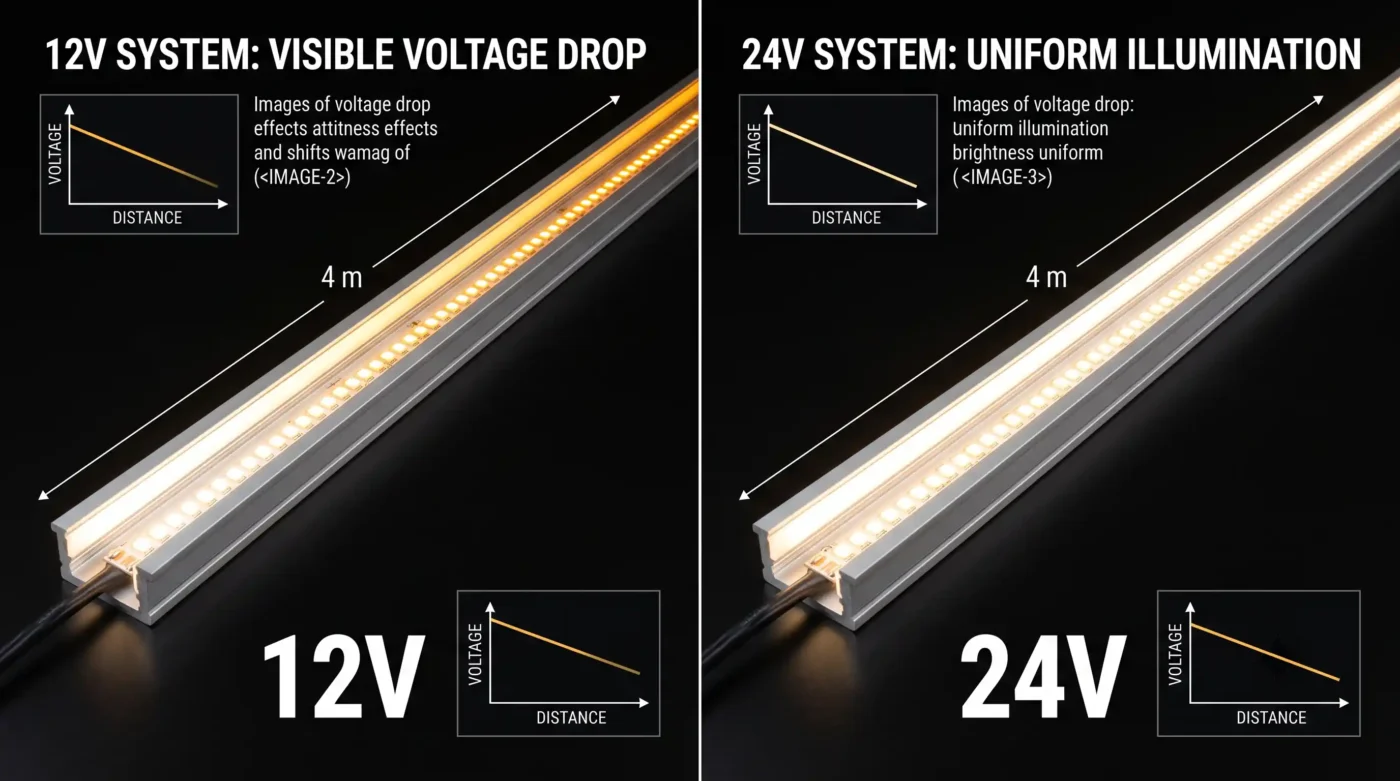
For large pergolas that often measure 10 ft x 16 ft or even reach a 42 ft span after multi-module combination, a 24 V system is the only engineering-logical choice. The core reason is voltage drop. When current flows through the thin copper traces of an LED strip, electrical energy is lost as heat over distance, causing visible dimming and color shift at the far end.
According to Ohm’s law, when maintaining the same lighting power — for example 14.4 W/m — the higher the system voltage, the lower the current. In a 12 V system, a 14.4 W/m strip consumes 1.2 A per meter. In a 24 V system, the same strip consumes only 0.6 A per meter. Halving the current means resistive loss inside the wire is greatly reduced, allowing a 24 V strip to achieve 10 meters or more of one-way continuous power while maintaining absolutely consistent brightness from end to end.
| Comparison Dimension | 12 V Outdoor LED Strip | 24 V Outdoor LED Strip |
|---|---|---|
| Current at 14.4 W/m | 1.2 A/m | 0.6 A/m |
| Max continuous run without injection | ~5 m (16.4 ft) | ~10 m (32.8 ft) |
| Voltage drop behavior | Drops quickly; visible dimming and color shift at far end | Drops gradually; highly consistent illumination across the full run |
| Power injection frequency | Frequent parallel lines from driver are needed | Rarely needed;one wiring run often satisfies the requirement |
Following NEC Article 411 and Class 2 Power Supply Requirements
For manufacturers targeting the North American market, compliance with the National Electrical Code (NEC) is a non-negotiable red line. NEC Article 411 clearly specifies standards for low-voltage lighting systems in wet and outdoor landscape environments, requiring such systems to be powered by UL- or ETL-certified Class 2 power supplies.
Class 2 power supplies are subject to extremely strict safe-output limits: output voltage must not exceed 60 V DC or 30 V AC; total current must not exceed 5 A; and the maximum output power of a single circuit is strictly limited to 100 watts. This 100 W constraint completely reshapes the optoelectronic topology of large pergolas. If a large double-bay pergola requires 80 ft of perimeter lighting, the electrician absolutely must not connect all of it to a single giant 400 W industrial switching power supply — this violates NEC rules and creates a serious fire hazard.
The compliant method is distributed power architecture: divide pergola lighting into multiple physically isolated waterproof zones and configure an independent Class 2 certified driver rated below 100 W for each zone. The industry golden rule also requires 20 percent power-supply headroom — a 96 W driver should carry no more than 76.8 W of actual LED load, ensuring the power supply does not continuously operate at full-load limit and greatly extending capacitor life.
Strict Optical Protection and Thermal Management Engineering
For LED installation, it is never acceptable to simply peel the 3M adhesive backing from the strip and stick it directly onto the powder-coated aluminum profile of the pergola. Outdoor frost, rain, UV exposure, and thermal expansion and contraction can cause adhesive to fail completely within a few months.
Three Layers of Lighting Protection
Waterproofing of the light source — IP67/IP68
Abandon low-cost IP65 drip-glue strips, whose surface coatings yellow, embrittle, and crack easily under UV exposure. Use IP67- or IP68-rated neon flex strips wrapped in UV-resistant silicone extrusion tubes, or fully potted COB strips.
Mechanical installation and thermal path — Aluminum channels
LEDs must be embedded in reserved grooves within the pergola profile or fixed with dedicated U-shaped aluminum channels. The aluminum channel is a critical heatsink: it quickly transfers heat generated by the LED chips to the entire metal skeleton of the pergola, preventing light decay caused by LED overheating.
Light diffusion — Diffuser cover
A frosted polycarbonate (PC) cover or high-quality silicone diffuser should be snapped over the aluminum channel. This provides a second layer of physical dust and water protection and also breaks up harsh LED hotspots, casting an even, soft, continuous diffuse glow across the louvers and posts to create the texture of premium architectural lighting.
Best Practices for Safe Wiring, Cable Routing, and System Integration
Even first-class drivers, top-grade environmental sensors, and expensive LED lighting systems will instantly lose overall reliability if wired casually by an installation team without professional training.
Fatal Cable-Material Mistakes and Correct Selection
One of the most common mistakes is pulling indoor 14-2 NM-B (Romex) cable outdoors to power low-voltage pergola equipment. This cable contains solid copper conductors and uses an indoor-grade PVC jacket. It lacks UV resistance, and after alternating winter cold and summer heat, its outer jacket can become brittle and crack, allowing moisture to enter the copper core and cause short circuits.
Low-voltage wiring for professional pergolas — used for 24 V motors and LED drives — must use direct-burial, UV-resistant, weather-grade stranded cable such as 16/2 or 14/2 specifications. Stranded conductors give the cable high flexibility, allowing it to follow the twisting internal wiring paths of the pergola without damage.
The sealing of connection points is equally critical. Ordinary low-cost plastic wire nuts must never be used at junction points. Outdoor temperature differences create large amounts of condensation inside metal posts. Field installation must require direct-burial gel-filled wire nuts or dual-wall heat-shrink connectors with adhesive liners, completely sealing the path for moisture intrusion.
High-Voltage Integration and Ground-Fault Protection (GFCI)
Any professional-grade pergola should use a concealed hardwired connection — run by a licensed electrician from the main distribution panel through buried underground PVC conduit directly into the load-bearing post of the pergola. Whether supplied through a receptacle or by hardwiring, all AC circuits supplying outdoor pergolas must be protected at the source by a ground-fault circuit interrupter (GFCI/RCD). This ensures that in the event of leakage current, a short circuit, or water ingress, power can be cut within milliseconds, eliminating electric-shock risk.
Centralized Control for Full-Scene Integration
Forward-looking manufacturers have begun sourcing highly integrated control hubs — 230 V AC control units with integrated power supplies — compactly hidden inside a waterproof box. A typical modern controller module includes:
Integrated Controller Output Matrix
Multiple 24 V DC outputs
Simultaneously control two independent roof louver motors and four sets of motorized windproof zip screens around the perimeter.
Constant-voltage dimming outputs
Directly provide 24 V PWM signals for precise dimming of multi-color-temperature or RGBW ambient lighting.
High-power relays
Switch suspended infrared heaters or high-power outdoor fans up to 13 A and several kilowatts.
Integrated sensor interfaces
Centrally collect signals from wind-speed, rainfall, snow-load, and motion sensors, then uniformly command the entire architectural ecosystem.
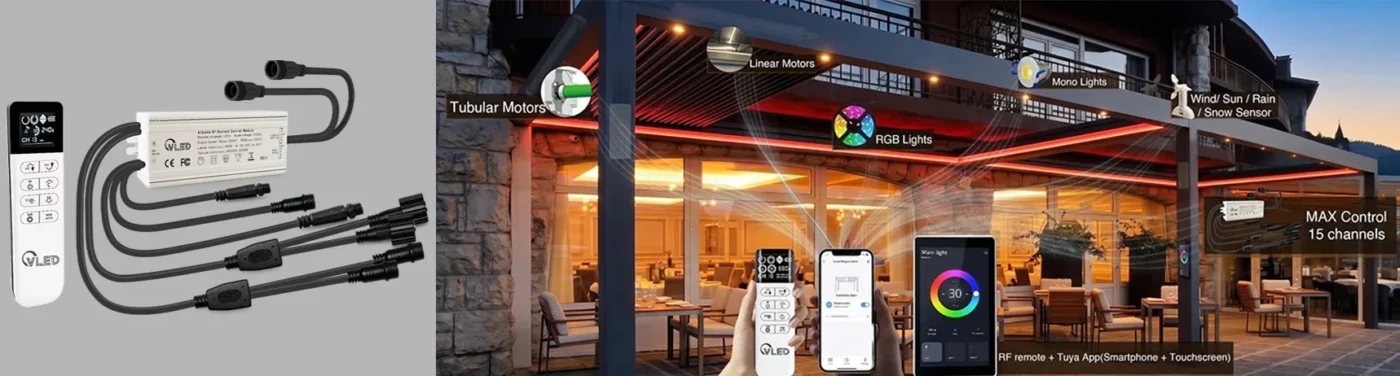
After all devices are integrated, the user no longer needs to operate multiple remotes. Through a Matter protocol panel or smartphone, the user can elegantly activate courtyard dinner mode: louvers open 30 degrees for ventilation, zip screens lower to block insects, infrared heaters start, warm-white lighting turns on — all happening seamlessly in an instant.
Conclusion and Call to Action
Motorized louvered pergolas have moved beyond traditional building-material hardware and formally entered the frontier of precision electromechanics and digital IoT. From choosing a rock-solid 24 V DC drive architecture to complying with EN 13659 wind-load standards and strict snow-melting logic; from overcoming voltage drop in long-distance outdoor LED wiring to strictly implementing electrical fire-safety requirements under NEC Class 2 limits; and then to fully embracing Matter-over-Thread — every decision at each electrical and control node directly determines the final market position of the pergola brand.
The era of relying on patchwork low-cost motors, non-compliant indoor LEDs, and interference-prone isolated RF controllers is completely over. It is time to re-examine your electrical bill of materials. Build deep strategic partnerships with professional electrical-control suppliers who truly understand harsh outdoor operating conditions, master international electrical standards, and command next-generation smart-home connectivity protocols. This is not only the best solution for ending high after-sales costs, but also the core weapon for breaking through the crowded competition of the high-end custom market and achieving strong product premiums.

Pingback: RGB-, RGBW- und Mono-LED-Steuerung für Pergolen mit Lamellen: Spezifikationsleitfaden
Pingback: Snow and Frost Protection Logic for Motorized Louvered Pergolas
Pingback: Ansteuerung von Stellantrieben und Rohrmotoren für Pergola-Lamellen: Leitfaden zur OEM-Integration