


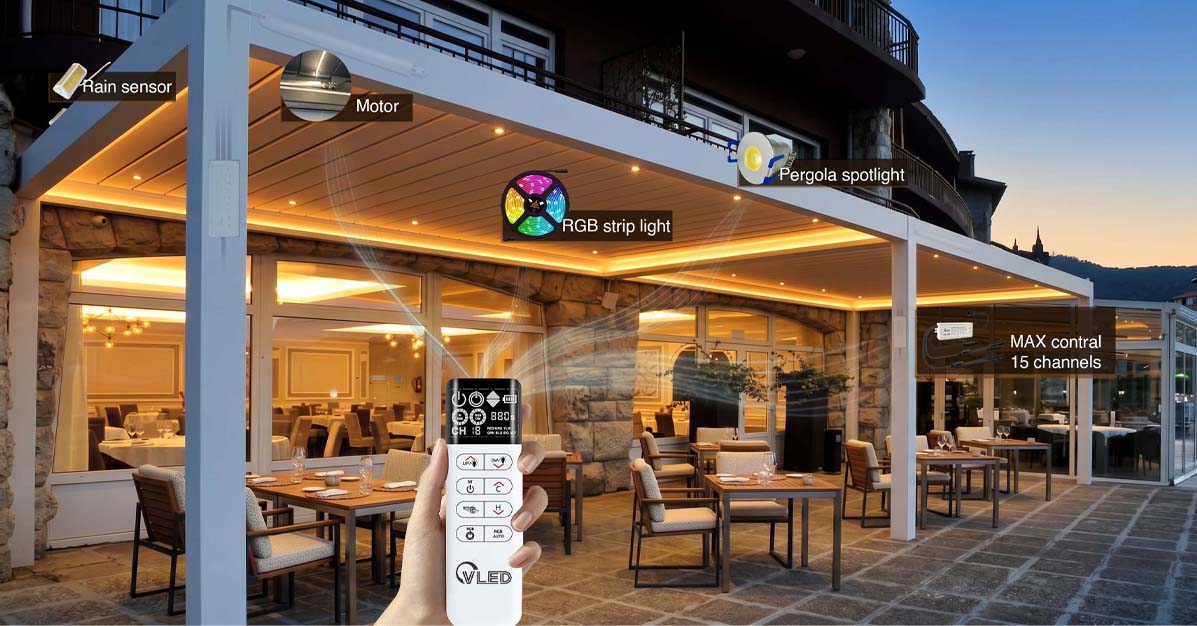
The global outdoor architectural structures market is undergoing a profound technological transformation. Traditional pergolas — once static structures of wood or basic metal offering passive shade — are rapidly being replaced by modern bioclimatic pergolas defined by deep integration, automation, and intelligence. This shift is not merely a change in consumer aesthetic preferences; it is an industry-wide reshaping driven by underlying technological innovation, the growing demand for commercial space utilization, and the widespread adoption of smart home ecosystems. Intelligent pergolas have become the defining direction for the future of outdoor living.
Market data paints a clear picture. The global motorized louvered pergola market reached $2.18 billion in 2024, and is projected to climb to $5 billion by 2035 at a compound annual growth rate (CAGR) of 7.8%. In North America and Europe — the two core markets with the highest demand for outdoor living quality — the adoption rate of smart pergolas is rising exponentially. Consumer expectations are undergoing a qualitative leap: 42% of consumers say they prefer modern pergolas with high functionality, comfort, and aesthetic value. In new residential and commercial outdoor projects, as many as 28% of installations already incorporate automated smart pergola features.
Yet behind this rapid expansion, pergola manufacturers face serious structural challenges. As many as 36% of potential buyers are deterred by concerns over high initial installation costs and ongoing maintenance expenses. The root of this pain point is the “hardware-software separation” model still prevalent in the market. Many manufacturers continue to rely on patchwork third-party solutions for control systems and lighting — a mindset rooted in traditional metalworking, not modern product design.
For pergola manufacturers aiming to dominate the market over the next decade, moving away from reliance on third-party technology and developing a proprietary pergola control system is no longer a mere nice-to-have; it has become an essential upgrade path for enhancing core brand value, optimizing cost structures, and building a decisive competitive edge. With their versatility, durability, and limitless customization potential, deeply integrated lighting and control systems represent the most robust and long-term strategic investment for any pergola manufacturer committed to maximizing the use of outdoor spaces and elevating their brand positioning.
Strategic Breakthrough: 5 Core Advantages of Owning Your Lighting & Control System
In an increasingly crowded outdoor architecture market, competing on aluminum profile thickness or powder-coating processes leads only to eroding margins. The real competitive moat lies in owning your electronic control architecture. Here is the core logic for why pergola manufacturers must internalize and proprietary-ize their lighting and control systems.
1. Perfect Structural–Electrical Integration: Concealed Wiring & Ultimate Safety
The foremost hallmark of any premium architectural product is the purity of its appearance. Conventional third-party systems are typically bolted on as an afterthought once the structure is complete. This post-installation approach inevitably results in exposed conduits and protruding junction boxes that destroy the clean aesthetic of a modern pergola.
When manufacturers own their proprietary systems, electrical layout is incorporated from the very first stage of structural design. LED strips, power lines, signal cables, and core control modules can be seamlessly embedded within the internal cavities of aluminum beams, columns, and louvers. The benefits are significant:
Safety first. Outdoor structures are perpetually exposed to UV radiation, extreme temperature swings, and violent storms. Exposed conduits are prone to insulation aging and cracking, risking electrical leakage or short circuits. A proprietary system achieves physical water-electricity separation through internal routing. High-standard waterproof components — IP67 or IP68-rated control enclosures and connectors — are sealed within the aluminum profiles, eliminating rainwater intrusion and dramatically reducing safety risks.
Without tangled external wires or third-party black boxes, the pergola presents a minimalist, architecturally refined aesthetic — perfectly suited for luxury hotel courtyards or high-end private estate projects.
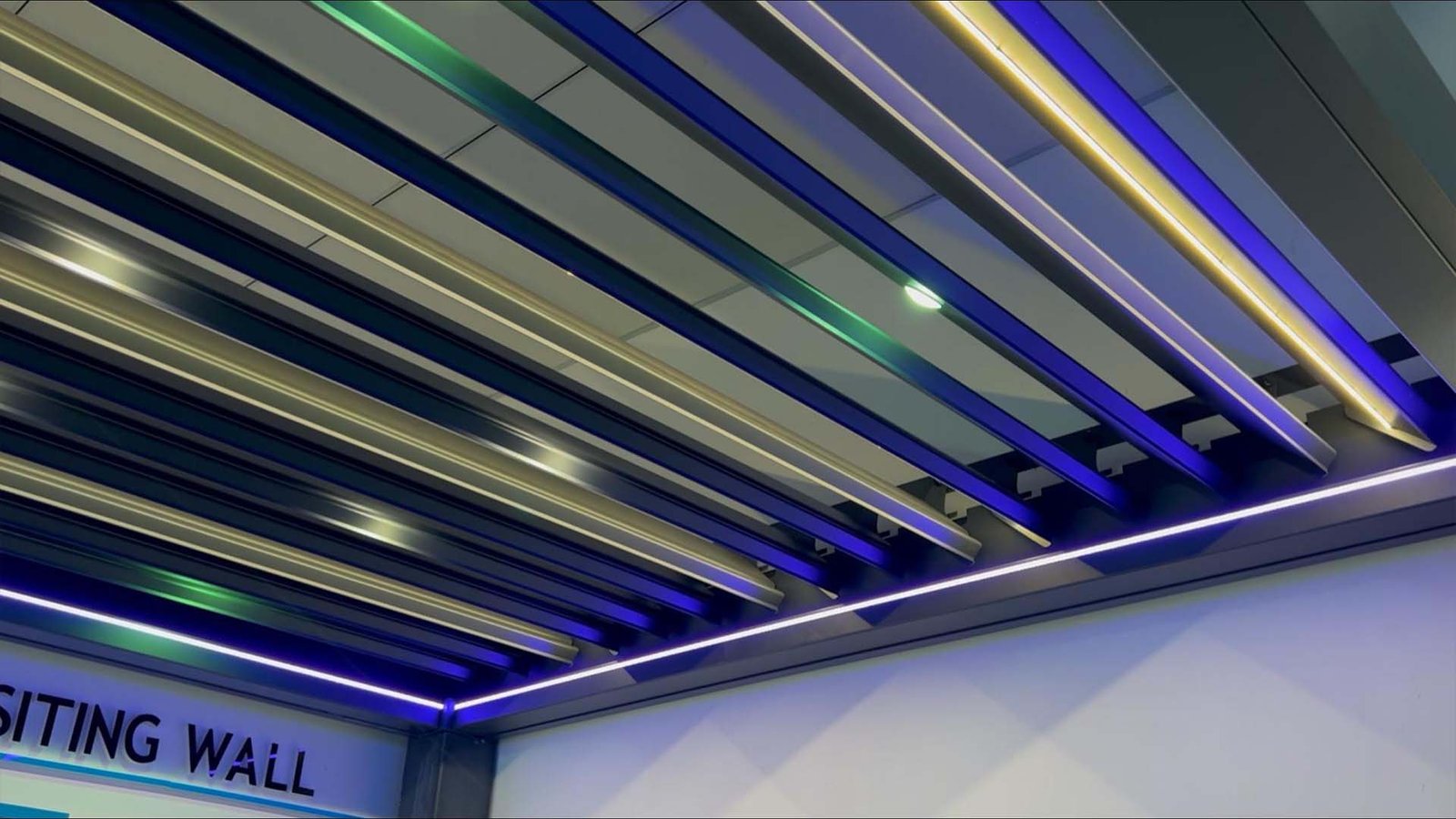
2. Unified Control Ecosystem: Eliminating Compatibility Barriers & Latency
In an era where user experience is everything, operational fluidity directly defines a product’s perceived value. Conventional patchwork pergolas often deliver a frustrating experience: one remote for louver angles, another for lighting, and a manual pull for the rain curtain. Forcing these disparate third-party devices into a smart home hub frequently causes protocol conflicts, signal delays, and frequent disconnections.
A self-developed or deeply customized system eliminates these barriers entirely. Lighting, motorized louvers, wind/rain curtains, weather sensors, climate control, and even outdoor audio can operate under a single unified logic — all commands processed on one integrated mainboard.
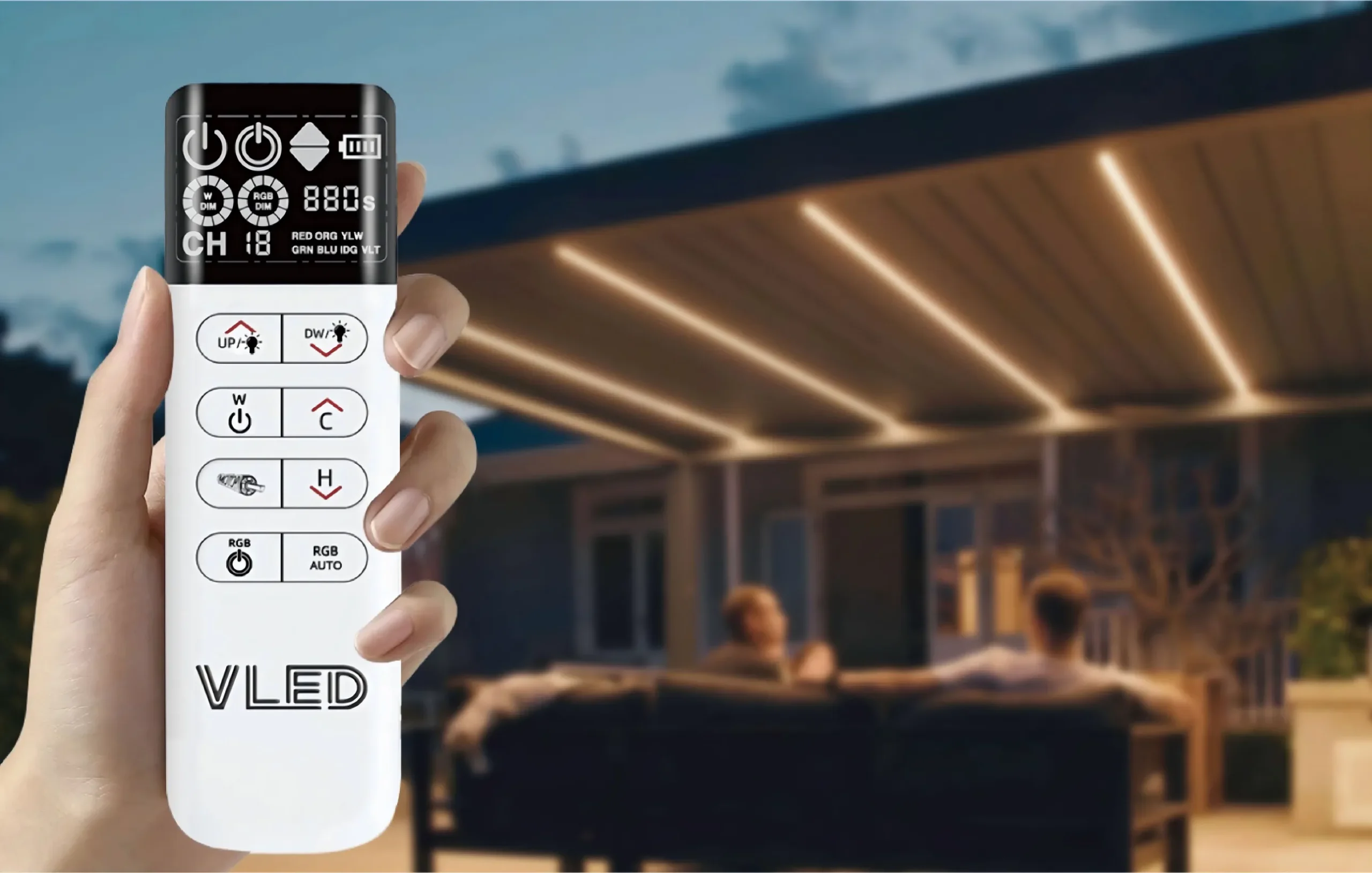
Users gain full control over the entire pergola system through a single remote or dedicated mobile app. When the system operates as a seamlessly coordinated whole, responses are instantaneous and consistent. This friction-free experience — free from hardware conflicts and protocol conversion delays — is the critical foundation for establishing a premium brand position.
3. High Customization Capability: Confidently Handling Complex, Non-Standard Projects
In the high-end market — especially commercial real estate and custom residential — “standard products” often fall short. Pergola manufacturers frequently face non-standard dimensions, irregular structures, and special functional requirements that demand bespoke engineering.
Relying on off-the-shelf control boxes constrains manufacturers to fixed power limits, fixed interface counts, and rigid programming logic. A large-span commercial pergola might need to simultaneously drive six high-power linear actuators across three independently controlled daylighting zones — something generic controllers simply cannot accommodate.
Owning a proprietary system grants unlimited customization freedom: adjusting motor over-current protection thresholds, redefining sensor trigger sensitivity, adding RGBW dimming channels — all nimbly adapted to specific engineering requirements, dramatically expanding the range of projects a manufacturer can take on.
4. Breaking Cost Ceilings: Bypassing Inflated Market Pricing
Relying on external smart home brands significantly inflates BOM (Bill of Materials) costs. These brands carry substantial premiums that erode margins — or force manufacturers to raise end prices and lose competitive ground in bids.
The more insidious cost is after-sales maintenance. Mismatched third-party components mean endless troubleshooting. When systems malfunction, the motor supplier blames the control board, and the control board supplier blames the wiring — this mutual finger-pointing consumes enormous time and resources.
Long term, a proprietary system aligned from hardware to software reduces per-unit marginal costs through scaled procurement, while near-zero failure rates and clear accountability eliminate hidden maintenance expenses that would otherwise devour profits.
5. Brand Differentiation & Brand Elevation: Commanding Market Pricing Power
Today’s consumers are not just buying a metal frame — they are buying an intelligent outdoor lifestyle. If two manufacturers offer identical aluminum specifications and powder-coating, but one delivers a proprietary, logo-branded controller with exclusive lighting rhythm modes, that manufacturer has clearly risen above commodity manufacturing and ascended to “technology brand” status.
Owning a self-developed or exclusively integrated lighting and control system is the most distinctive label of brand differentiation. It elevates professional authority within the industry, makes consumers feel the premium is fully justified, and gives manufacturers stronger negotiating power in channel distribution and engineering bids.
The End-User Experience: Reshaping Commercial and Residential Outdoor Spaces
For end consumers — whether commercial operators seeking to expand revenue-generating space or private homeowners upgrading their quality of life — integrated smart pergolas are fundamentally reshaping how people interact with outdoor environments.
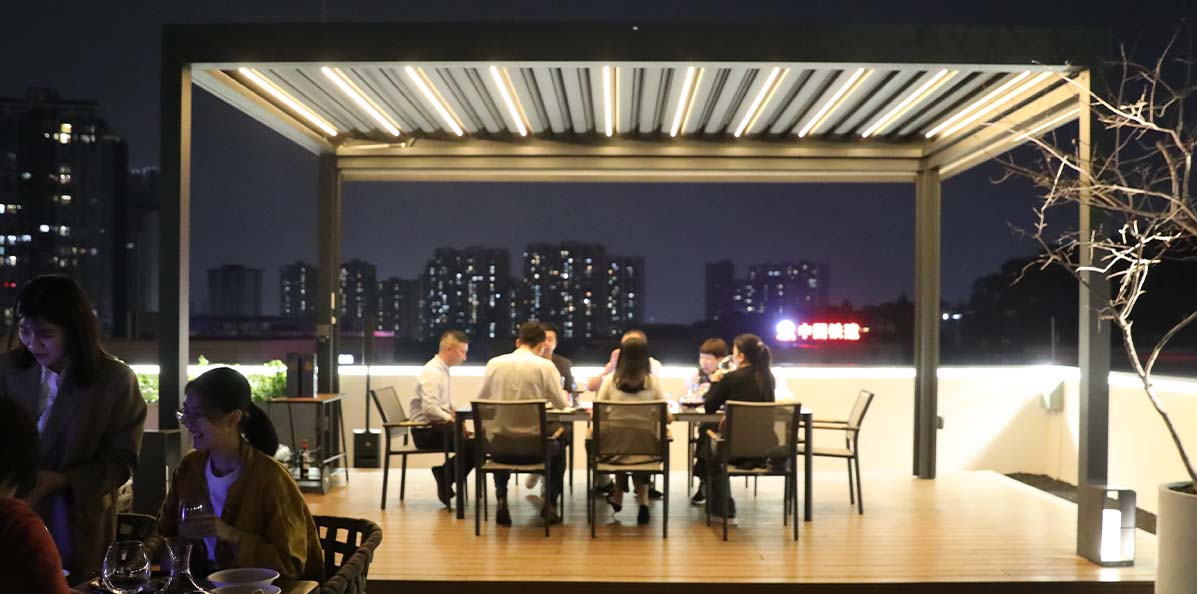
1 Revenue Multiplier for Commercial Spaces: All-Weather, All-Day Operation
In restaurants, hotels, and resorts, outdoor space utilization is directly tied to revenue. According to the latest industry insights, transforming outdoor areas into fully functional all-weather spaces is one of the top trends in commercial design for 2025 .
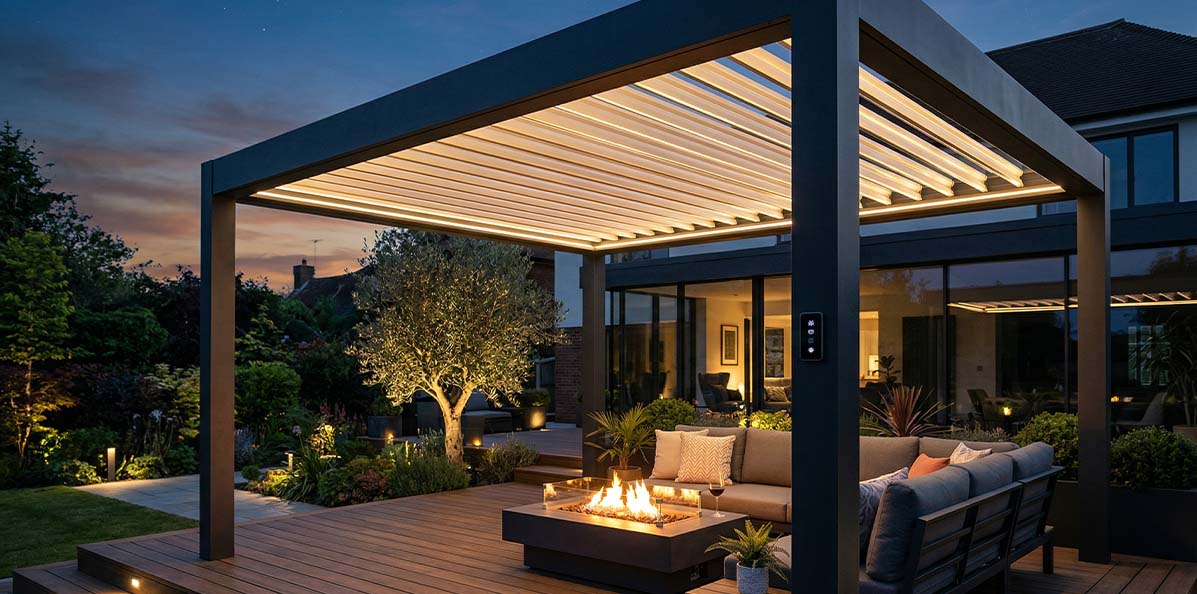
Through professional pergola lighting, a terrace that was previously only usable during daylight becomes an ambiance-rich dining destination the moment the sun sets. Warm lighting extends guest dwell time and lifts average spend per cover.
Equally critical is weather protection. When a pergola’s proprietary control system is connected to weather sensors, the motorized louvers fully close within seconds of detecting rain, with wind curtains descending simultaneously. Guests remain completely unaffected; the restaurant avoids scrambling to cancel outdoor reservations. This weather-proof expansion of usable floor area is among the most valuable investments a commercial operator can make.
2. Flexible Space Transformation: Adapting to Constantly Changing Needs
Commercial spaces require flexibility. The same outdoor venue must serve different functions at different times of day. High-precision motor control and stepless dimming technology allow businesses to configure entirely different environments based on time of day, season, or event type.
During the day, louvers angled at 45 degrees introduce soft natural light and promote air circulation — ideal for business lunches or intimate social gatherings. Come evening, closing the louvers and activating embedded RGB dynamic lighting transforms the same space into a lively open-air dining area or an upscale cocktail event venue — with no physical reconfiguration required.
3. Group & Individual Control for Large Installations: A Central Command Hub
In large commercial buildings, premium resort hotels, or expansive courtyards, multiple pergola units are often installed side by side to cover vast areas. Traditional management requires staff to carry armfuls of remotes and adjust each unit individually — inefficient and error-prone.
Professional integrated control systems introduce advanced group and individual control logic. A facility manager can execute a “global mode” with a single tap — for example, at 6:00 PM, activating all pergola lighting and closing every canopy across a matrix of dozens of units simultaneously. At the same time, granular individual control remains available: if a VIP table guest prefers more sunlight, staff can independently adjust that specific zone’s louver angle without affecting adjacent areas. This level of intelligent management dramatically reduces operational labor costs.
4. Luxurious Residential Upgrades and Lasting Wellbeing
In the residential market, the value of outdoor living spaces is surging equally. The Remodeling Impact Report published jointly by the National Association of Realtors (NAR) and NARI highlights that outdoor living space upgrades are among the highest-priority and most financially rewarding categories in the remodeling market.
For private homeowners, a pergola equipped with integrated LED lighting and an automation system dramatically elevates the residential experience and “Joy Score.” It transforms a once-plain backyard into the ideal venue for evening dining, family gatherings, and seasonal entertaining. No more manually cranking a shade sail. No more rushing outside in wind to rescue patio furniture. A gentle tap on a smartphone screen — or a voice command — and the pergola automatically adapts to provide perfect shelter and ambiance. This seamlessly connected indoor-outdoor lifestyle is at the heart of contemporary luxury residential design.
Setting the Standard That Illuminates the Future: Photometric & Energy Compliance

Globally, outdoor lighting design and control is facing increasingly stringent environmental and energy-efficiency scrutiny. Pergolas assembled from casually sourced budget lighting strips frequently fail inspections for high-end commercial projects or strict municipal jurisdictions — failing on light pollution, glare, or energy consumption compliance.
Manufacturers who own proprietary control systems can integrate international lighting standards at the R&D stage. For example, following the outdoor lighting specifications of the Gesellschaft für Lichttechnik (IES) — ensuring that LED fixtures integrated within the pergola meet stringent BUG (Backlight, Uplight, and Glare) rating requirements .
Through precision control modules, systems can achieve astronomical clock synchronization and illuminance sensing: automatically switching off during sufficient daytime light, and automatically dimming to 20% when unoccupied at night — ensuring basic safety navigation while minimizing light trespass and energy waste. This capability — meeting and even surpassing industry standards — is both an expression of environmental responsibility and a hard-earned ticket into international large-scale municipal and commercial engineering supply chains.
Avoiding the Pitfalls of Traditional Integration: Why Professional Customization Matters
If the advantages of smart integration are so compelling, why do so many manufacturers struggle on the upgrade path? The answer: traditional integration solutions on the market often make the process unnecessarily painful.
Incomplete functionality is a persistent problem. Generic solutions are typically designed for one specific motor or luminaire type, and cannot achieve the goal of “one remote, everything controlled.” Attempts to forcibly merge weather sensors, RGB dimming, and louver control routinely run into communication protocol dead ends.
Installation and wiring complexity is another fatal flaw. Generic solutions are not optimized for pergola-specific profile structures, requiring extensive stripping, soldering, and crimping on-site. This slows projects significantly and demands electricians with highly specialized skills.
Most damaging are the long-tail costs of component mismatch. Even after investing enormous effort into a patchwork installation, these never-rigorously-tested components typically produce high failure rates in use. Endless maintenance, troubleshooting, and parts replacement will consume profits entirely — and inflict irreversible brand reputation damage. The importance of selecting a professional lighting and control system genuinely aligned with your pergola’s structural logic cannot be overstated.
Begin Your Smart Upgrade: Our Solution
Facing the smart wave sweeping the pergola industry, compromising on mediocre off-the-shelf solutions is a guaranteed path to being left behind. Yet building an in-house electronics engineering team from scratch represents unbearable trial-and-error costs and timelines for most metal structure manufacturers.
The optimal path is partnering with experts who specialize deeply in this vertical — obtaining a mature, highly customized, fully compatible system-level solution that enables manufacturers to leapfrog the competition.
We are dedicated to the R&D and manufacturing of pergola integrated control systems. In recent years, we have made breakthrough advances in Pergola-Beleuchtung und pergola control. Our products integrate a comprehensive range of functionalities — single-color lighting, RGB lighting, motorized louvers, motorized curtains, and automatic wind/light/rain sensing — all controllable through a single remote. The system supports one remote controlling up to fifteen independent control units simultaneously: a genuine industry breakthrough.
If you are seriously considering upgrading your lighting and control system — or developing a proprietary system that truly reflects the quality of your pergolas — we would be delighted to learn about your plans. For over a decade, we have been deeply immersed in this industry: understanding which solutions work, which ones fail in the field, and what manufacturers genuinely need from a control partner. Contact us, and through in-depth discussion we can tailor the perfect intelligent control solution for your structure — and together build benchmarks for the future of outdoor living in this blue-ocean market growing at 7.8% annually.

Pingback: Why Pergola Manufacturers Should Treat Controls as a Core Product Feature
Pingback: The Evolution of Motorized Pergolas: From Simple Remotes to Weather-Responsive Systems