


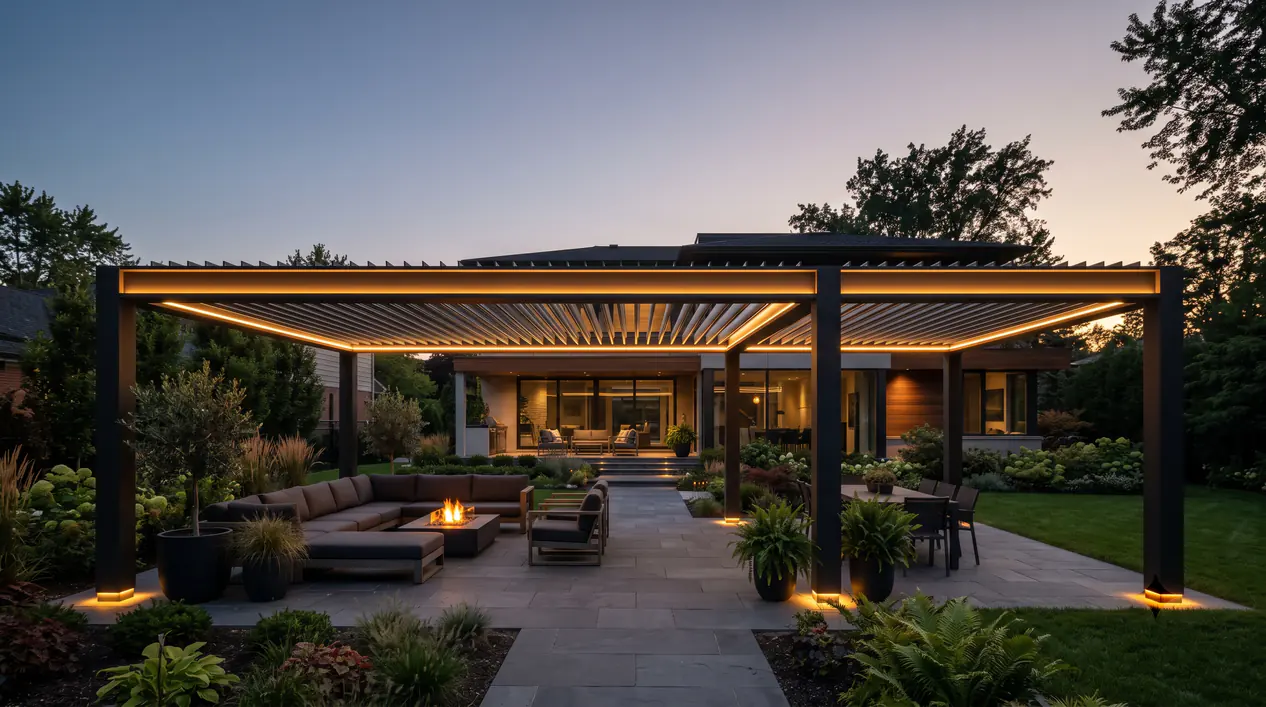
The definition of premium outdoor living is undergoing a profound physical and digital transformation. Louvered pergolas were once no more than basic overhead structures for shade and rain protection. Today, end consumers across North America and Europe regard them as intelligent extensions of the residential or commercial environment. Lighting is no longer a simple functional requirement — it is the central instrument for shaping atmosphere, extending operational hours, and expressing a customized luxury experience.
As market demand for functional integration grows exponentially, European and American pergola manufacturers are facing an unprecedented engineering challenge. Forcing linear actuator motors, monochromatic ambient lighting, RGB accent lighting, rain sensors, and anemometers into a single patchwork system consistently produces catastrophic warranty costs and a failed user experience. The traditional multi-vendor sourcing strategy — purchasing motor drivers, LED controllers, and environmental sensors from separate third-party suppliers — exposes terrible protocol incompatibilities and creates enormous risks in installation time and system stability.
This guide is written specifically for louvered pergola manufacturers targeting the North American and European premium markets. Through a rigorous analysis of optical layering, control architecture failure points, regional compliance standards (NEC and CE), and DarkSky ecological design principles, this report explores how a fully integrated 4-in-1 control system — exemplified by the VLEDSTAR PERGO Pro — fundamentally resets the industry standard.
Optical Layering in Pergola Lighting Design and Commercial Value
Before evaluating the underlying control architecture, manufacturers must deeply understand the stringent optical demands of the end market. Without exception, the finest outdoor spaces employ a Layered Lighting philosophy — weaving multiple independent light sources together so the pergola transitions seamlessly between climatic conditions and social scenarios.
1. Ambient and Task Lighting — Monochromatic White Systems
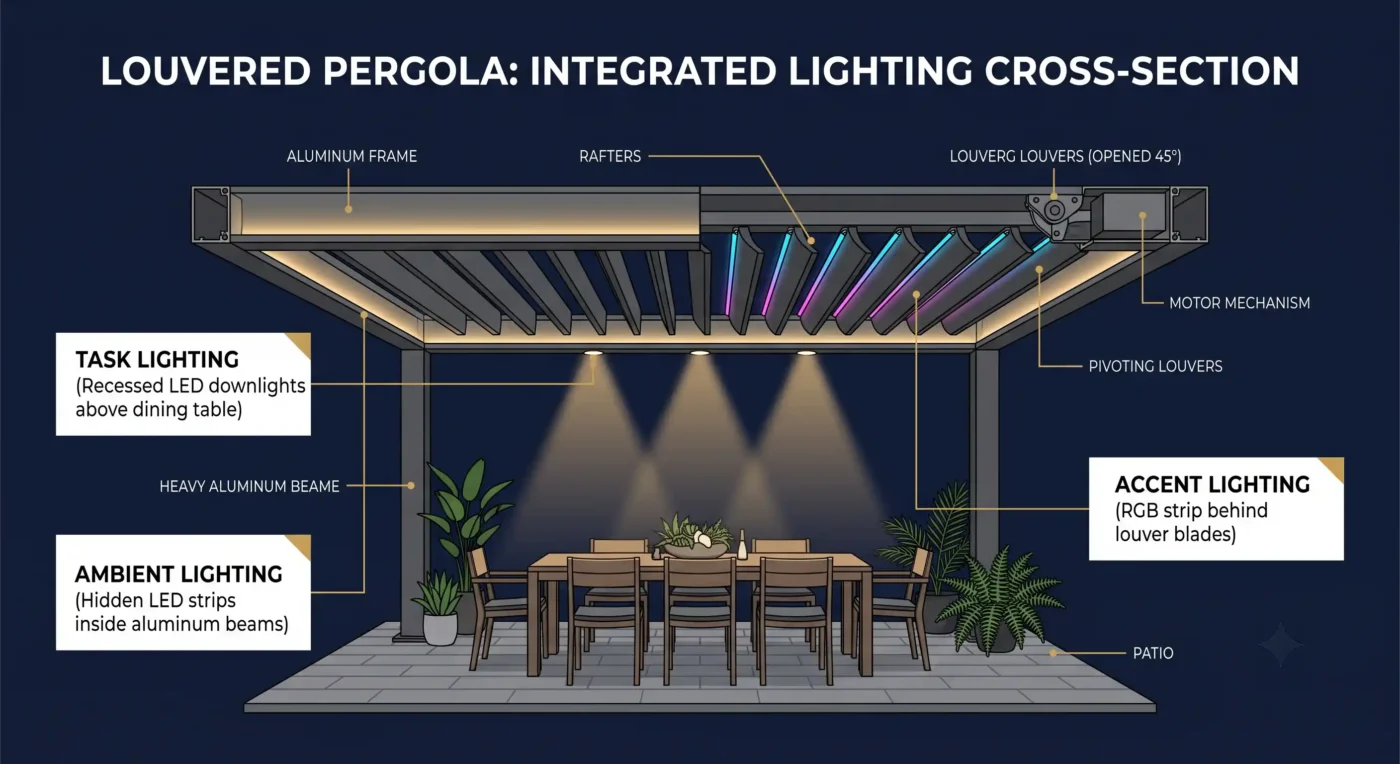
Ambient lighting forms the foundation of the pergola’s visual experience. Manufacturers typically integrate LED linear strips or micro puck lights along gutter edges, inside primary beams, or atop columns. For monochromatic systems, the uniformity of the light distribution and the smoothness of the dimming curve are the core indicators of electrical quality.
Task lighting is more targeted — deployed directly above outdoor kitchens, barbecue stations, or reading zones. It demands high lumen output (typically with anti-glare design) and precise brightness control. Inferior controllers frequently cause visible LED flicker or complete cutout as voltage drops below 25%. Industrial-grade control systems allow current to decay smoothly and precisely from 100% all the way to 5% — perfectly matching the visual adaptation of the human eye from dusk to deep night.
2. The Atmosphere Engine — RGB and RGBW Dynamic Control
While monochromatic light establishes practical utility, RGB (Red-Green-Blue) and RGBW (Red-Green-Blue-White) lighting are the core levers that raise the pergola’s premium positioning. RGB lighting empowers end users to freely customize the space’s color palette for specific social events — evening dinners, pool parties, or seasonal celebrations. In commercial applications such as upscale resort hotels or rooftop bars, RGB strips can align deeply with a brand’s visual identity system, creating extraordinary commercial value and memorability.
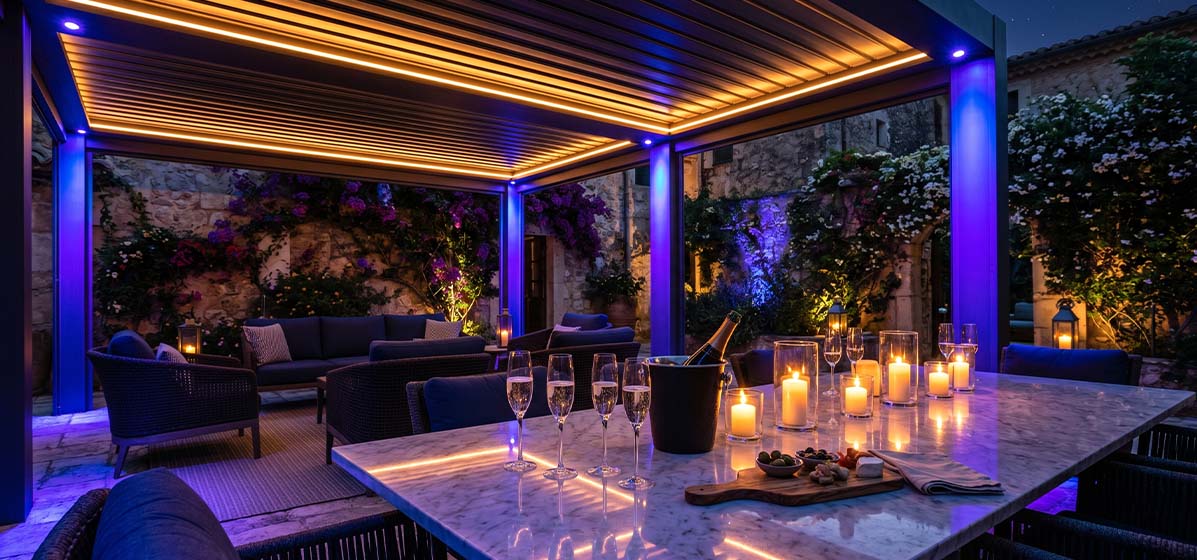
The technical challenge of managing RGB systems lies in color rendering consistency and dynamic transition management. Professional controllers go far beyond simple static color switching, offering dynamic modes such as rainbow timing while allowing users to precisely control color saturation, transition rate, and brightness. This level of control demands that the microprocessor achieve a very high PWM refresh rate to ensure the purity of color blending.
| Capa de iluminación | Typical Components | Deployment Location | Core Control Requirements |
|---|---|---|---|
| Iluminación funcional | Recessed downlights, directional micro spotlights | Directly above dining areas and outdoor worktops | High lumens, anti-glare, precise monochromatic low-voltage dimming |
| Iluminación ambiental | Linear LED strips, concealed overhead channels | Gutter edges, inside primary aluminum beams | Absolutely smooth dimming curve, highly consistent color temperature (typically ≤3000K) |
| Iluminación decorativa | RGB / RGBW flexible waterproof strip lights | Inside columns, louvre blade gaps | Broad-spectrum color accuracy, dynamic transition speed control, zero flicker |
The Fault Lines of Traditional Control Systems — Silent Destroyers of Manufacturer Profit
During the electrification wave in the louvered pergola industry, many manufacturers have fallen into a multi-vendor trap. Motors come from linear actuator specialists, lighting from traditional LED distributors, and sensors and smart gateways from third-party automation brands. This patchwork model may barely function in an ideal lab environment, but in a complex outdoor installation it reveals its physical and software fragmentation — ultimately becoming a source of costly warranty claims.
1. Protocol Conflicts and Loss of System Synchronization
Control components from different vendors typically run on mutually incompatible radio frequency (RF) protocols or communication standards. When a customer attempts to simultaneously close the louvres and adjust the lighting via a single remote control, patchwork systems routinely fail to execute macro instructions. For large commercial multi-pergola installations, the resulting system-level latency and packet loss cause louvre blades across different zones to open to inconsistent angles, with lighting colors unable to synchronize. This lack of mechanical and optical consistency severely damages the sense of luxury that premium products should convey.
2. Physical Destruction Risk from Linear Motor Travel Limit Failures
The core drive system of a louvered pergola relies on 24V DC linear actuators. Typical industrial-grade actuators offer approximately 2,000 N (about 450 lbs) of push-pull force and around 136 mm of mechanical travel. Traditional low-end control boxes often lack intelligent travel memory. When louvres are already fully closed — at the mechanical dead point — but the operator continues pressing the remote, or when a sensor triggers a false positive, the motor continues to receive power and stalls.
This sustained stall causes a current surge within seconds. At best, it burns out the clutch and plastic gears inside the actuator; at worst, it blows the main board capacitors of the control box. Documented cases show some manufacturers incurring per-incident warranty repair costs of several thousand dollars — entirely eliminating the project’s net profit margin.
3. Wiring Nightmares and Installation Time Inflation
Independent subsystems require independent wiring circuits. Installation engineers must laboriously thread separate high-current motor control cables, low-voltage LED wiring, and sensor signal feedback cables through the narrow internal structural raceways of aluminum extrusions. Dense terminal connections not only increase physical risks of short circuits and water ingress, but stretch what should be a one-hour electrical installation into many hours or an entire workday. This non-standardized on-site construction significantly limits a manufacturer’s capacity to scale output and revenue.
The 4-in-1 Integrated Architecture — A Technical Leap with the VLEDSTAR PERGO Pro
To fundamentally eliminate the chronic industry pain caused by system fragmentation, the controller must evolve from a simple “instruction receiver” into the “central computing hub” of the entire outdoor ecosystem. The VLEDSTAR PERGO Pro’s 4-in-1 highly integrated control system represents the pinnacle of this technical evolution. Through a reconstruction at the hardware level, it delivers a zero-configuration, zero-risk fulfillment solution for manufacturers.
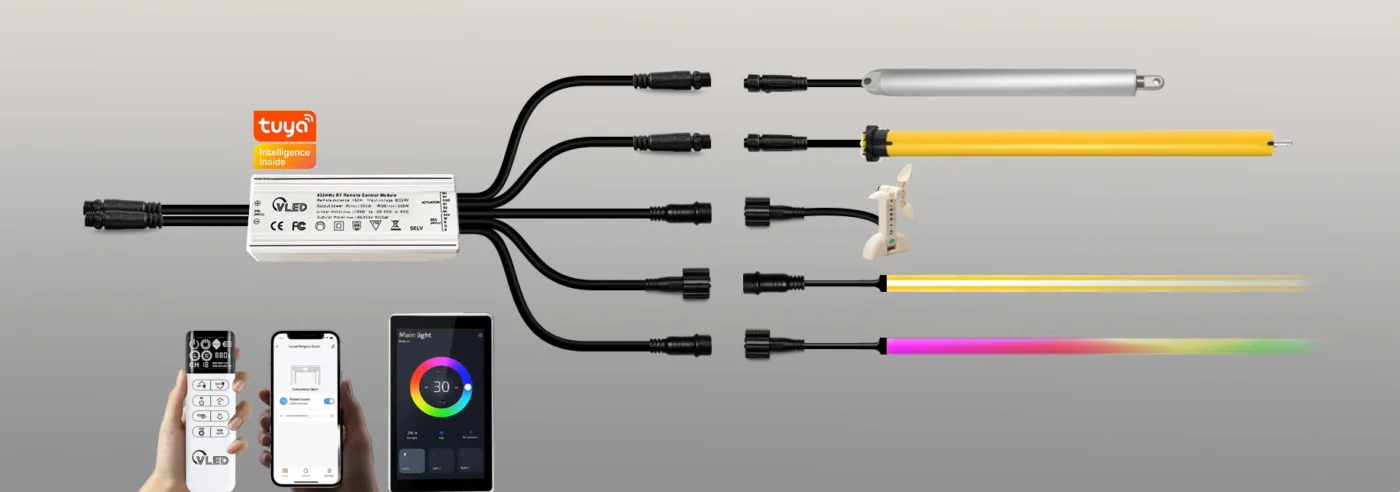
1. Absolute Physical Integration — 4-in-1 Architecture
PERGO Pro breaks the physical boundaries between subsystems, compressing four core functions onto a single compact control motherboard:
Linear Motor High-Precision Control
Drives louvre rotation with millisecond-level response and precise positioning capability.
Monochromatic Lighting Digital Control
Manages the on/off and ultra-low brightness dimming of the primary ambient lighting system.
RGB Accent Lighting Engine
Unified management of accent strip color mapping, saturation, and dynamic transition effects.
Environmental Sensor Direct Interface
Native support for rain and wind sensors, achieving millisecond-level hardware interrupts and automated response.
This plug-and-play design paradigm dramatically reduces the number of external terminal connections. All logic decisions and command processing are completed at the motherboard level, completely eliminating system lockups caused by external cable cross-talk or communication protocol mismatches.
2. Revolutionary Motor Travel Limit Programming
Directly addressing the industry pain point of easily burned-out actuators, PERGO Pro introduces a precise electronic virtual travel limit function. During initial on-site commissioning, the installation engineer simply enters a dedicated position setting mode via the remote control, manually driving the motor to the physical boundaries of “Fully Extended” and “Fully Retracted.” The system then precisely records the Hall-effect sensor values or current thresholds at those positions.
Once set, the motor will strictly observe these virtual physical limits during every subsequent daily operation. Even if the user holds down a button, the system proactively cuts power before reaching the boundary — fundamentally eliminating the risk of mechanical impact and overload board failure, extending the motor’s service life to its physical maximum.
3. 16-Channel Concurrent Control and Channel 0 Matrix Group Management
In large multi-module pergola projects — such as an outdoor terrace at a commercial restaurant — single-point control and global synchronization across multiple independent matrices is a rigid, non-negotiable requirement. PERGO Pro provides a powerful 16-channel management system.
The operational logic is engineered for precision and engineering intuition: engineers can safely lock or unlock selected group channels via specific remote control button combinations (such as holding buttons C and H for 3 seconds). More powerfully, when the operator switches to the special Channel 0 mode, the system activates supreme authority group control mode — supporting simultaneous control of up to 15 channels. A single command — such as “switch all to warm white” or “close all louvres” — is instantly broadcast to all paired receivers via the underlying RF protocol. This zero-delay synchronization delivers a theater-quality audio-visual experience for end users.
4. Eliminating Technical Debt — Forward-Compatible Expansion Interfaces
A best-in-class hardware architecture not only solves today’s known pain points — it reserves ample redundancy for five years of product evolution. Leading controller architectures now pre-integrate interfaces for 1-to-4 channel tubular motors (for perimeter wind-blocking roller blinds), full-spectrum RGBW/RGBCW lighting, and smartphone app direct control modules. For extreme climate regions, the system also supports command dispatch for infrared heaters, outdoor ceiling fans, and Bluetooth audio systems. This means manufacturers who select and maintain this unified electrical control platform at the R&D stage can flexibly configure options for end clients — or add accessories years later with no disruption — greatly simplifying supply chain and inventory management.
Crossing the Regulatory Barrier — NEC and European CE Compliance Design in Depth
In global trade, no matter how impressive a control system performs in the laboratory, if it fails to fully meet the mandatory electrical regulations of the target export market, the product faces customs detention, municipal permit rejection, or worse — a catastrophic liability fire. Pergola manufacturers must embed compliance into the R&D process at the very first stages of structural design and electrical component selection.
1. North American Market — NEC Regulations, the Class 2 Golden Rule, and Voltage Drop Management
In the United States and Canada, the National Electrical Code (NEC, officially defined under NFPA 70) contains extremely detailed provisions for outdoor low-voltage electrical systems. For louvered pergola lighting control systems, the most critical regulations are NEC Article 411 (governing low-voltage lighting systems operating at 30 volts or below) and Article 725 (defining Class 2 and Class 3 remote-control, signaling, and power-limited circuits).
Class 2 Power System — Strategic Compliance Value
Under the strict provisions of NEC Article 725, a Class 2 power supply is limited to a maximum output of 60V DC (typically 12V or 24V commercially), a maximum current not exceeding 4 amperes, and a maximum output power not exceeding 100 watts (or 100 VA). The reason North America mandates the Class 2 standard is that such circuits are physically designed to be inherently safe against electric shock and fire. Systems using a Class 2 certified power supply therefore enjoy significant policy exemptions — typically no expensive and difficult-to-install metal conduit is required for wire protection, and in many local Authority Having Jurisdiction (AHJ) areas, work can be performed by non-licensed installers, and some permit requirements may be waived. For pergola manufacturers, this means a dramatic reduction in end installation costs.
The engineering golden rule for thermal safety: the continuous load on a power supply should never exceed 80% of its rated capacity. If a pergola’s total LED load is calculated at 65W, multiply by a safety factor of 1.25 to get 81.25W — therefore the circuit must be fitted with a 100W Class 2 power supply as standard.
Voltage Drop Engineering — The Calculation Baseline
In large or extended pergola projects, the critical physical weakness of DC low-voltage transmission is voltage drop. If the main supply cable run is too long or the wire gauge too thin, strip lights at the far end will exhibit severe brightness attenuation and color shift. Ensuring that end-point voltage drop does not exceed 3% is the engineering baseline for maintaining illuminance consistency.
Consider a typical North American 24V system with a single-side lead run of 40 feet, an end load of 80W (calculated current approximately 3.33A), using 16 AWG cable (resistance approximately 0.004 ohms/ft):
Pool-Adjacent Special Provisions — NEC Article 680
If a pergola is planned for installation near a swimming pool, NEC Article 680 imposes significantly stricter limits. Based on distance from the water’s edge, zones are defined as Zone A (0–5 feet), Zone B (5–10 feet), and Zone C (beyond 10 feet). Within the 5-foot Zone A, no line-voltage equipment whatsoever may be installed; low-voltage lighting must also satisfy extreme constraints, and all metal framing — including pergola columns — must be bonded with strict equipotential bonding to guard against step potential hazards.
2. European Market — CE Marking, EN 60598 Safety Standards, and Thermal Challenges
For manufacturers targeting the European Union and European Economic Area (EEA), the CE mark is a non-negotiable legal baseline. What must be clarified for engineering teams is that CE is not a quality rating — it is a manufacturer’s mandatory legal declaration that the product complies with relevant EU directives, such as the Low Voltage Directive (LVD 2014/35/EU) and the RoHS Restriction of Hazardous Substances Directive.
For pergola lighting and control equipment integration, the most critical reference standard is EN 60598-1 (equivalent to IEC 60598-1), which prescribes in meticulous detail the electrical clearances, mechanical strength, and thermal safety requirements for luminaires and integrated electronic devices.
Extreme Thermal Safety Challenges
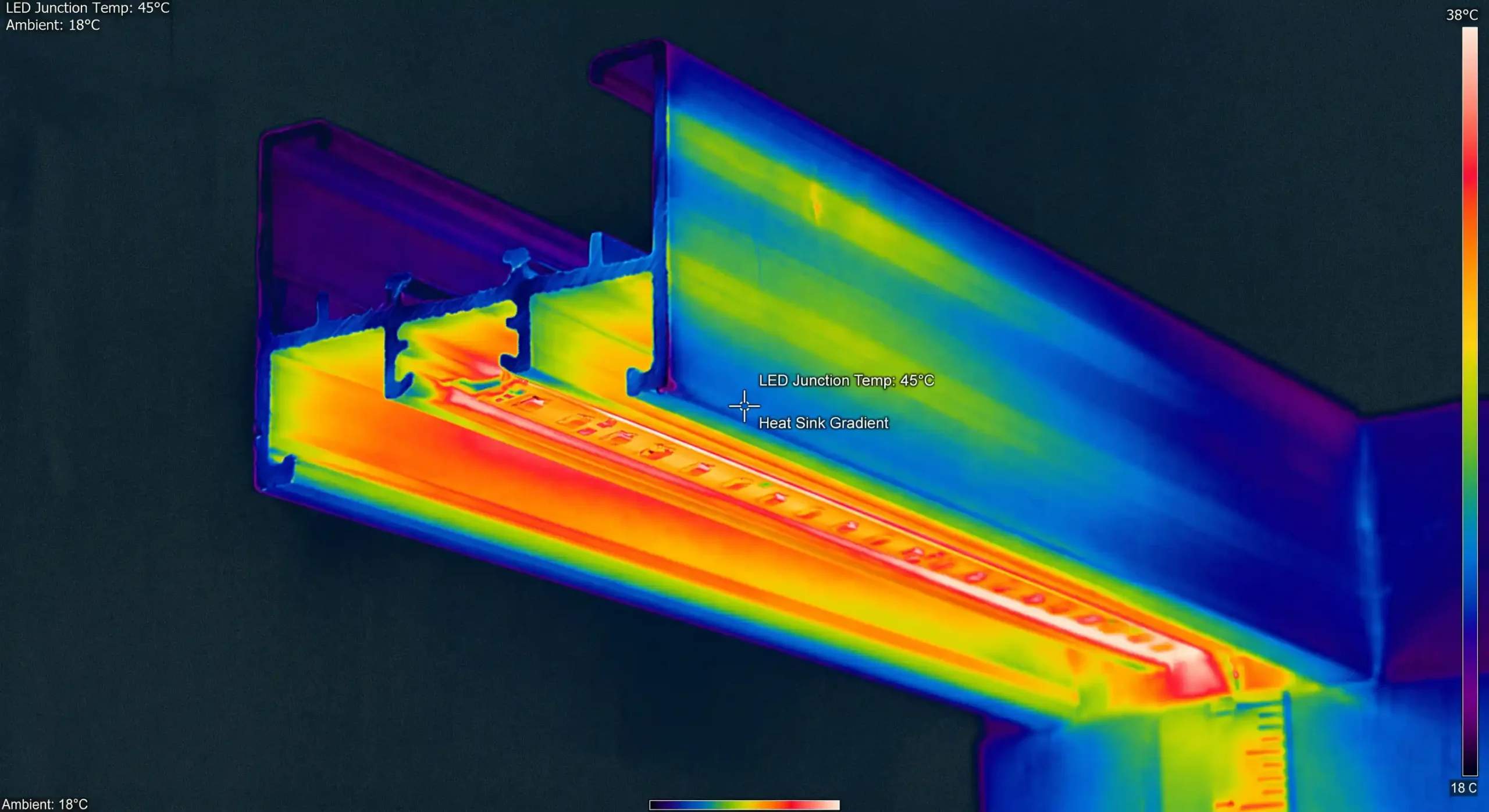
Due to sustained high summer temperatures across Europe, and because pergolas are typically exposed to unobstructed direct sunlight, dark powder-coated aluminum framing can easily exceed 70°C internally on an afternoon. Although aluminum extrusion itself is an excellent heat sink, closely enclosing high-power LED strips and control boards in a raceway with no convective airflow creates serious thermal safety challenges. Rigorous thermal cycling testing is essential to ensure that cable insulation and controller housings do not melt or degrade under sustained heat, which could cause a catastrophic short-circuit fire.
Additionally, any optical or control module installed inside gutter systems or atop columns must carry at minimum an IP65 (protection against sustained low-pressure water jets) or IP67 (protection against temporary full immersion) rating, using materials resistant to strong UV and chemical corrosion — such as marine-grade 316 stainless steel or high-specification powder-coated aluminum alloy.
| Market Region | Core Regulations and Standards | Key Technical Limitations | Manufacturer Best Practices |
|---|---|---|---|
| North America (US/CAN) | NEC Article 411 / 725, NEC 680, UL 8750 | Class 2 power supply mandatory (<100W, ≤30V) to waive conduit; strict end-point voltage drop management (<3%) | Provide pre-calculated AWG gauge / distance matrix in installation manual; supply complete system with UL-listed power supply and IP67 waterproof connectors |
| Europe (EU/EEA) | CE Mark, EN 60598-1, RoHS, LVD 2014/35/EU | Extreme enclosed-space thermal safety limits; elimination of hexavalent chromium and other hazardous substances; EMC electromagnetic compatibility constraints | Invest in third-party independent test reports (e.g., ENEC certification) to dramatically strengthen bids for municipal projects; ensure sufficient thermal convection channels are reserved within aluminum extrusions |
Light Pollution Control and Sustainability — Embracing DarkSky Global Design Standards
In today’s era of rising global environmental awareness, light pollution has become a significant obstacle to municipal planning approval for premium outdoor development projects. Uncontrolled glare, light trespass invading neighbors’ bedrooms, and skyglow obliterating the starscape not only disrupt local ecosystems’ natural rhythms — medical research has proven they severely impair human nocturnal melatonin secretion and sleep health. To align with this irreversible policy trend, top-tier pergola manufacturers must integrate DarkSky International principles into product definition from the outset.
According to the five principles of responsible outdoor lighting officially established by DarkSky, any outdoor lighting system must achieve the following at both the physical and software levels:
- UsefulEvery beam of artificial light must serve a clear functional purpose.
- TargetedLight should be precisely directed only where needed — never allowed to spill beyond its intended area.
- Low LevelBrightness must never exceed the minimum visual requirement necessary to maintain safety.
- ControlledActivated only when human activity is detected — through deeply integrated motion sensors or timers.
- Warm-ColoredWarm light must be used wherever possible; short-wavelength blue-violet light emission must be strictly limited.
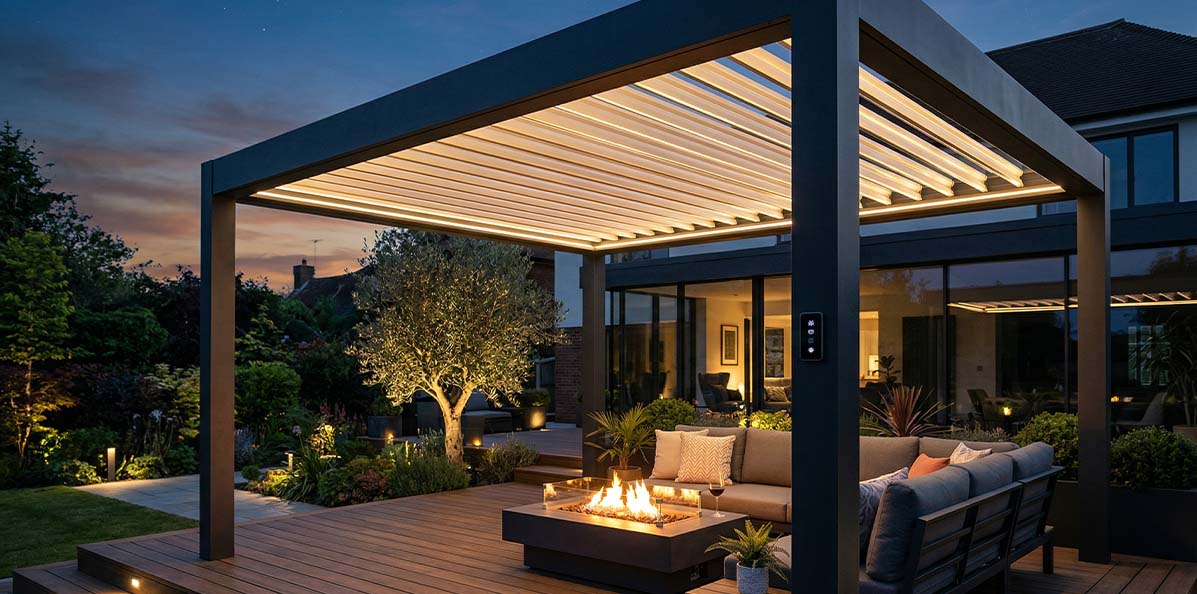
In practical optical engineering for pergolas, this means manufacturers must completely abandon traditional outward-facing wall sconces or cheap unshielded light emitters. The replacement is downward-facing fixtures with deep physical shielding angles, ensuring all generated light is forced below the horizontal plane (90 degrees) toward the lowest point (nadir) — achieving a truly “fully shielded” design with uplight controlled to 0.5% or ideally 0%.
On the supply chain side, manufacturers procuring LED chips or strips should establish a hard specification: the maximum correlated color temperature (CCT) must not exceed 3000K. Amber or warm white light between 1800K and 3000K physically minimizes Rayleigh scattering in the atmosphere and reduces lethal interference with phototactic wildlife — sea turtles, migratory birds, and others.
The Art of Structural Integration — Engineering Practice from Digital Blueprint to On-Site Installation
A truly industrial-grade lighting and control system cannot be an afterthought bolted on after the fact. It must integrate seamlessly and elegantly into the pergola’s minimalist architectural lines. This demands that manufacturers complete the upfront electrical architecture planning at the very beginning of aluminum extrusion die design — and even introduces augmented reality (AR) technology for digital twin simulation.
1. Structural Raceway Systems — Chassis-Level Design
A defining visual characteristic of premium custom pergolas — market references like the Pergola X or Evolve series — is that the user sees absolutely no exposed cables, cable ties, or rough weatherproof junction boxes. Column and beam internal structures must feature dedicated, isolated raceways so that the control system’s low-voltage data cables, AC mains cables, and even high-pressure mist lines are physically separated from each other and completely concealed.
During final system assembly, comprehensive use of IP67 waterproof quick-connect fittings with fool-proof keying ensures that on-site construction teams can achieve absolutely safe, leak-proof connections without specialized electrician’s stripping tools — dramatically reducing quality risk from variability in worker skill levels.
2. Physical Embedding of Optical Kits and Seamless Wall Washing
For perimeter LED strip lights providing primary ambient light, a dedicated reverse-hook channel should be reserved on the underside of aluminum gutter systems, combined with UV-resistant frosted polycarbonate diffuser lenses. This not only eliminates the cheap, visually unpleasant “dot effect” of bare LED chips through diffuse reflection — it delivers an exceptionally uniform wash of light along the pergola’s interior surfaces.
For spotlight arrays or micro recessed lights, these can be seamlessly integrated directly into individual louvre blades or pre-punched positions in the central primary beam. Pre-completing precision wire harness bundling and routing in the factory significantly reduces on-site construction time in the end customer’s garden, enhancing the brand’s professional image.
3. Hardware-Level Closed Loop for Environmental Adaptation
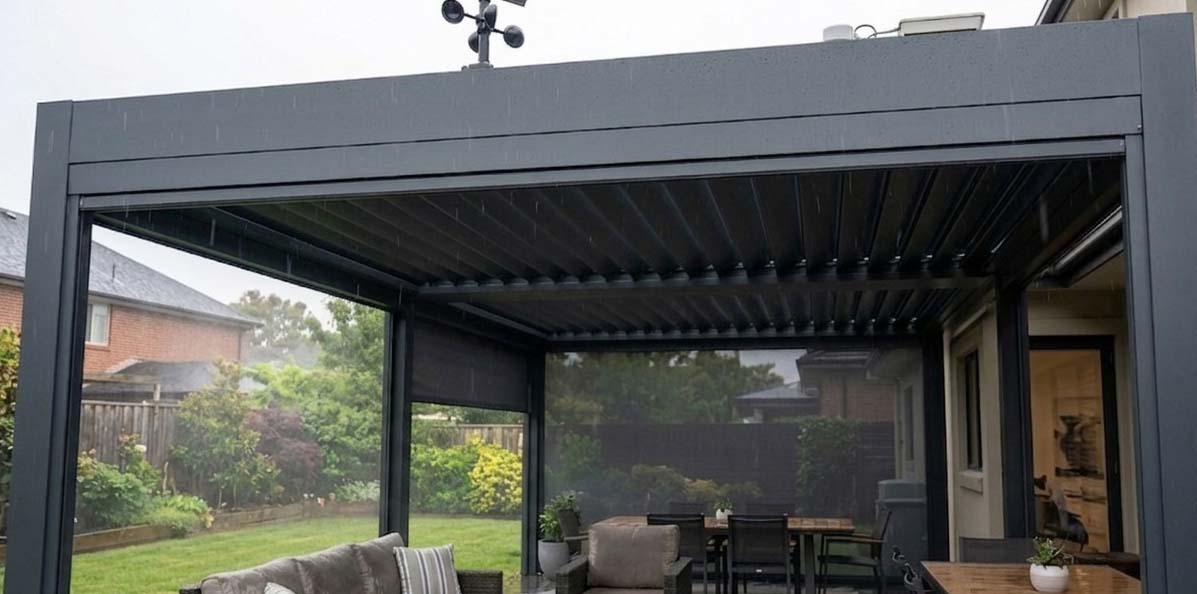
Premium pergolas are exposed to extreme natural weather year-round. The highest expression of their intelligence is not remote control via a smartphone app — it is the system’s underlying “passive defense mechanism.” After connecting a high-precision rain sensor and anemometer to the integrated controller, the underlying system code must have absolute logic priority judgment. For example, when the roof anemometer detects a gust instantaneously exceeding a safety threshold (such as 75 mph), the controller’s base logic immediately overrides the current lighting state or any manual user input, instantly releases the clutch, and drives the linear actuators to open the louvres to the optimal aerodynamic pressure-relief angle — preventing the entire metal structure from being overturned by the wind. When the rain sensor detects the first drop of rain, the louvres immediately close to seal out water, simultaneously triggering 3000K warm-toned lighting — automatically creating a warm, dry outdoor sanctuary for the user as the storm approaches.
4. Frontier Exploration — AR Algorithms for Order and Material Optimization
Before entering production, leading manufacturers have begun deploying AR applications such as HoloLens. Through sophisticated cutting stock algorithms, sales personnel can generate a 1:1 full-scale three-dimensional holographic pergola model in the client’s backyard. The system can simulate the real appearance of lighting at night, and instantly calculate required aluminum lengths, screw quantities, and appropriate control cable lengths. This not only allows clients to see exactly what they will get — it has been shown to reduce return rates from dimensional discrepancies by 55%. This digital chain extending from the sales stage through to the control stage is defining the operating standard for the next generation of pergola manufacturers.
Conclusion and Action Plan — Control Is Market Pricing Power
In the increasingly competitive European and American louvered pergola market, simply piling on aluminum thickness, boasting about coating quality, or emphasizing physical dimensions can no longer build any meaningful competitive moat for a brand. The core premium in the market going forward is, without dispute, determined by the underlying fluidity of the system ecosystem and the level of intelligent software-hardware integration.
For too long, fragmented electrical components and compromised patchwork control have burdened pergola manufacturers with enormous R&D trial-and-error costs and endless after-sales warranty obligations. Now, the industry’s paradigm shift has arrived. Integrated architecture not only eliminates installation nightmares through precision mechanical protection (electronic travel limits preventing motor burnout) and a simplified implementation approach (single-box centralized dispatch eliminating wiring chaos) — it also elevates outdoor shading products into serious pillars of the premium smart home ecosystem through industrial-grade RGB dynamic color rendering, multi-channel zero-latency synchronized group control, and a compliance design fully aligned with NEC and CE electrical standards.
Transitioning from maintaining the status quo of fragmented sourcing to embracing a deeply integrated, all-in-one control solution is no longer an optional upgrade for manufacturers. It is the strategic necessity that determines a brand’s survival in the premium market. Command the core control hub and lighting system, and you will hold the ultimate market pricing power in the global outdoor living revolution.

Envíenos su solicitud