


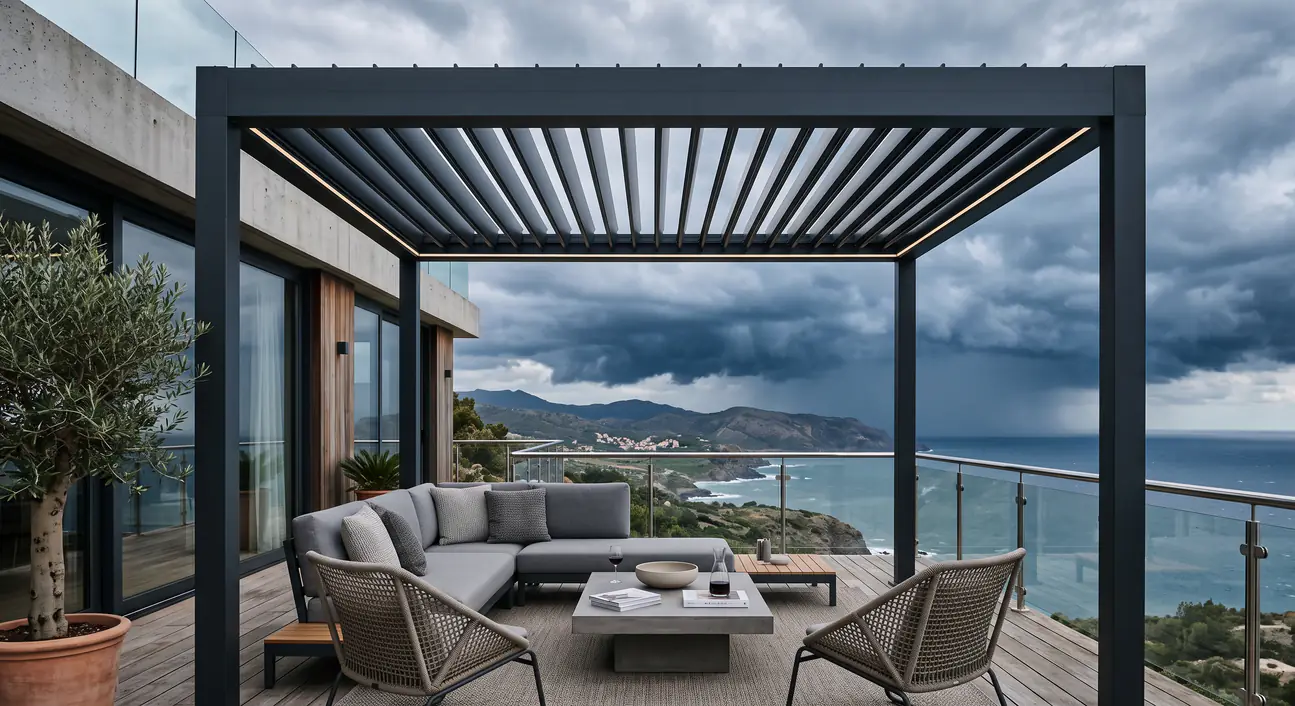
In today’s premium outdoor living and architectural shading markets in Europe and North America, the bioclimatic pergola has evolved from a simple physical shade structure into an intelligent micro-architectural system that actively responds to climate change. For high-end motorized pergolas that often cost from USD 10,000 to USD 60,000, end users are no longer buying aluminum profiles alone — they are buying an all-weather outdoor lifestyle that feels seamless. When a sudden shower arrives, the system must react accurately within seconds and drive the motor to close the louvers perfectly, protecting the outdoor kitchen, expensive upholstered furniture, and premium electronics beneath the pergola.
In real after-sales data and project feedback, however, rain sensor reliability remains one of the biggest pain points for pergola manufacturers. False alarms can cause louvers to close for no reason on clear but humid mornings. Missed detection or delayed response can ruin a customer’s outdoor party. In wind, rain, snow, or severe cold, conflicting control logic can even burn out motors or allow strong wind to tear the pergola structure apart. As a professional manufacturer of pergola lighting and control systems, we believe reliable louver closure in rain is not achieved by simply adding a weather probe that costs a few dozen dollars. It requires a deep system-level redesign across the physical detection principles of the sensor, the stability mechanism of the underlying communication protocol, the extreme-weather priority logic of the main control board, and the weather-resistant engineering of the mechanical structure. This report provides pergola manufacturers in Europe and North America with a detailed automation architecture guide, showing how to build a truly robust climate response system through close integration of hardware and software.
The Physics of Rain Detection: Capacitive and Optical Sensor Logic
In an automation ecosystem, the rain sensor acts as the tactile nerve that detects weather outside. Industrial and commercial rain probes on the market are mainly based on two technical paths: capacitive/resistive detection and optical detection. Manufacturers must understand the strengths and limitations of these physical mechanisms in depth before specifying the right hardware for customers in different climate zones.
Dielectric Constant Analysis in Capacitive Sensors
Capacitive sensors work by using the large difference between the dielectric constants of water and air. When rain, snow, or high-humidity moisture adheres to the conductive array on the sensor surface, the capacitance between the plates changes significantly. The microcontroller then outputs a rain signal. In this field, the Ondeis sensor launched by Somfy is a benchmark product.
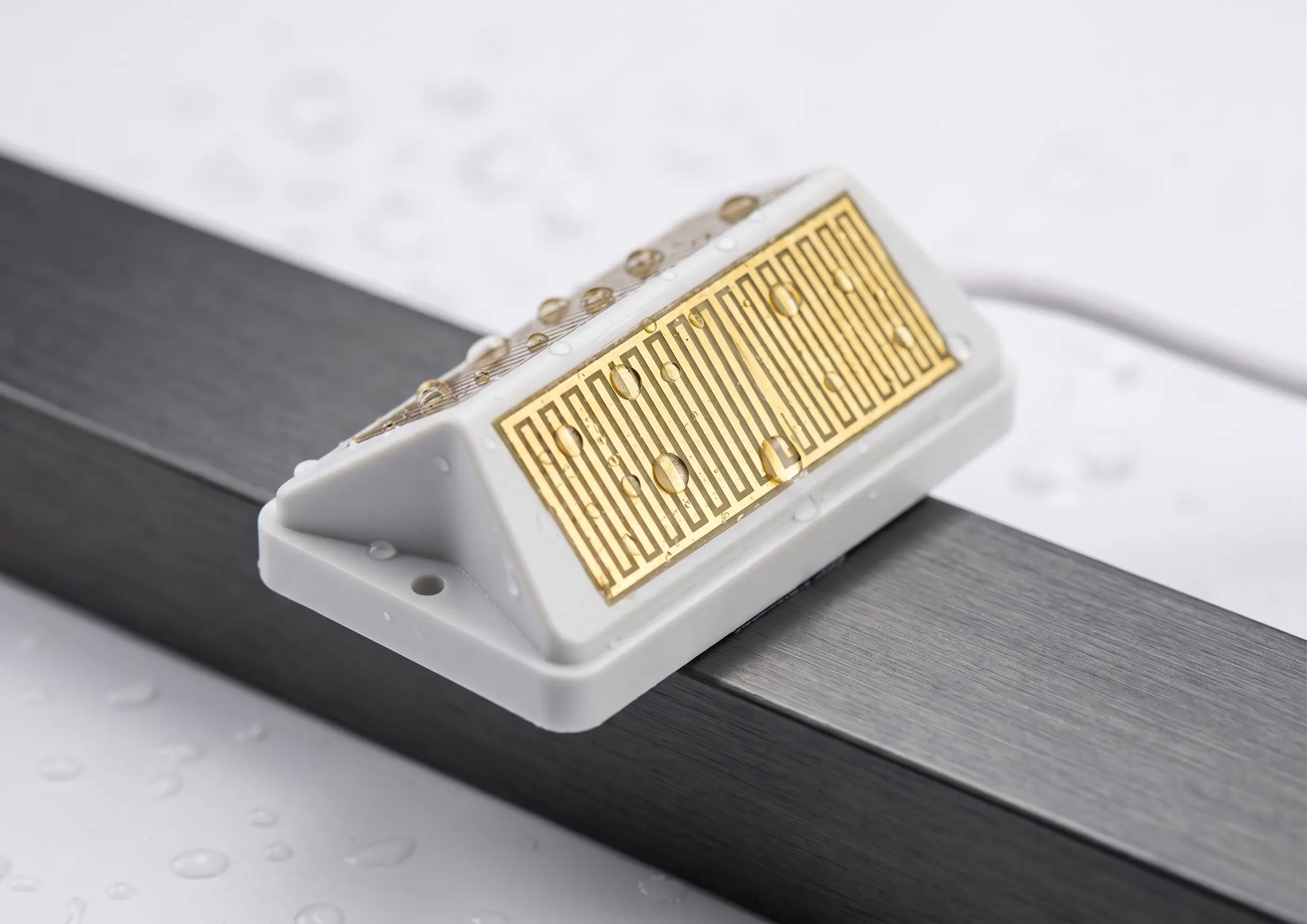
Capacitive technology has an irreplaceable advantage in high-latitude Europe and cold regions of North America. Its core strength is excellent thermal management. Taking the Ondeis 24V DC probe as an example, it integrates a self-regulating PTC heating element with maximum peak power up to 4 W. This high-power heating mechanism gives the sensor two major advantages. First, after rain stops, the heater quickly evaporates surface moisture, preventing the system from judging the weather as rainy for too long and allowing the pergola to reopen the louvers promptly to restore daylight. Second, during winter snow or frost, the heating function can melt ice and snow effectively, giving it part of the role of a snow-load sensor. This is important for preventing accumulated snow from crushing the pergola. In addition, to withstand harsh outdoor corrosion, premium capacitive probes usually cover their conductive strips with a special anti-oxidation foil and use UV-resistant PC/ABS housing materials to ensure years of service life.
However, capacitive probes also have clear physical limitations. Because they rely entirely on dielectric changes at the surface, any debris attached to the sensor — such as autumn leaves, bird droppings, dust, or even humid salt-rich sea breeze in coastal areas — can change the baseline capacitance. This persistent interference can easily cause the system to misinterpret humidity or dirt as rainfall, leading to frequent unintended louver movement. This means manufacturers must require regular surface cleaning in the manual, increasing maintenance cost for the end user.
Total Reflection and Infrared Scattering in Optical Sensors
To overcome the contamination sensitivity of capacitive probes, optical rain sensors provide a very different solution. Optical sensors use infrared total internal reflection and scattering. Typical representatives include the RG-11 and RG-9 series from Hydreon in the United States.
The RG-11 sensor looks like a transparent tennis ball, and its detection mechanism is fully optical rather than mechanical or conductive. A transmitter inside the probe emits infrared beams. These beams undergo total internal reflection along the inner wall of the transparent hemispherical lens. When the outside environment is dry, the receiver receives a light signal of constant intensity. When the first raindrop hits the outer surface of the lens, the droplet breaks the total reflection condition and causes part of the infrared beam to escape into air or water. The internal detector captures the instant drop in light intensity and, together with advanced digital signal processing (DSP), can not only determine that rain has started immediately but also detect small droplets and filter out ambient light interference.
The revolutionary advantages of the optical system are very fast first-rain response and strong interference resistance. A single raindrop can trigger relay action, meaning that during the first few seconds of a downpour, the pergola can close the louvers before outdoor furniture gets wet. Because there are no exposed metal conductive parts, the optical probe is immune to false dielectric-change alarms caused by dust, spider webs, and leaves, delivering a truly maintenance-free promise. For power management, the RG-11 can activate micro-power sleep mode through DIP switch 8 (SW8). In this state, standby current is only 1.5 mA, which makes it an excellent choice for remote pergola systems or independent solar-powered installations.
Optical sensors are not without weaknesses. Their greatest challenge is adaptation to extreme cold. Although the RG-11 also includes a tiny 0.25 W heater to prevent light condensation, this very small power level is insufficient for heavy snow or severe icing. Once the transparent lens is covered or frozen by ice and snow, the light beam will scatter continuously, causing the probe to fail completely or output incorrect signals for a long time. Therefore, in regions with long and severe winters, such as Northern Europe or Canada, relying only on an optical sensor creates significant system risk.
Weather Sensor Selection and Application Environment Comparison
To help pergola manufacturers choose technology more intuitively, the following table compares the performance of the two core sensor technologies across key dimensions:
| Evaluation Dimension | Capacitive/Resistive Sensor (e.g. Somfy Ondeis) | Optical Infrared Sensor (e.g. Hydreon RG-11) | Manufacturer Selection Recommendation |
|---|---|---|---|
| Basic detection principle | Detects moisture through changes in dielectric constant between plates. | Detects droplets through disrupted infrared total reflection and scattering. | Match the sensor to the climate characteristics of the target market. |
| First-rain trigger sensitivity | Medium. It usually requires enough rainwater to cover multiple electrodes before capacitance changes. | Very high. A single 0.5 mm raindrop can trigger action through optical refraction. | In subtropical or tropical climates with frequent downpours, prioritize optical sensors for second-level response. |
| Snow melting and frost prevention | Excellent. A self-regulating PTC thermistor up to 4 W can quickly melt ice and snow. | Weak. Only 0.25 W auxiliary heating is available, and the lens can freeze easily in severe cold. | In high-latitude cold regions where snow-load collapse prevention matters, capacitive sensors should be standard. |
| Environmental contamination resistance | Weak. Leaves, dust, and salt-fog deposits can change baseline capacitance and cause false alarms. | Very strong. DSP algorithms can compensate for lens aging and dirt interference, enabling true low maintenance. | In coastal high-salt areas or heavily wooded locations, optical sensors can greatly reduce after-sales complaints. |
| Power consumption and supply requirements | Higher. Current rises sharply during heating and usually requires stable 24V DC or 230V AC wired supply. | Very low. Supports 1.5 mA deep sleep mode, suitable for battery or solar systems. | For freestanding pergolas or retrofit markets, solar-powered optical solutions are suitable. |
The analysis shows that no single sensor can perfectly adapt to all weather conditions worldwide. Forward-looking pergola control system manufacturers should abandon the idea of one universal sensor and instead offer modular sensor kit combinations. For example, a flagship bioclimatic pergola shipped globally can use a dual-redundant design of optical rain probe plus independent temperature probe. This ensures rapid response during summer downpours while also maintaining safe operation in winter freezing conditions.
Transmitting the Nerve Signal: Motor Communication Protocols and Smart Home Integration
If the rain sensor is the tactile nerve that senses external weather, the motor communication protocol is the neural pathway that sends central commands to the muscles — meaning the drive system. In severe weather with strong wind and thunderstorms, signal loss, delay, or interference is a direct cause of pergolas failing to close in time and generating expensive claims. Across the industry, pergola automation protocols are undergoing a major shift from one-way RF to two-way mesh networks and then to professional bus architecture.
The Strengths and Limits of One-Way RF: RTS Protocol
RTS (Radio Technology Somfy) is one of the most widely used proprietary radio protocols in the global shading industry, operating at 433.42 MHz. RTS undeniably helped popularize motorized shading products because of its strong penetration, very low deployment cost, and ability to avoid complex wiring. For example, a pergola equipped with an Ondeis WireFree RTS solar wireless sensor can deploy and pair the weather probe within minutes.
In the smart home era, however, the technical limitations of RTS are magnified. RTS is a typical unidirectional protocol. This means that after a sensor or remote sends a command such as “close the louvers because it is raining,” the transmitter cannot know whether the pergola motor actually received the signal and completed the closing action. If radio interference exists on the same frequency band — such as from old garage-door remotes or some amateur radio equipment — or if the signal is blocked by thick walls, the command may be lost while both the system and the user remain unaware. For a rain-protection pergola responsible for protecting assets worth tens of thousands of dollars, the lack of status feedback is an unacceptable safety blind spot.
The Rise of Two-Way Communication: io-homecontrol and Zigbee 3.0
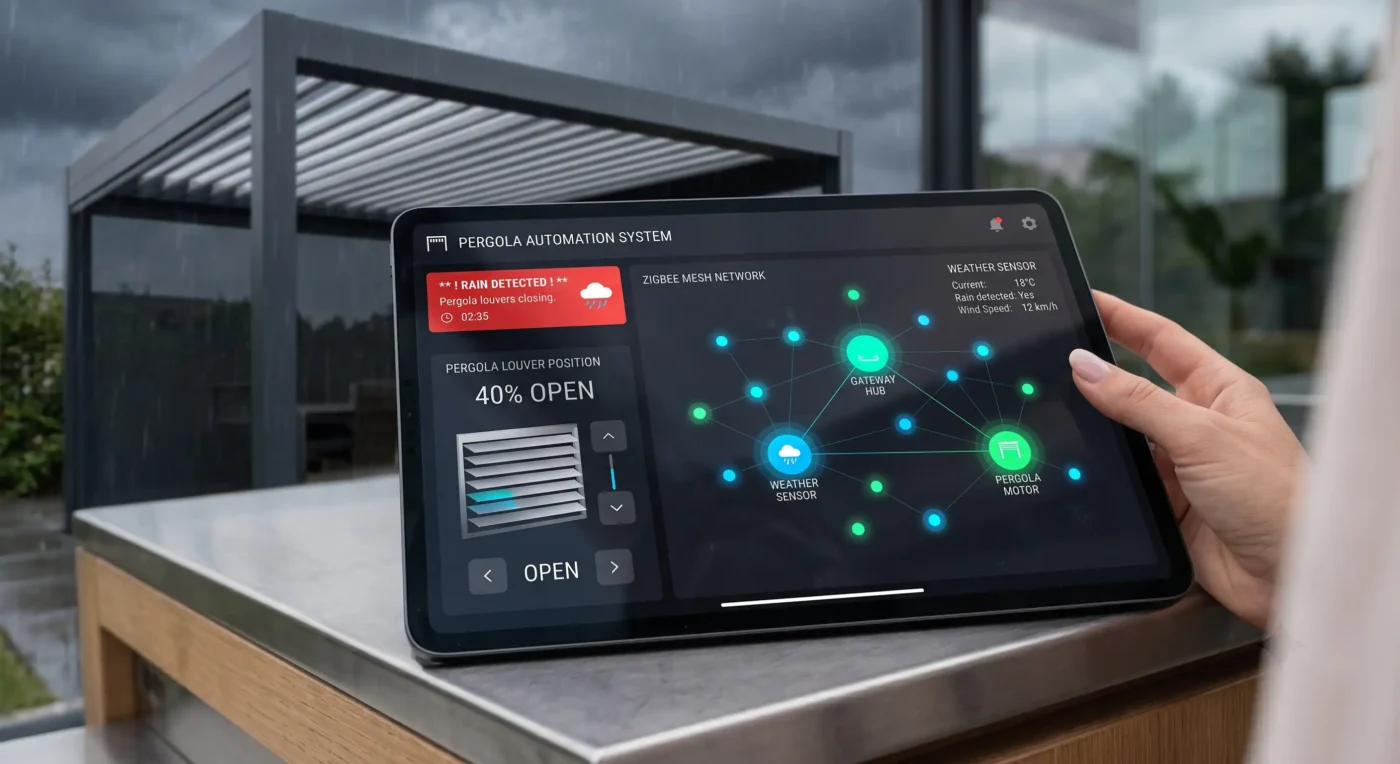
To eliminate the blind spots of one-way control, several major European building equipment companies jointly introduced the io-homecontrol two-way wireless protocol operating at 868.95 MHz, while the North American market widely adopted Zigbee based on the IEEE 802.15.4 standard.
These bidirectional protocols bring a qualitative leap to pergola automation. The motor is no longer a silent device — it becomes an intelligent node with feedback capability. After the rain sensor triggers a closing command, the pergola motor reports its real-time position continuously to the upper gateway (such as TaHoma Switch) while executing the movement. It then sends a confirmation receipt after the louvers are fully closed and locked. This confirmation mechanism not only lets the user see through a smartphone app (such as Renson Connect) that the pergola is in a waterproof state while away from home — it also enables the control host to trigger retransmission or an alarm when confirmation fails. In addition, both protocols use strong encrypted key distribution mechanisms, preventing replay attacks from external malicious radio signals and protecting the perimeter security of the home.
Premium Commercial and Luxury Residential Integration: KNX Building Bus Standard
When the application scenario rises to luxury villas, Michelin restaurant terraces, or large commercial districts, even advanced wireless protocols cannot match the interference resistance of physical hardwiring. At this point, KNX (Konnex) — the world’s only open standard for home and building control — becomes a strategic high ground that pergola manufacturers must master.
KNX systems truly integrate the pergola into the building’s living infrastructure. Through an Overkiz customized TaHoma DIN Rail gateway or an advanced Noval control cabinet, the pergola is no longer an isolated shading product — it becomes an actuator on the KNX bus. Imagine a commercial automation scenario: when the precision KNX weather station on the roof detects heavy rain, it triggers the pergola’s 24V DC motor through the wired bus with zero delay to close the louvers. At the same time, through preset macros or routines, it links the indoor systems: closing floor-to-ceiling curtains to prevent rain glare, increasing the brightness of RGB ambient lighting under the pergola, turning on infrared heaters such as Bromic heating equipment, and synchronizing status updates on Apple HomeKit and Loxone platforms. This cross-device system-level coordination, together with extremely high reliability and minimal maintenance, is the premium value space that KNX — with roughly 70% share of European building automation — offers to pergola manufacturers. As the Matter protocol and Thread edge network led by the CSA (Connectivity Standards Alliance) mature, pergola control boards must reserve hardware-level interfaces for IP-based communication to prepare for the era of seamless whole-home smart interoperability.
Intelligence at the Control Hub: Weather Conflicts and the Priority Matrix
Outdoor weather is unpredictable, which means the control system often receives more than one weather signal at the same time. If, during a late-autumn cold front, the system receives alarms for strong wind, heavy rain, and freezing temperature simultaneously, which sensor should the control board obey? If a pergola’s logic remains as simple as “close when it rains,” the damage it causes in extreme weather can far outweigh the convenience it provides.
The essence of a professional pergola control core — such as Noval’s Modulo or Compact series and Somfy’s Pergola Tilt io control unit — lies in a non-negotiable weather priority matrix implemented through hardware and software. During factory programming, pergola manufacturers must place safety above comfort.
Priority 1 — Absolute Highest
Structural Safety and Wind Load Protection
Wind is the number-one destroyer of large outdoor structures. When the louvers are fully closed at 0 degrees, the entire pergola roof becomes a huge wing. As strong wind passes over it, the structure can experience enormous aerodynamic uplift force and structural shear force.
For this reason, commands from the anemometer have the highest system priority above all others. When detected wind speed exceeds the safe threshold defined by the pergola’s structural engineering — usually set between 35 mph and 60 mph depending on the tensile strength of the installation foundation — the control board must force an emergency protection sequence. The motor ignores all other commands and drives every louver to the angle with the smallest wind-facing surface, usually a fully vertical 90 degrees or a specific angle aligned with the wind direction. This allows strong wind to pass through the pergola with minimal obstruction and greatly reduces stress on posts and anchor bolts. At this point, even if heavy rain is falling, the system must refuse any attempt to close the louvers for rain protection. Compared with a wet outdoor sofa, a pergola worth tens of thousands of dollars being ripped from its foundation and thrown into the main building is the catastrophic event that must be prevented.
Priority 2 — Secondary Safety
Snow and Freeze Protection
After destructive wind risk has been ruled out, the second line of defense is low temperature and solid precipitation. When a rain sensor with integrated temperature detection finds that ambient temperature has dropped below freezing (0°C / 32°F) and moisture is present, the system should classify the condition as snow or freezing rain.
In this climate, keeping the louvers tightly closed can create two fatal consequences. First, heavy snow accumulates quickly. In Colorado or Canada, snow load can easily exceed 60 psf, pushing aluminum beams into permanent deformation. Second, EPDM rubber seals along the louver edges can freeze and stick together as low-temperature moisture condenses. If the user mistakenly triggers the motor at this point and forces frozen louvers apart, the drive linkage may break or the motor may burn out. Therefore, when a frost alarm is triggered, the control logic must automatically open the louvers slightly into a frost position. This breaks physical contact between seals and allows snow to slide through the gaps. This is also why controllers such as Somfy’s include DIP switch 4 specifically for activating the temperature sensor.
Priority 3 — Everyday Protection
Rain Closing Logic
Only under normal weather conditions — when there is no danger of wind damage and no freezing or jamming risk — should the system hand control back to the rain sensor. At that point, once the sensor detects precipitation, it immediately instructs the motor to rotate the louvers smoothly from any open angle and lock them at the fully closed 0-degree position within a very short 10- to 15-second window. The open terrace is instantly transformed into a waterproof outdoor room.
Priority 4 — Comfort Adjustment
Sun Tracking and Glare Control
At the bottom of the priority hierarchy is the sun sensor. Under normal calm weather, the system adjusts the louver tilt angle automatically — such as 45 degrees or 135 degrees — based on solar altitude and light intensity. This uses the chimney effect of rising warm air to support natural ventilation and cooling while blocking harsh direct glare. Any sudden signal from wind, snow, or rain can interrupt and override this everyday comfort control at any time.
Mechanical Engineering Under Extreme Pressure: Hardware Tested by Downpour, Cold, and Strong Wind
Even with the most sensitive optical sensor, the safest two-way encrypted protocol, and the most carefully designed priority matrix, all intelligence becomes meaningless if the motor stalls from insufficient torque during wind and rain or if the roof leaks severely because of design defects. The reliability of a motorized louvered pergola must ultimately be supported by mechanical engineering and material science.
Redefining Waterproofing: From Leak Prevention to Systematic Watershed Design
In pergola marketing, the term “100% waterproof” is often overused. In rigorous architectural engineering, absolute waterproofing means a fully sealed structure that can withstand hydrostatic pressure like a submarine. The design philosophy of a premium bioclimatic pergola is actually efficient watershed management. Its core is to intercept and guide rainwater in an organized way through precise fluid-dynamics design.
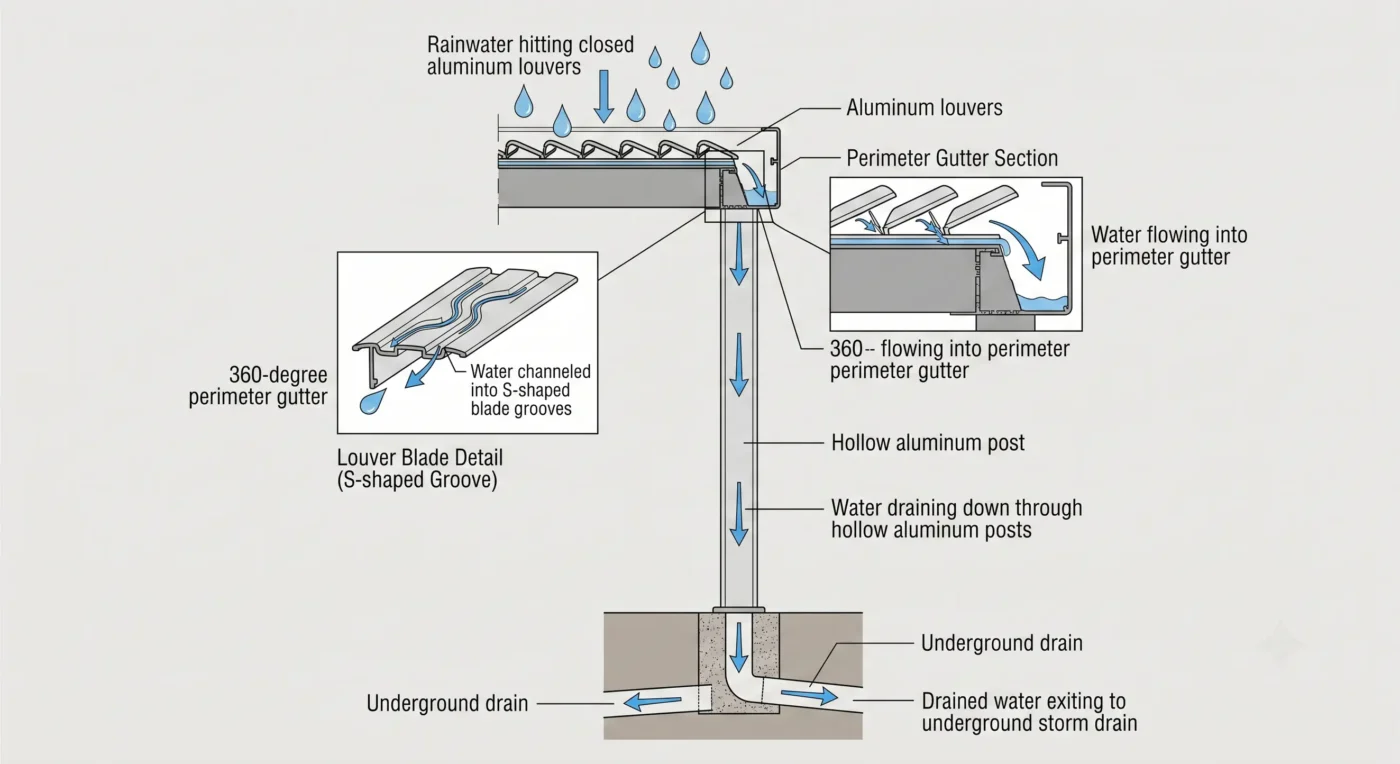
After the rain sensor triggers the motor to close, the louvers reveal their precise mechanical interlocking structure. When heavy extruded aluminum louvers close, they are not perfectly horizontal. Instead, the installation engineer presets a tiny pitch that is almost invisible to the naked eye, usually 0.5% to 1%. When heavy rain hits the blades, water is rapidly collected by the channels in S-shaped or dual-walled louver structures and guided by gravity into the surrounding 360-degree wide perimeter gutter (such as the 5.5-inch oversized gutter used by StruXure). From there, water flows down through hollow support posts into the underground drainage system. The detailing is even more critical: every louver engagement point and edge joint is fitted with industrial-grade weather stripping. When the motor applies its final closing torque, these seals are compressed tightly. They block lateral penetration from wind-driven rain and use the hydrophobic nature of the material surface to interrupt capillary action, ensuring that after rain stops and the louvers open again, trapped water does not drip into the space below.
The Harsh Test of Extreme Cold on 24V Servo Motors
In winter, precipitation often comes with low temperatures. A 24V DC low-voltage servo motor that operates smoothly at room temperature faces sharply increased mechanical resistance below freezing. As temperature drops, lubricant inside the motor gearbox becomes much more viscous and the drive shaft moves less freely. Rubber seals lose elasticity and become stiff. If snow load on the pergola roof is added, the instantaneous torque required to start the entire gear drive and linkage reaches its limit. If the controller lacks intelligent overload protection at this point, the motor can burn out easily from a stall. Premium systems — such as Somfy Pergola io — include electronic overcurrent detection and encoder monitoring. Once abnormal resistance is detected (such as a louver jammed by ice), the system immediately cuts current and triggers anti-pinch or overload protection feedback. Manufacturers must warn end users clearly in the manual: when the system is frozen, do not repeatedly send commands through the app in an attempt to force the ice to break.
Hurricane-Level Structural Stability: T6 Aluminum and Mass
For pergolas sold to Florida, Texas, the Gulf Coast, or markets that require compliance with strict Miami-Dade building codes, relying only on sensors to open the louvers for wind relief is far from enough. In a Category 5 hurricane with sustained winds of 157 mph or more, the pergola’s survival depends on its base mass and the engineering strength of its connectors.
Ordinary low-end imported pergola kits — often made with T5 aluminum and weighing only 300 to 400 pounds overall — can twist severely or even be pulled from their foundations in 70 mph gusts. Premium commercial-grade pergolas, such as Hanso Apex or The Luxury Pergola, use aerospace-grade T6 aluminum alloy with 43% higher tensile strength. A 10 x 13 ft unit can weigh as much as 1,800 pounds. This high mass, combined with 304 marine-grade stainless steel through-bolt connections and expansion anchors embedded deeply into concrete footings, is what allows the entire frame to remain stable in 150 mph or even 200+ mph extreme storms, providing an almost indestructible shelter for the motorized components.
Implementation: Strict Requirements for System Calibration and Installation
Even the best theoretical design will fall short if the final installation is flawed. For pergola manufacturers that export products or build local dealer networks, creating strict installation SOPs and providing engineering training for dealers is a key way to reduce after-sales complaints.
Physical Wiring and the Ideal Sensor Location
Installers must understand microclimate basics when placing rain sensors. The sensor must never be installed in the rain shadow of the main building or near tall trees where leaves may cover the probe surface. The best physical location is the very top of the pergola structure in a completely open area. For low-voltage wiring, casual exposed wiring must be prohibited. UV-resistant, weatherproof outdoor multi-core shielded cable (such as Belden 9421) should be mandatory, and the cable should enter the probe base through IP65 waterproof cable glands. Strip length must be controlled strictly to prevent rainwater from wicking along the internal copper conductors by capillary action and reaching the circuit board, which can cause short circuits. In addition, the sensor base must remain level or follow the manufacturer’s required slight angle so that surface rainwater can slide away quickly, preventing standing water from causing incorrect system judgment.
Localized Parameter Calibration
Factory default parameters can never fit every market. The sensitivity requirements for rain sensors in humid Seattle and dry Arizona are completely different. Commissioning personnel must recalibrate the system according to local climate characteristics by adjusting the potentiometer inside the sensor or the logic menu on the underlying control board.
In coastal areas with frequent morning fog or high humidity, the sensitivity of capacitive sensors should be reduced appropriately, or a longer confirmation delay should be added, to prevent the pergola from closing without actual rainfall. In tropical regions with frequent thunderstorms and strong convective weather, optical sensors should be set to the highest-sensitivity first-drop response mode to achieve second-level response under extreme conditions.
Active Maintenance: Breaking the Marketing Myth of Maintenance-Free Systems
No matter how strong the hardware is, no structure exposed to nature for long periods is truly maintenance-free. Dust coverage, leaves blocking gutters, and frozen snow are the three chronic problems that damage system reliability. Forward-looking manufacturers should add predictive maintenance mechanisms to their smart control apps (such as TaHoma or a proprietary platform). By combining algorithms with local seasonal changes — such as the arrival of leaf-fall season — the app can proactively push maintenance reminders to the user’s phone. These reminders can prompt the user to clean the 360-degree gutter, wipe the sensor surface, and inspect aging weather seals. Only by combining passive hardware defense with proactive software care can the service life of the pergola truly be extended.
Industry Outlook: Toward an All-Knowing Predictive Microclimate System
Making a bioclimatic pergola close reliably when it rains is not a single technical task. It is an interdisciplinary challenge involving material metallurgy, precision fluid dynamics, microwave RF communication, and complex logic algorithms.
Looking at the development of the premium shading industry, manufacturers that want to stand out in the next stage of competition must follow several strategic benchmarks.
Sensor configuration must become modular and redundant. Manufacturers should abandon dependence on a single technology and provide flexible sensor matrices for different climate zones. High-power heated capacitive probes should be promoted in cold regions, while high-sensitivity optical probes should be emphasized in rainy tropical markets.
Manufacturers must embrace building-grade bus systems and two-way IoT ecosystems. One-way RF technology with safety blind spots should be phased out, while io-homecontrol, Zigbee 3.0, and KNX standards should be fully integrated to remove barriers to Matter, Apple HomeKit, and other whole-home smart ecosystems.
Manufacturers must respect nature and maintain the safety baseline. Any eye-catching function must yield to strong mechanical structure and strict wind-load priority logic, ensuring that the pergola can remain standing in extreme storms above 150 mph.
Looking ahead, pergola automation will inevitably shift from passive response to active prediction. With cloud IoT technology, future control boards will connect directly with national weather APIs and local high-precision radar networks. Ten minutes before a storm cell arrives overhead, the system will close the louvers smoothly in advance based on the predicted track, eliminating the time lag of physical sensors. Pergola system manufacturers that master this predictive climate response technology will reshape the technical barriers and value benchmarks of luxury outdoor living in Europe and North America.

Pingback: Outdoor Kitchen Pergola Control Packages: Lighting, Louvers, Fans, and Sensors
Pingback: Umbrales de los sensores de viento para pérgolas: cómo encontrar el equilibrio entre seguridad, ruido y comodidad del usuario
Pingback: Colocación del sensor de lluvia en techos de lamas motorizados: directrices para fabricantes e instaladores
Pingback: Snow and Frost Protection Logic for Motorized Louvered Pergolas
Pingback: Actuator and Tubular Motor Control for Pergola Louvers: OEM Integration Guide
Pingback: Linear Actuator vs Tubular Motor for Louvered Pergolas: Control Implications