


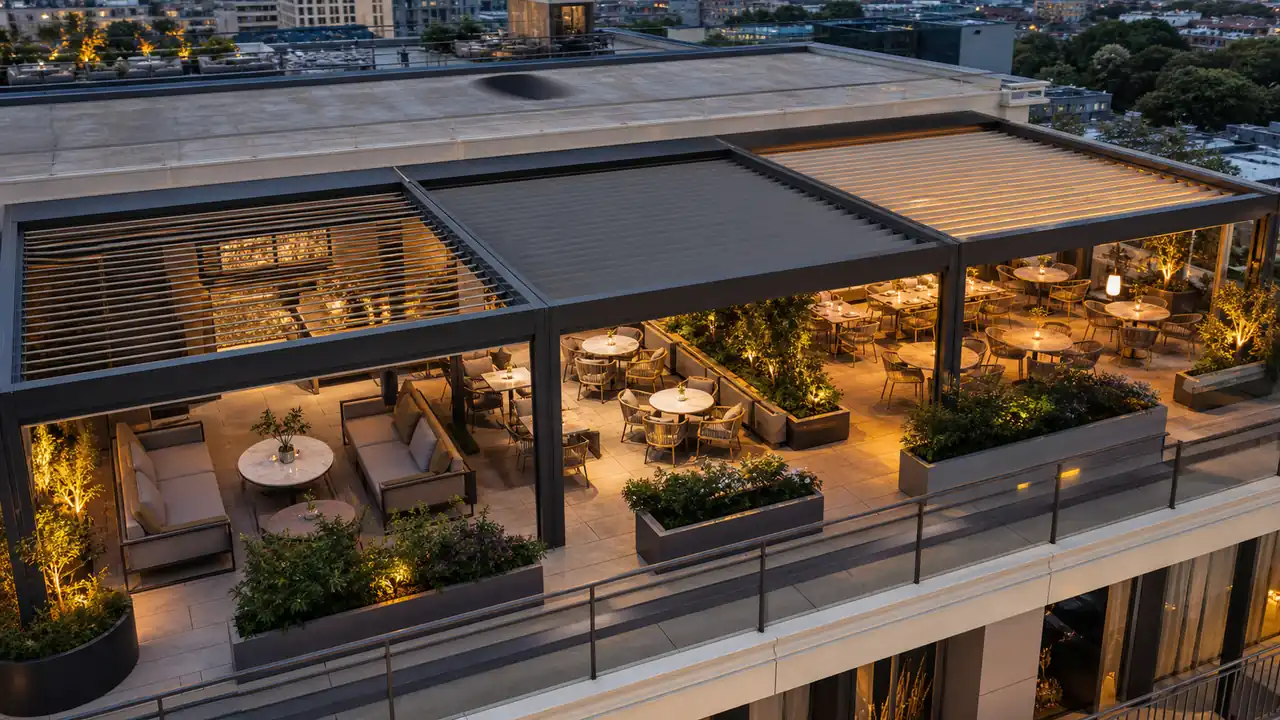
A restaurant terrace is not a large residential patio. A hotel pool deck is not a single pergola with a bigger motor. Hospitality spaces have different seating zones, service routes, operating hours, guest expectations and weather exposures. When every roof bay, light group and screen is forced to behave identically, the control system becomes a limitation on the venue.
The strongest commercial pergola products are built around one idea: the system should model how the venue operates. Roof movement, screens, lighting and weather inputs need a shared logic layer, while still allowing each zone to respond independently. That is the difference between a product that merely has automation and one that can be specified, installed and supported across a dealer network.
This is our position as a pergola lighting and control-system manufacturer: multi-zone control is not an optional premium feature to add at the end of a project. It is the architecture that makes commercial automation usable.
Why hospitality pergolas need zone-based control
Commercial terraces rarely have one uniform use. A restaurant may combine a bar edge, dining tables, a waiting area and a service corridor under one connected roof. A hotel may divide its outdoor space into breakfast seating, a pool lounge, a private event area and a circulation path. Each zone can have a different exposure and a different reason for being lit.
A single all-on/all-off command creates three predictable problems. First, it wastes energy and shortens the useful life of lighting that is not needed in every area. Second, it produces poor guest comfort: a screen or roof section may move even though only one part of the terrace is affected. Third, it makes staff choose between leaving the entire system in a safe but inconvenient state or manually correcting several devices during service.
Zone-based control solves the operational problem by assigning each area its own controllable relationship between roof, lighting and side protection. The control system can still offer a global command for opening, closing or storm protection, but the default experience should be granular.
| Hospitality zone | Typical control requirement | Useful lighting logic |
|---|---|---|
| Dining tables | Comfortable shade, rain response and staff override | Dimmable warm-white or tunable white task light with low glare |
| Bar or lounge edge | Longer operating hours and stronger visual identity | Independent linear light plus optional RGB or RGBW scenes |
| Walkways and service routes | Predictable visibility without disturbing guests | Low-level path or post lighting on a separate channel |
| Event or premium area | Fast scene changes and temporary operating modes | Preset scenes with manual local control and clear reset behavior |
Manufacturers should define these zones before selecting the final receiver, driver or remote. The venue’s operating model is the starting specification.
Multi-zone lighting is a product architecture, not a wiring trick
Splitting a lighting circuit into several outputs does not automatically create a good multi-zone product. The zones must be understandable to the installer, consistent across product variants and visible in the user interface. A dealer should know whether “Zone 2” means the east roof bay, the bar lights or a screen group before commissioning begins.
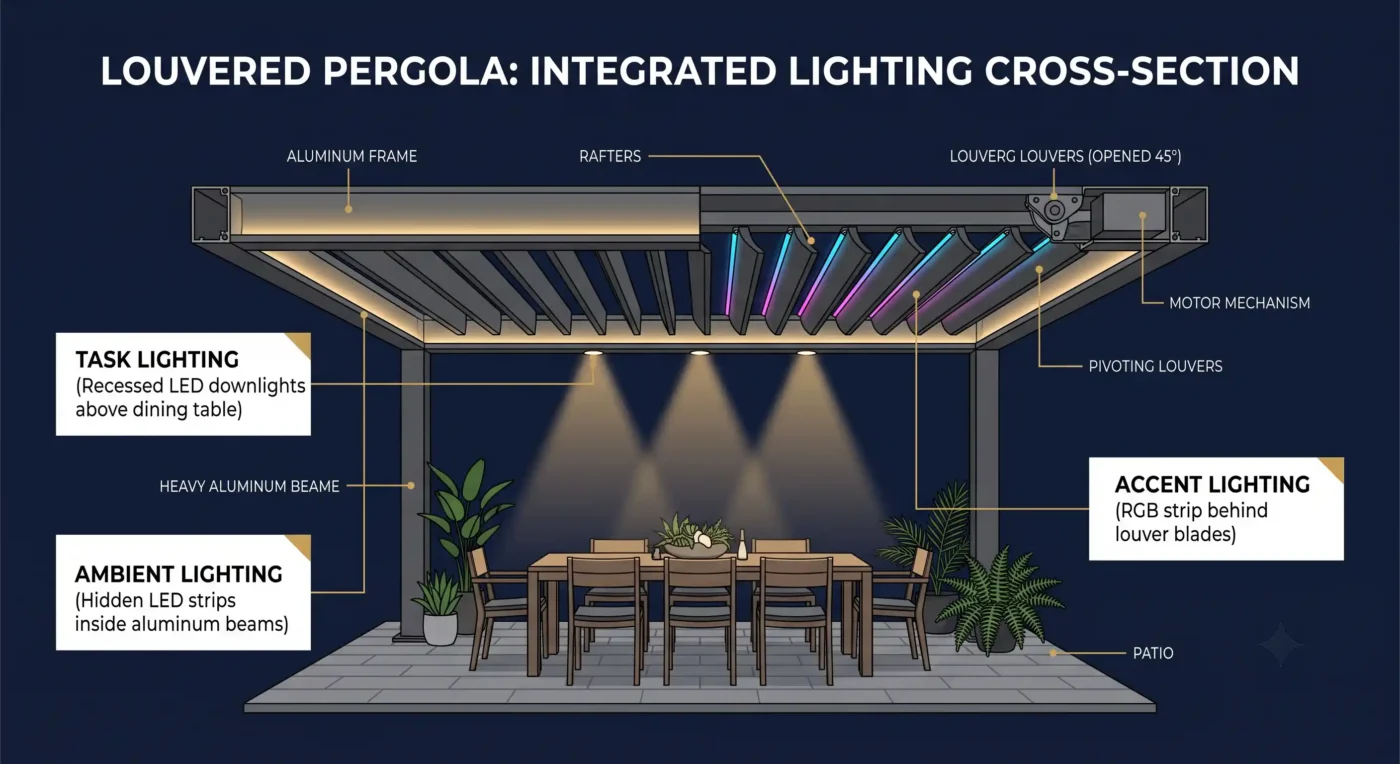
For a typical commercial pergola, we recommend separating lighting by function as well as by physical location:
- Functional white light: dining, food preparation, entry and service visibility.
- Ambient linear light: concealed LED strip lighting in beams, gutters or profiles.
- Accent light: spotlights, downlights or post lights used to define tables and architectural elements.
- Decorative color: RGB or RGBW lighting for selected events, brand moments or evening scenes.
These functions should not be forced onto the same dimming behavior. A dining light may require smooth white dimming, while a decorative channel needs scene memory and color mixing. A service route may need a simple, reliable low-level command rather than an app-only color interface.
De VLEDSTAR pergola lighting product range is designed around this type of system planning, including recessed spotlights, downlights, LED strips, wall and post lights, control units, power supplies, splitters and connectors. The value for a manufacturer is not just a larger catalog. It is the ability to standardize the physical interface, voltage family, mounting method and test procedure across a product line.
For larger commercial projects, the electrical design still needs engineering review. Confirm driver capacity, cable length, voltage drop, thermal conditions, connector sealing, access for replacement and any local requirements for task or emergency lighting. Decorative pergola lighting does not replace code-required illumination.
Weather automation should create operating states
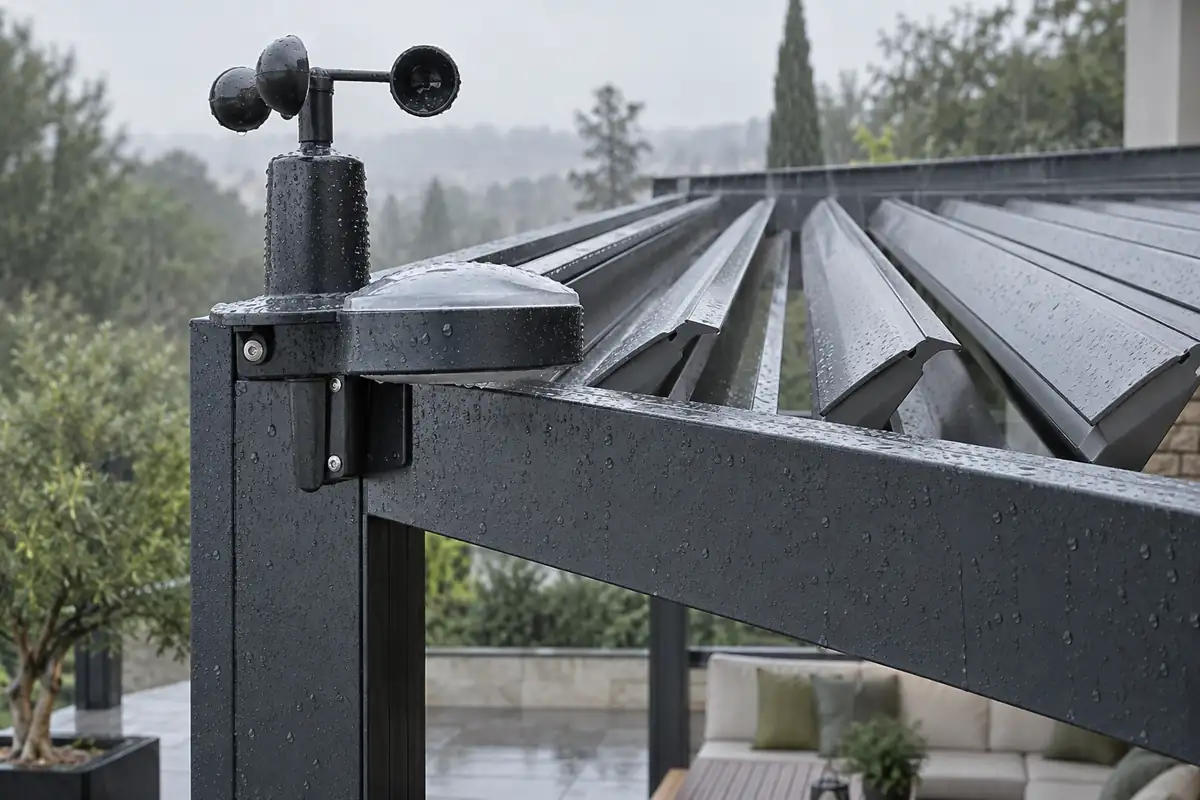
Many product pages describe rain, wind and sun sensors as if each input simply presses a different button. That approach is too shallow for a restaurant or hotel. Weather inputs can arrive at the same time, conflict with a manual command or remain active after the first event has passed. The controller needs a priority model.
A practical state model for a hospitality pergola may include:
| State | System behavior | Design question |
|---|---|---|
| Normal service | Zones follow schedules, scenes and authorized manual commands | Which controls are available to staff and which are reserved for service? |
| Rain response | Roof and screens move to the tested rain position; nonessential opening is restricted | How does the system prevent repeated cycling during passing showers? |
| High wind | Exposed components move to the manufacturer-defined protective position | Is the safe position closed, open or partially open for this roof design? |
| Snow or frost risk | Movement is limited or held until the structure is safe to operate | What happens when precipitation and low temperature occur together? |
| Fault or lost input | The system signals the issue and blocks unsafe automatic behavior | Does a disconnected sensor mean normal, unknown or protective operation? |
The exact thresholds must be validated for the roof, actuator, louver geometry, drainage and installation environment. A sensor specification alone is not a safety specification. Our guide to retractable louvered pergola control explains why motor feedback, limits, sensor priority and lighting loads should be tested together.
Commercial buyers also need recovery behavior. When rain stops, should the roof reopen automatically, remain closed until staff confirms, or return to the previous scene? For a hotel pool deck, the answer may differ from a restaurant terrace. The manufacturer should make the behavior configurable, documented and repeatable.
Design scenes around service moments, not feature lists
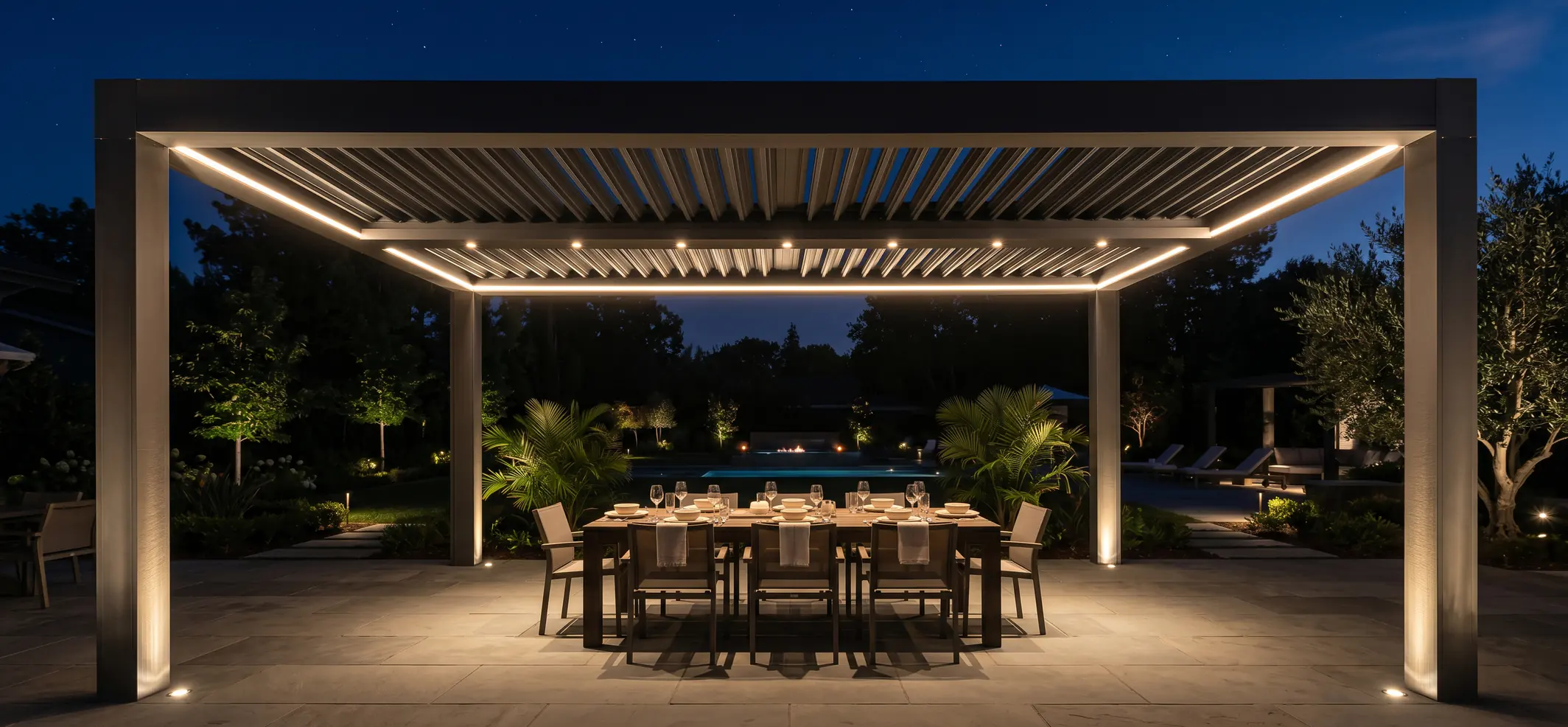
An app with many buttons is not the same as a useful control system. Hospitality staff think in operational moments: opening the terrace, preparing for dinner, responding to a shower, closing the venue or setting up a private event. The controller should translate those moments into clear scenes.
Opening
Roof sections move to the approved morning position, walkway lights reach a working level, and nonessential decorative channels remain off. This scene should be available locally without requiring a cloud connection.
Service or dinner
Dining-zone lighting comes on at a comfortable level, accent lights define tables or architectural edges, and the roof follows the selected comfort position. A restaurant manager should be able to adjust one zone without changing the entire terrace.
Weather protection
The weather state overrides the comfort scene according to the documented priority matrix. A visual status indicator or clear message helps staff understand why a command is temporarily unavailable.
Evento
Selected areas can use RGB or RGBW lighting, while service routes and adjacent guest areas retain their normal white-light settings. Event scenes should not bypass wind or rain protection.
Closing
The roof, screens and lights move to the approved closing state. The system should distinguish between a normal close and a weather-protection close so that the next opening behavior is predictable.
This scene-based approach is consistent with what leading automation companies emphasize: the product advantage comes from coordinated behavior across motors, lights and sensors. Somfy’s outdoor dining guidance, for example, frames pergola automation around comfort, weather response, lighting and heating rather than around a motor in isolation. For OEMs, the lesson is to define the scenes first and map them to hardware second.
Local control must remain the backbone
Restaurants and hotels may use Wi-Fi, building-management systems or a branded app, but the core product should not become unusable when internet access fails. Local RF control, a wall panel or another local interface should continue to support essential lighting and motor commands. Cloud features can add remote access, schedules, monitoring and updates; they should not be the only path to a safe local action.
For a commercial pergola, specify at least three interface layers:
- Local operator control: the fastest way for staff to adjust a zone during service.
- Technical commissioning control: access to pairing, motor learning, limit setup, sensor testing and fault diagnosis.
- Optional connected control: app scenes, remote status, schedules or integration with a selected building platform.
Do not let these interfaces develop separate behavior models. A rain lockout triggered by the sensor should be respected by the remote, the app and any external integration. A scene saved in one interface should not silently produce a different result in another.
Radio planning is also part of product design. Aluminum frames, control-box placement, antenna position, nearby equipment and the completed roof assembly can all affect performance. VLEDSTAR’s comparison of touch panels, remotes and apps covers the trade-offs between local simplicity, commercial usability and connected functions. Test the finished assembly, not only a receiver on a workbench.
What OEMs should demand from a control-system supplier
Supplier comparison should go beyond motor voltage and the number of channels shown on a brochure. A commercial pergola platform is ready for market only when the manufacturer can explain its behavior, installation process and support path.
Ask for documentation covering:
- Approved actuator and tubular-motor families, including feedback and limit methods.
- Lighting voltage, current limits, driver requirements and dimming behavior.
- Channel maps for roof zones, screens, white light, RGB/RGBW light and auxiliary outputs.
- Sensor trigger thresholds, reset conditions, hold times, priority and manual override rules.
- Connector pinouts, harness lengths, sealing methods, labels and service access.
- Local operation during an internet outage and the exact boundary of cloud-dependent functions.
- Commissioning tests for motor direction, limits, obstruction response, lighting, RF range and sensor recovery.
- Product-specific certification documentation for the actual controller, power supply, remote and lighting configuration.
- OEM options such as channel mapping, remote layout, enclosure finish, private-label packaging and installation documents.
VLEDSTAR develops and manufactures integrated pergola lighting and control systems for OEM and private-label programs. The sistema integrado de control de pérgolas supports multiple lighting types, linear actuators, tubular motors, weather inputs and RF, app or touchscreen control. Published configurations include up to four linear actuators and up to two tubular motors, but the final selection must be matched to the motor model, load, wiring and roof design.
That qualification matters. An honest supplier does not treat a headline channel count as universal compatibility. It confirms the motor protocol, voltage, power rating, connector, control method and intended operating behavior before production.
Build the control system into the pergola before production
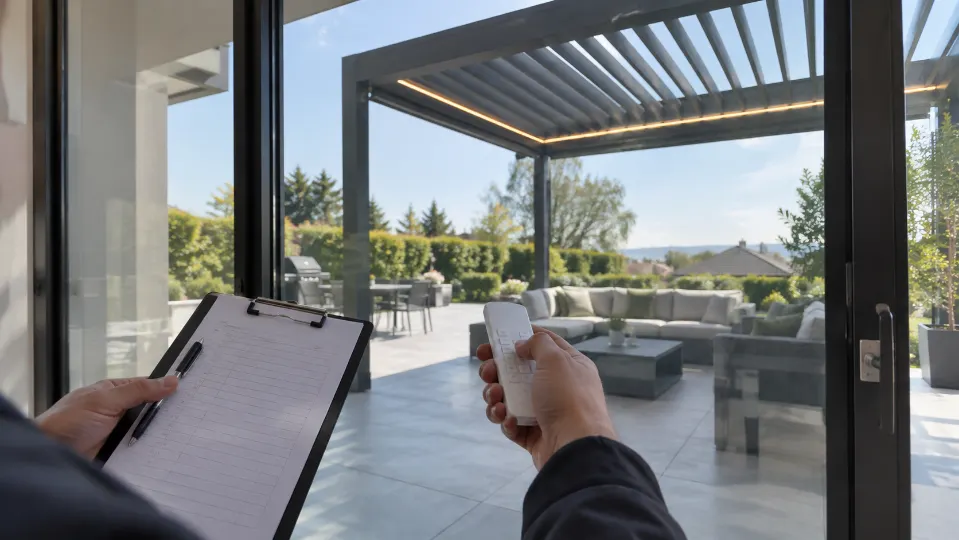
The most expensive time to discover a control-system problem is after the frame, roof and wiring have been standardized across a product family. Commercial manufacturers should bring the control supplier into the design process while the following decisions are still open:
- Where the controller and power supply will sit, and how a technician will reach them.
- How cables will pass through moving parts without creating a service or water-ingress problem.
- Which zones follow the seating plan and which follow the roof-module plan.
- How the system will behave when one sensor, motor or lighting channel is unavailable.
- How dealers will identify a failed component without replacing the entire control box.
- Which functions must be protected from casual guest access and which can be exposed to venue staff.
Use a pilot assembly that includes the real aluminum frame, roof mechanism, lighting loads, connectors and sensor locations. Then test the system under the conditions that matter: a full lighting load, repeated motor cycles, rain input, wind input, an interrupted command, power recovery, local control without internet and service replacement of a harness or controller.
Our lessons for pergola manufacturers take the same view: a control system should be judged by how consistently a dealer can install it and how clearly the product behaves when something goes wrong.
Our view: the winning commercial pergola is operationally calm
Hospitality operators do not buy automation to give staff more technology to supervise. They buy it to reduce interruptions. A successful restaurant or hotel pergola quietly manages routine changes while making exceptional conditions obvious and controllable.
That requires restraint. Not every zone needs RGB. Not every site needs the same screen strategy. Not every customer needs a cloud dashboard. The premium is in the coherence of the system: sensible defaults, independent zones, safe weather priorities, local control, clean installation and a support process that does not depend on guesswork.
For pergola manufacturers, this is also a commercial opportunity. A repeatable control architecture can support several product tiers, regional variants and private-label programs without redesigning the entire product each time. The frame may change. The roof may change. The logic should remain understandable.
Practical specification rule: before approving a commercial pergola control system, write down what should happen to every roof zone, screen group and lighting channel in normal service, rain, high wind, snow or frost risk, power loss, internet loss and sensor failure. If the supplier cannot answer those questions clearly, the system is not ready for a hospitality product line.
Conclusion: specify the behavior, then specify the components
Restaurant and hotel pergolas need more than motorized roofs and attractive lighting. They need a control architecture that reflects how the venue is divided, how staff work, how guests experience light and how weather changes the safe operating state.
Start with the zone plan. Separate functional, ambient, accent and decorative lighting. Define weather priority and recovery behavior. Keep local control available. Test the complete aluminum assembly. Document the harness, channel map and commissioning sequence. Then select the motors, drivers, sensors and interfaces that deliver that behavior consistently.
If you are developing a new hospitality pergola, adapting an existing roof platform or building a private-label accessory package, share your roof layout, motor requirements, lighting zones and target market with the VLEDSTAR team. We can help you evaluate an integrated lighting and control architecture, prepare a sample configuration and move the design toward repeatable OEM production.
Plan a multi-zone pergola control platform
Send us your seating layout, roof mechanism, preferred lighting types and weather functions. Our engineering team will help map the control channels, compatible components and OEM configuration options.
Explore the integrated pergola control system o review the pergola lighting range.

Envíenos su solicitud