


With dramatic fluctuations in global climate patterns and the deep integration of high-end residential design philosophies, the outdoor shading industry in 2026 is no longer satisfied with simple physical shelter. Brand owners and manufacturers are facing a technological revolution — a transformation from “building-materials trade” to “precision spatial-system engineering.” Against this backdrop, the Retractable Louvered Pergola has become the competitive pinnacle at the top of the industry pyramid, thanks to its unique bioclimatic regulation capability and extremely high mechanical complexity.
This guide aims to provide outdoor-shading brand owners, manufacturers, and high-end customization service providers with a professional-grade technical standard and market positioning analysis. The core insights are based on advanced retractable louvered pergola control systems represented by Pergo Pro Max, with in-depth analysis of dual-motor collaborative logic, structural mechanics choices, and the smart future under Tuya app control.
Technological Evolution of Retractable Louvered Pergolas in 2026
Through analysis of Q1 2026 Google search trends, we can see that consumer focus has shifted comprehensively from “shading area” to “control system reliability” and “survivability under extreme weather.” Market-leading brands such as StruXure, Azenco, y Renson have established the consumer mindset of the “Outdoor Room” rather than the “shading facility.”
The current market competition focuses on three pillars:
(1) the logical interlocking of retraction and tilting (preventing mechanical damage);
(2) seamless cross-platform connectivity under Tuya app control; and
(3) the structural redundancy of T6-grade aviation aluminum. This researcher believes that the “core value” of a louvered pergola lies in the ability of its control system to extend mechanical life — not in singular appearance design.
Mechanical Anatomy: Dual-Motor Collaborative Architecture
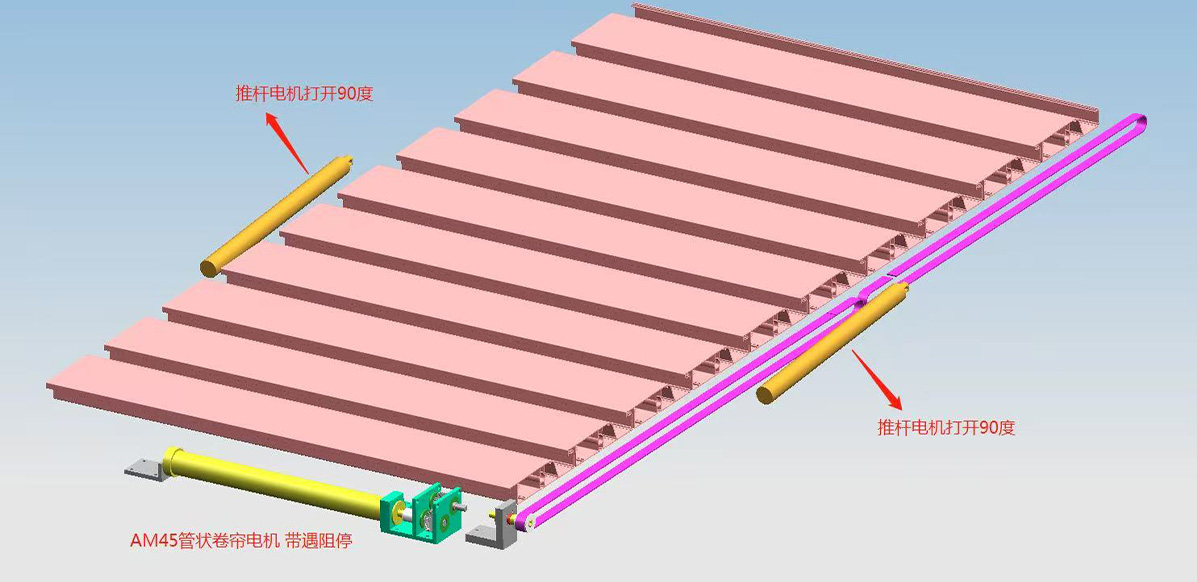
The uniqueness of a retractable louvered pergola lies in its ability to achieve fine adjustment of louver angles (controlling light, shadow, and ventilation) as well as horizontal translation of the entire roof (providing panoramic views). The realization of this two-dimensional motion relies on the cooperation of two motors with very different characteristics.
Linear Actuator: The Art of Angle
The push-rod (linear actuator) motor is the core driving force behind louver tilt. Its working principle is to convert the rotational motion of the motor into linear push-pull motion, driving a linkage mechanism that tilts all louvers synchronously. In high-end configurations of 2026, the linear actuator typically needs to meet the following technical specifications:
| Performance Metric | Standard Requirement | Technical Significance |
|---|---|---|
| Push / Pull Force | 2,000 N – 6,000 N | Overcomes dual-layer louver self-weight and wind load |
| Protection Rating | IP67M / IP69K | Handles extreme rainfall and high-pressure water-gun cleaning |
| Operating Noise | < 45 dB | Maintains the tranquil atmosphere of outdoor space |
| Feedback Mechanism | Hall Sensor | Achieves micron-level angular positioning accuracy |
The extension length of the linear actuator directly corresponds to the louver tilt range (typically from 0° to 130° or 170°). In the Pergo Pro Max control system, the linear actuator’s “maximum extended state” is defined as the logical origin point — at this position, the louvers are at their maximum vertical-open angle. This is the mandatory prerequisite for performing any subsequent retraction operation.
Tubular Motor: The Power of Stacking
The tubular motor is usually hidden inside the side beam or the storage box of the pergola. It is responsible for driving a transmission belt or chain, pulling the louvers along the horizontal track to one side for stacking. Unlike the linear actuator’s extreme pursuit of “force,” the tubular motor places more emphasis on “torque” and “synchronization.”
| CHARACTERISTIC | AC TUBULAR MOTOR (110 V / 230 V) | DC TUBULAR MOTOR (24 V) |
|---|---|---|
| Application Scenario | Large commercial projects, ultra-long spans | Residential customization, solar integration |
| Advantages | Constant torque; no power converter needed | Soft start/stop, higher safety, lower noise |
| Typical Torque | 40 Nm – 120 Nm | 6 Nm – 40 Nm |
The stable operation of the tubular motor determines the flatness of the louver stack. If the drives on both sides of the rails are not synchronized, mechanical jamming will occur — leading to permanent deformation of the aluminum profiles.
Core Control Logic: The Pergo Pro Max Interlocking Protection Mechanism
As professional control-system researchers, we must emphasize: hardware determines a pergola’s upper limit, while control logic determines its lower limit. The most common reason for retractable louvered pergola repairs is users issuing retraction commands in the wrong state, causing tilting louvers to collide hard with the track frame.
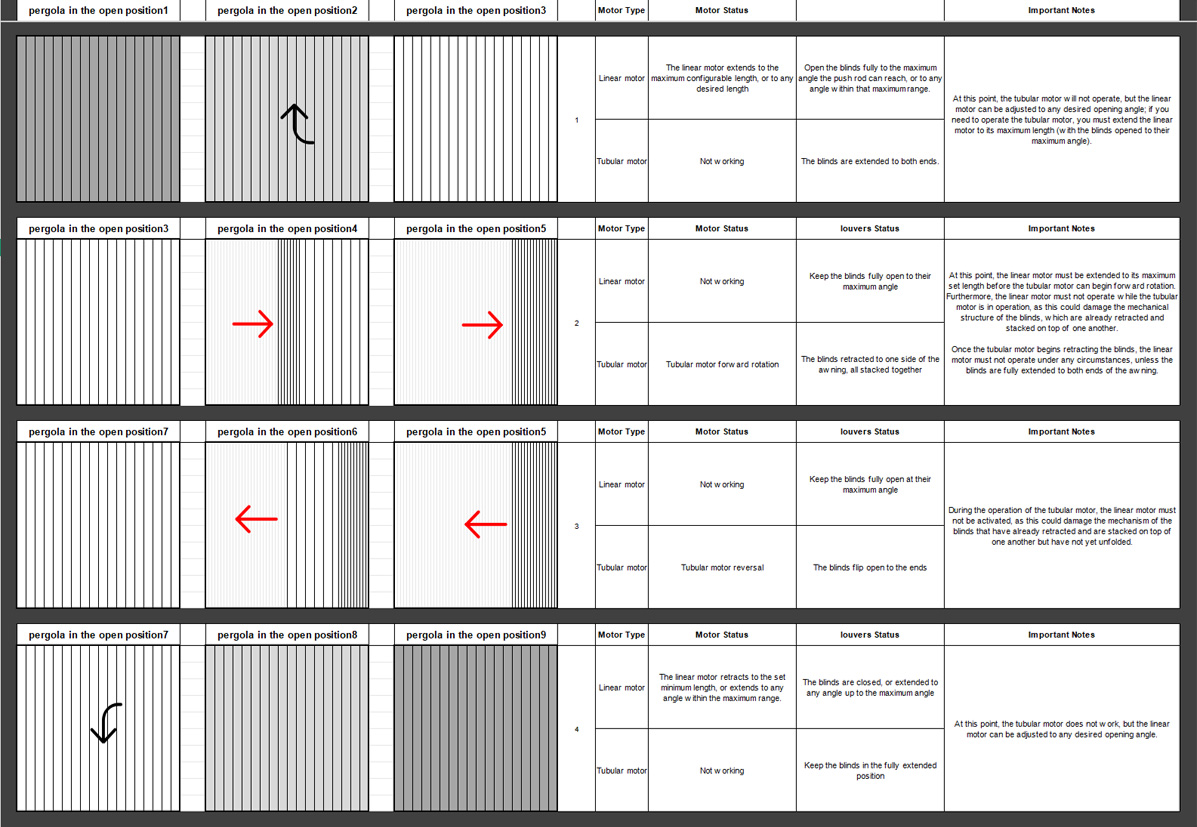
1. Retraction Operation Logic (Tubular Motor Dominant)
Before a retraction operation begins, the Pergo Pro Max system enforces a mandatory “self-check”:
- Activation Prerequisite: If the user triggers a “retract” command, the system first wakes up the linear actuator. The actuator must extend to the set maximum length — i.e., the louvers must be in the “fully open (vertical)” state.
- Interlocking Protection: While the tubular motor is moving the louvers horizontally, the operating authority of the linear actuator is locked out. This prevents accidental tilting from breaking the mechanical linkage when louvers are stacking on top of one another.
- Storage Endpoint: When the tubular motor rotates forward to the limit switch and stops, all louvers are evenly stacked on one side of the pergola, freeing up more than 70 % of the canopy area.
2. Angle Adjustment Logic (Linear Actuator Dominant)
Activation of the angle-adjustment function is similarly limited by the horizontal state
- Operating Conditions: The linear actuator can receive power only when the tubular motor is in its fully extended “limit state.” This means the canopy must completely cover both ends of the pergola, forming a complete roof plane.
- Adjustment Range: Users can perform stepless adjustment between 0° (fully closed and waterproof) and 135° (or even 170°). This logic ensures that the system never performs a tilt operation in any “half-open, half-closed” intermediate-track state — protecting the lifespan of the rail wheel-pulley assembly.
The most common reason for retractable pergola repairs isn’t material failure — it’s a control command issued in the wrong machine state. Interlocking logic, not aluminum thickness, is the real warranty.
2026 Materials Standard: T6 Aviation-Grade Aluminum and Mechanical Redundancy
When manufacturers procure raw materials, they must be able to identify the essential differences between T5 and T6 grade aluminum within retractable louvered systems. Because tilting louvers must repeatedly endure torsional torque, the fatigue resistance of the material is critical.
Aluminum Tempering Grade: Compression and Bending Resistance
| ALUMINUM GRADE | YIELD STRENGTH | 2026 INDUSTRY POSITION |
|---|---|---|
| T5 Aluminum | ~ 21,000 psi | Suitable only for low-end retail kits with low wind loads (< 70 mph) |
| T6 Aviation Aluminum | 35,000+ psi | Mandatory standard for high-end customization and commercial projects; ensures 25-year structural stability without deformation |
The advantage of using T6-grade aluminum (such as 6061-T6 or 6063-T6) is that it allows thinner-walled profiles to carry larger spans. For example, the Pergo Pro Max paired with a 6 × 10-inch reinforced crossbeam can achieve an astonishing single-module span of 7 meters with no intermediate columns — while still maintaining a consistent drainage slope.
Powder Coating and Qualimarine Certification
In coastal regions, salt-spray corrosion is the silent killer of retractable rails and their transmission components. The high-end standard for 2026 requires coating thickness of 60–80 microns and certification under European Qualicoat or Qualimarine standards. This coating is not only aesthetic — it also provides self-lubricating properties on the louver tilting friction surfaces, reducing the linear actuator’s power consumption.
The New Smart Frontier: Tuya App Control and Adaptive Sensor Logic
In 2026, pergolas have evolved from isolated outdoor hardware into core members of the Tuya whole-home ecosystem. Through deep adaptation of the Tuya protocol, pergolas have made the leap from “standalone devices” to “smart terminals.” Users no longer need to configure complex gateways — they can connect the pergola directly to the world’s largest AIoT platform via the Tuya App, achieving seamless interaction with tens of thousands of smart products.
Tuya Control Interoperability
Through the Tuya protocol, the Pergo Pro Max control box can report the real-time “louver position percentage” and “retraction percentage.” This unlocks the following capabilities for high-end custom service providers:
- Multi-Management Control: Owners can use the App for control, while professional central-control screens handle scene linkage.
- Obstacle-Aware Alerting: Using the Tuya protocol’s feedback channel, when the louvers encounter external resistance during retraction (such as snagged debris), the system immediately pushes a notification to the user’s phone and executes a reverse rebound — preventing motor burnout.
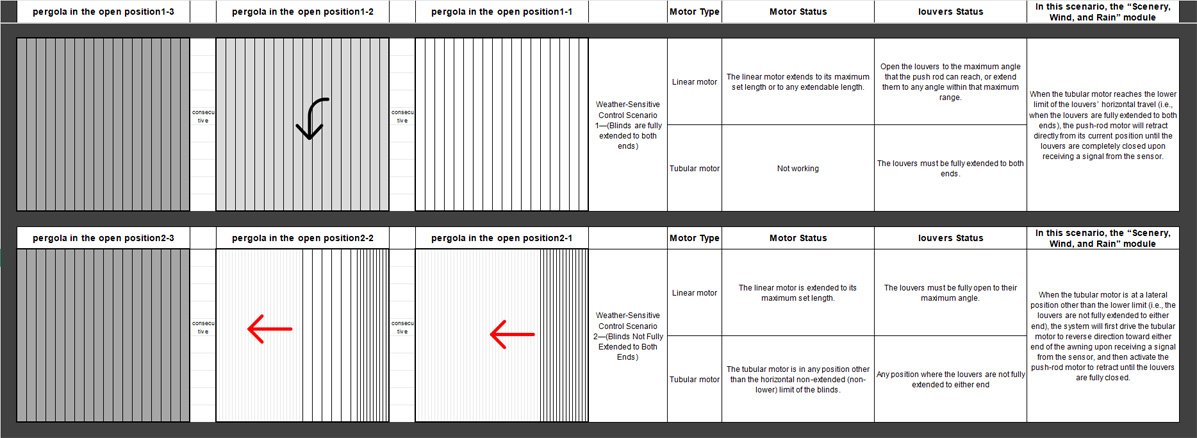
Sensor-Triggered Disaster-Prevention Logic
The core of an adaptive control system lies in its priority handling of sensor data:
- Anemometer (Wind Sensor): When wind speed exceeds the set threshold (typically 60 mph), the system automatically shifts the louvers into “safety mode.” For louvered pergolas, this means opening the louvers vertically to release lift, or fully retracting the canopy to reduce wind exposure.
- Rain Sensor: Uses highly sensitive capacitive induction. The Pergo Pro Max system can fully close the canopy within 15 seconds of detecting the first raindrop, and activate the RainLUX drainage system simultaneously.
- Freeze / Snow Sensor: In cold regions, pergolas face the risk of louver freezing. Smart logic monitors ambient temperature; when it drops below 0 °C with high humidity, the system automatically tilts the louvers to a 45° freeze-protection position — preventing ice and snow buildup from sticking the louvers shut.
Drainage and Climate Adaptability: RainLUX Technology Explained
In its closed state, a retractable pergola is essentially a movable roof. The sophistication of its drainage logic directly determines its commercial value.
Hidden Multi-Stage Drainage
The mainstream design of 2026 has completely abandoned external downspouts:
- Louver Water Channels: Micro-tilted internal grooves direct rainwater toward both ends of each louver.
- RainLUX Side Beam Rails: The crossbeam serves not only as a travel rail but also as a generously sized U-shaped water channel. With an extremely high flow coefficient, it can handle torrential rain exceeding 120 mm per hour.
- In-Column Drainage: The water channel connects directly to a hollow column (typically 7 × 7 inches), and rainwater exits at the column base. This design eliminates raindrop-splash noise and elevates the architectural refinement of the structure.
Insulation and Sound Damping (Dual-Walled Louvers)
To enhance seasonal comfort, the high-end retractable pergolas of 2026 generally adopt dual-walled, air-filled louver structures:
- Thermal Performance: The air layer between the two aluminum walls effectively blocks heat conduction. In summer, closed louvers can lower the temperature in the area below by 10–15 % compared to outside.
- Sound Damping Performance: During heavy rain, traditional single-layer aluminum produces a loud metallic drumming sound. Pergo Pro Max-compatible louvers are reinforced internally and can even be filled with sound-insulation foam — reducing rain noise by up to 50 % in decibels.
The Professional Pre-Purchase Checklist (Manufacturer & Service Provider View)
As a brand owner or high-end customization service provider, when selecting suppliers or control systems, you must establish an audit process that goes well above retail standards.
Electrical Safety and Compliance
- UL / CE Certification: Does the entire control box and motor assembly carry integrated certification? Single-component certification is often invalid when an insurance claim is filed.
- Low-Voltage Safety: Does the linear actuator run on a 24 V DC safe voltage? This not only lowers the installation threshold (no licensed electrician required), but also guarantees absolute personal safety in humid outdoor environments.
Mechanical Synchronization Accuracy
- Number of Hall Sensors: A high-quality tilting system should include at least 2–3 Hall sensors inside the linear actuator, used for real-time synchronization of multi-motor positions and to prevent torsional stress imbalance across long-span beams.
- Limit-Switch Redundancy: Beyond the software electronic limits, are mechanical hard limits also present as a final line of defense?
Installation Efficiency and Maintenance Convenience
- Quick-Install System: The new control systems of 2026 should support “no-wiring, no-calibration” installation. For example, the patented technology of the Pergolux Series 4 can shorten canopy installation time from 1 hour to 15 minutes — significantly reducing labor cost for service providers.
- Component Modularization: If a single louver in the retractable system is damaged by impact, does the system support single-piece removal and replacement, without disassembling the entire frame?
| INSPECTION ITEM | KEY TECHNICAL PARAMETER | QUALIFICATION STANDARD |
|---|---|---|
| Wind Pressure Load | 120 mph+ (Miami- Dade) | Third-party engineering-stamped drawings on file |
| Salt Spray Test | 1,000 – 3,000 hours | Qualimarine certification certificate |
| Cycle Life | 10,000 – 20,000 cycles | Equivalent to 15–20 years of daily use |
| Control Protocol | Matter 1.4 / 1.5 | Official CSA certification label |
Maintenance Protocol: From “Set It and Forget It” to “Periodic Life Management”
A retractable louvered pergola is a precision machine. To maintain an operating life of more than 20 years, manufacturers must provide customers with a clear maintenance protocol.
Lubrication and Track Cleaning
It is strictly forbidden to use petroleum-based lubricants (such as traditional WD-40), because they attract dust and accelerate wear on the plastic track wheel-pulley assemblies. Users should be instructed to apply a dry silicone-based or PTFE (Teflon) spray to the rotating pin shafts of the linear actuator every quarter. In addition, fallen leaves at the end of the slide rails must be cleared once a month to prevent the tubular motor from being overloaded by obstruction.
Conclusion: Finding Premium Space within a Technical Consensus
The retractable louvered pergola industry stands at an unprecedented crossroads. On one side is consumers’ enthusiastic pursuit of “all-weather smart living”; on the other is the harsh test that extreme climates impose on mechanical durability.
For brand owners, future premium pricing power will no longer come from beautiful marketing brochures — it will come from the “safety statement” of the control system. When you can promise customers that, thanks to the Pergo Pro Max dual-motor interlocking logic, their canopy will never be damaged by a misoperation; when you can prove that T6-grade aluminum stands rock-steady in the face of a hurricane — that is when you truly hold the market discourse power of 2026.
If you are a pergola brand planning a product-line upgrade, or are sourcing an industrial-grade control-system solution, we recommend launching a technical audit centered on Tuya app smart control immediately. Prioritize systems with linear-actuator and tubular-motor logic interlocking — this is the line of defense that protects your brand reputation and reduces after-sales rates.

Envíenos su solicitud