


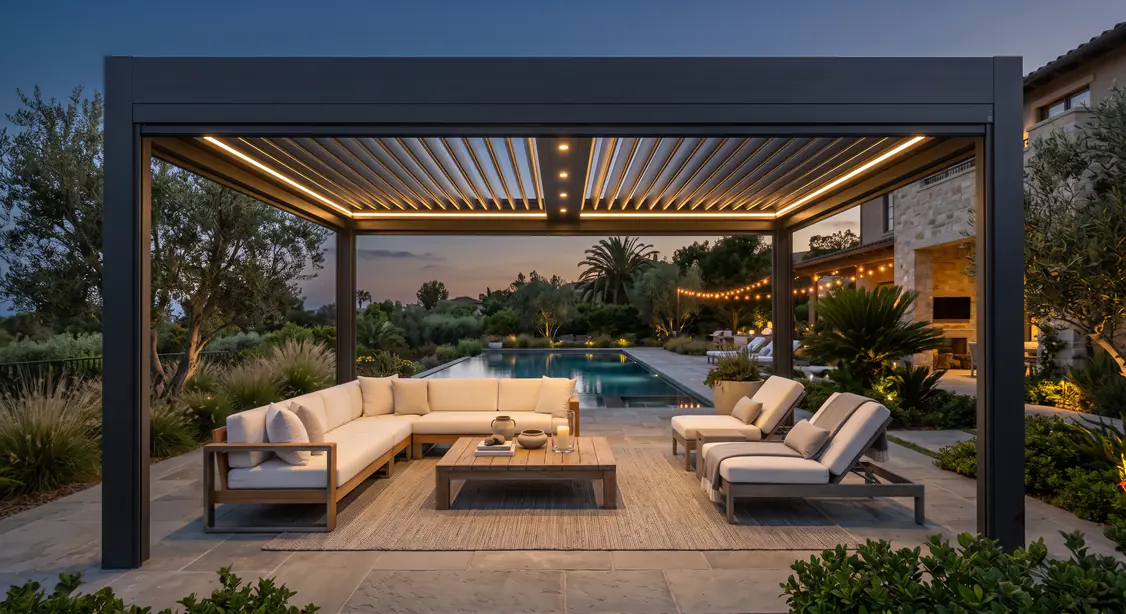
Pergola manufacturers usually focus their R&D resources on the wind and snow performance of the main aluminum structure, such as resistance to wind loads of 165 to 200 mph and snow loads ranging from 75 to 15,000 lb. After project delivery, however, a short circuit caused by condensation ingress, or color deviation at the end of an LED strip caused by long-distance power transmission, can force a dealer to dispatch a crew for a second site visit. This directly consumes what should have been healthy project profit and also weakens brand credibility across the dealer network.
For modern pergola manufacturers, building a highly reliable, code-compliant, easy-to-assemble integrated low-voltage lighting kit has therefore become a core task for creating technical differentiation and enabling the sales channel.
Spatial Breakdown of Modern Pergola Lighting and Dealer Pain Points
High-end pergolas are no longer simple shade structures. They have become core carriers of all-weather outdoor living spaces. To create a richer spatial atmosphere, leading brands such as StruXure promote the idea of layering light. By combining lighting at different physical zones — including perimeter edges, movable louvers, and structural posts — this design approach supports multiple end-user needs, from high-output task lighting to low-glare ambient lighting.
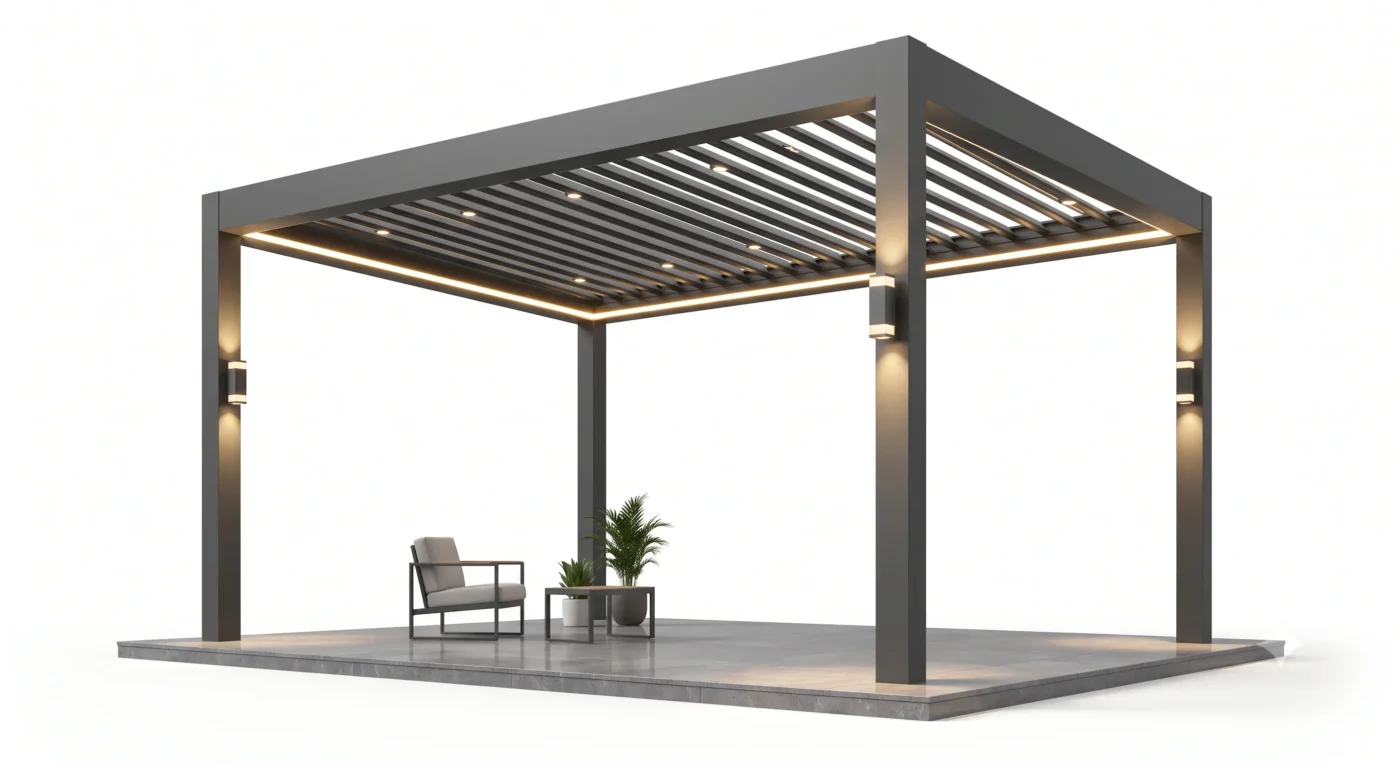
Design Characteristics and Integration Paths for Lighting in Different Pergola Zones
In real projects, each zone has different movement characteristics and water-accumulation risks. This places different technical requirements on the integration method of the lighting kit.
| Installation Zone | Representative System Application | Physical and Electrical Environmental Challenges | Best Integration and Wiring Path |
|---|---|---|---|
| Gutter and perimeter edge | Recessed linear trim lighting, tunable white / RGBW neon flex strips | Long-term high humidity, and even short-term standing water caused by delayed drainage during heavy rain | Use a recessed channel design. Install highly flexible, UV-resistant, solid silicone co-extruded light strips that snap directly into the profile or are fixed to the inner side with anti-slip clips. |
| Adjustable rotating louvers | Louver-integrated puck lights, miniature downlights | Frequent rotation from 0° to 120°, with wires exposed to continuous torsional stress and microscopic shear force | Route wires through the louver pivot axis. Use multi-strand, ultra-flexible, abrasion-resistant PTFE wires, with silicone grommets at cable exits. |
| Vertical face of load-bearing posts | Wall-mounted up/down lights, miniature post lights | Exposed to wind, rain, and direct sunlight, with severe salt-spray electrochemical corrosion risk in coastal areas | Use solid brass or anodized aerospace aluminum housings. Mount on the surface or in a semi-recessed configuration, with wires running vertically inside the post cavity. |
Design Defects in Current Assembly Models and Why Dealers Resist Them
Many mid-market pergola manufacturers still provide lighting kits in a relatively primitive, pieced-together format. For example, some brands ship general consumer-grade neon strips from mass-market brands such as Govee in the product box and ask dealer installers to manually fasten them inside the gutter with clips.
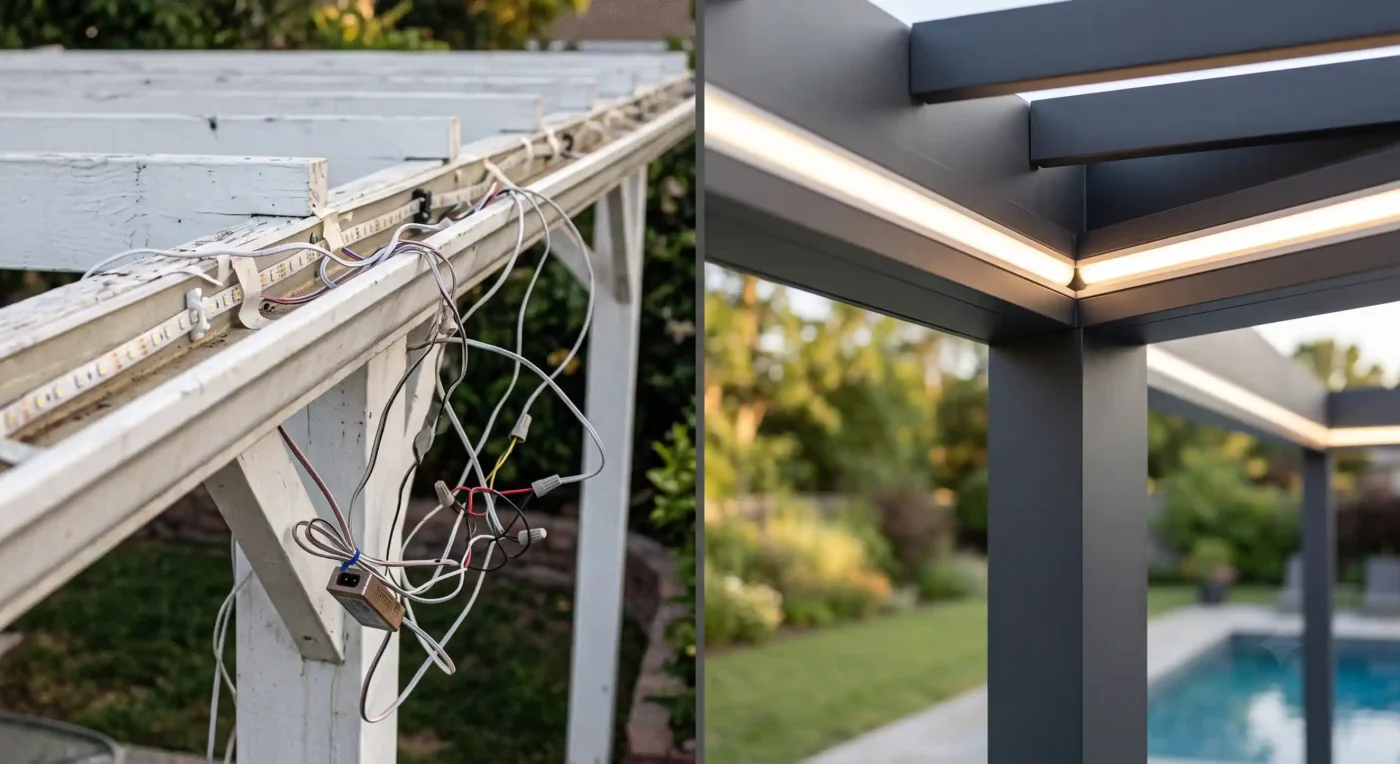
This type of solution creates major installation risks. First, consumer-grade light strips are often uncuttable. In pergola projects with non-standard custom dimensions — such as an 11 ft by 17 ft patio that does not match standard strip lengths — excess strip length cannot be hidden cleanly and local brightness decay may become uneven. Second, on-site wiring, soldering, and heat-shrink sealing significantly extend labor time.
In the European and North American markets, hourly labor costs for skilled installers remain high. Dealers strongly avoid semi-finished components that require secondary processing on site. What dealers truly expect is the kind of highly prefabricated 1-day install system advocated by brands such as PERGOLUX and Structureworks. This requires the lighting kit to have wiring channels — such as a TraX System — and certain functional lights, such as downlights, pre-integrated inside the metal profiles at the factory. The dealer installation team can then focus on structural assembly and deliver the project quickly.
European and North American Electrical Codes and Safety Compliance
In the hardscape construction and premium shading industries in Europe and North America, lighting kits that fail to comply with local electrical safety codes cannot pass plan review and on-site inspections by the authority having jurisdiction (AHJ). A deep understanding and strict implementation of relevant compliance standards is therefore a prerequisite for pergola manufacturers when building lighting kits.
NEC Article 411 and the Legal Boundary of Low-Voltage Lighting
Article 411 of the National Electrical Code, published by the National Fire Protection Association, is the legal foundation for lighting systems operating at 30V AC or 60V DC and below. It clearly defines safe voltage margins in dry and wet locations:
Dry locations: The maximum operating voltage of the system must not exceed 30V AC or 60V DC.
Wet locations: Because water conductivity significantly reduces human contact resistance, the operating voltage is restricted to below 15V AC or 30V DC to prevent fatal electric shock risk.
Outdoor pergolas operate in open-air environments and are directly exposed to rain and condensation, making them typical wet-location systems. This means that the rated output voltage of any qualified DC-powered pergola lighting kit must never exceed 30V DC. From a compliance perspective, this establishes 24V DC as the absolute industry standard.
NEC Article 725 and the Safety Boundary of Class 2 Power Supplies
To avoid the mandatory use of expensive metal conduit and allow dealers to use low-voltage cables that are easier to route on site — such as direct-burial flexible cable — pergola lighting transformers or LED drivers must be certified to UL 1310 and defined as Class 2 limited-energy power supplies.
Under Class 2 safety limits, the energy released by a single low-voltage control output is locked within three upper limits:
Maximum output voltage: not exceeding 60V DC
Maximum operating current: below 5A
Maximum total power: limited to 100W (or 100VA)
This limited-energy mechanism ensures that even if a cable jacket is abraded or damaged by external force, the arc energy is not enough to start a fire, and the low current will not cause meaningful physical electric shock to an end user who touches it.
UL 2108 and UL 1838 Testing Requirements
When applying for system certification, the full lighting system must pass the applicable testing standards.
UL 2108 — Low Voltage Lighting Systems — applies to most LED strips and recessed spotlights integrated inside shading structures. It requires luminaires to be used with listed Class 2 power supplies and imposes strict temperature-rise test limits for luminaires operating inside metal cavities.
UL 1838 — Low Voltage Landscape Lighting Systems — applies to landscape luminaires exposed to soil, ground surfaces, or the area around pergola bases. It focuses especially on impact resistance, material aging caused by long-term ultraviolet radiation, and corrosion resistance of the enclosure.
Solving Voltage Drop and Thermal Management Challenges Under a 24V DC Architecture
In low-voltage DC power systems, the basic laws of physics define a delicate balance among voltage, current, and resistance. Compared with the 12V architecture historically used in the landscape lighting industry, 24V DC provides overwhelming engineering advantages in power capacity, long-distance voltage-loss control, and system heat performance.
Voltage Drop Formula and Physical Constraints
Voltage drop is the most important physical parameter for determining LED brightness consistency. The absolute voltage loss on a DC power path can be calculated precisely with the following formula:
Où I is the operating current in the circuit, in amperes; R is the conductor resistance per unit length, in ohms per foot; and L is the one-way physical transmission distance, in feet.
According to the Illuminating Engineering Society and NEC-adjacent design practices, the voltage drop at the end of the power line must be controlled within 3% to prevent visible lumen depreciation or color shift caused by LED voltage attenuation.
In a 12V system, the maximum allowable 3% voltage loss is only 0.36V. If 16 AWG wire is used to drive a 60W LED circuit, a run of only about 15 ft can exceed this threshold, causing the light strip at the far end of the pergola to appear dim or causing inaccurate RGB color mixing.
In a 24V system, the maximum allowable 3% voltage loss increases to 0.72V. At the same time, because the current required to transmit the same power is half that of a 12V system, the absolute voltage drop is also reduced by half. This allows a 24V system to extend its effective, no-degradation transmission distance by 4 times without increasing conductor gauge, greatly relaxing wiring limits for large or multi-bay pergola systems.
Exponential Difference in Thermal Management
According to Joule’s law, the power loss generated as heat inside wires and components is proportional to the square of the operating current:
Formula — Joule Heating
In a limiting scenario with a maximum Class 2 output power of 96W:
12V DC system: The current must reach as high as 8A. This actually exceeds the Class 2 limit of 5A and cannot run as a single circuit.
24V DC system: The current is only 4A. Because heat loss is proportional to the square of current, the heat theoretically generated by a 12V system at cables and connectors is 4 times that of a 24V system.
Inside sealed aluminum profile cavities filled with thermally insulating powder coating, this heat buildup can create destructive thermal aging effects on controller electronics and LED chips. The low heat-loss characteristics of a 24V system avoid this engineering risk and ensure that the electrical system remains within a safe temperature-rise range even during continuous operation in hot summer conditions.
Comparison of 12V and 24V DC Systems in Cable Selection and Physical Limits
The following table shows the key performance differences between 12V and 24V systems in a typical pergola project with a 96W maximum design load and a 50 ft wiring distance.
| Key Parameter | 12V DC Architecture | 24V DC Architecture | Practical Impact on Pergola Integration |
|---|---|---|---|
| Theoretical operating current | 8.0A | 4.0A | A 12V system exceeds the 5A Class 2 limit, requiring dealers to split the system into multiple circuits and add more transformers, increasing hardware cost. |
| 3% relative voltage-drop threshold | 0.36V | 0.72V | A 24V system doubles the electrical tolerance window, greatly reducing callbacks caused by end-of-run color deviation due to imperfect field wiring. |
| Recommended conductor gauge (AWG) | 10 AWG or 12 AWG | 14 AWG or 16 AWG | 10 AWG cable is extremely thick and stiff, making it almost impossible to force through the tiny wire channels inside rotating louvers. 16 AWG is flexible and easier to conceal. |
| Temperature rise of cable and connectors | Very high, easily accelerating thermal melting and carbonization of wire jackets inside profiles | Very low, with operating temperatures usually more than 35°C lower than a 12V system | A 24V system significantly reduces the probability of controller thermal-protection lockout and greatly extends mean time between failures (MTBF). |
| Maximum continuous single-run length | About 16 ft (based on a standard 5W/ft strip) | More than 32 ft (based on a standard 5W/ft strip) | Supports uninterrupted integrated wiring for lighting along extra-wide pergola edges and removes the complexity of mid-run power injection. |
Physical Protection and Materials Science in Extreme Outdoor Environments
Pergola systems are exposed for years to alternating sunlight, extreme cold, high winds, and heavy rain. Material selection and airtight protection ratings determine whether the lighting kit can survive a 5-year or 10-year warranty period.
Avoiding Misconceptions About IEC 60529 IP Ratings
Many pergola manufacturers mistakenly believe that an IP65 rating in the lighting purchase contract is sufficient for all outdoor scenarios. IEC 60529, issued by the International Electrotechnical Commission, defines ingress protection ratings as follows:
IP65: Protected against low-pressure water jets from any direction, but not designed for prolonged immersion.
IP67: Supports temporary immersion in water up to 1 m deep for up to 30 minutes.
IP68: Supports continuous immersion according to the depth and duration specified by the manufacturer.
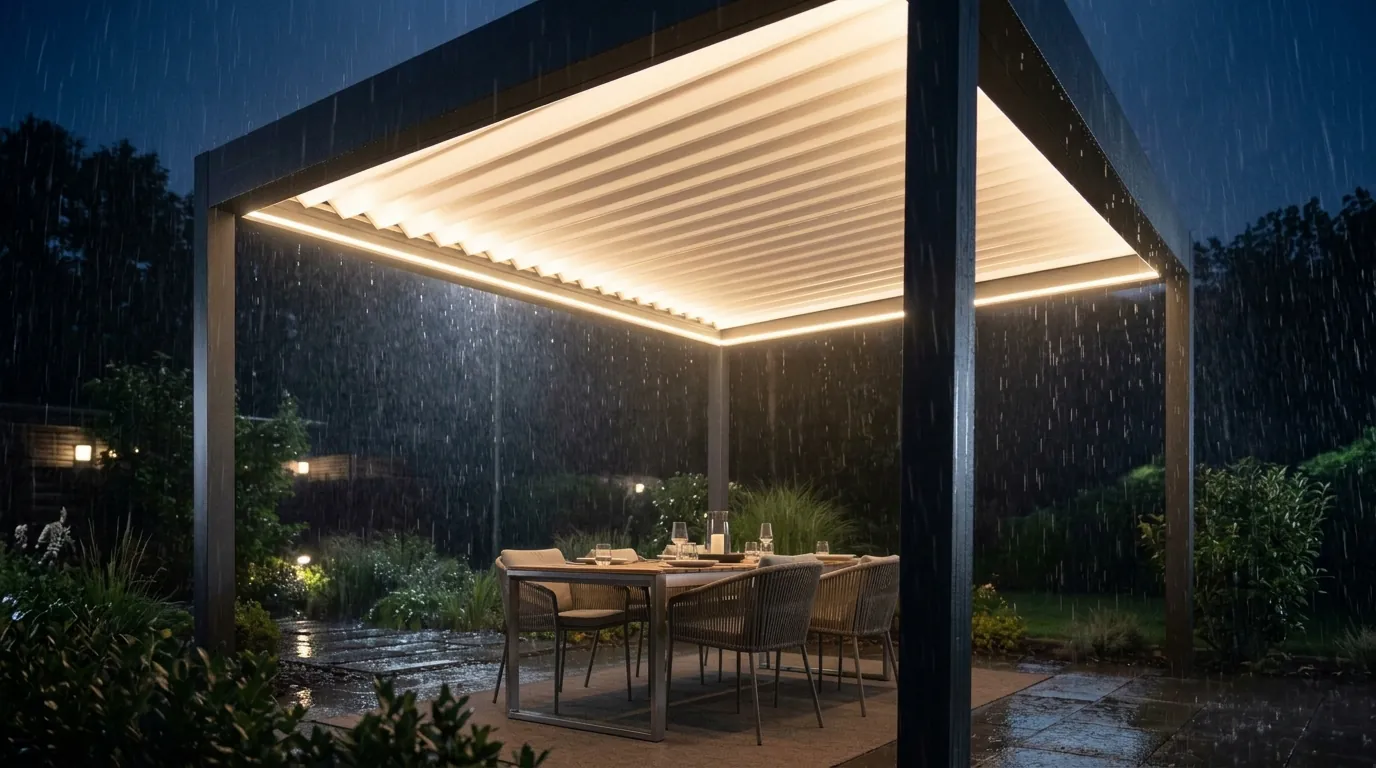
The gutter system around the pergola frame can easily experience delayed drainage during heavy rain or when blocked by leaves, causing standing water to temporarily submerge lighting positions hidden along the inner wall of the profile. If only IP65 strips are used in this zone, accumulated water inside the profile may enter through microscopic gaps in the strip’s plastic end caps under the combined effects of pressure difference and capillary action, causing local LED short circuits.
Therefore, linear light strips installed at the perimeter edge and inside gutter areas must use IP67 or even IP68 solid silicone co-extrusion without exception.
Preventing Electrochemical “Black Wire” Corrosion in Coastal Salt-Spray Environments
In coastal projects with high humidity and heavy salt spray, low-voltage lighting systems face a specific technical failure mode: the “black wire” problem. When trace amounts of condensation and sea-salt particles — mainly NaCl — pass through imperfectly sealed connectors and contact energized copper low-voltage conductors, the DC electrical potential drives electrolysis. Copper ions then react rapidly with chloride ions, forming black copper oxide (CuO) and copper chloride (CuCl₂).
These black corrosion products spread along the microscopic gaps between the strands of multi-strand wire through capillary action, moving deep into the cable and toward the controller. This sharply increases the resistance of what was originally a highly conductive copper conductor, accelerates heating and aging, and ultimately causes complete failure due to internal open circuits.
To fully break this corrosion chain, the system design must use three layers of protection:
Wire improvement: Ordinary bare copper wire must be prohibited throughout the system. Tinned copper wires with strong oxidation resistance should be used to protect the internal conductor from electrochemical attack.
Airtight connectors: Terminals must use injection-molded M12 threaded waterproof quick connectors with dual-layer fluororubber O-rings to achieve IP68 airtight and liquid-tight physical protection.
Luminaire housing material: Low-grade alloy materials prone to galvanic corrosion should be avoided. Use solid cast brass or anodized 6063-T5 aluminum profiles protected by professional-grade outdoor powder coating to block moisture contact.
Engineering Controls to Reduce Dealer Callbacks
For dealers, the reliability of a pergola lighting system depends heavily on how easy it is to make wiring mistakes on site. To minimize losses caused by human error during installation, manufacturers need to build a series of error-proofing mechanisms directly into the lighting kit.
Plug-and-Play Electrical Error-Proofing System
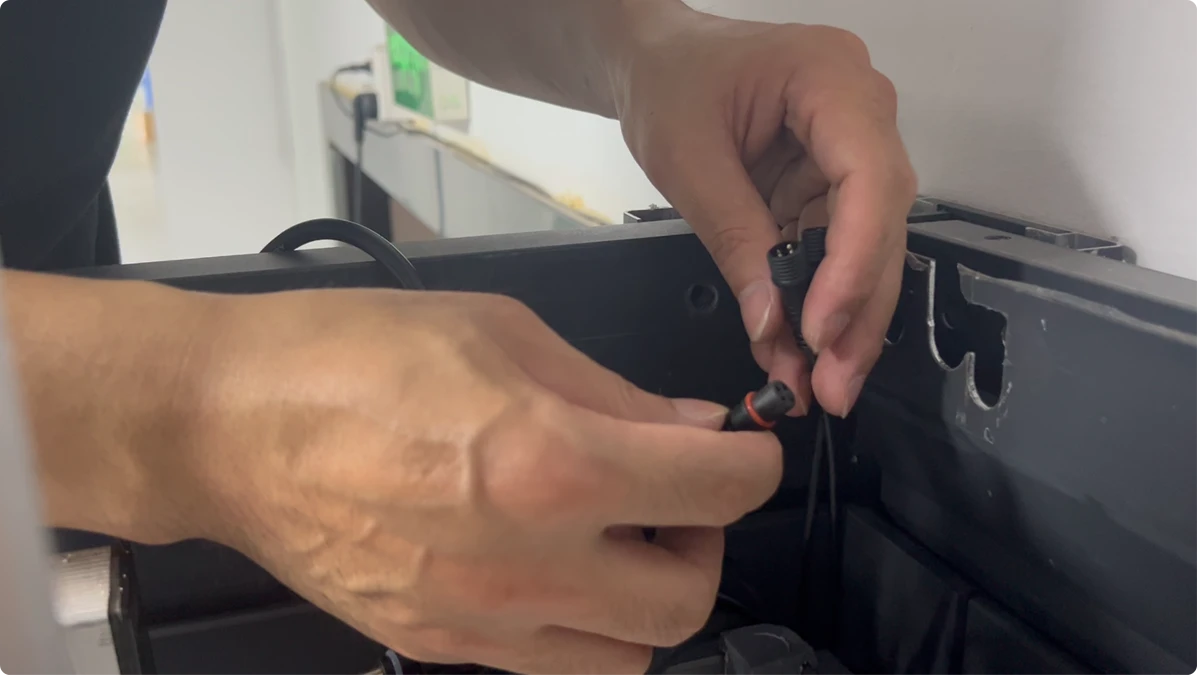
On hardscape jobsites in Europe and North America, asking workers on scaffolding to route wiring with wire strippers and soldering irons is unrealistic and risky. A mature lighting kit should fully adopt a plug-and-play electrical system based on male and female quick connectors.
This system uses asymmetric physical keyways — also known as polarized keyways — so that red/blue or positive/negative conductors cannot be reversed physically. Once the profiles are assembled, dealer installers only need to rotate and lock the pre-installed quick connectors inside the beams. A high-protection electrical node can be completed within seconds, avoiding the hidden cost of hiring expensive licensed electricians for field work.
S-Loops for Metal Thermal Expansion and Contraction
Aluminum alloys such as 6063-T6 have a high linear expansion coefficient, approximately 23 × 10⁻⁶ m/(m·K). This means that in a long-span aluminum pergola beam with a length of 20 ft, when ambient temperature rises from −10°C in winter to 40°C in summer, the absolute linear displacement caused by temperature difference is:
Formula — Thermal Expansion
If the internal wiring is completely straight and taut, this frequent long-term mechanical pulling can directly tear the weak copper foil circuit inside the LED strip or pull waterproof connectors loose, causing mysterious intermittent contact failures or permanent open-circuit failures.
To offset this profile expansion and contraction displacement, installation manuals and wiring designs must require a visible S-loop as a deformation buffer in transition areas where wires cross connection points, enter a post from buried conduit, or pass from a beam into the louver pivot axis. This extra bend acts like a mechanical spring — it smoothly absorbs displacement during extreme temperature changes, prevents connection points from bearing tensile and shear stress, and also follows gravity to guide condensation downward along the curve, preventing it from entering the controller cavity.
Wiring Separation to Eliminate Induced High-Voltage AC Flicker
Inside the limited space of a pergola post, 120V AC power cables often run alongside 24V DC low-voltage signal and lighting wires to supply high-power infrared electric heaters or louver motors. Under the strict separation requirements of NEC 725.136, power conductors and Class 2 low-voltage conductors must not run together without barriers inside the same physical conduit within a post.
AC power cables release strong high-frequency electromagnetic radiation during operation. If they are too close to long low-voltage control cables, they can induce a small alternating electromagnetic voltage on the low-voltage side. Although this induced current is not lethal, it can continuously energize LED driver chips enough to make pergola lights show faint flicker, ghost-like glow, or breathing flashes at night after the user has turned the power off.
Manufacturers must design dual-channel physical separation grooves inside aluminum posts or include flame-retardant insulating conduit sleeves in the kit, ensuring that power and low-voltage cables run separately and eliminating induced voltage and electromagnetic interference at the source.
Smart Control Architecture: Moving from Traditional Remotes to the Matter Ecosystem
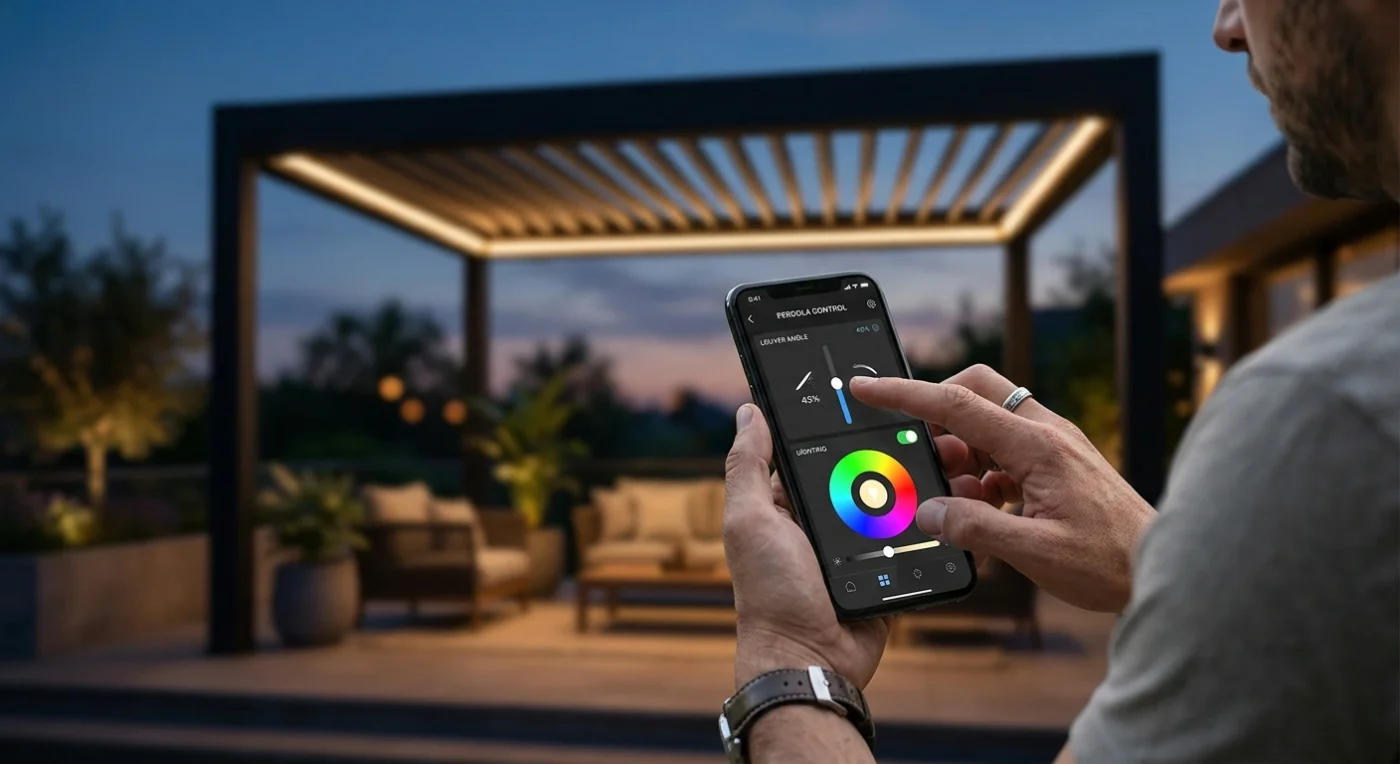
As outdoor smart-home ecosystems expand rapidly in European and North American households, users no longer expect pergola lighting control to be limited to traditional single-frequency RF remotes. Instead, they expect deeper integration across devices and whole-home scenes.
Evolution of Integrated Control Systems
The evolution of intelligent lighting control can be divided into three technical generations, showing a clear trend from closed and fragmented systems toward unified connectivity.
| Control Generation | Typical Technology Carrier | System Control Logic | Dealer and User Experience Pain Points |
|---|---|---|---|
| First generation: standalone RF control | Traditional 433 MHz RF remote | Point-to-point one-way control based on analog RF signals | Short control distance and weak anti-interference capability. Users cannot control the system by phone, and remotes are easy to lose. |
| Second generation: proprietary vendor app ecosystem | Closed proprietary control systems such as Ovia App and Govee Home App | Communication through Bluetooth/Wi-Fi modules and the vendor’s proprietary cloud platform | Every outdoor device requires a separate app. In environments without public internet access, local offline response becomes slow or may fail entirely. |
| Third generation: Matter-over-Thread | Matter-certified controller, Thread local network | Unified standard application-layer protocol with purely local connectivity through a low-power Thread mesh network | Direct support for Apple Home, Google Home, and Amazon Alexa, enabling true zero-latency, offline local automation and simple voice interaction. |
Commercial Premium of Matter Technology in Modern Smart Pergolas
Taking the globally recognized Nordic pergola brand PERGOLUX as an example, its latest Series 4 product line is now fully equipped with a next-generation Matter protocol control center. This decision greatly improves the purchase intent of technology-oriented end users and, at the business level, frees dealers from several burdens.
No dependency on third-party central gateways: Dealers do not need to spend time configuring a specific branded controller or third-party gateway on site. Once powered on, the pergola can be automatically discovered and securely paired by the user’s existing mainstream smart-home hub, such as Apple HomePod or Amazon Echo.
Multi-device, multi-screen interaction: End users can freely use a phone app, voice assistant, or even a waterproof multifunction remote to control louver opening angle, screen height, linear strip color, and heater temperature with one tap. This multidimensional sensory linkage creates a premium outdoor experience.
Establishing Technical Authority in the Dealer Channel Through a Modular Low-Voltage Electrical Platform
For pergola manufacturers in Europe and North America, lighting systems are no longer decorative accessories. They have become a decisive factor in overall delivery quality and dealer satisfaction. By building a systematic modular lighting solution based on 24V DC constant-voltage architecture, Class 2 limited-energy power protection, IP67/IP68 fluorosilicone integrated co-extruded airtight protection, and plug-and-play threaded connector wiring, manufacturers can turn uncertain on-site electrical assembly into simple, efficient, and predictable construction.
This engineering improvement provides major benefits for dealers: high-quality project delivery can be completed within a single day, while long-term callbacks caused by water ingress, black-wire corrosion, or electrical flicker can be reduced to nearly zero.
As a professional source integrator specializing in premium pergola smart lighting and microcomputer control systems, our analysis team is committed to providing full-spectrum OEM/ODM deep system customization and development services for leading global pergola manufacturers — from outdoor high-protection all-in-one smart LED drivers fully compliant with UL 1310 limited-energy certification, to abrasion-resistant embedded louver cable kits designed for alternating high and low temperatures.
Our professional system design team welcomes joint development with your R&D team. We can share complete low-voltage electrical compliance drawings and extreme-environment test data to help your pergola products build an unshakable technical position in the European and North American markets.

Ping de retour: Outdoor Kitchen Pergola Control Packages: Lighting, Louvers, Fans, and Sensors