


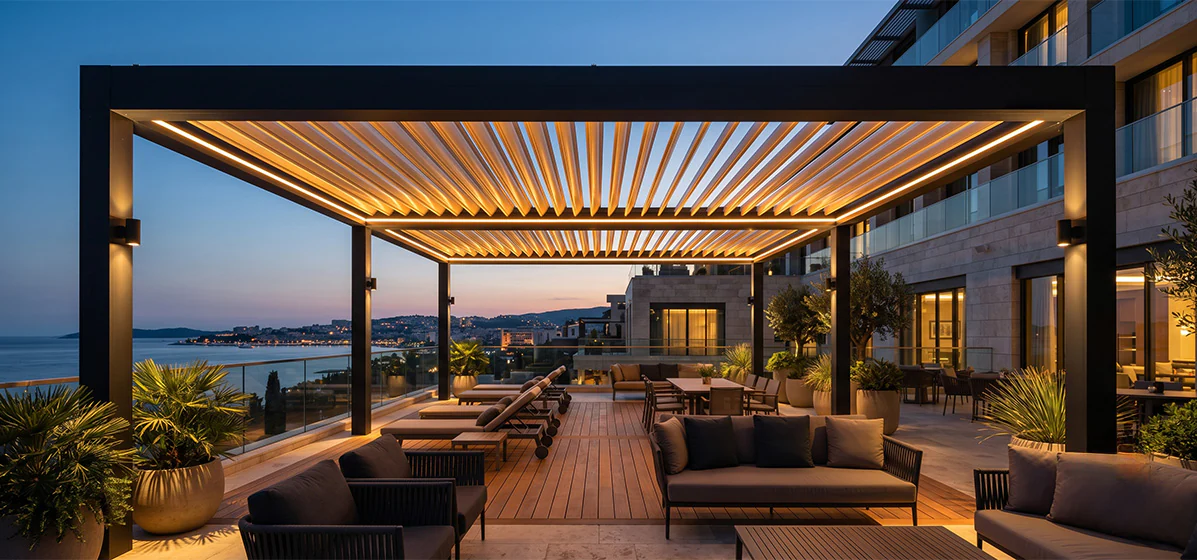
he underlying architecture of the high-end outdoor shading industry in Europe and North America is undergoing a profound technological reconstruction. Over the past decade, pergola manufacturers have generally focused their R&D on fundamental material science: extrusion processes for 6063-T5 aerospace-grade aluminum, the salt-spray corrosion resistance of powder coatings, and the load-bearing limits of structural posts. Yet as the physical properties of aluminum approach their practical ceiling, the core barrier that now determines the price premium, end-user experience, and after-sales maintenance cost of high-end bioclimatic pergolas has quietly shifted to electronic control systems.
An excellent pergola control system is far more than a simple stack of relays and switches. It is the central nervous system of the entire outdoor ecosystem. It must seamlessly coordinate multidimensional hardware, precisely drive the linear actuators and tubular motors responsible for louver rotation, finely modulate monochrome and RGB ambient lighting, and interpret complex climate data from wind, light, rain, and snow sensors in real time, triggering structural protection mechanisms within milliseconds. For pergola manufacturers seeking to build a technical moat in mainstream North American and European markets, understanding and applying a native all-in-one integrated control architecture is the essential path from a passive shading product to an active climate-adaptive space.
Reshaping the Drive Core: Control Logic for Linear Actuators and Tubular Motors
Within the mechanical transmission network of a bioclimatic pergola, the motor is not only the actuator; it is also the direct load endpoint of the control system. The mainstream power configurations in European and North American markets fall into two major categories: linear actuators and tubular motors. These two options differ fundamentally in physical structure, force model, and transient current requirements on the control board. A professional control system must output drive logic adapted to these distinctly different physical characteristics.
Linear actuators convert rotary motion into straight push-pull movement, providing direct mechanical thrust without gear backlash for aluminum louver rotation or roof translation. In heavy-load scenarios, such as thickened double-layer aluminum louver pergolas spanning more than 4 meters, the control system typically needs to coordinate heavy-duty linear actuators with thrust ranging from 1200 N to 3000 N, such as the W5 or N6 series. This direct-drive architecture eliminates the mechanical inertia and rebound introduced by traditional belts or external planetary gears, keeping louvers stable even under extreme stresses such as blizzards. For manufacturers, the control system must be able to intervene with millisecond-level overload protection. When louvers are frozen by winter ice and snow, the operating current of the motor coil can surge instantly. At that moment, the controller must cut output immediately to prevent motor burnout or irreversible fracture of the mechanical linkage.
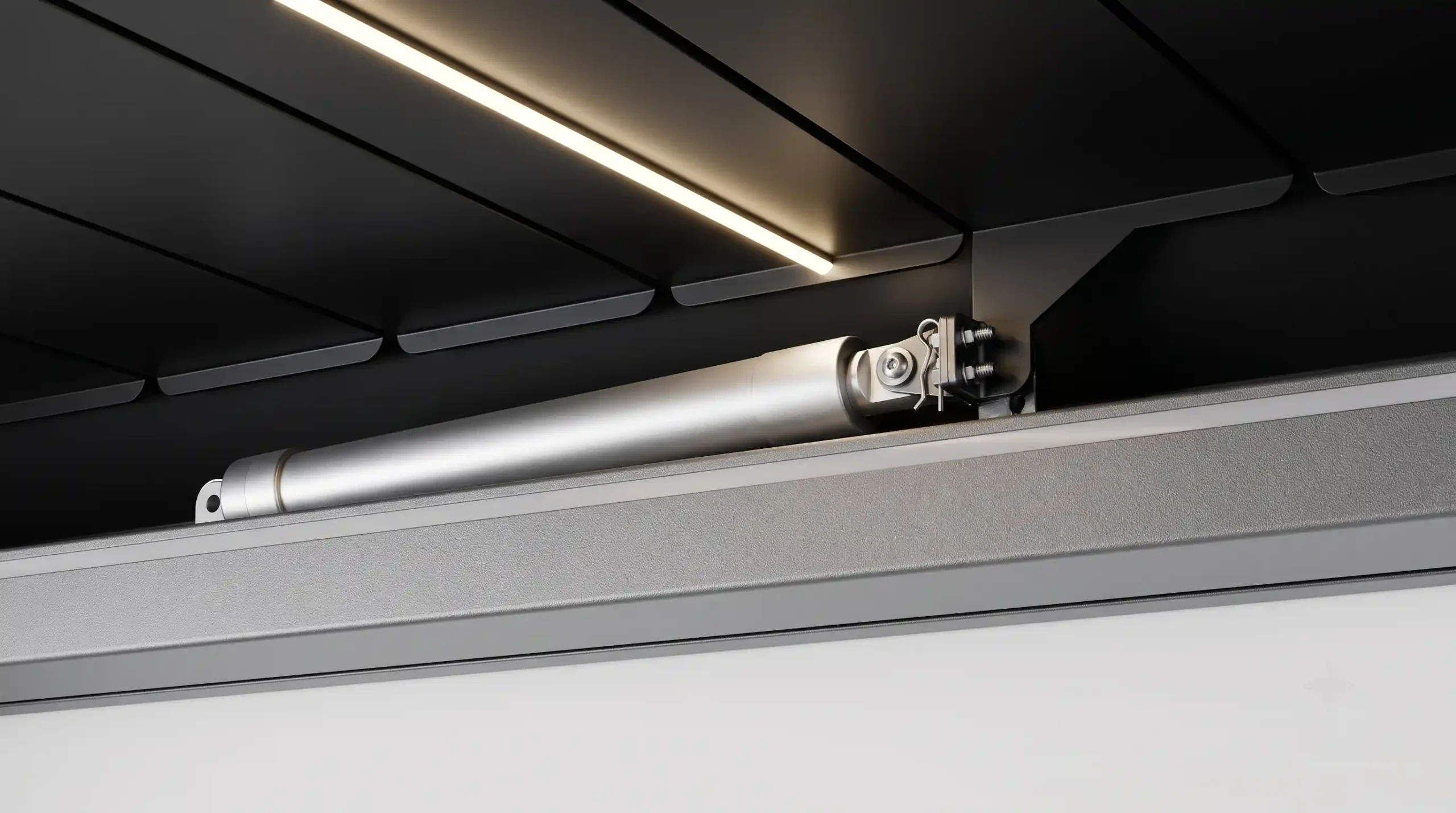
Linear motors also require extremely precise travel limit setting. A first-class integrated control system allows installation engineers to remotely set the fully extended and fully retracted digital nodes through an RF remote control. This digital limit management ensures smooth louver movement across the opening range from 0 degrees, fully closed and watertight, to 140 degrees, maximum ventilation. It eliminates impact noise at the physical end stops of metal components and greatly extends the fatigue life of the mechanical structure.
Compared with linear actuators that are directly exposed within the structural frame, tubular motors are usually hidden inside aluminum roller tubes and are widely used for windproof and mosquito-proof ZIP screens around the pergola, or for flexible fabric retractable roofs. The control logic for tubular motors focuses more on constant torque output and soft-start/soft-stop behavior. In voltage architecture, low-voltage DC tubular motors, typically 24 V or 36 V DC, are gradually replacing traditional mains AC motors and becoming standard in high-end residential projects. A DC control architecture not only greatly reduces operating noise, usually keeping it below 40–60 dB, but also gives the control board finer micro-step speed regulation while fitting perfectly with the increasingly common independent solar power systems used in modern courtyards.
The Interplay of Light and Microclimate: Precise Modulation of Multidimensional Lighting Matrices
Lighting is the key medium through which bioclimatic pergolas break the boundary between day and night and reshape the atmosphere of outdoor spaces. Under the traditional model, manufacturers often fall into a patchwork approach when assembling pergolas: the motor control box comes from one supplier, while the lighting dimming module comes from another. End users are left with multiple remote controls, fragmented control logic, and cluttered wiring boxes. A new generation of professional 4-in-1 integrated control systems coordinates complex lighting matrices at a deep level on the same underlying physical control board.
At the technical execution layer, high-end control systems use pulse width modulation, or PWM, to manage constant-voltage LED matrices. This high-refresh electrical control logic, for example a 1 kHz PWM frequency, ensures absolutely flicker-free and smooth brightness adjustment from 0 to 100 percent, whether observed by the naked eye or captured through high-definition camera equipment.
Monochrome lights are usually embedded as hidden light strips inside the louver blades or surrounding beams, providing basic warm white or neutral white illumination for nighttime reading or dining. A professional integrated controller assigns them independent power channels, ensuring that lighting voltage remains stable at the instant when the louver rotation motor starts under high current. The lights do not flicker at all.
In full-color and dynamic ambient lighting, RGB and RGBW, the parsing capability of the control system determines the quality of the light and shadow. RGB wall-washing strips or ambient outline lights around the pergola require highly precise color-mixing algorithms. Leading control boards include native RGB signal parsers, eliminating the need for bulky external third-party decoders. They can precisely select static colors and deliver dynamic color gradients with up to 1024 grayscale levels, including rainbow speed adjustment. This depth of lighting integration allows users to switch seamlessly between quiet reading and party scenes with a single remote control.
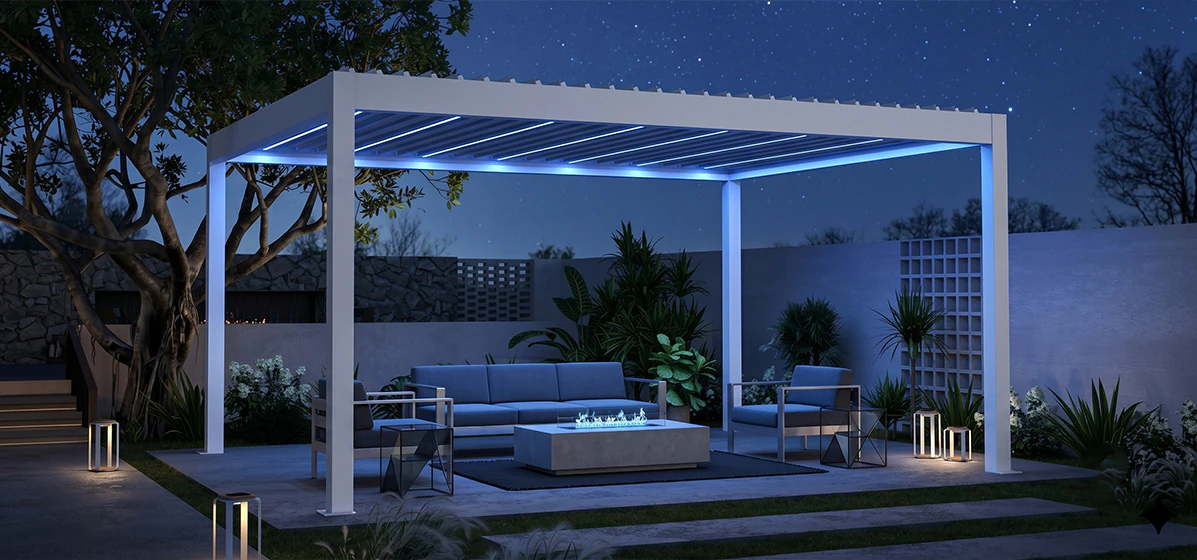
In addition, as outdoor electronic equipment exposed to complex weather conditions, lighting strips and control terminals must strictly follow the IEC 60529 international standard for dust and water resistance. Any compromise can lead to expensive cross-border after-sales costs. The first digit represents dust protection. For outdoor lighting, 6, meaning complete dust protection, is the non-negotiable baseline. Even a micron-level layer of dust on an LED chip can raise local temperature by 5–10 degrees F, accelerating thermal decay of the phosphor and causing irreversible color shift. The second digit defines water resistance: IP65 can resist low-pressure water jets and is the basic threshold for most wall-mounted luminaires; IP66 can withstand direct impact from a 100 L/min high-pressure water stream and is suitable for commercial environments that require frequent deep cleaning; IP67 allows the luminaire to be immersed in water 1 meter deep for 30 minutes, making it essential protection for buried nodes and control modules exposed to rooftop standing water.
Weather Defense Algorithms: Highest-Priority Logic for Wind, Light, Rain, and Snow Sensors
The reason a bioclimatic pergola can be called bioclimatic lies in the environmental perception and stress-defense capability of its control system, as sensitive as a biological nervous system. When wind, rain, and snow arrive, the sampling accuracy of sensors and the defensive algorithm of the control board directly determine the survival of the entire aluminum structure.
Wind load is the most destructive natural force facing a pergola. When strong wind passes over a flat, closed louvered roof, aerodynamic principles cause the faster airflow above the roof to generate enormous negative-pressure uplift forces, enough to pull loose posts out of their anchors or tear aluminum profiles apart. Therefore, once the system is connected to an anemometer, the control logic must assign it the absolute highest priority.
Once instantaneous or sustained wind speed reaches a dangerous threshold, for example 40 mph, the control board instantly removes the user’s manual control authority, forcibly locks out all scheduled tasks and smart-home operations by triggering a system-level lockout mechanism, and immediately instructs the linear motors to rotate the louvers to the angle with the least resistance, usually partially open so that strong wind can pass through the structure and unload the enormous aerodynamic uplift. At the same time, flexible windproof screens are forced to retract to prevent the fabric from tearing in high wind. To prevent motor overheating caused by frequent starts and stops during stormy weather with repeated gusts, advanced control logic sets a buffer lockout time lasting several hours, such as 4 hours after wind speed falls back. During this period, all automation commands are blocked until the weather threat has fully passed. This rigorous low-level algorithm is the technical foundation that allows a pergola to pass the strictest Class 6 wind resistance tests under the European EN 13561 external awning standard and EN 13659 shutter wind resistance standard, corresponding to wind speeds of 112 km/h and above.
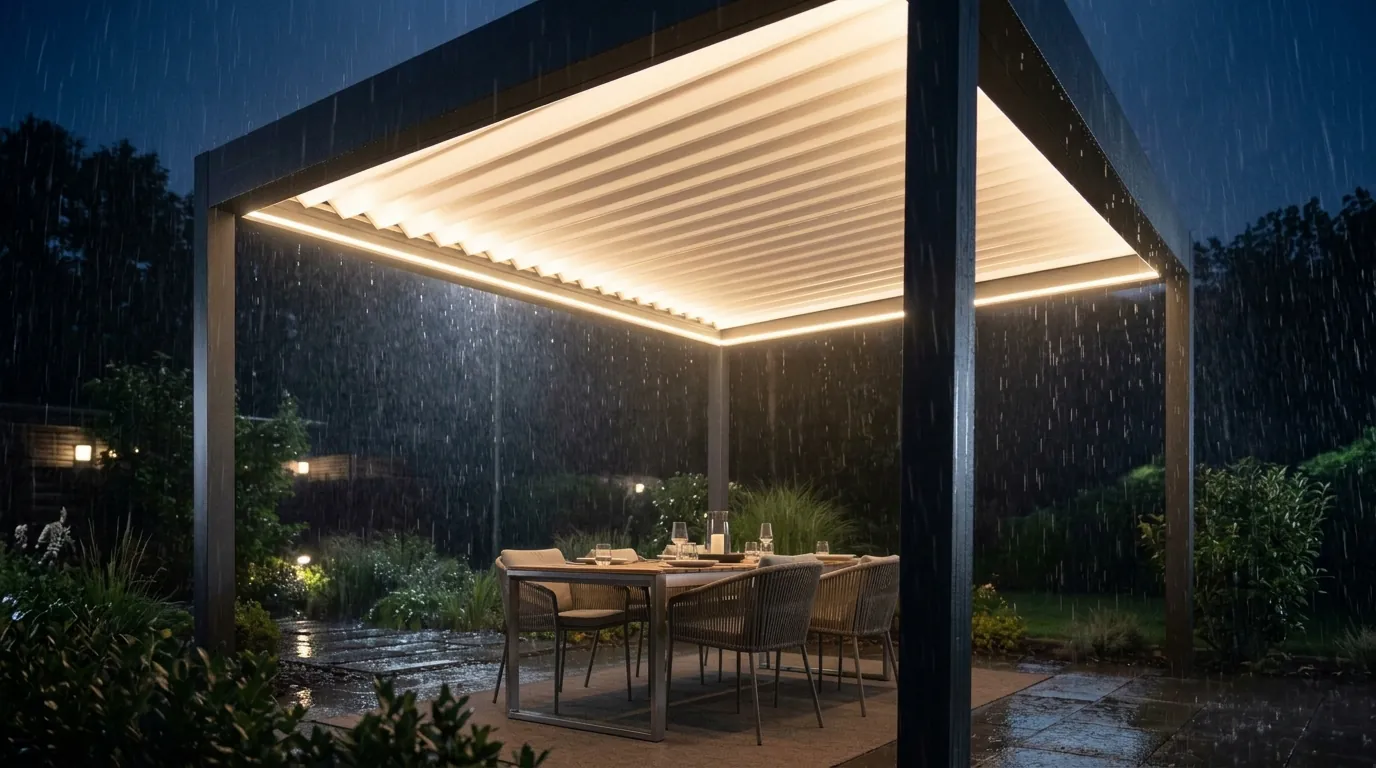
Defense against rain, snow, and low temperature also tests the intelligence of the control system. High-precision rain sensors trigger signals through the physical conductivity of surface moisture. When the first raindrop lands, the system must wake the motor within seconds, lock the louvers tightly closed, and activate the concealed gutter system inside the posts. Especially important is the integration of rain delay technology into professional low-level control logic. Before the moisture on the sensor probe surface has completely evaporated and dried, the system firmly refuses to execute any opening command, avoiding the awkward situation where intermittent dripping after rainfall wets expensive outdoor furniture.
In regions with more extreme climates, such as North America and Northern Europe, winter snowstorms bring not only low temperatures but also potentially lethal snow loads of up to 50–65 psf. Advanced weather sensors, such as the Breeze Pro series, automatically connect 12 V DC power to activate internal probe heating when the ambient temperature falls below 38 degrees F, about 3 degrees C, preventing the sensor itself from being covered by ice and snow and becoming blind. At the same time, the system estimates potential weight loads according to snowfall, intelligently adjusts the louver angle so snow slides off rather than accumulates, or directly links with the infrared heating array inside the pergola to actively melt snow.
For sunlight management, UV sensors perform fine thermodynamic adjustment. When the sun is intense, the control system automatically tilts the louvers to 45 degrees. This not only blocks harmful UV rays but also cleverly uses the physics of rising hot air, the chimney effect, to quickly extract the stuffy air gathered beneath the pergola through the gaps between the louvers, maintaining a comfortable microclimate. This intelligent sun-tracking greatly reduces the cooling load of adjacent indoor buildings and improves the overall energy efficiency of the property.
The Breakthrough: The Industry Revolution of a Native 4-in-1 Integrated Control Architecture
In the past, European and North American pergola assemblers long endured the pain caused by patchwork supply chains. Separately sourced motor drivers, lighting decoders, weather gateways, and RF remote modules turned on-site installation into a wiring nightmare. Communication handshake protocols between components from different brands often conflicted, sharply increasing professional electrician labor costs and leading to very high rates of terminal device repair.
During this technical bottleneck, 4-in-1 integrated control systems represented by VLEDSTAR PERGO Pro have redefined the electrical architecture of the pergola. A truly native integrated controller achieves physical and logical unification of four core modules through a highly optimized underlying motherboard: it precisely outputs 24 V DC to drive motors and store digital limits; assigns independent channels to handle stepless dimming for monochrome lighting; integrates hard-decoding chips to directly render the RGB ambient spectrum; and, most importantly, reserves physical direct-connect interfaces for sensors on the motherboard. This allows weather interruption signals to bypass unstable cloud networks and directly trigger electromechanical protection actions at the motherboard level, ensuring that even when home Wi-Fi fails during fierce wind and rain, the defense mechanism remains rock solid.
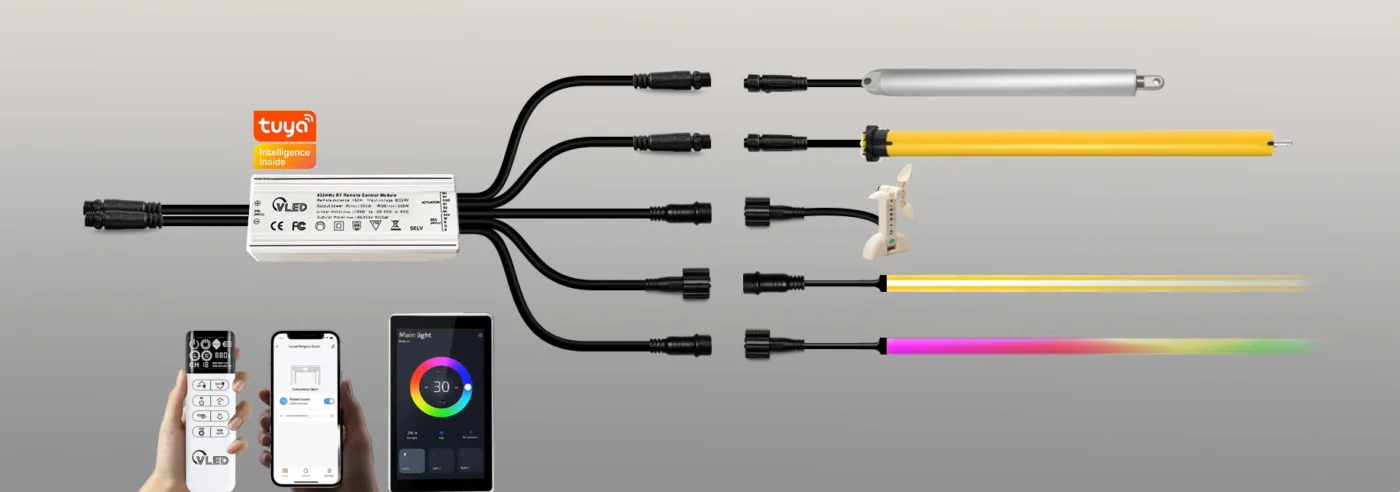
For commercial spaces such as golf clubs and luxury hotel terraces, where large multi-module connected pergolas are urgently needed, leading control systems adopt a 16-channel RF or digital addressing architecture. Through this architecture, managers can achieve single control, precisely adjusting the louver angle and lighting color above a specific seating area, or activate group synchronized control. The instant a command is issued through Channel 0, the main control channel, the linear motors of more than a dozen pergola modules push the louvers upward at exactly the same mechanical speed, while all light strips change color in sync. This almost exacting synchronization not only creates a striking visual effect but also prevents metal torsional stress in connected structures caused by inconsistent opening speeds.
IoT Integration: Extending Toward the Whole-Home Smart Ecosystem
Once the mechanical and low-level electrical control architecture has reached maturity, the outward extension of modern control systems points toward the Internet of Things. Traditional one-way RF remote controls can no longer satisfy contemporary users’ expectations for digital living.
By integrating smart hub centers such as Bond Bridge Pro or Somfy TaHoma switch, the integrated control system can seamlessly convert its underlying RF signals into Wi-Fi or Zigbee protocol networks. Going further, advanced control systems are embracing universal low-level protocols such as Matter, which means pergolas can be incorporated out of the box into the ecosystems of Apple HomeKit, Amazon Alexa, and Google Assistant.
Users no longer need to search everywhere for a remote control. With a simple voice command, a powerful API interface can call the automation scenes preset in the control system. For example, when morning coffee mode is triggered, the system automatically rotates the louvers to 30 degrees at 8 a.m. to welcome the morning light and turns on a soft warm outline light. When the family leaves and away mode is activated, the louvers automatically close to a fully watertight state, the windproof screens slowly lower, and the wind and rain sensors enter the highest level of defensive readiness. This seamless intelligent connection transforms a cold metal structure into a warm, smart living space.
Compliance, Cost, and Strategy: How Control Systems Reshape a Manufacturer’s Profit Statement
For pergola manufacturers seeking to fully capture mainstream European and North American markets, selecting the control system is not only a technical issue. It is a strategic decision involving regulatory access, supply chain efficiency, and corporate profit margin.
European and North American markets have extremely strict review systems for exterior building electrical equipment. The hardware circuits of the control system must pass comprehensive certification from authoritative bodies such as CE in Europe, UL/CUL in North America, and TUV. This includes electromagnetic compatibility, or EMC, testing; safety assessment under the Low Voltage Directive, or LVD; and RoHS environmental standards. At the physical testing level, the algorithm response speed of the control system must work perfectly with the mechanical structure in order to withstand pressure in laboratory wind tunnels and pass EN 13561 and EN 13659 standard tests. The more accurate the system’s prediction and the faster its lockout and unloading response, the more confidence manufacturers have when marking 130+ mph or even 200 mph hurricane-grade wind resistance in product specifications, allowing them to capture a substantial premium in the high-end market.
From the financial perspective of total cost of ownership, or TCO, the greatest hidden leverage of adopting a 4-in-1 integrated control system lies in dramatically reducing production complexity and after-sales burden. Traditional distributed solutions require experienced electricians to spend hours on-site stripping wires, crimping terminals, and troubleshooting relay conflicts. Highly integrated controllers use foolproof plug-and-play aerospace-grade connectors, allowing ordinary installers to complete the physical connection of motors, lighting, and sensors within minutes. At the same time, eliminating intermediate transition nodes removes most contact failures and protocol conflicts at the source. This native stability directly causes the manufacturer’s RMA, or return merchandise authorization, rate to drop sharply. The annual savings in cross-border after-sales travel costs and spare-parts replacement costs are converted directly into net profit on the company’s books.
The evolution of the bioclimatic pergola industry is, in essence, a leap from material-stacking engineering to mechatronic intelligent control engineering. In this process, the control system is no longer a marginal accessory hidden beneath aluminum profile covers. It is the brain and soul that define the product’s core value, protect structural life safety, and deliver a luxurious operating experience to users.
Whether the goal is to resist devastating hurricanes along the North American coastline, adapt to the cold and rainy variability of European climates, or satisfy the intense demand of high-net-worth consumers worldwide for seamless smart-home integration, a control system that integrates millisecond-level motor drive, delicate multi-zone light rendering, and proactive weather sensing is the ultimate weapon for any top-tier pergola manufacturer building a brand moat.
Say goodbye to fragile and complex patchwork components, and embrace the native power of integration. If you are looking for a more stable, more intelligent 4-in-1 core controller with 16-channel synchronization and digital limit capability for your next-generation flagship product, visit Pergola Control Systems now to explore professional integrated solutions customized for top European and North American outdoor shading applications, and help your products achieve a true competitive leap in the global market.

Pingback: Pacchetti di controllo per pergole da cucina all’aperto: illuminazione, lamelle orientabili, ventilatori e sensori
Pingback: Pacchetti di controllo per pergole da cucina all’aperto destinati agli OEM
Pingback: Sistemi di controllo per pergole a lamelle retrattili: requisiti relativi a motore, telecomando e sensori
Pingback: Soglie dei sensori del vento per pergolati: come trovare il giusto equilibrio tra sicurezza, rumore e comfort degli utenti
Pingback: Pergola Wind Sensor Thresholds: Safety, Noise, Comfort