


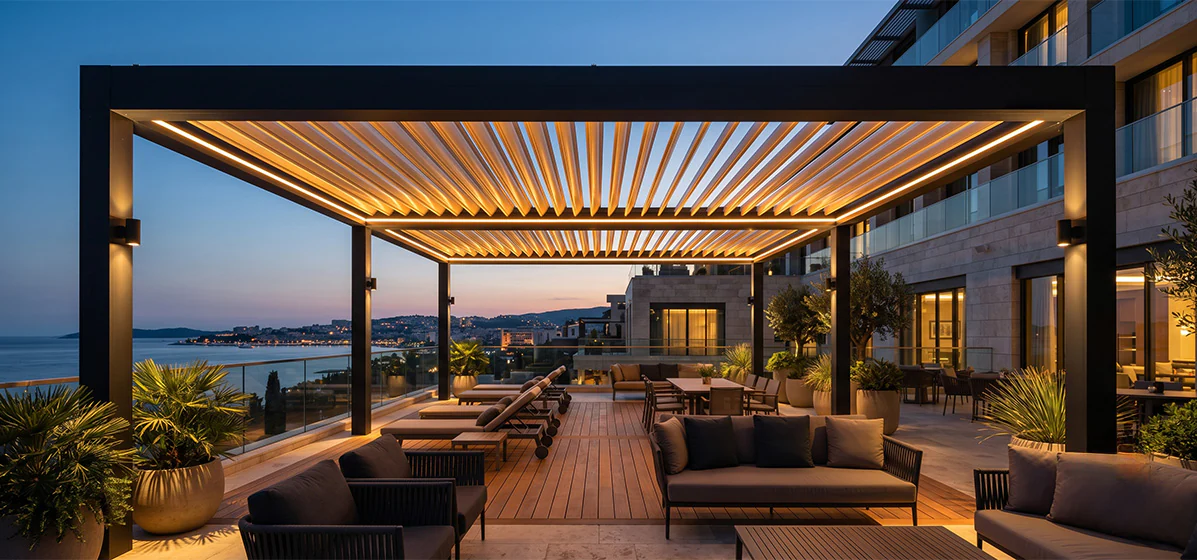
For smart retrofit projects involving existing motorized pergolas, the core technical requirements and commercial value proposition are undergoing a profound paradigm shift. Traditional physical shading structures can no longer satisfy modern commercial spaces’ demand for immersive experiences, environmental responsiveness, and dynamic brand communication. For advertising and media agencies, large stadium operators, premium retail brands, luxury hotels, and other commercial entities, upgrading an isolated aluminum pergola into a highly connected media-architecture node and environmental-control terminal is a key path to activating outdoor digital assets.
Based on an in-depth technical perspective from professional LED display manufacturing and high-end intelligent lighting control, this research report comprehensively deconstructs the underlying technical logic, electrical topology, and integration mechanisms for heterogeneous network protocols in motorized pergola retrofits. Through a close analysis of current mainstream control standards, including ANSI E1.11-2024, Art-Net, and DALI-2, the report aims to provide an engineering and strategic blueprint with strong implementation depth for the digital upgrade of commercial space assets.
Multidimensional Analysis and the Reshaping of Commercial Innovation Space
A deep deconstruction of current market search intent around “smart upgrades for motorized pergolas” reveals that the vast majority of existing technical guides and solutions are heavily skewed toward residential (B2C) or consumer-grade DIY applications. These entry-level retrofit guides typically follow a conservative, incremental path: solve basic lighting first, add privacy screens next, and finally bolt on rudimentary smart control built around consumer Wi-Fi modules. At the electrical and optical level, they generally recommend basic 12V or 24V single-color surface-mounted (SMD) LED strips and rely on simple relays or smart plugs for crude on/off logic.
From the standpoint of professional LED display and architectural lighting engineering, however, this consumer-grade framework suffers from fatal systemic gaps when confronted with commercial projects that demand high frequency, high concurrency, and extreme stability. The commercial innovation space must break out of the narrow definition of “physical shading plus basic lighting” and instead redefine the existing aluminum motorized pergola as a programmable dynamic media skeleton and an all-weather environmental response pod.
The strategic depth of a commercial-grade retrofit should strike directly at three dimensions of technical pain — and these form the core thesis of this report:
First, pixel-level control fused seamlessly with architectural media. The retrofit should not stop at static mood lighting; it should fully introduce addressable pixel nodes capable of high-refresh-rate playback, together with transparent LED technology — instantly converting the structure’s physical columns and glass partitions into media surfaces that carry video streams and dynamic brand color.
Second, the grand unification of heterogeneous protocol layers. A commercial pergola is crowded with low-level communication languages from different worlds: serial buses driving wind-rated screens, 0-10V or DALI-2 digital interfaces for architectural lighting, and the DMX512 protocol for stage-grade effects. Building one central brain capable of orchestrating all of these protocols is the make-or-break factor of the retrofit.
Third, an industrial-grade electrical topology and a thermodynamically stable system. Facing harsh outdoor environmental stress — coastal salt-spray corrosion, extreme temperature swings — and the long-duration, high-load duty cycles of commercial venues, fragile daisy-chain wiring must be abandoned wholesale in favor of NEMA 4X industrial enclosures, star network topology, and rigorous voltage-drop compensation models.
Layered Optical Design for Commercial Spaces & IESNA Standard Mapping
In a commercial-grade pergola retrofit, optical design must abandon crude single-point sources and undifferentiated floodlighting in favor of a three-dimensional photometric layering scheme that conforms to the rigorous standards of the Illuminating Engineering Society of North America (IESNA). Professional lighting engineering deconstructs the luminous environment into three independent yet interwoven layers — task, ambient, e accent/media — and assigns each its own dimming curve and trigger logic inside the central control system.
Task Lighting
Task lighting is the core layer that guarantees visual function across commercial dining, outdoor executive work areas, and refined product displays. Per IESNA outdoor recommendations, illuminance on dining and reading planes must be held precisely within the 30–50 foot-candle band — enough visual clarity, zero harsh glare. Correlated color temperature (CCT) must be strictly matched to the business format: dining areas mandate 2700K–3000K warm white, a band whose physical properties markedly improve food color rendering (CRI) and create a relaxed, highly inviting atmosphere. Conversely, if the pergola extends an outdoor business-meeting or corporate-training space, it must shift to a neutral 3500K–4000K, because cooler temperatures biologically suppress melatonin and sustain visual acuity and mental focus. To realize this layer, directional spotlights or downlights with deep anti-glare lenses are typically embedded in the top beams, mounted strictly 7–9 feet above the table surface.
Ambient Lighting
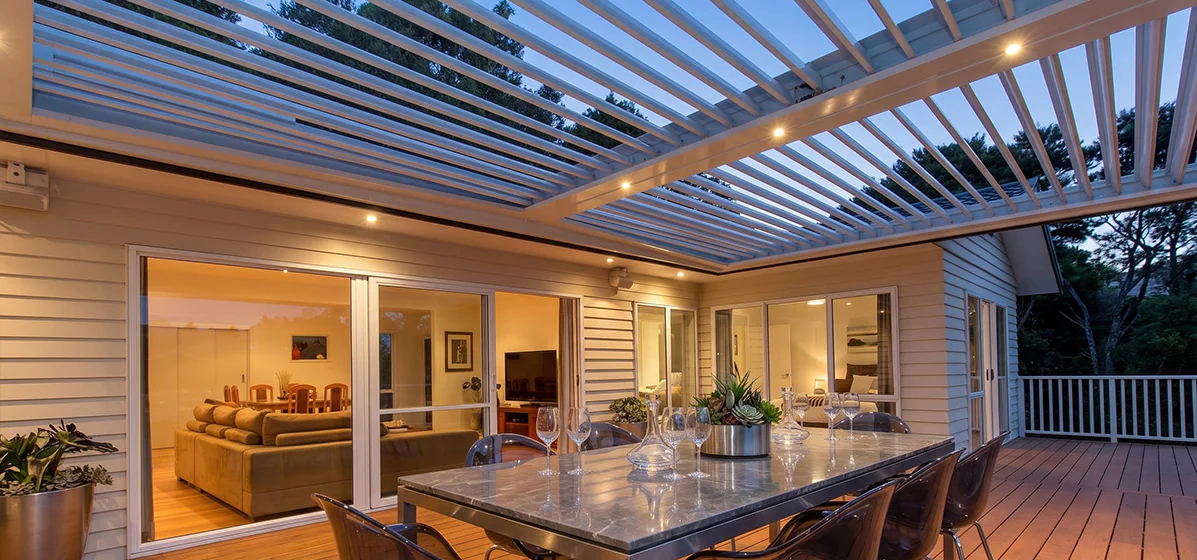
Ambient lighting lays the brightness baseline and the emotional tone for the entire canopy volume. For a luxury hotel lounge or a major event’s VIP viewing deck, ambient levels need only hold a low 10–20 foot-candles. On component selection: the SMD LED strips common in consumer retrofits readily produce visible “dotting” or banding under the diffuse reflection of aluminum profiles — an unacceptable flaw in a luxury venue. Commercial-grade retrofits therefore mandate linear sources built on COB (Chip-on-Board) packaging. With ultra-high-density die placement under a continuous phosphor layer, COB delivers an absolutely uniform, seamless ribbon of light without bulky diffusers — and with superior heat-spreading characteristics.
Accent & Media Lighting
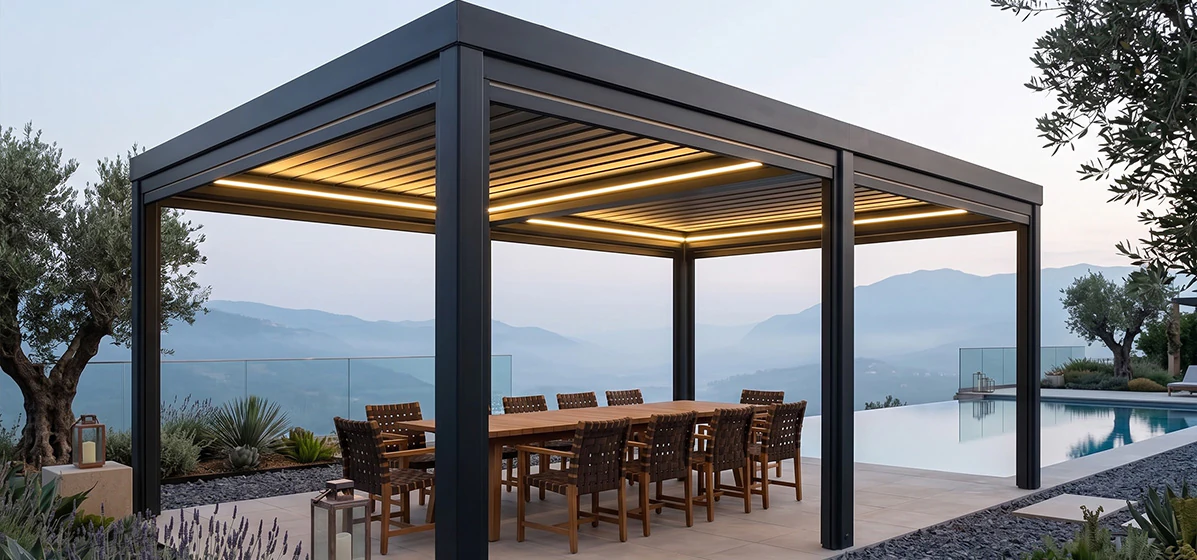
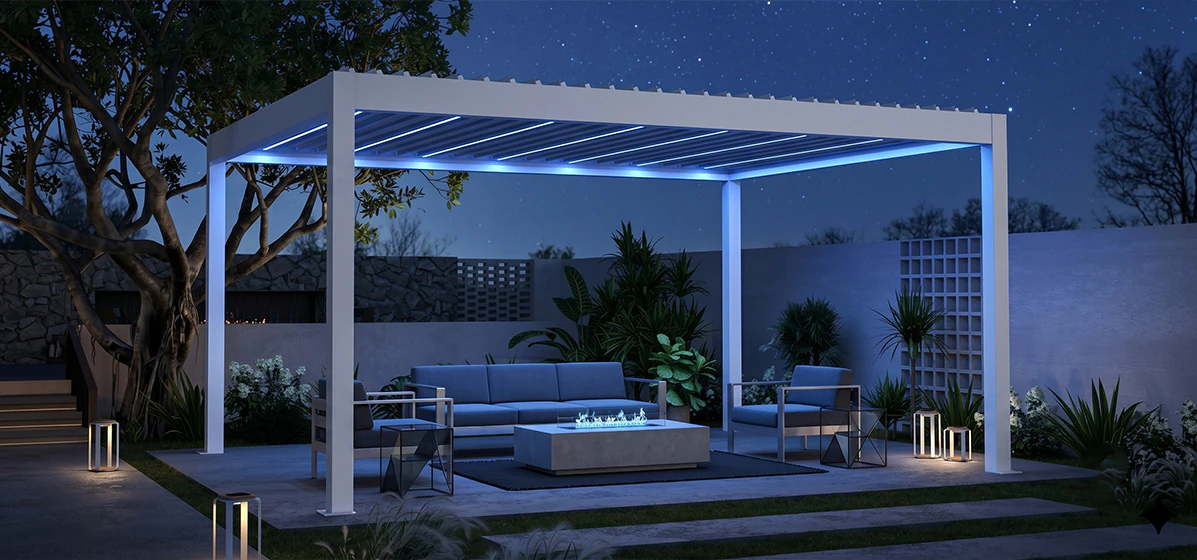
Accent and media lighting is the crowning touch from the LED-manufacturing and media perspective. Traditional accenting uses a faint 2–5 foot-candles to trace the geometric edges of aluminum columns or the architectural texture of the louvered roof, never competing with primary lighting. In a digital retrofit, this layer acquires dynamic media properties: by concealing high-IP-rated RGBW full-color sources inside louver tracks or columns and pairing them with programmable controllers, the structure itself disappears while deep canopy effects unfold through alternating color-band mapping — or the surface directly plays dynamic visuals synchronized to the brand’s visual identity.
| Optical Control Layer | IESNA Target Illuminance | Recommended CCT Range | Typical Commercial & Public Applications | Core Hardware & Technical Route |
|---|---|---|---|---|
| Task | 30 – 50 fc | 2700K – 4000K | Luxury al-fresco fine dining, brand pop-up display counters | Narrow-beam deep anti-glare downlights, track spotlights |
| Ambient | 10 – 20 fc | 2200K – 3000K | Hotel open-air lounges, stadium VIP boxes | COB seamless linear LED, high-output wall washers |
| Accent / Media | 2 – 5 fc (static mode) | Dynamic RGBW / full-spectrum tunable | Festival stage backdrops, architectural media façades, immersive interactive zones | DMX512 addressable pixel arrays, transparent LED display panels |
From Static Lighting to Digital Multiplexing: The DMX512 Technical Leap
For event-production companies and media agencies, the existing motorized pergola is a digital asset awaiting development. To turn it from a mere lighting carrier into a media display platform with a genuine frame-rate concept, completely rebuilding the underlying communication protocol is the only path. Traditional architectural lighting needs nothing more than switching the live conductor or nudging a 0-10V analog voltage; the dynamic performances of a modern commercial façade depend absolutely on digital multiplexing.
Since its first release by the United States Institute for Theatre Technology (USITT) in 1986, the DMX512 protocol has been revised repeatedly; the current official standard is ANSI E1.11-2024, published by the Entertainment Services and Technology Association (ESTA). The protocol long ago escaped its early confinement to stage dimming desks and is today the absolutely dominant standard linking controllers with architectural-grade intelligent fixtures, effects equipment, and building-façade pixel lights.
At the physical layer, DMX512 rides unidirectional EIA-485 (RS-485) differential signaling at a fixed 250 kbit/s. This asynchronous, half-duplex serial protocol gives the signal exceptional resistance to electromagnetic interference, well suited to complex outdoor EMI environments. The architecture divides the network into independent logical units called Universes, each containing 512 discrete control channels. Within each channel the system transmits a precise value from 0 to 255 to control one specific parameter of the target device — intensity, color, or even the tilt of a physical motor.
A 512-channel DMX Universe can independently drive up to 128 RGBW pixel nodes — 512 channels ÷ 4 channels per pixel — refreshed in a continuous stream at a typical 44 Hz.
RGBW channel mathematics
In high-end commercial pergola work, the engineering community broadly adopts RGBW four-channel fixture systems to cure the color-temperature drift, low CRI, and efficacy losses that arise when pure RGB tri-color mixing synthesizes white. The dedicated white die dramatically improves natural-white fidelity — and changes the channel-allocation math, as shown above. A standard DMX controller streams data to those nodes continuously, achieving pixel-smooth color transitions and complex animation mapping that satisfy the strictest dynamic-media requirements of large installations.
A complete DMX topology typically runs from a master console emitting the refresh stream, through optically isolated DMX splitters for regeneration and amplification, and finally to DMX decoders distributed throughout the pergola — which convert the digital signal into the pulse-width-modulated (PWM) constant-current or constant-voltage drive that lights the LEDs.
Beyond DMX’s Physical Limits: Ethernet Architecture & Large-Scale Art-Net Deployment
However dominant RS-485-based DMX512 may be in stability and adoption, its physical ceilings are exposed the moment a project scales to a modern commercial plaza, a major cultural-tourism development, or a panoramic pergola matrix dense with pixel nodes. Classic DMX512 caps a single bus at 400 meters (≈1,300 feet) and, without repeating splitters, at 32 physical unit loads. Worse, 250 kbit/s of bandwidth congests visibly — frame latency, data backlog — once thousands of HD pixels demand smooth playback on a complex media façade.
To shatter those hardware shackles, a commercial retrofit must cross the line-voltage/low-voltage divide and adopt high-order networking over Ethernet, where the Art-Net protocol (and its sibling sACN) is the industry’s breakthrough. Art-Net’s essence is the encapsulation of bulky DMX512 packets so they travel at high speed over standard UDP/IP across ordinary Ethernet media.
The value Art-Net brings to a pergola retrofit begins with a fundamental restructuring of network topology. A traditional DMX512 chain, being serial daisy-chain, is brittle: one cut cable or one shorted device takes down every node downstream, and fault isolation is miserable. Art-Net instead rides standard gigabit commercial switches to form a resilient star topology: every endpoint conversion node owns an independent data path, so a single physical failure is perfectly contained and can never cascade into a network-wide blackout — a dramatic uplift in fault tolerance for commercial operations.
Channel capacity expands exponentially. One IP address easily carries multiple Universes; in the protocol’s macro structure, every 16 Universes form a Subnet, 16 Subnets form a network tier, and up to 128 tiers are supported. At the theoretical extreme, a fully built Art-Net network sustains up to 32,768 Universes — releasing the full media expressiveness of the architectural envelope and letting an entire motorized pergola perform as one tile of a giant video matrix in city-scale lighting synchronization.
More critical still: high-end Art-Net-to-DMX converters (for example, Sundrax’s GigaJet and ArtGate series) endow the system with intelligent signal merging. In complex commercial scenarios this lets two entirely different control endpoints address the same fixture simultaneously, configurable as HTP (Highest Takes Precedence), LTP (Latest Takes Precedence), or explicit Priority modes.
The applied value is immediate. During ordinary trading hours, the pergola’s lighting is led by an internal timeline and ambient-light sensors, washing the architecture in a gentle glow. When a New Year’s countdown or a brand launch arrives, the show director’s professional lighting console seizes control over Ethernet in an instant — its Priority is set higher — and the pergola transforms into a dazzling strobe matrix locked to the stage. When the show ends and the console disconnects, the system falls back seamlessly to sensor-led steady-state logic: architectural lighting and performance effects, organically unified.
Fusing Mechanical Drive with Digital Vision: Multi-Modal Heterogeneous Protocol Bridging
Today’s commercial motorized pergolas — industry benchmarks such as StruXure, Equinox, Vergola, and Pergomatic — rely on line-voltage or low-voltage DC tubular motors as their core physical drive, precisely controlling the tilt of roof louvers to modulate daylight, or raising and lowering perimeter wind- and insect-screens. The single greatest pain point in systems integration is breaking the long-standing language barrier between the mechanical control system (the motor bus) and the digital visual system (lighting and display protocols).
High-end commercial motor platforms have abandoned dry contacts and one-way RF remotes, moving wholesale to digital communication matrices on RS485 serial interfaces. Take the architecture of Somfy, the world-leading French motor manufacturer: its premium series (the Glydea ULTRA RS485, the ST50 AC RS485) natively speak RS485 — not only accepting travel commands precise to the percentage point, but also reporting back to the control hub in real time the louvers’ physical tilt angle, the screens’ current height, and the motor’s thermal load. That is true bidirectional, closed-loop data exchange.
The key to this cross-domain fusion is the deployment of protocol bridges. In a Control4 ecosystem, for example, engineers typically install a dedicated digital motor interface (such as Somfy’s Control4-to-Digital-Motor Interface). Acting as a router node within the Zigbee mesh, the bridge seamlessly receives wireless Zigbee commands from a third-party high-order hub — Control4, Crestron — and translates them in real time into RS485 serial frames delivered to the motors over twisted pair. In the reverse direction, it publishes the motors’ encoder positions back into the Zigbee network for central-dashboard visualization and downstream logic decisions.
This depth of physical-and-data fusion gives the pergola formidable environmental self-adaptation and self-protection. With intelligent climate sensors folded into the system — for instance the Breeze Pro sensor in the Equinox ecosystem, monitoring instantaneous wind speed, rainfall, and UV intensity — engineers write highest-priority conditional triggers into the base firmware. The moment wind speed spikes past the safety threshold or heavy rain is detected, the sensor’s interrupt signal bypasses every app, voice command, and schedule and issues a mandatory protective order to the motors: retract all perimeter wind screens within seconds to shed structural wind load, and force the roof louvers into a 100% waterproof interlocked seal — shielding the fixtures, loudspeakers, and expensive outdoor furniture beneath from the worst of the weather.
Building the Commercial Digital Hub: Lutron Athena’s Architectural-Grade Application
For projects obsessed with circadian comfort and ultimate sensory experience — luxury hotels, corporate headquarters, museums, private clubs — owning DMX media nodes with high-frame-rate video capability is nowhere near enough. The space needs one full-domain orchestration brain that fuses natural daylight, tunable artificial lighting, architectural shading, and media effects into a single seamless network. In that context, introducing Lutron’s Athena architectural lighting-control system is widely regarded as the category-defining implementation path.
Athena demolishes the protocol silos of traditional lighting control. It natively supports legacy 0-10V analog dimming and phase-adaptive control, while fully embracing the forward-looking DALI-2 (Digital Addressable Lighting Interface) standard. As the DALI Alliance’s latest generation, DALI-2 codifies strict requirements in Part 207 (LED digital dimming), Part 209 (color control), and Part 202 (emergency lighting), enabling every compliant LED driver to perform precise bidirectional diagnostics and full-spectrum control. More striking still, Athena absorbs DMX512 — once reserved for stage effects — as a native module of its control network via a dedicated DMX interface. The result: from one unified Lutron management surface, an operator can hold the restaurant’s gentle DALI-2 warm glow in one hand and, in the same breath, unleash the ferocious DMX strobe matrix wrapped around the pergola’s exterior.
What cements Athena as the terminal choice for commercial venues is its uncompromising pursuit of human-centric lighting and its cloud-based distributed architecture. Through the coin-sized Athena Wireless Node and powerful DIN-rail processor modules, the pergola integrates seamlessly with Lutron’s Ketra dynamic natural-light system. Ketra fixtures carry high-precision on-board color-calibration chips that continuously and steplessly retune output CCT and intensity against the site’s exact coordinates and the real clock: the cool, faintly blue light of dawn (suppressing melatonin), gliding into high-intensity noon white (sharpening alertness), and finally melting into deeply warm amber before dusk (inviting relaxation) — a faithful simulation of the sun’s own circadian arc that measurably lifts guests’ comfort and dwell time.
Meanwhile, the cloud-connected Lutron Dashboard aggregates the pergola’s environmental data and energy statistics onto the central screens of a large commercial complex, letting property teams perform remote, cross-regional control and preventive maintenance from anywhere on the planet — digital asset management of the highest order.
Underlying Electrical Work, Thermal Planning & Anti-Corrosion Strategy for Hostile Climates
Beneath the grand narratives of digital protocol and software orchestration, every commercial pergola retrofit ultimately stands or falls on the rigor of its low-level electrical topology and its defenses against brutal outdoor physics — deep cold, scorching heat, driving rain, and salt-laden air. Ignore the physical behavior of low-voltage DC and the laws of heat dissipation, and the finest control platform becomes a castle in the air; system life and stability suffer catastrophically.
Hub-and-Spoke Topology Is Non-Negotiable
In residential DIY and budget outdoor lighting, contractors habitually daisy-chain — wiring every fixture nose to tail. Across a commercial pergola’s perimeter of dozens of meters, that serial structure breeds the fatal cumulative caduta di tensione: as current pushes through long, thin copper, the conductor’s inherent resistance bleeds energy away like friction. Visually, strips near the feed point glare while fixtures at the far end go dim; in RGB systems the far end even drifts into gross color distortion — a “white” scene turning pink or yellow — because the red, green, and blue dies require different forward voltages. And if any one segment in the chain breaks, everything downstream goes dark: an unforgivable defect where zero failure is the brief.
Professional electrical engineers therefore mandate a star, hub-and-spoke architecture: a central waterproof junction box (the hub) concealed at the pergola’s base, with independent feed branches (the spokes) running to every individual fixture or to strip segments no longer than 5–10 feet. The geometry guarantees a uniform voltage at every endpoint — erasing brightness inconsistency — while its physical isolation lets any single-point fault be located fast without disturbing the rest of the system.
Voltage-Drop Mathematics & Wire-Gauge Discipline
Precise voltage-drop calculation and scientific wire-gauge matching are the core laws of system longevity. In modern high-end commercial projects, 24V DC has fully displaced 12V DC as the baseline. The physics is simple: by the power identity (Power = Current × Voltage), the same total wattage draws only half the current at 24V. Because conductor heating and voltage loss scale with current, halving it suppresses both dramatically — allowing thinner cable to deliver power reliably over longer runs.
Engineering practice enforces an iron rule: total circuit voltage drop must stay within 3%–5% of nominal (for a 24V system, no more than 1.2V of loss). The governing model:
Vdrop
=
2 × L × I × R
1000
I — total circuit current in amps (load wattage ÷ system voltage) ·
R — resistance per 1,000 ft for the chosen gauge (e.g., 16 AWG ≈ 4.0 Ω/kft)
If the design-stage result exceeds the ideal 3%–4.4% safety threshold, the drawings must be revised immediately: thin 16 AWG runs are mandatorily upgraded to 14 AWG or even 12 AWG to cut physical impedance and guarantee lossless delivery of both power and control signal.
| Cable Run, Transformer → Load | Safe Gauge @ 12V DC | Safe Gauge @ 24V DC |
|---|---|---|
| 0 – 30 ft | 14 AWG | 16 AWG |
| 31 – 60 ft | 12 AWG | 14 AWG |
| 61 – 100 ft | 10 AWG | 12 AWG |
| Over 100 ft | 8 AWG (as trunk feeder) | 10 AWG |
Thermal Management: The Hidden Killer
Thermal distribution engineering is the technical blind spot non-professionals miss most often. The hollow columns and beams of a modern minimalist aluminum pergola are perfect raceways for hiding wire — and near-perfect sealed heat traps. Force a high-output commercial strip (especially high-power COB) into those closed aluminum U-channels or rail profiles, and its waste heat has no convective escape. Sustained excessive junction temperature accelerates phosphor aging inside the die, triggering irreversible lumen depreciation and gutting the fixture’s service life.
The construction remedy: bond a high-quality thermal interface material (TIM) or industrial high-conductivity double-sided tape seamlessly between the strip’s thermal substrate and the aluminum profile — cleverly converting the pergola’s entire metal skeleton into one vast passive heatsink that pumps heat into the open air. In software, senior engineers then cap maximum full-load brightness at roughly 80% of rated output: a remarkably cost-effective operations tactic that is invisible to the naked eye yet extends the array’s healthy life exponentially.
Power Headroom: The 20% Rule
In power-supply and transformer sizing, the governing principle is the absolute avoidance of thermal collapse under extreme conditions. Every outdoor commercial project selecting a switch-mode power supply (SMPS) or heavy magnetic transformer must observe the design floor of 20% extra safety headroom. If a supply zone’s LED strips, controller nodes, and small drive motors total 80W at full load, procurement must specify a transformer rated no lower than 100W (80W × 120% = 96W). This prevents prolonged-overload overheating, shutdowns, and fire risk — and banks current redundancy for future device additions and upgrades.
Ingress Protection, the 5-Mile Rule & Black Wire Disease
For pergolas living year-round under rainstorms, high humidity, and coastal salt spray, the strictest physical isolation and metallurgical anti-corrosion specifications apply. All concealed runs through the hollow structure must comply with the mandatory low-voltage lighting provisions of NEC Article 411, with vertical runs through concealed spaces carrying CL2 or higher CL3 flame-retardant certification. Every exposed LED fixture, connector, and driver node must be rated IP67 minimum (surviving brief immersion and pressure-washer jets); in typhoon-exposed coastal zones or low-lying areas prone to standing water, that requirement rises unconditionally to IP68.
For coastal luxury resorts and seaside commercial districts, the trade enforces a non-negotiable “5-Mile Coastline Rule.” Within five miles of the shore, the atmosphere carries persistently high concentrations of chloride ions and salt aerosols whose corrosivity is severe: the common Type 304 stainless hardware, anchor bolts, and brackets sold everywhere develop rapid pitting corrosion and structural embrittlement there — a genuine collapse hazard. All structural metal connectors, motor enclosures, and fixture backplates in such locations must be upgraded to molybdenum-alloyed Type 316 medical/marine-grade stainless steel, resisting salt attack at the molecular level.
Finally, the wiring itself faces a lethal coastal hazard known as “black wire disease.” Where a junction on standard bare-copper conductor is imperfectly sealed, capillary action inside the insulation continuously wicks in salt-laden humid air; within months the pure copper core oxidizes black and turns brittle. Line resistance climbs sharply, voltage drop spirals, and the system eventually burns out. For extreme commercial sites, every low-voltage DC feeder from the transformer must be replaced wholesale with surface-treated tinned copper wire, and every control hub, communications gateway, and transformer module must be sealed inside industrial enclosures meeting the NEMA 4X anti-corrosion standard — securing decades of stable service for the system’s entire nervous system.
Grand Narratives for Vertical Commercial Scenarios: Algorithm-Driven Automation Scripts
Piling up smart hardware nodes does not automatically generate commercial value. For the target audiences — advertising and media giants, large stadium operators, luxury hotel groups — what actually commands a premium and reshapes the customer experience are automation scripts: routines deeply aligned with business logic, driven jointly by sensors and precision timeline algorithms. Below are tailored strategic blueprints by vertical.
Luxury Hotels, Cultural-Tourism Estates & Premium F&B
Core demand: an imperceptible, deeply immersive, fully climate-adaptive luxury environment. Implementation path: a Lutron Athena or Control4 flagship processor as the system brain, logic-binding the perimeter climate-sensor array, whisper-quiet Somfy RS485 motors, and a lighting matrix that orchestrates both DALI-2 and DMX.
On a clear summer evening — roughly 30 minutes before sunset — the system pulls live astronomical data and fires the algorithm engine. The roof louvers rotate precisely to a 45-degree transmission angle, maximizing the spectacular natural afterglow, while the concealed DALI-2 ambient layer fades from 0% to a full 2700K warm 100% over a 10–15 minute curve so smooth the eye cannot catch it — stitching the handover from natural to artificial light to perfection. Should a downpour strike mid-way through a VIP open-air dinner, the rooftop rain and wind sensors fire instantly. Their interrupt enjoys absolute top execution priority over every routine program: within a five-second golden response window the louvers slam into a 100% waterproof interlock while the perimeter screens descend in unison, sealing the space. The instant daylight is physically blocked, the Lutron system detects the illuminance dip and commands the task layer above each dining table to compensate brightness upward by 20% — the VIP guests’ visual experience never flickers. Composure and elegance, engineered.
Stadiums, Music Festivals & Brand Pop-Up Launches
Core demand: awe-inspiring brand visual dominance with the media firepower to detonate a crowd’s energy on cue. Implementation path: abandon lighting-think entirely; build a highly redundant star Ethernet network on high-bandwidth Art-Net. In the digital dimension the pergola is no longer a shade structure but a giant fixture group and playback matrix within the DMX logical universe — dense anti-glare RGBW HD pixel bars hidden along its broad columns and louver tracks, large-area high-transmittance transparent LED video panels bonded seamlessly onto its glass wind partitions.
During a brand’s annual launch or a decisive sporting clash, the pergola matrix outside the venue waits in a primed standby state. At the climax — a buzzer-beating goal, a stunning product reveal — the show director’s console fires a dry-contact or network UDP command. The trigger streaks over Ethernet into the pergola’s signal-merging gateway, instantly suppressing routine architectural lighting. In a flash, the exterior transparent LED skins and the interior pixel strips erupt: ferocious red-and-white (or brand-color) strobing at the hardware’s 44 Hz limit, or a colossal color waterfall carrying the brand logo — a media-façade shockwave that conducts the arena’s fever straight out into the open city.
Universities, Corporate Campuses & Government Facilities
Core demand: uncompromising long-term energy efficiency, unattended operation, and rigorous nighttime safety and anti-intrusion defense. Implementation path: a self-healing Matter/Thread low-power wireless mesh, broad deployment of PoE (Power over Ethernet) nodes, multi-sensor occupancy/motion arrays, and an advanced closed-loop daylight-harvesting algorithm.
Through the long unattended hours of deep night, the system holds the pergola in energy-saving sleep at an ultra-low 5% boundary glow — just enough perimeter guidance light to keep the CCTV cameras correctly exposed. The moment the Thread PIR array or microwave radar detects unknown footfall (or a patrolling guard) approaching the perimeter, the algorithm wakes instantly: tracking the movement path, surging column and ground-boundary zones to 100% illuminance to strip away the dark, and slewing CCTV heads toward the area for priority recording. Once the system confirms departure and a set dwell timer elapses, the light dissolves back to its 5% glimmer along an exquisitely slow curve. This precise on-demand response not only multiplies the deterrent power of the public space — across a full lifecycle financial model it delivers 40%–60% lighting-grid energy savings for large institutions, squarely aligned with global green ESG strategy.
From Passive Shade to Strategic Digital Asset
Elevating a traditional motorized pergola — once a merely passive piece of “physical shading” — into an all-weather, climate-adaptive core asset with serious digital media distribution capability is far beyond what a few stick-on light strips or a bolt-on Wi-Fi remote can deliver. It is a high-order electrical reconstruction campaign that fuses structural mechanics, three-dimensional photometry, digital network engineering, and disciplined thermodynamic planning.
By fully embracing the digital protocol cluster anchored on DMX512 and Art-Net, the dynamic media potential of the LED pixel matrix is released into space. By adopting an architectural-grade macro hub such as Lutron Athena, cross-protocol, whole-domain scene orchestration becomes reality. And by holding the line on hardcore electrical construction standards — coastal anti-corrosion, industrial IP encapsulation, hub-and-spoke topology — the modern commercial operator can break the static limits of physical architecture and turn the pergola into a core weapon for driving foot traffic, extending nighttime trading hours, and maximizing the brand’s digital visual dominance.
Early positioning in this class of digital spatial infrastructure is not merely a disruption of today’s dull commercial experience — it is a forward strategic claim on the next decade’s digital commercial discourse power.
Strategic outlook
To the advertising and media giants, large retail matrices, and luxury hospitality teams determined to lead the experience economy: before launching an architectural intelligence upgrade at any scale, shed consumer-grade habits of mind. Engage directly with professional LED display solution manufacturers of deep technical pedigree and with commercial smart-system integrators holding top-tier credentials such as CEDIA certification. Only by building a precise three-dimensional optical mapping model, deploying a high-bandwidth, low-latency gigabit control network, and committing to a thermodynamic wiring plan that can survive the test of time will your outdoor digital architecture hold a generational technical lead — and rock-solid operational stability — through the storms of the decade ahead.

Inviaci la tua richiesta