


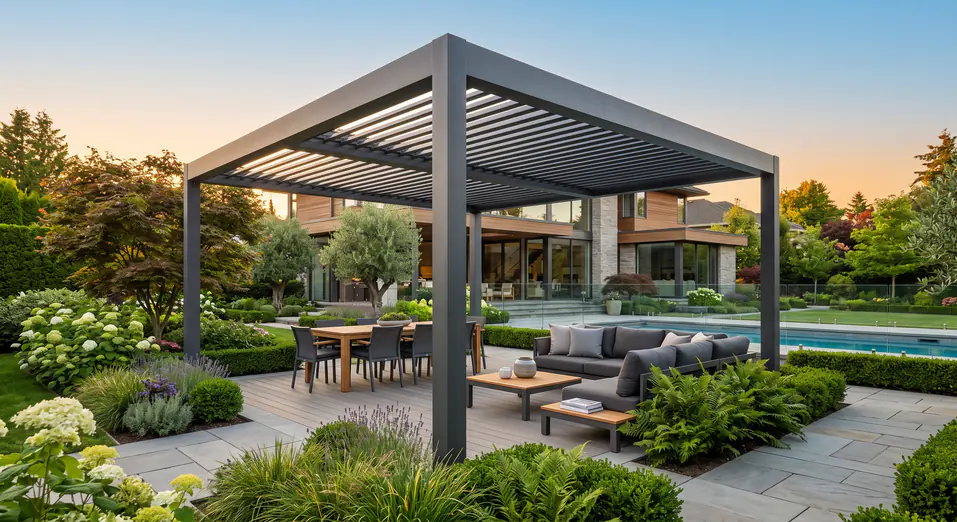
magine this scenario. Your engineering team has just completed the installation of a custom motorized louvered aluminum pergola in the backyard of a high-end residential client. The project is worth tens of thousands of dollars. It features flawless powder coating, concealed drainage channels shaped by careful hydrodynamic design, and a structure engineered to withstand hurricane-force winds up to 150 mph. You hand it over with confidence, backed by a 15-year structural warranty.
Then, after only a few autumn rainstorms, the client calls in anger. They claim the pergola is leaking badly, and some aluminum edges are already bubbling and rusting.
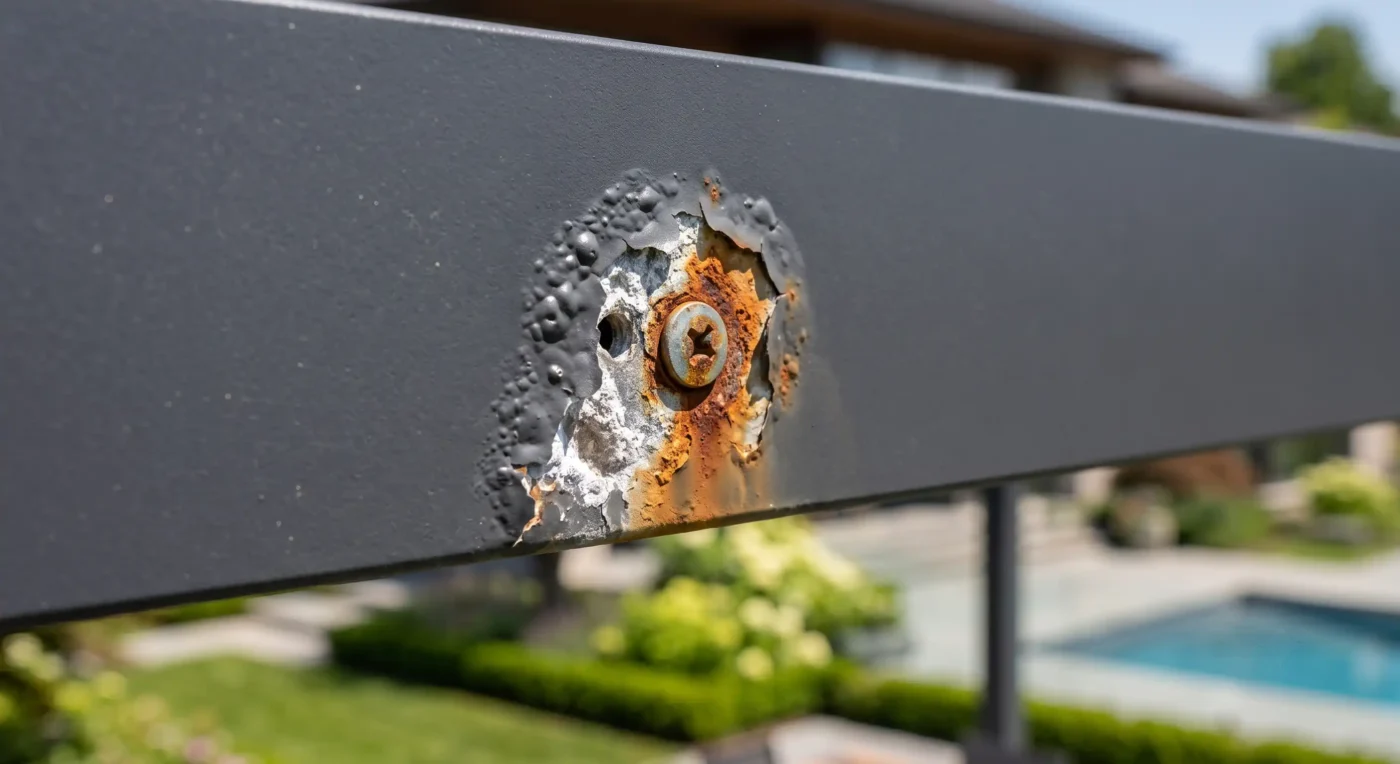
When your technical manager arrives on site, the cause is painful to see. To create what they thought was a romantic festive atmosphere, the homeowner hired a non-professional installer who drilled directly into your waterproof beams and structural posts just to hang a cheap set of retail string lights bought for $50. That single decision pierced the system’s primary waterproof barrier, and the low-grade galvanized screws triggered irreversible galvanic corrosion against the aluminum frame.
As a professional manufacturer focused on illuminazione della pergola e smart pergola control systems for European and North American markets, VLEDSTAR hears versions of this story every year from pergola brands, dealers, and installation teams. Consumer-facing content celebrates string lights for flexibility, nostalgia, and low cost, while treating integrated LED systems as expensive and impersonal. From a B2B manufacturer’s point of view, however, this is not an aesthetic preference. It is a strategic decision that affects ASP, brand positioning, structural risk, warranty exposure, and long-term smart-home competitiveness.
In 2026, the outdoor living structure market is being reshaped by both technological acceleration and rising consumer expectations. This article examines the real difference between string lights and integrated LED systems through the lens of market data, engineering logic, warranty economics, Matter interoperability, and DarkSky compliance.
The Macroeconomic Shift in the Outdoor Living Market
To understand why lighting now holds strategic value inside a pergola product line, we have to step beyond shade and shelter alone. In Europe and North America, pergolas are no longer viewed as optional backyard accessories. Designers increasingly define them as seamless indoor-outdoor living spaces.
1.1 High Structural Spending and Demographic Tailwinds
According to the “2025/2026 U.S. Home Improvement Report” released by Harvard University’s Joint Center for Housing Studies (JCHS), despite headwinds from inflation and fluctuating mortgage rates, U.S. consumers’ annual spending on home improvement and maintenance has remained stable at a high level of over $600 billion. Behind this massive pool of funds lie profound demographic shifts:
- Aging in place among baby boomers. Older homeowners are investing more in safe, comfortable outdoor environments with slip-resistant illumination, accessible circulation, and easy-to-control systems. That directly increases demand for glare-free, high-output, automation-ready integrated lighting.
- Asset-minded millennial homeowners. A large share of millennial buyers want outdoor upgrades that visibly enhance resale value. Exposed string-light wiring often signals a temporary, rental-style solution. A built-in smart LED system signals permanence, customization, and premium property value.
1.2 A Dual Boom in Outdoor Structures and Outdoor Lighting
Market forecasts show strong parallel growth across pergola structures, outdoor lighting, and intelligent LED control.
| Segment | 2025/2026 Market Size | 2033/2036 Forecast | CAGR | Key Drivers |
|---|---|---|---|---|
| Global outdoor living structures | USD 3.3 billion (2025) | USD 6.6 billion (2036) | 6.5% | North America leads; Europe growing fast; pergolas hold a major share |
| Global outdoor lighting | USD 16.27 billion (2025) | USD 28.43 billion (2030) | 8.4% to 9.4% | LED dominance, commercial and premium residential demand |
| Smart outdoor LED control solutions | USD 760 million (2025) | USD 3.28 billion (2032) | 23.15% | Matter, IoT integration, smart-home and smart-city adoption |
These trends point to one commercial reality: in 2026, lighting and climate control are no longer optional add-ons. They are part of the core infrastructure of a modern outdoor room. If manufacturers do not offer professional integrated lighting, homeowners will often fill the gap after delivery with third-party string lights that create avoidable technical and reputational risk.
Why String Lights Look Attractive to Consumers but Dangerous to Manufacturers
Consumer articles often compare string lights and custom lighting only on two axes: ambiance and upfront cost. That narrow framing is exactly what creates so many post-installation problems for pergola brands.
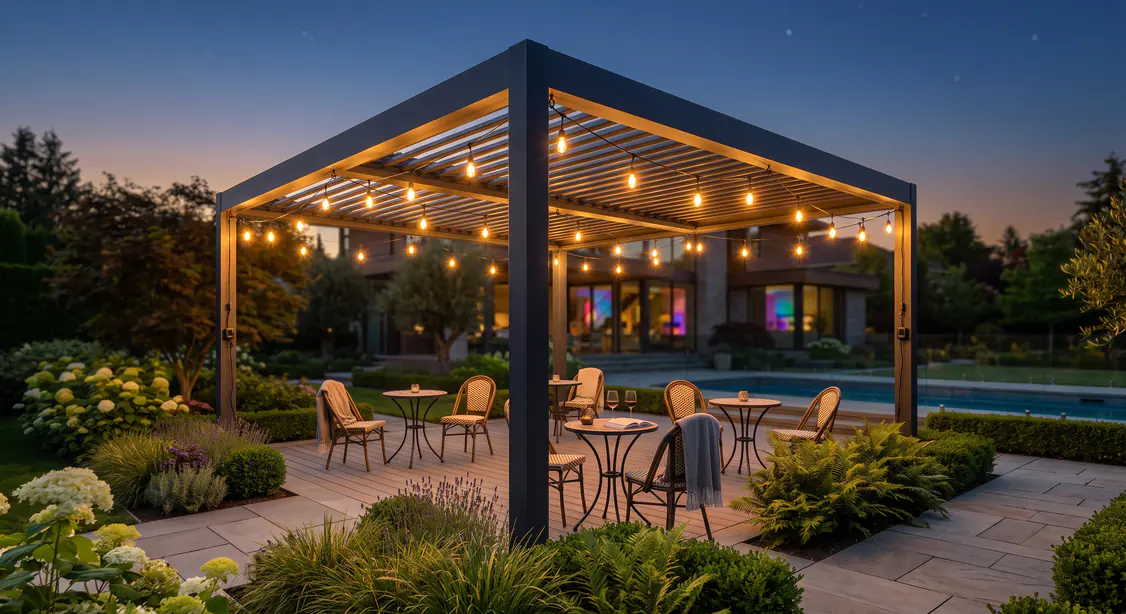
2.1 Why Consumers Love String Lights
String lights are easy to understand and easy to buy.
- They are inexpensive, typically ranging from $30 to $200.
- They are widely available through Amazon, Home Depot, and other mass retailers.
- They create an instantly recognizable “cafe” or “holiday” mood.
- They appear to be plug-and-play and simple enough for DIY use.
For homeowners, that combination feels low-risk and highly visual.
2.2 The Engineering Reality Behind the Mood
From a lifecycle cost and brand-management perspective, string lights bring serious weaknesses.
Poor weather resistance and short service life
Most retail-grade string lights use PVC jackets and low-grade contact components. Under freeze-thaw cycles, salt air, UV exposure, and moisture, cables harden and crack, bulbs take in water, clips fail, and circuits short. After only one or two full seasonal cycles, the entire installation can look neglected. That is a terrible match for a pergola system designed to last for decades.
Weak lighting performance for real outdoor living
String lights mainly provide diffuse ambient glow. They often create glare at night, and they do very little for functional tasks. In 2026, many pergolas include outdoor kitchens, dining zones, prep counters, and reading areas. A weak all-direction glow cannot support safe food prep, clear visibility, or premium usability.
Destruction of architectural aesthetics
Modern aluminum pergolas are defined by clean architectural lines. String lights introduce exposed black or green cords, extension cables, loose hooks, and visible plugs. What should feel like integrated outdoor architecture quickly starts to look temporary and improvised.
The Manufacturer’s Hidden Pain Point: Structural Damage and Warranty Exposure
For pergola manufacturers, the issue is not just visual. It is physical, mechanical, and financial. Modern louvered pergolas depend on precision water management. When louvers close, interlocking seals channel rain into concealed gutters within the beams. Water then follows a calculated drainage slope through internal downflow paths inside the posts. This is a tightly engineered system. Small unauthorized modifications can compromise the whole structure.
3.1 The Cascade Triggered by DIY Drilling
When homeowners fasten string lights to a pergola, they often use drills and generic screws. That simple action can trigger several forms of failure.
| Type of Damage | Mechanism | Resulting Risk |
|---|---|---|
| Waterproof barrier failure | Drilling pierces hollow beams or gutter walls; low-cost sealants crack under thermal expansion and contraction | Water intrusion, internal pooling, dripping onto furniture or electrical parts, warranty disputes framed as “product leakage” |
| Galvanic corrosion | Zinc-coated screws contact aluminum in a wet electrolyte environment | Pitting, bubbling powder coat, visible corrosion, reduced structural integrity |
| Motion-system interference | Hanging cables swing in wind or snag moving louvers, pins, shafts, or linkage arms | Burned motors, damaged control boards, incomplete closure, uneven loading, torn louvers |
3.2 Why Warranty Language Does Not Save the Brand
Most pergola manufacturers already include strict exclusions in their warranty terms:
- Structural frames may carry 10- to 15-year protection.
- Unauthorized drilling, third-party modifications, and damage from non-approved accessories are typically excluded.
- Electrical components are often covered for only 2 to 5 years, and usually only when installed by authorized personnel during the original build.
The legal position may be clear, but the commercial damage is not avoided. When a homeowner creates the problem with aftermarket string lights, they rarely blame themselves. They leave negative public reviews and accuse the pergola brand of poor waterproofing or bad design. The manufacturer then pays for site visits, diagnosis, and brand repair even if the warranty claim is formally rejected.
The only proactive defense is to offer an integrated factory-approved lighting package from the start.
What Integrated Pergola LED Lighting Should Really Mean
True integrated LED pergola lighting is not just a bulb hidden inside aluminum. It is the coordinated result of structural design, optics, materials science, and control planning. A professional integrated pergola lighting solution should deliver the following advantages.
4.1 Architectural Integration and Invisible Wiring
The best lighting design follows a simple rule: see the light, not the fixture.
- Factory-planned concealed wiring. Low-voltage waterproof harnesses are routed through dedicated internal paths, with hidden junction boxes and plug-and-play waterproof connectors.
- Recessed or flush-mounted fixtures. Downlights and micro spotlights sit neatly inside beams or posts without interfering with louver movement.
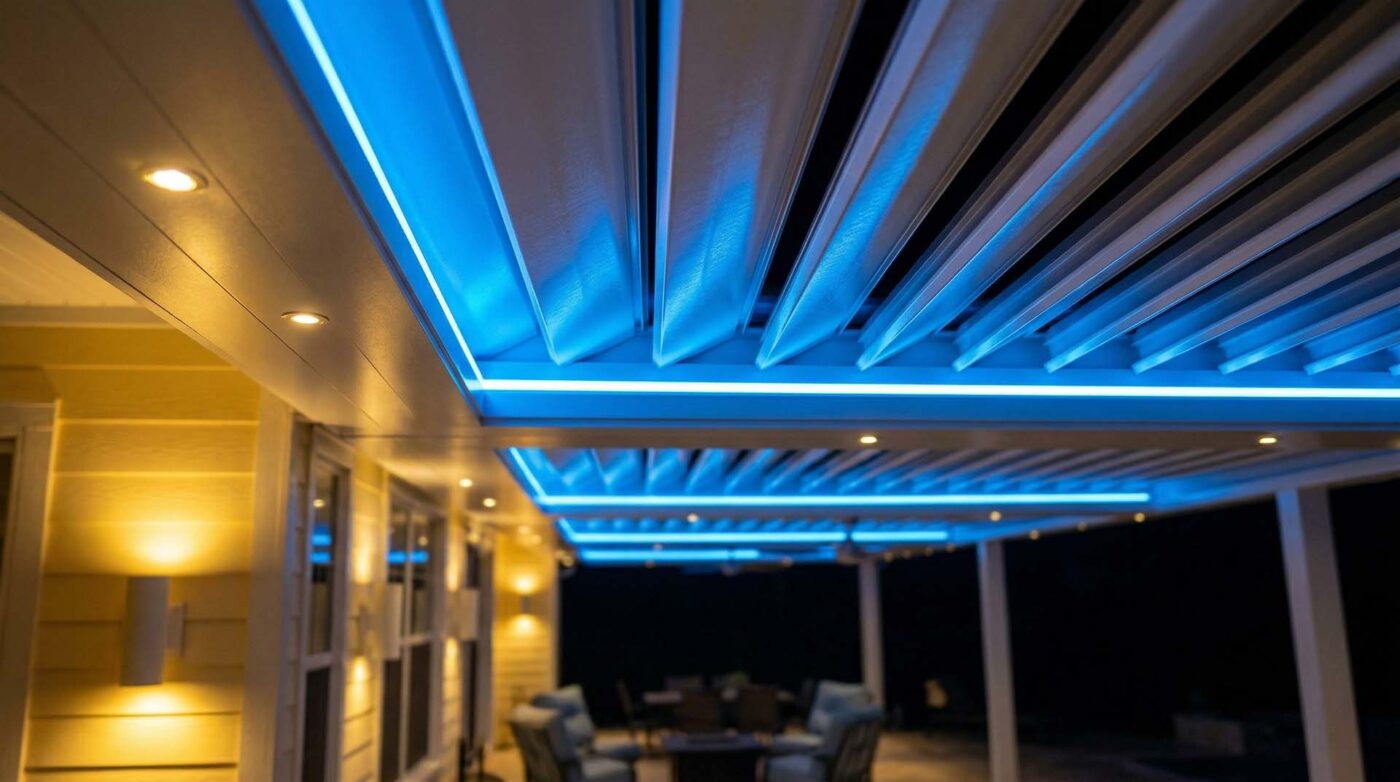
- Protected linear lighting channels. LED strips should be housed in custom aluminum profiles with UV-resistant polycarbonate diffusers to achieve dot-free illumination while shielding electronics from rain, moisture, and UV degradation.
4.2 A Layered Lighting Strategy for Premium Outdoor Spaces
High-end pergolas should be lit more like indoor living rooms than like patios with decorative bulbs. Manufacturers can increase both performance and margin by packaging multiple lighting layers:
- Ambient lighting. Linear LED strips around beams or inside posts create soft, glare-controlled background illumination.
- Task lighting. Adjustable downlights or mini spotlights above dining tables, bars, and BBQ zones provide focused illumination where visibility matters.
- Accent lighting. Uplights, perimeter strips, or silicone neon lines highlight columns, textures, and geometry to create visual depth.
This layered approach turns lighting from a decorative afterthought into a value-driving design feature.
4.3 Reliability That Matches the Pergola Itself
Commercial-grade integrated LED systems use solid-state components rather than fragile glass filament bulbs. Lifetimes over 25,000 hours are normal. Proper thermal management, corrosion-resistant fixture bodies, and outdoor-rated housings make the system credible across extreme cold, high heat, and constant humidity. For manufacturers, that reliability keeps the customer’s lighting budget inside your product ecosystem instead of losing it to retail string-light vendors.
The 2026 Control Divide: Matter and True Smart Integration
If the lighting conversation stops at “does it turn on,” the biggest strategic shift in the market gets missed. The real moat is interoperability and automation. That is where a professional sistema di controllo della pergola changes the game.
5.1 Matter 1.4+ Ends the Smart-Home Island Problem
For years, smart-home users suffered from fragmented systems. One app controlled the louvers, another app controlled RGB lighting, and other devices belonged to Apple HomeKit, Google Home, or Alexa ecosystems with limited cross-communication.
By 2026, the Matter standard—led by the Connectivity Standards Alliance (CSA), which brings together hundreds of tech giants such as Apple, Google, and Amazon—had become the undisputed leader in the global smart device market. It fundamentally reshaped the way outdoor devices connect:
- Thread mesh networking. Controllers installed inside pergola posts can act as stable nodes rather than depending on weak edge-of-yard Wi-Fi.
- Multi-admin compatibility. A single QR code can allow the same system to join Apple Home, Google Home, and Amazon Alexa environments.
- Local execution. Matter operates over local IPv6 networks, reducing cloud dependency, cutting latency, and keeping lighting control available even during internet outages.
| Control Dimension | Smart Plug + String Lights | Matter-Based Integrated System |
|---|---|---|
| Network architecture | Depends on unstable outdoor Wi-Fi | Built on Thread mesh for broader, more stable coverage |
| Ecosystem compatibility | Often tied to one platform | Native compatibility across major ecosystems |
| Latency and privacy | Cloud-routed commands, higher delay, more privacy exposure | Local execution, faster response, stronger privacy |
| Onboarding experience | Separate app downloads and account setup | Simple scan-and-connect through system-level smart-home apps |
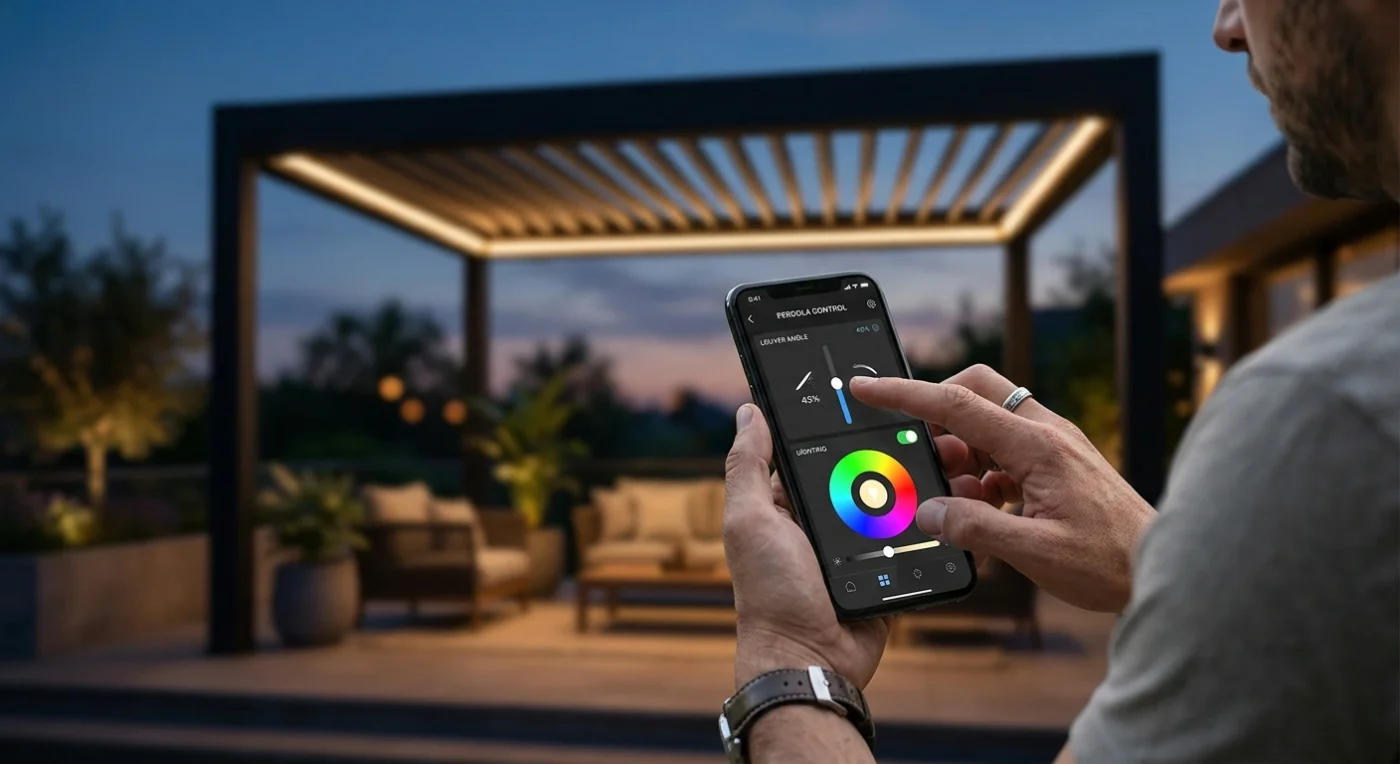
For pergola brands, choosing a ready-made Matter-capable control platform also avoids the cost and distraction of building and maintaining a fragile proprietary app stack.
5.2 Smart Scenes and Environmental Response
Once a pergola includes a real control gateway, it stops being a passive structure and becomes a responsive outdoor environment.
- Climate response. When wind, rain, or sunlight sensors detect changing weather, the system can close louvers and automatically raise lighting output for safety and visibility.
- RGBW scene control. Advanced engines can switch from warm 3000K reading light to seasonal or event-based color scenes with simple voice commands or preset scenes.
- Whole-system coordination. Lighting, motors, weather sensors, and additional accessories can be managed through one unified logic layer rather than as isolated devices.
That level of integration is simply not possible with third-party hanging string lights.
Compliance Is Becoming a Competitive Weapon: DarkSky and Sustainability
Integrated LED systems are not only about margin and aesthetics. They are also increasingly necessary for regulatory and environmental compliance. As global light pollution continues to worsen, municipalities, HOAs, and eco-conscious residential developments are paying more attention to outdoor lighting standards. In many projects, DarkSky-aligned design is no longer optional.
6.1 Why String Lights Fail the DarkSky Test
Traditional string lights violate the core principles of responsible nighttime lighting:
- Bare bulbs emit light in multiple directions, including upward.
- Their uncontrolled glow contributes to skyglow and light trespass.
- Wind movement can send light across property lines into neighboring bedrooms and gardens.
- Many products use cooler color temperatures or inconsistent lamp quality that work against ecological goals.
In upscale communities, this kind of improvised lighting can become a compliance problem as well as a neighbor-relations problem.
6.2 How Integrated Systems Create a Compliance Moat
Professional manufacturers can design integrated systems around DarkSky-friendly principles:
- Full cutoff distribution. Recessed optics keep output below the horizontal plane and prevent uplight.
- Warm color temperature control. A baseline of 2200K to 3000K fits both compliance expectations and premium outdoor ambiance.
- Curfew dimming. With a smart control core, lighting can automatically dim to very low output late at night and rise only when occupancy is detected.
Selling a pergola platform that is stylish, ecologically responsible, and easier to approve in regulated communities creates powerful commercial differentiation.
Conclusion: Manufacturers Need to Lead, Not React
When we combine market direction, engineering risk, warranty economics, Matter interoperability, and DarkSky compliance, the conclusion is clear.
In the 2026 and future outdoor-structure market, integrated LED lighting and smart controls are no longer optional extras. They are core strategic tools for protecting ASP, preventing physical damage, strengthening brand trust, and meeting the expectations of premium residential and commercial buyers.
Allowing customers to drill into a carefully engineered waterproof pergola just to hang cheap decorative bulbs is commercially irrational. Manufacturers should take control before that happens by making lighting and controls part of the original product offer.
At VLEDSTAR, we help pergola brands build that advantage through end-to-end solutions that combine concealed fixture integration, low-voltage wiring logic, Matter-ready hardware, and outdoor-rated optical performance. For brands that want to move beyond reactive warranty disputes and into higher-value product strategy, factory-integrated lighting is no longer a nice option. It is the standard that defines the next generation of premium pergolas.

Inviaci la tua richiesta