











LED luminaires have garnered widespread attention and application due to their extended service life. However, how long can LED luminaires actually last? This is a question requiring scientific testing methods and standardised reports for resolution. Within the modern lighting industry, the lifespan of LED luminaires is primarily assessed through three key reports: LM-80, TM-21, and LxxByy. These reports respectively provide data on the lumen maintenance rate of LED chips, lifespan projections, and lifespan requirements within tender specifications.
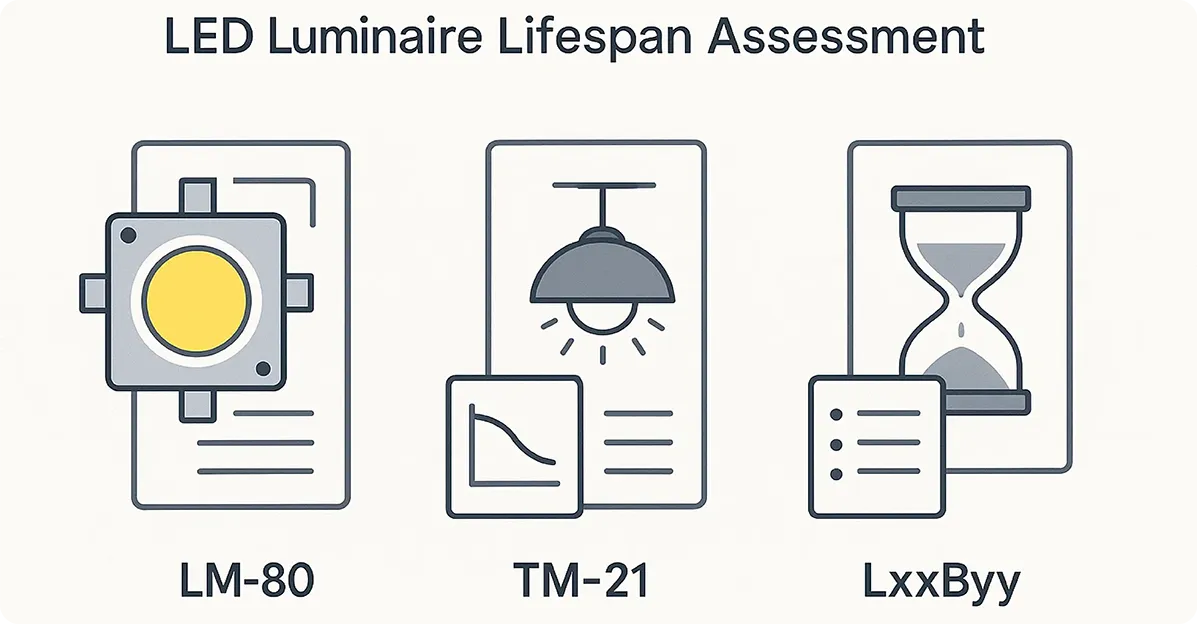
LM-80 is a standard established by the Illuminating Engineering Society (IES), primarily used to test the lumen maintenance of LED packages, modules, or arrays.
The principal purpose of LM-80 is to provide data on the lumen depreciation of LED chips under varying temperatures and currents, thereby furnishing foundational information for predicting the lifespan of LED products. This report is typically employed for energy efficiency certifications, such as ENERGY STAR and DLC certification in the North American market.
Test Method:
- Test Conditions: LM-80 testing must be conducted at a minimum of three distinct temperatures (typically 55°C, 85°C, and a manufacturer-selected temperature such as 105°C), while maintaining a constant LED drive current.
- Test Duration: Testing shall continue for at least 6,000 hours, with data recorded every 1,000 hours. For more precise predictions, extending to 10,000 hours is recommended.
- Luminous Flux Maintenance: Test results display the curve of luminous flux decay over time, indicating the maintenance of luminous flux at different time points for the LED light source.
Test Report Content:
- Luminous Flux Decay Curve: The trend of luminous flux decay under each temperature condition, illustrating changes in luminous flux.
- Colour Difference Data: Changes in colour difference between 6000 hours and 0 hours for the LED, assessing colour drift.
- Acceptance Criteria: Sample quantity, colour difference, decay rate, and other metrics must comply with certification requirements.
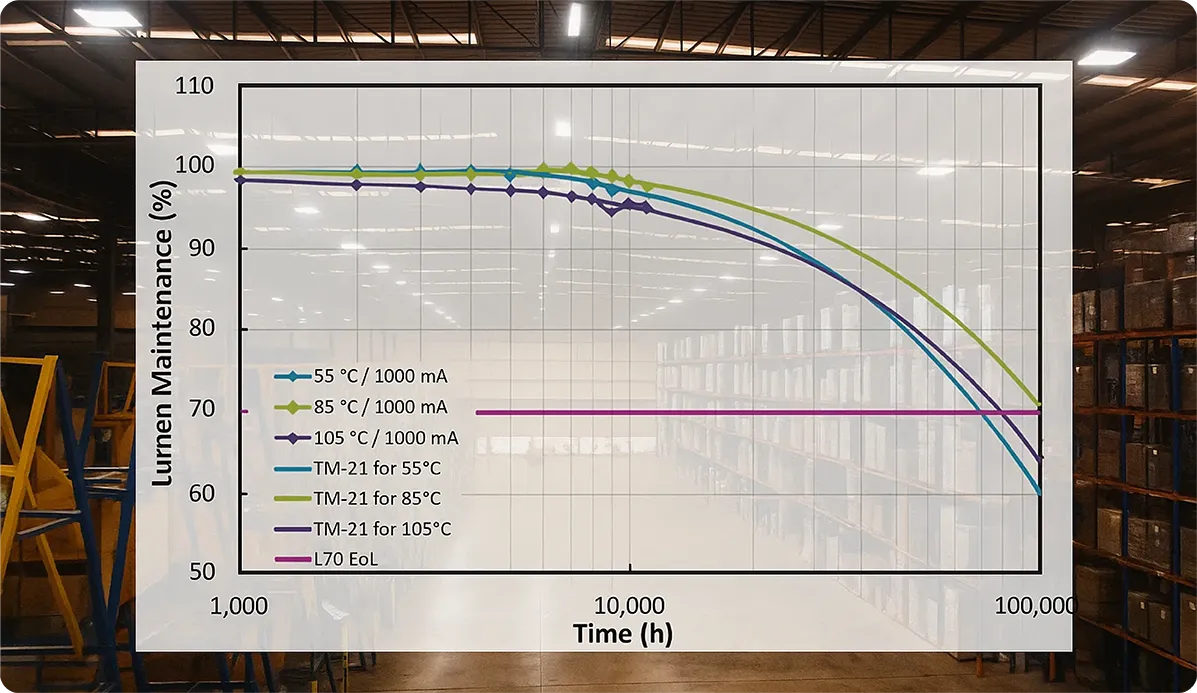
Through LM-80 test reports, manufacturers can provide data on the lumen maintenance of LED packages under various conditions; however, this does not directly yield a predicted lifespan for LED luminaires. Consequently, the industry has introduced the TM-21 standard to extrapolate the lifespan based on LM-80 data.
TM-21 is an LED lifetime prediction standard based on LM-80 data, published by the IES in 2011. Its primary purpose is to estimate the lifetime of LED light sources or complete luminaires by extrapolating from LM-80 lumen depreciation data. TM-21 plays a crucial role in assessing the longevity of LED packages and modules, particularly where long-term predictions of LED luminaire lifespan are required.
Test Method:
- Data Source: TM-21 utilises the lumen maintenance data from LM-80 test results, employing mathematical modelling to extrapolate and predict the lumen depreciation trend of LED light sources under specific conditions.
- Data Processing: TM-21 standardises the luminous flux for each temperature and current setting, setting the initial luminous flux to 1 (100%), and calculates the average value for each test point.
- Sample Size: A recommended sample size of 20 is advised, with higher sample sizes yielding greater prediction accuracy.
- Extrapolation Method: Where LM-80 provides a test duration of 6,000 hours, TM-21 can extrapolate this to six times the test duration, i.e., 36,000 hours. For a test duration of 10,000 hours, extrapolation extends to 60,000 hours.
Report Contents:
- Lifetime extrapolation results: For instance, the L70 lifetime (the point at which luminous flux decreases to 70% of its initial value) serves as a common lifetime metric.
- Temperature impact analysis: Based on the actual operating temperature of LED luminaires, the Arrhenius equation is employed to adjust the lumen depreciation curve at different temperatures.
- Applicable Markets: TM-21 is widely adopted across global markets, particularly in North America, Europe, and the Asia-Pacific region, serving as a crucial document in tendering for diverse projects.
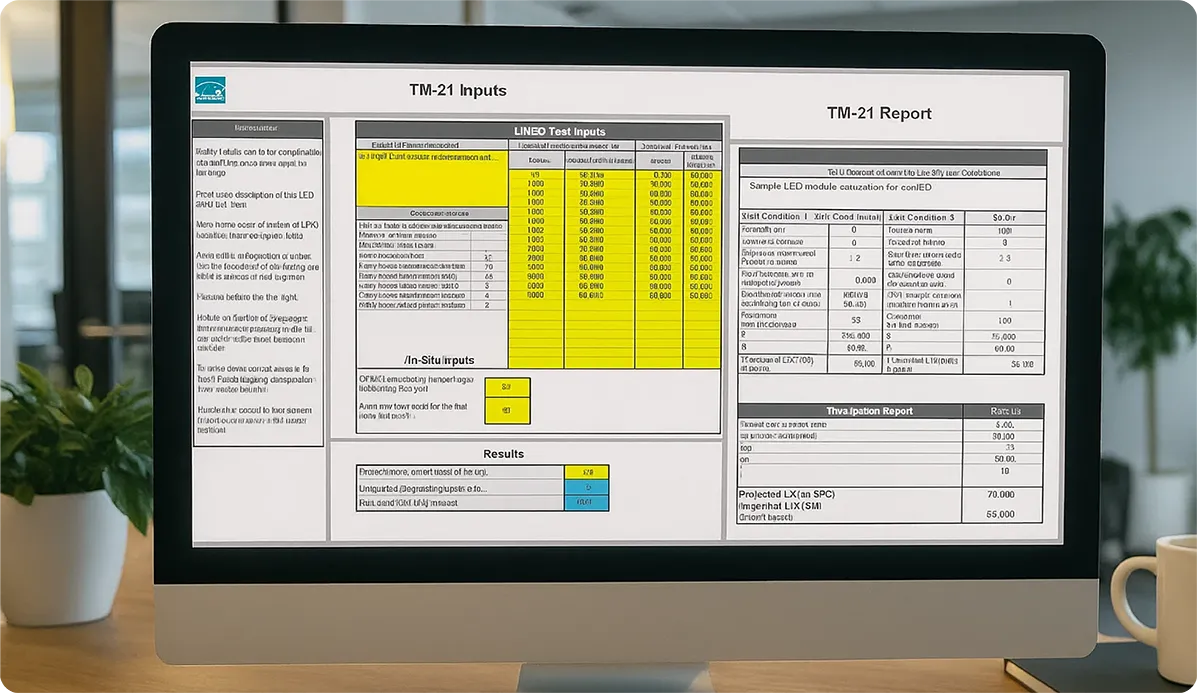
The TM-21 report renders the prediction of LED luminaire lifetimes more reasonable and feasible, particularly during the design and production stages, where product longevity can be optimised according to the luminaire’s temperature and current conditions.
Beyond LM-80 and TM-21, another prevalent method for assessing LED longevity is the LxxByy metric. This report primarily quantifies the specific percentage of luminous flux decay, commonly used to demonstrate the performance of LED luminaires after a specified duration. It is typically denoted as ‘Lxx Byy @ zz,000 hours’.
Definition of LxxByy:
- Lxx: Denotes the time at which the LED luminous flux maintains xx% of its initial value. For example, L70 indicates the time when luminous flux remains at 70%.
- Byy: Represents the percentage (yy%) of LEDs within the luminaire failing to achieve the Lxx maintenance rate. For instance, B10 signifies that 10% of LED light sources fail to attain a 70% luminous flux maintenance rate.
- Timeframe: LxxByy is typically associated with specific durations (e.g., 50,000 hours or 100,000 hours) to demonstrate LED light source lumen depreciation performance over extended operation.
Report Content:
- Lifetime Data: LxxByy reports generally illustrate LED luminaire lumen maintenance after specific periods, providing clients with intuitive understanding of LED lifespan during project tendering.
- Application Scenarios: LxxByy has become a standardised assessment method in numerous international tenders, particularly for large-scale projects such as urban lighting, stadium illumination, and industrial lighting.
The LxxByy report supplements gaps in LED luminaire lifespan assessment addressed by LM-80 and TM-21, facilitating more effective demonstration of luminaire lumen maintenance during prolonged operation within projects.
The assessment of LED luminaire lifespan is based on three reports: LM-80, TM-21, and LxxByy. LM-80 provides foundational data for LED luminaires through long-term lumen maintenance testing. TM-21 extrapolates LM-80 data to deliver more reliable lifespan projections, while the LxxByy report enables customers to clearly understand the lumen maintenance levels of LED luminaires. These three reports render LED luminaire lifespan assessment more scientific and predictable, helping manufacturers and customers better comprehend product performance and enhance market competitiveness.
Author

Andy Gao
With 15 years in the LED lighting industry, I’ve witnessed its evolution from general fixture production to today’s highly specialized segments. As Co-Founder of Veldstar, my journey mirrors this shift – driving our exclusive focus on pergola and garden lighting solutions. Through dedicated innovation, we develop controllers and systems rivaling leaders like Somfy and Teleco. Here, I share insights and showcase products engineered to elevate outdoor spaces with style, functionality, and advanced control. Learn more via linkendin profile:https://www.linkedin.com/in/pergolalights/

Share This Article:
Send Us your Request