










We use the word “bright” every day, but to optical engineers, this phrase could spark a “war of concepts.” Are you referring to the lamp itself being dazzling, or how clearly it illuminates the tabletop? Behind this lies an entire “metrology” system precisely describing how light is generated, transmitted, and received. Today, let’s dissect these core concepts like building blocks: luminous flux, luminous intensity, illuminance, luminance, solid angle, and projected solid angle. Once mastered, you’ll truly “master” light.
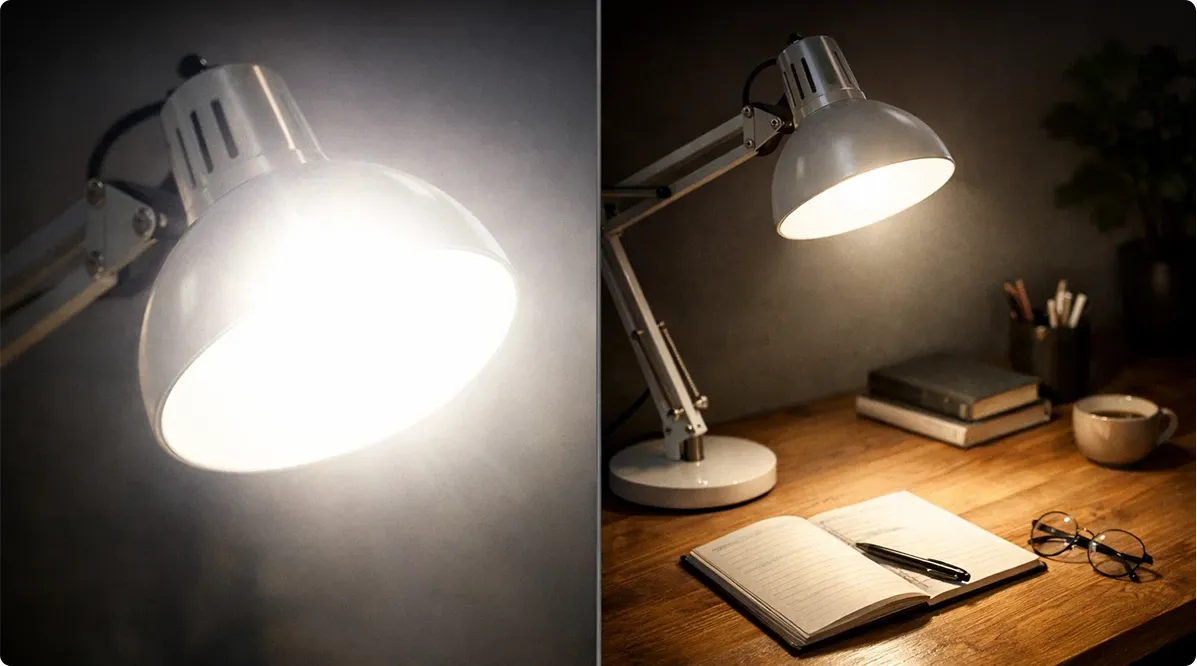
Imagine a water pipe. Luminous flux (Φ, measured in lumens lm) is the total volume of water flowing out of the pipe per unit time. It describes the sum of all visible light energy emitted by a light source—a concept of “total packaged output.” A 100-watt incandescent bulb produces approximately 1300 lumens—its total “light output.” But total output alone isn’t enough; light spreads in all directions. This leads us to the second key concept—solid angle.
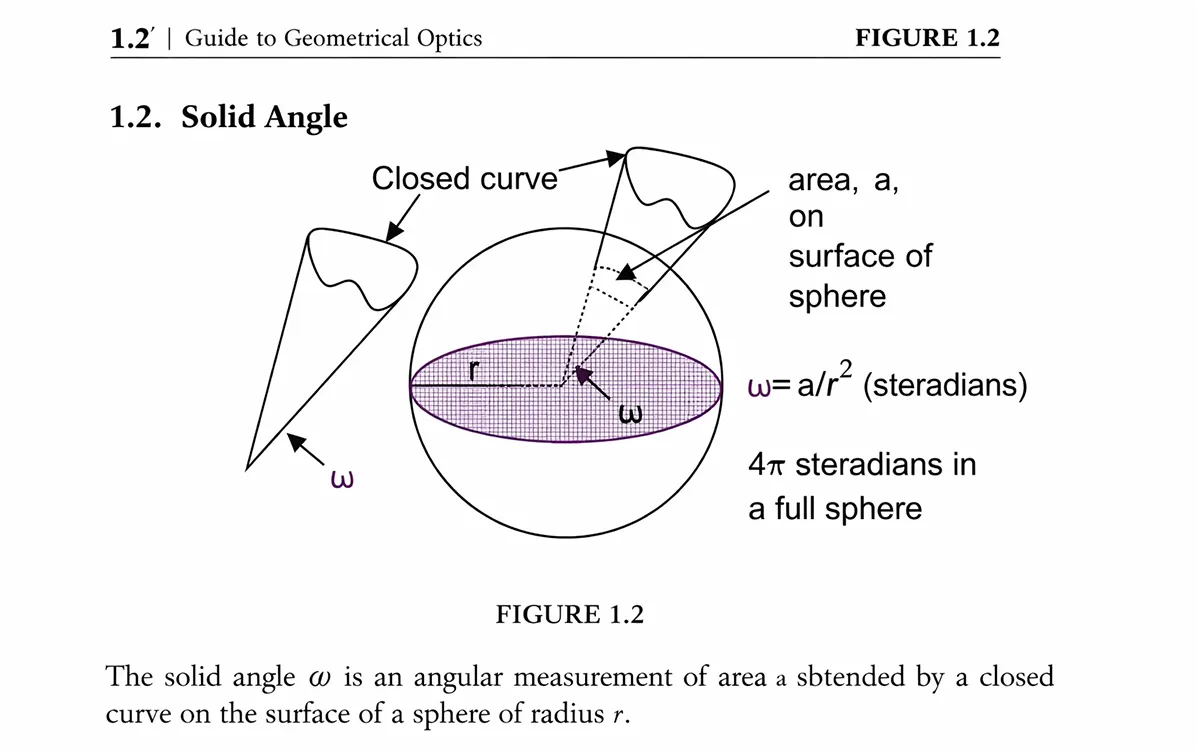
If a plane angle is like cutting a slice of pizza, then a solid angle (Ω, measured in steradians sr) is like cutting a “three-dimensional pizza slice” from the center of a sphere. A complete sphere has a solid angle of 4π steradians. Imagine your eyes as the center of a sphere; all directions you can see form a complete “visual space.” Any partial area within this space—like the range limited by a lampshade—represents a solid angle smaller than 4π. Solid angles measure the extent to which light diverges in space.
Now we combine the concepts of luminous flux and solid angle. If luminous flux is compressed and emitted within a specific solid angle, its “density” increases. Luminous intensity (I, unit: candela cd) is precisely the physical quantity describing this degree of concentration: I = Φ / Ω. It refers to the luminous flux emitted by a light source within a unit solid angle in a specific direction.
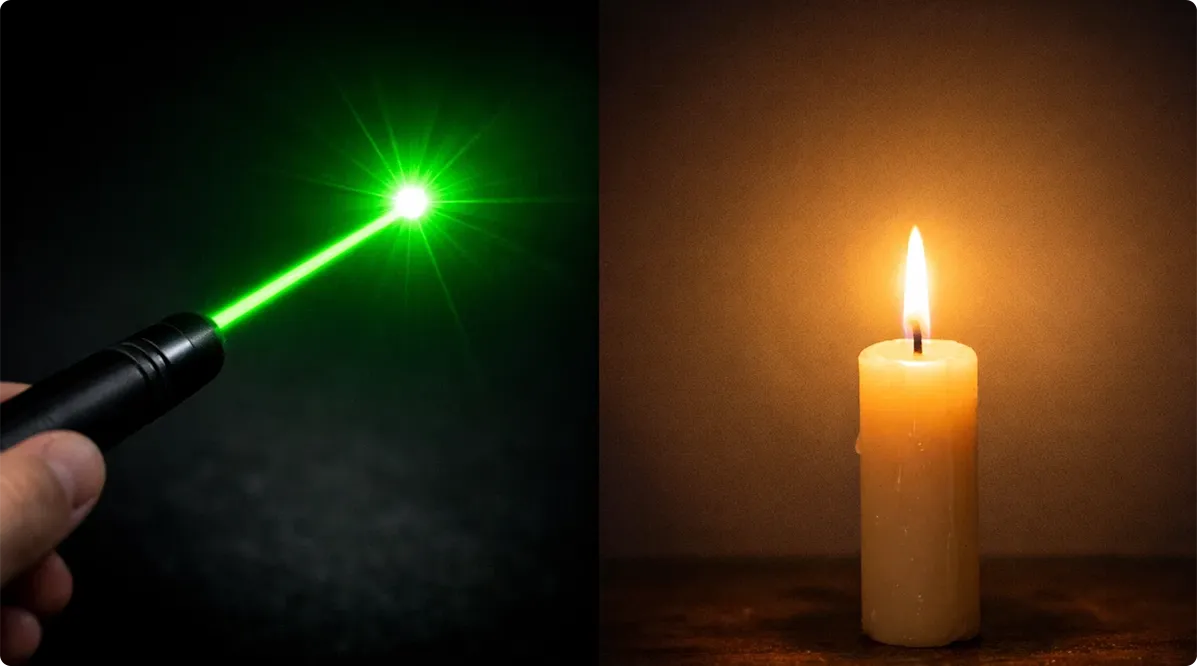
A laser pointer, despite its low total luminous flux (Φ), emits all light within an extremely small solid angle (Ω). This results in an extremely high luminous intensity (I) in that direction, making it very dazzling. A candle, on the other hand, emits a large luminous flux in all directions. However, due to its large solid angle, its luminous intensity is not high.
Illuminance (E, measured in lux lx) describes the amount of luminous flux received per unit area of illuminated surface: E = Φ / A. It answers the question, “How bright is this tabletop?” depending on the light source and distance. This is why reading under streetlights is clearer than under moonlight: although the moon (reflecting sunlight) has enormous total luminous flux, its distance is so great that the “luminous flux density” (i.e., illuminance) reaching the book page is negligible.
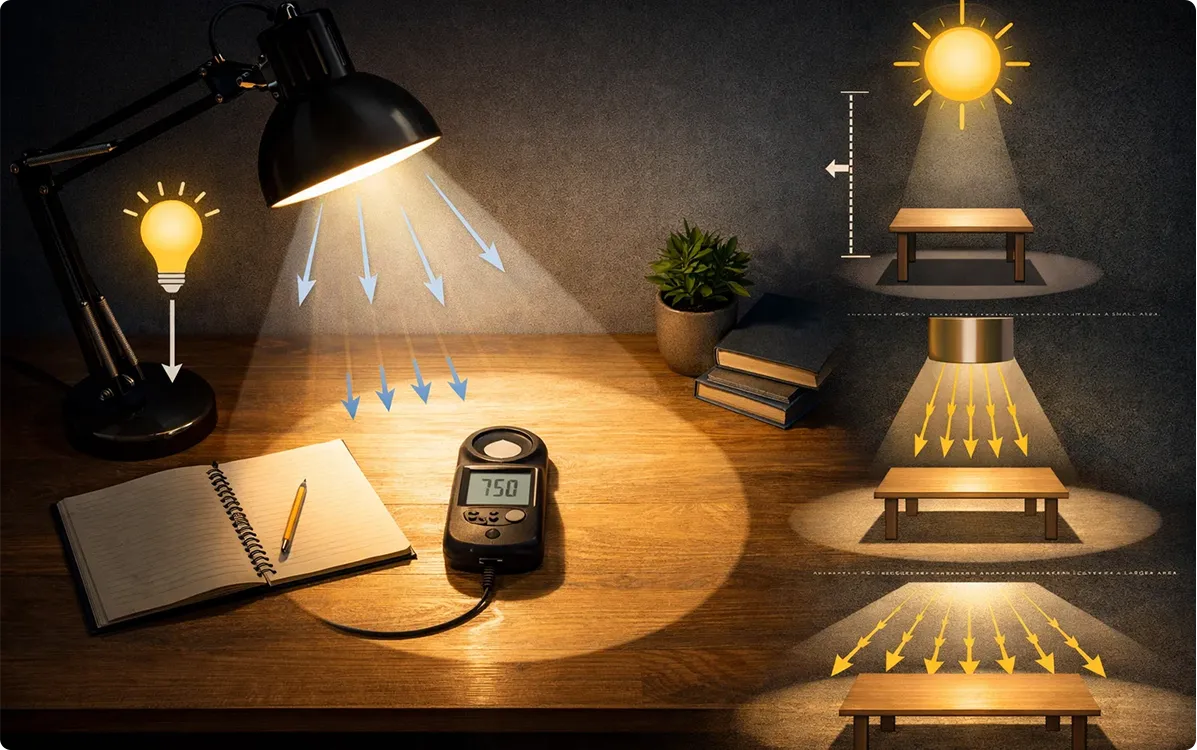
This is the most easily confused concept, yet it is the true “king” parameter.
Luminance (L, measured in nits or cd/m²) represents the perceived brightness of a light source in a specific direction as sensed by the human eye (or a detector). Its definition synthesizes all previous concepts: L = I / (A · cosθ). Here, I is the luminous intensity in that direction, A is the light-emitting area of the source, and θ is the angle between the viewing direction and the normal.
Luminance describes the luminous flux per unit area of the light source surface within a unit solid angle. It is an intrinsic property independent of distance. For example, a streetlight has far greater luminous intensity (I) and total luminous flux (Φ) than a smartphone screen, but its surface area (A) is larger, and its light diverges in all directions (large solid angle Ω). In contrast, a smartphone screen concentrates its luminous flux over a small area and within a narrow solid angle. Calculations show that the screen’s luminance (L ≈ I/A) can easily exceed 1000 nits—far surpassing the luminance of an old streetlight’s surface. This is why staring directly at a smartphone screen feels more glaring.
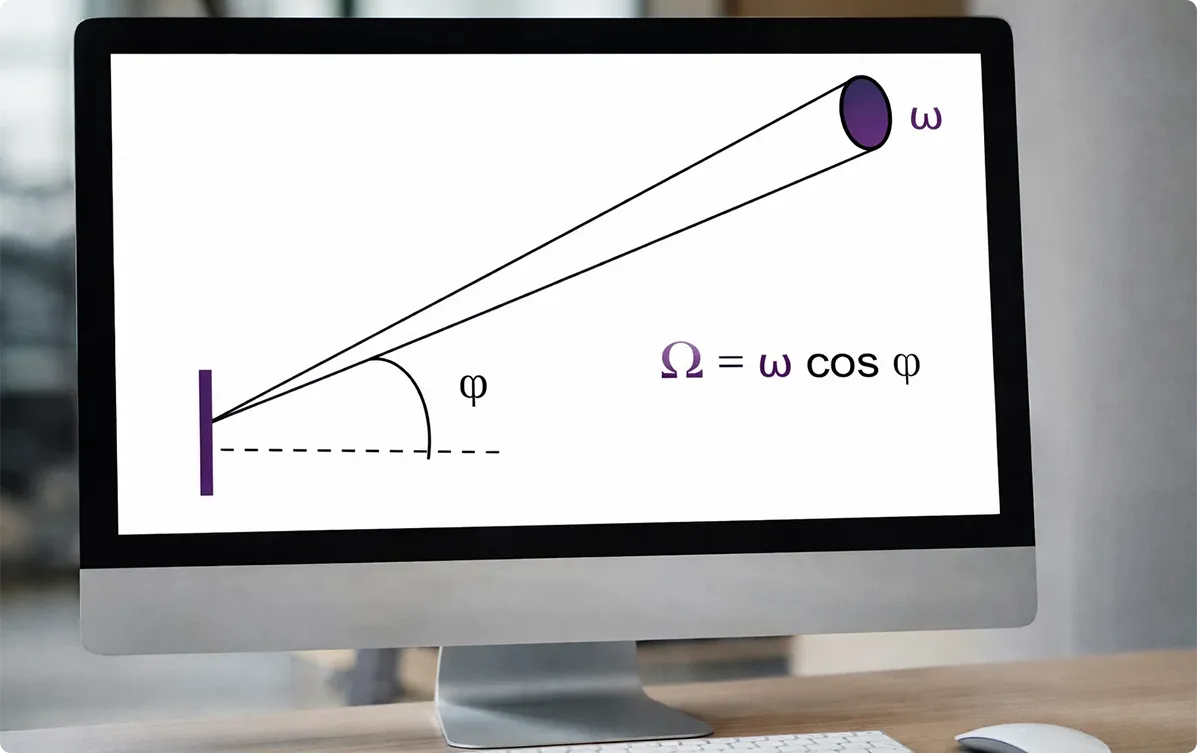
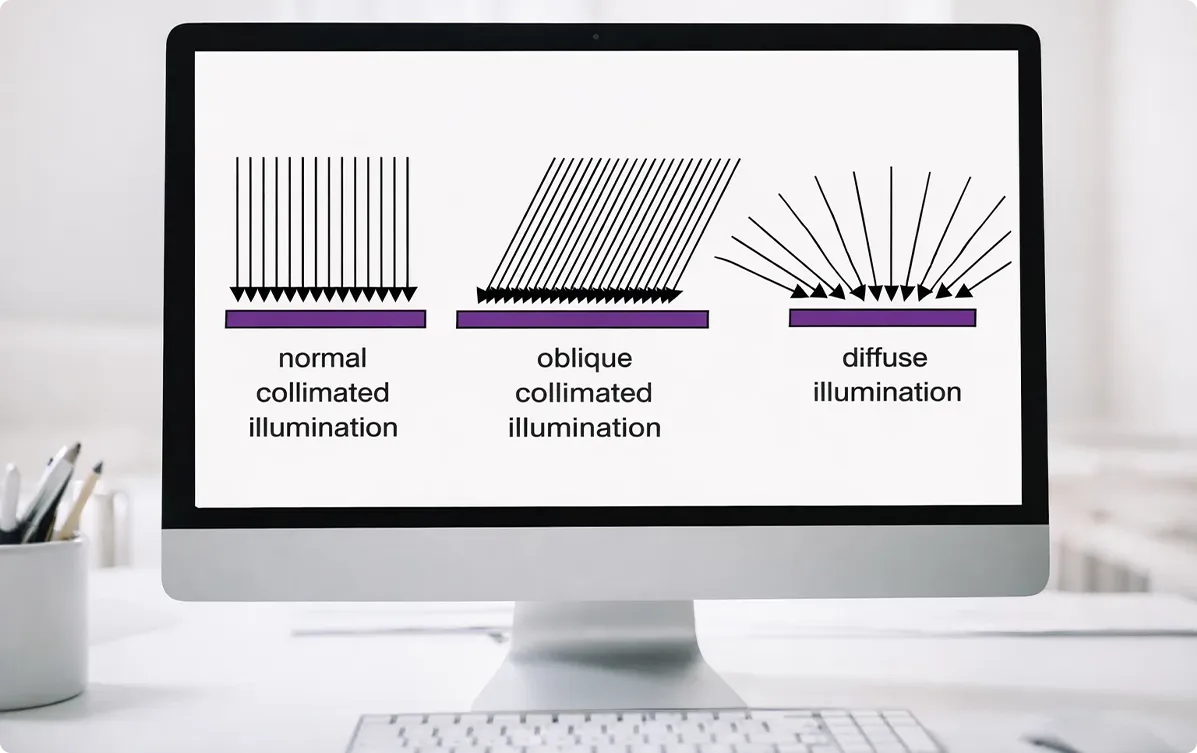
In the definition of luminance, the area term is A · cosθ, representing the projected area. Why project? Because when the viewing direction is tilted, the effective luminous area you perceive shrinks. This naturally introduces the concept of projected solid angle.
When calculating the illuminance on an illuminated surface, the solid angle between the light source and the surface must also account for this tilt factor—the projected solid angle. It bridges the gap between light source luminance and surface illuminance, serving as a core tool for more precise calculations in ray tracing and radiometry.
Author

Andy Gao
With 15 years in the LED lighting industry, I’ve witnessed its evolution from general fixture production to today’s highly specialized segments. As Co-Founder of Veldstar, my journey mirrors this shift – driving our exclusive focus on pergola and garden lighting solutions. Through dedicated innovation, we develop controllers and systems rivaling leaders like Somfy and Teleco. Here, I share insights and showcase products engineered to elevate outdoor spaces with style, functionality, and advanced control. Learn more via linkendin profile:https://www.linkedin.com/in/pergolalights/

Share This Article:
Send Us your Request