


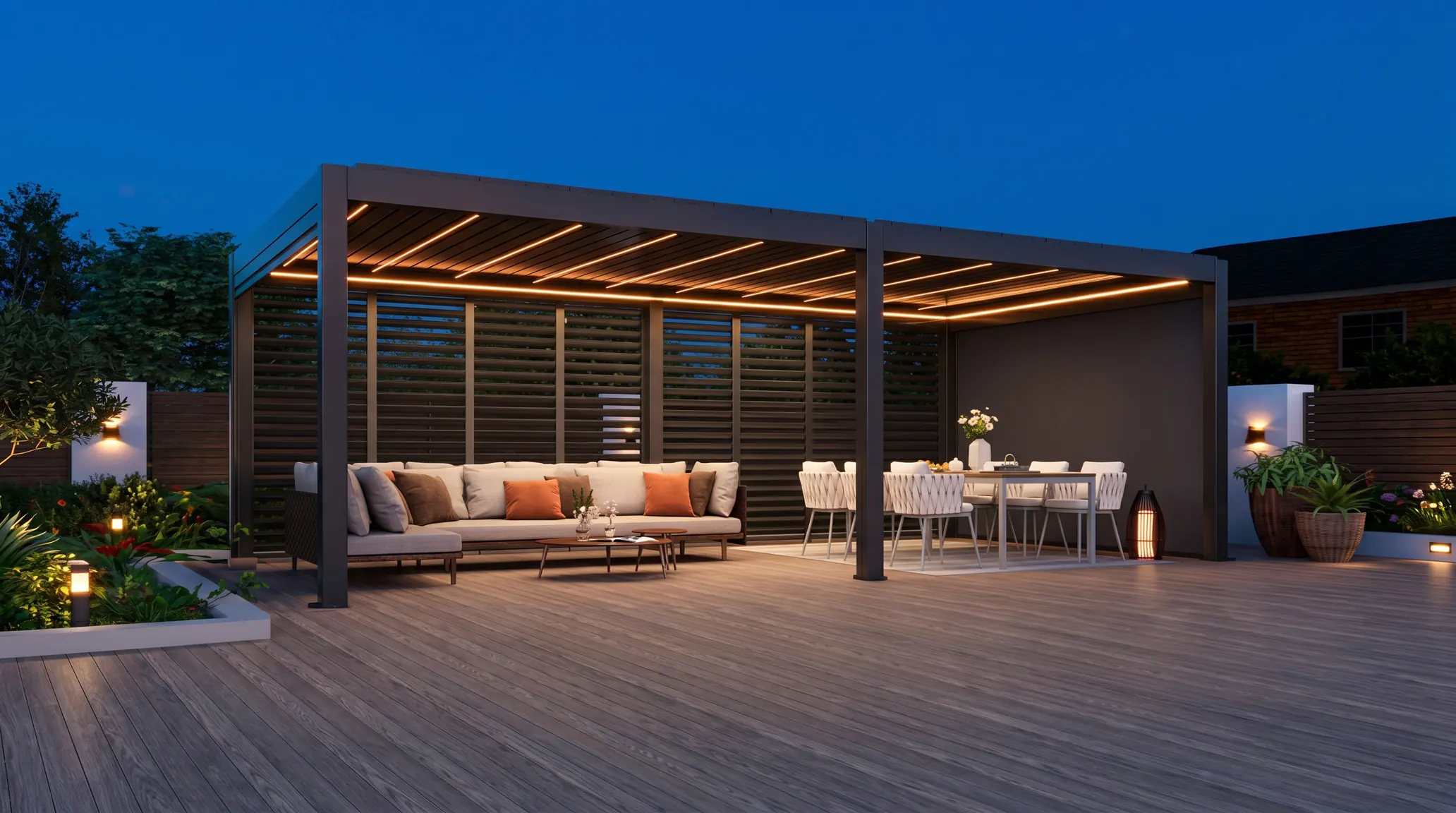
A premium pergola is no longer judged only by the aluminum frame, blade profile, or powder coating. For many European and North American buyers, the question has moved downstream: can the roof, lighting, privacy screens, heaters, and weather sensors behave like one product after installation?
That question matters because it changes how an OEM should design the electrical system. If every accessory ships with its own receiver, wiring method, remote, and support logic, the pergola may look integrated in the showroom but feel fragmented in the field. A single pergola control platform gives manufacturers a cleaner way to build, test, sell, install, and service advanced outdoor living systems.
Key Takeaways
- Search results show strong demand for unified control of louvers, LEDs, screens, heaters, fans, and weather sensors.
- The OEM opportunity is not another remote. It is a product architecture that reduces wiring, commissioning, training, and after-sales friction.
- A strong platform separates safety logic, comfort scenes, motor control, lighting control, and smart home access.
- The best specification starts with zones, loads, protocols, waterproofing, certification path, and service strategy.
What Are Buyers Really Searching For?
Current search results around smart pergolas, motorized louvered roofs, and pergola operating systems show a clear pattern. Leading pages from brands such as StruXure and Azenco talk about one app or one remote managing louvers, lighting, heaters, fans, screens, and sensors, with app control and voice control as part of the user experience.
The visible content structure is usually lifestyle-first. It starts with outdoor comfort, then moves into motorized louvers, LED lighting, smart sensors, screens, heaters, and home automation. That structure fits homeowners, dealers, and architects. It also leaves space for an OEM-level article that speaks to manufacturers who must make the system work at scale.
The innovation space is therefore practical, not decorative. Instead of repeating that smart pergolas are convenient, OEMs need a sharper view of how control architecture affects production, installation, warranty claims, dealer confidence, and accessory upgrades.
The angle of this article is simple: for pergola manufacturers, louver, LED, screen, heater, and sensor control should be designed as one platform before the product reaches the dealer network.
Why Should OEMs Treat Pergola Control as a Platform?
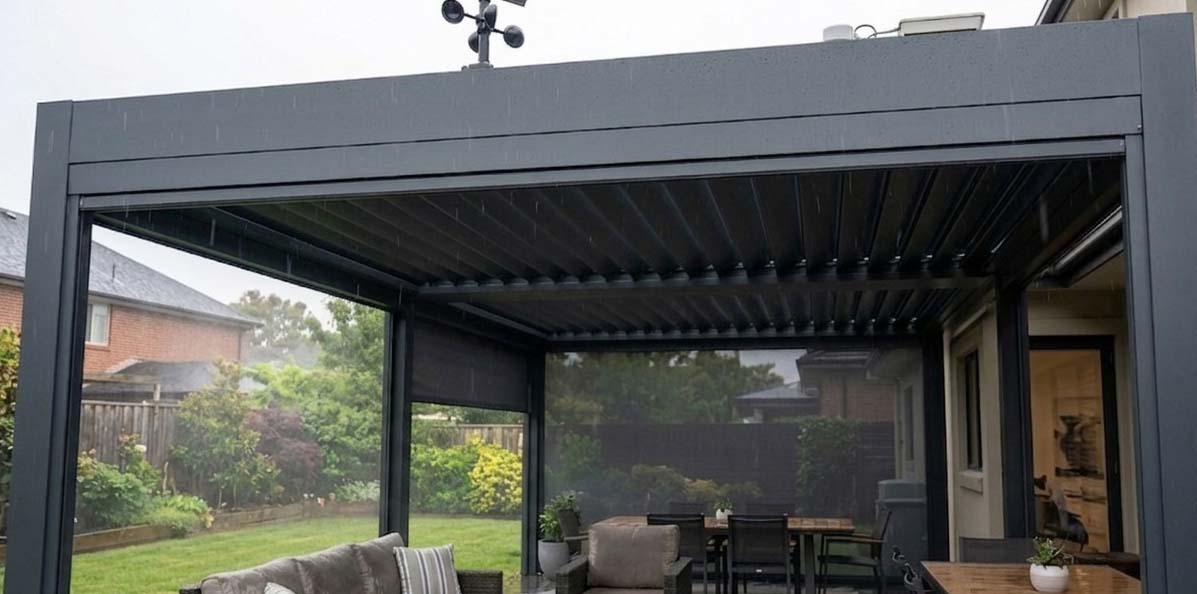
OEMs should treat pergola control as a platform because each added accessory changes the whole system, not just one function. The Connectivity Standards Alliance describes Matter as an IP-based standard built for reliable, secure smart-home interoperability, which shows where connected products are heading: fewer isolated devices and more coordinated ecosystems.
A pergola roof can rotate louvers. LED strips can dim or change color. Zip screens can move down for privacy. A heater can extend evening use. A rain or wind sensor can protect the structure. Those functions sound separate until one event requires them to act together.
Consider a restaurant terrace. A sudden rain event should close louvers, pause an unsafe screen movement if wind is high, protect lighting circuits from nuisance behavior, and preserve manual override for staff. A scattered accessory approach turns that event into five separate decisions. A platform turns it into one tested behavior.
This is why many high-end pergola brands now talk about centralized operating systems. StruXure, for example, presents control of louvers, lighting, fans, heating systems, and screens through a centralized app, remote, or voice assistant. Azenco also describes smart pergola features that combine louver position, LED lighting, motorized screens, and smart weather sensors.
For an OEM, the real value sits below the marketing message. A platform can standardize hardware options, cable routing, dealer training, pairing logic, labeling, quality checks, and service diagnosis.
What Functions Belong Inside One Pergola Platform?
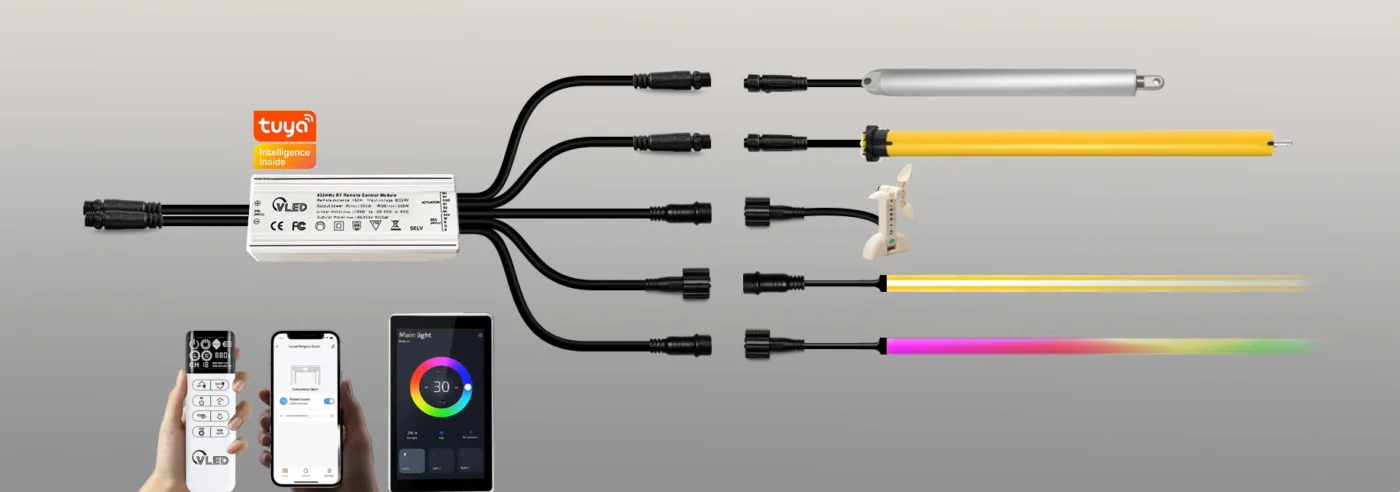
A serious pergola control platform should cover the high-frequency comfort functions and the high-risk safety functions in one architecture. At minimum, that means louver movement, LED lighting, motorized screens, heaters, weather sensors, local controls, remote controls, and optional smart home connection.
The platform does not need every function on every model. In fact, that would make the bill of materials harder to manage. The better approach is a modular control family where the same logic can scale from an entry pergola kit to a multi-zone hospitality installation.
Louver control
Louver control is the primary motion function. It may use linear actuators, tubular motors, or a dedicated motor drive depending on the roof design. For OEMs, the important questions are stroke calibration, limit protection, synchronization, obstacle response, and behavior during weather events.
If the louver module is treated as only an open-close motor, the system loses refinement. A platform should support stable intermediate positions, clear channel labeling, and repeatable pairing. This is where a purpose-built pergola control unit becomes more useful than a generic receiver.
LED control
Lighting control should cover more than on and off. OEM projects may need single-color dimming, RGB, RGBW, multiple zones, memory scenes, smooth transitions, and safe low-voltage distribution. The lighting system also needs outdoor connectors, correct driver sizing, and clean installation inside posts, gutters, or beam cavities.
For a broader product view, a manufacturer can map lighting options against its own pergola models using a dedicated pergola lighting range. That helps sales teams avoid mixing incompatible strips, spotlights, drivers, and controllers across different roof sizes.
Screen control
Screen control usually involves tubular motors, up-down-stop commands, and limit setting. It becomes sensitive when several screens run around one pergola. If wind rises, the platform needs a clear priority rule: should screens retract, pause, or ignore the command because the louvers have a different protection state?
That question is not only technical. It affects dealer training and customer complaints. A pergola platform should define screen behavior by zone, by wind threshold strategy, and by manual override rules.
Heater control
Heaters demand special discipline because they involve higher power, heat exposure, mounting distance, and regional electrical requirements. UL Solutions’ heating product guidance covers electric heating appliances, commercial heating systems, radiant panel equipment, and related safety testing, which is a useful reminder that heating should not be treated like another low-voltage lighting channel.
For OEM design, the safer approach is to separate heater switching and protection from low-voltage logic while keeping the user interface consistent. The customer can still see “heat” in the same remote or app, but the power path, relay rating, enclosure, wiring, and compliance review must fit the heater category.
Sensor control
Sensors turn a pergola from a remote-controlled structure into an automated outdoor product. Rain, wind, sun, and snow sensors all create different actions. Rain may close louvers. Wind may retract screens. Sun may adjust shade or lighting scenes. Snow may require a protective louver position based on the roof design.
The key is priority. A platform should define what happens when the rain sensor, wind sensor, and user command conflict. Without a priority hierarchy, the system can feel unpredictable, especially in coastal, mountain, and hospitality applications.
Where Do Separate Accessory Systems Fail?
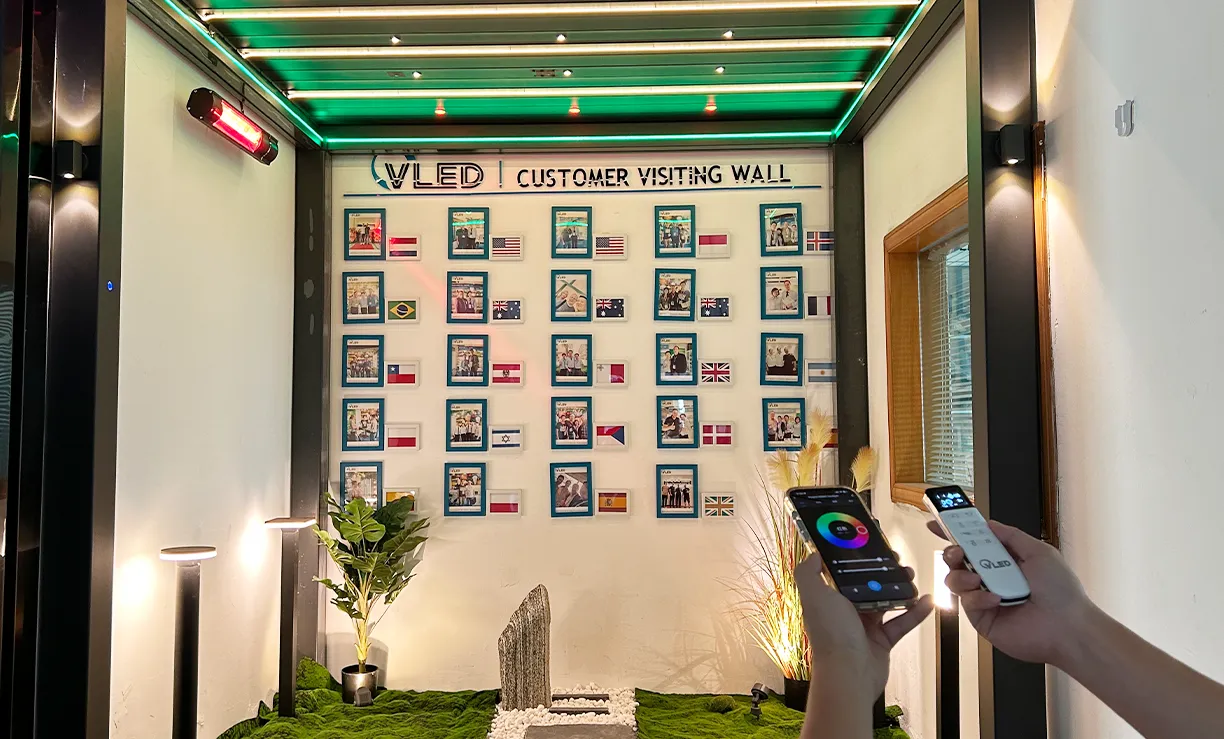
Separate accessory systems fail when they make the installer and end user solve integration after the product has shipped. A pergola may include good motors, good lighting, good screens, and good heaters, yet still create a poor experience if each part has its own receiver, remote, wiring map, and troubleshooting path.
The first failure is control clutter. A homeowner or restaurant manager may receive one remote for louvers, one for screens, one for LEDs, one wall switch for heaters, and one app for smart home pairing. That weakens the premium feel, even if the mechanical structure is excellent.
The second failure is duplicated wiring. Multiple control boxes, power supplies, junction points, and cable routes take time to install. They also create more places for water ingress, wrong connections, and service confusion. Outdoor products should avoid unnecessary electrical complexity.
The third failure is unclear responsibility. If the louver motor works but the screen stops responding after a weather event, which supplier owns the diagnosis? The motor supplier, screen supplier, lighting supplier, installer, app provider, or OEM? A platform reduces that ambiguity by defining the command chain.
The fourth failure is poor upgrade logic. Many manufacturers sell base models first, then add lights, screens, heaters, or sensors later. If the original control system was not designed for expansion, every upgrade becomes a small custom project. That hurts margins and slows dealer adoption.
How Should an OEM Specify the Control Architecture?
An OEM should specify the control architecture from the pergola model family outward. Start with roof size, motor type, lighting zones, screen sides, heater loads, weather sensor needs, and dealer installation skill level. Then choose the platform, not the other way around.
The control architecture should answer six questions before the first sample order:
- How many independent zones will the pergola need in the largest standard configuration?
- Which functions are low-voltage, which are mains voltage, and which require isolation?
- Which functions must remain local even if Wi-Fi or cloud access fails?
- Which sensor commands override user commands?
- How will dealers pair, label, test, and reset channels on site?
- How will the OEM identify a failed receiver, sensor, motor, driver, or remote during service?
The answers will shape the control box, remote, wall panel, app gateway, sensor package, cable harnesses, and installation manual. They also decide whether the product can support residential, dealer, and commercial channels without constant redesign.
A strong starting point is to evaluate an integrated pergola control system that already combines lighting, motion, sensors, remote control, and outdoor installation needs. The platform should still be adapted to the OEM product line, but it should not require the OEM to invent the full electronics stack from zero.
| Decision Area | What OEMs Should Define | Why It Matters |
|---|---|---|
| Zones | Louver groups, LED zones, screen sides, heater circuits, fan or auxiliary channels | Prevents channel shortages and confusing remote layouts |
| Power | Low-voltage drivers, motor voltage, heater power, surge strategy, cable gauge | Protects reliability and supports regional compliance review |
| Weather logic | Rain close, wind response, sun trigger, snow behavior, manual override | Turns automation into predictable product behavior |
| Controls | Handheld remote, wall switch, app gateway, voice assistant, building control interface | Matches user expectations in residential and commercial projects |
| Service | Pairing method, reset process, spare parts, fault isolation, documentation | Reduces dealer callbacks and warranty escalation |
Which Control Layer Should Come First: RF, App, or Smart Home?
The local control layer should come first because pergolas must remain usable outdoors even when a phone is not nearby or a network is unstable. App and smart home control add value, but they should sit above a reliable RF, wall-control, or wired local layer.
This is a practical OEM position. A homeowner expects a smart app. A dealer expects fast commissioning. A hotel or restaurant expects staff to operate the terrace without searching for one manager’s phone. Those needs overlap, but they are not identical.
RF control remains useful because it is simple, familiar, and fast to teach. Wall control gives a fixed point for everyday operation. App control supports scenes, scheduling, and remote access. Smart home integration supports voice control and ecosystem visibility.
Matter is relevant because it points toward multi-brand smart home compatibility. The Connectivity Standards Alliance states that Matter helps devices from multiple brands work together and supports Wi-Fi, Thread, and Bluetooth Low Energy for commissioning in its first specification release. For pergola OEMs, this does not mean every product must immediately become Matter-certified. It means platform planning should avoid a dead end.
The best control stack is layered:
- Local safety and motor logic inside the pergola platform.
- RF or wall control for daily operation and dealer testing.
- App gateway for scenes, scheduling, and user-friendly configuration.
- Smart home bridge or protocol path for voice control and broader automation.
That layering protects the OEM from overpromising. It also lets the manufacturer sell different packages without changing the core product architecture.
How Should Weatherproofing Shape the Platform?
Weatherproofing should shape the platform from enclosure design to connector selection. The IEC explains that IP ratings describe degrees of protection against solid objects, dust, accidental contact, and water. For pergola electronics, that concept affects control boxes, sensor housings, connectors, cable exits, and installation location.
Outdoor control problems rarely come from one dramatic failure. More often, they come from moisture paths, condensation, loose connectors, wrong cable bending, exposed junctions, or installers improvising because the system is hard to route.
A platform built for OEM production should therefore include waterproof connectors, clear cable lengths, labeled outputs, strain relief, drainage-aware mounting, and serviceable access. It should also define which parts belong inside the frame, which parts can sit in a protected cavity, and which parts need a separate electrical box.
Lighting accessories deserve special attention. LED strips and spotlights often run through long aluminum profiles, gutters, rafters, or posts. A complete pergola lighting solution can reduce mismatched drivers, weak connectors, and unclear installation methods.
Weatherproofing also affects sensors. A rain sensor that is installed in the wrong place can react late or react too often. A wind sensor that is blocked by the building may not reflect real site conditions. The platform should provide mounting guidance, test methods, and clear limits on what the sensor can and cannot guarantee.
What Does a Good OEM Package Include?
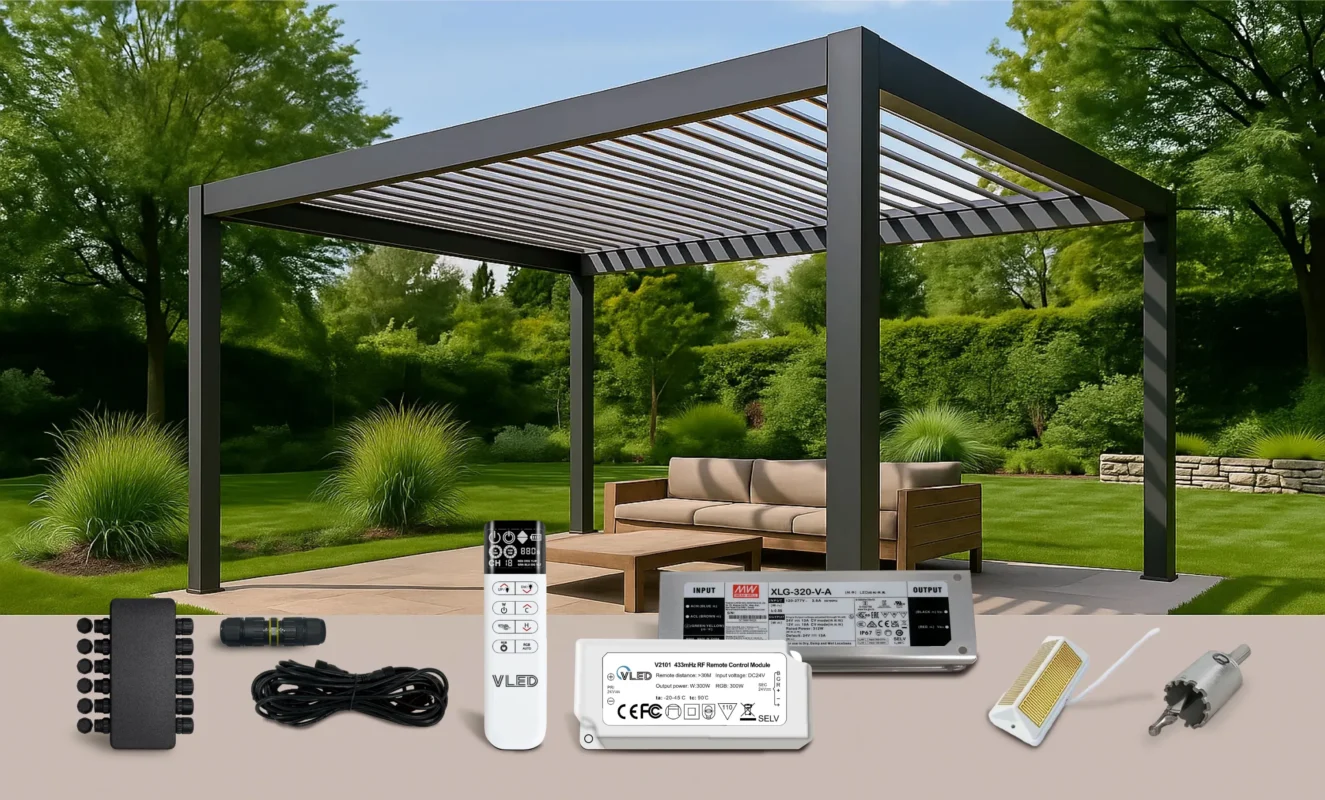
A good OEM package includes hardware, wiring, control logic, documentation, and support assets. The product is not complete when the control box works on the engineer’s bench. It is complete when a trained dealer can install it repeatedly with low confusion and a stable customer experience.
For most pergola manufacturers, the package should include:
- A control unit sized for the planned motor and lighting channels.
- Remote and wall-control options with clear channel naming.
- LED drivers, dimming modules, or RGB/RGBW control where needed.
- Sensor inputs for rain, wind, sun, or snow based on the target market.
- Waterproof connectors, splitters, extension cables, and labeled harnesses.
- Installation drawings for common pergola sizes and frame layouts.
- Dealer commissioning steps for pairing, limit setting, sensor testing, and reset.
- Spare-part logic so after-sales teams can replace one failed part without rebuilding the system.
The package should also have options. A compact residential pergola may need one louver group, two lighting zones, and rain sensing. A large hospitality structure may need multiple louver groups, independent LED scenes, several screens, heaters, and a staff-friendly wall interface.
OEMs should resist the temptation to build a different electrical kit for every sales scenario. A modular platform with shared parts and clear add-on tiers is usually easier to manage than a large collection of unrelated accessories.
Practical OEM view: the platform should reduce decisions for the dealer, not hide decisions from the engineer. The engineer still defines loads, safety limits, sensor priorities, and installation rules. The dealer receives a system that is clear enough to install and explain.
How Does Platform Control Improve the Dealer Experience?
Platform control improves the dealer experience by making every pergola behave in a familiar way, even when the configuration changes. A dealer can learn one pairing process, one channel logic, one sensor test, and one service path instead of learning a different system for every accessory supplier.
This matters in the European and North American markets because pergola sales often depend on local dealer networks. Dealers need confidence. If an advanced pergola takes too long to commission, or if a service call requires too many supplier conversations, the dealer may stop promoting the higher-value configuration.
A good platform supports the dealer before, during, and after installation. Before installation, it offers clean drawings and a predictable BOM. During installation, it provides labeled cables and repeatable tests. After installation, it gives the dealer a narrow troubleshooting path.
The end user may never see this work. That is the point. The user experiences one remote, one app, smooth scenes, and weather-aware protection. The dealer experiences fewer surprises. The OEM experiences fewer warranty disputes.
What Should OEMs Avoid When Building a Unified Platform?
OEMs should avoid treating platform control as a cosmetic app layer. A good-looking app cannot fix weak wiring, unclear sensor logic, overloaded circuits, or poor dealer documentation. The control strategy must start at the electrical and mechanical design stage.
The most common mistakes are easy to recognize:
- Adding app control before local control is reliable.
- Mixing heater power and low-voltage control without a clear separation strategy.
- Using the same remote layout for every product size, even when channel logic changes.
- Letting rain, wind, and user commands conflict without a defined priority.
- Specifying LED products without matching drivers, cable lengths, and dimming behavior.
- Ignoring reset, replacement, and spare-part workflows until warranty issues appear.
Another mistake is overbuilding the entry model. Not every pergola needs the most advanced gateway, every sensor, or every lighting mode. The platform should let the OEM offer simple, premium, and commercial packages while preserving the same core logic.
The platform should also avoid locking the manufacturer into one sales story. Some customers care most about sun and rain control. Some care about evening ambience. Some care about privacy screens. Some care about restaurant seating hours. The control system should support those stories without forcing a custom redesign each time.
How Should OEMs Choose a Control Partner?
OEMs should choose a control partner based on application fit, customization ability, documentation quality, and after-sales support. Price matters, but the cheapest receiver can become expensive when it creates installation time, dealer confusion, and warranty claims across multiple countries.
A useful evaluation process includes both bench testing and field-style testing. On the bench, engineers can check motor outputs, dimming behavior, RF distance, sensor response, and heat rise. In a field-style mockup, the OEM can test cable routing, pairing steps, louver positions, screen movements, lighting scenes, and dealer instructions.
Ask the supplier practical questions:
- Can the control unit support the motor types used in our pergola range?
- Can the platform manage mono, RGB, or RGBW lighting without separate user confusion?
- Can channels be labeled in a way dealers and end users understand?
- Can sensor priorities be adapted for our louver and screen safety strategy?
- Can the hardware fit our frame cavities, control box location, and waterproofing method?
- Can the supplier support OEM branding, documentation, samples, and future product updates?
The partner should understand pergola construction, not only electronics. A supplier who knows outdoor profiles, hidden wiring, LED thermal behavior, motorized roof movement, and dealer realities will usually design a more usable system.
For OEMs comparing architecture options, related guides such as a pergola control system BOM checklist and an integrated lighting and louver control guide can help translate the platform idea into purchasing and engineering decisions.
The OEM Position: Integration Is Now Part of the Product
Integration is now part of the pergola product, not an optional technology layer. A buyer may first notice the roof design, but long-term satisfaction often depends on daily control: how the louvers move, how lights dim, how screens respond, how heaters start, and how sensors protect the space.
For manufacturers, this changes the competitive standard. A pergola that ships as a structure plus accessories can still sell. A pergola that ships as a coordinated outdoor platform is easier to explain, easier to upgrade, and easier for dealers to support.
The strongest OEM strategy is not to add every feature at once. It is to define a control foundation that can scale. Start with reliable louver and lighting control. Add screen and heater logic with proper electrical separation. Define sensor priorities early. Keep local control dependable. Then add app and smart home functions where they strengthen the customer experience.
That is how a manufacturer turns a premium pergola from a collection of parts into a finished product.
Build a Pergola Control Platform Around Your Product Line
If your next pergola series needs coordinated louver, LED, screen, heater, and sensor control, start with the architecture before locking the accessory list. Share your roof type, motor plan, lighting zones, screen layout, and target markets, and VLEDSTAR can help evaluate a practical OEM control package for sample testing.

Pingback: Somfy, Bond, Tuya, Teleco, or Custom RF: Which Control Ecosystem Fits a Pergola Product Line?
Pingback: How to Size 24V LED Drivers for Pergola Beam, Louver, and Strip Lighting Packages
Pingback: Wind Sensor Thresholds for Pergolas: How to Balance Safety, Noise, and User Comfort
Pingback: Rain Sensor Placement for Motorized Louvered Roofs: Factory and Installer Guidelines
Pingback: Rain Sensor Placement for Motorized Louvered Roofs
Pingback: Snow and Frost Protection Logic for Motorized Louvered Pergolas
Pingback: Actuator and Tubular Motor Control for Pergola Louvers: OEM Integration Guide
Pingback: How Integrated Controls Reduce Pergola Installation Labor for Dealers
Pingback: Scene Control for Pergolas: Dinner Mode, Storm Mode, Sunset Mode, and Dealer Presets
Pingback: IP65 vs IP66 vs IP67 for Pergola Controllers
Pingback: Manual Override and Fail-Safe Design for Motorized Pergola Controls
Pingback: Manual Override & Fail-Safe Pergola Controls | OEM Guide
Pingback: Separate Modules vs Integrated Pergola Controller: Cost, Wiring, and Support Comparison