


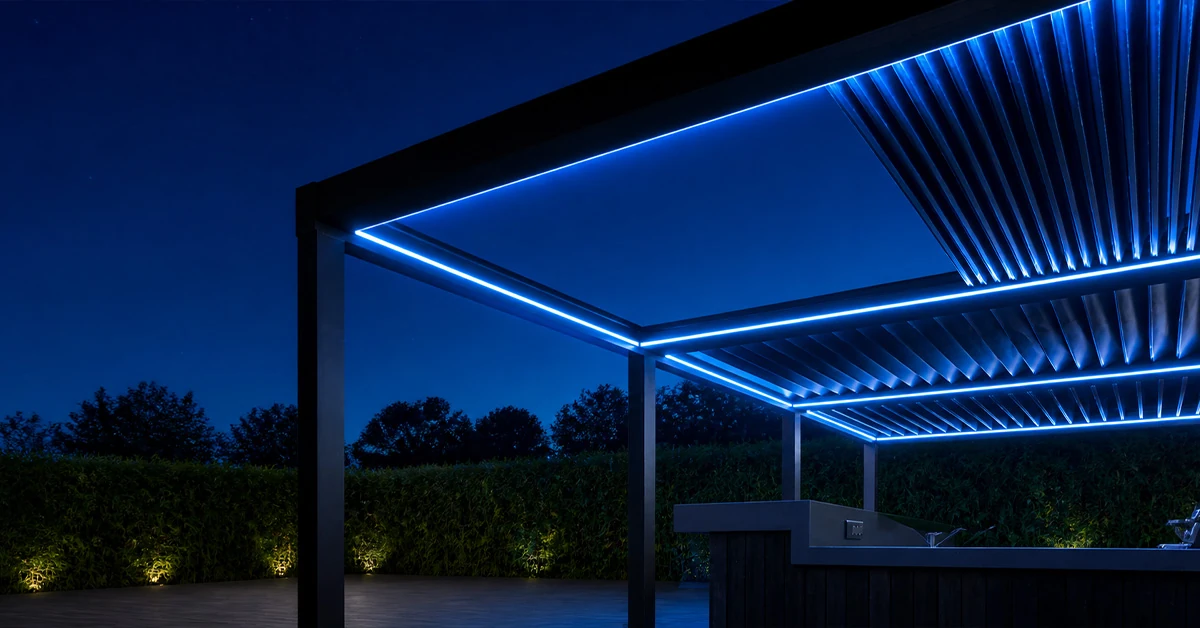
A modern louvered pergola is no longer only an aluminum roof structure. In many European and North American projects, it is expected to operate like a complete outdoor room. The same pergola may include warm white LED lighting, RGB ambience lighting, linear actuators for louver rotation, tubular motors for screens or retractable roof sections, ceiling fans, heaters, and wind, sun, rain, or snow sensors.
If each function arrives with its own receiver, remote, wiring method, and app, the final product may look premium from the outside but feel unfinished in daily use. The homeowner sees too many controls. The installer sees too many pairing steps. The dealer receives more support calls. The manufacturer carries the hidden cost.
The better direction is an integrated pergola control system: one control box, one remote, one app, and one logic layer for lighting, motors, weather protection, and auxiliary devices such as fans.
This article takes a manufacturer-first position. Controlling pergola lights and fans from one remote or app is not mainly about convenience. It is about designing a pergola control architecture that can be repeated across product lines, installed cleanly by dealers, and trusted by end users in real outdoor conditions.
The Market Talks About Convenience, but OEMs Need Architecture
A review of current Google search results around smart pergola control, pergola lighting control, remote-controlled pergolas, and app-controlled outdoor living systems shows a clear pattern. Most top-ranking pages are written for homeowners. They focus on benefits such as opening the louvers by remote, controlling lights from a phone, adding weather sensors, or connecting the pergola to a broader smart home system.
That search intent is valid. A homeowner wants a simple answer: can one remote or app control the pergola? Brands such as StruXure, Azenco, Renson, e Somfy all help educate the market around motorized outdoor comfort, automation, sensors, and smart control.
However, the content gap is obvious for manufacturers. Many pages explain the user benefit, but fewer explain what the pergola manufacturer must specify behind the interface. How many channels are needed? What voltage should the lighting system use? Can the controller manage linear actuators and tubular motors together? How does the system prioritize rain, wind, snow, and manual user commands? Can the RF signal work through aluminum structures? Does the control box fit inside the pergola profile?
That is the innovation space for this article. The best angle is not “one remote is convenient.” The stronger angle is “one remote only works well when the pergola is engineered as one electrical control system.”
The Problem with Accessory-by-Accessory Control
Many pergola projects still grow in pieces.
The lighting supplier provides a dimmer. The motor supplier provides a remote. The fan supplier provides another controller. The weather sensor supplier provides a separate automation module. The installer then has to make all of it work inside a narrow aluminum frame.
This approach may be acceptable for a one-off installation, but it is weak for manufacturers who need repeatable production, clean assembly, and predictable service.
The customer does not care how many suppliers are involved. They simply expect the pergola to respond smoothly: open the louvers, dim the warm white lights, turn on the fan, close during rain, and protect itself during wind or snow.
The market signal is clear: control integration is now part of the pergola’s perceived value. For manufacturers, it should also become part of the engineering specification.
Accessory-by-accessory control creates four common problems: inconsistent installation, messy user interfaces, slower fault diagnosis, and limited upgrade paths. A manufacturer may want to add RGB lighting, fan control, or a snow sensor in the next model year, but the original control architecture may not leave enough channels, power planning, or input logic.
What One Remote or App Should Actually Control
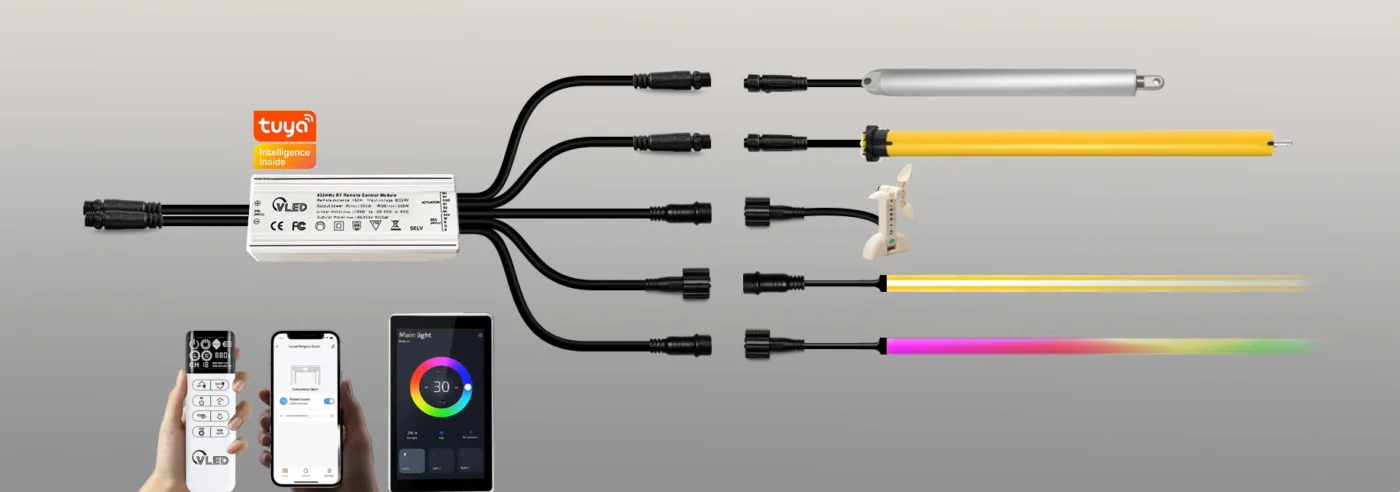
A serious pergola control system should go beyond basic on-off lighting. For manufacturers, the useful question is not only whether the pergola can connect to an app. The better question is how many pergola functions the system can manage reliably from one ecosystem.
O nosso Sistema de controlo da pérgola is designed around that idea. It integrates RF remote control, Tuya app control, and touchscreen panel operation into one system. The same control architecture can manage RGB lighting, mono lighting, linear actuators, tubular motors, and weather sensors.
A practical integrated system should cover:
- RGB lighting for full-color ambience, scene modes, and smooth dimming.
- Mono lighting, typically DC24V strip lighting for clean architectural illumination.
- Linear actuator control for louver blade movement.
- Tubular motor control for retractable screens, roofs, awnings, or related shading products.
- Weather sensor input for wind, sun, rain, and snow protection.
- Group control for multiple pergola zones.
- App-based control for smart scenes and phone-based operation.
- RF remote control for fast, familiar daily operation.
- Touchscreen or wall control for fixed-position use.
Fans can be integrated into the same user experience when the fan system is compatible with the controller architecture or connected through an appropriate fan-rated receiver or auxiliary control module. For manufacturers, the key is to design this at the system level instead of leaving the fan as an isolated accessory.
A unified system also helps manufacturers define product tiers. An entry model may use mono lighting and louver control. A mid-range model may add RGB lighting and app operation. A premium model may add screens, fans, and full weather sensing. A commercial model may use grouped control for several pergola bays. The visible product changes, but the control foundation remains consistent.
Lighting Control: More Than Turning LEDs On
Lighting is often the first feature customers notice after sunset, so it deserves more attention than a simple on-off switch. For pergola manufacturers, lighting control affects appearance, safety, wiring, thermal behavior, power supply selection, and perceived product quality.
Mono white lighting is the practical layer. It supports dining, reading, pathways, hotel terraces, restaurant seating, and everyday outdoor use. In many pergolas, DC24V LED strips are preferred because they can be integrated into aluminum profiles and distributed across longer runs more cleanly than many low-voltage alternatives. The key questions are brightness, dimming smoothness, channel grouping, connector design, and service access.
RGB lighting is the emotional layer. It creates ambience, color scenes, and visual differentiation for higher-end product lines. For OEMs, RGB is useful only when it is controlled gracefully. If colors change roughly, dimming flickers, or scenes feel disconnected from the rest of the pergola, the feature can feel like an afterthought. When RGB lighting is part of the same remote and app ecosystem, it becomes easier to package as a premium experience.
O Pergola Lights control system supports RGB lighting and mono lighting control in one architecture. This matters because many manufacturers need both: clean white task lighting for normal use and full-color scenes for product differentiation.
Manufacturers should also consider how lighting is installed physically. Waterproof connectors, protected cable routes, low-voltage distribution, and access to the control box all affect installation quality. A lighting system that looks good in a rendering but is difficult to wire inside the frame will slow production and create service issues later.
Fan Control: The Comfort Feature That Should Not Feel Separate
Fans are becoming more common in covered outdoor living spaces, especially in warmer parts of North America, southern Europe, Australia, and hospitality environments. A ceiling fan can improve perceived comfort without changing the roof position, and it can make a pergola more usable during humid evenings or still summer afternoons.
The mistake is treating the fan as an unrelated indoor accessory. If the user needs one remote for the pergola and another remote for the fan, the outdoor room feels less integrated. If the app controls the louvers and lights but not the fan, the user experience becomes uneven.
For manufacturers, fan integration should be planned around electrical compatibility, user logic, and exposure. Fans may require specific voltage, speed control, safety protection, and load handling, so they should not be connected casually to a lighting output. Outdoor fan selection should also match the installation environment. The IEC IP rating system is a useful reference for understanding how enclosures are classified against dust and water ingress, but the final product specification should always consider the actual installation condition and local market requirements.
Why RF Remote Still Matters
Some brands focus entirely on app control, but outdoor products should not depend on a phone alone.
In real use, the homeowner may be eating outside, hosting guests, or walking past the pergola with wet hands. A physical RF remote is still the fastest and most natural interface. It also reduces training time for dealers and installers.
A strong RF system is especially important in aluminum pergola structures, where signal performance can be affected by metal frames. Our system is designed for long-distance RF control, with more than 100 meters of control range and anti-interference performance through 3mm aluminum structures.
That matters in the field. A remote that works only in a showroom but fails across a large patio, pool area, or hospitality terrace becomes an after-sales problem. For manufacturers, RF reliability is not a small specification; it protects the brand experience.
Remote control also supports product handover. Dealers can demonstrate the system quickly: open, close, stop, dim, change color, activate a zone, or trigger a preset. A homeowner can understand the product in minutes. A commercial customer can train staff without turning every operation into a smartphone task.
Why App Control Matters Too
The app is where the pergola becomes more than a powered structure.
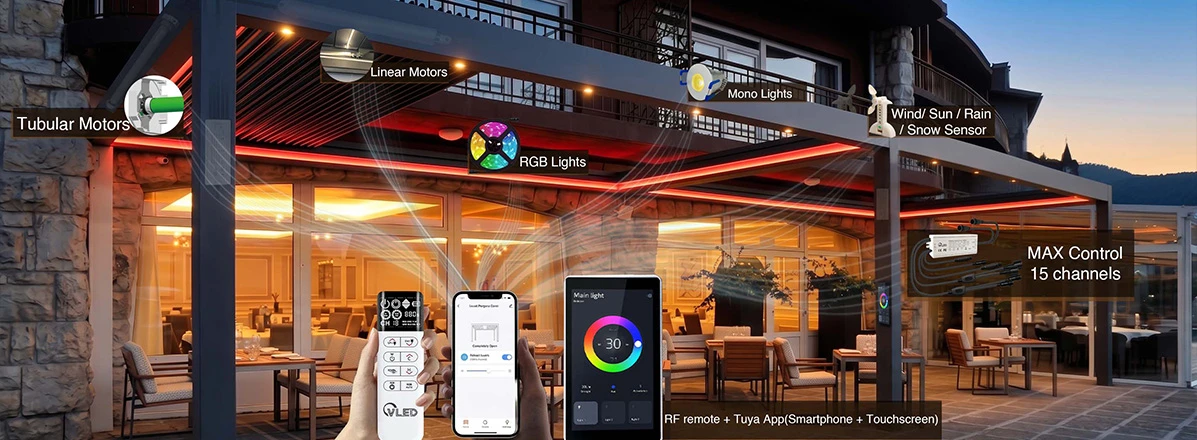
With Tuya app integration, users can operate lighting and movement functions from a smartphone, create scenes, and manage the pergola with a familiar smart-home style interface. This is valuable for residential users, but it is especially useful in hospitality and commercial installations where staff may need to manage multiple zones.
The app also supports the one outdoor room mindset. Instead of thinking separately about lights, fans, roof position, and weather response, the user can think in scenes:
- Dinner mode: warm white lighting, fan on low speed, louvers partially open.
- Lounge mode: RGB ambient lighting, roof adjusted for airflow.
- Storm mode: weather sensor triggers protective movement.
- Closing mode: lights off, motors return to a secure position.
This is where manufacturers can differentiate. The premium experience is not simply that every accessory is powered. It is that every accessory feels coordinated.
App control also supports model positioning. A manufacturer can offer RF-only packages for cost-sensitive lines, app-enabled packages for smart-home buyers, and touchscreen panel packages for high-end residential or commercial projects. The control platform should make those options possible without forcing a different engineering approach each time.
Motor Control: Linear Actuators and Tubular Motors Need Different Thinking
Lights and fans shape comfort, but motors define the movement experience of the pergola. A slow, noisy, poorly synchronized, or unreliable motor system can damage the customer’s trust immediately.
Linear actuators are commonly used for louver blade rotation. They require clear open, close, stop, and limit behavior. In multi-actuator systems, synchronization and obstruction response become important. The user should not need to understand the mechanics; the movement should simply feel controlled and confident.
Tubular motors are often used for screens, awnings, shutters, or retractable shading products. They may come from motor brands such as Somfy, AOK, or Dooya, depending on the product line and market. Our pergola control system is designed to connect with tubular motor applications, which helps manufacturers integrate side screens or related shading functions into the same control environment.
For OEMs, this is a major advantage. A pergola platform may start with louver movement and lighting. Later, the manufacturer may add side screens, privacy shades, retractable fabric, or vertical sun protection. If the control system already supports both actuator and tubular motor logic, product expansion becomes easier.
Motor behavior should also be connected to sensors. If wind speed rises, the system may need to retract or secure a moving element. If rain begins, louvers may need to close. If snow is detected, the system may need to prevent a risky position. Good control architecture links movement decisions to environmental input.
Weather Sensors Are Not Optional for Premium Pergolas
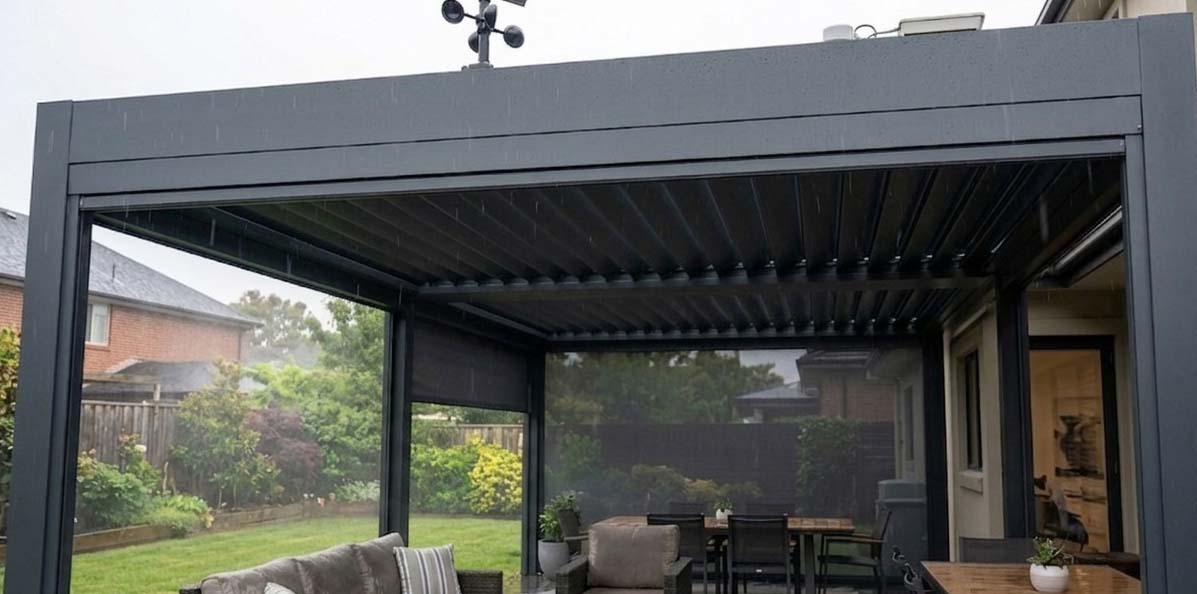
In Europe and North America, pergolas are increasingly sold as year-round outdoor living systems. That makes weather protection central to the value proposition.
Rain sensors can automatically close the pergola when rain is detected. Wind sensors can move the structure into a safer position when wind speed becomes risky. Sun sensors can support comfort and shading logic. Snow detection is especially important for colder climates where accumulation can damage louvers, screens, or roof structures if the system is left in the wrong position.
Several leading market pages now highlight sensor-driven automation as a major feature, not an add-on. Louvred Roof Online describes pergola automation as a combination of weather sensors, motorized components, and a smart controller. Azenco also discusses outdoor automation as part of a broader smart pergola experience.
For manufacturers, sensors reduce dependence on the homeowner’s reaction time. That is the real value. A customer may forget to close a pergola. A sensor does not.
The engineering challenge is priority. Weather automation must be predictable. If rain is detected while the user has the louvers open, the system should follow the manufacturer’s rain protection strategy. If wind input conflicts with a user command, the safer action should take priority. If snow is detected, the system should avoid behavior that increases structural risk.
This is why weather sensors should be designed into the control system instead of added at the end. A separate sensor module may send a signal, but the real value comes from how the controller interprets that signal and coordinates lighting, actuators, tubular motors, and user commands.
Manufacturers should define weather logic by market. Coastal projects may place more emphasis on wind, northern markets may require snow-related protection, and hot regions may use sun sensors for comfort and shading. Hospitality projects may need staff override rules, while residential projects may prioritize automatic safety.
The Manufacturing Advantage: Fewer Boxes, Cleaner Installation
The most overlooked benefit of integrated control is not the app. It is the production workflow.
An all-in-one control system reduces the number of separate receivers, transmitters, and wiring decisions inside the pergola frame. Our system is built as a compact control box that fits into most pergola cavities, with waterproof connectors for faster installation and cleaner assembly.
That changes the economics of a pergola line.
Instead of training installers on several disconnected systems, manufacturers can standardize around one control platform. Instead of diagnosing whether a lighting receiver, motor remote, or sensor module caused the issue, service teams can start from one known architecture. Instead of offering too many incompatible control combinations, sales teams can package the pergola as a clear, integrated product.
This is how control systems create margin: not only by adding features, but by removing complexity.
Cleaner installation also supports better aesthetics. The pergola frame should not be filled with visible adapters, exposed junctions, or inconsistent wiring paths. For exported pergola products, a defined control box, connector system, and wiring plan help reduce variation after the product leaves the factory.
Compliance and Documentation Should Come Early
Wireless control, low-voltage lighting, outdoor enclosures, and motorized movement all raise documentation questions. Manufacturers should consider these questions before launching the product line, not after the first distributor requests compliance files.
For wireless devices in the United States, FCC Parte 15 is commonly relevant to radio frequency devices. For European markets, CE, EMC, radio equipment, low-voltage safety, and local installation requirements may apply depending on the finished product configuration. For outdoor electrical equipment, ingress protection and connector design should also be reviewed carefully.
This article does not replace compliance testing or legal advice. The point is simpler: integrated architecture makes documentation easier to manage. A patchwork system with many independent transmitters, receivers, power supplies, and add-on modules usually creates more compliance work than a standardized control platform.
What Manufacturers Should Specify Before Choosing a Control System
For a pergola manufacturer, the control system should be selected early, not after the frame and accessories are already designed.
Key questions include:
- How many lighting channels are required?
- Will the pergola use mono lighting, RGB lighting, or both?
- How many linear actuators are needed for louver movement?
- Are tubular motors required for screens, awnings, or retractable roofs?
- Does the system support wind, rain, sun, and snow sensors?
- Can the RF signal perform reliably through aluminum structures?
- Is app control available through a proven ecosystem such as Tuya?
- Can multiple pergolas or zones be grouped and controlled independently?
- Are waterproof connectors available for faster installation?
- Does the control box fit inside the pergola cavity?
- Can the system support future accessories such as fans or heaters through compatible modules?
These questions are practical. They decide whether the final pergola is easy to build, easy to use, and easy to support.
Manufacturers should also decide what must be standardized and what can remain optional. The control box, voltage strategy, cable routes, connector family, sensor input logic, RF pairing process, and service documentation should be standardized. Lighting color, app availability, fan integration, screen control, and sensor packages can then become configurable options for different product tiers.
A Practical OEM Specification Framework
For manufacturers developing a new pergola line, the base platform should include the control box, power supply strategy, RF remote operation, louver actuator control, and at least one lighting configuration. Premium modules can then add RGB lighting, app control, touchscreen panels, side screen motors, fan integration, heaters, and additional sensors without requiring a complete redesign.
Weather behavior should be written into the product specification, not decided casually in the field. Control box location, cable routing, connector use, pairing procedure, and service access should also be documented. A premium pergola product should be easy to repeat.
The same thinking applies to the customer interface. Decide which functions appear on the RF remote, which functions appear in the app, and which functions belong on the touchscreen panel. Too many visible options can confuse users. Too few can make the system feel limited.
Our View: The Remote Is No Longer Just a Remote
The pergola remote used to be a simple transmitter. Open. Close. Stop.
That model is outdated.
Today, the remote and app together represent the user interface of the entire outdoor room. They control comfort, lighting atmosphere, airflow, weather response, and product safety. For manufacturers, this means the control system should be treated with the same seriousness as the aluminum profile, drainage design, motor selection, and LED quality.
A weak control system makes a strong pergola feel unfinished.
A strong control system makes every function feel intentional.
That is why our pergola lighting and control system is built as an integrated platform: RGB and mono lighting control, multi-actuator movement, tubular motor compatibility, wind, sun, rain, and snow sensor logic, RF remote, Tuya app, touchscreen panel, long-distance control, anti-interference performance, IP65 protection, and compact installation.
The goal is simple: help manufacturers deliver a pergola that feels premium before, during, and after installation.
What This Means for Pergola Manufacturers
The pergola market is moving from mechanical shade products toward integrated outdoor living systems. A manufacturer that treats control as an accessory will keep reacting to problems: a remote that does not pair, a sensor that conflicts with a motor, a fan that cannot be included in a scene, or a dealer who installs the same product differently each time.
A manufacturer that treats control as part of the core product can create a stronger commercial position. The sales story becomes cleaner, the installation process becomes more repeatable, the product family becomes easier to expand, and the end user receives a pergola that behaves like one system.
Conclusão
Controlling pergola lights and fans from one remote or app is not only about convenience. For manufacturers, it is about building a cleaner product system.
When lighting, motors, sensors, and auxiliary functions are planned as one control architecture, the pergola becomes easier to install, easier to sell, easier to maintain, and better to use. That is the direction the premium pergola market is moving.
If you manufacture louvered pergolas, retractable roofs, verandas, awnings, patios, or outdoor living systems, now is the right time to rethink the control layer. Explore our integrated pergola lighting and control solution here: Sistema de controlo da pérgola, and contact us to discuss a customized control package for your next pergola product line.

Pingback: Opções de controlo da cobertura de pérgulas: painéis fixos vs. persianas motorizadas para fabricantes de equipamento original (OEM)
Pingback: Pacotes de controlo para pérgulas de cozinhas exteriores: iluminação, persianas, ventiladores e sensores