


Key takeaways
- Somfy and StruXure show that control becomes a product advantage when every function feels like one system.
- Renson and Teleco demonstrate that weather automation needs explicit safety states, not a collection of disconnected sensors.
- LINAK and Jiecang show why actuator feedback, compact hardware, and configurable manufacturing support matter to OEMs.
- The best next step for a pergola maker is to define the control architecture before selecting motors, lighting, or an app.
For a pergola manufacturer, the control system is no longer a hidden accessory. It determines how the roof moves, how the structure reacts to rain and wind, how lighting feels at night, how quickly a dealer can install the product, and how expensive the next service call will be.
That is why the most useful question is not “Which famous brand should we copy?” The better question is: “What operating principles made these companies credible, and how can we adapt those principles to our own product line?” This article answers that question from the perspective of a manufacturer developing pergola lighting and control systems for OEM and brand customers.
What do the leading pergola control brands have in common?
The common pattern is system ownership. Somfy presents pergola automation through motors, weather sensors, lighting, and TaHoma control. Renson presents sensors as configurable scenarios that continue working when the homeowner is away. StruXure connects louvers, screens, lights, fans, and heaters through a central operating experience. These companies sell coordinated behavior, not isolated components.
That distinction matters for manufacturers. A customer does not experience a motor, receiver, sensor, and LED driver separately. They experience a roof that closes when rain starts, opens to a comfortable position after a storm, dims without flicker, and responds predictably to a remote or app. The product is the behavior between components.
| Company | Visible strength | Lesson for a pergola OEM |
|---|---|---|
| Somfy | Motion, sensors, lighting, and connected-home integration | Build a control ecosystem that can expand without confusing the installer. |
| Renson | Configurable weather scenarios and unattended protection | Make automation rules visible, testable, and adjustable. |
| StruXure | One interface for multiple outdoor functions | Design the complete outdoor experience, not only roof movement. |
| Teleco | Dedicated pergola control logic and climatic inputs | Translate weather conditions into defined operating states. |
| LINAK | Durable linear actuators and precise movement | Specify force, feedback, duty cycle, noise, and service life together. |
| Jiecang | Pre-configured, compact, customized pergola solutions | Reduce commissioning work through plug-and-play architecture. |
Lesson one: control the complete experience, not only the roof
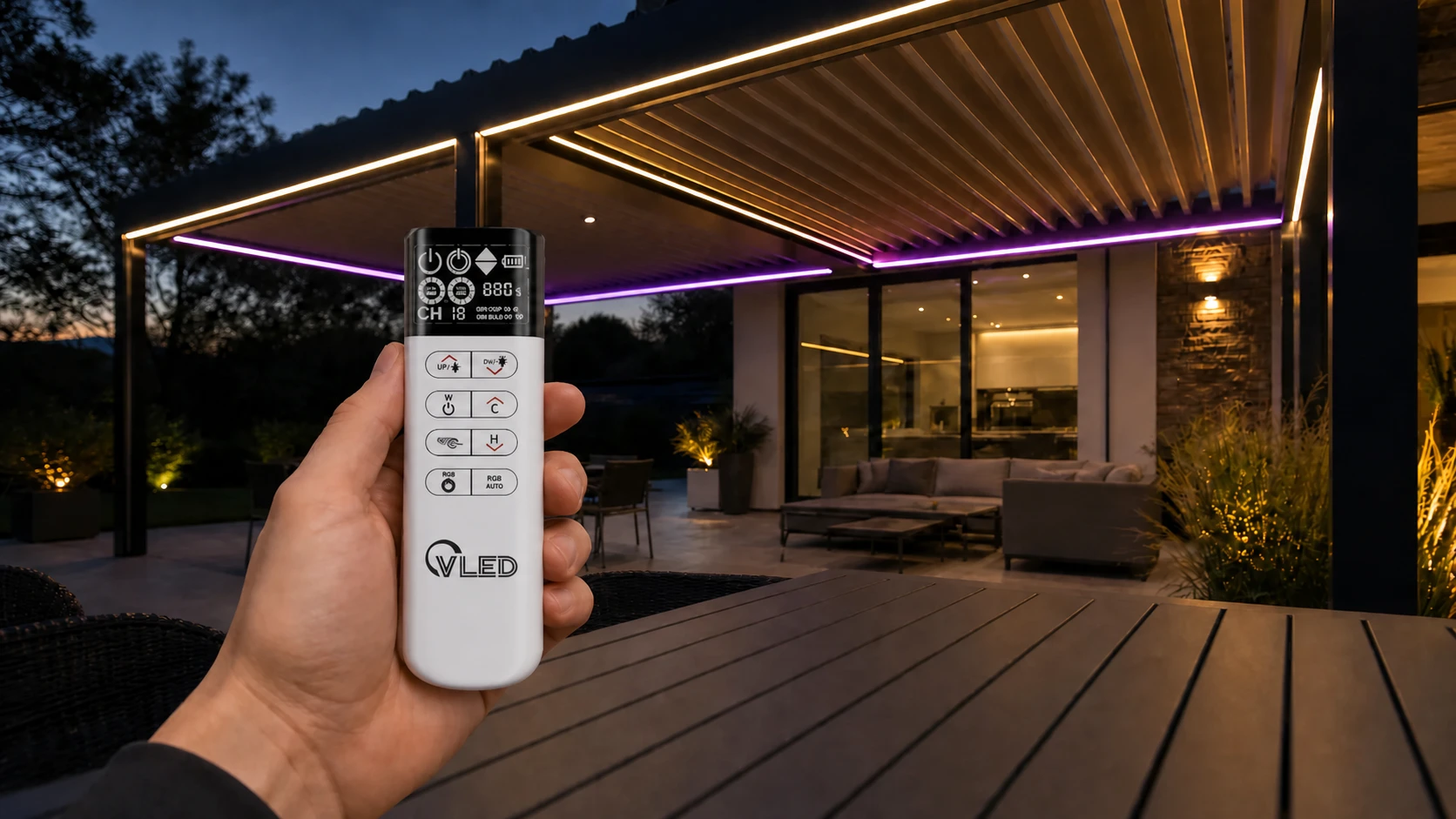
Somfy and StruXure make the first lesson clear: a premium pergola should feel like one product even when it contains many subsystems. StruXure describes a single operating platform for louvers, lighting, fans, heating, and screens. Somfy positions the TaHoma ecosystem as a way to manage pergola products, lights, sensors, and other connected devices from one place.
Manufacturers should therefore define the experience in scenes and operating modes before defining button labels. “Dinner” might combine a louver position, warm-white lighting, and screen settings. “Storm protection” might override comfort scenes and place the roof in a protective state. “Away” might enable unattended weather response while disabling nonessential lighting.
This also creates a clearer product ladder. A basic model can offer a remote and two lighting zones. A mid-range model can add weather sensors and motor feedback. A premium model can add app control, scene memory, and home-automation integration. The architecture stays consistent while the commercial package changes.
Da VLEDSTAR sistema integrado de controlo de pérgulas follows this product logic by combining lighting, linear actuators, tubular motors, weather inputs, RF control, app control, and touchscreen control in one platform. For an OEM, the value is not the number of functions on a specification sheet. It is the ability to present one coherent control experience under the OEM’s own product identity.
Lesson two: weather sensors need a priority system
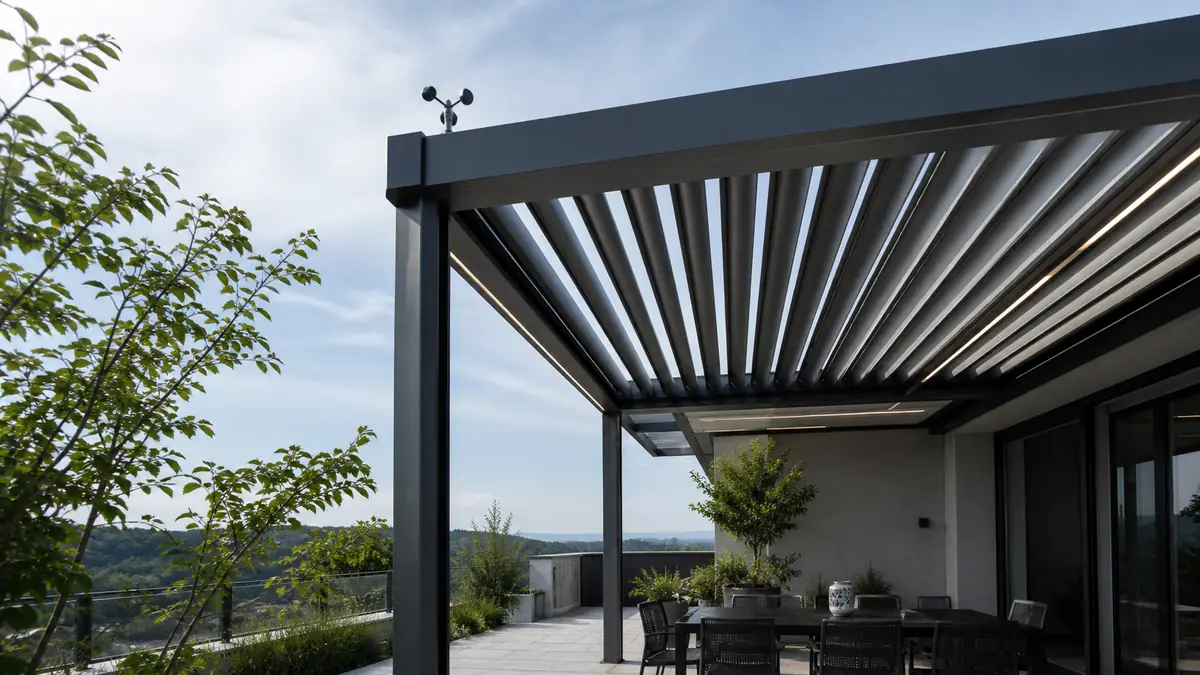
A rain sensor is not a control strategy. Wind, rain, sun, temperature, and snow conditions can request different actions at the same time, so a manufacturer needs a formal priority hierarchy. Renson describes configurable scenarios for wind, rain, and sun. Teleco documentation shows a more explicit approach, with separate responses for wind, rain, snow, and temperature conditions.
For most motorized pergolas, a practical hierarchy starts with structural protection, then freeze and snow protection, then rain management, then comfort automation, and finally manual convenience. The exact order must be validated against the roof design, motor type, drainage method, local climate, and engineering limits. It should never be left to an installer to invent in the field.
A useful control-state model
- Normal: manual control, scenes, sun response, and lighting functions are available.
- Rain: the roof moves to the defined rain position, and nonessential automatic opening commands are restricted.
- High wind: the roof moves to the manufacturer’s tested protective position, which may be closed, partially open, or fully open depending on the structure.
- Snow or ice risk: combined temperature and precipitation logic changes the allowed movement and may require hold-to-run control.
- Fault: the system records or signals a sensor, motor, communication, or obstruction problem and prevents unsafe automatic movement.
The important point is that a sensor should not directly “press a button.” It should create a state. The controller then decides which commands are permitted, which are blocked, and what happens when the alarm clears. This is the difference between a smart-looking product and a controlled safety system.
Manufacturers evaluating a supplier should ask for the complete priority matrix, including recovery behavior. What happens after rain stops? Can the user override the system? For how long? What happens if the temperature probe is disconnected? Is a lost wireless sensor treated as normal, unknown, or unsafe? These questions belong in design reviews, manuals, and dealer training.
Lesson three: treat the actuator as a feedback device
LINAK’s pergola work highlights a point that is often missed in low-cost systems: movement quality depends on more than motor power. Actuator force, stroke, speed, end stops, position feedback, noise, duty cycle, and environmental protection all affect the finished roof. LINAK also emphasizes low-voltage operation, tested durability, and integration with other control systems.
That approach changes how an OEM should specify a control system. “The motor turns the louvers” is not a sufficient requirement. The system should know whether the actuator reached its target, whether an obstruction increased current, whether two actuators are synchronized, and whether a command was completed or interrupted.
For a louvered roof, feedback supports smoother commissioning and better service. It can help the controller learn limits, stop before mechanical damage, detect an obstruction, and report a fault instead of silently repeating a failed command. It also gives the manufacturer a defensible way to define acceptable behavior during testing.
This is where the lighting system also benefits from integrated design. A single control architecture can coordinate actuator movement with LED scenes, but only if the power budget, wiring, connectors, RF behavior, and enclosure layout were designed together. VLEDSTAR’s control platform supports up to four linear actuators and up to two tubular motors, while its lighting outputs are designed for 12V or 24V outdoor lighting configurations. The correct specification still depends on the final load and application, so the system should be validated project by project.
Lesson four: make installation part of the product
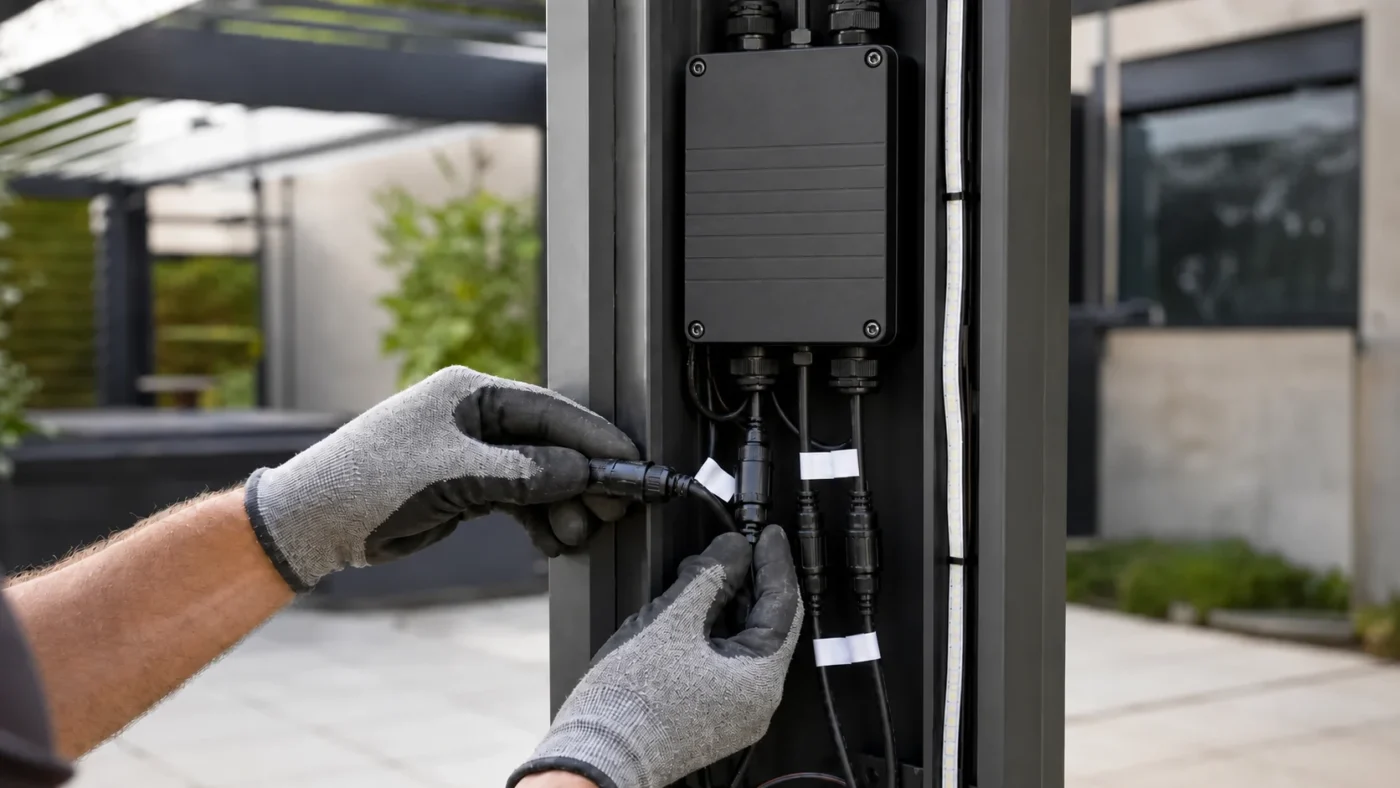
Jiecang’s Pergola Flex positioning is valuable because it treats pre-configuration and compact control hardware as competitive features. The control box is presented as a plug-and-play solution, with motor and accessory channels assigned before the installer reaches the site. That reduces miswiring, setup time, and the number of decisions made under pressure.
A pergola controller is successful when a competent dealer can install it consistently across many structures. That requires more than a small enclosure. It requires keyed connectors, clear channel names, repeatable motor learning, accessible service points, wiring diagrams that match the physical product, and a commissioning sequence that does not depend on hidden engineering knowledge.
Designers should also work backward from the aluminum frame. Where will the controller sit? Can it be removed without dismantling the roof? Does the RF signal pass through the enclosure and frame? Can the installer reach the pairing button? Can a replacement unit be fitted without changing every field connection?
These are manufacturing questions, not after-sales questions. A compact IP65 control box, waterproof connectors, multi-channel grouping, and a documented installation process can reduce both dealer friction and warranty exposure. The VLEDSTAR veranda control solution also shows how connector options and 24V lighting configurations can be organized for outdoor structures beyond a single pergola format.
Lesson five: use openness strategically
Somfy, StruXure, LINAK, and Jiecang each demonstrate a different version of ecosystem thinking. The lesson is not that every manufacturer must support every smart-home protocol. The lesson is that compatibility should be deliberate, documented, and matched to the markets where the product will be sold.
A useful architecture separates the core safety and motion logic from optional user interfaces. The roof should remain safe if the app is offline. A wall switch should not bypass a wind alarm. A remote should not be the only way to recover from a configuration error. External integrations should communicate with a stable interface rather than reaching into undocumented internal behavior.
For one OEM, that may mean RF plus a branded app. For another, it may mean dry contacts, wired building automation, or a gateway that supports a selected ecosystem. The commercial decision should consider installer capability, service ownership, cybersecurity expectations, regional approvals, and replacement strategy. “Works with an app” is not a complete integration plan.
What should pergola manufacturers build into their own roadmap?
The strongest roadmap is modular, but not fragmented. Start with a common controller and define layers that can be added without rewriting the product: motor control, lighting control, weather protection, user interfaces, and external integration.
- Write the behavior specification first. Define every normal, alarm, recovery, fault, and manual-override state before choosing the final hardware.
- Separate safety from comfort. Weather protection must remain reliable even when the app, cloud connection, or a decorative lighting function is unavailable.
- Standardize the installation interface. Use consistent connectors, labels, channel assignments, and commissioning steps across the product family.
- Test the whole assembly. Validate the controller, actuator, frame, sensors, lighting, power supply, and RF path as one system. Bench-testing parts separately will not reveal every field failure.
- Build a service path. Provide diagnostic indicators, replaceable modules where practical, version-controlled manuals, and a clear process for dealers to identify the failed component.
The right supplier should be able to support that roadmap with engineering changes, sample builds, firmware or logic adjustments, connector customization, and production consistency. It should also be able to explain what the system does when something goes wrong, not only what it does when everything works.
Where should manufacturers be careful?
No benchmark brand provides a universal answer. Renson’s integrated product scenarios may fit a complete system manufacturer better than a component supplier. LINAK’s actuator-centered approach may be ideal for a design that needs precise mechanical movement, while a tubular-motor architecture may be more appropriate for a retractable roof. Teleco’s weather logic is useful as a reference, but its exact alarm positions cannot be copied without considering the structure.
Manufacturers should also resist adding features faster than they can support them. More channels, more colors, more integrations, and more sensors increase the test matrix. If the dealer cannot understand the system or the service team cannot reproduce a fault, the apparent feature advantage may become a liability.
The best control platform is therefore not the one with the longest feature list. It is the one whose behavior is predictable, whose safety logic is explicit, whose installation is repeatable, and whose architecture can evolve without forcing a complete product redesign.
Conclusion: copy the discipline, not the brand
Somfy teaches ecosystem thinking. Renson teaches configurable weather automation. StruXure teaches the value of one outdoor operating experience. Teleco teaches explicit alarm logic. LINAK teaches the importance of actuator quality and feedback. Jiecang teaches the commercial value of pre-configured, compact, customized systems.
Together, those lessons point to one conclusion: pergola control should be designed as a core product platform, not purchased as an afterthought. Manufacturers that own the behavior of their roof, lights, sensors, and installation process can create stronger differentiation, better dealer experiences, and more defensible long-term service economics.
Turn the control architecture into a product advantage
If you are developing a new pergola line, replacing separate remotes, or adding weather-responsive lighting, review the sistema integrado de controlo de pérgulas and the pergola lighting product range. VLEDSTAR supports OEM development with pergola lighting, motor control, weather-sensor integration, and manufacturing-oriented customization. Meet the VLEDSTAR team and discuss the control requirements for your next product platform.

Pingback: Control Systems for Restaurant and Hotel Pergolas: Multi-Zone Lighting and Weather Automation