


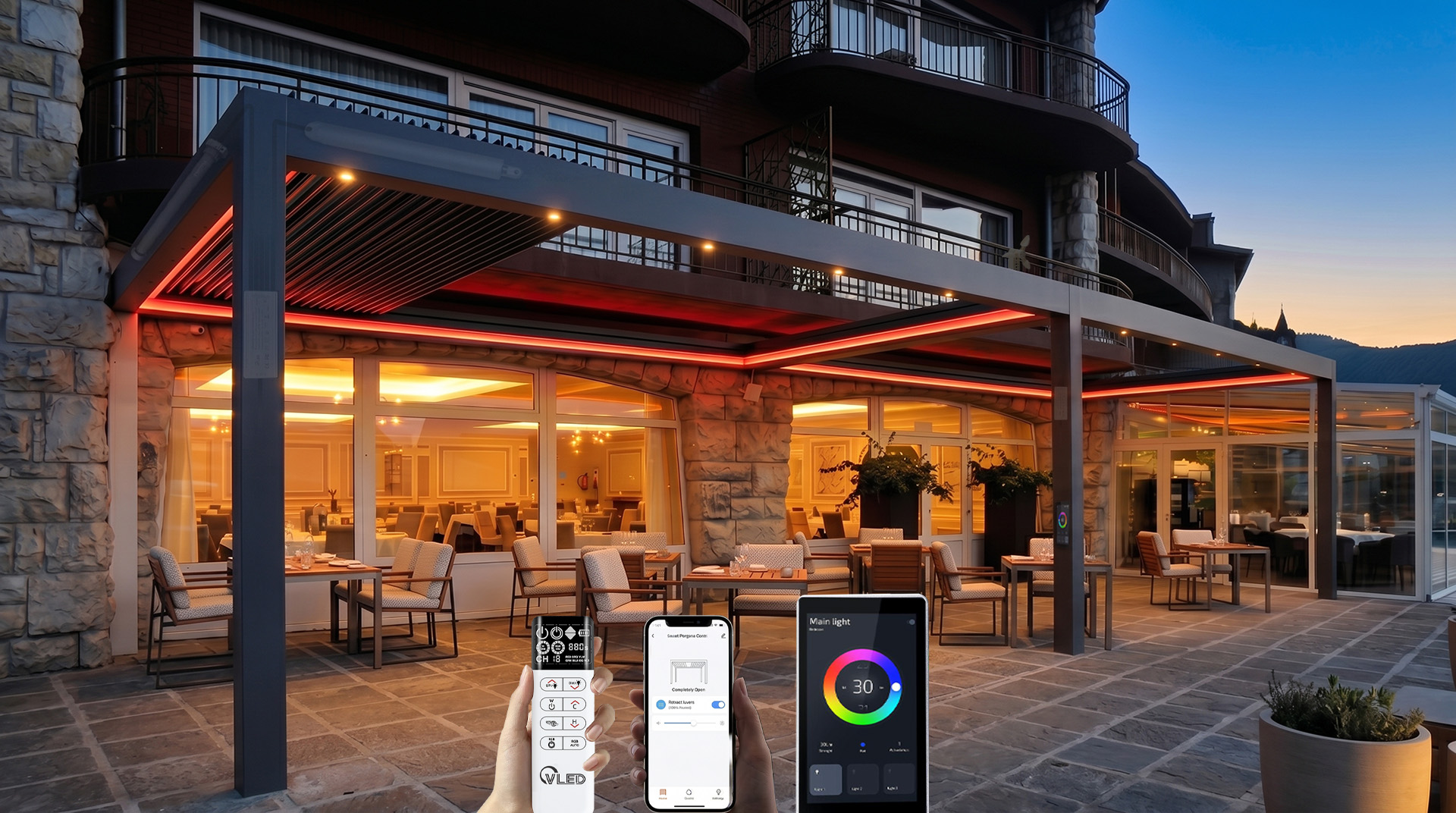
According to professional smart home market reports released by the Custom Electronic Design & Installation Association (CEDIA), outdoor lighting, motorized shading, and outdoor audio-video systems have ranked among the top three growth categories in high-end residential integration for several consecutive years. In high-net-worth homes and premium commercial projects across Europe and North America, owners often allocate about 20% of their overall renovation or landscape budget, averaging more than USD 41,000, directly to smart ecosystem integration.This consumption trend is reshaping the shading and outdoor building materials industry. The modern pergola has evolved from a simple outdoor metal shade structure into a highly intelligent, system-level architectural environment control terminal.
For pergola manufacturers serving Europe and North America, traditional non-smart or basic standalone control solutions are facing serious supply chain and on-site installation challenges. Combining linear motor controllers, dimming modules, RGB strip drivers, and environmental sensors from different brands often results in oversized control boxes, complicated field wiring, and significantly higher after-sales warranty and technical support costs. As a result, adopting a highly integrated control system at the manufacturing stage, with multimodal control through app, RF, Wi-Fi, LCD touch panel, and voice, has become a core strategy for pergola manufacturers that want to build a high-end brand moat and improve assembly efficiency.
The Smart Outdoor Wave in High-Net-Worth European and North American Markets, and the B2B Pain Points Behind It
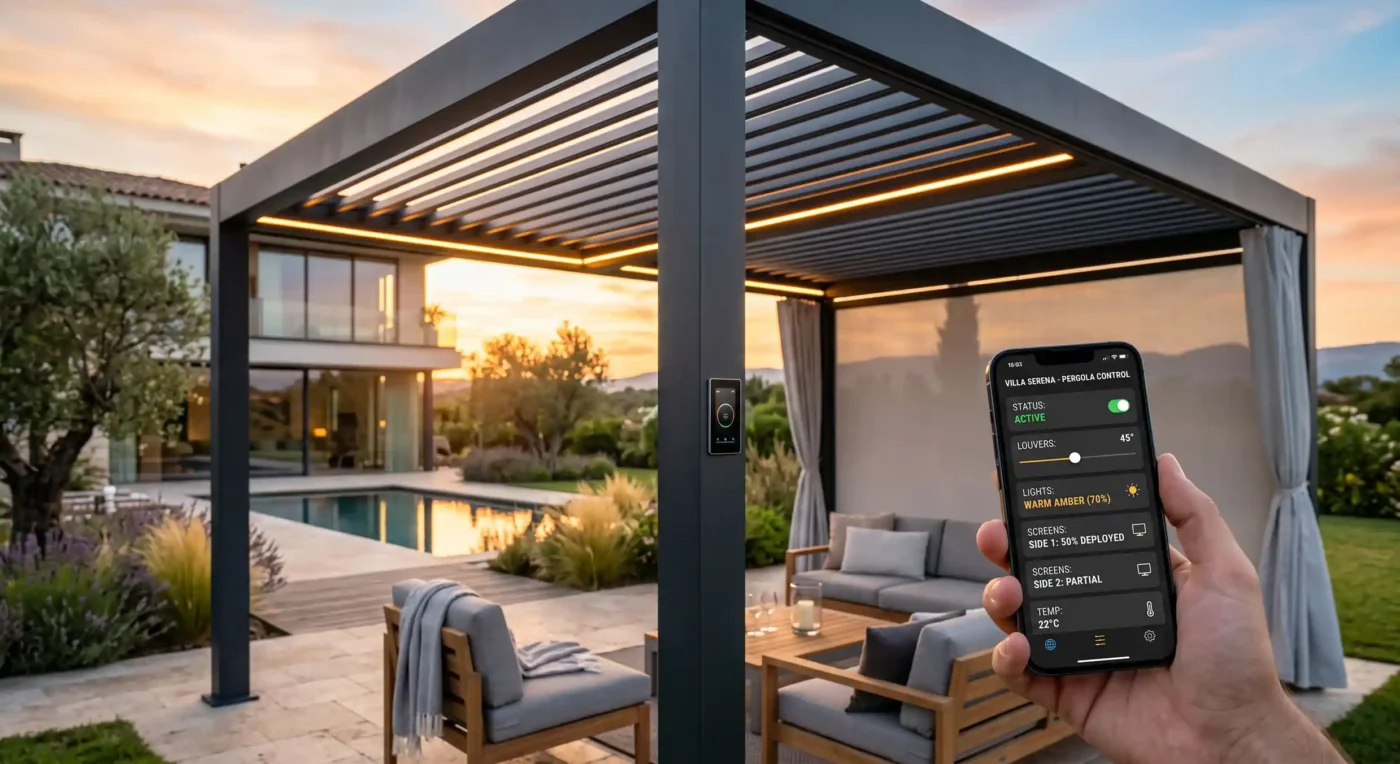
As outdoor living becomes increasingly popular among middle-class and high-net-worth households in Europe and North America, pergola use cases are no longer limited to daytime sun shading. They now extend to evening entertainment, outdoor dining, and comfortable cross-season living spaces. This diversified lifestyle scenario requires pergola systems to coordinate louver rotation angle, wind-resistant ZIP screen movement, multi-color dimmable lighting, and localized heating or cooling fans at the same time.
However, many manufacturers face the pain point of fragmented integration when selecting technical solutions. In most cases, motorized louvers use linear motor drives, while surrounding ZIP screens use tubular motors. These two motor types naturally differ in control logic and limit setting. In addition, high-end projects commonly require dimmable warm white LED lighting and adjustable RGB ambient light strips. If these functions are controlled by separate receivers, installers must configure several different remote controls on site or fill the control box with complex bridge modules. This distributed architecture is highly prone to signal interference and can multiply failure rates because of the large number of wiring nodes.
European and North American markets also impose demanding requirements on installation safety standards and visual finish, including concealed wiring and ultra-thin control box design. Control systems therefore need to move toward an integrated, multi-channel, easy-pairing industrial standard from the production stage. This reduces BOM costs while delivering the diversified control methods expected in modern smart home interaction.
The Technical Evolution of a Four-in-One Integrated Control Architecture
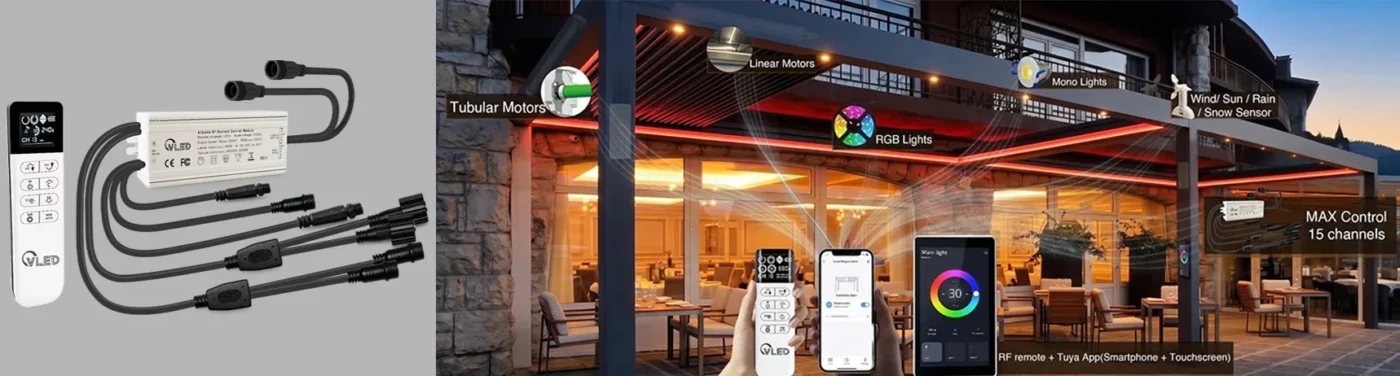
To solve these assembly and integration challenges, professional smart control system manufacturers have developed highly integrated solutions. Taking the PERGO Pro four-in-one smart control system as an advanced industry example, it integrates louver linear motor drive, mono dimming lighting, RGB strip control, and a local rain sensor interface into one compact receiver housing. This design allows pergola factories to complete more than 90% of wiring internally during the assembly stage, greatly reducing on-site labor difficulty and installation time.
The table below compares the technical parameters and engineering performance of a traditional distributed control system with the PERGO Pro industrial-grade four-in-one control platform:
| Technical Evaluation Dimension | Traditional Distributed Control Solution | PERGO Pro Four-in-One Integrated Control System |
|---|---|---|
| Main control chip and integration level | Multiple independent wireless modules assembled together, requiring external dry-contact bridging | Highly integrated four-in-one single main board with built-in ultra-thin LCD status display |
| Multi-channel management | Commonly 1 or 5 channels, making complex zone linkage difficult | 16-channel system supporting single-channel control, multi-channel grouping, and Channel 0 master control |
| Linear motor travel calibration | Depends on mechanical limits or complex external current detection modules | Supports precise electronic travel limit setting |
| Lighting system drive capability | Supports only basic on/off control; RGB control requires an additional third-party controller | Built-in dual-channel drive supporting both mono dimming and stepless RGB color transitions |
| Safety mechanism and protection level | Sensor data transmission has high latency and lacks a local hardware-level closed loop | Rain and other environmental sensor data is input directly into the main processor for millisecond-level local response |
| Future expansion compatibility | Closed hardware design, unable to upgrade smoothly to new devices | Reserved interfaces support 1–4CH tubular motors, RGBW/RGBCW light strips, ceiling fans, and heater expansion |
One of the key technical advantages of the PERGO Pro control platform is its built-in 16-channel control system. Traditional pergola control systems usually provide only a single channel or a few physical channels. When used in large multi-pergola projects that require grouped control, such as luxury hotel terraces or golf club banquet areas, the control experience can become fragmented. The 16-channel design allows installers to flexibly group different shading and lighting zones, while Channel 0 enables one-touch master control. This solves the synchronization challenge of multi-zone control.
The Collaborative Logic of a Three-Dimensional Control Ecosystem: App, RF, and LCD Touch Panel
To satisfy different user preferences and application scenarios, modern smart pergolas need a three-dimensional control matrix composed of local physical interaction, wireless RF remote control, and cloud ecosystem interconnection.
RF Remote Control (433.92MHz): The Secure Foundation of Local Low-Level Communication
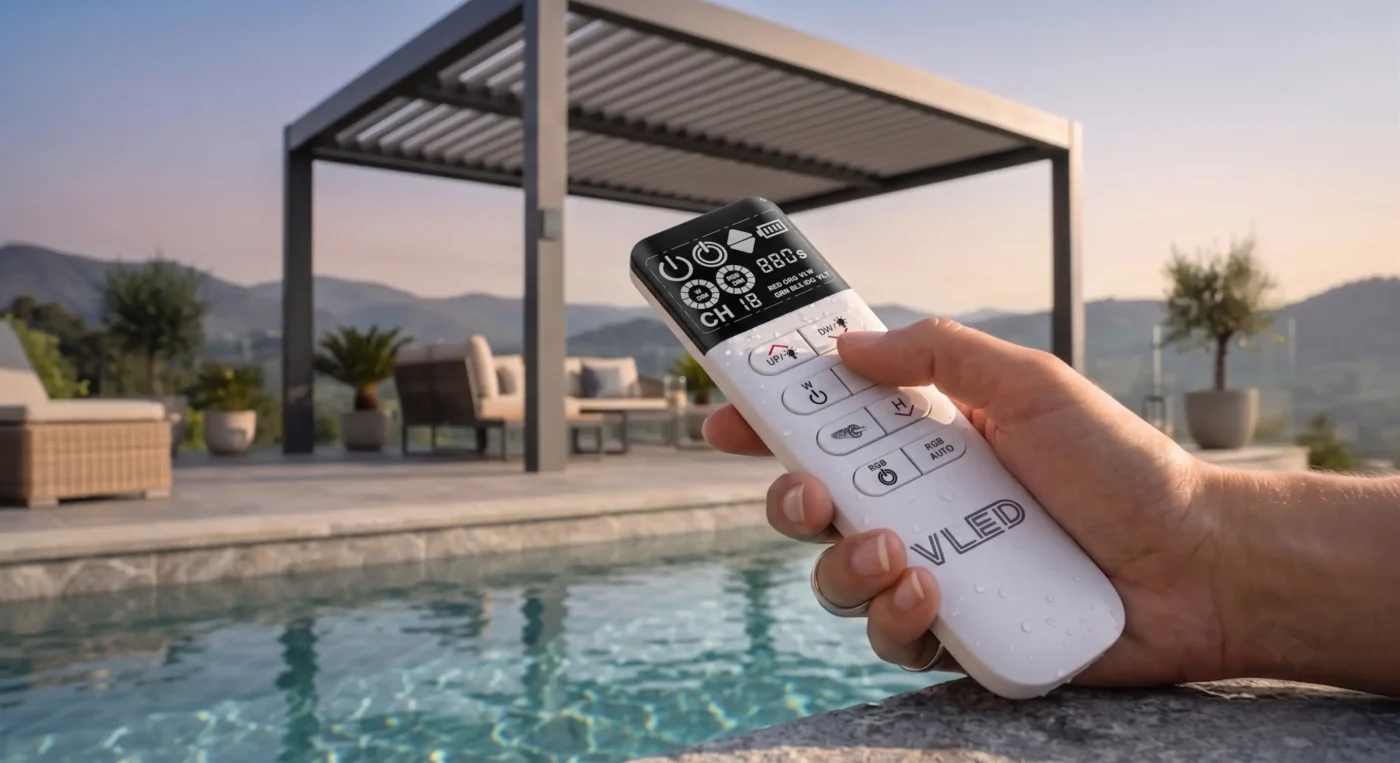
Because of its low latency, strong penetration, and independence from external network access, wireless RF technology remains an irreplaceable safety layer in outdoor control. During severe rainstorms, typhoons, or physical home network outages, a 433.92MHz RF remote can ensure immediate physical operation of louvers and protective screens within a range of 200 feet. This avoids the paralysis risk of purely cloud-based control solutions when the network goes offline.
In addition, the PERGO Pro system’s electronic limit learning and precise travel fine-tuning can be completed through the RF remote control together with the built-in LCD status display. This improves both the safety of technicians working at height and the efficiency of configuration.
LCD Touch Screen Panel: Combining Aesthetics with Local Centralized Control
For design-forward high-net-worth homes and five-star boutique hotels in Europe and North America, plastic remote controls are easy to lose and often feel out of place against premium interior and exterior finishes. Wall-mounted LCD touch panels or smart keypads solve this contradiction elegantly.
The touch panel can communicate bidirectionally with the central control box through wired communication or a stable local wireless protocol. It can provide real-time feedback on pergola operating status, such as the current louver opening percentage, zone temperature, and lighting mode. An elegant UI, combined with wall-mounted or recessed installation, greatly elevates the perceived quality of the entire space while giving users who are not carrying a phone a convenient and visually intuitive control point.
Tuya Smart and the Cloud Ecosystem: Full-Function Mobile Control and Export Compliance
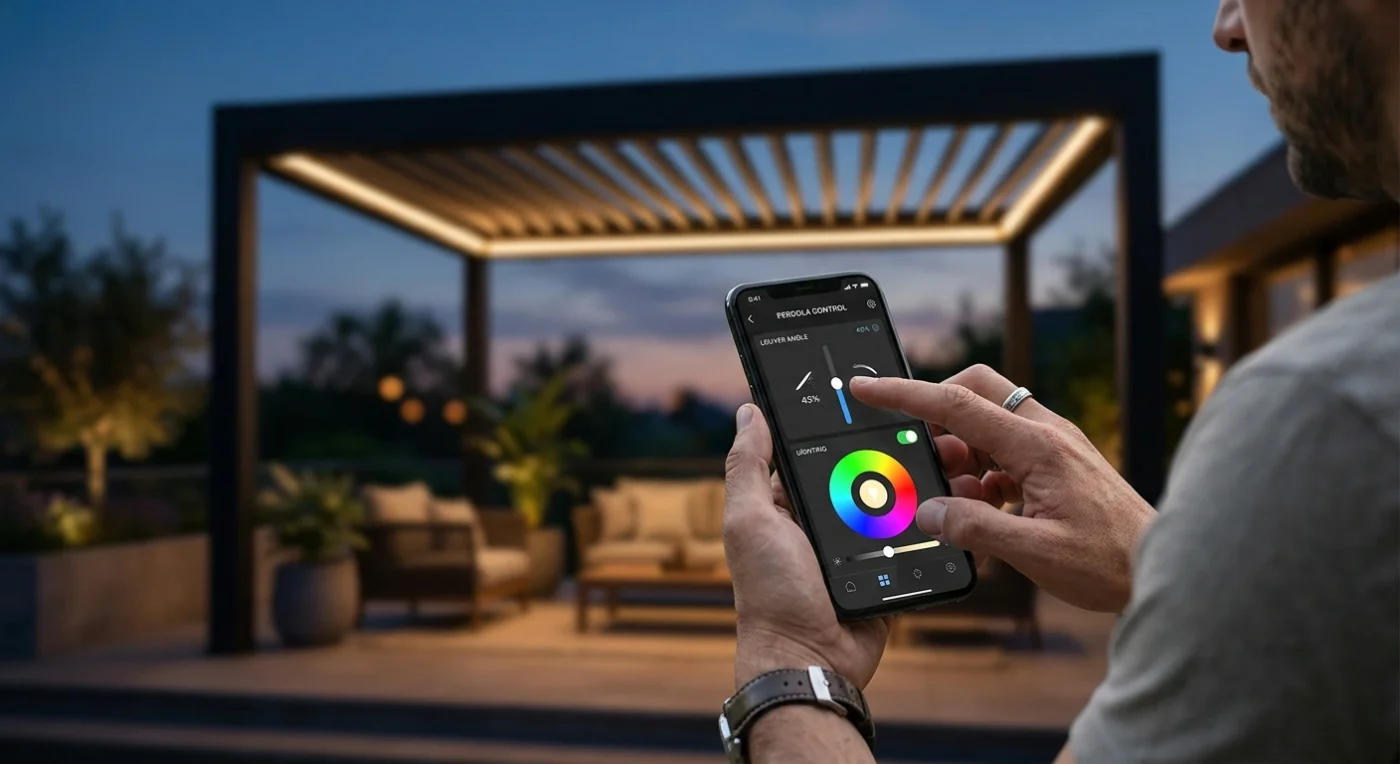
When users leave the control panel or need to check the outdoor courtyard remotely, such as from a vacation home or during business travel, Wi-Fi or cellular app control becomes essential. By connecting the control module to the globally recognized Tuya Smart platform, the pergola system can be managed through a powerful and visually polished app.
The Tuya ecosystem provides manufacturers with full-lifecycle device management PaaS services. Its data centers deployed in Europe comply with the strict requirements of the EU General Data Protection Regulation (GDPR). This not only eliminates the hundreds of thousands of dollars that pergola manufacturers would otherwise spend developing and maintaining cloud servers and apps, but also provides legal and technical support for exports to Europe, North America, and other markets that are highly sensitive to data privacy.
With the mature interfaces of the Tuya ecosystem, pergolas can easily support scheduled switching and complex sunset scene automation through a mobile app. They can also break through brand compatibility barriers, allowing users to control the pergola naturally through mainstream smart speakers such as Amazon Alexa and Google Assistant.
Technical Implementation of Smart Safety Protection and Precise Multi-Physical-Channel Control
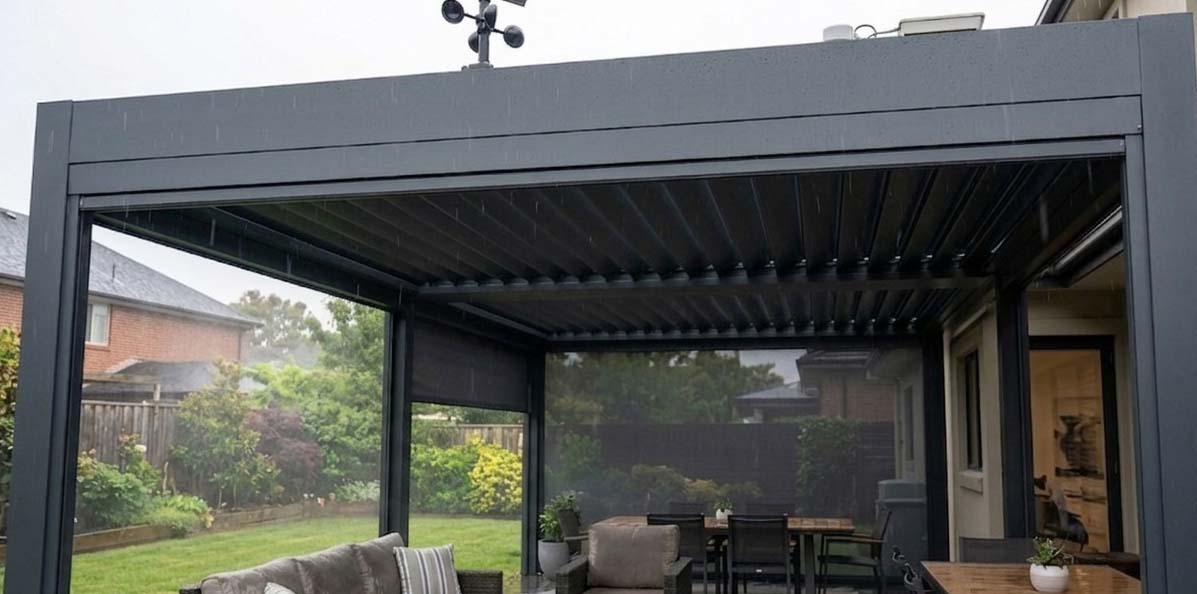
A truly smart pergola must be able to sense environmental changes and make rapid autonomous decisions through closed-loop control. By integrating high-precision local rain sensors, anemometers, and light-sensitive components into the PERGO Pro four-in-one low-level main board, the system can execute logic decisions through local algorithms without network access, protecting the structure from irreversible damage.
Its typical scene-linkage control logic and environmental self-recovery technology can be understood through the following physical operating path:
Physical Operating Path
[Environmental sensing layer]-> rain sensor / wind sensor / light sensor-> continuously collects data and outputs analog signals [Data processing layer]-> PERGO Pro low-level main board microprocessor
-> executes local logic decisions, such as rain closure or high-wind limit protection [Actuation output layer]-> precision motor drive control and dimming chip
-> multi-channel output for motor torque closure, mono lighting, and RGB lighting linkage [Physical feedback layer]-> louver 0–150 degree fully sealed waterproof state / wind-channel automatic venting state
In rainy weather, when the local rain sensor detects the first drops of rain, the signal is sent directly to the controller’s main processor. It bypasses cloud relay and commands the linear motor to close the double-wall hollow louvers completely at maximum torque, reaching a 0-degree angle. Together with a concealed gutter system, this provides a waterproof outdoor leisure environment.
In strong wind, if the wind sensor detects that wind speed has reached the preset safety limit, the system automatically activates the motor to adjust the louvers to a vertical slightly open position, or quickly retracts the wind-resistant ZIP screens on both sides. This prevents strong wind from accumulating under the louvers and creating powerful upward lifting force, protecting the overall rigid structure through controlled airflow diversion.
For lighting control, the PERGO Pro dual-mode lighting drive system supports standard mono warm white LED dimming for comfortable dining brightness, as well as intelligent RGB spectrum transition technology, such as rainbow timing. This instantly transforms a high-end pergola into an artistic lighting installation for outdoor entertainment scenarios, including family parties and commercial receptions, greatly improving design value and user experience.
Matter Standards and the Future Evolution of Outdoor Multi-Device Integration
As the smart home industry moves toward greater standardization, the Matter 1.4/1.4.1 standard led by the Aliança para as Normas de Conectividade (CSA) is becoming a shared future for the entire industry. Matter is a new local connectivity protocol based on Internet Protocol (IPv6). Its core goal is to eliminate the physical and software boundaries between different smart home ecosystems, such as Apple HomeKit, Google Home, and Samsung SmartThings.
Because Matter runs directly on Wi-Fi, Ethernet, and Thread low-power wireless mesh networks, any Matter-certified pergola control system can be seamlessly recognized and locally controlled by mainstream gateways such as Apple HomePod and Nest Hub. Users do not need to download multiple messy third-party bridge apps. This “develop once, connect everywhere” characteristic helps pergola manufacturers significantly reduce investment in app compatibility development, allowing them to focus resources on appearance, craftsmanship, motors, lighting, and other core hardware innovations.
As system control cores upgrade, the next generation of smart control systems, including the planned software and hardware iteration path for PERGO Pro, will gradually expand from basic louver and lighting control to more peripheral outdoor living equipment — covering tubular motor control, RGBW/RGBCW mixed-color lighting, outdoor ceiling fans, high-power infrared heaters, and professional waterproof audio systems. This trend toward concentrating multiple devices around one integrated core board will reshape the traditional shading and outdoor building materials industry, giving the pergola the ultimate product identity of an “environmental central control and entertainment brain.”
Modular Product Upgrades and Commercial Value Paths for European and North American Pergola Manufacturers
For pergola manufacturers in Europe and North America, selecting a control system is not only a technical decision, but also a commercial decision that affects product line planning and profit margin. By modularly grading control solutions, manufacturers can satisfy cost-sensitive project customers while opening a high-premium product line for customized high-end and fully smart outdoor living spaces.
The table below shows how pergola manufacturers can use integrated control systems to upgrade from simple shading structure suppliers to premium courtyard environment solution providers:
| Upgrade Stage | Target Market Direction | Core Hardware Configuration | Core Customer Experience and Commercial Value |
|---|---|---|---|
| Stage 1: Standard hardscape type | Ordinary residential/commercial real estate and price-sensitive basic engineering projects | Basic anti-corrosion aluminum frame + double-wall insulated louvers + linear motor + simple wireless transmitter | Provides 0–150 degree motorized shading adjustment and basic opening, closing, wind protection, and rain protection |
| Stage 2: Multi-dimensional refined fit-out | High-end private residences pursuing style, evening entertainment, and dining needs | PERGO Pro four-in-one main board + dual-channel mono warm LED lighting + 16-channel multifunction RF metal remote control | Eliminates external dimmers; uses industrial-grade precise travel limit setting to prevent motor overload damage and greatly reduce after-sales warranty costs |
| Stage 3: Smart whole-home ecosystem | High-end villa communities and high-net-worth owners seeking minimalist, seamless technology experiences | PERGO Pro main board + wall-mounted LCD touch panel + Tuya Smart Wi-Fi cloud module | Hides the remote control completely; enables contactless smart voice pergola control through Alexa/Google; creates rich courtyard scene modes and sunrise/sunset schedules through the Tuya app |
| Stage 4: Panoramic wellness space | Ultra-luxury private homes, luxury resort hotel terraces, and spaces with extremely high microclimate requirements | Upgraded integrated system + comprehensive wind, rain, and light environmental sensors + linked infrared heaters, ceiling fans, and outdoor Sonance-grade audio systems | Removes manual intervention and creates a luxury outdoor wellness space that can autonomously breathe and avoid risk, maximizing pergola product margin and average order value |
Through this modular upgrade path, shading structure manufacturers can meet customers with different budget levels at a very low hardware reconfiguration cost, while maximizing production, inventory management, and supply chain efficiency.
Brand Transformation and Technical Decision-Making for Pergola Manufacturers
In today’s pursuit of excellent outdoor living quality, integrating complex control technology into minimalist architectural aesthetics has become a defining rule for the European and North American shading and outdoor building materials industry. By adopting a four-in-one integrated control architecture similar to PERGO Pro, pergola manufacturers can simplify BOM procurement at the factory production end and shorten internal wiring assembly time by nearly 50%. At the client delivery end, they can provide a top-tier smart outdoor living system that combines Tuya App control, local RF safety control, and a premium wall-mounted LCD touch panel.
To secure a stronger position in the fast-moving global high-end courtyard market, pergola manufacturers should move away from traditional patched-together, distributed, non-smart assembly solutions. Visit the PERGO Pro control system official technical page to obtain detailed control circuit white papers, CAD installation wiring diagrams, and engineering sample testing. True industrial-grade, integrated smart technology can become the core competitive engine of high-end bioclimatic pergolas.

Envie-nos o seu pedido