


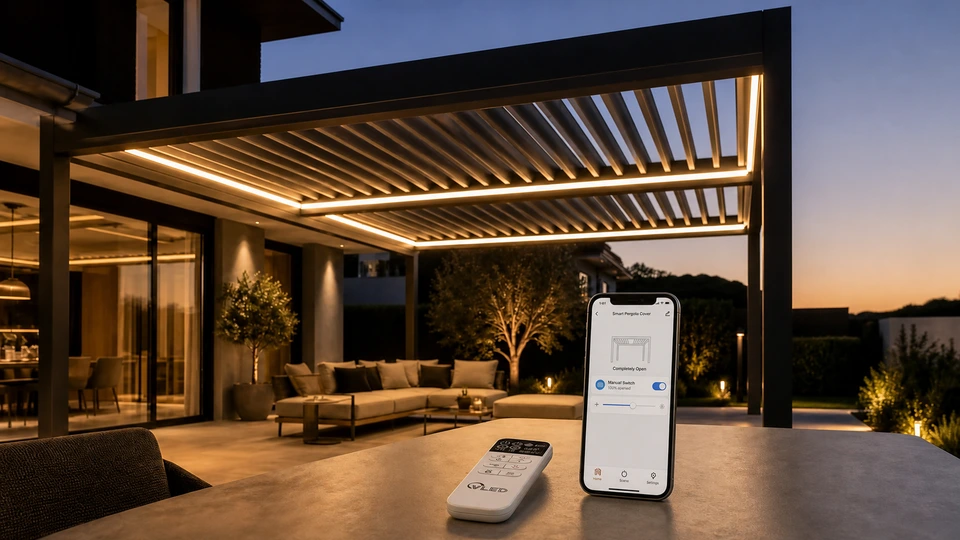
A pergola buyer may never ask about receiver topology, channel mapping, or driver headroom. They will notice the result immediately: whether one remote is enough, whether the app shows the real state of the roof, whether the system reacts sensibly to rain, and whether the lighting feels integrated rather than attached.
That makes the control layer a product decision, not a late-stage accessory decision. Leading outdoor-living brands already position remote control, mobile control, lighting, and weather response as part of the pergola experience. Renson, for example, describes app control for louvers, screens, lighting, and heating, while Somfy presents remote and smartphone control as part of a motorized pergola system. These examples point to a commercial reality: customers compare the entire operating experience, not just the aluminum frame.
Manufacturer’s position: Build four upgrade levels on one tested architecture: Basic Remote, App Control, Sensor Automation, and Premium Lighting. Keep the user experience simple while allowing the BOM, wiring, and control logic to scale across models.
Why a Package Ladder Works Better Than a Feature List
A feature list tells a dealer what a system contains. A package ladder tells the dealer how to sell it. That difference matters when your product range includes several roof sizes, motor configurations, lighting choices, and market requirements.
A practical upgrade ladder gives every level a job:
- Basic Remote: reliable everyday operation for customers who want simple control.
- App Control: convenience, scheduling, scenes, and remote access for connected-home buyers.
- Sensor Automation: a pergola that responds to rain, wind, sun, or other defined environmental conditions.
- Premium Lighting: layered white, CCT, RGB, or RGBW lighting that turns the structure into a usable evening environment.
The commercial value is not only a higher average order value. A standardized ladder also reduces quoting errors, makes dealer training easier, and lets the factory validate more combinations before products reach a jobsite. VLEDSTAR’s Lista de verificação da lista de materiais (BOM) do sistema de controlo da pérgula treats the control system as an operating architecture because the wrong channel, power, or connector decision can create service work long after the sale.
Package 1: Basic Remote Control Should Still Feel Complete
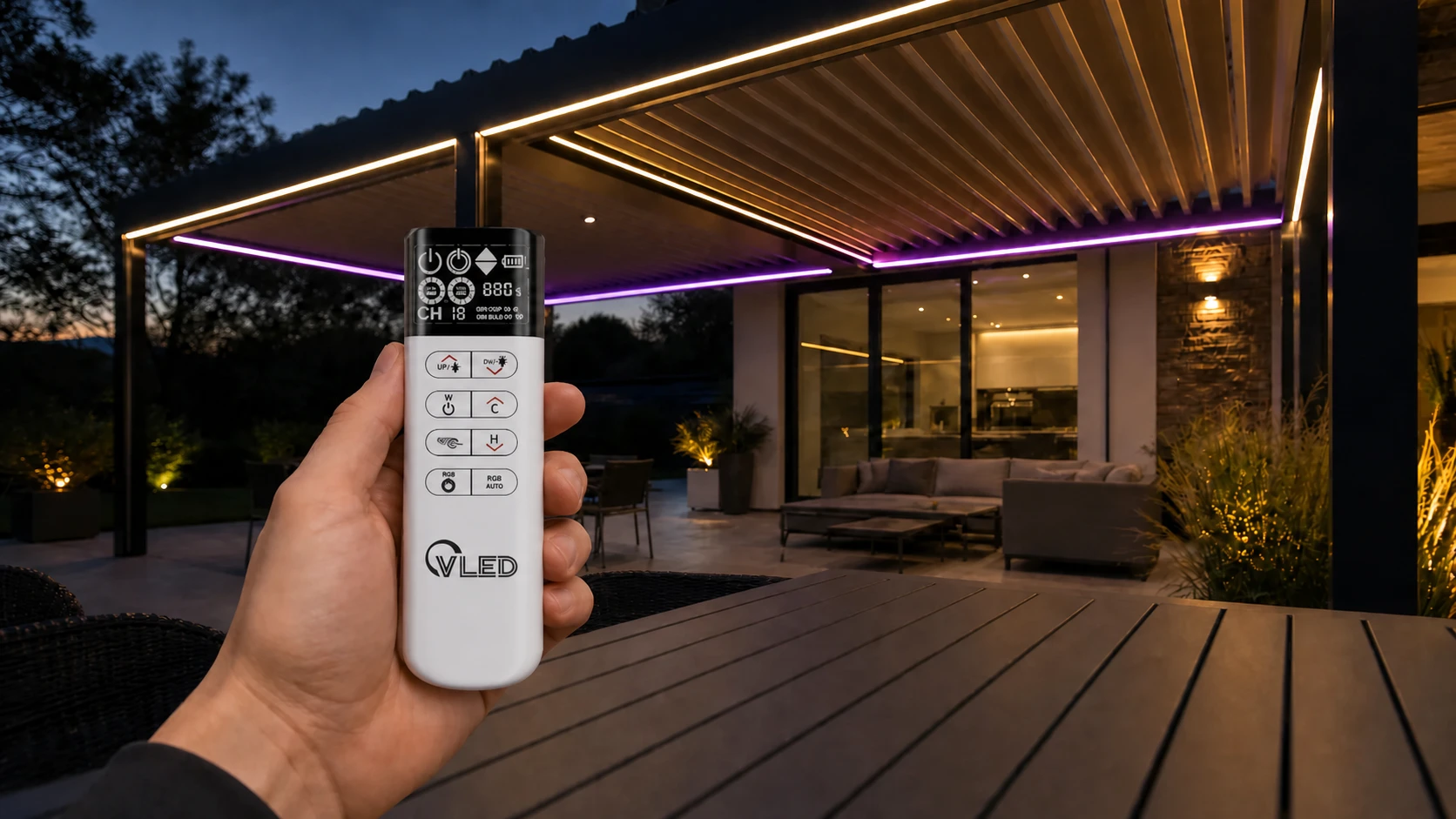
The entry package should be simple, but it should not feel unfinished. A customer choosing a handheld RF remote still expects consistent control, clear channel behavior, and a lighting system that does not require a second set of confusing controls.
What the basic package should include
- An RF remote matched to the number of roof, screen, motor, and lighting zones.
- A receiver or control box with documented pairing and reset procedures.
- Independent control for the functions the customer is most likely to use together.
- Manual override behavior when the app or network is unavailable.
- Clearly labelled wiring, connectors, and commissioning instructions.
For a small residential pergola, that may mean louver movement plus one white-light channel. For a larger structure, the same package may need separate roof bays, screens, or lighting groups. The important point is to define the control map before the factory assembles the kit. A remote with too few useful channels creates workarounds; a remote with poorly documented channels creates installer and homeowner confusion.
RF performance also deserves product-level attention. Aluminum structures can affect radio behavior, so manufacturers should test the receiver location and antenna path inside the actual frame design. VLEDSTAR’s RF signal guide for aluminum pergolas explains why control reliability depends on enclosure geometry, receiver placement, and interference testing rather than on the remote’s advertised range alone.
Package 2: App Control Adds Convenience, Not a Substitute for Hardware Discipline
App control is attractive because it gives the pergola a modern interface. It can also create the most avoidable support problems if the underlying system has not been designed for it. The app should expose the same logic as the remote, not become a separate control universe.
A well-defined app package can add:
- Control from a phone or tablet within the supported network architecture.
- Schedules for lighting, screens, or recurring comfort routines.
- Scenes such as daytime shade, outdoor dining, and evening lighting.
- Status feedback where the selected hardware supports two-way communication.
- A simple commissioning flow that a dealer can explain without specialist software.
Do not promise more status feedback than the hardware can provide. A one-way command that says “close” is not the same as confirmed roof position. Manufacturers should document whether each output is open-loop or closed-loop, how a lost connection is handled, and which local controls remain available during an internet outage.
The app should also be treated as one interface in a multi-control system. VLEDSTAR’s sistema integrado de controlo de pérgulas combines RF remote, mobile app, and touchscreen options around lighting, actuators, tubular motors, and sensors. That architecture gives dealers a clear upgrade path without forcing the basic package and premium package to use unrelated control boxes.
For manufacturers selling into smart-home markets, compatibility claims should be precise. State the supported app platform, network requirement, communication method, and available integrations. A narrow promise that works consistently is more valuable than a broad promise that depends on an installer’s workaround.
Package 3: Sensors Turn a Motorized Roof Into a Responsive Product
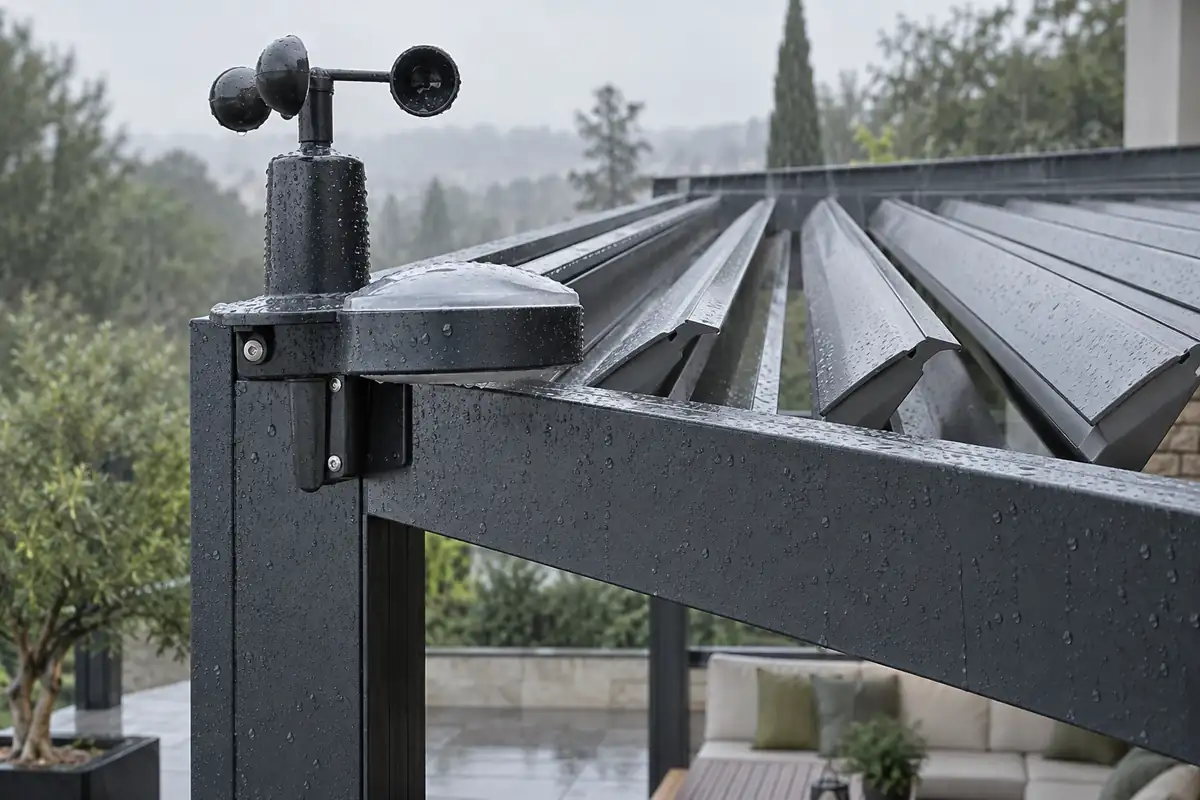
Sensors are the point where a pergola stops waiting for a person to press a button. They should therefore be specified as control logic, not as decorative add-ons. The sensor input must have a priority, a trigger threshold, a response action, a recovery rule, and a manual override policy.
| Sensor | Typical product role | Design question for the manufacturer |
|---|---|---|
| Rain | Close louvers or protect the occupied area | How long should the closed state remain after the sensor dries? |
| Wind | Move the roof or screens to a defined protective position | Does wind logic override app commands and lighting scenes? |
| Sun or light | Support shading and dusk-triggered lighting | Is the response binary, scheduled, or proportional? |
| Snow or load | Support cold-climate protection strategies | Does the structural design require a separate load policy? |
The most common mistake is to specify “rain sensor included” without specifying what the system does after the sensor triggers. A robust sequence may close the louvers, hold the state while rain continues, prevent rapid cycling, and then return control only after a defined delay. Wind protection may need a higher priority than comfort automation. Lighting may remain on, dim, or change scene depending on the intended experience.
Placement is equally important. A rain sensor hidden under a beam, exposed to gutter overflow, or blocked by moving louvers is not representative of the roof environment. It must remain serviceable and should be tested through the full motion range. Read VLEDSTAR’s rain, wind, sun, and snow sensor integration guide alongside the more specific rain sensor placement guide when defining the mechanical and electrical package.
Manufacturers should also separate comfort automation from structural safety. Sensor logic can support the product, but the final protective behavior must align with the pergola’s engineering limits, local installation requirements, and the operating instructions supplied with the finished system. External frameworks such as KNX building automation technology are useful references for thinking about conditional control logic, but a purpose-built pergola controller may be the more practical architecture for a repeatable OEM platform.
Package 4: Premium Lighting Is a System, Not a Brighter Bulb
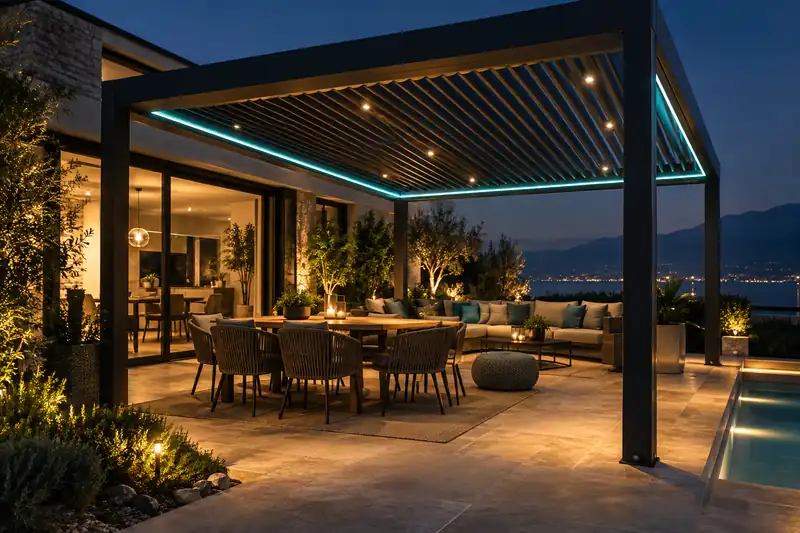
Premium lighting upgrades should improve both the visual result and the commercial story. The best package gives the customer useful white light, comfortable accent light, and a coherent way to control both. It should also be engineered around the pergola profile, not selected after the frame and wiring are finalized.
Build lighting in layers
- Task and general light: recessed downlights or focused spotlights for dining, circulation, and work areas.
- Linear architectural light: LED strips integrated into beams, perimeter profiles, or louver details.
- Accent and vertical light: post, wall, or low-glare fixtures that define the structure at night.
- Atmosphere: RGB or RGBW capability for hospitality, entertainment, and premium residential scenes.
The lighting package should specify voltage, wattage, channel type, dimming behavior, waterproofing, cable length, connector style, and thermal conditions. A controller that can manage the scene but cannot support the installed load is not a premium system. For long runs, the factory should validate voltage drop, driver headroom, connector resistance, and the physical routing inside the profile.
VLEDSTAR’s soluções de iluminação para pérgulas cover recessed downlights, spotlights, LED strips, wall and post lights, accessories, and integrated controls. The range includes single-color, RGB, and RGBW strip options as well as DC12V and DC24V configurations. That breadth matters because a manufacturer can keep the control platform stable while changing the visible lighting package for different product tiers.
Premium does not mean adding every color effect. In many residential and hospitality applications, high-quality warm white light, low glare, accurate dimming, and consistent diffusion create more perceived value than excessive color modes. RGBW becomes meaningful when the use case supports scenes, seasonal programming, or entertainment. The right specification starts with how the pergola will be used at night.
How to Keep All Four Packages on One Product Platform
The upgrade ladder only works when the packages share a common architecture. Otherwise, every sale becomes a new integration project. A scalable platform normally has a stable control core, modular outputs, documented channel maps, and a wiring strategy that leaves room for future upgrades.
| Platform decision | What to standardize | Why it protects the product line |
|---|---|---|
| Control core | Receiver, firmware logic, pairing, and reset behavior | Reduces training and service variation between models |
| Outputs | Motor channels, white light, RGB/RGBW, screens, and auxiliary loads | Allows package changes without changing the whole system |
| Inputs | Sensor ports, wireless nodes, and manual overrides | Makes automation an engineered option rather than a retrofit |
| Physical integration | Control box size, cable paths, connectors, and service access | Prevents a system that works electrically but cannot be installed cleanly |
| Documentation | BOM, wiring map, commissioning checklist, and dealer guide | Turns factory knowledge into repeatable field performance |
Before releasing a package, test the complete operating sequence: local remote control, app commands, sensor triggers, lighting scenes, power cycling, communication loss, and manual recovery. Test with the actual aluminum cavity and wiring lengths. This is where an integrated supplier can add value: the lighting, control, power, connectors, and sensor behavior are evaluated together rather than passed between separate vendors.
VLEDSTAR has focused on LED lighting and integrated pergola control since 2010, developing OEM-oriented systems for louvered and retractable roofs, verandas, patios, awnings, and carports. The VLEDSTAR company profile provides more detail on the factory’s R&D, manufacturing, and quality-system background. For a manufacturer, the relevant question is not only what a component does in a sample; it is whether the supplier can support the same architecture across revisions, volumes, and regional product variants.
What Dealers Need From the Upgrade Structure
Dealers do not need a longer technical brochure. They need a package structure that can be quoted, installed, demonstrated, and supported without ambiguity.
Give dealers four clear answers for every package:
- What does the customer gain at this level?
- Which hardware and wiring are included?
- What can be added later, and what must be selected before production?
- What happens when power, Wi-Fi, or a sensor signal is unavailable?
Use customer-facing language for the sales sheet and engineering language for the installation pack. “Storm protection” can explain the value; the installer document must define the sensor input, trigger behavior, priority, reset condition, and testing method. This separation keeps the sales message simple without hiding the decisions that determine field reliability.
Also make the upgrade path honest. If app control requires a different gateway, say so. If premium RGBW lighting requires additional channels or a different power budget, show it. Transparent options reduce last-minute substitutions and help the dealer sell the package as a planned improvement rather than an uncertain add-on.
Recommended Package Architecture for a Manufacturer
For most pergola product ranges, the following structure is a strong starting point:
- Basic Remote: RF remote, core motor control, one defined lighting channel, local manual recovery, and the standard wiring kit.
- App Control: everything in Basic Remote plus app gateway or Wi-Fi control, scene support, schedules, and documented network behavior.
- Sensor Automation: everything in App Control plus selected weather inputs, priority logic, recovery delays, and sensor placement instructions.
- Premium Lighting: everything in Sensor Automation plus layered lighting, higher channel capacity, dimming or color control, premium connectors, and a night-use scene library.
This is not a universal BOM. A retractable roof, a rotating louver roof, and a multi-bay commercial terrace may need different motors and protection rules. The value of the structure is that it gives your team a repeatable way to adapt the BOM without losing the customer-facing logic.
Perguntas mais frequentes
Should every pergola include app control?
No. App control is valuable when the target customer wants schedules, remote access, scenes, or smart-home integration. A reliable RF remote remains the right choice for buyers who prioritize immediate local operation. The important requirement is that both interfaces use the same control logic and that local operation remains available when the network is unavailable.
Are weather sensors suitable as an entry-level option?
Usually not. Sensors create value when the roof, motors, and controller have a clearly documented response strategy. They should be sold as an engineered automation package, with defined placement, priority, thresholds, recovery behavior, and commissioning steps. Adding a sensor without those decisions can create false triggers and support problems.
What makes pergola lighting premium?
Premium lighting combines optical comfort, integration, control, and reliability. Low glare, useful white light, smooth dimming, consistent diffusion, appropriate waterproofing, and a clean profile installation often matter more than a long list of effects. RGB or RGBW adds value when it supports a real scene or hospitality use case.
Can the upgrade packages use one controller?
They can when the controller has modular outputs, sufficient power capacity, documented channel logic, and a physical design that supports the required wiring and service access. The factory should validate the full package range with actual motors, lighting loads, sensors, and frame cavities before promising universal compatibility.
Design the Upgrade Path Before You Design the Next BOM
A pergola control package is easiest to sell when it is easiest to understand, and easiest to support when it was engineered as one system from the start. Define the four package levels, standardize the control core, and validate the real combinations in the frame your dealers will install.
VLEDSTAR can help manufacturers scope lighting, RF control, app interfaces, actuator channels, sensors, power supplies, connectors, and OEM customization as one coordinated system. Explore the integrated pergola control platform, review the lighting product range, or contact the VLEDSTAR team with your pergola models and target upgrade tiers.

Envie-nos o seu pedido