


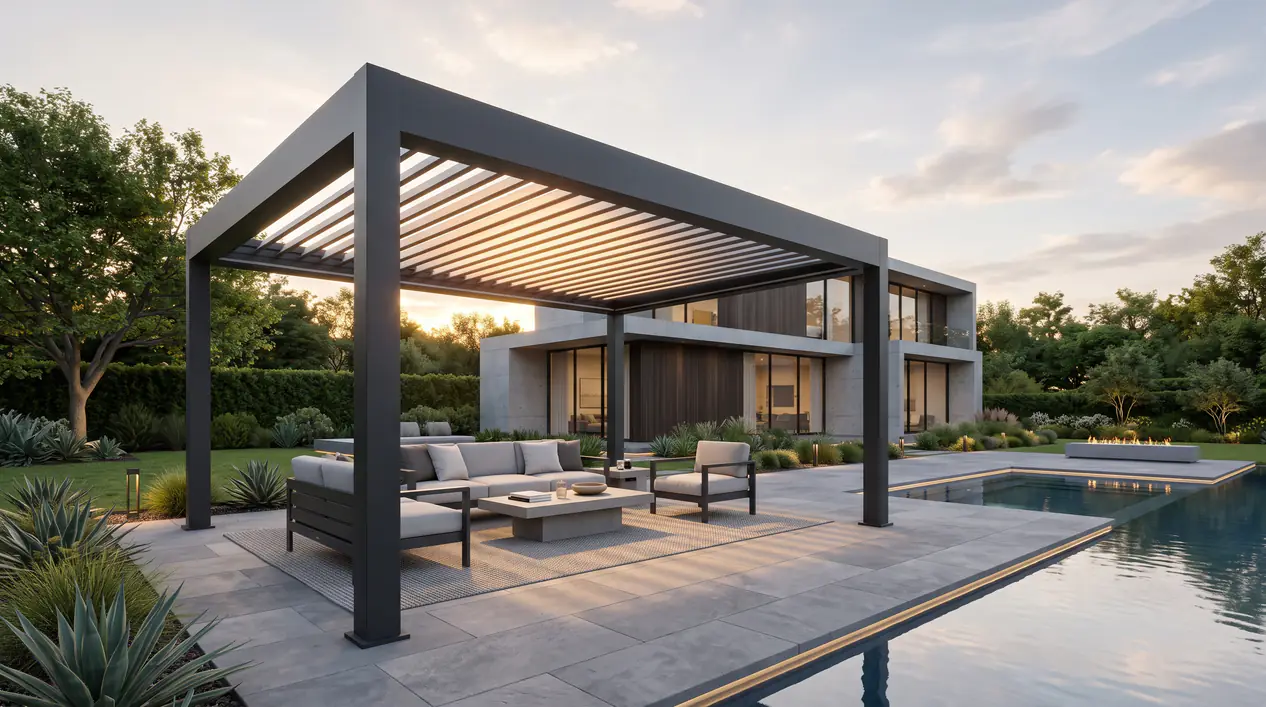
The global outdoor living market has moved far beyond simple shade hardware and is rapidly evolving toward highly automated microclimate management systems. For premium aluminum louvered pergola OEMs targeting Europe and North America, strong extrusion capability and basic structural engineering are no longer enough to build a durable moat in commercial and luxury residential projects priced from USD 12,000 to more than USD 55,000. The core competitiveness of a pergola system is shifting quickly toward its “central nervous system”: the electrical control system that precisely drives the louvers, integrates low-voltage lighting, responds to severe weather in real time, and connects deeply with the smart home ecosystem.
Structural manufacturers often face serious cross-disciplinary challenges when integrating electronic and electrical systems. A poorly specified control system, or one built on outdated protocols, can cause repeated on-site rework, wiring failures, and catastrophic system breakdowns during hurricanes, blizzards, or other extreme weather events. The result is brand damage and high after-sales maintenance costs. As a manufacturer specializing in electrical and lighting control systems for outdoor shading, we understand the pain points OEMs face when selecting suppliers and defining product specifications. This article provides a detailed, forward-looking specification guide covering the evolution of communication protocols, the control logic behind mechanical dynamics, proactive protection strategies for weather sensors, and core electrical safety standards in North America and Europe, including UL, NEC, and CE requirements.
Protocol Interoperability: Defining the Communication Backbone
In large-scale smart home deployment, the choice of underlying communication protocol directly determines whether a pergola system can connect seamlessly with mainstream ecosystems in Europe and North America, including Apple Home, Google Home, Amazon Alexa, Savant, and Control4. For years, the outdoor shading market was filled with proprietary RF remotes, each operating in its own isolated environment. Modern high-net-worth users have grown tired of managing multiple remotes and fragmented control experiences. OEMs must define the underlying protocol early in the product lifecycle to avoid future technical debt.
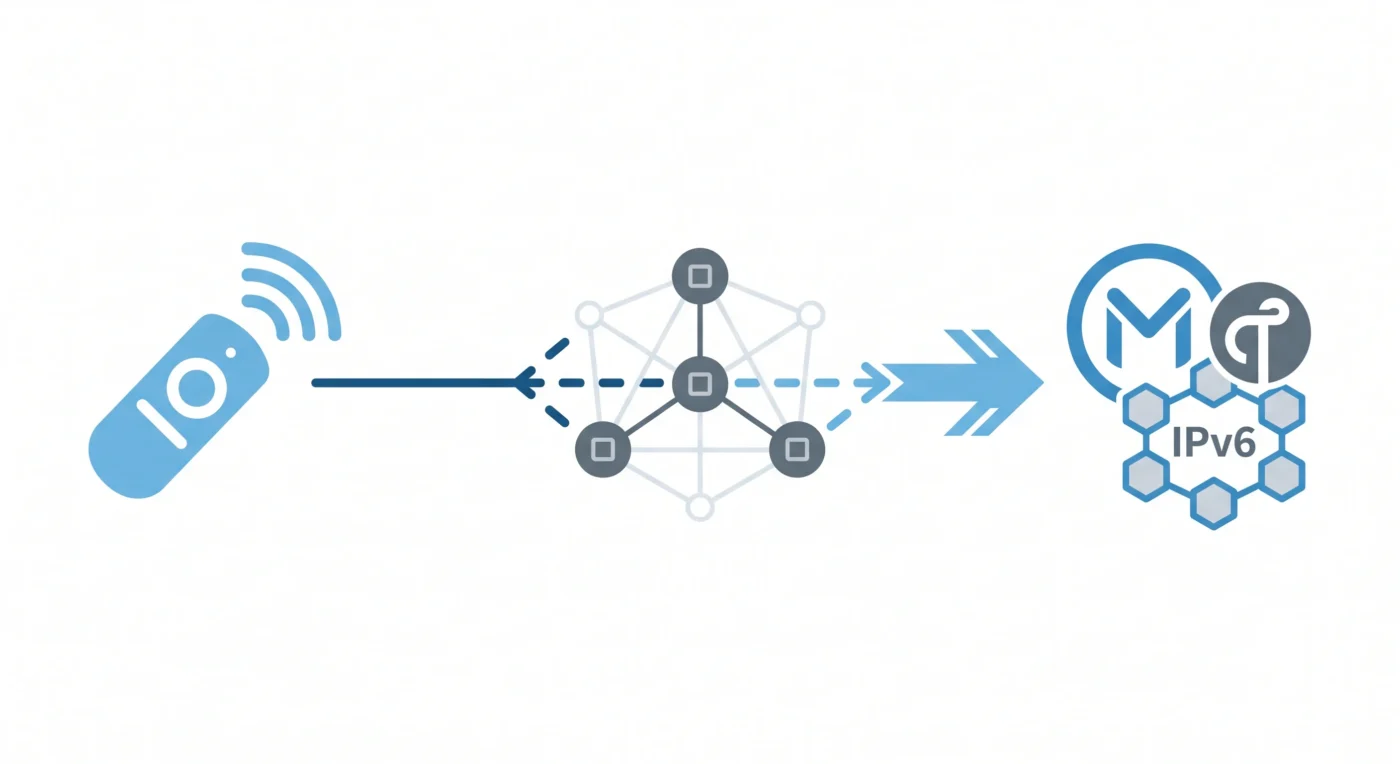
Traditional RTS (Radio Technology Somfy) and standard 433 MHz RF communication were once dominant in the industry. These protocols offered strong interference resistance, good wall penetration, and relatively simple point-to-point pairing, making them popular in earlier basic shading products. From a modern IoT perspective, however, RTS is essentially a one-way communication protocol. The control hub can send “open” or “close” commands, but it cannot receive any status feedback from the motor. If pergola louvers fail to close fully because of snow load or mechanical obstruction, the smartphone app may still show that the command was successfully sent, creating the false impression that the system is safely closed. For commercial or luxury residential pergolas costing tens of thousands of dollars, the lack of closed-loop feedback creates major warranty exposure. Although RTS systems can still be bridged to smart networks through gateways such as Somfy TaHoma, making them useful for low-cost retrofit projects, their inherent one-way limitation is no longer sufficient for future premium OEM flagship lines.
To solve the problem of status visibility, Zigbee 3.0 has rapidly become a preferred standard for mid- to high-end motorized pergola control systems because of its low power consumption, two-way communication, and mesh networking. Zigbee’s positional feedback gives the system a new level of transparency. Motors and smart controllers can report the exact louver opening angle to the hub in real time, even down to a 72% open position, while also monitoring battery status for independent sensors. This visibility allows the control system to stop operation immediately when abnormal motor resistance is detected and push preventive maintenance alerts to the user’s mobile device. In terms of network topology, Zigbee’s mesh networking is especially powerful in large commercial courtyards or multi-module pergola arrays. Every hardwired Zigbee node, whether a tubular motor or a compatible smart plug, can act as a signal repeater, with outdoor line-of-sight hop distances reaching up to 100 meters. This decentralized design eliminates the distance blind spots of traditional single-point RF control and enables near-perfect communication reliability whether the controller is placed in a basement equipment room or an outdoor weatherproof box.
At the leading edge of technology in 2026, however, the final protocol battle is centered on Matter over Thread. Matter is a cross-platform application-layer protocol developed by the Connectivity Standards Alliance (CSA) to eliminate smart home ecosystem barriers. Thread is an IPv6-based mesh networking technology designed for low-power, low-latency IoT devices. Together, they are reshaping outdoor automation standards. A Matter-certified pergola control system can be natively discovered and controlled by Apple, Google, and Amazon platforms without requiring the OEM to spend heavily on developing and maintaining a bulky proprietary app. More importantly, unlike earlier Wi-Fi direct solutions that depended heavily on cloud servers, Matter emphasizes edge computing and local area network communication. This means that even if the external internet connection is cut off during a severe storm, local sensor automations, such as automatically opening louvers to relieve wind pressure when gusts rise, can still execute within milliseconds. This greatly improves system reliability. Leading integrated solutions, including architectures based on Nordic Semiconductor’s nRF5340 dual-core SoC, have already been adopted by forward-looking pergola brands. Built-in Thread border-router capability can unify complex control logic for lighting, heaters, fans, and louvers within a simplified Matter framework.
A deeper industry insight is that when OEMs actively adopt Matter over Thread architecture, they effectively shift a major portion of cost away from themselves. By transferring the expense of software app development, cloud server operation, and cross-platform compatibility testing to universal protocols maintained by global technology leaders, manufacturers can refocus valuable R&D resources on structural materials and industrial design.
Mechanical Dynamics: The Physical Logic Behind Motors and Actuators
No matter how sophisticated the control algorithm may be, the actuator system that converts digital commands into physical movement, namely the motor and linkage, remains the heart of any motorized pergola. A high-quality drive motor must deliver decades of service life while offering strong outdoor durability and precise torque management. As products move from lightweight imported kits to heavy-duty commercial systems, motor selection often becomes the decisive factor between success and failure.
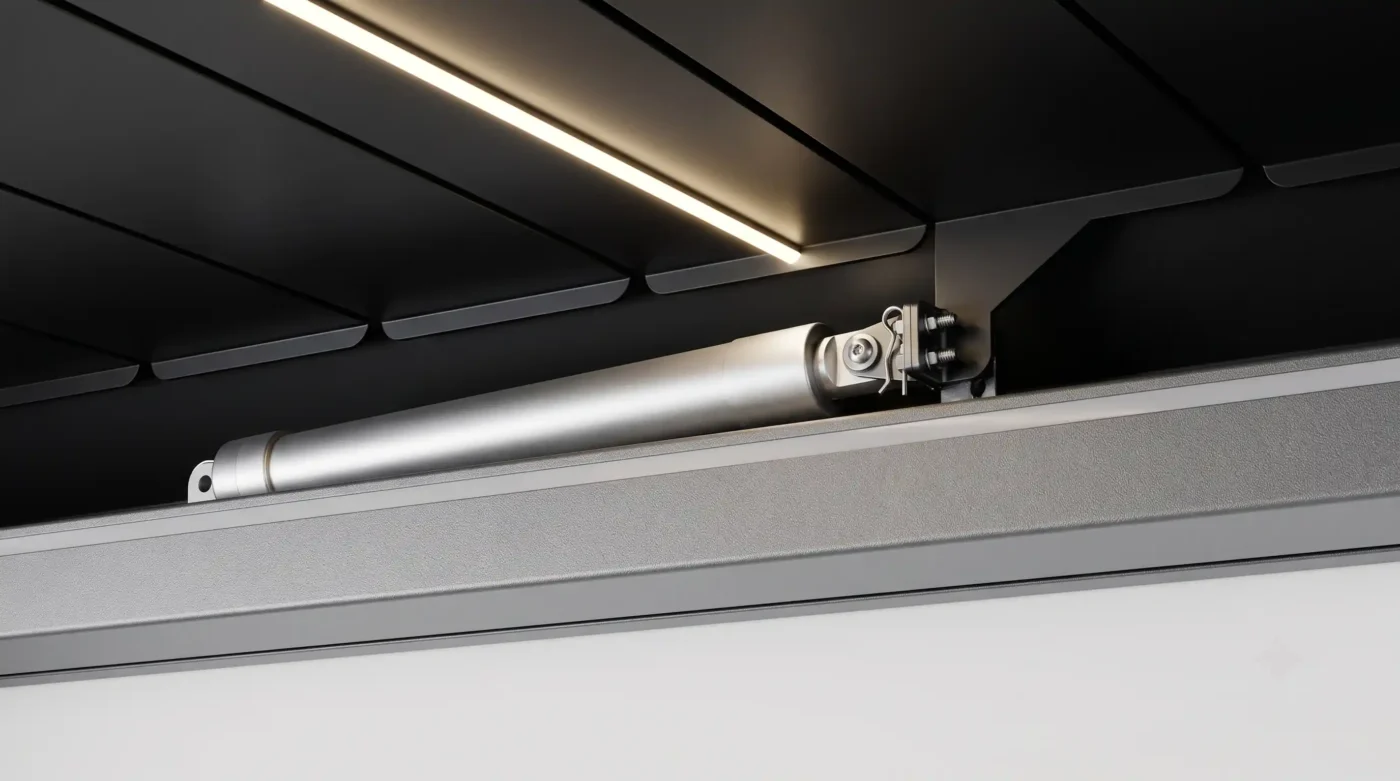
In today’s premium motorized pergola architecture, concealed 24V DC tubular motors dominate the market. Compared with earlier bulky, noisy, high-consumption industrial AC motors, low-voltage DC motors provide decisive advantages in quiet operation, energy efficiency, and compact size. A professional system design hides the tubular motor completely inside the pergola’s top header beam. This preserves the clean architectural appearance of the structure while protecting core electrical components from heavy rain and long-term UV degradation. Motor operating noise is usually controlled between 40 and 60 dB, roughly equivalent to a quiet conversation, so adjusting shade and light does not disturb the calm atmosphere of outdoor living.
Smooth power output depends on precise torque matching and gear transmission engineering. High-quality DC motors can provide powerful linear thrust of up to 1,000 to 1,200 N, smoothly rotating dozens of heavy double-wall aluminum louvers into position within a short 10- to 15-second cycle. Premium systems support wide rotation ranges from 0 degrees, fully closed and weather-resistant, to 130 degrees or even 170 degrees, giving users precise control over light and shade throughout the day. Power must be distributed evenly to every louver through a tightly engineered push-pull linkage system. A well-designed linkage must solve torque attenuation, ensuring that the first louver near the motor and the farthest louver at the end start and stop at the same angle with only microsecond-level timing differences. Poor transmission design causes tolerance accumulation. After several years of frequent use, louvers may loosen, twist, fail to seal, leak rainwater, or seize mechanically.
In harsh outdoor environments, IP protection and weather resistance define the survival baseline for the motor. Industrial-grade pergolas require core electromechanical components to meet at least IP65 protection against water jets, while top-tier drive motors should pass IP67 certification for temporary immersion. This means that even if drainage gutters overflow during a typhoon and water briefly accumulates inside the header beam, the motor can still deliver rated torque without short-circuiting. High-quality motors are also typically designed for more than 10,000 full open-close cycles. At two operations per day, this provides a mechanical service life of roughly 13 to 15 years, far beyond the lifecycle of ordinary consumer electronics.
Closely connected to the motor system is the structural design of the louvers themselves. The premium market has largely moved away from single-layer aluminum sheets toward seamless dual-wall louver profiles. This design creates an insulating air layer between two thin aluminum walls, significantly reducing radiant heat transfer to the space below during hot summers. It also increases section modulus and structural rigidity, allowing the louvers to resist bending over large spans. When dual-wall louvers are fully engaged by the motor, edge gaskets form a watertight barrier that directs rainwater into concealed gutters inside the main frame and then down through the posts to the ground. This is what enables true all-weather climate separation.
Weather Response and Structural Protection: Automated Defense Against Wind and Snow Loads
When discussing control-system logic, it must be tightly connected to the physical limits of the pergola structure. In Europe, where Eurocodes apply strictly, and in the United States, where the International Building Code (IBC) governs fixed structures, pergolas are not simply backyard leisure products. They are permanent architectural structures that must withstand extreme wind and snow loads and pass rigorous municipal approval. The ultimate value of the control system lies in whether it can turn passive resistance into active defense before environmental stress exceeds structural limits.
Compliance certification is the entry ticket for OEM products entering mainstream markets. In the United States, commercial-grade pergolas must pass certification from the International Code Council Evaluation Service (ICC-ES). This requires the pergola frame and its control system to comply with Chapter 16 of the IBC on structural loads, resist hurricane winds of 150 mph to more than 200 mph, and support roof snow loads of 20 to 70 psf. In Europe, EN 13561 strictly classifies wind resistance for outdoor shading products. For example, Class 2 is generally suitable for commercial streets with ordinary exposure, corresponding to Beaufort force 5 winds of about 29 to 38 km/h. Class 3 is intended for coastal areas, hilltops, street corners, and other high-wind locations, corresponding to Beaufort force 6 winds of about 39 to 48 km/h. To support these physical performance targets, European manufacturers commonly use 6063-T5 aerospace-grade aluminum with wall thicknesses of at least 2.0 to 3.0 mm.
However strong the physical structure may be, nature can still reach unpredictable extremes. The real technical barrier is whether the control system can automatically change the pergola’s aerodynamic profile through a surrounding sensor array.
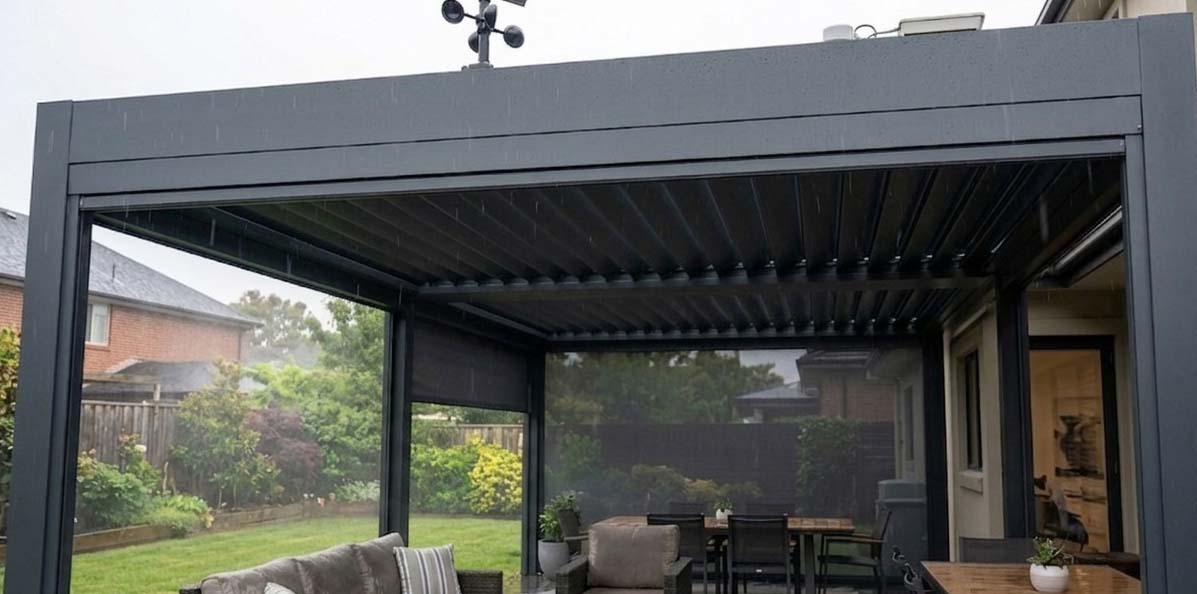
When a high-precision anemometer or multi-axis vibration sensor integrated at the top of the system detects sustained wind speed or gusts exceeding a preset safety threshold, such as Beaufort force 7 or destructive 90 mph winds, the intelligent microcontroller unit (MCU) immediately takes highest-priority control and overrides any manual command. The system automatically rotates all louvers to a specific wind-relief angle, usually 90 degrees vertical or a 45-degree wind-facing angle. This millisecond-level response is critical. It instantly breaks the large sail effect created by a fully closed roof and eliminates the dangerous uplift force generated when strong wind passes over a flat roof, protecting the pergola anchors and load-bearing posts from being torn upward.
For winter rain and snow, the sensor interlock logic demonstrates advanced engineering. A conventional rain sensor closes the louvers as soon as it detects rain. But when ambient temperature drops close to freezing and continuous precipitation occurs, creating a high risk of freezing rain or heavy snow, a simple close command can be disastrous. Hundreds of pounds of snow can quickly accumulate on the flat, closed louver roof. As day-night temperature swings cause freeze-thaw cycles, water can seep into mechanical joints and expand as ice. If the system then receives an open command, the motor may overload and burn out while trying to force frozen, heavy louvers to move. Advanced weather-control hubs integrate temperature probes. In low-temperature precipitation mode, the system deliberately keeps the louvers open, allowing snow to fall through the structure naturally and eliminating the risk of ice damage and motor burnout. Systems with this type of advanced environmental response logic allow OEMs to win B2B project bids, such as luxury resorts or restaurants in polar climates, with a robust protection strategy that removes human error from the equation.
Outdoor Electrical Safety and Power Distribution: Low-Voltage Drive and Mandatory Compliance
Electrical safety is a decisive factor in whether a pergola system can pass local municipal permits and avoid project delays. In wet, rainy backyards or poolside areas where water contact is frequent, traditional 120V systems in the United States or 220V systems in Europe create serious electric shock risks. High-voltage wiring also requires licensed electricians to perform deep burial and conduit work, which drives installation costs sharply upward.
Modern premium pergola control systems have moved decisively toward low-voltage architecture, and this shift has a strong regulatory foundation. Under Article 411 of the U.S. National Electrical Code (NEC), which governs low-voltage lighting, the maximum safe voltage in outdoor landscape and leisure areas with wet-contact risk is limited to 15V AC or 30V DC. Using an integrated 24V DC architecture means that the pergola’s motors, light strips, and sensors all operate under a safe Class 2 power category. Even if cables are damaged by severe weather or external cutting, the low current remains far below the lethal shock threshold required to penetrate human skin resistance, removing a major life-safety risk at the physical source.
From an installation-economics perspective, low-voltage architecture creates a step-change advantage. Under wiring regulations, hazardous 120V high-voltage cable must be buried 18 to 24 inches underground and protected by rigid metal or heavy plastic conduit. By contrast, compliant Class 2 12V or 24V low-voltage cable usually requires only shallow burial of about 6 inches beneath soil or ground cover, and in many applications can be direct-buried. This allows ordinary landscape contractors or hardscape installation crews to complete the wiring legally and safely, reducing dependence on expensive licensed electricians and accelerating project delivery.
The core that drives the entire low-voltage ecosystem is a central control panel that integrates the power transformer, communication protocol gateway, multi-channel relays, and overload protection circuits. For the North American market, OEMs must ensure that this control panel strictly complies with the UL 508 industrial control panel safety standard. UL 508 certification is not merely an isolated inspection of a single relay or terminal block. It is a system-level evaluation of the entire electrical assembly under extreme operating conditions. It requires calculated thermal redundancy for outdoor high-temperature exposure and independent, properly matched fuses or circuit breakers for every output circuit assigned to motors and lighting. Many leading pergola OEMs understand the value of letting specialists handle specialist work. They procure standardized control systems from qualified UL 508A electrical panel manufacturers instead of assembling electronic components in an aluminum fabrication plant. This procurement strategy helps every production batch pass local building inspections smoothly while removing the OEM’s exposure to major legal liability from electrical fire risks.
Light, Heat, and Peripheral Expansion: Building a System-Level Microclimate Ecosystem
In today’s premium lifestyle context, pergolas in Europe and North America have evolved from simple daytime shading tools into all-weather outdoor living rooms. The mission of the control system is therefore not only to rotate aluminum louvers, but also to provide robust modular expansion for lighting, ambient temperature, and spatial boundaries.
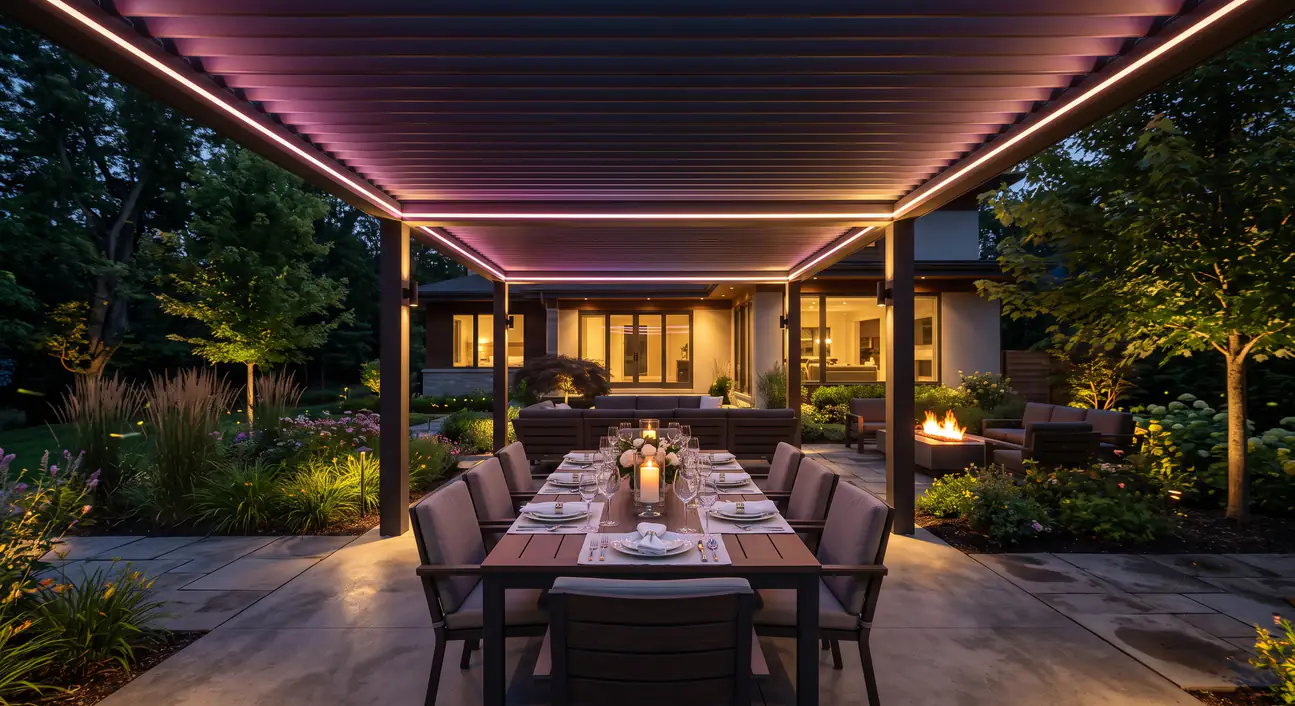
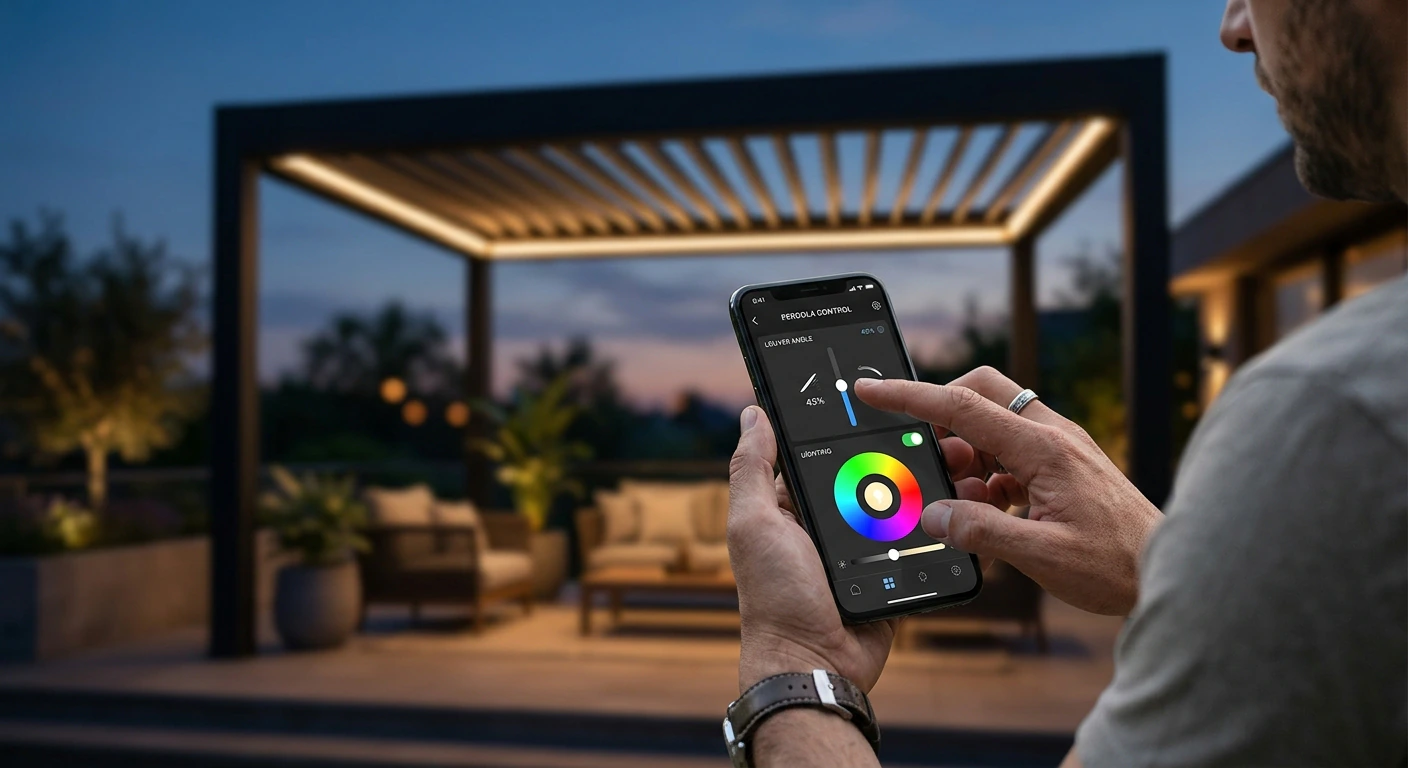
Lighting is central to creating nighttime commercial atmosphere and residential warmth. A strong control-panel design should provide multiple independent low-voltage DC outputs to support layered lighting layouts with different functions. The first layer is ambient lighting, usually delivered through anti-glare LED trim lights embedded in aluminum channels within the main beams and posts. These linear lights should meet the highest IP68 waterproof standard, while the control system should deeply support pulse-width modulation (PWM) for smooth, flicker-free 0–100% linear dimming and full RGB color mapping. The second layer is task lighting, such as puck lights installed between roof louvers or under the main beam. These provide focused, high-color-rendering downward beams for outdoor kitchens, barbecue areas, or long dining tables, ensuring safety and visibility. The most important engineering consideration is unified power management and voltage-drop suppression. Outdated designs often attach multiple transformers from different brands around the pergola. Advanced system architecture uses one high-power UL-listed hub to distribute unified 24V DC power efficiently to all motor and lighting branches. This topology preserves a clean structure while ensuring that distant lighting fixtures still receive stable input voltage, preventing brightness loss.
When late autumn arrives or early spring cold fronts appear, infrared heaters and motorized zip screens become key tools for extending the usability of outdoor spaces and improving commercial dining occupancy. Because infrared heaters are usually heavy-load devices rated above 3,000 W, they must rely on high-voltage power. A well-designed low-voltage pergola control hub solves this by integrating dry contacts or external isolated solid-state relay modules. Through this low-voltage-control, high-voltage-load mechanism, users can start and stop high-voltage heaters smoothly from the same smartphone app or handheld remote without leaving their seats.
Even more sophisticated is the logical interlocking between perimeter barriers and microclimate equipment. When motorized zip screens are fully lowered on all sides, creating a relatively enclosed insulated space, continuous full-power heater operation without fresh-air circulation can cause local overheating and may even create carbon monoxide buildup or fire risk. A highly integrated intelligent control system can build a safety baseline through automation logic. For example, after detecting that the screens have reached the fully closed lower limit, the system can automatically cap heater output at 50%. Or, when an ambient carbon dioxide sensor triggers an alarm, it can automatically open the top louvers by 10% to provide micro-ventilation. This system-level coordination across the microclimate is the fundamental difference between an ordinary shade canopy and a top-tier intelligent pergola.
Manufacturing Strategies That Improve OEM Delivery: DFMA and Innovation
In a competitive market, even the most precise and advanced electrical control logic will fail commercially if it turns on-site wiring into a nightmare for installers. Every unexpected extra day in the installation schedule directly erodes OEM margin through labor cost. For this reason, DFMA, or Design for Manufacture and Assembly, is especially urgent and valuable in control-system design.
Traditional field wiring requires electricians to spend hours on unstable scaffolding stripping wires, crimping terminals, applying heat-shrink tubing, and wrapping waterproof insulation tape. It is inefficient and highly vulnerable to human error, which can create hidden short-circuit risks. Modern efficient control systems have moved fully toward pre-wired harnesses and plug-and-play engineering. Before the aluminum profiles leave the factory, the assembly plant routes all weather-rated low-voltage cables precisely through hollow posts and beams. The cable ends use aerospace-grade M12 multi-pin waterproof connectors with strict poka-yoke design to prevent misconnection. After the heavy structural components arrive at a luxury residence or commercial site and mechanical assembly is complete, the installation crew only needs to connect matching color-coded plugs and tighten the waterproof locking collars. In as little as 15 minutes, they can complete the full nervous-system bus connection for drive motors, multi-channel lighting, and weather sensors with nearly zero error. This modular strategy can reduce electrical commissioning time by more than 90%.
Power distribution architecture is also evolving for different application scenarios. The mainstream approach uses a centralized hub, placing all complex relays, power converters, and smart gateways inside one sealed IP65 weatherproof control box, usually mounted on the main wall or hidden behind a post service panel. The major advantage of this architecture is that routine maintenance, troubleshooting, and firmware module upgrades years later can be completed by opening one low-level access point. Technicians do not need to climb back onto a dangerous roof.
In sustainable innovation, solar-powered off-grid systems are breaking terrain constraints. For deep garden locations, golf courses, or isolated landscape nodes where it is impossible to trench utility power from the main building, some advanced control systems creatively integrate high-efficiency monocrystalline solar panels, such as 33 W modules, with large-capacity lithium iron phosphate batteries, such as 40 Ah packs. Thanks to ultra-low-power sleep technology on the control board and high-efficiency DC motors, this self-sufficient ecosystem can continue to provide stable power for louver movement even after a full week of cloudy or rainy weather. It delivers truly commercial-grade pergola deployment with zero wiring cost and zero grid energy consumption.
Conclusion: Rebuilding Competitive Barriers in the Era of Intelligent Pergolas
Looking across the full technology landscape, the evolution of motorized louvered pergolas has moved well beyond the early manufacturing stage of pursuing aluminum weight, physical span, and static load capacity alone. In today’s global market, any pergola product capable of penetrating developed European and North American markets and sustaining premium brand pricing must include a central nervous system with four defining characteristics.
Align fully with next-generation connectivity protocols. OEMs should move beyond the experience limitations of one-way traditional RF control, deploy mesh-based Zigbee 3.0 in large commercial arrays, and actively prepare for IPv6-based Matter over Thread standards. This breaks down ecosystem isolation and gives the product more than a decade of digital asset life and compatibility.
Build a weather-grade active defense system. The system should move beyond simple passive switching and integrate multi-dimensional environmental data, including wind speed changes, sudden snowfall, heavy rain, and freezing temperatures, into the underlying algorithm. This allows millisecond-level automated physical avoidance under extreme disaster conditions and protects the user’s high-value structural asset.
Maintain the highest electrical safety and compliance baseline. In outdoor areas where water and electricity intersect, OEMs should strictly follow NEC Article 411 low-voltage requirements and UL 508 industrial panel standards, adopting a unified 24V DC architecture to eliminate shock and compliance risks at the physical source.
Create a seamlessly integrated lighting, heating, and microclimate ecosystem. The pergola roof should become the core coordination platform. Through standardized bus protocols, stepless LED dimming, infrared heating arrays, and motorized wind screens can be logically interlocked to deliver a dependable all-weather outdoor living space.
The market is harsh and transparent. It is already punishing manufacturers that attempt to capture short-term profit with cheap motors, poorly made circuit boards, and improvised remotes. Every control-system crash, every connection failure, every heavy-louver jam, every abnormal noise, and every uncontrolled rainwater backflow irreversibly drains brand credibility in top-tier B2B commercial projects and high-net-worth residential markets.
For aluminum pergola OEMs that aim to secure a position in the global premium outdoor shading market, or even redefine the industry standard, the strategic priority must shift now. We strongly recommend that structural manufacturers immediately reassess their electrical supply chains. Stop trying to develop electronic automation logic, complex network protocol integration, and demanding electrical certifications behind closed doors in areas outside their core expertise. Instead, identify and work closely with professional electrical and control system manufacturers that hold complete UL and CE certifications, understand IoT interoperability in depth, and have a clear grasp of outdoor structural mechanics. Only by specifying the most advanced and most stable brain and nervous system from the source can the steel and aluminum framework you have worked so hard to create become an intelligent outdoor structure that breathes, responds to nature, and follows human intuition. It is time to match your exceptional structure with an equally exceptional intelligent control center.

Пингбэк: Retractable Louvered Pergola Control Systems: Motor, Remote, and Sensor Requirements
Пингбэк: Контрольный список комплектующих системы управления перголой для производителей крыш с жалюзи
Пингбэк: Pergola Control System BOM Checklist for OEMs
Пингбэк: Rain Sensor Placement for Motorized Louvered Roofs: Factory and Installer Guidelines