


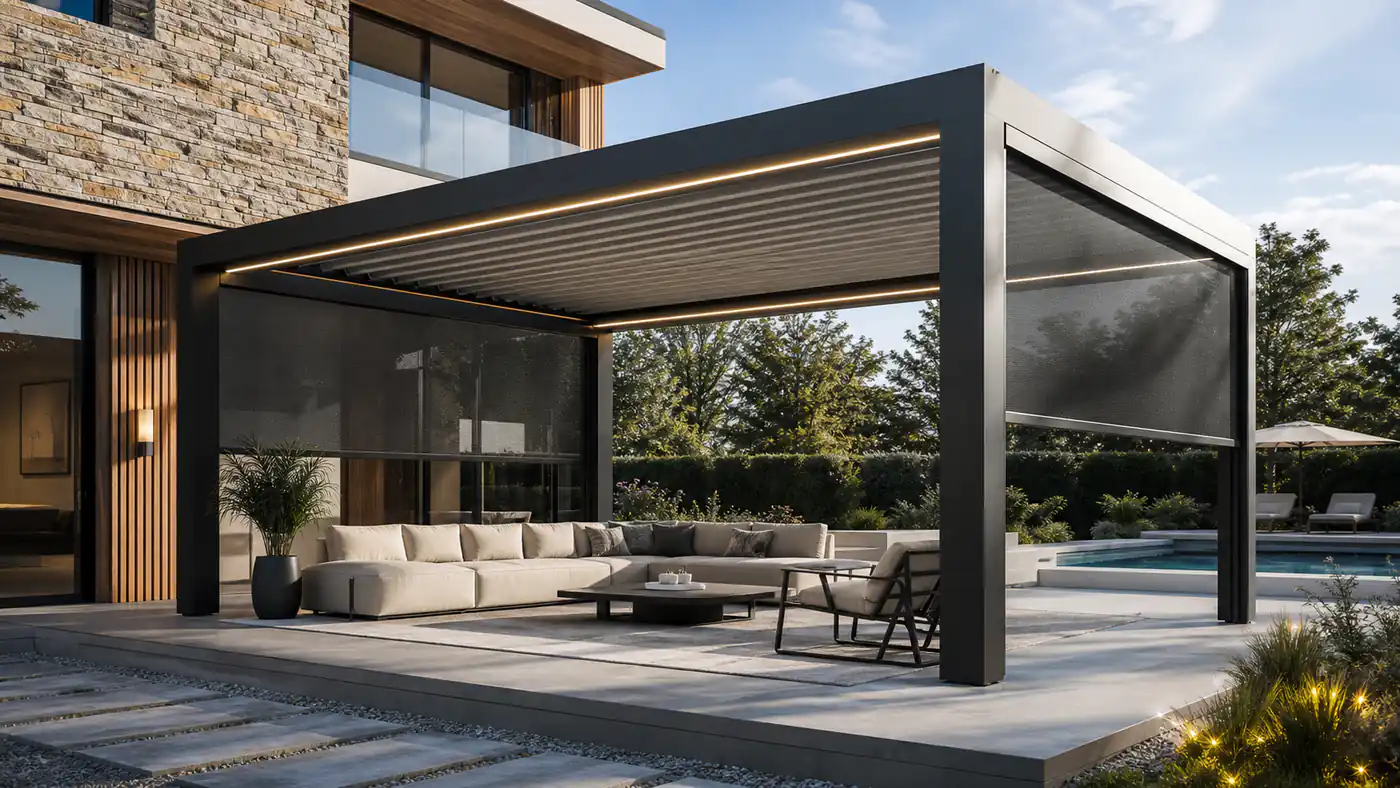
Modern outdoor architectural design is undergoing a profound shift from passive shading to active bioclimatic regulation. Trends in high-end residential and commercial real estate in 2026 show that outdoor spaces are now treated as seamless extensions of indoor living. Consumers expect outdoor comfort, all-weather usability, and smart functionality to meet the same demanding standards they already expect indoors. In this market evolution, the core barrier that determines whether a motorized pergola can command a premium is no longer simply the thickness of its aluminum profiles, but the central control system it carries.
For pergola manufacturers, distributors, and project contractors in Europe and North America, the quality of the control system architecture directly affects installation efficiency, after-sales maintenance cost, and the end user’s interaction experience. Leading integrated solutions, such as pergola control systems designed specifically for the high-end market, have already proven that a unified control hub capable of synchronizing lighting, linear actuators, tubular motors, and wind, sun, rain, and snow sensors is the only practical way to break down hardware silos and build a truly intelligent outdoor ecosystem. This guide analyzes the technical chain and commercial value of modern motorized pergola control systems from the perspectives of hardware logic, system cascading, engineering installation, accessory replacement strategy, and deep OEM customization.
Unified Control Architecture: Ending Fragmented Outdoor Intelligence
Early electrical systems for motorized pergolas often suffered from serious fragmentation. Louver rotation relied on one remote control, surrounding windproof ZIP screens used a separate control module, while LED lighting and outdoor heaters required a third switch. This multi-controller setup not only made factory wiring much more complex, but also created a highly fragmented user experience.
Modern professional-grade control systems rebuild the control topology through highly integrated RF and smart gateway protocols. Multi-channel controllers can manage devices with very different electrical characteristics within one unified logic framework.
| Control layer | Core component form | Technical protocol and communication standard | Engineering and experience pain points solved |
|---|---|---|---|
| Sensing layer | Wind, sun, rain, snow, and temperature sensors | 433.92 MHz RF, 24 V DC hardwiring, solar power | Eliminates manual intervention and enables millisecond-level weather defense response |
| Actuation layer | Linear actuators, tubular motors, digital dimming modules | 24 V DC / 110-240 V AC, PWM dimming | Unifies command reception for different drive logics, including push-pull and rotation |
| Interaction layer | 12/16-channel remotes, wall panels | Rolling-code encrypted RF, wide operating range from -10 deg C to 60 deg C | Ends multi-remote confusion and enables precise stepless knob dimming |
| Cloud ecosystem layer | Smart gateways, such as Bond Bridge Pro | Wi-Fi, Bluetooth, API integration with Alexa/Savant | Removes physical distance limits and integrates the pergola into whole-home automation scenes |
This architecture establishes a “single brain, multiple drives” control philosophy. When the control box receives a high-priority pulse signal from a weather sensor, it can instantly coordinate all motors and lighting to execute disaster-prevention or energy-saving routines. Its efficiency comes from strict event priority sequencing: extreme storm warnings always override rain commands, rain commands override light adjustment, and all automation commands can still be overridden by manual user operation in emergencies.
Drive Physics: Precise Coordination of Linear Actuators and Tubular Motors
In the dynamic skeleton of a pergola, control-system commands must eventually be converted into precise mechanical motion. Professional manufacturers need a deep understanding of the physical motion paths of different shading modules so they can match the correct motor type in the bill of materials. Confusing the torque logic of tubular motors with the thrust logic of linear actuators is a serious and common mistake among entry-level system integrators.
Linear Actuators: The Core Engine of the Louver Matrix
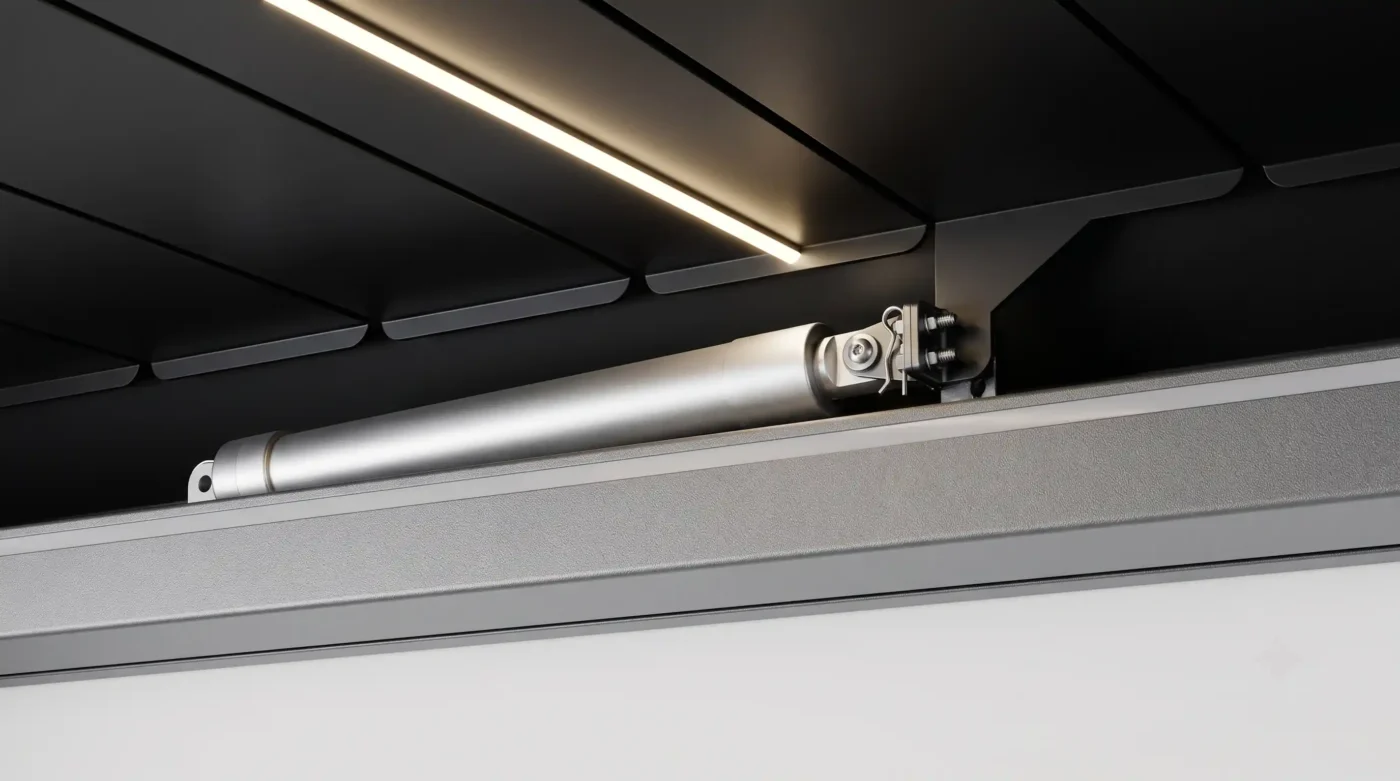
The roof panels of high-end bioclimatic pergolas are usually made from dual-wall louvers produced with 6063-T6 aerospace-grade extruded aluminum profiles. This design provides excellent structural rigidity and thermal insulation, but it also means that the louver matrix has substantial overall weight and wind resistance. Smoothly rotating these louvers between 0 degrees, for full rainproof closure, and 135 or 160 degrees, for maximum ventilation, requires linear actuators that output straight push-pull force.
Linear actuators matched with modern control systems now meet demanding industrial-grade parameters. Because they are exposed for long periods to salty coastal air, heavy rain, and even freeze-thaw snow and ice conditions, their protection rating has advanced from the traditional IP65 level to the highest IP69K level. IP69K certification ensures that the actuator is completely dust-tight and can withstand direct spraying from 80 deg C high-temperature water at 80 to 100 bar from a close distance of 10 to 15 cm. This level of protection eliminates the risk of short circuits or seizure caused by water ingress, making it a required specification for upscale coastal residences and commercial hotel projects.
In terms of mechanical performance, these actuators are usually driven by safe 24 V DC low voltage, provide powerful thrust from 800 N to 2500 N, and run at a constant speed of 22 mm/s to 25 mm/s. This allows the louver matrix to complete its full travel quietly and elegantly within 15 to 30 seconds. Operating noise is strictly controlled below 60 dB, preserving the calm atmosphere of premium outdoor spaces.
Tubular Motors: Roll-Driven Flexible Barriers
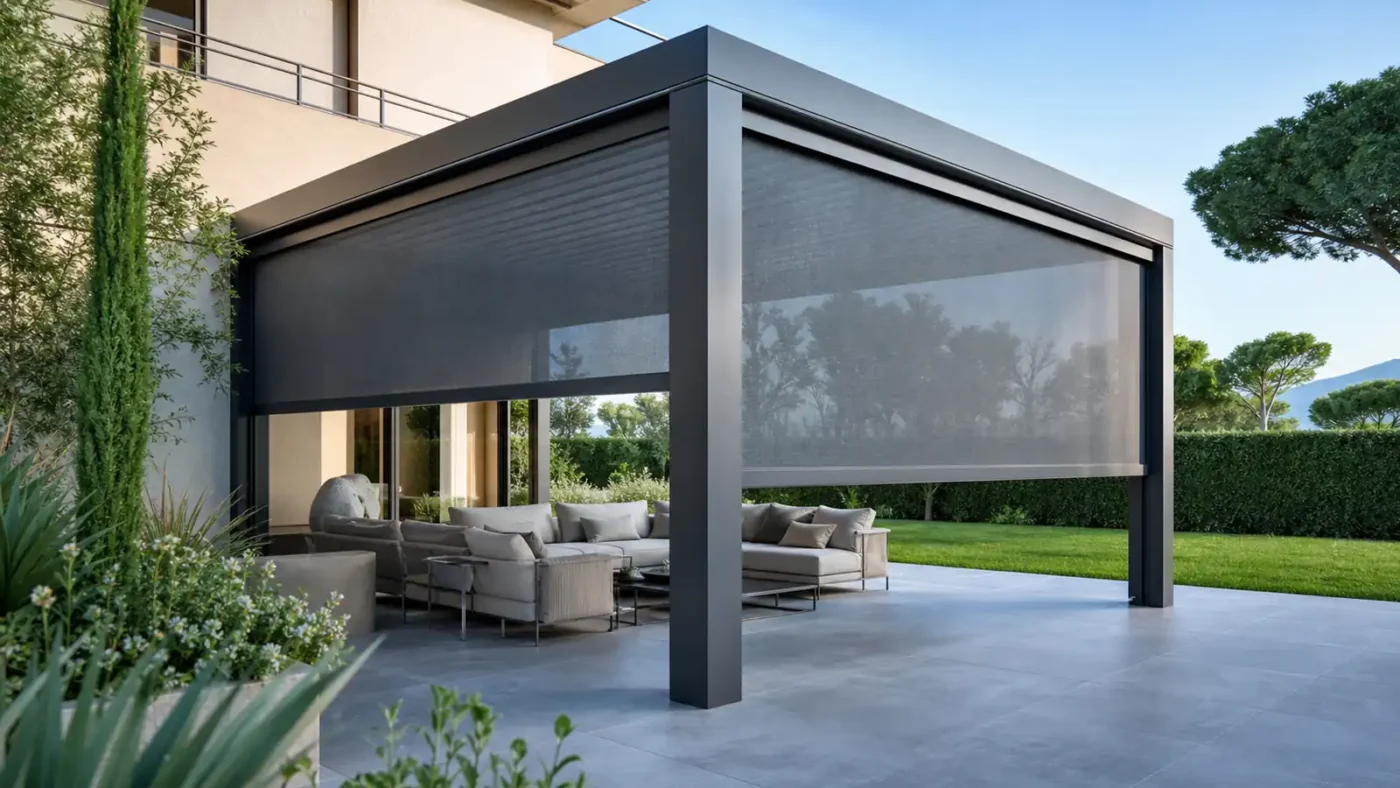
Unlike linear actuators, which handle rigid push-pull motion, tubular motors are designed for rolling rotation. They are usually hidden inside aluminum roller tubes and used to drive windproof ZIP screens or soft sunshade curtains around the pergola.
The main control challenges for tubular motors are maintaining fabric tension and detecting obstacles. Top-tier control systems give tubular motors intelligent electronic limit setting and resistance rebound capabilities. When a windproof screen touches outdoor furniture or a person during descent, the motor can detect abnormal resistance instantly through tiny current fluctuations, stop downward movement within milliseconds, and automatically reverse upward.
To adapt to grid standards in different countries, commercial tubular motors commonly use a wide-voltage design of 110-240 V and 50-60 Hz, greatly simplifying adaptation costs for global OEM exports.
Smart Lighting Matrix: The Visual Hub for All-Weather Scenes
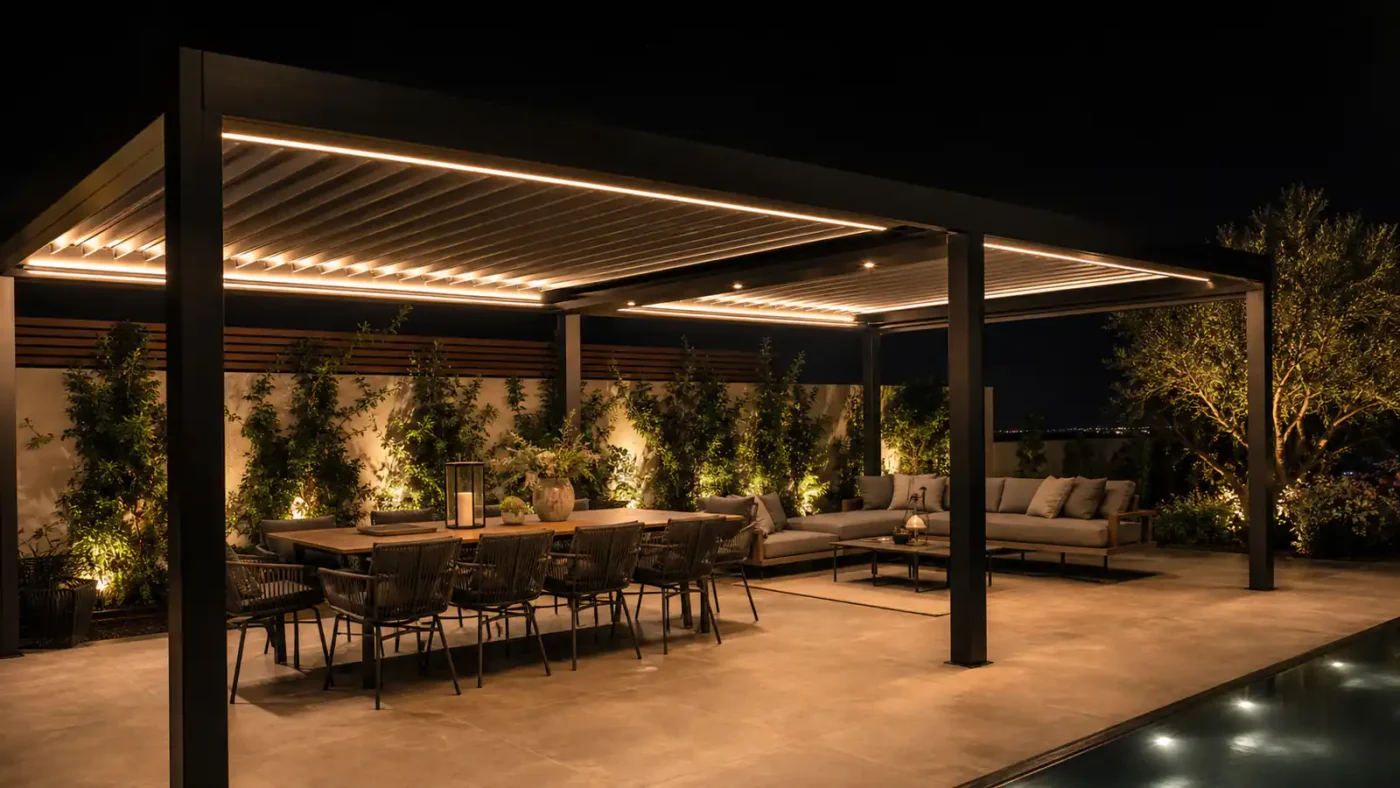
Modern outdoor living has broken through the physical limits of daylight hours. A good pergola is not only a daytime shade structure, but also a visual centerpiece at night. The control system’s ability to manage lighting modules directly separates premium products from low-cost assemblies.
System integrators use 24 V DC step-down modules to embed highly integrated LED strips into hidden grooves in aluminum main beams or into the side walls of rainproof gutters, creating indirect base lighting where the light is visible but the fixtures are concealed. More complex systems also cut linear light sources directly into the rotating louver blades, allowing the projection angle to change dynamically as the louvers move and creating dramatic spatial light and shadow effects.
At the interaction level, RF control boxes that support multi-channel management include advanced PWM digital dimmers. Paired with smart remotes that use stepless knobs, users can switch smoothly between 2700 K warm white light, suitable for dining and fireside conversation, and 6000 K cool white light, suitable for reading and food preparation. They can also activate RGB full-color mode for commercial party scenes. Stepless dimming not only eliminates the harsh flicker caused by traditional relay switching, but also significantly extends the service life of LED components.
Weather Defense Algorithms: Sensor Prediction and Automated Response
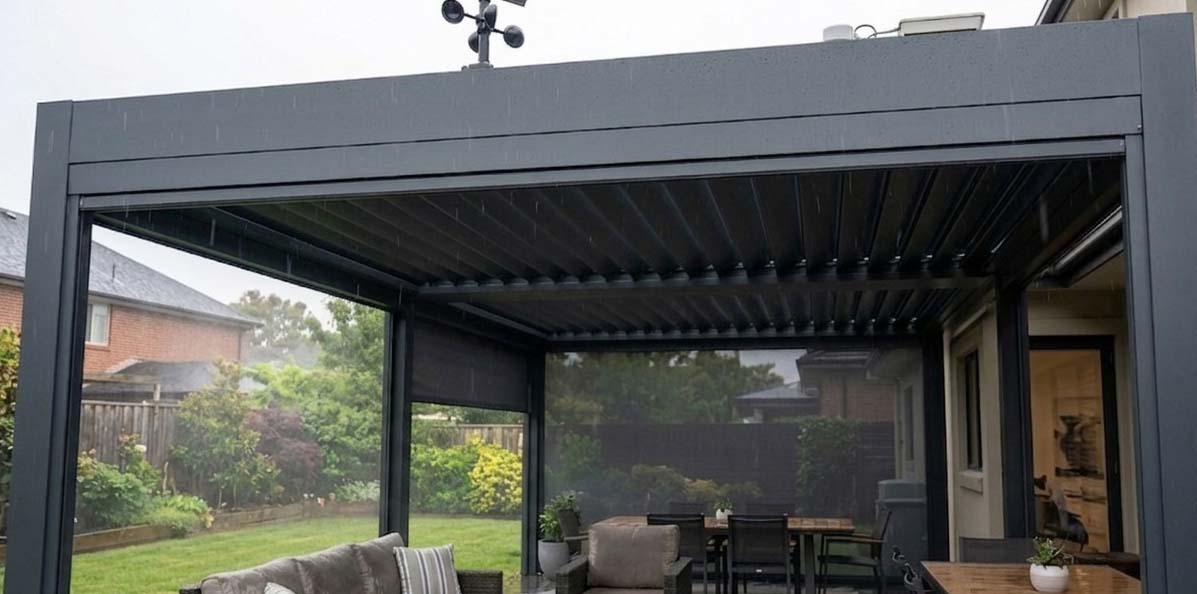
A motorized pergola without weather sensors is little more than a large mechanical device that constantly requires human supervision. Connecting wind, sun, rain, and snow sensors to the control bus is the soul of bioclimatic self-adaptation. Modern sensing matrices no longer passively wait for damage to occur. Instead, they monitor microclimate changes in real time through high-frequency polling.
With the support of sensor networks, such as the Breeze Pro wireless sensor in the Bond Bridge Pro ecosystem, environmental data can be sampled as often as once every 10 seconds. The moment raindrops fall, the conductive array on the rain sensor detects moisture. The system does not need cloud relay. It directly triggers the closing command in the local control box. The linear actuators then engage at maximum power, locking the louvers fully shut before rain can wet premium outdoor sofas. Water flows along the precision drainage channels in the louvers into the integrated gutters around the structure, then drains to the ground through concealed downpipes inside the posts.
Against destructive gusts, wind-defense algorithms demonstrate the highest safety logic of the control system. When the wind-speed sensor detects that ambient wind exceeds a defined damage threshold, such as 40 mph or 64 km/h, the control system immediately executes a forced pressure-relief routine. It rotates the louvers to the maximum open angle to greatly reduce wind resistance and forcibly retracts all surrounding windproof screens to prevent guide rails from tearing.
Most importantly, after high-wind defense is triggered, the system automatically applies a lockout period lasting up to four hours. During these four hours, any preset timed closing task or sunlight adjustment task is forcibly ignored, ensuring that the structure remains in its safest posture while storm airflow is extremely unstable. However, local manual physical control remains available for extreme emergencies.
For ice and snow hazards in cold regions, sensor hardware is also strengthened at the base level. Snow accumulating on closed louvers can generate an astonishing static load, enough to crush aluminum beams. For this reason, high-end sensor modules automatically connect to an additional 12 V DC power supply when ambient temperature falls below 38 deg F, or about 3.3 deg C, activating internal electric heating elements to prevent the probe from freezing and failing. At the same time, when the control algorithm detects low-temperature snowfall, it keeps the louvers vertically open to eliminate the risk of snow accumulation on the roof.
Engineering Deployment: Kit Installation, Commissioning, and Modular Replacement
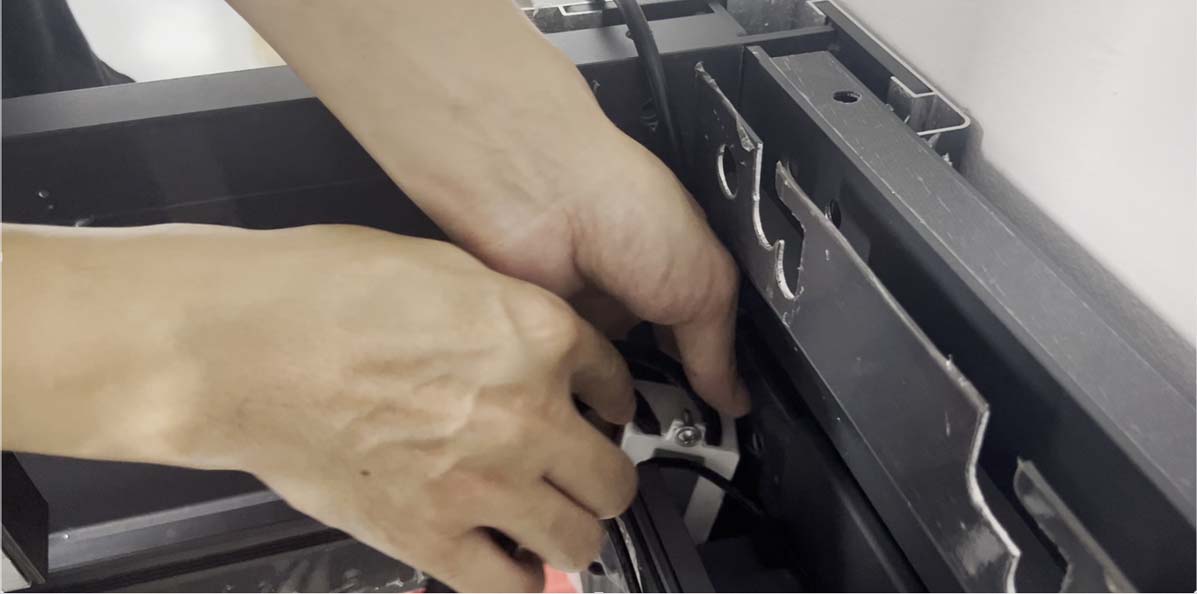
Excellent control-system design must fully account for error tolerance and assembly efficiency during on-site construction. Through modular plug-and-play design, pre-engineered kits turn electrical installation from a high-threshold technical task into a standardized assembly process, greatly reducing contractors’ on-site labor costs.
Concealed Wiring and Mechanical Stress Relief
During installation, all power cables, sensor signal wires, and motor cables must run through the cavities of the aluminum profiles. To prevent rainwater ingress caused by capillary action, professional installation standards require a downward U-shaped drip loop before every cable enters a motor, control box, or wiring terminal.
When mechanically mounting a linear actuator, calibration of the initial physical position is an absolute prerequisite for avoiding equipment damage. Technicians must use a portable 24 V test battery to ensure that the actuator rod is at its fully retracted physical limit. If the rod is fixed to the linkage while slightly extended, then once the system executes a closing command, the actuator’s powerful thrust will deadlock against the rigid frame and instantly destroy the aluminum linkage or actuator housing.
In addition, when fixing U-shaped connection brackets, experienced installers use the threaded design at the bottom of the actuator rod to manually unscrew it by two turns as a fine-adjustment allowance. They also set the bracket back by about 1/16 inch to 1/8 inch on the aluminum beam. This eliminates hard friction caused by mechanical tolerances and ensures that louver rotation remains smooth.
Rigorous Replacement and Compatibility Rules
Over a product life cycle of more than ten years, and sometimes several decades, electrical module replacement is unavoidable. Replacing a motor or receiver is not simply a matter of physical disassembly and installation. The first challenge is matching the underlying communication protocol.
The market contains many closed ecosystems that are incompatible with each other. For example, Somfy RTS receivers only recognize RF remotes using the RTS protocol. A 433.92 MHz tubular motor using a specific hopping-code logic plus 100 kHz can never communicate directly with a generic low-cost smart-home gateway. When replacing accessories, service technicians must ensure that the new control module’s underlying encryption protocol, motor thrust or load specification, and limit logic are fully consistent with the original system.
After hardware replacement, every opened waterproof cover plate and main-beam joint must be resealed along the edges with industrial-grade structural adhesive or silicone sealant. This secondary waterproofing fully blocks moisture from entering the electrical core.
Strategic Differentiation: OEM and ODM Customization Guide for Europe and North America
In an increasingly homogenized global pergola market, offering control-system solutions with deep customization capability is a strategic springboard for manufacturers seeking to evolve from metal fabricators into outdoor lifestyle brands. For OEMs and ODMs trying to build defensible positions in high-end European and North American markets, the control system is the best leverage point for differentiated brand premiums.
From Requirement Definition to Climate-Grade Customization
A rigorous OEM project includes ten standardized gates, from concept brief to container loading. Customization is by no means limited to laser-engraving the buyer’s logo on the packaging box. It reaches into systematic reconstruction for specific regional climates.
Coastal North America and hurricane-zone defense: For Florida or the California coast, OEM solutions must hard-code storm defense mode into the control logic, combined with wider aluminum posts and high-torque motors, to meet strict building-code requirements for resistance to wind speeds up to 165 mph, equivalent to a Category 5 hurricane. All external sensor bases and motor housings also require additional salt-spray and corrosion-resistant treatment.
Software ecosystem and brand privatization: High-net-worth consumers in North America need more than remote controls. They also expect voice control and whole-home connectivity. Strong OEM manufacturers provide distributors with API interfaces that integrate natively with mainstream control systems such as Apple HomeKit, Amazon Alexa, and Control4. By offering white-label customized mobile apps, distributors can embed their brand identity deeply into daily user interaction, greatly improving brand loyalty.
Supply Chain Verification and Compliance Barriers
Before any prototype with customized control logic enters batch manufacturing, it must undergo demanding environmental validation. This includes simulating long-term extreme cold and heat cycles in a constant-temperature and constant-humidity chamber, as well as conducting tens of thousands of failure-free opening and closing cycles under load for the linear actuators.
During logistics and transportation, because the control system contains many precision electronic PCB boards and optical sensors, OEM manufacturers must implement strict packaging validation through drop, vibration, and compression testing. This ensures that the product remains intact during transoceanic container transport.
More importantly, a successful export-ready OEM control system must provide localized, branded, and compliant documentation. From CAD structural drawings accurate to the millimeter and clear low-voltage and high-voltage wiring topology diagrams, to test reports that meet local safety certifications such as UL, FCC, and CE, detailed engineering documentation is the final cornerstone for reducing overseas distributors’ after-sales costs and building strong B2B trust.
Industry Outlook and Call to Action
The evolution of bioclimatic pergolas is, at its core, the technical history of outdoor equipment moving from mechanization toward digitization and automation. With the strong thrust of linear actuators, the flexible spatial division enabled by tubular motors, the proactive defense of high-frequency weather sensors, and the atmosphere rendering of stepless dimming systems, highly integrated modern control systems are redefining luxury outdoor living.
Low-cost electronic components assembled piecemeal only lead to endless water-ingress short circuits, protocol conflicts, and expensive on-site repairs. Pergola manufacturers, importers, and engineering developers in Europe and North America that want to lead the next product cycle must fundamentally reassess their control architecture.
Adopting a unified control hub that has passed rigorous IP69K climate validation, seamlessly integrates multiple motor forms and smart sensor ecosystems, and supports deep OEM system customization is the only reliable way to transform ordinary aluminum profiles into high-value technology-driven architectural products. Embracing advanced integrated control technology is not just a technical iteration of a product line. It is a strategic requirement for establishing premium pricing power in an intensely competitive market.

Пингбэк: Pergola Roof Cover Control Options: Fixed Panels vs Motorized Louvers for OEMs
Пингбэк: Комплекты управления для пергол открытых кухонь: освещение, жалюзи, вентиляторы и датчики