










🤔 How many years does a 24-hour salt spray test equate to?
✅ Specific time conversions are as follows:
- Neutral salt spray test 24h ⇌ Natural environment 1 year;
- Acetic acid salt spray test 24h ⇌ Natural environment 3 years;
- Copper-accelerated acetic acid salt spray test 24h ⇌ Natural environment 8 years.
🔍 Analysis:
Corrosion refers to the deterioration or degradation of materials or their properties caused by environmental factors. Most corrosion occurs in atmospheric environments, which contain corrosive components and factors such as oxygen, humidity, temperature fluctuations, and pollutants. Salt spray corrosion represents one of the most prevalent and destructive forms of atmospheric corrosion. Here, “salt spray” refers to an atmosphere rich in chlorides, with its primary corrosive component being the marine chloride salt “sodium chloride.” This chloride primarily originates from oceans and inland saline regions.
1. Concept of Salt Spray Testing
Salt spray testing is an environmental test that primarily utilizes artificial simulated salt spray conditions created by salt spray testing equipment to evaluate the corrosion resistance of products or metallic materials.
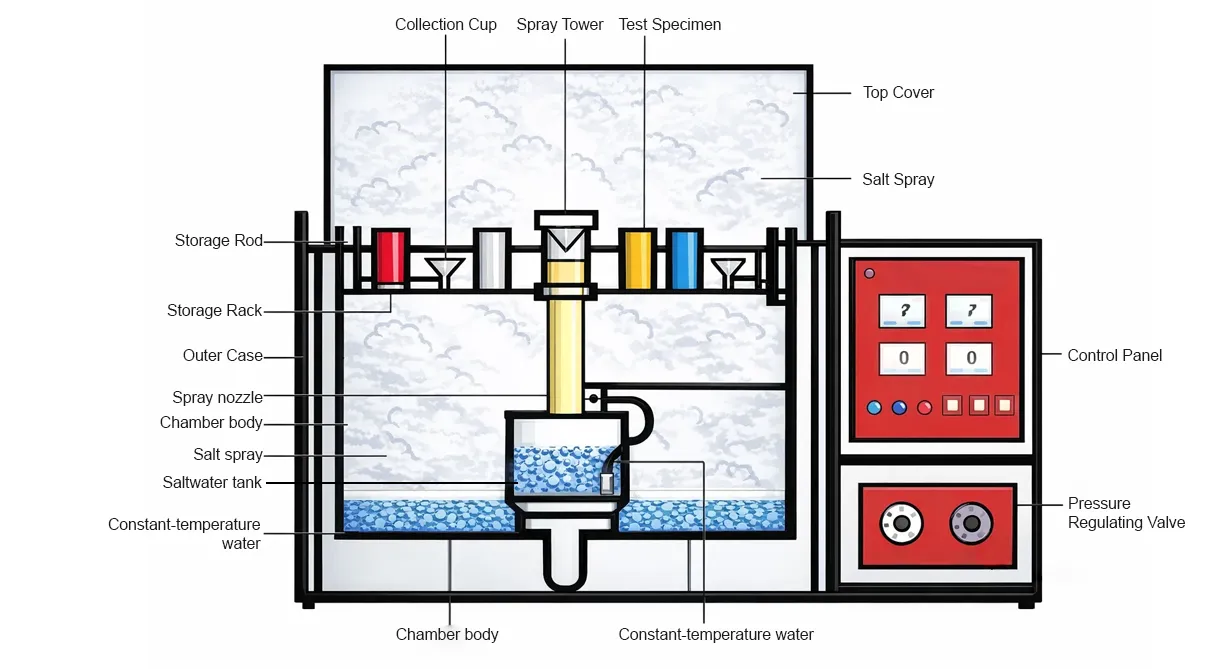
Most corrosion of metallic materials occurs in atmospheric environments, which contain corrosive components and factors such as oxygen, humidity, temperature fluctuations, and pollutants. Salt spray corrosion represents one of the most common and destructive forms of atmospheric corrosion.
Salt spray corrodes metal materials primarily through the penetration of conductive salt solutions into the metal, triggering electrochemical reactions. This forms a micro-battery system comprising “low-potential metal—electrolyte solution—high-potential impurities,” facilitating electron transfer. The metal, acting as the anode, dissolves and forms new compounds—the corrosion products. Chloride ions play a primary role in the salt spray corrosion process. They possess strong penetrating ability, easily penetrating metal oxide layers to enter the metal interior and disrupt the metal’s passivation state. Simultaneously, chloride ions have low hydration energy, readily adsorbing onto metal surfaces and displacing oxygen from the protective oxide layer, thereby causing metal damage.
- Classification of Salt Spray Tests
Salt spray tests fall into two main categories: natural environmental exposure tests and artificial accelerated simulated salt spray environment tests. Artificial simulated salt spray environment tests utilize a test chamber—a device with a specific volume—to artificially create a salt spray environment within its space. This environment is used to evaluate the quality of a product’s resistance to salt spray corrosion.
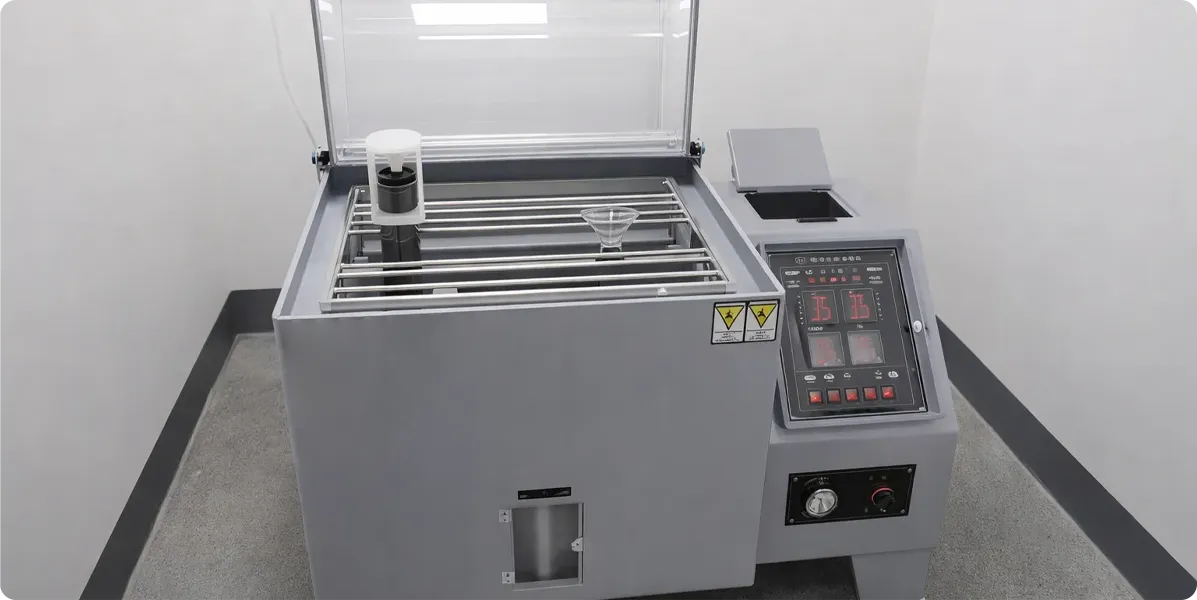
Compared to natural environments, the chloride salt concentration in artificial salt spray environments can be several to dozens of times higher than typical natural salt spray levels, significantly accelerating corrosion rates. Conducting salt spray tests on products thus yields results much more quickly. For instance, while testing a product sample in natural exposure conditions might take a year to show corrosion, similar results can be obtained in just 24 hours under artificial simulated salt spray conditions.
Artificial simulated salt spray testing encompasses neutral salt spray testing, acetic acid salt spray testing, copper-accelerated acetic acid salt spray testing, and alternating salt spray testing.
(1) The neutral salt spray test (NSS test) is an early-developed accelerated corrosion testing method with broad current applications. It employs a 5% sodium chloride saltwater solution with a pH adjusted to the neutral range (6–7) as the spray solution. The test temperature is uniformly set at 35°C, requiring a salt spray deposition rate between 1–2 ml/80 cm²·h.
(2) The Acetic Acid Salt Spray Test (ASS Test) evolved from the neutral salt spray test. It involves adding glacial acetic acid to a 5% sodium chloride solution, lowering the pH to approximately 3 and rendering the solution acidic. Consequently, the resulting salt spray becomes acidic rather than neutral. Its corrosion rate is about three times faster than that of the NSS test.
(3) The Copper-Accelerated Acetic Acid Salt Spray Test (CASS test) is a recently developed accelerated salt spray corrosion test abroad. Conducted at 50°C, it incorporates a small amount of copper chloride into the salt solution to intensify corrosion induction. Its corrosion rate is approximately eight times that of the NSS test.
Conversion of specific durations: 24 hours of neutral salt spray test = 1 year in natural environment 24 hours of acetic acid salt spray test = 3 years in natural environment 24 hours of copper-accelerated acetic acid salt spray test = 8 years in natural environment
Author

Andy Gao
With 15 years in the LED lighting industry, I’ve witnessed its evolution from general fixture production to today’s highly specialized segments. As Co-Founder of Veldstar, my journey mirrors this shift – driving our exclusive focus on pergola and garden lighting solutions. Through dedicated innovation, we develop controllers and systems rivaling leaders like Somfy and Teleco. Here, I share insights and showcase products engineered to elevate outdoor spaces with style, functionality, and advanced control. Learn more via linkendin profile:https://www.linkedin.com/in/pergolalights/

Share This Article:
Send Us your Request