


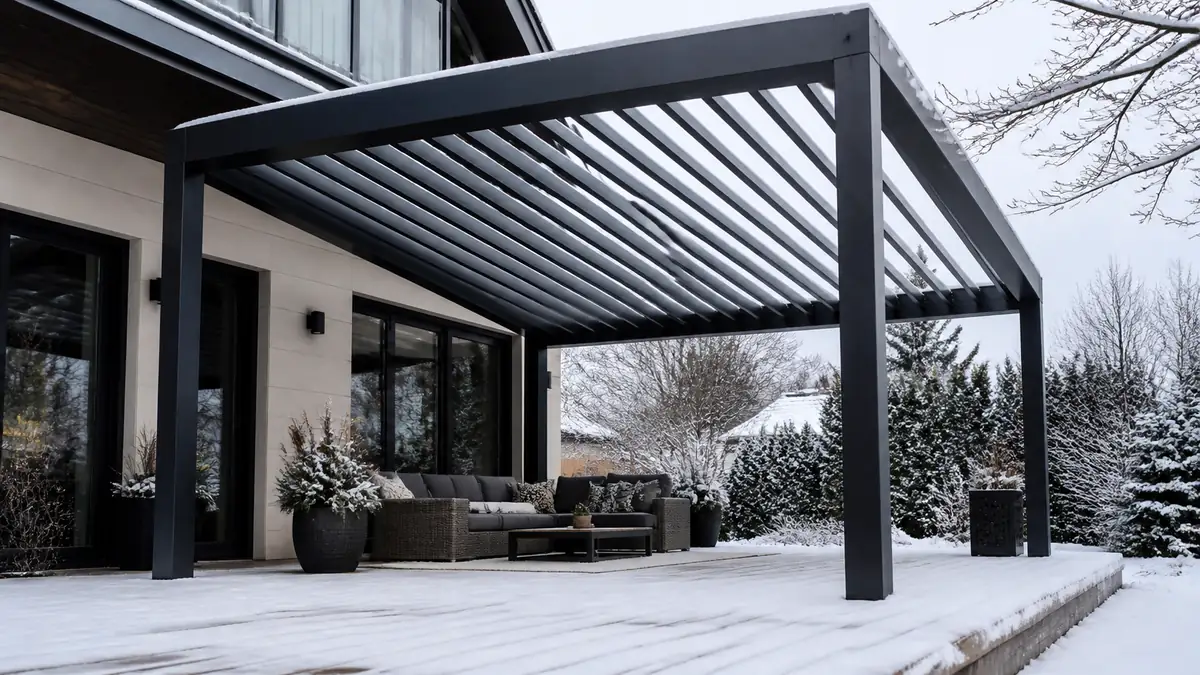
Önemli Noktalar
- Snow and frost protection should be treated as a control logic problem, not a single sensor feature.
- The correct winter response depends on the pergola roof design, certified snow load, louver geometry, drainage path, and local climate.
- For OEMs, the most important decision is the protection priority: safety lockout first, structural load strategy second, user comfort third.
- A reliable system needs defined states such as winter watch, snow mode, frost lockout, recovery mode, and service alert.
- Manufacturers should test winter logic on a bench and in a full-size roof mockup before shipping it to dealers.
The Starting Point: A Snow Sensor Is Not a Snow Load Certificate
Snow and frost automation should never be used to imply structural capacity. Snow load remains an engineering and code question. In the United States, roof and structure load design is commonly connected to standards such as ASCE 7. The basic point is simple: snow accumulation is a structural risk, not just a convenience issue.
A pergola controller can reduce the chance of the roof being parked in the wrong position during winter weather. It cannot turn a light-duty outdoor living structure into a snow-rated roof. This distinction should be clear in OEM manuals, dealer training, and app messaging.
The controller’s job is to support the product strategy the manufacturer has already defined. If the roof is designed to shed snow through an open louver position, the controller should help move the roof into that winter parking angle before accumulation becomes dangerous. If the roof is engineered to close and drain light snow or slush in a specific configuration, the controller should follow that tested configuration. Both strategies can be valid. What is risky is shipping a controller that treats every snowfall the same.
Why Winter Logic Is Different from Rain Logic
Rain automation is usually simple: detect water, close the louvers, protect the furniture. Snow and frost are not simple because the same action can be correct in one condition and wrong in another.
Light wet snow may behave like rain for a short period. Dry snow may pass through an open roof more safely than it collects on a closed surface. Freezing rain can bond louvers, seals, gutters, and end caps together. Frost can make a motorized system look healthy electrically while the mechanical parts are physically locked. A user may press the remote because the sun is out, while the shaded side of the blades remains frozen.
The U.S. National Weather Service separates winter hazards such as freezing rain, sleet, frost, and ice because they create different field conditions. For pergola controls, that distinction matters. A winter logic table that only says “snow detected equals close roof” is not enough for a professional-grade system.
Define the Winter Protection Objective Before Choosing the Sensor
Before an OEM chooses a snow sensor, the engineering team should define the protection objective. The sensor is only the trigger. The objective decides the response.
In motorized louvered pergolas, winter protection usually has four objectives:
- Reduce unsafe snow accumulation by moving the blades to the manufacturer’s tested winter position.
- Prevent motor, gearbox, actuator, hinge, and louver damage when ice may be binding the roof.
- Keep the user informed without letting convenience commands override safety states.
- Give dealers a clear diagnostic path when the system refuses to move.
This is why a single snow threshold rarely works across an entire product line. A narrow residential pergola, a large hospitality roof, a coastal installation, and a mountain-market pergola may share the same remote design, but they should not necessarily share the same winter parameters.
The Inputs a Serious Winter Logic Should Consider
Good snow and frost protection does not need to be complicated for the user. It does need to be explicit inside the controller. At minimum, the logic should be designed around the following inputs.
| Input | What it tells the controller | Why it matters in winter |
|---|---|---|
| Snow or precipitation sensor | Moisture, falling snow, or ice-related detection depending on sensor type | Starts winter protection, but should not be the only decision point |
| Ambient temperature | Whether moisture may freeze or remain liquid | Separates rain behavior from frost-risk behavior |
| Surface or probe temperature | Whether the roof components themselves may be below freezing | Useful when sun warms the air but blades, seals, or gutters remain frozen |
| Motor current or actuator feedback | Whether movement requires abnormal force | Protects the drive system when louvers are blocked by ice or packed snow |
| Limit switch or Hall feedback | Whether the roof reached the expected position | Allows the controller to detect failed movement instead of assuming success |
| Wind sensor | Whether high wind requires a protective louver position | Snow and wind can conflict, so priority must be defined |
| User command source | Remote, wall panel, app, or voice command | Determines whether the system should accept, delay, or reject manual movement |
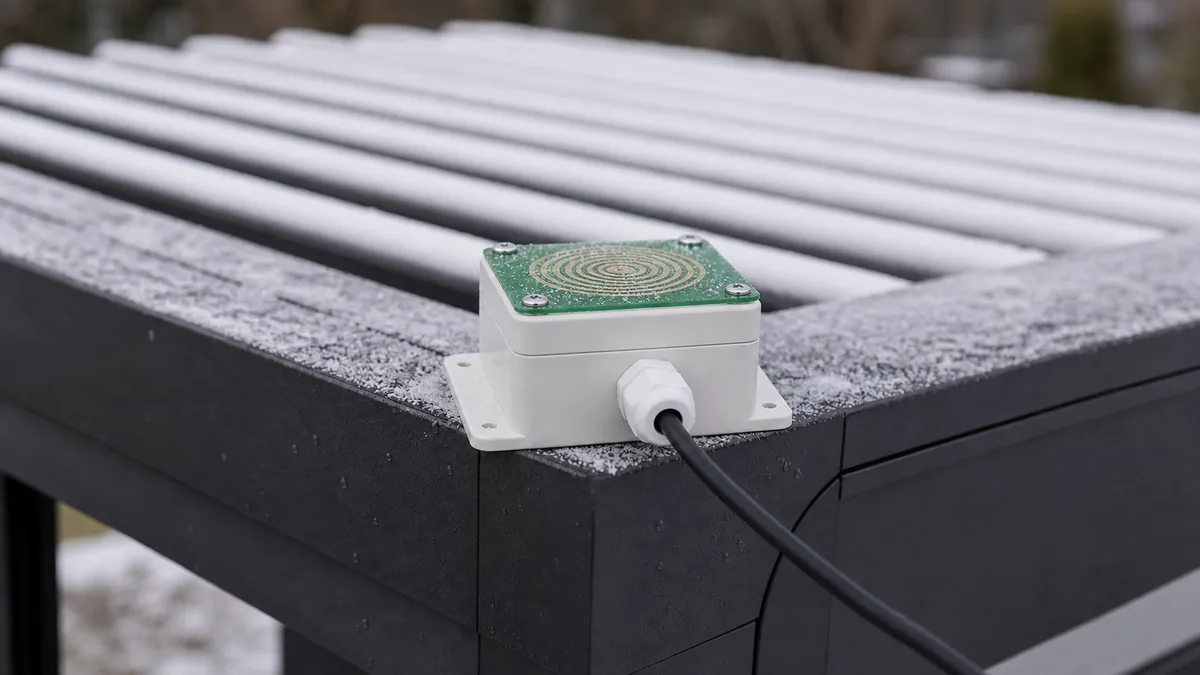
VLEDSTAR’s integrated pergola control architecture is built around this kind of coordination: lighting channels, linear actuators, tubular motors, weather sensors, RF remote control, Tuya app control, and touchscreen operation can be specified as one platform instead of scattered accessories. The technical advantage is not only fewer components. It is that the winter response can be designed as part of the system, not added afterward. For a broader view of this approach, see our pergola kontrol sistemi ve smart pergola controller pages.
A Practical Winter State Machine for Motorized Louvers
The most stable winter strategy is a state machine. It gives engineers, firmware developers, installers, and customer service teams the same language for how the pergola behaves.
Normal Mode
The pergola accepts standard commands from the remote, app, wall panel, or smart home system. Rain and wind protection remain active. Lighting scenes and louver movement behave as expected.
Winter Watch
The system enters winter watch when low temperature and possible precipitation are present, even before confirmed snow accumulation. Movement is still allowed, but the controller may slow actuation, monitor current more tightly, and prepare to move to the configured winter parking angle.
Snow Mode
Snow mode starts when the controller receives a confirmed winter precipitation signal. The system moves to the manufacturer’s defined snow position. For many louvered roofs this may be a steep open angle that reduces accumulation. For some engineered roof designs, it may be a closed or partially closed position that supports drainage and customer comfort. The important point is that this position must be tested and documented for the specific roof system.
Frost Lockout
Frost lockout prevents movement when the system has reason to believe the louvers, seals, gutter, or drive train may be frozen. This state should override normal user commands. If the user presses the remote, the system should refuse movement clearly instead of trying to force the motor.
Recovery Mode
Recovery mode begins after temperature rises and precipitation stops. The controller should not instantly return to normal operation. It should wait through a defined delay, verify that the motor feedback is normal, and move gradually if the product design supports controlled recovery.
Service Alert
A service alert is triggered when movement fails, current spikes repeatedly, position feedback does not match the command, or the system exits and re-enters lockout too often. This is not only a safety function. It reduces dealer frustration because the system can explain what happened.
The Priority Stack: Safety Before Comfort
Winter logic fails when every input is treated equally. The user wants to open the roof. The rain sensor wants to close it. The snow strategy may want to open it. The wind sensor may demand another angle. The motor current may say movement is unsafe. Without a priority stack, the controller becomes unpredictable.
| Priority | Condition | Recommended control behavior |
|---|---|---|
| 1 | Obstruction, abnormal current, missing position feedback, or suspected mechanical lock | Stop movement, reverse only if the mechanism supports safe relief, then enter lockout or service alert |
| 2 | Frost or ice risk with low temperature and moisture history | Block non-essential movement and inform the user through the available interface |
| 3 | High wind event | Move to the wind-safe position defined by the manufacturer |
| 4 | Confirmed snow mode | Move to the tested winter parking angle if movement is mechanically safe |
| 5 | Rain or slush without freeze risk | Use the normal rain strategy, usually close or tilt for drainage depending on roof design |
| 6 | User comfort commands | Accept commands only when no higher-priority protection state is active |
This hierarchy is where OEMs can reduce ambiguity. It should be reflected in firmware, remote behavior, app messages, installation manuals, and dealer troubleshooting documents. We discuss similar priority thinking in our guides on wind sensor thresholds for pergolas ve rain sensor placement for motorized louvered roofs.
The Open-or-Close Question Is the Wrong First Question
Many winter pergola discussions become trapped in one question: should louvers open or close when it snows? For OEMs, the better question is: what winter parking position has this roof been engineered, tested, and documented to use?
There is no universal answer because louvered pergolas are not one mechanical category. Blade depth, hinge position, pitch, gutter design, seal design, actuator geometry, tubular motor torque, roof span, and support post layout all affect the correct response. A roof designed for mild rain protection in a coastal market should not inherit the same snow behavior as a reinforced structure sold into alpine regions.
A mature controller should therefore allow OEM-level configuration. The dealer or homeowner should not be guessing. The factory should define the winter action during product development, then lock it into the control package for that product series.
Frost Protection Must Include a Movement Lockout
Frost is not only a weather condition. It is a mechanical binding risk. If frozen seals or ice-packed side channels hold the louvers in place, the motor may try to move while the structure refuses to move. That can damage actuators, gearbox assemblies, linkages, fasteners, and blade alignment.
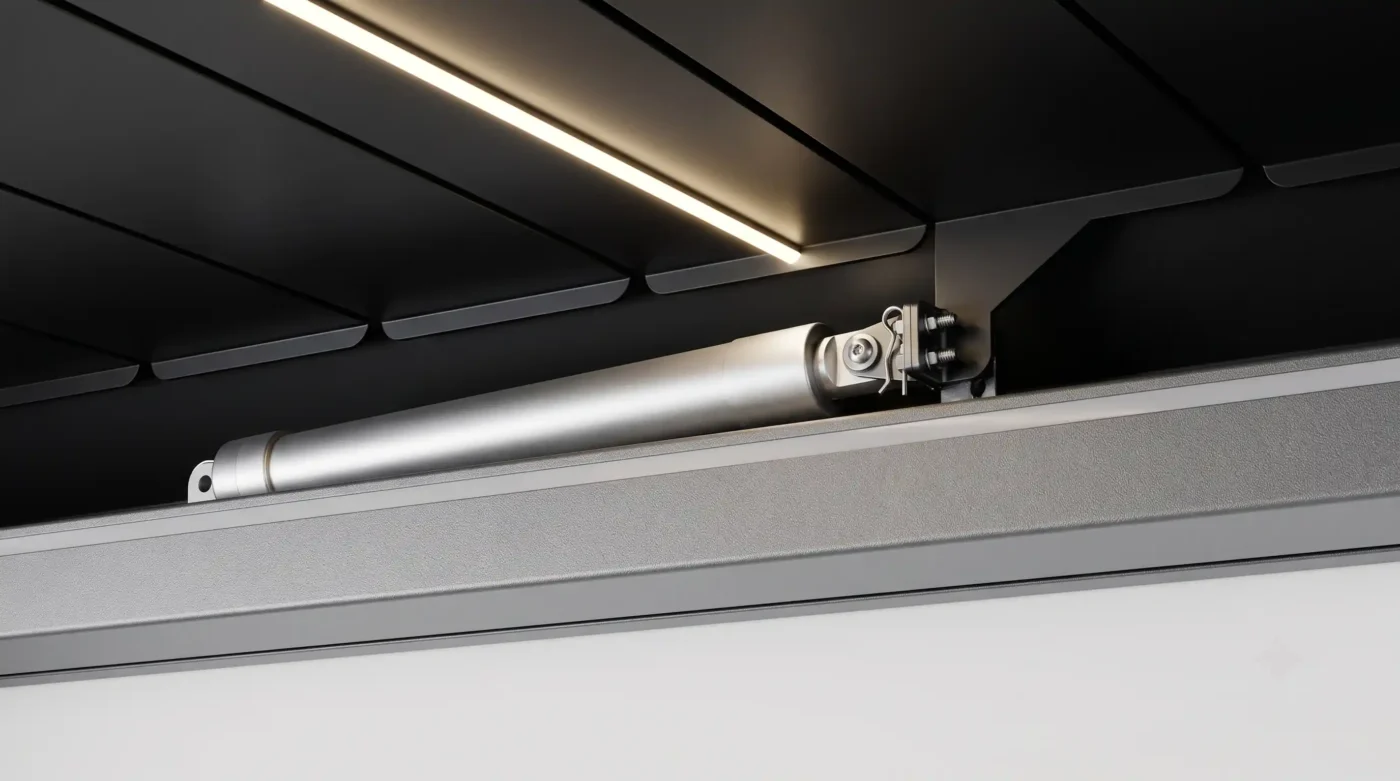
A good frost lockout is conservative. It should consider recent moisture, ambient temperature, surface temperature when available, movement history, and motor feedback. If the logic sees a high probability of ice binding, it should block movement before damage occurs.
For the user, this should not feel mysterious. The app or wall panel can show a plain text message such as “Movement paused because frost protection is active.” The remote can use a documented response pattern if the hardware does not have a screen. The important point is that the system communicates refusal as protection, not failure.
Manual Override Should Be Limited and Traceable
Manufacturers often face pressure to give users a manual override. That is understandable. A restaurant owner may want to open a roof after a snowfall. A homeowner may believe the ice has melted. A dealer may need to move the system during service.
The override policy should be designed carefully. A consumer override should not defeat frost lockout if motor current or position feedback already suggests mechanical resistance. A dealer override can exist, but it should be slower, documented, and ideally logged by the controller or app. Commercial projects may need stricter rules because staff members change and operating conditions vary.
This is one reason integrated control matters. When the same control platform manages motor outputs, sensor inputs, user interfaces, and diagnostic behavior, the OEM can define override policy coherently. When every accessory has its own receiver and remote, the system may have no reliable memory of why it moved or refused to move.
Sensor Placement Decides Whether the Logic Receives the Truth
Even a well-written winter algorithm performs poorly with bad sensor placement. A snow or precipitation sensor placed under an overhang, near warm exhaust, behind a parapet, or in a wind shadow may not see the same weather the roof sees. A temperature probe mounted inside a protected cavity may report a safer condition than the louver surface itself.
The installation manual should define sensor location, cable routing, service access, pairing steps, and test procedures. For OEMs selling through dealer networks, this should be part of the control system package, not a note added after field complaints appear. Our pergola sensor integration guide covers the wider rain, wind, sun, and snow sensor architecture that supports this kind of field reliability.
Do Not Let Lighting and Winter Protection Live in Separate Worlds
Snow and frost logic may sound like a motor-only problem, but pergola manufacturers increasingly sell the whole outdoor experience: louvers, LED strips, spotlights, heaters, fans, screens, sensors, remotes, wall panels, and app control. If winter protection lives in one box while lighting and user scenes live in another, the product feels fragmented.
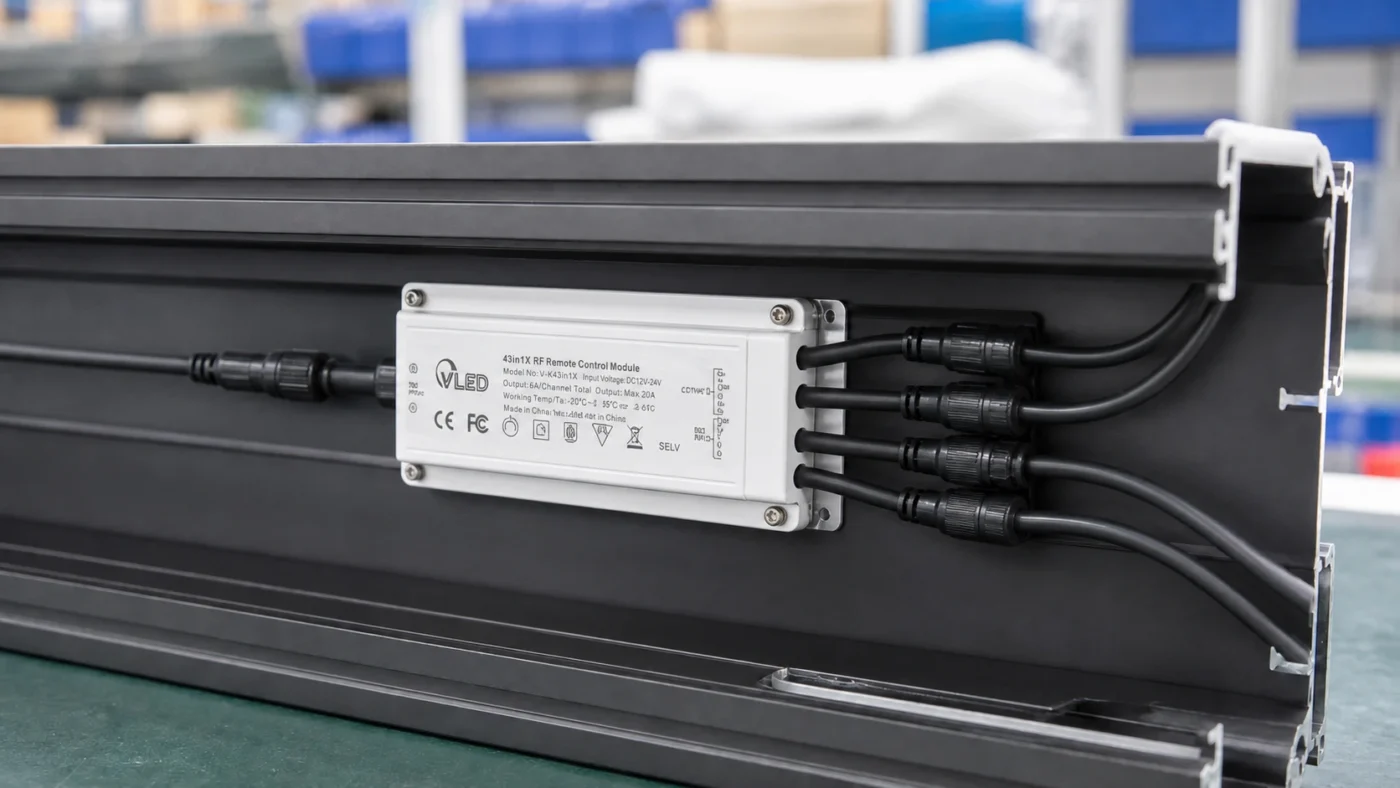
For example, a winter lockout should not necessarily disable low-voltage lighting. A restaurant pergola may need evening lighting even when roof movement is paused. A homeowner may still want a safe lighting scene while the louvers remain in the winter position. Separating these behaviors clearly can improve user satisfaction without compromising mechanical protection.
This is where VLEDSTAR’s manufacturing focus fits the OEM problem. We develop and produce pergola lighting and integrated control systems, including RF control, Tuya app control, touchscreen panels, RGB and mono LED channels, motor outputs, weather sensor inputs, waterproof connectors, and compact IP-rated control units. For manufacturers comparing architecture choices, our OEM pergola control platform guide ve integrated pergola control systems guide show how these functions can be specified as one product platform.
Testing Winter Logic Before Production
Winter protection should be validated before the control package reaches dealers. A useful test plan does not require waiting for a snowstorm. It requires a controlled way to simulate sensor inputs, temperature thresholds, motor load, and position feedback.
At the bench level, engineers should test sensor activation, low-temperature thresholds, user command rejection, motor current limits, lockout timing, recovery delay, and fault memory. On a full-size roof mockup, they should test blade movement under realistic cable lengths, actuator mounting angles, gearbox load, signal interference from aluminum profiles, and waterproof connector behavior.
The test should also include user-facing behavior. When the controller refuses movement, does the app explain why? Does the remote behavior match the manual? Can a dealer identify the difference between frost lockout, wind protection, snow mode, and motor obstruction? These details decide whether the feature reduces support calls or creates them.
What OEMs Should Put in the Specification
A snow and frost protection requirement should be written into the control system specification, not left as a supplier assumption. The specification should describe the roof’s winter parking position, sensor inputs, temperature thresholds, priority order, lockout behavior, recovery delay, override policy, and service diagnostics.
For a professional OEM project, the specification should answer these questions:
- Which winter position is approved for each pergola model and roof size?
- At what temperature does rain logic become frost-risk logic?
- Does the system use ambient temperature, surface temperature, motor feedback, or a combination?
- What happens if snow mode and wind mode are active at the same time?
- Can the user override protection states, and under what conditions?
- How does the controller detect failed movement or abnormal motor load?
- How are fault states communicated through the remote, wall panel, or app?
- How can a dealer test the winter logic during installation?
Once these answers are defined, the control unit becomes part of the product’s engineering identity. It is no longer a generic accessory. For hardware-level planning, see our pergola kontrol ünitesi page and our motorized louvered pergola controls, sensors, and lighting guide.
External Standards and Safety References Worth Reviewing
A pergola control supplier should not replace the structural engineer, certification consultant, or local code authority. Still, engineering teams should keep several reference areas in view when defining snow and frost logic.
- ASCE 7 for structural load context in U.S. projects.
- National Weather Service winter safety resources for weather terminology such as freezing rain, sleet, snow, and ice.
- UL 325 for safety context around door, gate, louver, and window operator systems.
- Local building codes, snow load maps, electrical codes, and product-specific certifications for each target market.
The purpose of these references is not to fill the blog with standards language. It is to keep the control discussion grounded. A winter algorithm should support the product’s certified design limits, not obscure them.
The OEM Position: Winter Logic Is a Product Feature, Not a Sensor Option
Manufacturers who sell motorized louvered pergolas into Europe and North America should treat snow and frost protection as part of the product architecture. It belongs in the same conversation as louver mechanics, actuator selection, control box placement, waterproof connectors, RF range, app behavior, and dealer documentation.
That position changes procurement. Instead of asking a supplier, “Do you have a snow sensor?” the OEM should ask, “Can your control platform support our winter states, our priority table, our motor feedback, our parking angles, and our dealer test procedure?”
It also changes product marketing. A pergola brand does not need to overpromise that automation solves every winter risk. A stronger message is that the system has defined weather-responsive logic, conservative lockout behavior, and a control architecture built for real outdoor conditions.
That is the difference between a feature list and an engineered product.
SSS
Should motorized pergola louvers open or close when it snows?
The correct action depends on the pergola design. Many louvered roofs should move to an open or steep winter parking angle to reduce accumulation, while some engineered systems may use a closed or partially closed position for light snow or slush. The OEM should define and test the approved winter position for each model.
Can a snow sensor protect a pergola from heavy snow load?
No sensor can replace structural design, certified load capacity, local code compliance, or user maintenance. A snow sensor can help the controller move the roof into the intended winter position, but the structure still needs a clear snow load rating and winter use instructions.
Why should frost lockout override the remote control?
Frost can bind louvers, seals, gutters, and linkages. If the user forces movement while parts are frozen, the motor or actuator can be damaged. Frost lockout protects the mechanical system by refusing non-essential movement until conditions are safer.
What is the best control architecture for OEM winter protection?
The strongest architecture uses one integrated controller for motors, lighting, weather sensors, RF remote, app control, wall panel, and diagnostics. This allows snow, frost, wind, rain, lighting, and user commands to follow one priority strategy.
Build Winter Logic Into the Control Platform
If your next motorized louvered pergola series needs snow and frost protection, start with the control logic before finalizing the accessory list. Share your louver geometry, motor type, target markets, sensor plan, and winter parking strategy with VLEDSTAR, and our engineering team can help evaluate a practical OEM control package for sample testing.
Explore our integrated pergola control system, review the pergola kontrol ünitesi, or contact VLEDSTAR through PergolaLights.net to discuss your winter-ready control specification.

Pingback: Linear Actuator vs Tubular Motor for Louvered Pergolas: Control Implications
Pingback: Motorlu Pergola Kontrollerine Yönelik Manuel Devre Dışı Bırakma ve Arıza Emniyeti Tasarımı