


Önemli Noktalar
- Most public control-system content sells comfort to homeowners. Manufacturers need repeatable installation logic for dealers.
- The control kit should standardize channels, labels, connectors, sensor priority, pairing, and service records.
- Local RF or wall control should remain the dependable base, with app control added as a planned upgrade layer.
- VLEDSTAR has worked in LED lighting since 2010 and helps pergola brands turn lighting, motors, sensors, and controls into one OEM-ready kit.
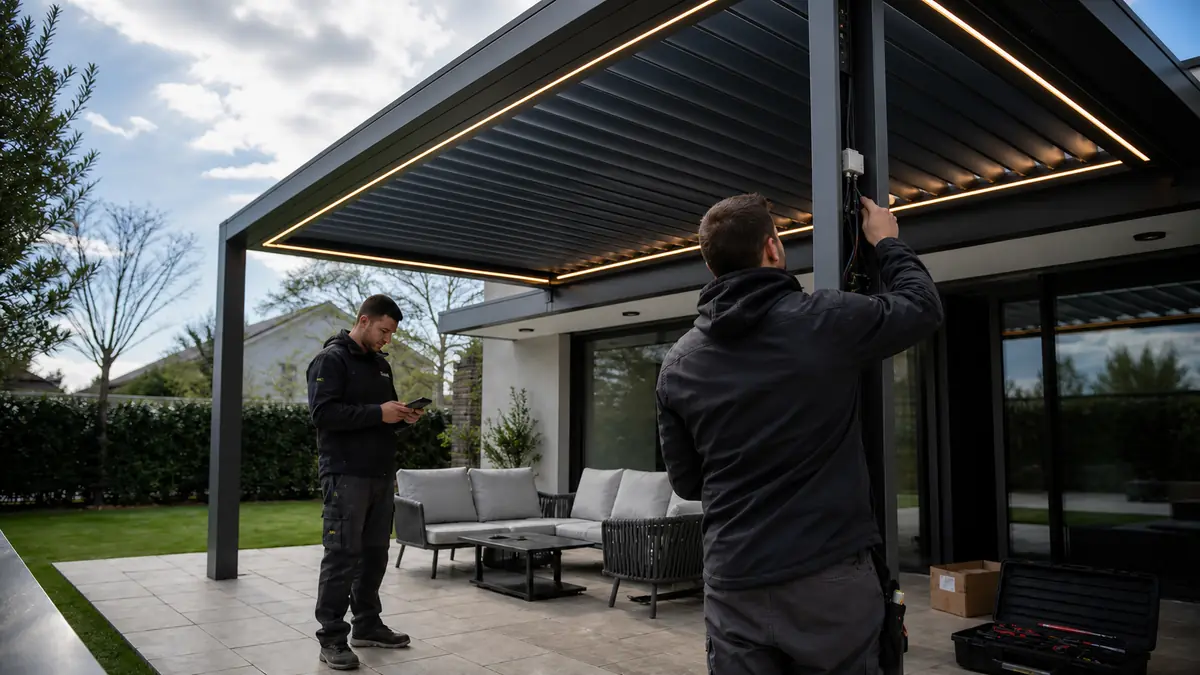
The fastest way to create dealer frustration is to treat the control box as an accessory. For the homeowner, controls are a remote, an app, or a button. For the dealer, controls are cable routes, receiver pairing, waterproof connectors, channel labels, direction checks, limit settings, sensor behavior, and warranty questions after the team has left the site.
That is why pergola manufacturers should design the control kit from the dealer’s side of the ladder. The question is not only, “Can this motorized pergola open, close, dim, and react to rain?” The sharper question is, “Can the same dealer install the same logic across ten product sizes, two motor types, three lighting packages, and several markets without calling the factory every time?”
Our answer is opinionated: a motorized pergola control kit should be a product platform, not a bag of compatible parts. It should make the pergola brand easier to sell and easier to support. If it does not help the dealer, the feature is probably unfinished.
Why Most Smart Pergola Control Discussions Miss the Dealer Problem
Most motorized pergola control discussions focus on comfort, weather response, and one-interface living. Somfy presents protection from bad weather, year-round use, and remote or smartphone control. Renson highlights wind, rain, and sun sensors. StruXure emphasizes one system for louvers, lights, fans, heat, and screens.
Those pages are useful because they show what end customers have learned to expect. The buyer wants shade, weather protection, lighting, and simple control. The commercial venue wants staff-friendly operation. The dealer wants something more practical: a system that behaves the same way on site as it did in the sample room.
That leaves an important gap for pergola manufacturers. The market already has enough “smart pergola” pages that explain what a phone app can do. Manufacturers need deeper guidance on how to package controls so dealers can install them repeatedly, train new teams faster, and support installed projects without confusion.
Why Dealer-Friendliness Should Shape the Control Kit First
Dealer-friendliness should come first because installation quality determines how the homeowner experiences the pergola after delivery. A motorized pergola may look premium in aluminum, but one confusing remote or unlabeled receiver can make the whole product feel improvised.
Most control problems do not begin with bad electronics. They begin with unclear architecture. One project uses a separate louver remote, another uses an app gateway, the next has RGBW lighting on a different receiver, and the fourth adds a rain sensor from another supplier. Every variation may work alone. Together, they create support debt.
A dealer-friendly kit reduces the number of decisions made on site. It tells the installer where the control box sits, which cable connects to which output, which remote channel controls each function, how to pair, what to test, and what to record before handover. That turns skill into a repeatable process.
For manufacturers selling into Europe and North America, this is not a small operational issue. A dealer network scales only when training scales. The more your control kit depends on installer interpretation, the harder it becomes to protect brand quality across regions.
What Should Be Inside a Dealer-Friendly Pergola Control Kit?
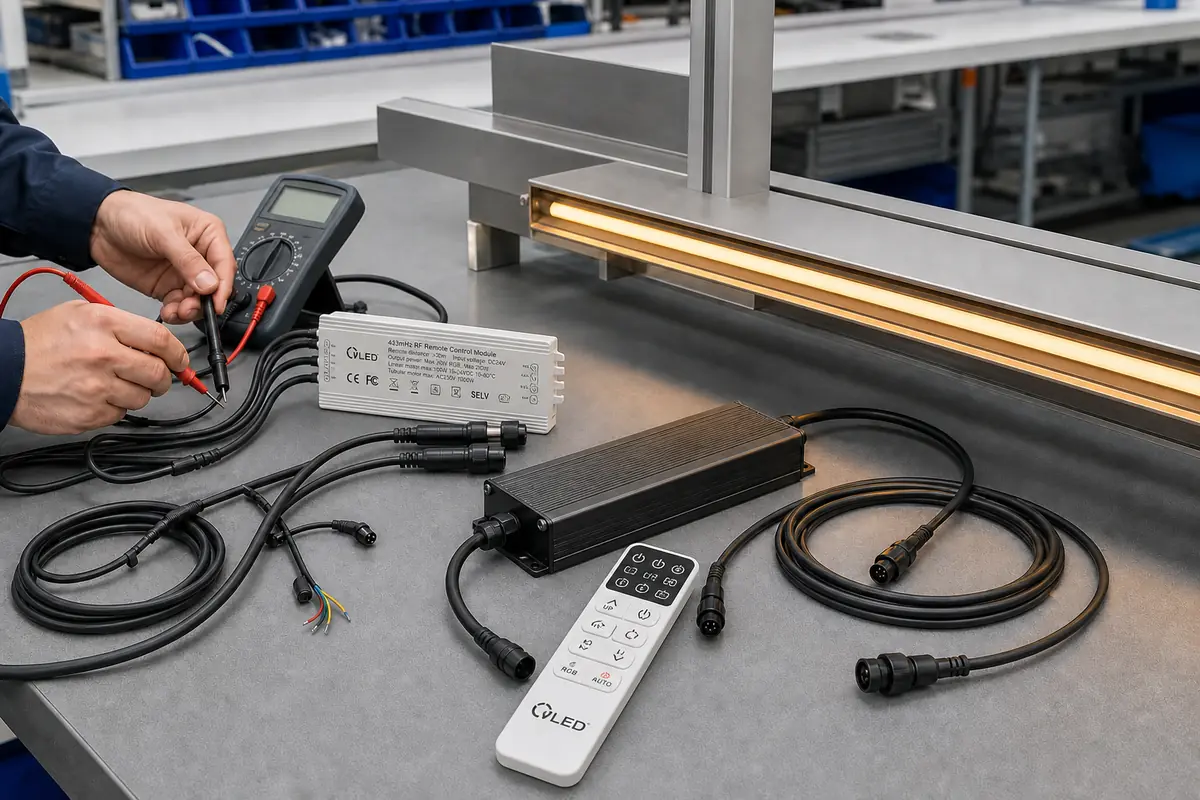
A dealer-friendly pergola control kit should include the control unit, user interface, power and driver plan, waterproof wiring, labelled connectors, sensor inputs, mounting guidance, pairing workflow, test checklist, and spare-part logic. The kit is not complete until the dealer can install and support it without guessing.
At minimum, the kit should be designed around five layers.
1. Control Core
The control core defines what the system can coordinate. For a motorized pergola, that usually means louver motors, LED lighting zones, optional screens, weather sensors, and user interfaces. VLEDSTAR’s pergola kontrol sistemi is built around this all-in-one thinking, with RF remote, Tuya app, touchscreen panel, lighting outputs, motor control, and weather-sensor logic in one platform.
2. Power and Driver Architecture
Dealers need a clear power map. The kit should specify input voltage, 24V lighting outputs, driver capacity, load limits, fuse or protection strategy, and separation between motor and lighting circuits. Outdoor electrical work must be checked against local code by qualified professionals, but the manufacturer can reduce risk by supplying a clean electrical package.
3. Wiring and Connectors
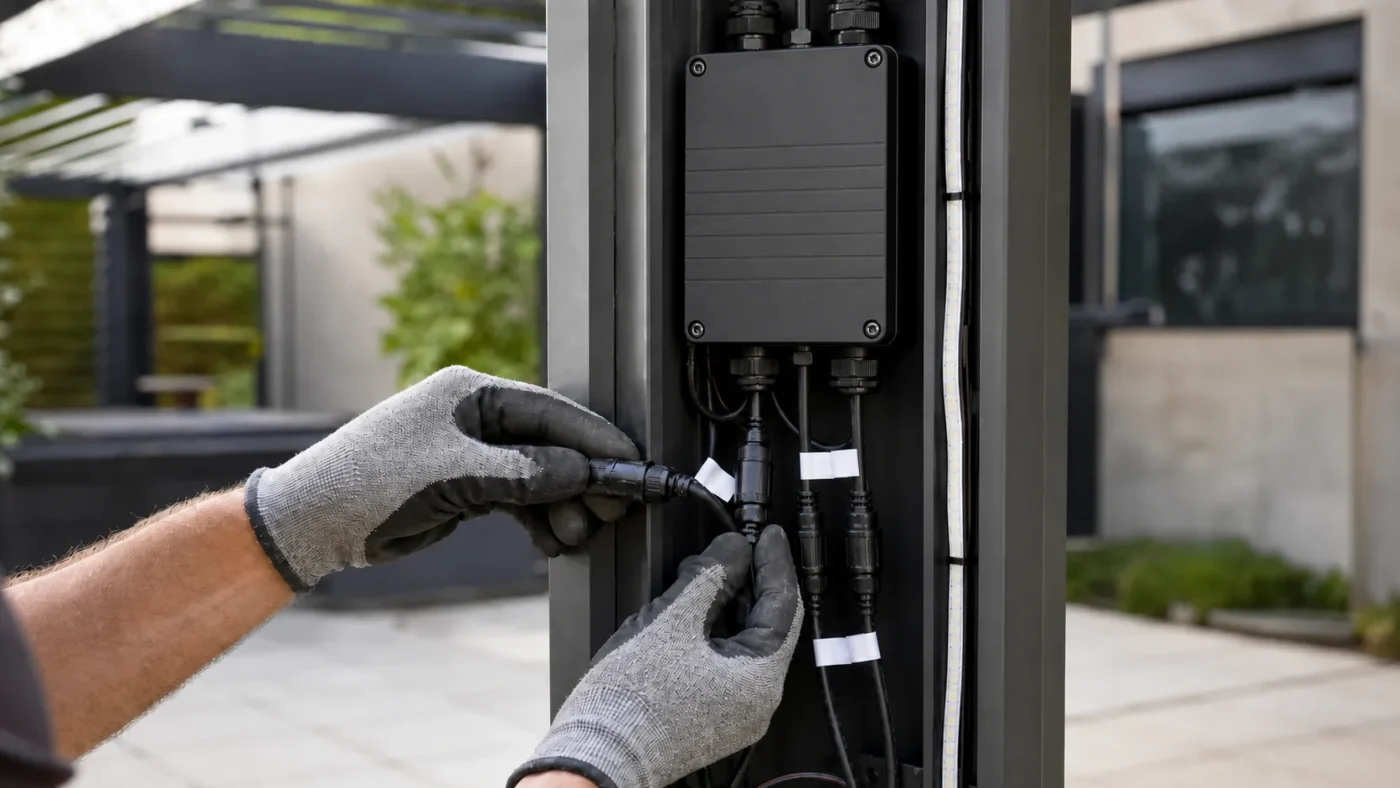
The wiring harness should be shaped for the pergola frame. Waterproof connectors, splitters, cable lengths, and labels matter as much as the control PCB. The IEC, IP sınıflarını açıklıyor as a classification for protection against dust and water, which is why outdoor control kits should avoid vague words like waterproof and specify the rating by enclosure and connector location.
4. User Interfaces
A good kit does not force one interface to do every job. RF remote control is still valuable because it works locally and is easy to teach. App control adds scenes and remote access. A wall panel helps guests and commercial staff. Voice control can be useful, but it should not be the only reliable path to operate a moving roof.
5. Documentation and Spare Parts
Documentation is part of the product. Dealers need a wiring diagram, channel map, pairing steps, reset warning, sensor test process, QR code or model label, and a replacement-part table. Without this layer, support teams will spend time identifying what was installed before they can solve the issue.
How Should the Channel Map Be Designed?
The channel map should be simple enough for installers to memorize and fixed enough for support teams to diagnose. A pergola brand should not let every dealer decide which button controls the roof, the lights, the screens, and the group mode.
Channel logic is where many “compatible” systems become unfriendly. A controller may technically support many outputs, but the dealer still has to explain the remote. If the homeowner needs a training session to remember basic functions, the interface design has failed.
We recommend treating the channel map as a brand standard. Keep the first channels consistent across the full product range. For example, channel 1 can be louver open, stop, and close. Channel 2 can be main white lighting. Channel 3 can be RGB or scene lighting. Channel 4 can be screens or secondary lighting, depending on the product tier. The exact layout can change by brand, but the rule should not.
| Kit Layer | Dealer-Friendly Design Rule | Neden Önemli? |
|---|---|---|
| Louver movement | Keep open, stop, close, and direction checks consistent across models. | Installers learn one movement logic and avoid wrong-direction callbacks. |
| White lighting | Use a fixed channel for on, off, and dimming. | Every handover starts with the most-used lighting function. |
| RGB or RGBW lighting | Separate scene control from basic white lighting. | Homeowners can enjoy color without losing functional light control. |
| Sensors | Make weather override behavior clear and testable. | Dealers can prove the protection logic before leaving the site. |
| App gateway | Use device names that match physical labels. | Support teams can talk the dealer through setup without confusion. |
For a deeper look at remote interface choices, VLEDSTAR’s guide to RF remote, app, voice, and wall switch control is a useful companion. The principle is the same: the interface should follow the work that dealers and users actually do.
Should App Control Replace RF Remote Control?
App control should extend the system, not replace local control. A motorized pergola lives outdoors, often near metal structures, variable Wi-Fi coverage, wet hands, guests, and service technicians. The dealer needs a local way to test and operate the roof before any account, cloud service, or phone pairing step is involved.
Smart-home demand is real. Somfy, Bond, Tuya, Teleco, Matter, and other ecosystems have all influenced what buyers expect. The CSA product listing for a Matter pergola controller also shows that lighting, heating, and roof-louver control are moving into broader connected-home categories.
Still, an app-first kit can create unnecessary support problems. Wi-Fi names change. Users forget accounts. Phones are replaced. Gateways lose power. Cloud services can add delay. None of these issues should prevent a dealer from checking louver movement, lighting, or sensor response on site.
A stronger architecture is layered. Use RF remote or wall control as the dependable base. Add app control for scenes, remote access, scheduling, and premium user experience. Then add voice or smart-home integration only where the region and product tier justify the setup work.
This is also why manufacturers should decide the ecosystem strategy before launching the product line. VLEDSTAR’s article on Somfy, Bond, Tuya, Teleco, and custom RF pergola controls explains how different platforms fit different product tiers.
How Should Weather Sensors Be Packaged for Dealers?
Weather sensors should be packaged as tested protection logic, not as loose accessories. Renson’s sensor page shows the mainstream expectation: wind, rain, and sun inputs should allow a pergola to respond when nobody is home. For a manufacturer, the harder job is making that behavior predictable for the dealer.
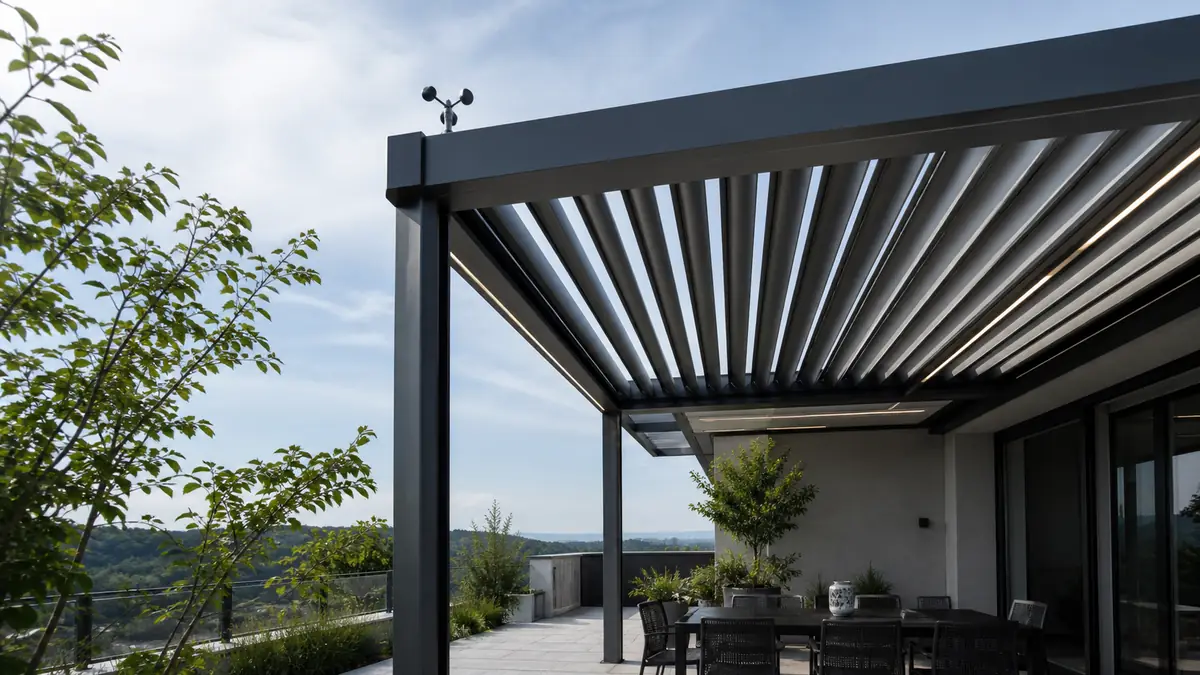
A dealer-friendly sensor package needs three things: clear priority, clear placement, and clear testing. Wind protection should not compete with a comfort scene. Rain closing should match roof drainage design. Snow or frost response should be defined for markets where winter load is a real concern.
Placement matters because a sensor can be technically correct and still perform poorly. A rain sensor hidden under an overhang reacts late. A wind sensor mounted in a dead zone may not represent the true exposure of the structure. A sun sensor placed in shade can trigger the wrong behavior. Dealers need mounting rules that fit the pergola frame, not generic sensor theory.
The test process should be simple enough to perform on every installation. Trigger the sensor. Confirm the expected movement or lockout. Record the result. Explain the override to the homeowner. The goal is not only automation. The goal is confidence.
VLEDSTAR’s rain, wind, and sun sensor integration guide gives more detail on compatibility and control-box inputs. For OEM kits, the key point is to decide sensor behavior before the dealer opens the carton.
What Makes a Control Kit Ready for European and North American Dealers?
A kit is ready for European and North American dealers when it respects outdoor installation reality, radio rules, electrical safety expectations, and regional service habits. The manufacturer does not need to turn every dealer into an electronics engineer, but the kit must be designed for qualified installation and clear verification.
RF products, app gateways, LED drivers, and motor controllers sit inside a regulatory environment. In the United States, wireless devices may fall under 47 CFR Part 15 Subpart C for intentional radiators. Outdoor luminaires, drivers, and power components may also need market-appropriate safety evaluation for wet locations, wiring, insulation, and installation instructions.
This does not mean a blog article can replace compliance engineering. It cannot. It means the control kit should be designed with compliance conversations in mind: RF band, antenna structure, enclosure rating, driver selection, cable type, connector sealing, labeling, installation manual, and traceability.
Dealers also care about region-specific usability. A North American dealer may prefer a simple remote plus a smart-home bridge. A European dealer may have stronger familiarity with outdoor automation ecosystems. Commercial installers may want grouped structures, wall panels, and staff modes. A manufacturer-grade kit should allow those variations without rebuilding the base control architecture.
Where Does VLEDSTAR Fit in the Kit Design?
VLEDSTAR fits at the point where lighting, controls, wiring, and production must become one repeatable OEM package. We do not manufacture pergola frames. We focus on the electrical and control layer that helps pergola brands turn aluminum structures into reliable outdoor living products.
According to the VLEDSTAR company profile, the company started in the LED lighting industry in 2010 and has accumulated more than 16 years of experience in LED lighting and integrated control solutions for pergola systems. That experience matters because pergola controls are not indoor smart-home gadgets. They must work around aluminum cavities, outdoor moisture, long cable runs, LED loads, motor behavior, and dealer labor.
Our product range includes pergola downlights, LED strip lights, wall and post lights, waterproof connectors, power supplies, weather sensors, RF smart controls, and plug-and-play lighting kits. On the pergola lighting and smart control solutions page, this is presented as a fully integrated lighting and control ecosystem for brands that want to reduce compatibility issues and build their own accessory system.
That is the practical value for manufacturers. A dealer-friendly kit is easier to build when the lighting supplier also understands control outputs, channel maps, driver sizing, connectors, enclosure space, and remote behavior. It keeps sourcing from becoming a puzzle.
How Should Manufacturers Specify the Kit Before Production?
Manufacturers should specify the kit before production by writing down the control architecture, not just the component list. A bill of materials tells the factory what to pack. A control specification tells the dealer how the pergola should behave.
Start with the product tiers. A basic residential pergola may need louver control, one white lighting zone, a rain sensor input, and an RF remote. A premium line may add RGBW lighting, app control, group modes, and touchscreen control. A restaurant or hotel terrace may need multiple structures, staff-friendly wall panels, weather priority, and service labels.
Then define what never changes. The remote channel order. The connector naming. The control box location. The pairing workflow. The sensor priority. The handover checklist. These standards give the dealer confidence, even when the pergola size or lighting package changes.
Finally, create a service record. Every completed installation should identify the controller model, remote model, channel map, firmware or production version if relevant, sensor setup, app gateway status, and spare-part code. This record turns future support from detective work into maintenance.
Dealer-Friendly Specification Checklist
- Fixed channel map for louver movement, white lighting, RGB lighting, screens, and group control.
- Control box mounting position matched to the pergola frame cavity and service access.
- Waterproof connector plan with labels that match the wiring diagram.
- Sensor priority rules for wind, rain, sun, snow, and manual override.
- Local RF or wall-control baseline before app or voice setup.
- Factory test process and dealer handover checklist.
- Replacement remote, receiver, sensor, driver, and cable codes.
If your team is still deciding whether to develop a control platform or source one, start with VLEDSTAR’s buyer checklist for sourcing a pergola lighting and control system. The right sourcing model should reduce dealer complexity, not only reduce component cost.
Final View: The Dealer Is the Real Test Bench
The real test of a motorized pergola control kit is not the product video. It is the dealer’s second installation, the first replacement remote, the first rainy-day sensor call, and the first homeowner who wants to add lighting after the pergola is already installed.
If the kit survives those moments, it is more than smart. It is dealer-friendly. It has a clear architecture, a stable interface, waterproof connection logic, local control, planned app expansion, and support records that make sense months later.
That is the control kit manufacturers should be building. Not the most complicated kit. Not the kit with the loudest app story. The one that lets the dealer install with confidence and lets the brand scale without support chaos.
Planning a Dealer-Friendly Control Kit?
If your next motorized pergola line needs integrated lighting, RF remote control, app control, motor compatibility, weather sensors, waterproof connectors, or an OEM-ready wiring package, VLEDSTAR can help you define the control architecture before production begins.
Explore our integrated pergola control system, review our pergola lighting and smart control solutions, or contact the VLEDSTAR team through PergolaLights.net to discuss a custom dealer-ready kit for your product line.

Pingback: Pergolalar için Sahne Kontrolü: Akşam Yemeği Modu, Fırtına Modu, Gün Batımı Modu ve Bayi Ön Ayarları
Pingback: Pergola Kontrol Cihazları ve Sensörleri için IP65, IP66 veya IP67: Asıl Önemli Olan Nedir?
Pingback: Pergola Kontrol Cihazları için IP65, IP66 ve IP67 Karşılaştırması
Pingback: Pergola Kontrol Sistemi Tedarikçilerini Nasıl Değerlendirmeli? OEM Alıcıları İçin 15 Soru
Pingback: Pergola Control System Suppliers: 15 Questions for OEMs