


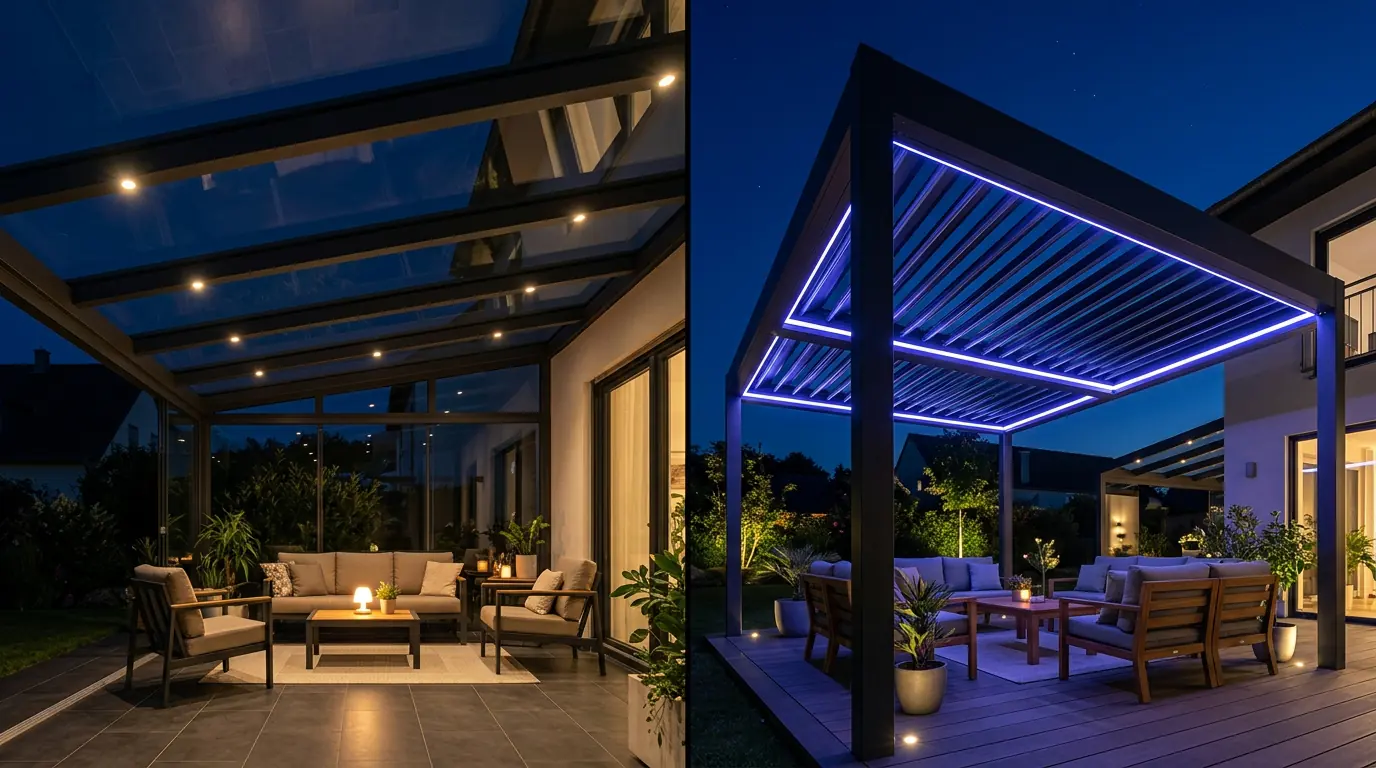
Gross margins in the European and North American premium outdoor structure market are under serious pressure. Thickening aluminum profiles, optimizing basic waterproofing, or extending structural spans is no longer enough to justify sustained price premiums. The evolution of outdoor architectural design and high-end residential extension spaces has thoroughly blurred the physical boundary between indoors and out. Whether an outdoor structure can be called a “microclimate control center” — and command the premium that label carries — depends almost entirely on the depth to which lighting and control systems are integrated at the core.
As a specialist R&D manufacturer of outdoor lighting and control systems, we observe that Glass Verandas and Louvered Pergolas possess irreconcilable physical differences in structural logic, daylighting mechanism, and climate-response strategy. These foundational differences directly determine divergent paths in lighting topology design, electrical wiring, thermal management architecture, and the selection of smart control protocols. For pergola and outdoor structure manufacturers, deeply understanding these differences — and pre-integrating lighting and electrical control as core modules from the earliest R&D stage — is the only way to break free from commodity-level price competition and establish a defensible technology moat.
Opposing Optical Physics & the Reconstruction of Photometry
Before any rational lighting and control system can be designed, the first requirement is to deconstruct how each architectural form physically manages natural light. Lighting design is not a standalone add-on component — it exists to fill, modulate, and enhance the “visual gaps” produced by the structure’s own light management behavior.
Glass Veranda: Glare Control and Reflection Suppression in an Always-Transparent Environment
The physical essence of a Glass Veranda lies in its transparent or semi-transparent fixed roof structure — laminated safety glass, ultra-clear glass, or polycarbonate panels — which delivers maximum natural light penetration throughout the day, maintains a seamless connection with the exterior natural environment, and avoids reducing daylight to adjacent interior rooms. Yet this structure, with its extreme pursuit of transparency, exposes specific optical flaws at night and under intense solar conditions.
High light transmittance inevitably brings high solar energy absorption. Glass Verandas rely heavily on top-mounted or under-mounted motorized roof blinds to combat intense thermal radiation, preventing the severe “greenhouse effect” and blinding glare. Once night falls and the external environment darkens, artificial lighting inside the space produces intense total internal reflection on the underside of the glazed roof. Without precise control of luminaire projection angles and source color temperature, the entire glass roof becomes a reflective black mirror — dramatically destroying the sense of spatial extension and transparency, and creating an oppressive enclosure.
The artificial lighting design principle for Glass Verandas is defined as “ambient light supplementation with absolute reflection suppression.” The control system must achieve deep logical integration with the shading system at the firmware level.
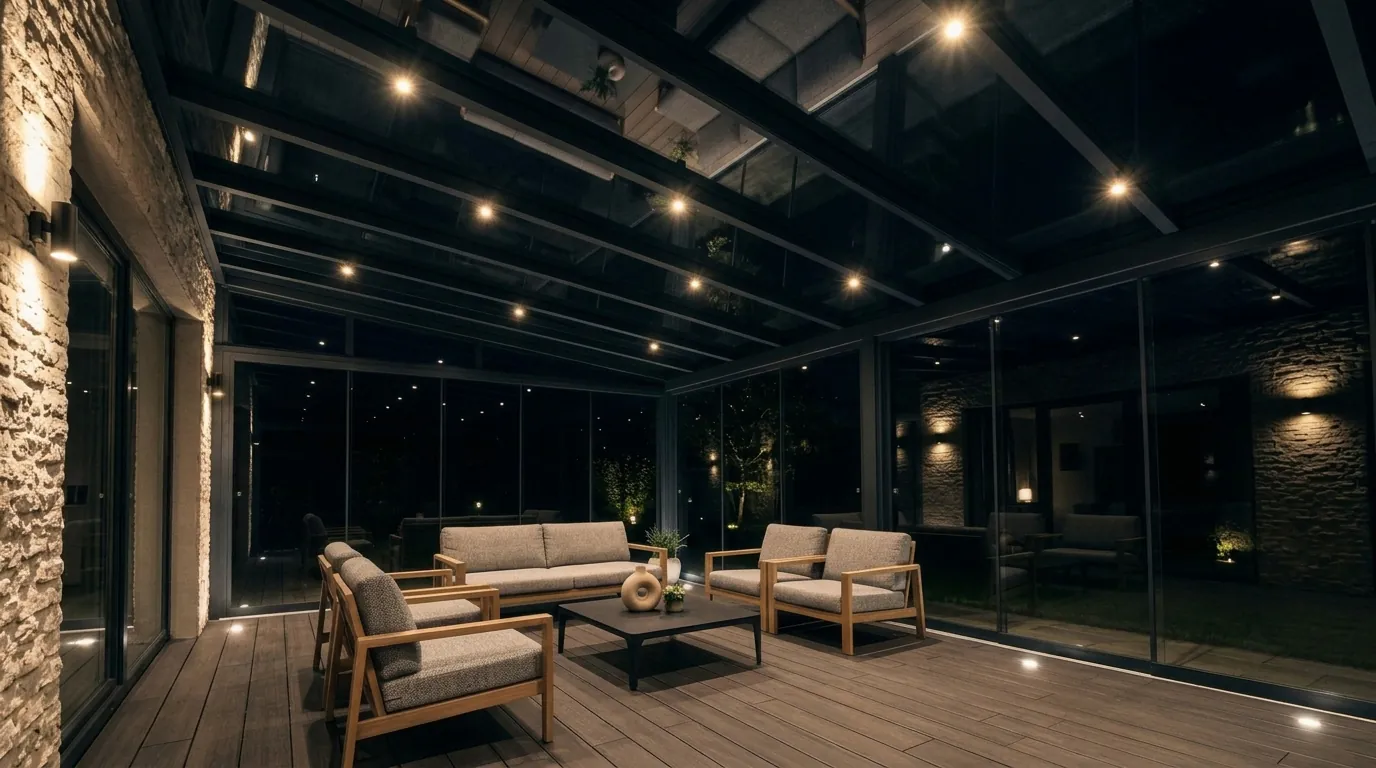
For example: when the roof blinds are retracted, artificial lighting should operate in a low-brightness wall-wash mode to avoid ceiling reflection; when the blinds are fully deployed, the system automatically switches to high-CRI direct illumination mode, converting the diffuse-reflective properties of the blind fabric into a soft, planar light source.
Louvered Pergola: Dynamic Light-and-Shadow Valve & Primary Illumination Replacement
The Louvered Pergola uses aluminum alloy bioclimatic louvers that rotate dynamically from 0° to 135°, providing a highly mechanized, real-time climate-responsive means of controlling sunlight and ventilation. This structure exhibits extreme dynamic characteristics in its shaping of light and shadow.
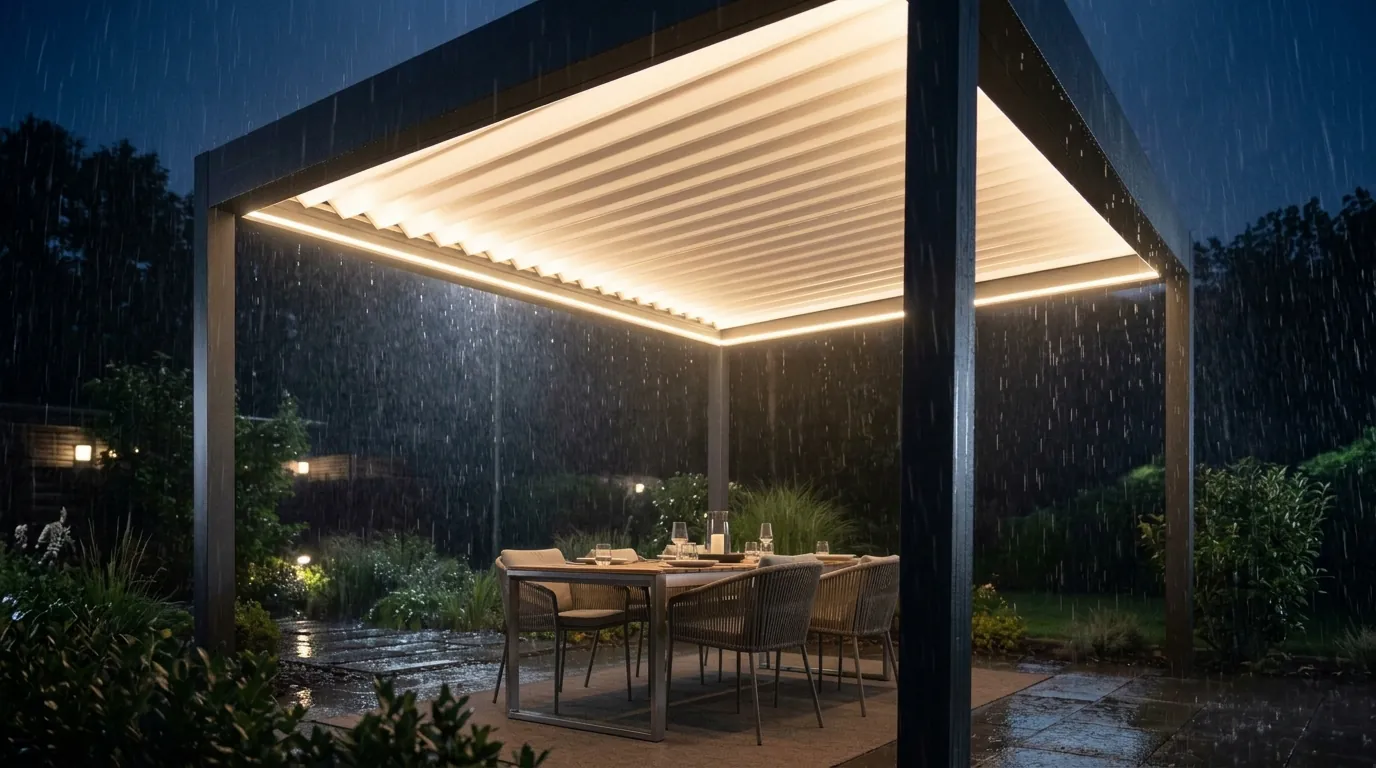
When integrated rain and snow sensors detect precipitation and the blades close completely to achieve 100% waterproofing, the heavy aluminum blades cut off the overhead light source entirely. The entire pergola interior plunges from bright natural light into deep shade within seconds. Even during a daytime rain shower, users must rely entirely on the artificial lighting system to maintain basic spatial usability. When blades open to 45° or 90°, direct sunlight is sliced by the metal louvers into high-contrast stripe shadows — a geometric aesthetic, but unsuitable for reading or dining.
The lighting design principle for Louvered Pergolas is “primary illumination replacement and scene reconstruction.” Because natural light levels fluctuate dramatically inside the structure, the LED lighting system must provide not just ambient accent light, but powerful task lighting capability — and the control system must respond with millisecond-level synchronization to the mechanical blade movement.
| Optical & Lighting Design Feature | Glass Veranda | Louvered Pergola |
|---|---|---|
| Overhead Transmission Medium | Fixed transparent laminated glass or polycarbonate panel | Dynamically rotating 0°–135° opaque aluminum louver blades |
| Natural Light Distribution | High transmittance all day; uniform light distribution | Extreme light-dark contrast; stripe shadow cutting to total darkness |
| Primary Luminaire Type | Deep anti-glare, ultra-small-aperture puck lights | Blade-integrated LED linear strips and perimeter ambient accent strips |
| Light Projection & Glare Strategy | Vertical downward projection; avoid glass surface reflection | Multi-directional diffuse reflection; use closed white-coated blades as ceiling reflector |
| Mechanical System Integration | Linked with top and side windproof roll screens / shading systems | Synchronized brightness compensation with overhead blade opening angle |
Physical Topology, Electrical Wiring Architecture & Voltage Drop Management
The opposing optical physics directly impose fundamentally different challenges on electrical wiring engineering. At the manufacturing and assembly stage, both structure types face their own technical barriers relating to luminaire distribution, concealed routing design, and dynamic waterproof junctions.
Glass Veranda Minimalist Electrical Architecture: The Challenge of Ultra-Slim Profiles
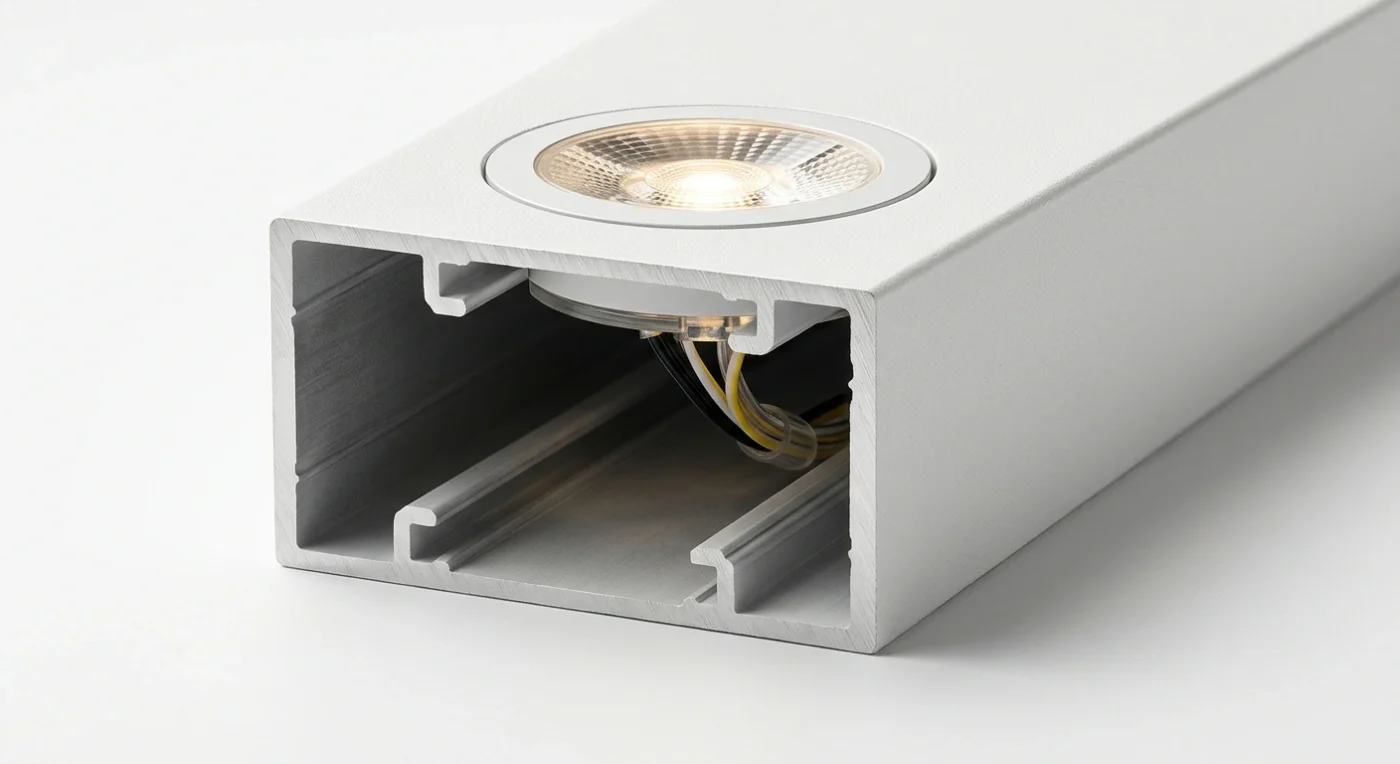
Modern Glass Verandas trend toward extreme minimalism — designers strive to reduce the visual presence of the aluminum skeleton to the absolute minimum. Leading products on the market have compressed main rafter widths to around 56mm, paired with fully flush hidden gutter designs. This pursuit of visual purity leaves almost no internal cavity for electrical wiring.
The mainstream technical solution is embedding ultra-compact warm-white LED puck lights into the narrow aluminum rafters, typically deployed in series or parallel groups of up to twelve luminaires. Due to the glass material’s strong reflective properties, these point-source puck lights must incorporate professional deep glare control optical lenses.
The scarcity of routing space is the greatest engineering challenge. The glazed roof panels are immovable rigid structures — meaning that once installed at the client’s site, the cost of changing routing logic or replacing damaged cables is catastrophic. All conductors must be threaded through the extremely narrow, fixed internal channels of the aluminum profiles during the factory pre-assembly phase. Where conductors penetrate cross-section connections, the waterproof integrity of the glass sealing strips must not be compromised in any way, or irreversible leakage results.
To balance the point-source overhead lighting, professional design typically places continuous wall-wash LED strips inside the columns or bottom rail — or integrates them into the perimeter framing of sliding glass doors — creating layered illumination that visually further softens the presence of the glass roof.
Louvered Pergola Dynamic Electromechanical Engineering: Overcoming Mechanical Fatigue & Long-Run Voltage Drop
The electromechanical complexity of Louvered Pergolas grows exponentially. The core difficulty lies in safely and durably powering high-speed moving parts. When louver blades with integrated custom LED strips are driven by mechanical motors to frequently twist between 0° and 135°, the conductors connecting the blade interior strips to the main beam power supply are subjected to extremely harsh mechanical fatigue tension and torque stress.
Dynamic wiring technology is the key to resolving this pain point. Structural and electrical engineers must collaborate to use anti-torsion cables with PTFE or high-flexibility silicone insulation, paired with dedicated IP65/IP67-rated waterproof swivel connectors. Cable bundles must be precisely concealed within the physical pivot axis at the blade end, or threaded through dedicated flexible waterproof conduit — preventing years of mechanical friction from damaging insulation and causing short circuits or fire risks.
For perimeter ambient lighting, Louvered Pergolas typically install a continuous ring of high-brightness RGBW perimeter trim lights along the inner edge of the wide main gutter. When rain triggers the top blades to close completely, these RGBW strips project light upward. The fully spread aluminum blades — especially those finished with white powder coating — instantly become a vast overhead reflector. Through precise diffuse-reflective optical calculation, the entire pergola interior is wrapped in extremely soft, uniform, variable-color indirect lighting that completely eliminates the oppressive feeling of an enclosed ceiling.
This large-scale perimeter illumination introduces another thorny electrical problem: voltage drop in low-voltage DC supply. A standard Louvered Pergola measuring 4.5m × 3.5m has a perimeter exceeding 16 meters. In a safe 24V DC low-voltage system, one continuous high-density RGB+CCT LED strip at full brightness can draw up to 21W/m. Physics dictates that when 24V DC travels long distances through a thin flexible printed circuit board, resistance causes significant voltage attenuation. Continuous runs beyond 5 meters produce visible brightness drop and severe RGB color shift at the far end — clean white light becomes pink or yellow.
Professional electrical topology design must employ multi-point power injection. Electrical engineers need to run a set of large-gauge trunk supply cables every 3 to 5 meters along the main gutter, injected in parallel into each LED strip node. This requires that the aluminum main beams incorporate dedicated, physically isolated independent power chase channels — completely separated from the rainwater drainage path — at the extrusion stage.
LED Driver Power & Thermal Management in Extreme Climates
If physical wiring forms the vascular system, the LED driver is the heart that keeps the entire microclimate control system running. Outdoor pergolas are permanently exposed to extreme ambient temperatures, high humidity, and intense UV radiation. Specifying commercial-grade or industrial-grade power systems directly determines the product’s service life and fundamentally influences the manufacturer’s after-sale warranty costs.
Avoiding Thermal Runaway and Cold-Start Failures
In summer, the internal cavity of fully enclosed aluminum top beams under direct sun can easily spike to 70°C or higher. If manufacturers adopt ordinary indoor-rated power supplies to cut costs, the heat rapidly depletes the electrolyte in internal electrolytic capacitors, triggering fatal thermal runaway. Actual service life collapses from the 50,000 hours stated in product brochures to just a few months.
As an industry benchmark, leading B2B manufacturers widely specify military-reliability-grade IP65/IP67 outdoor drivers such as the MEAN WELL HLG or XLG series.
Fanless convection cooling and potting: These top-tier drivers use heavy full-metal enclosures with internal cavity potting of high-thermal-conductivity modified silicone or epoxy compound. This construction achieves complete dustproofing and waterproofing, and — more importantly — evenly conducts PCB heat to the metal shell, enabling stable full-load operation through natural air convection alone across a shell temperature range of -40°C to +90°C, eliminating the cooling fan as the most likely mechanical failure point.
Cold-start compensation in extreme cold: In harsh Nordic or North American winters (-30°C to -40°C), the physical characteristics of LED chips change — forward voltage rises significantly. Ordinary constant-voltage drivers often cannot instantly deliver sufficient voltage, causing lights to fail to illuminate or flicker continuously. Advanced constant-power drivers (such as the MEAN WELL XLG series) integrate intelligent detection chips that automatically sense the LED load voltage drift caused by extreme cold (e.g., automatically compensating from a standard 52V DC up to 54V or higher), increasing output voltage while precisely limiting current to maintain constant power output — ensuring that even in a blizzard, the outdoor lighting system ignites instantly.
Precise Load Calculation and Redundancy Safety Matrix
For large outdoor structures, rough power estimation is a serious industry mistake. For a standard-sized Louvered Pergola deploying RGB+CCT strip at 100% white light across a 15-meter perimeter, plus blade interior supplementary lighting, peak theoretical maximum draw easily exceeds 350W.
International professional electrical design standards strictly require that regulated power supply actual long-term continuous load must never exceed 80% of rated nominal power. Facing a 350W load, the system must provide at least 450W of power capacity headroom. Since internal column and beam space is extremely limited, fitting a single oversized unit (e.g., 480W or 600W monolithic module) is often impractical. Manufacturers therefore favor a distributed power architecture — multiple compact, high-power-density 100W or 150W drivers (e.g., XLG-150) distributed across the four corner columns or beam ends. This distributed architecture dramatically reduces local thermal flux, avoids hot-spot accumulation, and provides a degree of system redundancy: if one driver fails, the remainder of the pergola maintains basic illumination.
Additionally, all interfaces from the mains connection point to the control enclosure must be sealed with IP-rated adhesive compound and meet strict safety certifications such as UL 8750 or IEC 61347 — the fundamental basis for manufacturers to confidently offer consumers “15-year structural warranty, 5-year electrical component warranty.”
| Driver Technical Requirement | Standard Consumer Indoor / Semi-Outdoor PSU | MEAN WELL HLG / XLG Industrial Outdoor Driver |
|---|---|---|
| Koruma Derecesi | IP44–IP54; splash-resistant; internal condensation accumulation risk | IP65/IP67; full-metal enclosure; internal cavity fully potted with thermal compound |
| Thermal Management Limit | Above 50°C easily triggers thermal protection shutdown or capacitor failure | -40°C to +90°C fanless natural convection cooling, stable operation |
| Cold-Start Capability | Below -10°C insufficient voltage; strip flickers or fails to light | Intelligent constant-power compensation; auto-adapts to cold-state voltage drift |
| Expected Lifespan & Certification | ~10,000 hours; lacks protection against heavy surge events | >50,000 hours; built-in 4kV–10kV lightning surge protection |
The Control Protocol Ecosystem War: From Hardware Silos to Full-Domain Mesh Coordination
The smart outdoor space experience has long surpassed the crude era of using multiple isolated RF remote controls to separately operate blade motors, LED strips, and infrared heaters. Today, B2B pergola manufacturers are racing to transition toward highly integrated wireless control ecosystems. In this battle that will define future industry structure, Teleco Automation, Somfy, ve Casambi represent three fundamentally different underlying technology paths and application philosophies.
Teleco Automation: Dominant Hardware Integration Specialist for Outdoor Structures
Teleco Automation’s core commercial logic is to provide outdoor pergola and blind manufacturers with plug-and-play All-in-One dedicated hardware-level control solutions. Its control center is deeply bound to the mechanical operating characteristics of both Louvered Pergolas and Fabric Verandas, with extensive low-level hardware optimization baked in.
Teleco’s technical moat lies in its multi-dimensional hardware unification. Its core control box can directly receive 24V DC motor feedback encoder precision signals for millimeter-accurate blade angle positioning, while seamlessly integrating — within the same hardware module — low-voltage LED dimming (supporting single color and RGB color mixing), high-power resistance and infrared heater arrays (supporting total loads up to 6,800W), and even rain-proof Bluetooth audio announcement system management.
On the interaction terminal side, Teleco’s most impressive feature is its industrial-grade handheld RF remote (e.g., TVNOON868 series) with 42 to 63 independent command channels. End users can seamlessly command blade rotation, zip screen raise/lower, matrix lighting color changes, and heater level adjustment using this single “physical Swiss Army knife” — without switching between smartphone apps. The flip side is that despite Teleco’s Daisy App supporting smartphone control and voice assistants (Amazon Alexa / Google Assistant), its communication layer still relies heavily on traditional 868MHz RF technology. When deeply fusing with other advanced building management systems (BMS), or connecting into broader third-party IoT ecosystems, this hardware-closed-loop architecture shows its limitations.
Somfy: The Industry Standard for Motor Drive and Active Climate Defense
As the undisputed global leader in motor and shading system automation, Somfy holds an unassailable dominant position in motorized blind drive for Glass Verandas and blade motor control for Louvered Pergolas. In commercial real estate and premium residential projects, specifying Somfy motors has become almost the default standard.
Somfy’s wireless technology foundation consists of its mature RTS (one-way RF) and IO-homecontrol (a highly secure two-way encrypted protocol) standards. Via the IO protocol, the smart control hub can read the exact physical position of every shading motor in real time, with precise percentage status feedback displayed in the TaHoma smart gateway interface.
Somfy’s most powerful weapon in outdoor environments is its robust “climate awareness and active defense mechanism network.” Wind speed anemometers, rain/snow sensors, and sun sensors can establish hardware-level safety interlock directly with the Somfy control hub. For example: when sensors detect wind speed exceeding a threshold, the system immediately forces the flexible windproof zip screens around the Glass Veranda to retract, preventing fabric tearing; when sudden heavy rain is detected, the Louvered Pergola’s top blades instantly and automatically lock to the fully waterproofed closed position. This purely local hardware-level safety response — independent of cloud networks — is the last line of defense protecting expensive outdoor structures from extreme weather destruction.
Casambi: The Bluetooth Mesh Revolution Redefining the Light Environment
If Somfy built the tough musculature and responsive skeletal structure of outdoor architecture, then next-generation wireless digital protocols represented by Casambi form the neural network that endows those structures with advanced intelligence and emotional interactivity. Casambi abandons the traditional centralized control box and builds a completely decentralized, self-organizing mesh network on Bluetooth Low Energy 5.0 — shattering complex control wiring and communication dead zones.
In outdoor environments, Casambi’s BLE 5.0 protocol extends wireless line-of-sight transmission range from a traditional 50 meters to 200 meters, effortlessly covering extra-large connected pergola complexes or expansive commercial outdoor plazas. Even more revolutionary is its “unrestricted interoperability and open ecosystem.” Casambi has not confined itself to being a hardware vendor — it has built a digital platform called LightingOS. Thousands of third-party professional sensors and driver modules certified to Zhaga-D4i or fitted with NEMA ANSI 136.41-standard sockets (fully compatible with DALI, 0-10V, PWM, and multiple other dimming protocols) can plug directly into the Casambi network.
For Glass Verandas and Louvered Pergolas, Casambi enables extremely complex scene logic to be remotely pre-programmed through the Casambi Pro mobile software — implementing advanced “Daylight Harvesting and Environmental Monitoring” algorithms. When a Glass Veranda’s shading blind auto-closes due to intense external solar thermal radiation, multiple spectral sensors in the Casambi network instantly detect the drop in indoor working-plane illuminance. The system then automatically and extremely smoothly brightens the ambient LED matrix, and automatically adjusts color temperature according to circadian rhythm at dusk. This entire complex computation runs autonomously among local mesh nodes — no external central processing server required.
A Historic Convergence: The Somfy–Casambi Integrated Ecosystem
In 2026, a tectonic-level technology convergence occurred in the smart shading and advanced lighting sector. Casambi and Somfy officially announced a deep strategic partnership, achieving interoperability between wireless lighting systems and motorized shading control systems at the underlying API protocol level.
Previously, architects and installation engineers were often forced to work in two parallel universes: deploying one complex system to control motors and laying down another to control LED lighting and color. This partnership broke that deadlock by deeply coupling Casambi’s open wireless 0-10V/DALI interface with Somfy’s proprietary Somfy Digital Network (SDN) motor drive technology.
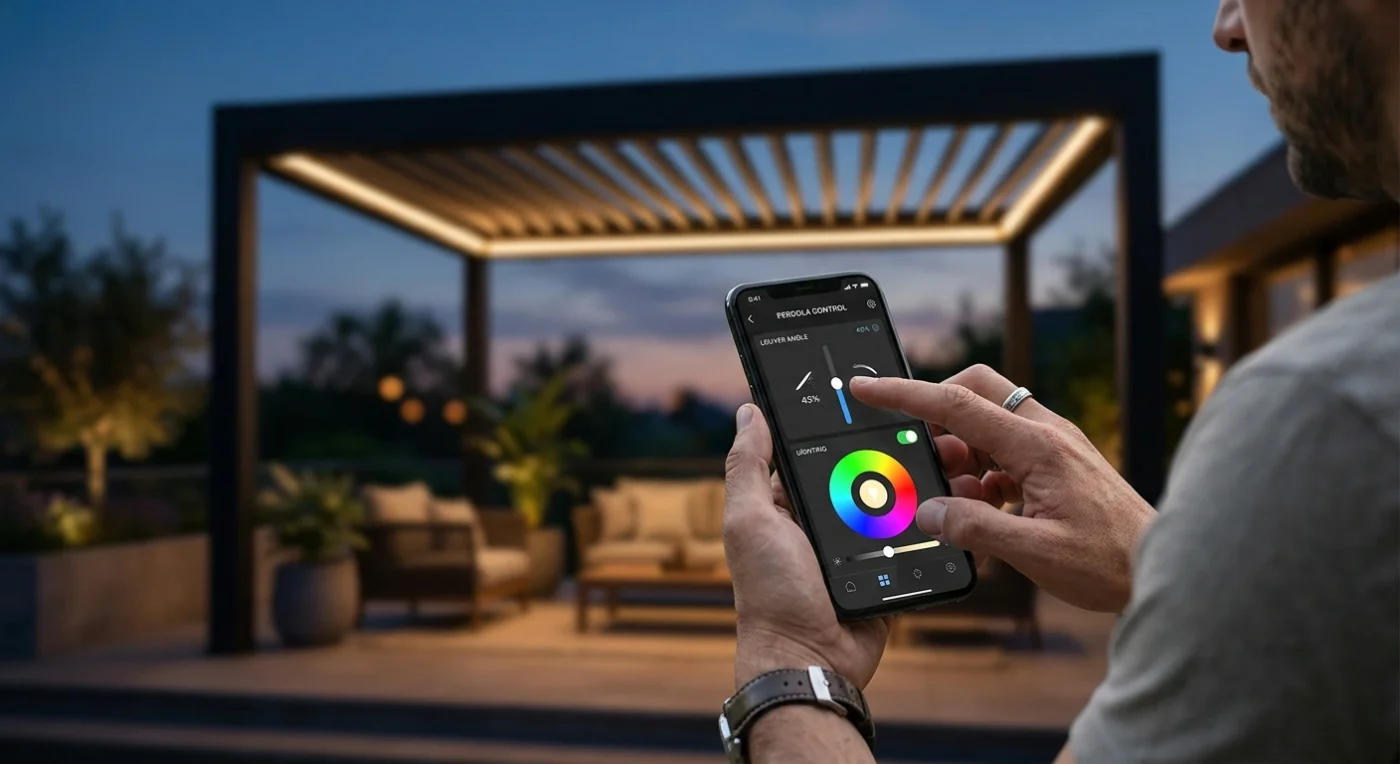
System integrators can finally program seamless macro scenes within a single unified digital platform (LightingOS or TaHoma) — combining “natural light” (controlled by adjusting louver blade angle or deploying shading fabric) with “artificial light” (fine LED dimming and full-gamut color rendering). This foundational fusion not only eliminates redundant control bus installation costs and dramatically shortens on-site commissioning time, but fundamentally solves the “remote control proliferation and app fatigue” issue that has long plagued premium consumers — creating truly intelligent microclimate spaces that resonate in harmony with the architectural environment.
System Integration Pathways & Commercial Strategy Transformation for B2B Manufacturers
In an increasingly fierce European and North American outdoor leisure structure market, lighting and control systems have completed a critical transformation — from optional premium accessories to core profit engines. Analysis of leading manufacturers’ evolution paths reveals that moving toward OEM pre-integration has become the core strategy determining average selling price, channel leverage, and long-term brand moat.
Abandon Aftermarket Retrofitting — Embrace OEM Factory Pre-Integration
The traditional industry practice was to ship large aluminum pergola structures as bare mechanical skeletons to the destination, leaving all complex lighting layout and low-voltage wiring entirely to the end customer, who would hire an electrician on site for DIY-style retrofitting. This crude model not only dramatically increases scheduling uncertainty and prohibitively expensive labor costs — more seriously, site electricians typically lack understanding of the specific pergola’s drainage design. Arbitrary profile drilling for wire routing destroys powder coating, punches through the waterproof sealing of gutters and drainage beams, and directly causes endless subsequent leak claims and catastrophic brand reputation damage.
Today, the world’s leading systems-level pergola manufacturers (such as StruXure’s Pergola X series, Pergomatic, and others) have decisively shifted to high-degree pre-integration strategies:
Integrated Wire Chases Designed at the Source: At the aluminum profile’s initial mold design and extrusion stage, structural engineers and lighting control experts collaboratively design dedicated independent physical wire chases (e.g., StruXure’s patented TraX integrated system). This core design achieves 100% physical isolation between the water path (rainwater guidance and discharge gutters) and the electrical path (LED supply harnesses, motor control cables, heater wiring, concealed speaker wiring). This guarantees that even under extreme downpours carrying hundreds of millimeters of rainfall per hour, the entire AC/DC electrical system remains absolutely dry and safe.
Modular Quick-Connect and Rapid Assembly Systems: Before leaving the factory’s temperature-controlled workshop, workers pre-complete all complex wiring and harness bundling inside the main beams, with IP67 or IP68-rated aviation connectors or fool-proof quick-connect terminals pre-installed at all component physical connection points. When the heavy structural components arrive at the client’s back garden installation site, the installation team requires no complex wire stripping or crimping — just simple physical assembly and plug-in, like assembling LEGO blocks — completing in 3 to 5 hours what would otherwise take days of complex audio, lighting, mechanical, and electrical system integration and commissioning.
Building a Standardized Cross-Protocol Control Backbone
For B2B manufacturers with expansion ambitions, redesigning the underlying electrical topology and PCB control motherboard for every customer-specific configuration (some needing only white light, some requiring RGBW, some adding infrared heating) would be a supply chain management abyss.
The wise strategy is to decisively embrace an underlying architecture platform that supports cross-protocol interoperability (e.g., the Casambi LightingOS ecosystem, which connects seamlessly to IoT hubs). Manufacturers should internally establish a highly standardized 24V or 48V high-power constant-voltage topology as the foundational power backbone. On top of this solid backbone, modular end-node intelligence is added or removed flexibly based on specific order budgets — for example, snap-in RGBW dimming modules or plug-and-play multi-spectral environmental sensor modules. This “standardized backbone + modular nodes” strategy means manufacturers rarely need to change the core control hardware logic, dramatically amortizing R&D costs while enabling flexible SKU expansion.
Simultaneously, ensuring that the entire control and electrical chain — from source Mean Well heavy-duty drivers, through end-of-gutter LED arrays, to BLE-based Casambi communication nodes — strictly passes the most demanding safety certifications for the target sales territory (e.g., UL/cUL certification mechanisms for North America, CE, RoHS, and Zhaga certification specifications for Europe). This is not only the compliance baseline for mitigating legal risk, but also the core qualification barrier enabling companies to transcend the fiercely contested consumer backyard market and successfully bid on high-premium commercial real estate projects — luxury hotels, Michelin-starred restaurant all-weather outdoor dining areas, and large golf resorts.
Conclusion & Action Recommendations
Beneath the surface, Glass Verandas and Louvered Pergolas have taken two entirely different product evolution paths in visual aesthetics, spatial transparency experience, and climate physical protection mechanism. Yet when both aspire to deliver the ultimate comfortable outdoor living experience, they converge at the same technological singularity: building a precise, IoT-intelligent-control-based, dynamic management system for light, shadow, and thermodynamics.
Glass Verandas must deploy extremely concealed minimalist point-array illumination combined with deep data interlock with high-precision shading fabric — neutralizing the catastrophic greenhouse effect while maintaining spatial transparency and avoiding nocturnal optical pollution. Louvered Pergolas must overcome their challenges through high mechanical fatigue-resistant dynamic flexible wiring and comprehensive full-gamut RGBW perimeter illumination matrices, reconstructing a highly self-sufficient artificial lighting ecology beneath their massive and heavy metal canopy.
Behind these two contrasting surface-level requirements lies the constant-power driver matrix (e.g., Mean Well all-weather industrial-grade systems) capable of standing firm in brutal outdoor conditions from extreme cold to scorching heat, and the mesh control brain (e.g., the deeply interconnected Somfy motor network and Casambi Bluetooth Mesh network ecosystem) capable of thoroughly breaking traditional hardware boundaries to seamlessly fuse nature’s ever-changing daylight with artificial LED arrays.
Your Next Strategic Action
To all pergola and premium outdoor leisure structure manufacturers: we stand at a crossroads where industry reshuffling and product definition are being thoroughly overturned. Continuing to treat lighting and control systems as irrelevant, optional third-party add-ons — or compromising on electrical standards by accepting consumer-grade low-cost components — will rapidly marginalize your core products in tomorrow’s premium renovation market.
As electrical and control system integration specialists deeply rooted in this field, we strongly urge all structural manufacturers to immediately initiate deep “Early-stage R&D Collaboration” with professional outdoor lighting and smart control system development platforms such as ours. From the very first conceptual draft of new aluminum alloy extrusion tooling, embed concealed electrical wire chase routing, large-power-supply thermal dissipation space, wireless RF signal penetration zones, and modular quick-connect interface standards into the highest-priority design considerations.
Immediately re-examine and fully upgrade your supply chain electrical topology architecture. Partner with us to build truly life-sensing intelligent microclimate ecosystems — not just the fastest path to elevating your product line’s premium capability, but the only winning strategy for defining the high-end outdoor lifestyle of the next decade.

Talebinizi Bize Gönderin