


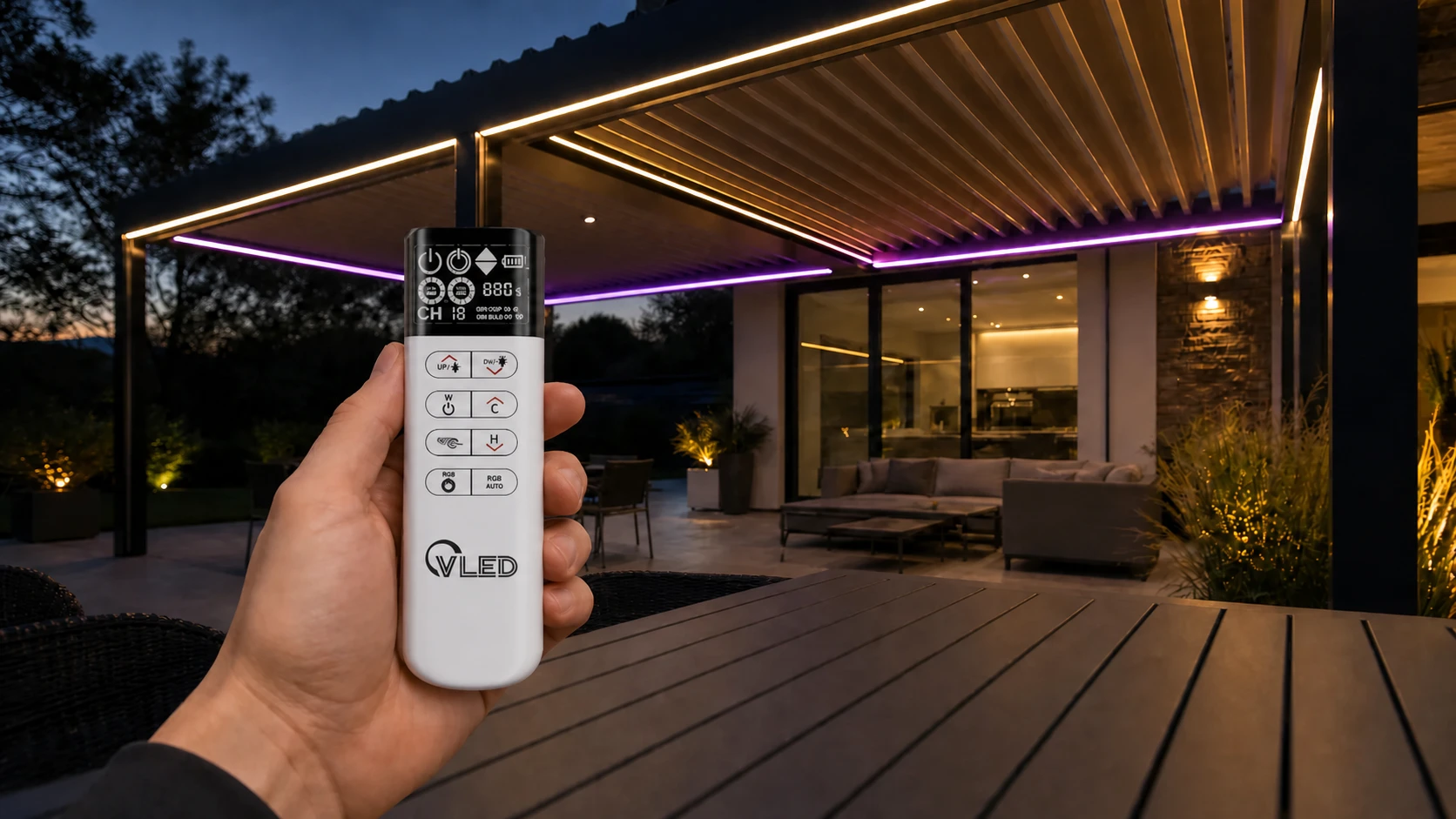
Most pergola remote-control discussions start in the wrong place. They ask how many buttons the handset needs. For a manufacturer, that is too late in the design process.
The better question is this: can one control platform coordinate two moving actuator outputs, two independently dimmable mono LED zones, and one RGB lighting zone without turning installation, service, and dealer training into a support burden?
That question matters because high-end pergola buyers do not judge the control system as a set of separate devices. They judge the complete outdoor room. If the louvers move smoothly but the lighting needs another remote, the product feels less engineered than its frame suggests.
At VLEDSTAR, we design and manufacture pergola lighting and integrated control systems for outdoor structures. Our work since 2010 has shown one pattern clearly: one remote is easy to promise, but difficult to execute well unless the controller, receiver logic, power design, channel map, and pairing workflow are built around the same OEM product strategy.
Önemli Noktalar
- One pergola remote should control grouped functions, not hide separate systems behind one handset.
- Two actuators need synchronized movement logic before lighting channels are added.
- Mono LED zones and RGB zones should stay electrically separate, even when the user interface feels unified.
- OEMs should define channel maps, labels, pairing rules, and service modes before mass production.
- Outdoor control design must account for enclosure rating, RF compliance, metal interference, and dealer support.
What Does the User Expect One Pergola Remote to Do?
For the homeowner, one remote means one intuitive interface for roof movement and lighting scenes. For the manufacturer, it means the control box must route multiple power outputs, memorize channel pairing, protect each load type, and keep actuator movement separate from LED dimming commands.
A good pergola remote should make complex hardware feel simple. It should not expose the homeowner to the engineering underneath. The user should be able to open, stop, and close the louvers, dim the two white zones independently, change RGB color, and turn the whole pergola off without thinking about receivers, relays, PWM channels, or pairing modes.
That is why the remote must be designed around functions, not only buttons. Two actuator outputs may share a movement command, but they should not share the same electrical assumptions as a 24V LED strip. A mono LED zone needs clean dimming. An RGB zone needs separate color-channel control. The remote is only the visible part of that architecture.
The strongest OEM control systems do not make the remote more complicated. They make the control box smarter, then keep the user interface calm.
This is the position behind VLEDSTAR’s integrated pergola control system: lighting, actuators, motors, weather sensors, RF remote, app control, and panel control should be engineered as one product layer for pergola manufacturers.
Why Separate Controllers Become a Problem for Pergola Manufacturers
Separate controllers look acceptable during prototyping because every function can be tested alone. The trouble appears during installation and after-sales service, when different remotes, receivers, wiring rules, apps, and reset procedures meet inside the same aluminum pergola.
The typical fragmented setup has one controller for the actuators, another for white LED strips, another for RGB lighting, and sometimes a separate bridge for app control. Each supplier may be competent. The final system still feels scattered.
For OEMs selling into Europe and North America, that scattered architecture creates four commercial problems.
- Installers spend more time pairing devices and explaining control logic.
- Dealers struggle to support replacement remotes because every receiver has its own memory process.
- Product managers cannot package lighting tiers cleanly across different pergola sizes.
- End users see separate controls for what they expected to be one premium outdoor system.
This is why the real advantage of one remote is not the plastic handset. It is the repeatable control architecture behind it. VLEDSTAR’s pergola kontrol ünitesi is positioned for exactly that OEM need: one IP65 control box to manage LED lighting, linear actuators, tubular motors, and weather sensors through RF remote, Tuya app, and LCD touchscreen panel options.
What Is the Correct Channel Map for This Configuration?
The cleanest channel map treats the two actuators as one movement group and keeps each lighting zone independent. This gives the homeowner simple commands while preserving separate electrical outputs for white lighting, RGB lighting, and motorized movement.
For the article title configuration, the remote can be planned around five controlled functions:
| Function | Hardware behind it | User command | OEM design point |
|---|---|---|---|
| Actuator group | Two linear actuators | Open, stop, close, tilt position | Movement should be synchronized and protected from conflicting commands. |
| Mono LED zone 1 | 24V single-color LED output | On, off, dim up, dim down | Use it for perimeter, beam, or general warm white lighting. |
| Mono LED zone 2 | Second 24V single-color LED output | On, off, dim up, dim down | Use it for task, post, bar, or dining-zone lighting. |
| RGB zone | RGB LED output | Color, mode, brightness, off | Keep ambience lighting separate from white functional lighting. |
| Scene or group command | Firmware-level control logic | All off, evening scene, service mode | Group commands should call predefined outputs, not overload a single channel. |
This arrangement also leaves room for product-tier planning. A base model may enable only one mono zone. A premium model may enable both mono zones and RGB. A hospitality model may extend the same logic into a broader multi-zone plan, similar to the approach described in VLEDSTAR’s guide to multi-zone pergola lighting control.
How Should Two Actuators Be Controlled from One Remote?
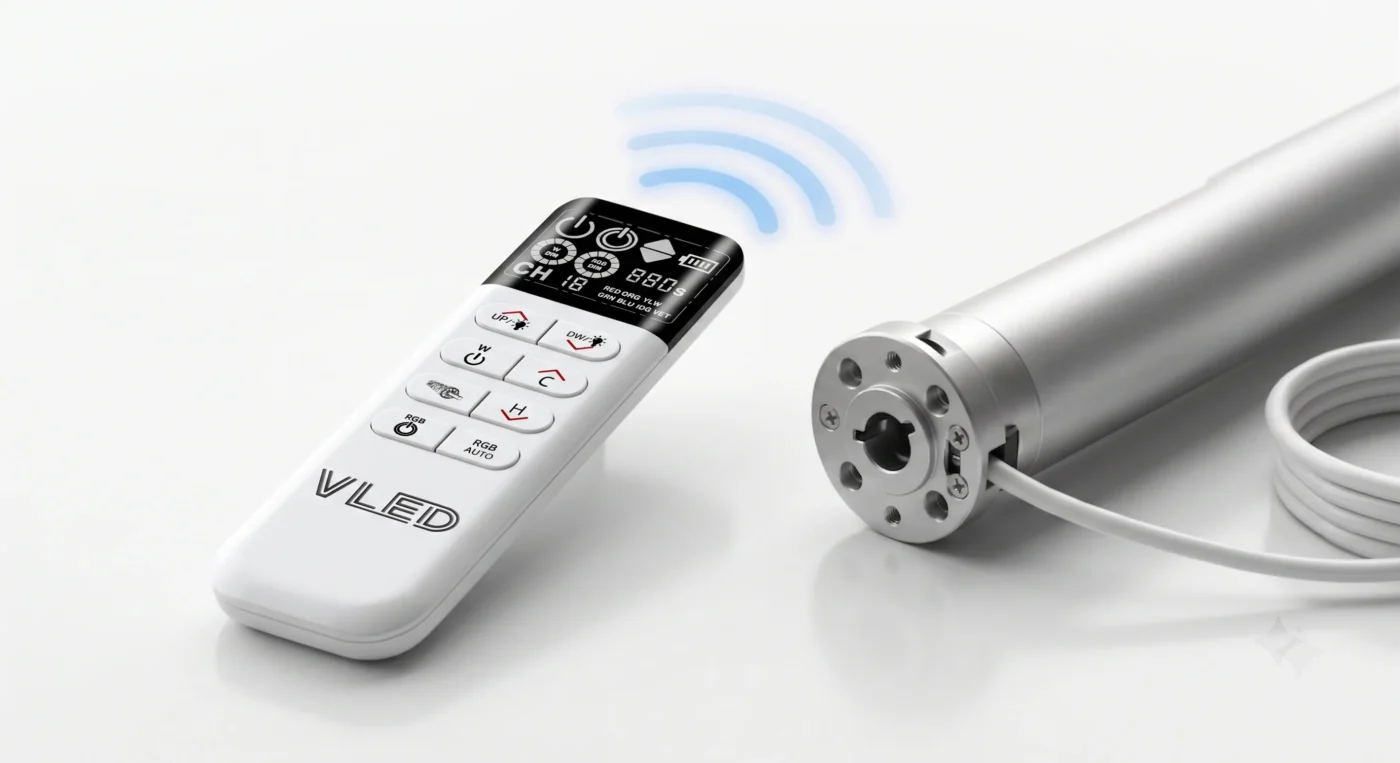
Two actuators should normally respond as a synchronized movement group, not as two independent homeowner commands. The controller should manage direction, stop behavior, current limits, stroke consistency, and feedback logic so the roof movement feels like one mechanical action.
This is especially important for louvered pergolas because the user does not want to operate “left actuator” and “right actuator.” They want the roof to open or close. If the two actuators drift, stall differently, or reach their limits at different times, the problem becomes mechanical, electrical, and reputational at once.
For OEM design, the actuator section of the controller should answer these questions before the remote layout is approved:
- Will the actuators use Hall feedback, limit switches, current sensing, or timed movement?
- Should both actuators receive commands at the same time, or should the firmware sequence them?
- How will the system behave if one actuator reaches its limit before the other?
- Can the installer reset, recalibrate, or pair the actuator group without opening the main control box?
- What happens when a weather sensor command interrupts a manual movement command?
These questions belong in the control specification, not in the dealer troubleshooting guide. If your product line includes actuator and lighting packages, VLEDSTAR’s pergola linear actuator and LED strip light kit shows how actuator movement and LED lighting can be packaged together instead of treated as unrelated accessories.
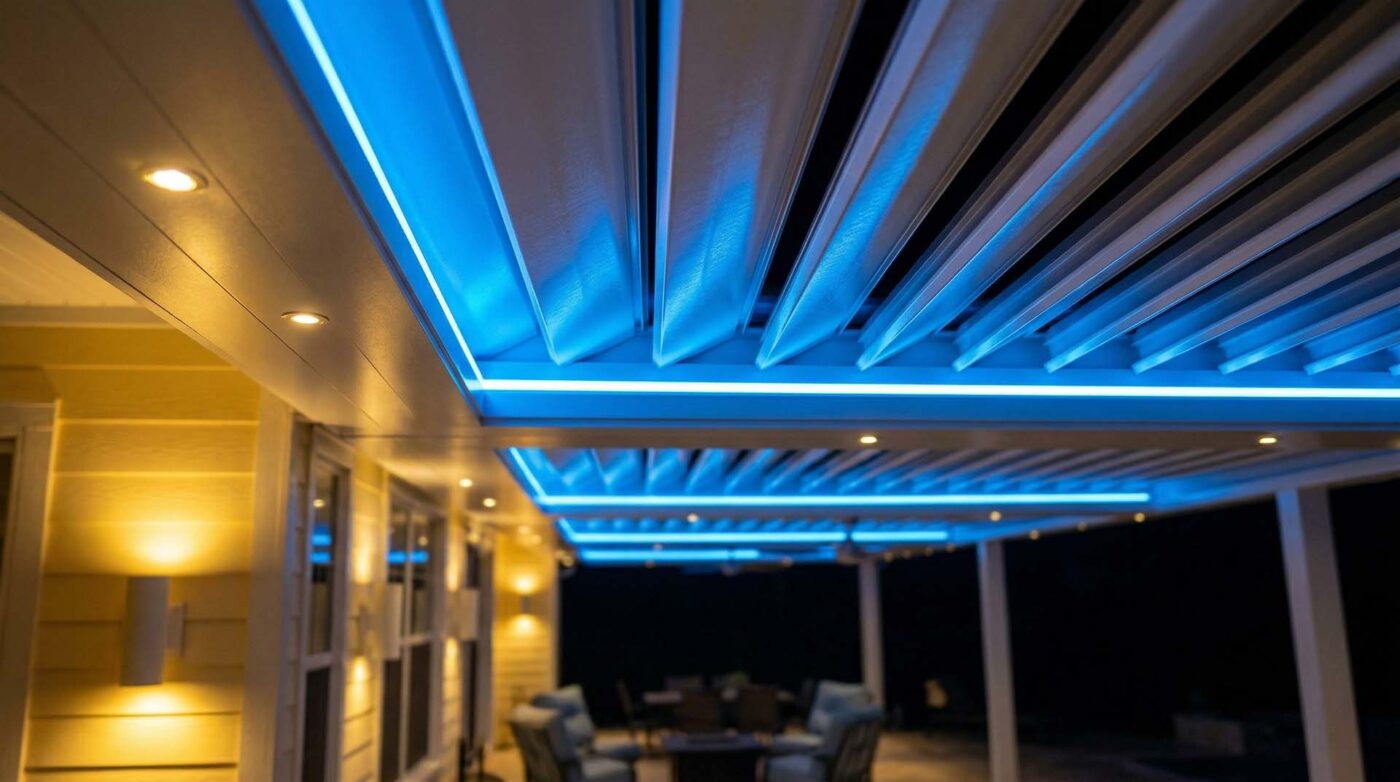
Mono and RGB lighting should share the same remote interface, but they should not share the same output logic. White lighting is usually functional, while RGB lighting is atmospheric, so each zone needs separate dimming, memory, and scene behavior.
In a pergola, mono LED zones often carry the real usability load. Warm white or neutral white strips provide dining light, pathway light, or beam light. The homeowner may use these zones every evening. RGB is different. It creates mood, branding, or hospitality effects, but it should not compromise the reliability of the white lighting circuit.
A practical one-remote design usually separates lighting into three levels:
- Individual control for mono zone 1 and mono zone 2.
- Individual color and brightness control for the RGB zone.
- Scene control that combines selected outputs into one user action.
The most common mistake is to turn the RGB channel into a marketing feature and ignore the two mono zones. That is backwards for premium pergolas. White light determines whether the outdoor room is useful. RGB determines whether it feels flexible. Both matter, but they do not serve the same job.
For lighting specification depth, VLEDSTAR has separate product and guide pages for tek renkli pergola LED şerit setleri, RGBW pergola strip light kits, ve RGB, RGBW, and mono LED control for louvered pergolas.
What Should the Remote Layout Look Like?
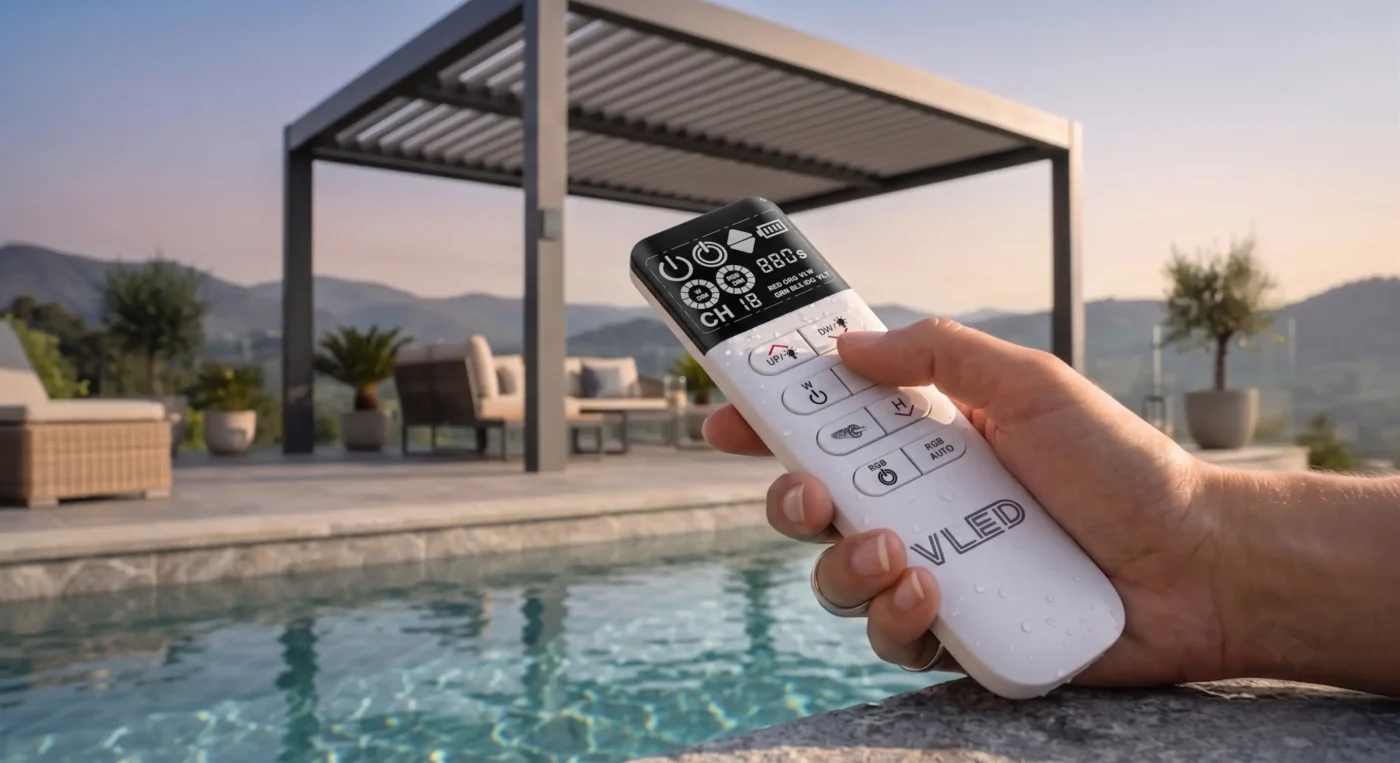
The remote layout should separate movement, white lighting, RGB lighting, and group scenes into recognizable control areas. This reduces support calls because the user can understand the system without memorizing hidden long-press behavior.
Manufacturers sometimes try to make one remote by assigning too many functions to too few buttons. That keeps the handset small, but it increases support friction. A dealer then has to explain short press, long press, double press, pairing press, factory reset, and hidden scene commands. That may be acceptable for a consumer gadget. It is risky for a high-ticket outdoor structure.
A better OEM remote strategy is to define a clear hierarchy:
- Dedicated movement controls for the actuator group.
- Dedicated zone selection for mono LED 1, mono LED 2, and RGB.
- Brightness controls that behave consistently across all lighting zones.
- Color controls only when the RGB zone is selected.
- A limited number of scenes, such as dinner, lounge, cleaning, and all off.
The remote does not need to expose every firmware capability. In fact, it should not. The installer can use pairing and setup modes; the homeowner should see only daily-use controls. VLEDSTAR’s remote pergola louver channel pairing guide expands this idea for channel planning, replacement remotes, and support workflows.
What Must Be Designed Inside the Control Box?
The control box is where one-remote control either becomes reliable or fails quietly. It must separate motor outputs, mono LED outputs, RGB outputs, receiver logic, sensor inputs, and power protection while still behaving like one system to the user.
For this configuration, the control box should be specified around output integrity. The two actuator outputs must handle movement load and direction control. The two mono LED zones need dimming that does not flicker, drop voltage unevenly, or lose memory after power interruption. The RGB zone needs independent color-channel control and a wiring method that installers can repeat.
Outdoor conditions raise the bar. Enclosure protection should be selected with the actual installation environment in mind, not only the catalog headline. The IEC IP rating framework is a useful reference for understanding how dust and water ingress protection is classified. For North American projects, electrical design should also be reviewed against the relevant local code requirements and product standards, including the National Electrical Code published by NFPA 70 and applicable LED equipment standards such as UL 8750.
The goal is not to make the controller oversized. The goal is to make it predictable. A compact, integrated box can be easier to install than a collection of receivers, provided the output terminals, labels, pairing process, and load limits are designed for OEM assembly.
This is why VLEDSTAR’s smart pergola controller is built around a single controller concept for RGB and mono lighting, actuator louver tilt, tubular motor control, and weather sensor integration.
How Do RF, App, and Wall Panel Control Fit Together?
RF remote control should usually remain the primary daily interface, while app and wall-panel control add convenience and project flexibility. For pergolas, the control stack must work even when Wi-Fi setup is incomplete or the homeowner changes phones.
This is one reason RF remains important in outdoor pergola control. Aluminum structures, long beam cavities, and receiver placement can make wireless performance more difficult than it looks in an indoor showroom. VLEDSTAR has written separately about metal interference in pergola lighting control, because RF reliability is not a small detail when the control box sits inside or near a metal structure.
For manufacturers selling internationally, RF planning also touches compliance. In the United States, radio devices must be evaluated against FCC Bölüm 15. In the European Union, wireless equipment falls under the Radio Equipment Directive. These references do not replace certification work, but they remind OEM teams that frequency, transmitter behavior, labeling, and documentation are part of product design.
App control should complement the remote, not rescue a confusing remote. Wall panels should support fixed-location use, not introduce a second control language. A mature pergola control platform keeps command logic consistent across all interfaces.
What Should OEMs Decide Before Production?
OEMs should decide the control architecture before tooling, packaging, and dealer documentation are locked. Once products ship, unclear channel maps and pairing rules become expensive because every dealer must solve the same problem in the field.
Before production, define these items in writing:
- The exact output map for actuator group, mono LED zone 1, mono LED zone 2, and RGB zone.
- The maximum load and recommended wiring length for each LED output.
- The actuator feedback method, movement timing, limit behavior, and recalibration process.
- The RF channel plan, including replacement remote pairing and factory reset rules.
- The default scenes, memory behavior, and what happens after power recovery.
- The enclosure rating, connector type, labeling method, and installer-facing wiring diagram.
- The app and wall-panel behavior, if those interfaces are part of the product tier.
This is also where supplier capability matters. A standard controller may work for a small batch. A pergola brand with multiple sizes, lighting options, and regional markets needs firmware configuration, enclosure planning, terminal layout, logo options, documentation, and production consistency.
VLEDSTAR’s factory background is relevant here. The company started in LED lighting in 2010 and focuses on pergola lighting, RF smart control systems, plug-and-play kits, and customized integrated control solutions. For manufacturers, that combination is more useful than buying lighting from one source and motor control from another.
What Is the Best System Architecture for This Exact Setup?
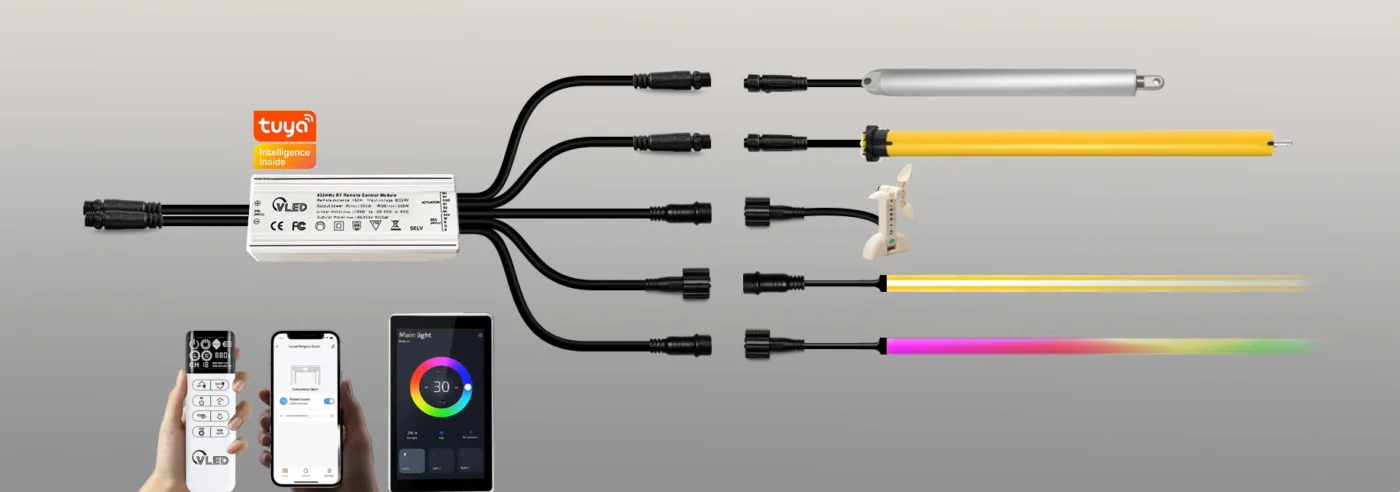
The best architecture is a single integrated control box with separate protected outputs for the actuator group, two mono LED zones, and the RGB zone, paired to one RF remote and optionally mirrored through app or wall-panel control.
Recommended OEM Architecture
| Layer | Recommended design | Why it matters |
|---|---|---|
| User interface | One RF remote with clear movement, zone, brightness, color, and scene controls | The homeowner sees one pergola system, not five devices. |
| Control logic | Firmware groups the two actuators and separates all lighting zones | The roof moves as one unit while lighting remains flexible. |
| Power outputs | Independent actuator, mono LED, and RGB outputs with defined load limits | Electrical separation makes troubleshooting and scaling easier. |
| Kurulum | Labeled terminals, repeatable pairing, and plug-and-play harness options | Dealers install faster and make fewer field decisions. |
| Product line | Same platform configured for different pergola sizes and lighting packages | The manufacturer can build good, better, and premium tiers without redesigning control logic. |
In practice, this means one remote can control two actuators, two mono LED zones, and one RGB zone when the system is designed as a platform. The remote sends commands. The controller interprets them. The outputs remain separate. The user experience stays simple.
That distinction is important. A one-remote pergola is not created by hiding several receivers in the roof and hoping the installer can pair everything correctly. It is created by designing the control unit, remote, lighting drivers, actuator logic, and documentation together.
Final View: One Remote Is a Product Strategy
One pergola remote should not be treated as an accessory feature. For manufacturers, it is a product strategy that affects installation speed, perceived quality, dealer training, after-sales service, and the customer’s daily relationship with the pergola.
The manufacturers that will win in premium outdoor living are not only the ones with stronger aluminum profiles or better-looking louvers. They are the ones that make the whole system feel deliberate. The roof moves smoothly. The white lighting supports real use. The RGB lighting adds atmosphere. The remote feels obvious. The app and wall panel follow the same logic.
That is the standard buyers increasingly expect from a high-end pergola. It is also the standard OEMs should demand from a control-system supplier.
Build the Control System Before the Support Problem Appears
If your pergola line needs one remote to control actuators, mono lighting, RGB lighting, sensors, app control, or wall panels, VLEDSTAR can help design the control architecture around your real product sizes, installation workflow, and OEM branding requirements.

Pingback: Özel Kontrol Özellikleriyle Bir Pergola Ürün Serisini Nasıl Farklılaştırılır?
Pingback: Pergolalar için Sahne Kontrolü: Akşam Yemeği Modu, Fırtına Modu, Gün Batımı Modu ve Bayi Ön Ayarları
Pingback: Motorlu Pergola Kontrollerine Yönelik Manuel Devre Dışı Bırakma ve Arıza Emniyeti Tasarımı