


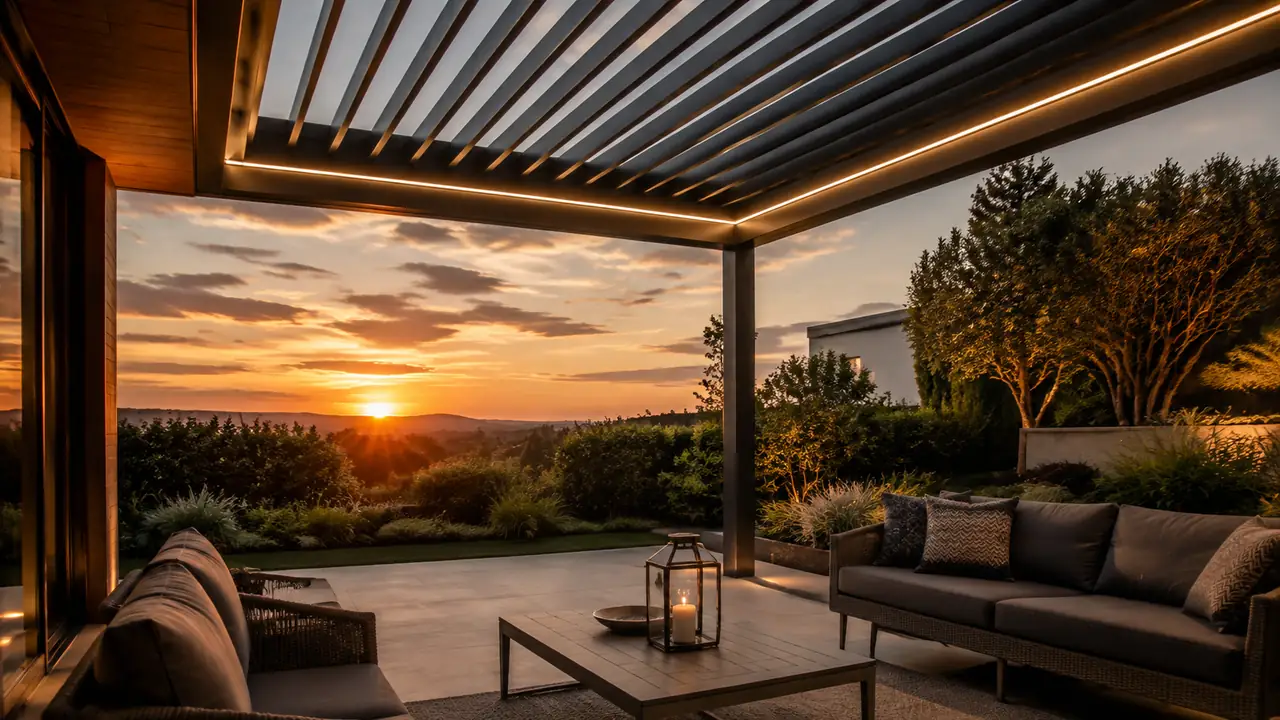
A customer presses “open” just as the first drops begin. A gust reaches the wind threshold while the sun sensor is asking for shade. Which command wins? In a professional motorized pergola, the answer should never depend on which signal arrived last. It should be defined by a priority matrix, enforced by the controller, and explained clearly to the dealer and end user.
For the control logic discussed in this article, the hierarchy is Rain > Wind > Light. Rain has the highest priority, wind is evaluated only when rain is inactive, and light automation runs only when neither protective condition is present. This is not merely a convenient programming choice. It is the control behavior that turns separate sensors into a coherent product.
Direct answer: when rain is active, a manual open command should not reopen the louvers. When strong wind is active and rain is not, the controller should execute the defined wind position and temporarily hold that state. Only after the protective condition clears should the user’s normal command and the light sensor regain authority.
The priority matrix is the real product
Many pergola product pages say that a weather sensor can close or open the roof automatically. That description is incomplete for a manufacturer. The difficult engineering question is not whether each sensor can send a signal. It is what the controller does when several signals, a scheduled scene, an app command, and a physical remote compete at the same time.
A useful priority matrix separates three things: the condition being detected, the protective action, and the period during which lower-priority commands are blocked. Without the third element, a roof may close for rain and then immediately reopen because the user pressed a button or the light sensor issued a command.
| Priority | Condition | Protective action | Effect on lower-priority commands |
|---|---|---|---|
| 1. Rain | Rain reaches the configured threshold. | Close the louvers immediately. | Wind, light, and manual open commands remain blocked during the rain hold period. |
| 2. Wind | Wind reaches the configured threshold while rain is inactive. | Open the louvers to release pressure and ventilate. | Light-based closing remains blocked during the wind lock period. |
| 3. Light | Light remains above or below its configured threshold while rain and strong wind are inactive. | Close for strong sun or open for low light, according to the programmed rule. | Normal user and scene control can operate unless a higher-priority state is active. |
This structure is consistent with the broader principle used in professional weather-responsive pergolas: sensor behavior must be translated into defined roof states, not left as a collection of independent accessories. Public systems such as StruXure’s weather technology overview also illustrate why rain and wind can require different roof responses.
What happens when the user presses Open during rain?
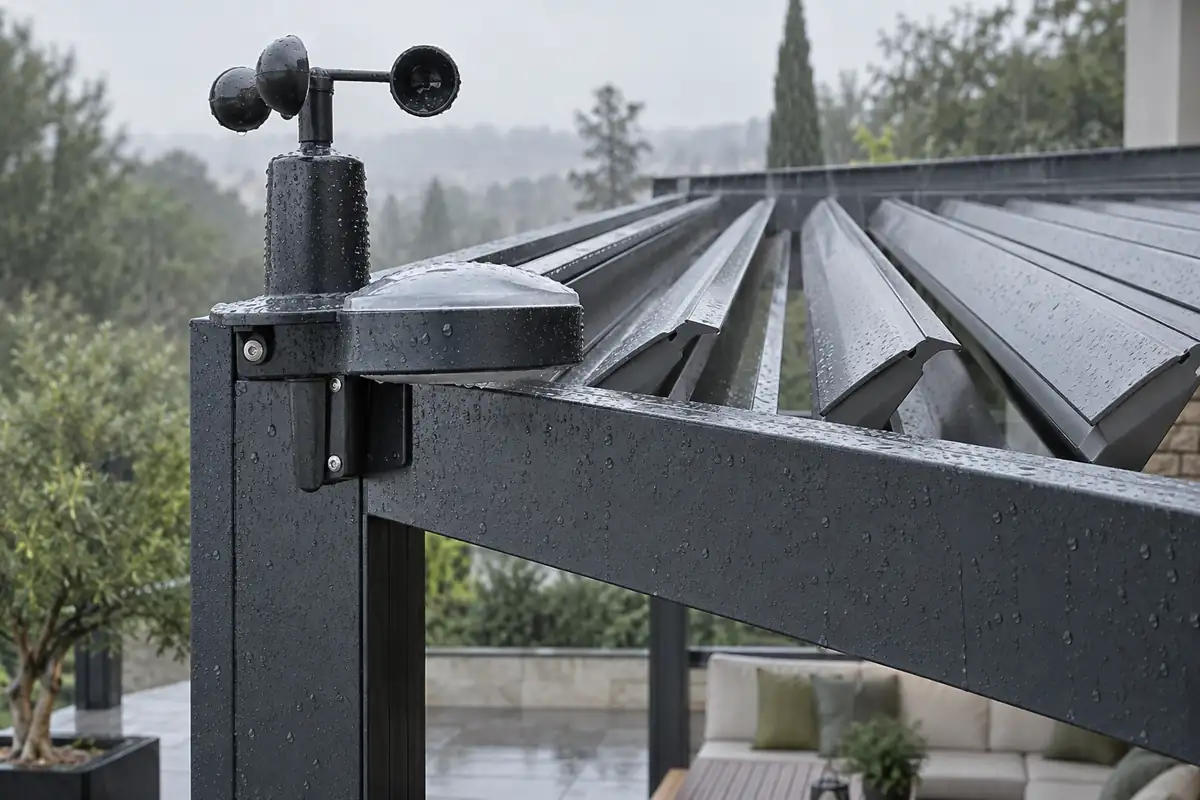
Rain should win. If the rain sensor is already above its configured threshold, the controller should reject the open action at the motor-output level, even if the user is standing beside the pergola with the remote in hand.
In the reference logic supplied for this article, the rain sensor must remain above the set threshold for approximately 25 seconds before the rain event is confirmed. Once confirmed, the system performs a forced close. This short confirmation period filters out an isolated contact, splash, or transient signal while keeping the response fast enough for changing weather.
After the forced close, the key behavior is the rain lock. For 15 minutes, the louvers remain closed and do not respond to automatic wind or light adjustments. A user may continue to press “open,” but the command should not defeat the active protective state. The interface should make that refusal understandable through a status message, indicator, or documented operating behavior.
Recommended state sequence: Rain detected → confirmation timer → forced close → 15-minute post-rain protection → return to wind logic, then light logic. The system should not jump directly from “rain detected” to “manual control restored.”
This distinction matters commercially. If a user can open the roof immediately after an automatic rain closure, the product may look responsive during a demonstration but fail its central promise in the field. A dealer may describe the feature as “automatic rain protection,” while the customer experiences water exposure caused by a perfectly valid manual command. The solution is not a stronger marketing claim. It is a clearly enforced state machine.
Why wind can command the opposite movement
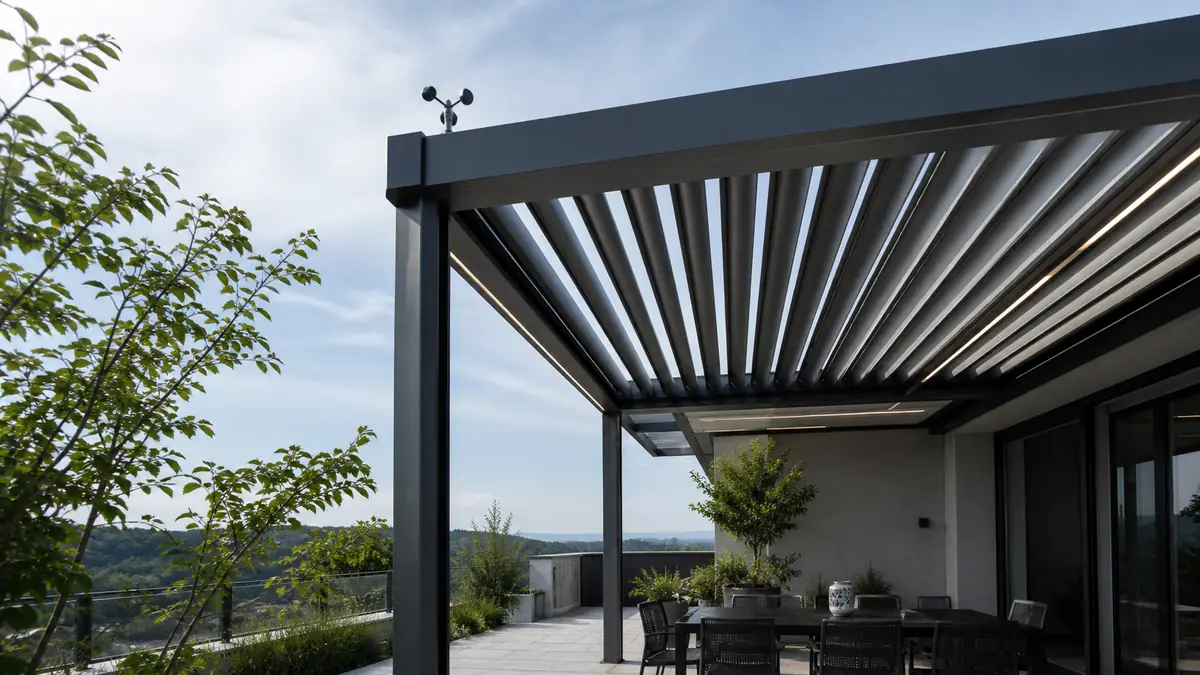
Rain and wind do not necessarily ask the roof to move in the same direction. Rain typically calls for a closed louver position to protect the space below. Strong wind may call for an open position that allows air to pass through the roof and reduces pressure on the structure. That apparent contradiction is exactly why a pergola controller needs priorities rather than simple “first signal wins” programming.
In the reference system, wind is evaluated only when rain is not active. When the wind threshold is reached and the condition persists for about three seconds, the controller performs a forced full opening. The purpose is pressure relief and ventilation. The system then applies a 15-minute wind lock: even if sunlight reaches its own threshold, the louvers remain fully open and do not close automatically to block the light during that period.
When the wind lock is released, the controller returns to normal evaluation. If the wind condition has cleared, light logic can resume. If wind remains above the threshold, the protective state should remain in force. This reset behavior must be based on the actual sensor state, not merely on the expiration of a timer.
Manufacturers should also avoid presenting a universal wind threshold. The correct setting depends on the roof geometry, actuator capability, louver profile, anchoring, installation environment, and the structural engineer’s specification. A sensor can provide an input; it cannot make every pergola safe at the same wind speed. For a deeper product-level discussion, see VLEDSTAR’s linear actuator versus tubular motor guide.
Light automation belongs at the bottom of the hierarchy
Light sensing is valuable for comfort and energy management, but it is not a protective command. That is why it should be evaluated only when rain and strong wind are inactive.
In the supplied logic, a high-light condition must remain above its threshold for two minutes before the sensor closes the louvers to reduce direct sun. A low-light condition must remain below its threshold for 18 seconds before the louvers open to admit more daylight. The light response does not use the same mandatory post-event lock as rain or wind. After the light condition has been satisfied, the system can return to its prior or defined position according to the programmed behavior.
This asymmetry is sensible. Rain and wind can create immediate protection requirements and should temporarily suppress comfort commands. Light changes are usually slower and are better handled with persistence timers that prevent rapid movement around a threshold. If light automation is allowed to compete with a wind-open state, however, the result is a roof that repeatedly fights itself: open for wind, close for sun, open again for wind. The priority matrix prevents that cycle.
Manual override should be defined, not assumed
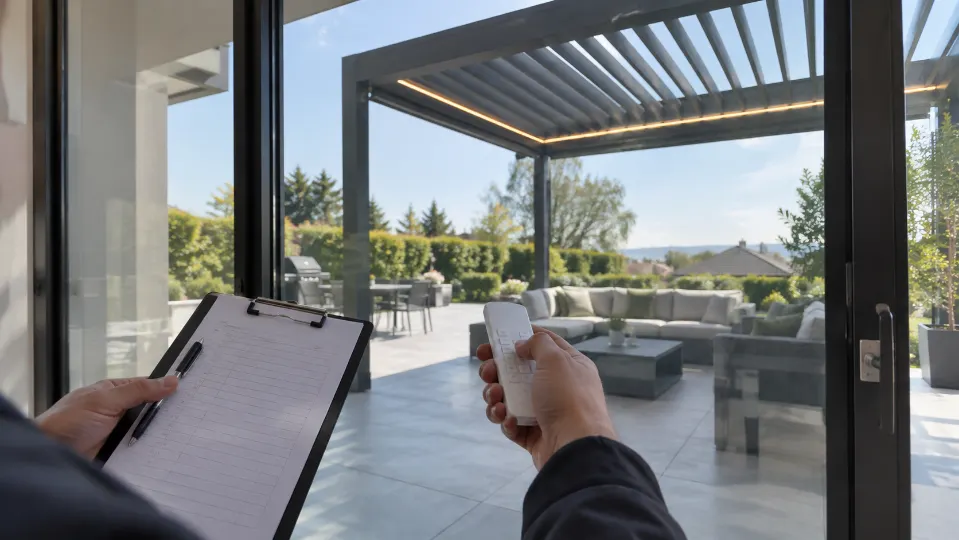
“Manual override” is one of the most misleading phrases in pergola specifications. It can mean at least three different things: the user can interrupt an automatic movement, the user can command a movement after the movement is complete, or the user can bypass a protective lock. These are not equivalent, and the last option should not be implied without a documented risk assessment.
A practical manufacturer policy is to allow manual control during normal operation, allow a stop command where the hardware and safety analysis support it, and block commands that would directly contradict an active rain or wind protection state. When the lock expires, normal manual control returns automatically. If a service technician needs a deeper override, it should be a protected commissioning or maintenance mode rather than an everyday remote-button shortcut.
The control interface should communicate the reason for a blocked command. A remote may use a dedicated status indicator; an app can show “Rain protection active” or “Wind protection active”; a dealer tool can display the sensor input, timer, and current roof state. The exact interface varies, but silent refusal creates unnecessary warranty calls.
VLEDSTAR’ın entegre pergola kontrol sistemi is designed around the idea that lighting, actuators, motors, weather sensors, RF control, and app control should be considered together. The published platform supports multiple actuator and tubular-motor outputs, weather-sensor inputs, and several control modes. For an OEM, the important benefit is not the number of features on a checklist. It is the ability to assign priority and recovery behavior consistently across the product line.
How manufacturers should validate the logic before launch
A sensor demonstration is not a control-system validation. Wetting the rain sensor and watching the louvers move proves only that one input can produce one output. A production-ready test must prove the conflicts.
Test the same sequence a customer will create
Start with the roof open, trigger rain, and press the open command during the forced-close cycle. Confirm that the roof closes and does not reopen. Repeat the test during the 15-minute rain lock. Then clear the rain condition and verify that the system returns to wind evaluation before light evaluation.
Test conflicting sensor states
Trigger wind while light is requesting closure. The wind action should take priority. Trigger rain while wind is requesting opening. The programmed rain behavior should win. Test the conditions in both orders because startup state and sensor recovery can expose different firmware problems.
Test persistence and reset timing
Verify the 25-second rain confirmation, the three-second wind confirmation, the two-minute high-light persistence, the 18-second low-light persistence, and the 15-minute protective holds. Use a commissioning tool or test log so the result is repeatable. Timers should be measured from the defined condition, not from a convenient visual estimate.
Test every output that shares the controller
Confirm actuator synchronization, motor limits, lighting behavior, RF commands, app commands, and recovery after a power interruption. If the pergola includes side screens, fans, heaters, or RGB lighting, define whether those outputs follow the roof state, remain independent, or receive their own protective command.
VLEDSTAR’ın rain sensor placement and commissioning guidance expands this process to include exposure, wiring, RF behavior, service access, and installer handover. These details matter because a well-designed priority matrix cannot compensate for a sensor that is sheltered, miswired, or unreliable after installation.
Design the behavior into the product line
For pergola manufacturers, the strongest approach is to define weather behavior before the first production run. Put the priority matrix in the control specification, remote map, app behavior, installation manual, commissioning checklist, and dealer training material. The same rule should appear wherever a user or installer might ask, “Why did the roof not open?”
The matrix should also be configurable only where configuration is safe. A dealer may need to adjust rain sensitivity, wind sensitivity, or light thresholds for a specific climate and roof design. That does not mean every user should be able to disable the protective hierarchy from a standard remote. A controlled parameter set protects both the end user and the manufacturer’s support team.
This is where integrated sourcing has a practical advantage. VLEDSTAR develops pergola lighting, control boxes, RF systems, sensors, actuators, and OEM/ODM solutions as a connected product ecosystem. The pergola aydınlatma çözümleri sayfası shows how lighting kits, drivers, accessories, and control systems can be specified together rather than assembled as unrelated parts. The VLEDSTAR factory page provides additional background on the company’s R&D and manufacturing position.
Final position: the safest command is the one the system can explain
A user opening a pergola during rain or wind is not an unusual edge case. It is a normal interaction that exposes whether the control system has a real hierarchy. Rain should close and hold. Wind should protect the roof with its defined pressure-relief position when rain is inactive. Light should manage comfort only after the protective conditions have cleared. Manual control should be available in normal operation but should not silently defeat an active safety state.
For manufacturers, this logic is part of the product identity. It affects mechanical protection, customer trust, dealer training, service calls, and the perceived quality of every connected feature. Define it early, validate the conflicts, and document the recovery behavior as carefully as the motor specification.
Frequently asked questions
Should rain override a manual open command on a pergola?
If the product is designed to prioritize weather protection, an active rain state should override a manual open command. The controller should close the louvers, maintain the rain lock for the defined hold period, and document when manual control becomes available again.
Why can wind open a pergola while rain closes it?
Rain and wind can require opposite louver positions. Closing helps shelter the area from rain, while opening can reduce pressure on the roof during strong wind. A priority matrix resolves the conflict: the active rain state remains dominant, while wind logic operates only when rain is inactive.
How should a pergola controller handle a user command during a sensor lock?
The controller should accept the command at the interface level but refuse or defer the motor action while the protective lock is active. The remote, app, or panel should provide a clear state indication so the user understands that the system is protecting the roof rather than failing to respond.
Build weather logic into your next pergola platform
VLEDSTAR helps pergola manufacturers develop integrated lighting and control systems with motor control, RF remotes, app control, weather sensors, waterproof connections, and OEM/ODM configuration. If your product line needs a defined rain–wind–light priority matrix, contact the VLEDSTAR engineering team through the pergola kontrol sistemi sayfası or request a project discussion from the factory page.

Pingback: Touch Panel vs Handheld Remote vs Mobile App for Pergola Controls