


The Bottom Line
- Separate modules suit simple configurations, prototypes, and retrofits where flexibility matters more than repeatability.
- Integrated control usually wins for standardized OEM ranges with motorized louvers, retractable screens, LED lighting, sensors, and multiple control methods.
- The correct comparison is total system cost, including wiring, commissioning, support, callbacks, inventory, and documentation.
- A good integrated design should remain serviceable, with clear channels, replaceable harnesses, and documented fault logic.
What Is the Real Difference Between the Two Architectures?
The difference is where system coordination happens. With separate modules, a motor receiver, LED driver, RF receiver, sensor interface, and possibly a smart-home gateway are selected and connected as individual products. With an integrated pergola controller, those functions are designed around a defined channel map and shared control logic.
That distinction matters because a modern pergola is a group of interdependent loads. A louver actuator may need synchronized movement. A rain or wind input may need priority over a lighting scene. Mono and RGB lighting may need separate output behavior. A dealer may also need a remote, wall panel, or app to operate the same product.
The best architecture is therefore the one that makes the product easier to build, install, explain, and repair. The number of boxes is only the starting point.
Which Option Usually Costs Less?
Separate modules usually have the lower visible unit price for a basic pergola. They can use off-the-shelf drivers and receivers, and the manufacturer can add functions one at a time. That advantage becomes less clear when every module needs its own enclosure, connector set, cable run, pairing procedure, manual, test step, and spare-part code.
For an OEM comparison, calculate cost in five layers:
- Component cost: controllers, drivers, receivers, sensors, power supplies, enclosures, and interfaces.
- Factory cost: harness preparation, labeling, assembly, testing, packaging, and inventory handling.
- Installation cost: cable routing, connector work, pairing, programming, and commissioning.
- After-sales cost: diagnosis time, replacement parts, site visits, warranty returns, and technical support.
- Product-line cost: engineering changes, documentation updates, dealer training, and platform maintenance.
An integrated controller does not remove cost. It concentrates more engineering work before production. That is valuable when the same architecture will be repeated across a product range. It is less attractive when every project has a different motor protocol, lighting voltage, or control philosophy.
How Do Separate Modules Affect the Bill of Materials?
A modular BOM is easy to understand at first: one line for the LED driver, one for the motor receiver, one for the remote, and one for the sensor. The hidden difficulty is the interface between those lines. Each interface creates a compatibility question that someone must own.
Manufacturers should ask whether the BOM identifies voltage, load, channel assignment, connector family, cable length, firmware version, pairing method, enclosure position, and replacement procedure. The Pergola kontrol sistemi malzeme listesi kontrol listesi provides a useful review format for these decisions.
Separate modules also multiply purchasing and quality-control touchpoints. A change to one receiver may alter the remote, wiring diagram, packaging list, or installer instructions. A controller that combines agreed functions can reduce part-number sprawl, but only if the supplier documents the internal outputs clearly.
What Happens to Wiring and Assembly Time?
Wiring is where the architecture becomes visible on a real pergola. Separate modules often require more branches, more junction points, and more opportunities to reverse polarity, mislabel a zone, or leave a connection insufficiently protected from outdoor exposure.
Integrated control turns much of that work into repeatable assembly. The manufacturer can define where the louver motor, tubular motor, mono LED, RGB LED, and sensor harness connect. Keyed waterproof connectors and fixed labels do not replace installation skill, but they reduce open-ended decisions on site.
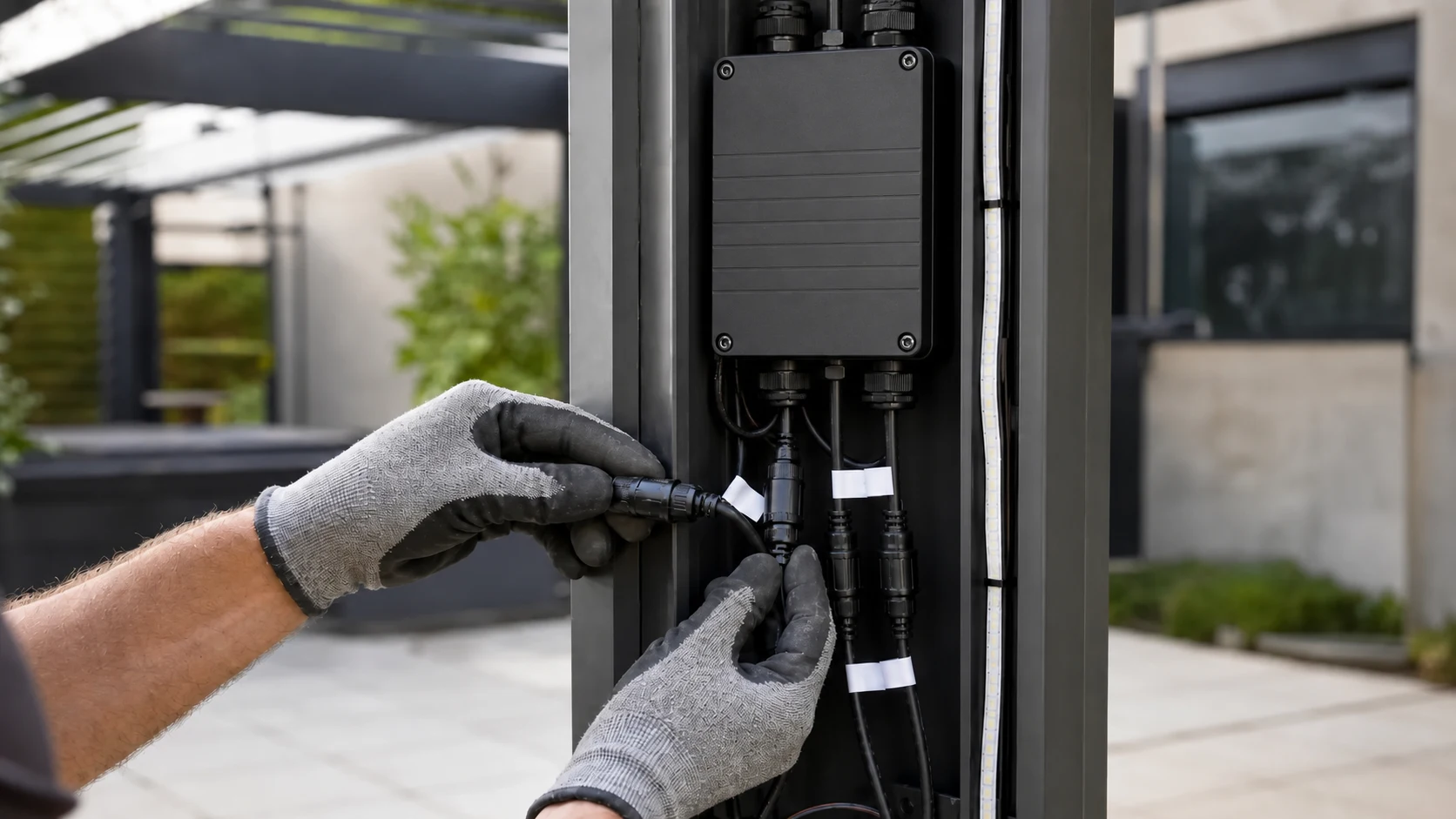
This is especially important inside narrow aluminum profiles. A wiring mistake may require removing a beam cover or tracing a cable through a post. The financial impact is not the minute needed to make a connection. It is the rework created when the finished frame must be opened again.
For dealer-led channels, the installation labor guide for integrated pergola controls explains why connector design, labeling, and predefined channel logic influence installation reliability as much as the controller itself.
How Does Commissioning Compare?
Separate modules create separate commissioning tasks. The installer may need to pair more than one remote, set motor limits in different interfaces, configure LED scenes independently, and test sensor behavior through several control paths. Each task can be manageable alone. Together, they increase training requirements and fault-isolation time.
An integrated system can use one channel map and one commissioning sequence. That does not mean every system behaves identically. Motor compatibility, load limits, RF performance, and sensor priority still need to be tested for the actual pergola design.
For example, the current pergola control unit specification describes RGB and mono LED control, up to four linear actuators, up to two tubular motors, weather-sensor inputs, RF control, Tuya app control, a wall touchscreen, 15-channel grouping, and an IP65 enclosure. Those capabilities are useful only when the OEM validates them against its own mechanical and electrical configuration.
Which Architecture Is Easier to Support After Installation?
Separate modules can be easier to replace one by one. If the LED driver fails, the service team can replace that driver without changing the motor receiver. This is a real advantage when the modules are common, well-labeled, locally stocked, and supported for the expected product life.
The weakness appears when the service team does not know which module caused the symptom. A lighting failure may come from the strip, driver, receiver output, connector, power supply, or a scene setting. A motor problem may involve the actuator, receiver, limit setting, remote pairing, or RF interference.
An integrated controller gives the brand one known architecture. That can shorten diagnosis because the channel map, firmware, connector plan, and expected behavior are controlled together. The design should still avoid a sealed mystery box. Service documentation should show terminal functions, output ratings, replacement steps, reset behavior, and the conditions that trigger safety actions.
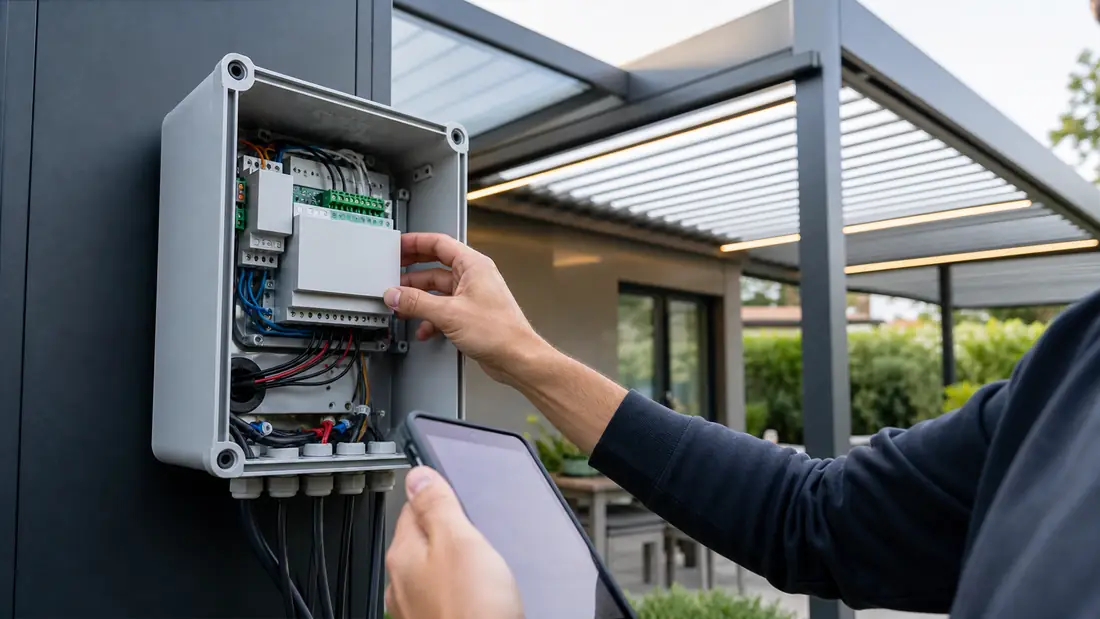
Outdoor enclosure claims also need precision. IEC 60529 defines the IP Code classification for enclosure protection. An IP rating describes the enclosure under specified test conditions. It does not, by itself, prove that every cable entry, field connector, or installation position will remain reliable on a finished pergola.
When Are Separate Modules the Better Choice?
Separate modules remain a sensible choice in four situations:
- Early product development: the team is testing different motors, LED technologies, or automation ecosystems.
- Simple products: the pergola has one motor function and a small lighting package with no sensor logic.
- Retrofit work: the existing wiring or motor must remain in place, so a drop-in interface is more practical than a full redesign.
- Regional variation: the product line requires different control standards and the supplier cannot provide a configurable platform.
In these cases, modularity has strategic value. It allows the manufacturer to change one subsystem without redesigning the whole control box. The trade-off is that the interfaces must be standardized, documented, and tested as seriously as the individual components.
When Does an Integrated Controller Make More Commercial Sense?
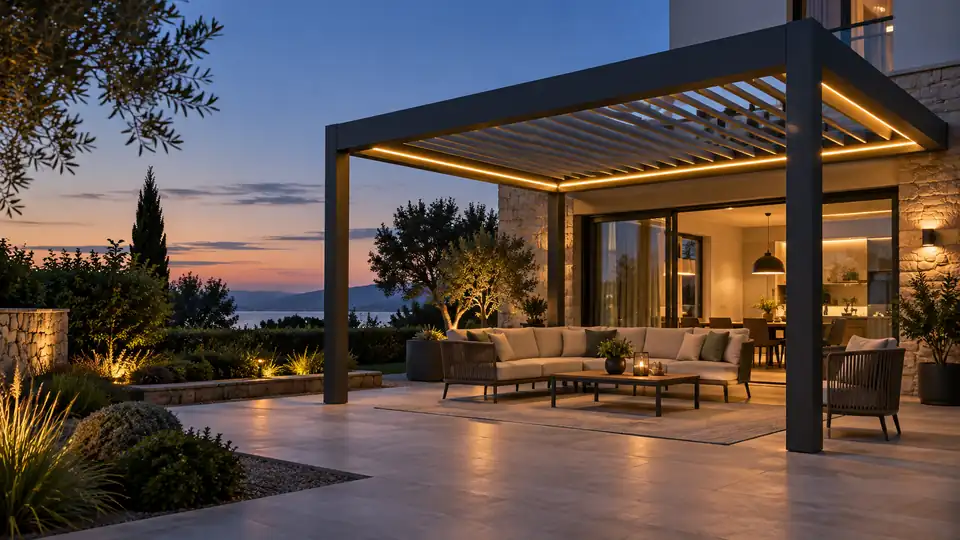
An integrated controller is usually the stronger choice when the pergola is sold as a complete outdoor-living product rather than a frame with add-on accessories. It is particularly well suited to a repeatable OEM range that combines louver movement, retractable screens, LED lighting, weather sensors, and more than one user interface.
The commercial benefit is consistency. The same control story can appear in the factory instructions, dealer quotation, installer training, user manual, and support process. A single controller can also make premium features easier to package, such as synchronized zones, lighting scenes, weather response, and app access.
Bu OEM pergola control platform page is relevant for manufacturers comparing private-label firmware, customized enclosures, channel configuration, and production support. The key question is not whether a supplier can provide a control box. It is whether the supplier can hold the architecture stable from sample evaluation through production.
What Should Manufacturers Check Before Choosing?
Do not approve either architecture from a feature list alone. Ask for a complete control package review covering the following points:
| Decision area | Separate modules | Integrated controller |
|---|---|---|
| Initial unit cost | Often lower for simple systems | May be higher, especially with custom engineering |
| Factory assembly | More interface wiring and test points | Predefined harness and channel logic can simplify repeat builds |
| Installer training | Several pairing and setup procedures | One documented commissioning sequence |
| Flexibility | High when components are interchangeable | High only when the platform is properly configurable |
| Fault diagnosis | Individual parts are replaceable, but faults may cross interfaces | Known architecture can make diagnosis faster if service data is available |
| Product scaling | More SKUs and compatibility combinations to manage | One platform can standardize multiple models and zones |
| Outdoor risk | More connection points to protect and inspect | Fewer coordinated connection points, but enclosure and harness design remain critical |
Also confirm the target market requirements early. For North American control panels, review the applicable path with a qualified compliance partner and consult UL Solutions’ UL 508A guidance where relevant. For radio-enabled products sold in Europe, review the applicable radio and EMC obligations with a qualified compliance partner. Compliance is not created by choosing an integrated box, but the architecture affects labeling, documentation, testing, and traceability.
Our Recommendation for Pergola OEMs
Choose separate modules when you need controlled flexibility for a simple, changing, or retrofit-oriented product. Choose an integrated controller when your main business goal is a repeatable pergola system that dealers can install, commission, and support with fewer decisions.
For most premium pergola ranges, we recommend a hybrid principle: integrate the user-facing control logic and the main output architecture, while keeping harnesses, connectors, sensors, and service parts clearly identifiable and replaceable. The customer experiences one system. The factory and service team still have a transparent engineering structure.
That balance is the difference between integration that merely reduces the number of boxes and integration that improves the product line.
Plan the Control Architecture Before You Freeze the BOM
Share your pergola dimensions, louver motor type, lighting zones, sensor requirements, target market, and expected volume. VLEDSTAR can help map the control architecture, harness, channel plan, and evaluation package before production tooling is committed. Review the pergola control system range or contact the engineering team through PergolaLights.net.

Pingback: Why Pergola Manufacturers Should Treat Controls as a Core Product Feature
Pingback: The Evolution of Motorized Pergolas: From Simple Remotes to Weather-Responsive Systems