


Our specification position
Use local RF or a wired control as the dependable operating layer. Add WiFi as a connectivity layer and the app as a user-experience layer. Safety and weather logic must remain local. If internet loss can prevent a user from operating the louvers, the architecture is incomplete.
A homeowner may ask whether a motorized pergola has an app. An OEM has to ask harder questions: What happens after the router is replaced? Can a dealer commission the roof without the homeowner’s phone? Does a rain command still execute during a cloud outage? Which radio version ships to each market? Who maintains the app five years after installation?
Those questions change the decision. The right comparison is not “RF versus WiFi versus app.” An app is an interface, not a radio architecture. It may reach the controller through local WiFi, a cloud service, Bluetooth during commissioning or an RF-to-WiFi bridge. Treating the three labels as equivalent hides the dependencies that later become support calls.
VLEDSTAR has worked in LED lighting since 2010 and develops integrated lighting and control solutions for motorized outdoor structures. That manufacturing perspective shapes this article: the control stack should be defined by predictable product behavior, not by the longest feature list. See our pergola lighting and control manufacturing background for the scope behind this position.
Why Is “RF vs WiFi vs App” the Wrong Comparison?
The comparison is wrong because it mixes a local radio method, a network connection and a software interface. RF usually describes the direct link between a handheld transmitter and a receiver. WiFi connects the controller or bridge to a local network. The app presents commands, scenes, status and account functions to the user. Each layer solves a different problem.
| Ebene | Primary job | Main strength | Main exposure | OEM must specify |
|---|---|---|---|---|
| RF-Fernbedienung | Immediate local commands | No router, account or internet required | Metal attenuation, interference and limited feedback on one-way systems | Regional radio variant, pairing, range in the finished structure, grouping and replacement process |
| WiFi | Network access for the controller or bridge | App access, updates and wider integrations | Coverage, router changes, onboarding and cybersecurity | Local versus cloud path, supported band, reconnection, security, diagnostics and offline behavior |
| App | User interface and service layer | Scenes, schedules, remote access and richer status | Account friction, OS changes, cloud dependency and lifecycle cost | Ownership, supported platforms, permissions, data policy, service period and end-of-life plan |
This distinction leads to a simple rule: every premium pergola may benefit from an app, but no essential movement command should exist only in the app. A remote or shared wall control remains useful for guests, restaurant staff, installers and anyone standing beneath the roof with wet hands and no phone.
What Control Stack Should a Pergola OEM Specify?
A local-first, three-layer architecture gives manufacturers the best balance of reliability and upgrade value. The controller owns motor limits, interlocks, sensor priority and outputs. Local interfaces send commands directly to that controller. Connected services extend the system but do not replace its operating core.
Layer 1: Local control and protective logic
This layer includes the motor controller, RF receiver, wired service input, wall control and weather-sensor logic. It must operate with no internet and, where the product design allows, with no active WiFi connection. Rain, wind, frost or obstruction policies belong here because a cloud round trip adds dependencies without improving the mechanical decision.
Layer 2: Network and gateway
The network layer may be an integrated WiFi module or a separate bridge. A bridge can be commercially useful: the same base controller serves a standard RF model and a connected upgrade, while the gateway can evolve faster than the motor-control hardware. An integrated module reduces boxes and wiring but ties radio certification, firmware and service life more closely to the main controller.
Layer 3: App, cloud and smart-home integration
The top layer handles naming, scenes, schedules, remote access, diagnostics and third-party ecosystems. The Connectivity Standards Alliance describes Matter as an IP-based protocol designed for interoperability and responsive local connectivity. That makes Materie relevant to a roadmap, but it does not remove pergola-specific engineering. An OEM still has to map louver positions, stop behavior, sensor lockouts, lighting channels and permissions into a clear product experience.
VLEDSTARs integrierte Steuerungsplattform für Pergolen follows this system view by coordinating RF, app and panel interfaces with lighting, motors and weather inputs. The important point is not the number of interfaces. It is that they share one behavior model.
What Should OEMs Specify for RF Control?
RF should be specified as a complete installed link, not as a frequency and a best-case distance. Aluminum beams, access covers, motors, LED drivers, cable routing and glazing all change the real radio environment. A range number measured with an exposed receiver on a bench is not an acceptance criterion for a finished pergola.
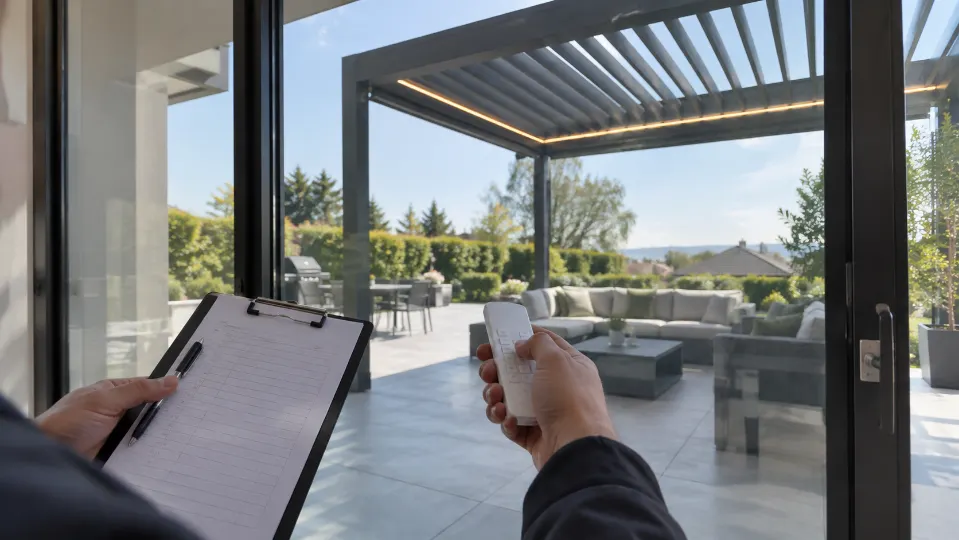
Start with the target markets. European short-range devices are evaluated under radio requirements that include standards such as ETSI EN 300 220-2. In the United States, remote-control transmissions may fall under conditions in 47 CFR §15.231, depending on the design and operating behavior. Permitted frequency, radiated power, duty cycle and certification evidence are regional decisions. “433 MHz everywhere” is not an OEM strategy.
Then define how the user experience behaves:
- Pairing: State how a remote enters pairing mode, how long the window stays open and how accidental pairing is prevented.
- Capacity: Set the maximum number of transmitters per controller and controllers per channel. Include group and individual control rules.
- Security: Specify the code method, replay protection where appropriate and the process for removing a lost remote.
- Feedback: Declare whether the link is one-way or two-way. Do not show confirmed roof position in an app if the system only infers it from elapsed time.
- Replacement: Define model compatibility, re-pairing steps and spare-part availability. A remote is a service component, not disposable packaging.
- Range: Set a pass criterion inside the assembled aluminum structure with all covers closed and electrical loads operating.
Antenna placement should be frozen before the extrusion and enclosure are approved. Our guide to preventing RF signal problems in aluminum pergolas explains why antenna clearance, receiver location and LED-driver noise must be validated together. The handset also deserves a proper industrial-design brief; button hierarchy, icons and channel labels affect support almost as much as radio performance. Use the custom pergola remote design checklist when defining that interface.
Example RF acceptance clause
The complete pergola shall execute open, stop, close and lighting commands from each defined user position with access covers installed, motors and LED drivers energized, and representative glazing between transmitter and receiver. The test plan shall record distance, orientation, command attempts, successful responses and any retransmission rule. Open-air transmitter range shall not be used as the sole acceptance evidence.
What Should OEMs Specify for WiFi Control?
WiFi should add reach and serviceability without becoming a single point of failure. The specification must describe the command path during normal operation, local-network loss and internet loss. “WiFi enabled” says nothing about whether commands stay on the local network, travel through a vendor cloud or stop working when an account service is unavailable.
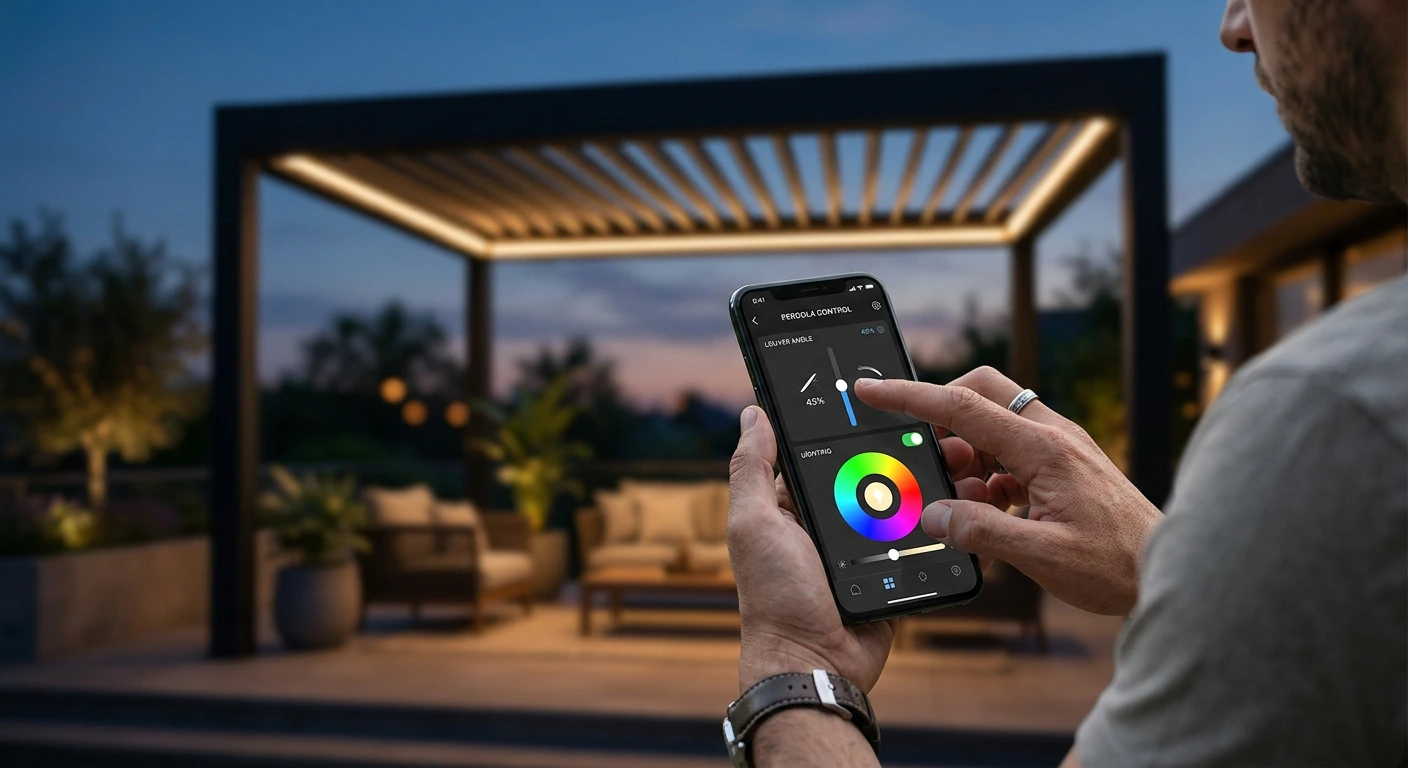
Define onboarding in operational terms. State the supported band, router-security modes, credential-reset process, pairing indicator, timeout and recovery after a failed setup. Many IoT devices still use 2.4 GHz because of coverage and module support, but an installer should not have to guess that at the jobsite. If Bluetooth is used only for discovery, say so in the manual rather than presenting it as another control mode.
Reconnection deserves equal attention. The controller should recover after router restart, DHCP lease change and temporary signal loss without requiring the homeowner to open the control box. The dealer needs visible diagnostics: network state, signal strength or a simple status code, firmware version and a documented factory-reset boundary that does not erase motor limits or safety configuration unless explicitly intended.
Connectivity also creates a product-lifecycle obligation. The NIST IoT cybersecurity baseline identifies device identity, protected interfaces, data protection, secure configuration, software updates and cybersecurity-state awareness as core capabilities. For a pergola OEM, those principles translate into concrete supplier questions:
- Does each controller have a unique identity or shared default credentials?
- Are updates authenticated, and what happens if power fails during installation?
- How long will security and compatibility updates be provided?
- Can remote access be disabled while local control remains available?
- Which data leaves the property, where is it processed and who can access diagnostics?
- What is the vulnerability-reporting and field-remediation process?
For Europe, the connected product and radio roadmap should be reviewed against applicable requirements, including the Radio Equipment Directive, with a qualified compliance laboratory. The design brief should name the markets, radio modules and firmware versions; a generic certificate folder is not enough.
What Should OEMs Specify for the App?
The app is a maintained product, not a free accessory to the control box. Its real cost appears in OS updates, account support, localization, privacy work, cloud hosting, store policies, device migration and the day a platform is replaced. OEMs should assign ownership for that lifecycle before printing “app control” on the carton.
First define the app’s authority. It may send convenience commands, create scenes and show status, but it should not silently override a local weather lockout. If the system blocks movement because of wind, frost or a service mode, the app must show the reason. A generic “device offline” message sends the installer toward the router when the controller may be behaving correctly.
Next define users and transfer. A homeowner account, installer account, hotel operator and temporary guest should not automatically receive the same permissions. The specification should cover owner transfer when a property is sold, dealer commissioning without permanent access to the customer’s system, removal of former users and recovery when the original phone is lost.
Finally, distinguish measured state from estimated state. A bidirectional controller with position sensing may report a verified louver value. A one-way bridge that repeats remote commands may only know the last instruction it sent. The UI should not label the second case as confirmed position. This is a small wording decision with a large trust impact.
Platform selection should follow the product line. Tuya can shorten the path to connected control; a branded application can create a more controlled experience but adds development and support responsibility; Matter can broaden ecosystem access; professional projects may require Control4 or Crestron. Our comparison of smart-home integration options for pergola OEMs maps these choices to different channels rather than treating one ecosystem as universal.
Specify the service promise
Put the supported mobile operating systems, account requirement, connected-service period, firmware policy, data handling, third-party integrations and end-of-life migration plan into the supplier agreement. If these items remain outside the commercial scope, the OEM still owns the customer expectation.
How Should the System Behave When Something Fails?
A reliable specification defines the failed state before approving the successful demo. The table below is more valuable than a showroom video because it establishes which functions survive and who can recover them.
| Zustand | Required behavior | Acceptance evidence |
|---|---|---|
| Internet unavailable | Local remote, wall control and local protective logic continue to operate | Disconnect WAN during movement, lighting and sensor tests |
| Router or WiFi unavailable | Essential local commands remain available; controller reconnects automatically when the network returns | Power-cycle router and verify recovery without opening the controller |
| Cloud or app service unavailable | No loss of local operation; app explains service state when it reconnects | Block cloud path while leaving the LAN active |
| Remote lost | Lost transmitter can be removed; replacement can be paired without replacing the controller | Execute the documented deauthorization and replacement procedure |
| Power restored | Outputs return to a documented safe state; no unintended motor movement | Interrupt power in open, closed and intermediate conditions |
| Firmware update interrupted | Controller recovers or rolls back without losing essential local control configuration | Run the supplier’s fault-injection or recovery test |
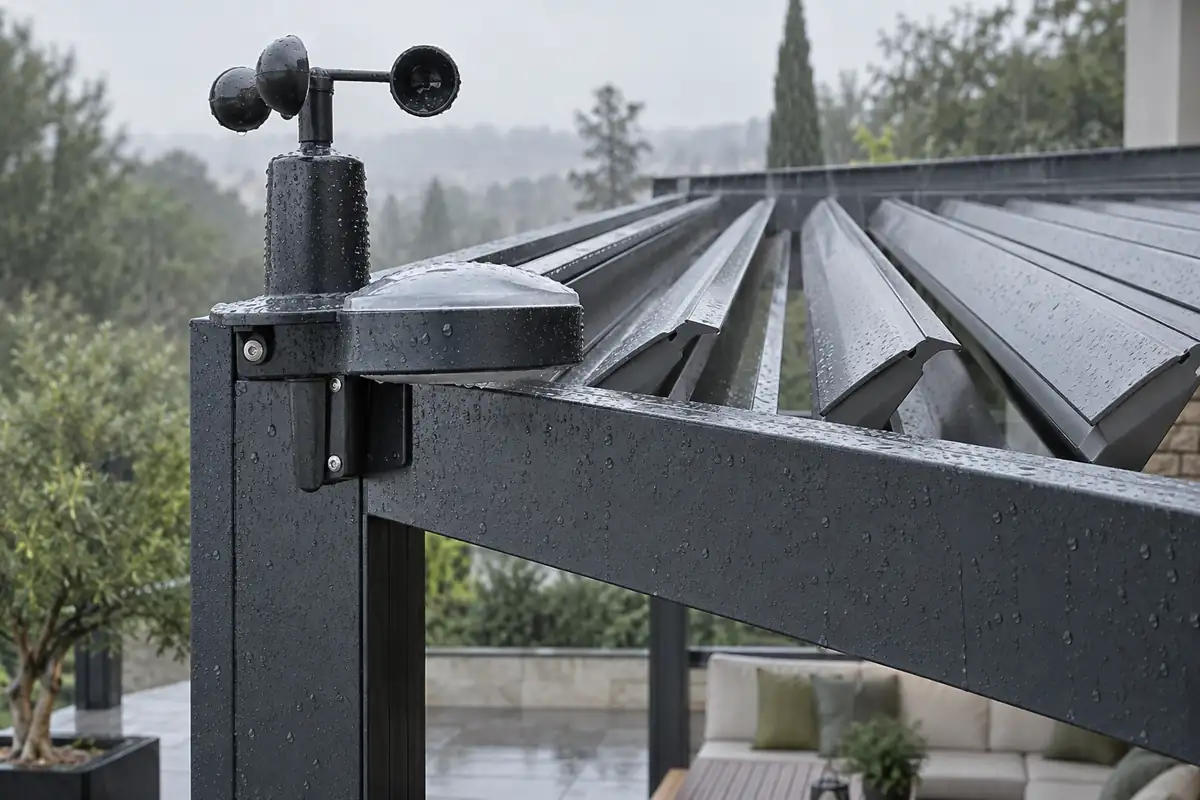
| Weather lockout active | Remote and app follow the same priority rule and display or signal the reason for refusal | Trigger each sensor input and attempt conflicting commands |
Weather behavior must be decided with the pergola’s structural and mechanical engineering teams. A rain response is not automatically a safety response, and wind or snow actions vary by roof design. What the control supplier can provide is deterministic priority logic, lockout, recovery and clear status. Our sensor priority logic guide shows how to define conflicting commands. The companion article on manual override and fail-safe control covers recovery without bypassing protection casually.
Test from the user’s position, not the engineer’s bench
The acceptance test should use a production pergola with the intended controller location, closed aluminum covers, production cable lengths, motors, LED drivers and sensors. Test from the house, patio perimeter and likely operator positions. Repeat with lighting at full load and motors moving. Commission multiple zones, replace a remote, change WiFi credentials, transfer an account and restore factory settings according to the manual.
Record firmware, hardware revision, antenna configuration and app version in the report. A pass without configuration traceability cannot protect the next production batch.
How Should Manufacturers Package RF, WiFi and App Control?
The strongest commercial structure is one local-first platform with connected upgrades, not three unrelated controller families. That approach keeps motor behavior, wiring, remote logic and dealer training consistent while allowing the brand to price connectivity according to channel and project type.
| Package | Included control | Best fit | Non-negotiable requirement |
|---|---|---|---|
| Core | RF remote, wired service input, local sensor logic | Standard residential models and network-free projects | Full normal operation without internet or account |
| Connected | Core package plus WiFi bridge or module and app | Premium residential models and dealer upgrades | Removing the connected layer does not disable the core |
| Integration | Connected package plus supported smart-home or professional-control interface | High-end homes, hospitality and managed projects | Documented function mapping, permissions and integration support boundary |
This structure also protects the supply chain. The OEM can qualify one motor-control behavior and add the gateway according to market demand. Dealers carry fewer spare parts, training stays coherent and the customer can upgrade without discarding the base controller. Integrated harnesses and labeled channels can further reduce site decisions; see how integrated controls reduce dealer installation work.
What Should Go Into the OEM Specification?
Write requirements as observable behavior with evidence, not as feature labels. The following twelve decisions should be complete before the controller, remote, app or gateway is approved.
- Controlled loads: motor types, direction, limits, current, lighting channels, accessories and simultaneous-load rules.
- Local baseline: commands that must work without WiFi, internet, cloud account or phone.
- RF market variant: frequency, protocol, output, regulatory evidence and SKU control by destination.
- Installed range: defined user positions, assembled enclosure state, electrical loads and pass threshold.
- Pairing and groups: transmitter capacity, channel map, group logic, lost-remote removal and replacement.
- WiFi behavior: supported band and security, onboarding, reconnection, credential change and reset boundaries.
- Command path: local versus cloud operation for every feature, including behavior during service outages.
- App lifecycle: platform support, permissions, owner transfer, localization, privacy, update period and end-of-life plan.
- Status semantics: verified, sensed or estimated state; error messages; event history and diagnostic access.
- Safety priority: motor interlocks, sensor rules, lockout, recovery, manual override and post-power-loss state.
- Cybersecurity: unique identity, authentication, protected interfaces, signed updates, vulnerability handling and data policy.
- Evidence package: drawings, BOM revision, wiring map, firmware record, radio reports, environmental tests, manuals and acceptance results.
Place these decisions in the control-system BOM rather than scattering them across purchasing emails and app screenshots. The pergola control BOM checklist provides a companion structure for connectors, enclosures, loads, sensor inputs and documentation.
Häufig gestellte Fragen
Is WiFi more reliable than RF for a motorized pergola?
Not inherently. RF and WiFi fail for different reasons. A short local RF path can operate without a router or internet connection, while WiFi adds network dependence and configuration. Reliability depends on antenna placement, the aluminum structure, interference, network coverage, firmware and tested fallback behavior.
Can an app replace the pergola remote?
An app should not be the only normal control path. Phones can be unavailable, WiFi credentials change, cloud services can fail and guests may not have access. Keep a local remote, wall control or service input for essential movement, then use the app for scenes, schedules, remote access and integration.
Should a pergola OEM specify 433 MHz or 868 MHz RF?
Specify the target market and required regulatory evidence before freezing the frequency. Permitted bands, power, duty cycle and test requirements differ by region. Do not assume one global RF SKU is compliant or performs equally in Europe and North America.
Does Matter eliminate the need for a pergola app?
No. Matter can improve interoperability and local connectivity, but the OEM still needs commissioning, diagnostics, firmware, account and service policies. A brand app may remain useful for pergola-specific settings, while Matter exposes supported functions to broader smart-home platforms.
How should OEMs test pergola remote range?
Test the finished pergola, not an open-air receiver board. Close access covers, run motors and LED drivers, test through common glazing and from defined user positions, and repeat across orientations. Record a minimum pass distance and command success criterion rather than repeating the transmitter’s best-case catalog range.
The Decision Is an Architecture, Not a Feature
RF wins the immediate local-control job. WiFi connects the pergola to a network. The app organizes convenience, access and integration. Asking one layer to replace the others creates fragile products; assigning each layer a clear role creates a control platform that dealers can install and customers can trust.
For most European and North American pergola manufacturers, the defensible specification is local-first: RF or wired operation as the baseline, local sensor priority in the controller, and an optional connected layer with a defined security and support life. The proof is not a successful app demo. It is predictable behavior through router changes, lost remotes, internet outages, weather events and future product revisions.
Specify the control stack before you freeze the pergola BOM
VLEDSTAR develops integrated pergola lighting and control systems covering RF remotes, Tuya app control, touchscreen panels, motor and actuator channels, weather inputs, wiring harnesses and OEM customization. Share your motor, lighting, market and product-tier requirements with our engineering team to review a sample-ready control architecture.

Senden Sie uns Ihre Anfrage