


Short answer: leading pergola automation brands win by integrating movement, lighting, weather protection, app control, installation, and after-sales support into one understandable system. OEMs can learn from that model without copying a competitor’s hardware. The better strategy is to build a control architecture that is easy to specify, install, brand, service, and scale across multiple pergola families.
When a homeowner compares motorized pergolas, the visible promise is simple: open the roof, soften the sun, close the louvers when it rains, and turn on the lights. Behind that promise is a much harder manufacturing problem. Motors, actuators, RF receivers, LED drivers, sensors, harnesses, apps, frame cavities, and installation instructions must behave as one product.
That is why the most useful question is not “Which pergola automation brand is the best?” It is “What operating model do the strongest brands have in common, and how can a manufacturer turn those lessons into a better product line?”
This article looks at several influential brands and system approaches, then translates their visible strengths into practical decisions for European and North American pergola manufacturers. The focus is not a consumer ranking. It is product strategy.
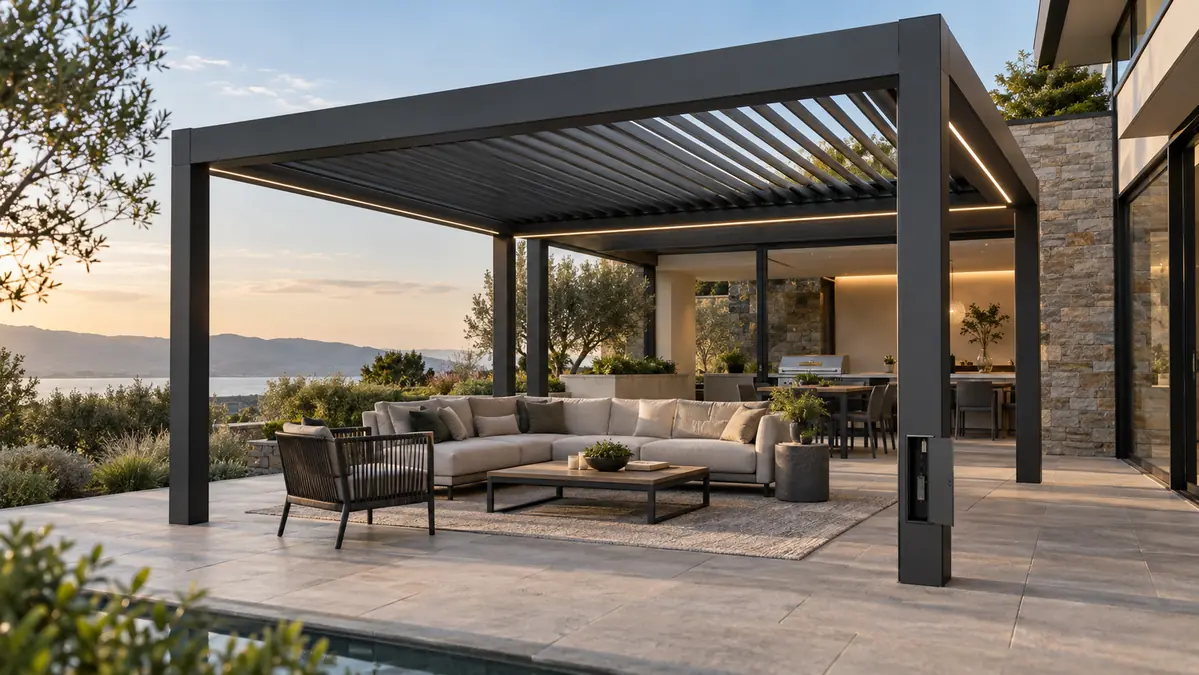
Which pergola automation brands are shaping customer expectations?
Different brands lead in different parts of the value chain. Some are motion-control specialists. Some sell complete architectural pergolas. Others compete through smart-home integration, dealer experience, or customization. Their common effect is to raise the standard that customers expect from every motorized roof.
| Brand or system approach | Visible strength | Lesson for a pergola OEM |
|---|---|---|
| Somfy | Motion control, sensors, connected outdoor living, and a broad professional ecosystem. | Build compatibility and commissioning into the product from the beginning. |
| StruXure | A premium pergola experience with smart louvers, integrated rain response, lighting, and home-control options. | Package automation as a clear ownership experience, not a list of components. |
| Corradi Alba | Architectural design, motorized louvers, integrated LED options, side closures, and configuration flexibility. | Make automation reinforce the structure’s design language and product tiers. |
| Renson | Outdoor-living systems that combine roof control with screens, lighting, heating, and comfort. | Design the pergola as a coordinated platform with accessory logic. |
| Brustor | Configurable pergola systems with motorization, screens, lighting, and dealer-led project delivery. | Give dealers repeatable configurations instead of unlimited field improvisation. |
These brands are not identical, and their specifications, distribution models, and regional availability differ. The comparison is useful because it shows where the market is moving: toward complete, configurable outdoor systems that combine structure, comfort, safety, and control.
Lesson one: the controller is a product platform, not an accessory
The most important lesson for manufacturers is architectural. A controller should not be selected after the roof, lighting, and motor package are already fixed. It should help define the product line.
Somfy’s pergola offering illustrates the platform approach. Its official material connects pergola tilt motors, control units, lighting, screens, sensors, and TaHoma smart-home control. StruXure similarly presents its bridge and operating systems as the layer that unifies louvers, lighting, and integrations. The customer sees one experience; the manufacturer must engineer the interfaces underneath it.
For an OEM, a platform-level controller should answer five questions before the first production run:
- Which motor types and feedback methods are supported?
- How many lighting zones, motor channels, and sensor inputs are required?
- Which functions remain available when Wi-Fi or cloud access is unavailable?
- How will installers pair, test, and reset each device?
- Which parts can be reused across standard, premium, and commercial models?
VLEDSTAR takes this same system view in its integriertes Pergola-Steuerungssystem. The platform is designed to coordinate lighting, linear actuators, tubular motors, weather inputs, RF remote control, app control, and touchscreen operation. The value for a manufacturer is not the number of functions on a brochure. It is the ability to test one control logic against a real frame, real wiring, and the selected motor family.
Lesson two: smart control must still work like a professional outdoor product
App control and voice control attract attention, but they do not replace the fundamentals of outdoor equipment. A pergola manufacturer still needs dependable local operation, clear status feedback, predictable pairing, manual recovery, and safe behavior during power or network interruptions.
Smart-home integration is most useful when it extends a well-designed local control system. Somfy’s TaHoma materials describe remote control, scenes, voice assistants, schedules, and sensor-based automation. StruXure highlights app control and integrations with platforms such as Alexa, Apple Home, Google Home, Control4, and SmartThings. These features create a premium impression, but the underlying lesson is more practical: customers should be able to control the pergola in the way that fits the project.
Manufacturers should therefore offer a control hierarchy:
- Local control: a reliable RF remote or wall control for everyday use.
- System control: grouped and independent channels for louvers, screens, and lighting.
- Smart control: app, scene, schedule, and optional voice integration.
- Service control: commissioning, reset, diagnostics, and firmware or configuration management.
When these layers are designed together, smart features feel like an upgrade. When they are added late, they often create extra gateways, extra remotes, and extra service questions.
Lesson three: weather automation is a safety function before it is a marketing feature
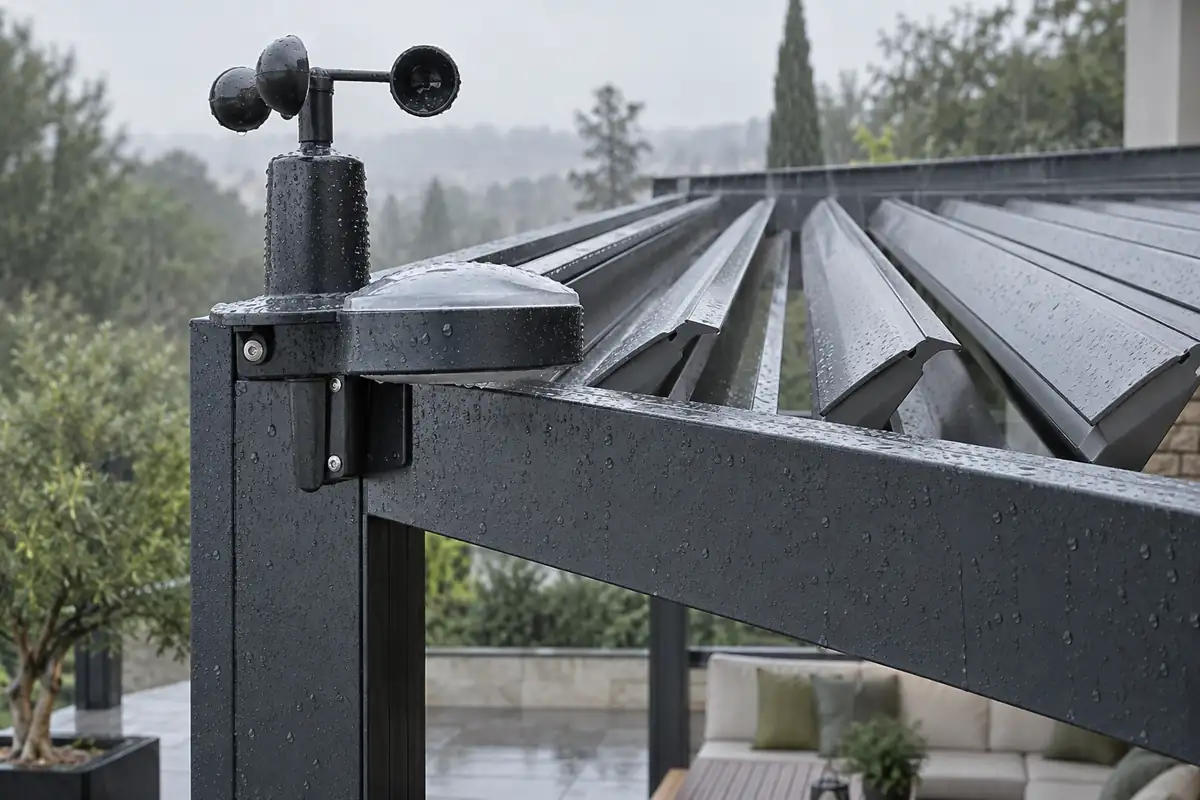
Rain, wind, sun, frost, and snow sensors are often used in product marketing because they make automation easy to understand. For engineers, they are decision inputs in a safety and protection system. A manufacturer must define what happens, when it happens, and what takes priority when signals conflict.
Official product information from Somfy describes rain, temperature, wind, and other sensor options for connected pergola control. StruXure promotes an integrated rain sensor that closes the pergola when rain begins. Those examples show the customer-facing promise. The OEM task is to turn that promise into documented logic.
A robust weather strategy should define at least:
- the sensor location and exposure conditions;
- the trigger threshold and time delay;
- the priority between automatic protection and manual commands;
- the safe position for the roof under wind, snow, or frost conditions;
- what happens after power returns;
- how an installer verifies the rule without waiting for bad weather.
VLEDSTARs Anleitung zur Integration des Pergola-Sensors and related resources on rain sensor placement, wind thresholds, und snow and frost protection logic reflect this engineering perspective. Weather automation should be treated as a tested operating mode, not an isolated accessory checkbox.
Lesson four: lighting is part of the automation experience
Premium pergola brands understand that customers do not separate the roof from the atmosphere underneath it. Corradi’s Alba page, for example, presents motorized louvers and integrated blade lighting as part of the same architectural experience. Renson and Brustor also position lighting and screens as coordinated outdoor-living options rather than unrelated add-ons.
This creates an opportunity for manufacturers that still source lighting separately. A lighting system should be engineered around the frame, the motor system, and the control interface. That means deciding early:
- where profiles, downlights, and spotlights fit within the beam or louver;
- which zones need mono, RGB, RGBW, tunable white, or other outputs;
- how drivers are sized and accessed;
- how dimming behaves at low levels;
- how connectors, splitters, and cable lengths are standardized;
- which lighting scenes should be preconfigured for dealers.
VLEDSTARs Beleuchtungslösungen für Pergolen include downlights, spotlights, LED strips, post lights, and plug-and-play kits. The manufacturing advantage is the ability to coordinate those components with control hardware instead of asking an installer to assemble an untested mix of parts. For OEMs, integrated lighting can become a visible product differentiator while reducing compatibility risk.
Lesson five: dealer experience is a competitive feature
Customers may buy the finished pergola, but dealers and installers determine whether the product is profitable to deliver. Leading brands make the dealer channel part of the system. Their product configuration, accessory options, installation process, and support materials are designed to reduce uncertainty on site.
This is where many otherwise capable pergola products lose margin. If roof motors, lighting, sensors, and screens each have separate instructions, pairing procedures, connectors, and failure modes, the dealer becomes the systems integrator. The manufacturer then inherits the support burden without controlling the installation.
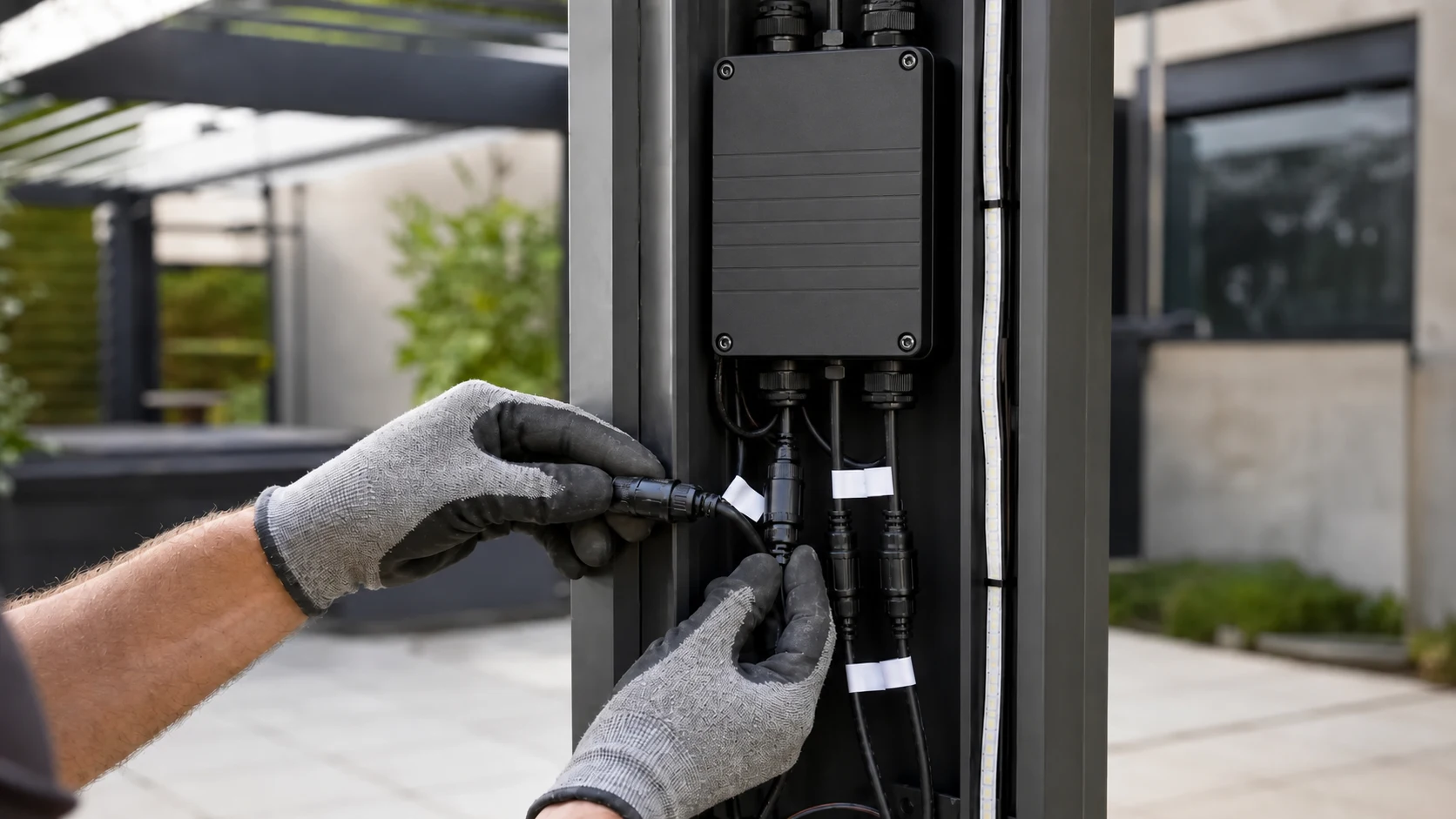
A dealer-ready automation package should include a clear wiring map, labeled connectors, channel assignments, commissioning steps, fault isolation, and a repeatable test procedure. VLEDSTAR’s article on integrated controls and installation labor describes this as a shift from open-ended field wiring to controlled product assembly.
The practical test is simple: can a trained installer configure the system correctly without making design decisions that belong to the manufacturer? If the answer is no, the product is not yet dealer-ready.
What should manufacturers copy, and what should they avoid copying?
Manufacturers should copy principles, not brand surfaces. A competitor’s remote shape, app layout, or feature list may be visible, but those details rarely create a durable advantage. The deeper advantage comes from solving the entire product journey.
| Adopt this principle | Avoid this mistake |
|---|---|
| One coherent control model across roof, screens, lights, and sensors. | Adding a separate transmitter for every subsystem. |
| Defined weather and recovery logic. | Promising “automatic protection” without documented thresholds and test steps. |
| Configurable product tiers using a shared architecture. | Creating a different controller and wiring method for every model. |
| Pre-engineered harnesses and waterproof connections. | Leaving connector selection and cable routing to the installer. |
| Serviceability and fault ownership. | Making the dealer diagnose whether the motor, driver, receiver, or app is at fault. |
| Brandable customer experience. | Letting generic supplier interfaces dominate the OEM’s product identity. |
VLEDSTARs OEM supplier evaluation questions und OEM pergola control platform resources are useful when a manufacturer is comparing in-house development with a specialized control partner. The decision should be based on the complete system: engineering evidence, production consistency, compatibility testing, customization, and service support.
How to turn these lessons into a stronger pergola product line
The best time to design the automation layer is before the frame and motor specifications are frozen. A practical development sequence is:
- Map the product families. Define which functions are common across standard, premium, retractable, and commercial models.
- Freeze the control architecture. Select motor interfaces, lighting outputs, sensor inputs, communication methods, and recovery behavior.
- Build a representative frame. Test the controller inside the actual aluminum cavity, not on an open workbench.
- Validate the difficult cases. Test RF performance around aluminum, voltage drop, water exposure, obstruction behavior, power recovery, and sensor conflicts.
- Package the dealer workflow. Convert the tested configuration into harnesses, labels, manuals, commissioning steps, and service procedures.
- Use the same logic in sales materials. Show buyers the complete experience: light, shade, weather response, quiet operation, and simple control.
VLEDSTARs view of controls as a core product feature follows this sequence. Since VLEDSTAR develops both outdoor lighting and integrated control systems, the engineering discussion can include the practical details that are often separated between suppliers: LED power, motor compatibility, RF behavior, sensor logic, wiring, enclosure protection, and production support.
How should a manufacturer evaluate an automation supplier?
A convincing demonstration is only the beginning. Before approval, ask the supplier for evidence that the system can survive the full product lifecycle.
- Can the supplier test the controller with the exact motor and lighting configuration?
- Are enclosure protection, connectors, drivers, and harnesses documented for the intended outdoor use?
- Can the system be customized without creating an unmaintainable one-off design?
- Are RF tests performed with the controller installed inside the real aluminum structure?
- Can the dealer replace a failed component without dismantling a finished roof?
- Are firmware, pairing, reset, and manual-override behaviors documented?
- Does one technical partner take responsibility for the interactions between lighting and motion control?
For a deeper approval checklist, see 15 questions for pergola control system OEM buyers. The right supplier is not necessarily the one with the longest feature list. It is the one that can translate a specification into repeatable production and dependable dealer support.
Final view: the winning automation brand sells confidence
The leading pergola automation brands teach a consistent lesson. Automation creates value when it disappears into the product experience. Customers should feel that the roof, lights, screens, and weather response belong together. Dealers should feel that the system is documented and repeatable. Manufacturers should feel that the same control logic can support the next product family.
For pergola OEMs, the strategic opportunity is larger than adding app control. It is to turn control into a product platform: one that supports your structure, protects your margins, strengthens your dealer channel, and gives your brand a recognizable ownership experience.
Plan the control architecture before your next pergola launch
Share your motor type, lighting configuration, sensor requirements, target market, and expected production volume with the VLEDSTAR engineering team. We can review the architecture, identify integration risks, and recommend a lighting and control package for sample evaluation.
Review the integrated pergola control system oder contact VLEDSTAR for OEM support.

Senden Sie uns Ihre Anfrage