










In the field of lighting, “white light” is not a single color.
What we commonly refer to as color temperature (measured in Kelvin) does not describe how “hot” a light source is, but rather:
whether this beam of white light appears more yellowish, whiter, or bluer to the eye.
The concept of color temperature originates from blackbody radiation in physics:
An ideal blackbody emits light of different colors at different temperatures. The lighting industry adopts this model, using “the color emitted by a blackbody at a specific temperature” as a reference for white light.
This established a consensus system:
2700K: Yellowish, warm
3000K: Neutral-warm
4000K: Neutral white
5000K and above: Cooler, bluish
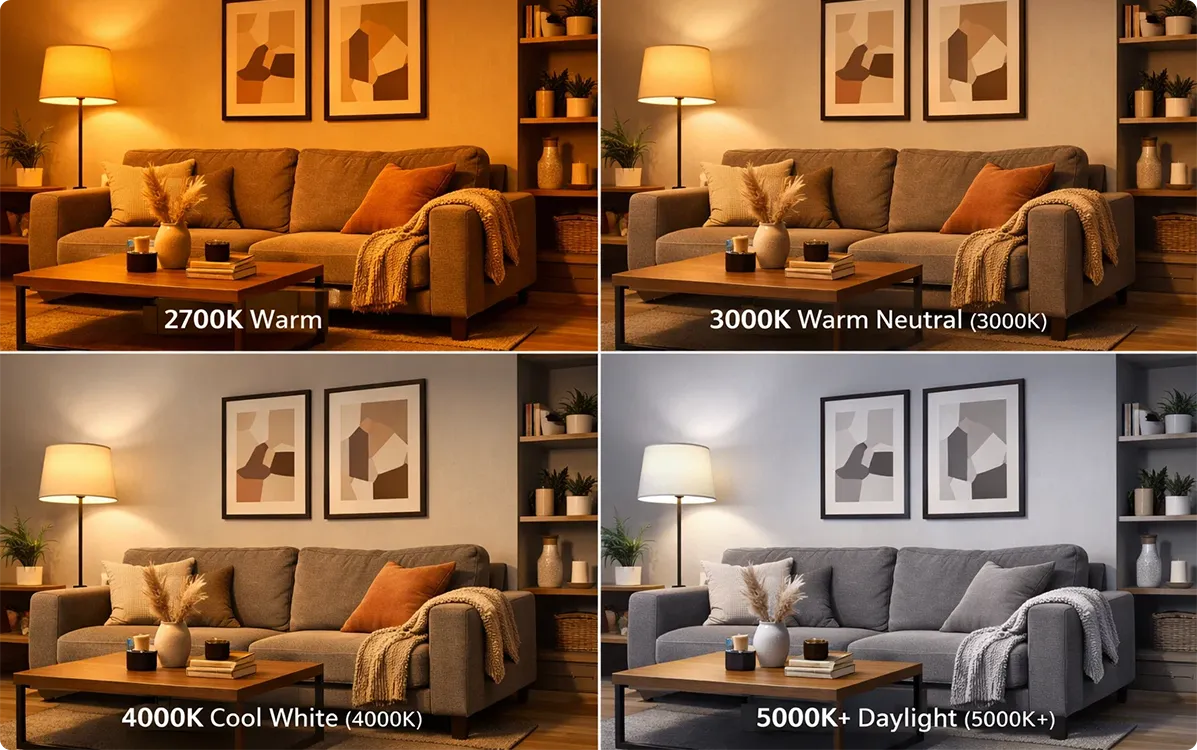
Here lies a counterintuitive point:
Lower values appear visually warmer; higher values appear visually cooler.
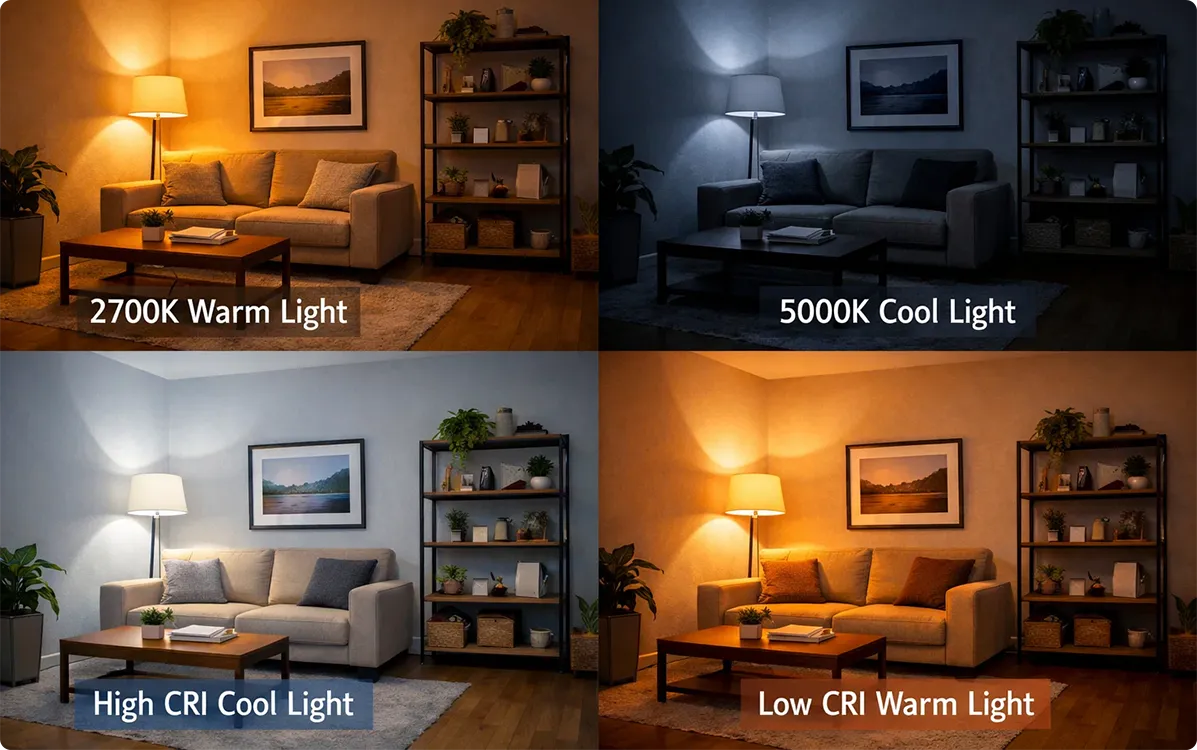
Luminous flux (lm/lux): How much light is present
Color temperature (K): Whether light appears yellowish or bluish
Color rendering index (CRI): How well it reproduces the colors of objects
These three properties are independent of each other.
You can have:
Very bright 2700K
Very dim 5000K
Cool light with high CRI
Warm light with low CRI
It is precisely because color temperature is an independent dimension that it has given rise to subsequent technologies like “dual-color temperature” and “adjustable white light.”
Because human perception is strongly coupled with color temperature and brightness.
In natural environments:
Daytime: Bright + Cooler
Dusk: Dimmer + Warmer
Human circadian rhythms and emotions have adapted to these changes.
This creates two distinct lighting demands:
I just want lights to “behave like incandescent bulbs”—darker and warmer
I want precise color temperature control tailored to time, setting, and function
Thus, the industry has pursued two technical paths:
Dim to Warm
Tunable White
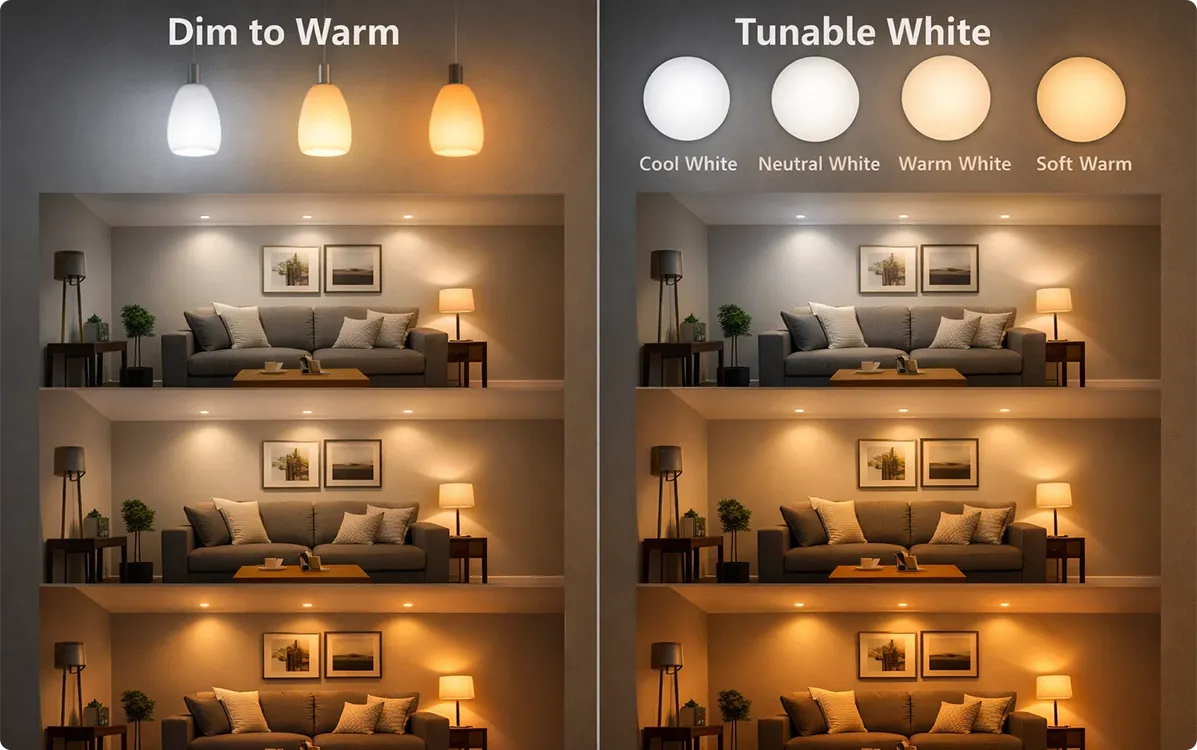
1. What is Dim to Warm?
The core feature of Dim to Warm is:
As brightness decreases, color temperature automatically shifts toward warmer tones.
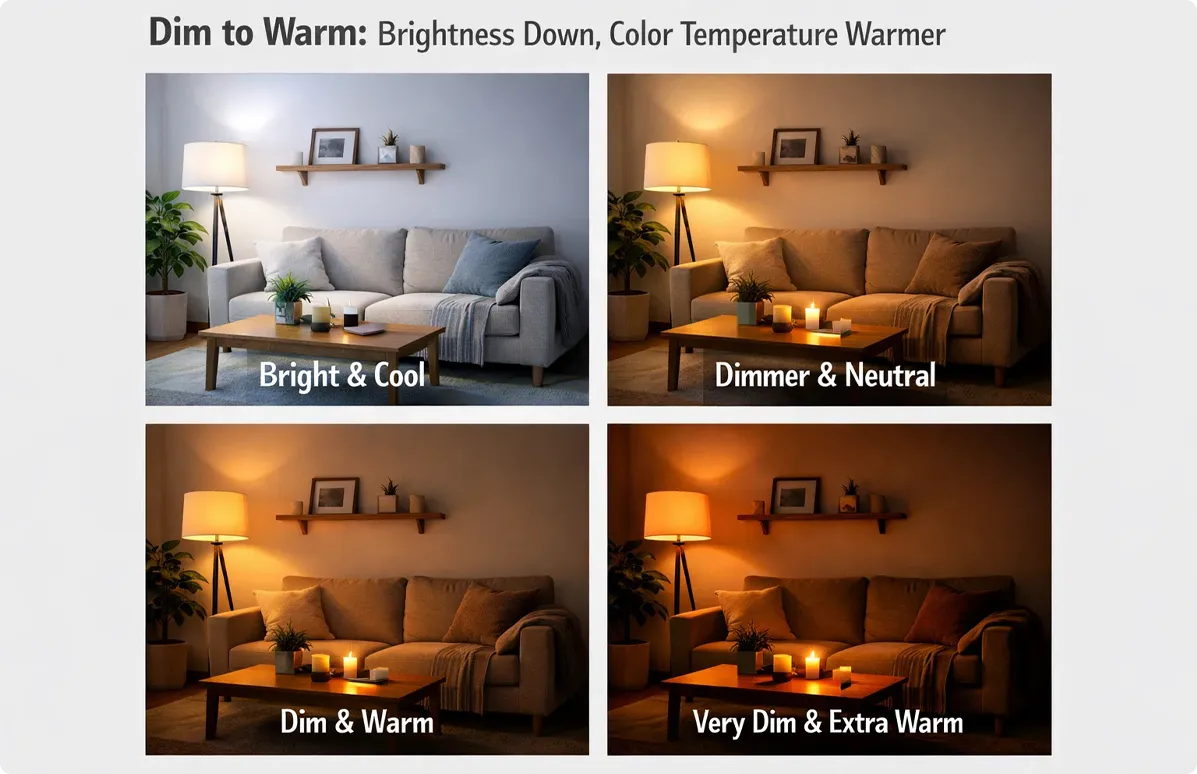
Users control only one dimension: brightness.
Color temperature changes “follow” this adjustment rather than being independently controlled.
2. How is Dim to Warm Achieved?
Inside the fixture, there are typically two types of LEDs:
White LEDs with higher color temperatures
Ultra-warm LEDs (1800–2200K)
When brightness changes:
The system adjusts the output of both LED types according to a preset ratio
Forming a fixed “brightness-color temperature curve”
This curve is factory-programmed and cannot be modified by users.
3. Summary of Dim to Warm Features
Advantages:
Extremely intuitive to use
Requires no understanding of color temperature
Hard to “misfine-tune”
Ideal for simulating halogen/incandescent lighting experiences
Limitations:
Color temperature cannot be independently controlled
Not suitable for system-level smart lighting
Limits future scene expansion
4. Typical Application Scenarios
Hotel guest rooms
Restaurants
High-end residences
Ambient commercial spaces
One-sentence summary: Dim to Warm is a “product experience-oriented” dual-color temperature solution.
1. What is Tunable White?
Tunable White refers to:
Complete decoupling of brightness and color temperature, enabling separate and precise control of each.
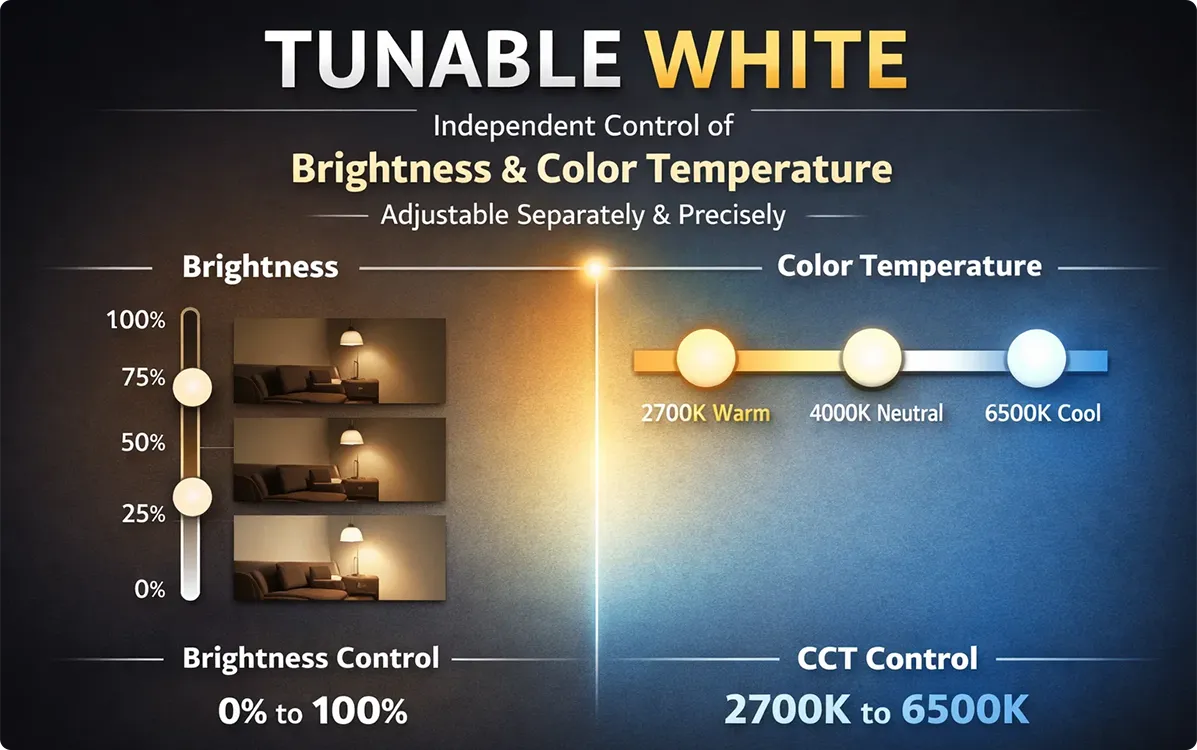
Users or systems can explicitly instruct the light:
How much brightness is needed now
What color temperature is needed now (e.g., 3500K, 4200K)
2. Implementation of Tunable White
The luminaire also utilizes two types of LEDs:
Warm White (e.g., 2700K)
Cool White (e.g., 6500K)
The difference lies in:
The two LED channels operate independently
The control system calculates the mixing ratio in real time
To output the target color temperature
This typically requires:
DALI DT8
Or systems like Casambi / KNX / DMX
3. Advantages and Challenges of Tunable White
Precise, programmable color temperature
Supports Human-Centric Lighting (HCL)
Suitable for systematic, standardized projects
Scenarios are replicable and scalable
Challenges:
Higher cost
System complexity
High commissioning threshold
High demands on power supply and light source consistency
4. Typical Application Scenarios
Office Lighting
Educational Spaces
Medical Lighting
Museums
Premium Commercial & Smart Buildings
In a nutshell:
Tunable White is a “system capability-driven” dual-color temperature solution.
Dimension |
Dim to Warm
|
Tunable White
|
Color Temperature Control |
Adjusts with brightness changes |
Independently controllable |
User Participation |
No need to understand |
Requires system |
Control Protocol |
Thyristor/0-10V/ DT6 |
DT8 / Smart System |
Debugging Complexity |
Low |
High |
Cost |
Lower |
Higher |
Positioning |
Ambience Experience |
Functionality + Experience |
Author

Andy Gao
With 15 years in the LED lighting industry, I’ve witnessed its evolution from general fixture production to today’s highly specialized segments. As Co-Founder of Veldstar, my journey mirrors this shift – driving our exclusive focus on pergola and garden lighting solutions. Through dedicated innovation, we develop controllers and systems rivaling leaders like Somfy and Teleco. Here, I share insights and showcase products engineered to elevate outdoor spaces with style, functionality, and advanced control. Learn more via linkendin profile:https://www.linkedin.com/in/pergolalights/

Share This Article:
Send Us your Request